A Research-Informed Approach to Reading, Creativity, Reflection, and Learning
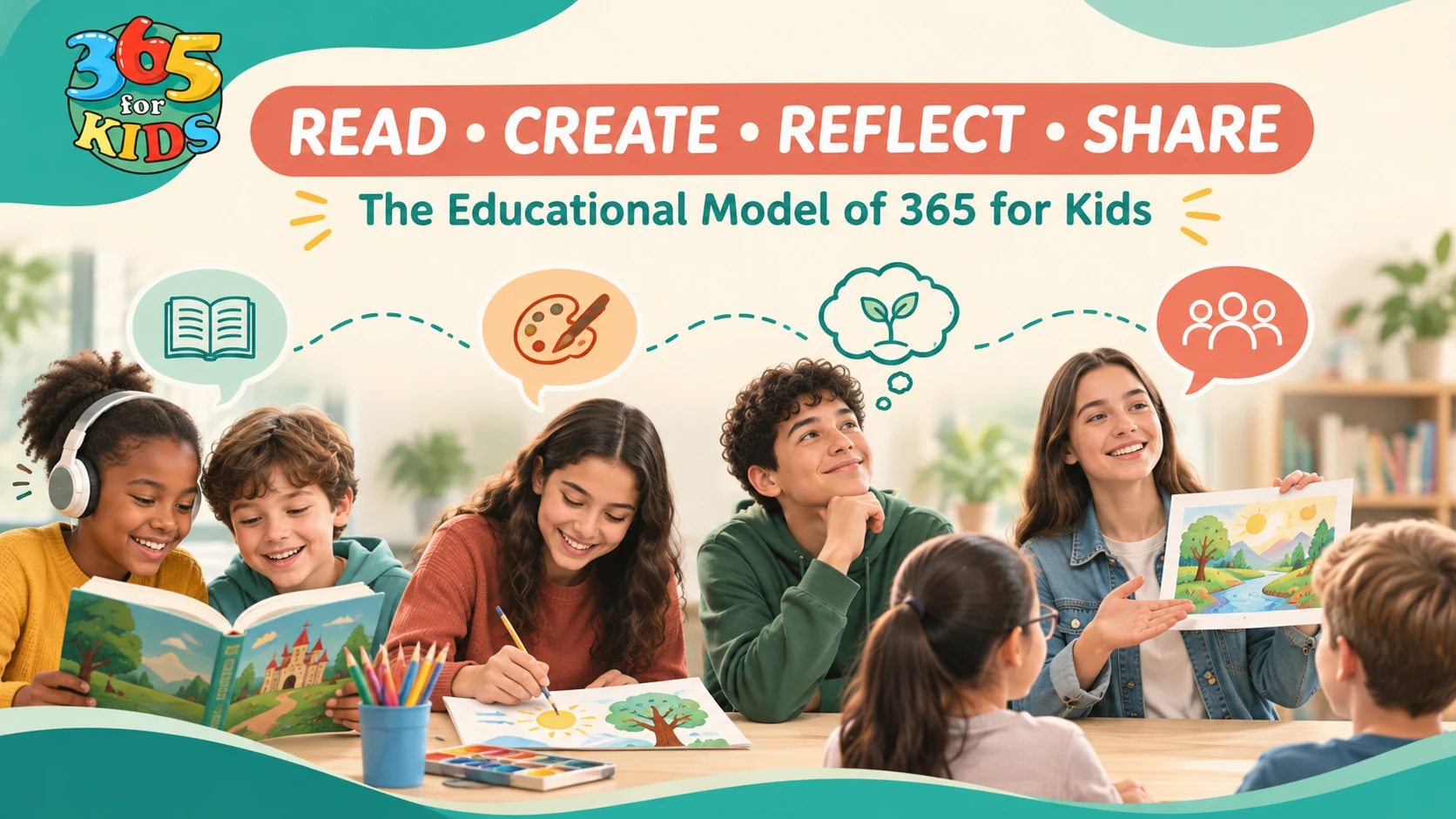
READ → CREATE → REFLECT → SHARE
The Educational Model of 365 for Kids
Pedagogical Concept, Research Foundations and Practical Applications
Our Purpose
The central purpose of READ → CREATE → REFLECT → SHARE is to nurture children’s enjoyment of reading and curiosity about knowledge as foundations for lifelong learning. It transforms an encounter with stories and educational content into a personal creative experience, thoughtful reflection, and safe sharing. The model invites children to discover pleasure in reading, develop their own perspectives, experiment freely, and recognize that their ideas and creations can matter to others.
Understanding the Model
READ → CREATE → REFLECT → SHARE is an educational framework developed by 365 for Kids, a program of 365 Mosaic Foundation. It brings together four mutually reinforcing experiences: engaging with meaningful content, responding through creativity, reflecting on the experience, and sharing with an appropriate audience.
The four stages are a memorable guide rather than a rigid formula. Thinking begins as children read or listen, continues as they create, and may deepen after they share. CREATE deliberately appears before the dedicated REFLECT stage: many children first respond to a story through an image, a sketch, a movement, a word, or the desire to make something. During the creative process they select, compare, revise, and discover meaning. Reflection then gives them an opportunity to look at what they have made and articulate what they noticed, felt, understood, or want to explore next.
1. Why an Integrated Approach Matters
Being able to read is not the same as wanting to read. A child may decode words confidently without choosing to pick up a book independently. Another child may be drawn into a story through listening before developing fluent independent reading skills. 365 for Kids brings reading, listening, choice, creative activity, and community participation together to make encounters with stories and knowledge personally meaningful.
Research on reading engagement has explored the connections among motivation, comprehension strategies, subject knowledge, choice, collaboration, and purposeful activities. Studies of Concept-Oriented Reading Instruction, for example, have examined how these elements can support engagement and learning [1, 2]. Guidance from the U.S. Institute of Education Sciences likewise emphasizes comprehension strategies, purposeful discussion, and motivating learning environments [3].
At 365 for Kids, reading is the starting point for action—not merely the endpoint of a comprehension test. A child might illustrate a character, create a comic strip, build a visual map, investigate a scientific phenomenon, or develop a personal interpretation of a cultural story. The creative task offers a reason to revisit the original content, ask further questions, and seek new knowledge.
2. The Four Stages
READ — Discover a Story, Idea, or New Knowledge
READ includes independent reading, listening, shared reading, and engagement with reliable educational material in an accessible format. Content may come from literature, folklore, science, cultural heritage, stories exploring virtues, everyday life questions, and other age-appropriate fields. Choice and context matter: children need an opportunity to understand and become curious, not simply to finish an assigned text.
- Offer well-chosen content that reflects children’s ages, interests, language experiences, and cultural contexts.
- Make room for reading, listening, supported reading, and returning to a story more than once.
- Clarify unfamiliar words and essential background without turning every experience into a test.
- Encourage children to ask, “What else would I like to discover about this?”
CREATE — Respond, Explore, and Think Through Making
CREATE is often the child’s first visible personal response. Children may draw, model, write, make comics or collages, build digital compositions, or use another appropriate creative form. They do not need a fully formed interpretation before they begin. Making itself can generate questions and new meanings. Choosing a scene, color, symbol, material, or viewpoint involves decisions that engage attention, memory, and imagination.
A review of the cognitive science of drawing describes drawing as a versatile tool for organizing and communicating thought [4]. Experimental work on the “drawing effect” has found benefits for remembering information in particular learning tasks [5]. Together, these findings offer an important rationale for treating creative activity as part of thinking and learning, not simply as decoration added after a lesson.
- Provide engaging illustration and creative prompts while leaving room for original interpretations.
- Value involvement, individual intention, exploration, and development rather than competition based on technical skill.
- Invite children to return to the source, revise a composition, and change their initial idea.
- When exploring traditional stories, distinguish a child’s imaginative interpretation from factual claims about the cultural source.
REFLECT — Look Again, Make Meaning, and Find Your Voice
REFLECT creates a distinct opportunity to return to both the story and the work created. Rather than only answering “What did I draw?”, a child might consider “Why did I choose this moment?”, “What surprised me?”, “Did my idea change while I was working?”, “Which detail in the story influenced me?”, or “What would I like to learn next?” The completed artwork becomes a starting point for another encounter with the content.
Reflection combines personal expression with interpretation and reasoned questioning. Harvard Project Zero’s Visible Thinking work offers approaches for making observations, explanations, and questions more explicit [6]. Evidence summarized by the Education Endowment Foundation likewise emphasizes the value of teaching metacognitive and self-regulation strategies in meaningful learning activities [7]. In 365 for Kids, guiding questions are integrated into the stories and activities to support children in recognizing their choices and exploring new perspectives.
- “Which moment did you choose, and why?” — connect creative choices with the source.
- “What did you understand differently while making your work?” — notice how thinking developed.
- “Which part of the story supports your interpretation?” — return to evidence and detail.
- “What new question do you have?” — keep curiosity active.
Reflection is not a search for a single prescribed moral lesson. Children can respond through conversation, a few written sentences, audio, sketches, or other suitable formats. Thinking may happen before, during, and after the creative activity; the dedicated REFLECT stage simply makes space for it to be noticed and expressed.
SHARE — Present, Communicate, and Participate
SHARE offers a meaningful audience: family members, a classroom, an art group, a library, a community exhibition, or a moderated online space. A child can explain the process, hear different interpretations, and discover that their voice and creative work can contribute to a wider conversation. Sharing gives social meaning to the experience; it is not measured by likes or online popularity.
Within 365 for Kids, sharing is an invitation, not a requirement for personal achievement. Public participation follows age-appropriate procedures, parent or guardian consent, moderation, and privacy safeguards. Free Printables & Activities will include a clear pathway to the appropriate official 365 for Kids sharing opportunity, together with alternatives for sharing privately at home, at school, or in a library.
- Let children decide what they wish to explain and whether they want their work presented publicly.
- Use appropriate consent, content review, and minimal personal information for public submissions.
- Encourage thoughtful feedback and appreciation of different interpretations rather than competitive comparisons.
3. Why CREATE Comes Before the Dedicated REFLECT Stage
The order does not imply that children create without thinking and only begin to reflect afterward. On the contrary, it recognizes that thinking can unfold within the creative act. As children develop an image or other work, they recall, select, observe, test, combine, and reshape ideas. A separate REFLECT stage then helps them describe these choices and connect them with the story or educational material that inspired them.
The OECD framework for creative thinking describes the generation, evaluation, and improvement of ideas as interconnected processes [8]. Research on drawing and cognition provides an additional foundation for understanding artistic expression as a means of exploring ideas [4]. The sequence used by 365 for Kids is therefore both accessible to children and open to genuine cycles of learning: READ ↔ CREATE ↔ REFLECT, followed by SHARE and sometimes another return to reading or creation.
4. Research and Pedagogical Foundations
4.1. Motivation to Read and Meaningful Engagement
Guidance from the Institute of Education Sciences highlights comprehension strategies, dialogue about text, and motivating classroom environments [3]. Research on Concept-Oriented Reading Instruction has examined the educational value of connecting reading with purposeful inquiry, meaningful tasks, choice, and collaboration [1, 2]. These perspectives inform 365 for Kids activities that invite children to engage with stories beyond a single reading session.
4.2. Drawing as a Cognitive Activity
Fan and colleagues (2023) describe drawing as an external means of representing ideas and knowledge that brings together perception, memory, and communication [4]. Wammes, Meade, and Fernandes (2016) found a memory advantage for drawing over writing words in specific recall tasks [5]. These studies help explain why creating images can be a thoughtful learning activity as well as an artistic one.
4.3. Creative Thinking and Revision
The OECD defines creative thinking in terms of generating, evaluating, and improving ideas, including in written and visual expression [8]. This supports a focus on exploration, interpretation, and revision—not simply the polished appearance of a final artwork.
4.4. Metacognition, Explanation, and Reflection
The Education Endowment Foundation synthesizes research on strategies that support learners in planning, monitoring, and evaluating their own activity [7]. Project Zero’s Visible Thinking approaches highlight thoughtful observation, reasoning, and questions [6]. At 365 for Kids, structured Think & Reflect questions and creative invitations provide children with accessible opportunities to make their thinking visible.
4.5. Choice, Accessibility, and Inclusion
CAST’s Universal Design for Learning Guidelines 3.0 emphasize multiple ways to engage with learning, access information, and express understanding, with particular attention to choice, agency, belonging, and joy [9]. This approach informs 365 for Kids resources in audio and text formats and encourages varied creative responses that respect children’s different abilities, languages, and experiences.
4.6. Authentic Audiences and Safe Communication
A classroom conversation, a library display, a Community Showcase, or an online exhibition can give children a real audience for their ideas. At the same time, online participation requires care for privacy, consent, and children’s digital footprints. UNICEF resources on children’s online privacy underscore the importance of informed family decisions [10]. 365 for Kids treats thoughtful sharing and child safety as complementary parts of participation.
5. Practical Applications Across Ages
The following examples illustrate how the model may be adapted. Age ranges are guides rather than fixed expectations; children’s interests, development, language experience, and individual needs remain central.
| Age group | Learning experience | Creative work and sharing |
| 6–8 | Short stories or audio; shared reading; conversation; exploring images with adult support. | Drawing or collage, a few words about a chosen moment, sharing through a parent or guardian. |
| 9–12 | Increasingly independent choice; comparing scenes and viewpoints; experimenting with materials and interpretations. | Comics, visual journals, short stories, explanations of creative decisions, group sharing. |
| 13–17 | Complex themes, source evaluation, ethical questions, critical interpretation and discussion. | Independent creative projects, multimedia work or essays; reasoned presentation and informed choices about publicity. |
6. An Example Learning Cycle: A Story About Helping Others
The following example illustrates how the model can work with a suitable story. Activities and time allocations are flexible and may be adapted for individual families, classrooms, art studios, or libraries.
- READ (approximately 10–15 minutes): Children read or listen to a story. Key vocabulary, setting, and questions are introduced as needed.
- CREATE (approximately 20–40 minutes): Each child chooses a meaningful moment to express through drawing, a comic, or collage, returning to the story and revising ideas along the way.
- REFLECT (approximately 5–15 minutes): Children consider their work: “Why this moment?”, “What did I discover while creating?”, “Which detail shaped my choices?”, “What might I change?”
- SHARE (when appropriate): Children present their work within a family, group, library, or an approved 365 for Kids participation channel, with appropriate consent and safeguarding.
After sharing, a child may choose a different story, return to the same material, or develop a new creative interpretation. In this way the four stages can form an ongoing cycle of curiosity and participation.
7. Families, Educators, Libraries, and Community Partners
Families can provide an encouraging atmosphere for choice, exploration, and conversation without insisting on one “correct” picture. Teachers and librarians can select suitable resources and facilitate meaningful questions. Art educators can support technique while protecting children’s individual intentions. Schools, libraries, and community organizations can create opportunities for group experiences and safe presentations of work.
365 for Kids supports these partners through story collections, audio resources, creative prompts, reflection questions, and pathways to participation. The activities are designed to be adapted to children’s ages and needs rather than followed as a single compulsory lesson script.
8. Cultural Respect, Authorship, and Children’s Rights
- Identify the people, local tradition, and sources behind cultural and traditional stories whenever that information can be established.
- Preserve culturally significant names and distinguish documented versions of a story rather than blending them without explanation.
- Recognize that public access to an old written record does not automatically settle questions of cultural appropriateness.
- Respect children’s creative authorship and explain how their work may be displayed or used.
- Limit unnecessary personal information, use appropriate permissions and moderation, and offer privacy-conscious participation.
- Help children and families understand the implications of putting work online and the available choices for sharing.
9. Closing Perspective
READ → CREATE → REFLECT → SHARE offers children a path from encountering meaningful content to an original creative response, deeper understanding, and constructive communication. Its greatest promise is to help children experience reading as the beginning of personal discovery: an invitation to imagine, explore, ask questions, create, and seek new knowledge.
Through stories, educational resources, creative activities, and opportunities for participation, 365 for Kids strives to make this journey engaging, inclusive, culturally respectful, and accessible to children and families in many settings.
References and Further Reading
[1] Guthrie, J. T., Anderson, E., Alao, S., & Rinehart, J. (1999). Influences of Concept-Oriented Reading Instruction on Strategy Use and Conceptual Learning from Text. The Elementary School Journal, 99(4), 343–366. https://doi.org/10.1086/461929
[2] Guthrie, J. T., & Klauda, S. L. (2014). Effects of Classroom Practices on Reading Comprehension, Engagement, and Motivations for Adolescents. Reading Research Quarterly, 49(4), 387–416. https://pmc.ncbi.nlm.nih.gov/articles/PMC4264840/
[3] Shanahan, T., et al. (2010). Improving Reading Comprehension in Kindergarten Through 3rd Grade. Institute of Education Sciences / What Works Clearinghouse. https://ies.ed.gov/ncee/wwc/PracticeGuide/14
[4] Fan, J. E., Bainbridge, W. A., Chamberlain, R., & Wammes, J. D. (2023). Drawing as a versatile cognitive tool. Nature Reviews Psychology, 2, 556–568. https://doi.org/10.1038/s44159-023-00212-w
[5] Wammes, J. D., Meade, M. E., & Fernandes, M. A. (2016). The drawing effect: Evidence for reliable and robust memory benefits in free recall. Quarterly Journal of Experimental Psychology, 69(9), 1752–1776. https://doi.org/10.1080/17470218.2015.1094494
[6] Project Zero, Harvard Graduate School of Education. Visible Thinking and Thinking Routines. https://pz.gse.harvard.edu/projects/visible-thinking ; https://pz.harvard.edu/thinking-routines
[7] Education Endowment Foundation (2025). Metacognition and Self-Regulated Learning, 2nd ed. https://educationendowmentfoundation.org.uk/education-evidence/guidance-reports/metacognition
[8] OECD (2024). PISA 2022 Results (Volume III): Creative Minds, Creative Schools, Creative Thinking Framework. https://www.oecd.org/en/publications/pisa-2022-results-volume-iii_765ee8c2-en/full-report/component-15.html
[9] CAST (2024). Universal Design for Learning Guidelines, Version 3.0. https://udlguidelines.cast.org/
[10] UNICEF Parenting. Online privacy guidance for parents. https://www.unicef.org/parenting/child-care/online-privacy