
A World of Stories · Volume III
Folk Tales and Legends from ASIA
Travel across Asia through its folk tales and legends. Read a story from a country that interests you, imagine its characters and places, and bring it to life in your own illustration.
Free
No purchase necessary
Ages 6–17
Children living in the U.S.
Apr 30, 2027
Submission deadline
How to Participate
1
Explore the folk tales and legends from Asia below.
2
Choose your favorite story and read it.
3
Create your own illustration of it — by hand, with any art materials.
4
Ask a parent or guardian to submit a photo of your artwork.
Participation is free. One artwork per child. Participation rules
What Happens to Your Child’s Artwork
- It is shown in an online gallery on our website — and stays there.
- It joins a national virtual exhibition, June 1–30, 2027.
- It appears in a digital exhibition catalog you can download — and, with your permission, in a printed catalog.
- Every accepted participant receives a personalized Certificate of Participation.
- With your permission, it may be selected for an illustrated book of these stories.
Not a contest: the first 500 eligible submissions are accepted, in the order received.
Explore the Stories
67 folk tales and legends from across Asia, grouped by region — East Asia, Southeast Asia, South Asia, Central Asia, West Asia, and North Asia and Siberia. Tap a story to read it.
About This Collection — Stories Beyond Borders
Asia is a continent of extraordinary variety: vast mountains, great rivers, ancient cities, forests, islands, and deserts. It is also home to countless languages, peoples, and storytelling traditions. Across generations, families have shared tales of courageous heroes, clever animals, mysterious beings, and ordinary people who do remarkable things.
But stories do not always follow the borders we see on a map.
Some tales are closely connected with one country. Others belong to a particular people or cultural tradition that extends across several countries. A story might be told in different languages, with different names or details, yet remain familiar to families living far apart. People have carried stories with them through travel, trade, migration, and the simple joy of telling them again.
That is why, as you explore this collection, you will sometimes see the name of a country and sometimes the name of a people or a shared cultural region. We organize the stories into East Asia, Southeast Asia, South Asia, Central Asia, West Asia, and North Asia and Siberia to make the journey easier. These regions help us find our way; they do not separate cultures into neat little boxes.
You will also discover stories from the many peoples of Siberia and northern Asia. Russia stretches across both Europe and Asia, and the traditions of its Asian regions deserve to be heard in their own right.
No single story can tell us everything about a country or a people. Every community has many voices, and traditional tales often have more than one version. Each story here is one invitation to listen, wonder, ask questions, and learn more.
As you read, look for the places and communities connected to each tale. Think about what feels familiar and what surprises you. Then let the story inspire your own imagination — perhaps in a drawing, a conversation, or a new question about the world.
East Asia
CHINA — The Cowherd and the Weaver Girl

Long ago, people in China looked up at the night sky and saw a bright river stretching between the stars. They called it the Heavenly River. On one side shone the star of the Cowherd; on the other, the star of the Weaver Girl. And they told a story to explain why the two were so far apart.
High above the earth, in the realm of Heaven, lived a young woman named Zhinü (Zhīnǚ). She was known as the Weaver Girl because of her extraordinary skill. At her loom she wove the radiant colors of the clouds, spreading beauty across the sky. Her hands worked with such care that even the finest threads seemed to hold the light of dawn and sunset.
Yet Zhinü’s world was ruled by duties and commands. Day after day she wove for Heaven. The earth lay far below, with its fields, villages, and changing seasons. She longed to know something of the life lived there—not the distant view from the sky, but the life of people who worked, cared for one another, and made their homes beneath the clouds.
On earth lived a young cowherd named Niulang (Niúláng). He was poor, and his work was hard. He spent his days caring for his ox and tending the land. His faithful animal had been his companion through lonely years, and although Niulang possessed little, he knew how to work patiently and how to care for a living creature that depended on him.
One day Zhinü came down from Heaven to the human world. There she met Niulang. He was no prince and owned no palace, but the simplicity of his life touched her heart. Niulang, in turn, saw in Zhinü someone whose kindness mattered far more than the splendor of her heavenly home. They fell in love, and Zhinü chose to remain on earth.
They married and made a life together. Niulang worked in the fields, while Zhinü used her gift for weaving. The work of their hands sustained their household. Their home was modest, but it was a place where each shared in the other’s labor and happiness. In time, they had two children, and the small family grew close.
But Zhinü belonged to Heaven, and there were laws in the celestial realm that did not permit her to live as the wife of a mortal man. When the Queen Mother of Heaven learned of the marriage, she was furious. The Weaver Girl was expected to return to her appointed place among the immortals. The Queen Mother sent heavenly attendants to bring her back.
Zhinü could not bear to leave Niulang and their children. Yet the command of Heaven was stronger than her wishes. She was taken away from the earthly home she had chosen and returned to the sky.
For Niulang, the days that followed were filled with sorrow. The children missed their mother, and he could not reach her by any path known to human beings. Heaven stretched far beyond the highest mountain. How could a cowherd with two children cross such a distance?
There was, however, one last gift from his faithful ox. In the traditional story, the old animal possessed a mysterious power. Before its death, it revealed that its hide could carry Niulang into the heavens. After the ox died, Niulang kept the hide as he had been told.
Now he took his two children with him and used the oxhide to rise into the sky. The impossible journey became possible. Far above the earth he followed Zhinü, longing to bring the family together again. The distance between them narrowed; for a moment, reunion seemed within reach.
The Queen Mother saw him approaching. She drew a hairpin from her hair and swept it across the heavens. At once a great shining river opened between Niulang and Zhinü. Its waters were made of countless stars. This was the Heavenly River—the Milky Way—and no ordinary traveler could cross it.
Niulang remained on one bank with the two children. Zhinü stood on the other. They could see one another across the silver brightness, but neither could reach the other. The river that dazzled the world below had become the barrier between their two lives.
Zhinü returned to her weaving in Heaven. Niulang watched from across the river, caring for their children. Night after night the stars marked the great distance between them. Time passed, yet their longing did not fade.
Then the magpies heard of the separated family. Moved by their sorrow, the birds gathered in great numbers and flew into the heavens. Wing beside wing, they made a living bridge across the Heavenly River. Where no road had existed, the magpies created a path.
At last Niulang and Zhinü could meet. The Queen Mother, seeing the strength of their devotion and the kindness of the birds, allowed them to cross the bridge once every year, on the seventh night of the seventh month of the traditional Chinese lunar calendar.
And so, according to the legend, each year the magpies return to the sky. For one precious meeting, the Cowherd and the Weaver Girl are together again. When that night has passed, the Heavenly River separates them until another year has gone by.
The story lives on in the celebration of Qixi (Qīxī), the Festival of the Seventh Night. People have told it for generations as they watched two brilliant stars—Altair, associated with Niulang, and Vega, associated with Zhinü—shine on opposite sides of the Milky Way.
The stars do not speak, and the great river of light is silent. But in the Chinese legend, the bridge of magpies reminds us that even an immense distance need not erase love, and that compassion can sometimes make a crossing where none seemed possible.
This is an original English literary adaptation of a traditional legend, not a translation of a single historical text. Chinese oral and literary traditions preserve more than one version of how the pair first meet. This adaptation follows an attested version in which Zhinü willingly descends to earth and chooses to marry Niulang; other traditional versions include an episode involving her stolen clothing. The central motifs of the family, the oxhide journey, the river of stars, the magpie bridge, and the yearly reunion are documented in the sources consulted. No additional adventures or characters have been introduced.
After the Story: Read · Create · Reflect · Share
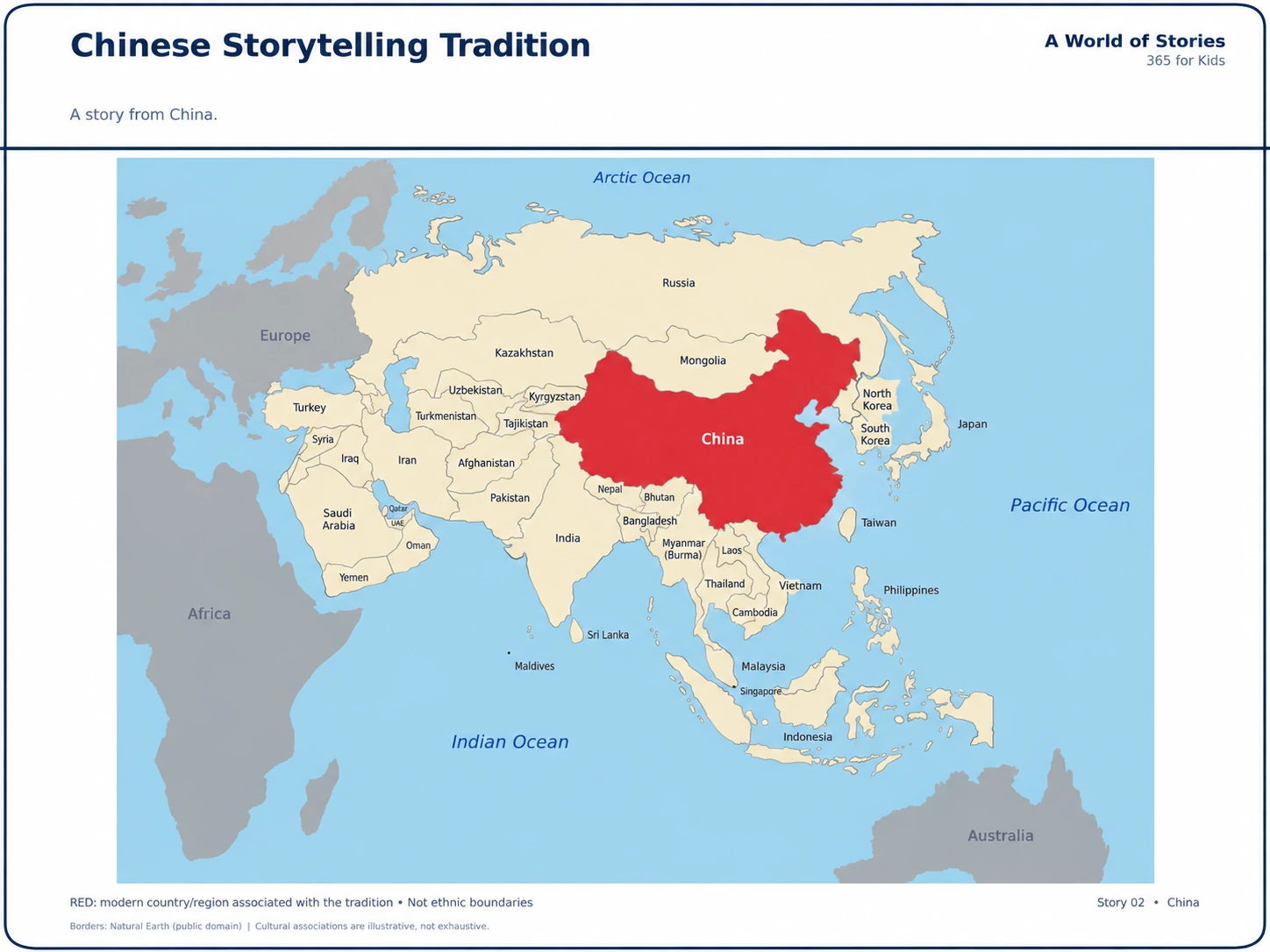
1. Find China on a map of Asia. What countries or seas surround it? Draw the flag of China.
2. What work did Zhinü do in Heaven, and how did Niulang live on earth?
3. What separated Niulang and Zhinü? How did the magpies help them meet?
4. The magpies could not remove the Heavenly River, but they found a way to help. What does their action tell you about compassion and cooperation?
Inspired by this story? Create your illustration!
CHINA — The Legend of the White Snake
In the Chinese city of Hangzhou, beside the waters of West Lake, there stands a bridge called the Broken Bridge. It is a place of willow trees, shifting mist, and rain that can sweep across the lake without warning. For generations, people have remembered it as the meeting place of a remarkable woman and the man she loved. The woman was known as Bai Suzhen, or Lady White Snake. But she had not always lived in human form.
For many years, a white snake had devoted herself to spiritual cultivation until she gained the power to appear as a woman. She wished to know the life of the human world: its changing seasons, its ordinary work, and the feelings that bound one person to another. With her traveled Xiaoqing, a green snake spirit who could also take human form. Together, the two companions journeyed to West Lake.
One day, as Bai Suzhen and Xiaoqing were walking near the Broken Bridge, clouds gathered over the water. Rain began to fall. A young man passing by noticed the two women caught in the downpour and offered them his umbrella. His name was Xu Xian. His gesture was small, yet Bai Suzhen did not forget it. Nor did Xu Xian forget the woman he had met beside the lake.
They met again, and affection grew between them. Xu Xian discovered Bai Suzhen’s kindness and intelligence; she found in him the gentle heart she had hoped to meet among human beings. Before long, they married. With Xiaoqing beside them, the couple made their home in Zhenjiang, where they opened a shop selling medicinal herbs. People came to seek remedies, and the shop prospered through their care and hard work.
Their days seemed peaceful. Xu Xian measured herbs and prepared medicines. Bai Suzhen helped those who came through the door, and Xiaoqing shared the work of the household and shop. Yet Bai Suzhen carried a secret that Xu Xian did not know. Beneath her human appearance, she remained a snake spirit. Her love was real, but she feared how her husband might receive the truth.
Not far away, at Jinshan Temple, lived a Buddhist monk named Fahai. When he learned of Xu Xian’s marriage, he was troubled. In the telling of the legend followed here, Fahai believed that a spirit and a human being ought never to be husband and wife. He warned Xu Xian that Bai Suzhen was no ordinary woman. Xu Xian had known her only as a loving companion, and at first he could scarcely believe the monk’s words.
Fahai urged Xu Xian to put his wife to a test. At the Dragon Boat Festival, when some people traditionally drank wine mixed with realgar, he told Xu Xian to offer such wine to Bai Suzhen. Realgar was believed to drive away snakes and harmful spirits. Xu Xian followed the monk’s advice, although doubt and fear were beginning to replace the trust he had once felt.
Bai Suzhen knew what the wine might do to her. She tried to avoid it, but at last she drank. Soon her power to keep her human form failed. Where Xu Xian had expected to find his wife, he saw an enormous white snake. The sight overwhelmed him. He fell lifeless to the ground.
When Bai Suzhen returned to human form and discovered what had happened, her grief was terrible. Xu Xian had been frightened by the truth about her, yet she could not abandon him. The story tells that she went in search of a rare, life-restoring herb, traveling into a realm beyond the ordinary world. It was a perilous quest, but at last she obtained the medicine she needed.
Bai Suzhen returned and used the herb to revive her husband. Xu Xian opened his eyes once more. The person who had crossed such a distance to save him was the very wife he had feared. Their life together might have begun anew, but Fahai had not given up his determination to separate them.
The monk brought Xu Xian to Jinshan Temple and prevented him from returning home. Bai Suzhen and Xiaoqing went to bring him back. When Fahai refused to release him, the two snake spirits summoned their powers over the water. Great waves rose around the temple. The struggle became known in many tellings as the Flooding of Jinshan Temple, one of the most dramatic episodes of the legend.
But Fahai was powerful, and Bai Suzhen could not overcome him. She and Xiaoqing withdrew. By this time Bai Suzhen was expecting a child, and the battle had left her exhausted. Her attempt to rescue Xu Xian had failed, and the waters she had raised showed how dangerous a struggle between such extraordinary powers could become.
At last Xu Xian escaped from the temple and found Bai Suzhen again. She no longer hid her nature from him. He now knew that the woman he loved was a white snake spirit, but he also knew who had labored beside him, cared for the sick, and risked everything to restore his life. In this version of the legend, he chose to remain with her.
For a little while, they were together. Bai Suzhen gave birth to a son. Yet Fahai still considered their marriage a violation of the proper order between the human and spirit worlds. He returned with a magical bowl and captured Bai Suzhen. Then he imprisoned her beneath Leifeng Pagoda, near West Lake, where her story had begun.
The pagoda stood above the place where she was confined. Xu Xian could not free her. Their son grew up without his mother beside him, knowing her through the story of her courage, her love, and her long imprisonment. Seasons came and went. The water of West Lake darkened beneath storm clouds and brightened again under the sun, but the pagoda remained standing.
As the boy grew to adulthood, he devoted himself to his studies. In one widely told continuation of the legend, he succeeded in the imperial examinations and earned the highest distinction. Yet the honor did not make him forget his mother. He went to Leifeng Pagoda to pay his respects and to plead for her release.
The story tells that the son’s devotion moved Heaven. The power that held Bai Suzhen beneath the pagoda was broken; the pagoda fell, and at last she was free. After years of separation, mother and son could meet, and the family was reunited.
Some tellings end the story differently. In certain versions, Bai Suzhen remains imprisoned; in others, Xiaoqing returns to rescue her. But in the ending told here, it is the child who remembers his mother and helps bring her home. The waters of West Lake, the Broken Bridge, and Leifeng Pagoda remain part of the landscape in which generations have imagined the legend.
The Legend of the White Snake has lived in storytelling, literature, opera, shadow puppetry, and other arts. Its characters have changed as the story has passed from one generation to another. Yet the question at its heart has endured: when someone appears different from what we expected, do we judge by fear—or by what we know of that person’s actions?
The Legend of the White Snake (Baishe Zhuan, 白蛇传) is a Chinese story closely associated with West Lake in Hangzhou, the Broken Bridge, Jinshan Temple in Zhenjiang, and Leifeng Pagoda. This is an original English literary adaptation of a later sympathetic tradition, not a translation of a single historical text. The son who studies, passes the imperial examinations, and frees his mother belongs to a well-attested ending; other versions end with her continued imprisonment or with her rescue by Xiaoqing. Earlier written forms of the story could present the White Snake very differently. Details of different tellings have not been presented as historical fact. Realgar wine is mentioned solely as a cultural detail of the legend, not as a drinking recommendation.
After the Story: Read · Create · Reflect · Share
1. Locate China on a map of Asia and draw its flag. Can you find Hangzhou and West Lake on a map?
2. Who were Bai Suzhen, Xiaoqing, Xu Xian, and Fahai? How did each of them affect the events of the story?
3. What happened after Xu Xian discovered Bai Suzhen’s true form? What did she do to save his life?
4. Xu Xian first reacted with fear, but later chose to return to Bai Suzhen. What changed? How might the story help us think about trust and judging others?
Inspired by this story? Create your illustration!
JAPAN — Momotaro — The Peach Boy

Long ago, in a village in Japan, an elderly husband and wife lived quietly together. They had no children. Every morning the old man went into the hills to gather firewood, while the old woman carried the washing down to the river. Their days were filled with work, and they shared whatever they had. Yet there was one wish they had carried in their hearts for many years: to have a child of their own.
One morning the old woman knelt beside the river, dipping the clothes into the clear, moving water. As she worked, she noticed something extraordinary floating downstream. It was a peach—but no ordinary peach. It was so large that she could scarcely believe her eyes. Its rosy skin shone above the current as it bobbed closer and closer to the bank.
The old woman reached into the water and pulled the enormous fruit ashore. She was delighted. What a wonderful surprise it would be for her husband when he returned from the hills! She finished her washing, lifted the heavy peach, and carried it carefully home.
That evening, the old man looked at the peach in amazement. He and his wife sat down together, eager to share it. But just as they were about to cut it open, the fruit split apart. Inside was a healthy baby boy. For a moment neither of them could speak. Then astonishment gave way to joy. The child they had longed for had come to them in the most wonderful way imaginable.
They named him Momotaro. In Japanese, momo means “peach,” and Tarō is a traditional boy’s name. The old couple raised him with great affection, and Momotaro grew quickly into a strong, spirited young man. His unusual arrival never made him forget the home that had welcomed him. He loved the two people who had cared for him, and they were proud of the boy who had become their son.
But beyond the peaceful village lay a danger that troubled many people. Far across the sea stood an island called Onigashima—the Island of the Oni. Oni were fearsome beings, often described in Japanese tales as ogres or demons. Those who lived on that island had been coming to human settlements, frightening the inhabitants and carrying away their belongings and treasures. The villagers feared that the raids would never end.
When Momotaro learned of their suffering, he decided to confront the oni. He told his parents that he wished to travel to Onigashima and put a stop to the stealing. The old man and woman were deeply worried. The island was far away, and the oni were said to be powerful. Yet they saw that Momotaro had made up his mind, not for the sake of riches or praise, but because people needed help.
Before he left, the old woman prepared a bundle of kibi-dango—small, nourishing millet dumplings—for him to eat along the road. The old man gave him his blessing. Momotaro thanked them both, tied the dumplings securely at his side, and set out toward the sea. He did not know how many dangers he would face, nor how he might overcome them alone.
He had not traveled far when a dog came up beside him. The dog noticed the dumplings and asked for one. Momotaro explained where he was going: to Onigashima, to stop the oni who had been troubling the villages. If the dog would join him on that journey, he said, he would gladly share his food. The dog accepted a kibi-dango and became his first companion.
Farther along the road, a monkey appeared. The monkey, too, wanted one of the dumplings. Momotaro told him about the island, and the monkey agreed to go with them in exchange for a share. The dog and the monkey did not take to each other at first. They quarreled as they walked, and Momotaro had to insist that they stop. Whatever their differences, they would need to travel together if they hoped to face the oni.
A little later a pheasant flew down to meet them. The bird asked where they were going, and when Momotaro spoke of the stolen treasures and the troubled villages, the pheasant offered to join them as well. Momotaro shared another kibi-dango. Now there were four travelers: the Peach Boy, the dog, the monkey, and the pheasant. Each had come from a different world of habits and strengths, but all were headed toward the same distant island.
At last the travelers reached the shore. Across the open water lay Onigashima. From the land, its distance seemed greater than ever; there was no path to follow over the sea. But turning back would leave the villagers in fear. Momotaro and his companions took a boat across the waves, keeping their eyes on the island ahead.
When they arrived, they saw the stronghold of the oni. The island’s inhabitants were formidable, and there were many of them. Even Momotaro’s animal companions understood how difficult the task would be. But the four had come too far to abandon it now. They advanced together and challenged the oni, determined to end the raids.
A fierce struggle followed. The oni relied on their size and strength, but Momotaro was brave and powerful, and his three companions fought beside him. The dog, the monkey, and the pheasant each played a part. They did not allow their earlier quarrels to divide them. Together they resisted the oni until, at last, the chief of the island admitted defeat and begged Momotaro to end the fighting.
Momotaro did not ask to become master of the island. He demanded that the oni stop attacking the villages and return the treasures they had taken. The chief agreed. The stolen riches were brought out, and the oni promised not to trouble the people again. What had seemed impossible when Momotaro set out from his parents’ house had been achieved—not by a lone traveler, but by four companions who had stood together.
The return voyage was a joyful one. Momotaro, the dog, the monkey, and the pheasant carried the recovered treasure back across the sea. When they reached the village, the people could scarcely believe the sight. The belongings taken from them had come home, and the oni would no longer come to frighten them. Relief and happiness spread through the village.
For the old man and woman, the greatest treasure of all was the safe return of their son. They had watched him leave with a bundle of millet dumplings and had feared they might never see him again. Now he stood before them, with three loyal companions at his side. Momotaro had proved his courage, but he had also learned how much could be accomplished by sharing what he had and accepting help from others.
And so Momotaro—the boy who had come from a peach—returned to the home where his story began. There, surrounded by his parents and his companions, he lived in peace. Long after the adventure was over, people continued to tell of the enormous peach, the three animal friends, and the voyage to Onigashima. The tale of the Peach Boy was passed from one generation to the next, until it became one of Japan’s best-loved stories.
Momotarō (桃太郎), meaning “Peach Boy,” is one of Japan’s best-known mukashi-banashi (traditional tales). This adaptation follows the familiar version in which a child emerges from a giant peach found in a river by an elderly woman. Traditional versions differ: the Hyogo Prefectural Museum of History preserves an illustrated telling in which the old couple eat the peach, become young again, and later have a son; other versions differ in the order of the animal companions, the way they cross the sea, and the details of the oni’s defeat. This original English literary adaptation follows the familiar “child from the peach” tradition rather than combining incompatible origins.
After the Story: Read · Create · Reflect · Share
1. Find Japan on a map of Asia and draw its flag. Is Japan an island country, and where is it located in relation to the Asian mainland?
2. What did the elderly couple discover inside the giant peach? Why did they name the boy Momotaro?
3. Which three animals joined Momotaro? What did he share with each of them, and what did they accomplish together?
4. Why did Momotaro go to Onigashima? In your opinion, was his greatest strength his courage, his generosity, or his ability to work with others? Explain your answer.
Inspired by this story? Create your illustration!
JAPAN — The Tale of the Bamboo Cutter
Long ago in Japan, an old bamboo cutter lived with his wife in a modest house near a grove. Each day he went among the tall green stems, cutting bamboo to make useful things. He knew the grove in every season: the rustling leaves on windy mornings, the cool shade beneath the stalks, and the pale light that filtered down to the earth.
One day he noticed something he had never seen before. At the foot of a single bamboo stalk, a clear light shone from within, as though a small lamp had been hidden there. The old man approached, wondering at the sight. When he carefully cut open the stalk, he found a tiny girl inside, scarcely three inches tall. She sat in the hollow bamboo, shining with a gentle radiance.
The bamboo cutter lifted the child into his hands. No ordinary child could have come into the world in such a way. He thought that she must have been sent for him to find, and he carried her home. His wife was as astonished as he was. They had no child of their own, and they welcomed the little girl into their household with great tenderness.
From that day, strange good fortune followed the old man. In the bamboo he cut, he began to find pieces of gold. The humble family became prosperous, and the child grew with astonishing speed. In only three months she reached the height of a young woman. Her beauty was remarkable, and there seemed to be light in the room wherever she sat. She came to be called Nayotake no Kaguya-hime—Princess Kaguya of the Slender Bamboo, the Shining Princess.
Her foster parents loved her dearly. Yet they could not keep news of her hidden. People spoke of the extraordinary daughter of the bamboo cutter, and visitors came from far away, hoping for a glimpse of her. Many were turned away. Some soon gave up their visits; others lingered outside the house, unwilling to abandon their hopes.
Five noblemen proved especially persistent. They were men of position and wealth, accustomed to having their wishes heard. Each asked to marry Kaguya-hime. The old bamboo cutter, thinking of his age and of his daughter’s future, urged her to consider them. But Kaguya-hime had no wish to marry any of the five. At last she proposed a condition: she would give each suitor a task, and would accept the man who brought her the treasure she named.
To the first suitor she said, “Bring me the stone begging bowl that belonged to the Buddha in India.” To the second she said, “Bring me a branch from the marvelous tree on Mount Hōrai, with roots of silver, a trunk of gold, and jewels for fruit.” The third was asked for a robe made from the fur of the fire-rat, a creature said to be unharmed by flames. The fourth must obtain the jewel that shone in five colors from a dragon’s neck. And the fifth must bring her the rare shell said to be found within a swallow.
The five men had expected that riches and rank would be enough. Instead they faced wonders that ordinary people could scarcely imagine. One by one, they set about their impossible quests.
The first suitor did not make the dangerous journey to India. He found an old stone bowl at a temple, wrapped it as though it were a precious relic, and waited before presenting it to Kaguya-hime. But the true sacred bowl, it was said, would shine with a wondrous light. The bowl he brought remained dull and dark. Kaguya-hime saw that it could not be the treasure she had requested, and the suitor’s hope came to nothing.
The second suitor was more elaborate in his deception. Instead of sailing to the legendary Mount Hōrai, he secretly employed skilled craftsmen to make a splendid branch. They fashioned silver and gold into the shape of a tree and set glittering jewels upon it. When he carried the branch to the bamboo cutter’s house, it seemed magnificent enough to have come from a land of immortals. He even told a grand story of his long voyage and of the hardships he had endured.
Kaguya-hime listened, but before the matter could be settled, the craftsmen who had made the branch arrived to ask for their unpaid wages. Their appearance revealed the truth. The beautiful branch was the work of human hands, not a treasure from Mount Hōrai. The second suitor, too, was turned away.
The third suitor sought a robe said to have been made from the fur of a fire-rat. Through a merchant, he obtained an extraordinary garment and believed it to be the real marvel. Kaguya-hime proposed a simple test: if the robe truly belonged to a creature untouched by fire, it would not burn. The garment was placed in the flames. Instead of surviving, it caught fire and was destroyed. The third suitor had been deceived by the treasure he had bought.
The fourth suitor ordered men to search for the dragon’s five-colored jewel. But finding such a dragon was no easy matter, and his servants could not bring him the prize. At last he ventured out himself upon the sea. There a terrible storm rose. Waves battered his ship, and the voyage turned from a proud adventure into a struggle to stay alive. Having escaped the danger, he returned without the jewel. His quest had ended not in glory, but in fear and defeat.
The fifth suitor tried to obtain the strange shell associated with a swallow. He had people search high beneath the eaves, where swallows made their nests. In the attempt to reach one, he fell from a great height and was badly hurt. He did not bring Kaguya-hime the treasure she had requested. In the older story, his injuries eventually cost him his life. Kaguya-hime heard of his suffering with sorrow. This last failure was not merely foolish; it was tragic.
Thus none of the five noblemen fulfilled his task. Some had tried to pass off false treasures as genuine. Others had risked everything in pursuit of impossible objects. Kaguya-hime remained unmarried. The men who had thought they could win her as easily as a costly possession were forced to accept that neither power nor splendid gifts could command her choice.
In time, the Emperor himself heard of the Shining Princess. He wished to see the extraordinary young woman of whom everyone spoke, and he, too, asked that she come to his palace. Kaguya-hime refused. Even the Emperor could not change her decision. She told him that she was not a person who belonged to his world and could not become his wife. Yet the two continued to exchange letters, and the Emperor did not forget her.
Years passed. In the bamboo cutter’s house, Kaguya-hime remained the beloved daughter who had come from a glowing stalk. Her parents had grown accustomed to the marvel of her presence, almost as though she had always lived beside them. But during the summer, when the moon rose full and bright, they began to notice a change. Kaguya-hime would gaze at it for a long time, and tears would gather in her eyes.
Her father and mother asked why the moon made her so unhappy. At first she could scarcely answer. Finally she told them what she had kept hidden: she had come from the Moon, and her time on Earth was nearing its end. Beings from her own world would soon arrive to take her home. She did not wish to leave the two people who had cared for her, but the journey could not be prevented.
The old couple were overcome with grief. They had found her when she was small enough to rest in a pair of hands; now they were being told that she must go where they could never follow. The bamboo cutter begged her to remain. But Kaguya-hime could promise only what she knew to be true: she loved them, and she would grieve to part from them.
When the Emperor learned what was to happen, he sent guards to the bamboo cutter’s house. Soldiers took their places around the dwelling, determined that no visitor from the sky should carry Kaguya-hime away. On the night of the full moon in the eighth lunar month, they watched the heavens and waited.
Then a brilliant light spread across the sky. A procession of celestial beings approached, accompanied by a wondrous carriage. The light was so powerful and strange that the soldiers could not resist it. Their weapons and courage were of no use against the visitors from the Moon. The old man could not bar their way, and the time of parting had come.
The moon people had brought a robe of feathers and an elixir of immortality. Kaguya-hime knew that once she put on the heavenly robe, the grief and attachments of her earthly life would slip from her memory. Before that happened, she wished to say farewell. She left words of love for the parents who had raised her and a letter for the Emperor, together with the elixir that had been brought from the Moon.
She put on the feather robe. The sorrow that had bound her to the Earth faded, just as the heavenly visitors had said it would. Then Kaguya-hime climbed into the celestial carriage. Before the eyes of those who loved her, the procession rose through the luminous night and traveled back toward the Moon.
The house beneath the bamboo grove was silent. Her parents mourned, unable to find comfort in their new wealth or in the thought of all the years they had spent together. The Emperor received Kaguya-hime’s farewell letter and the elixir of immortality. But to him, a life without end held little meaning if he could never see her again.
He ordered the letter and the elixir taken to a mountain thought to stand nearest to heaven. There, high above the land, they were burned. According to the old tale, smoke rose from the summit into the clouds, as though the Emperor’s final message might yet travel toward the Moon. The story links that mountain with Mount Fuji, and plays upon Japanese words associated with immortality and the mountain’s name.
And so the tale ends, not with a wedding or a treasure won, but with the memory of a girl found in a shining bamboo stalk—a girl who belonged to the Moon, yet came to love a home on Earth. The bamboo cutter had received something more wondrous than gold. For a brief time, he and his wife had been the parents of Princess Kaguya.
Taketori monogatari (竹取物語), commonly called The Tale of the Bamboo Cutter or The Tale of Princess Kaguya, is an anonymous work from Japan’s early Heian period, generally dated to around the tenth century, and is among the earliest surviving works of Japanese prose fiction — a classical literary tale, not simply an anonymous oral folktale. This original English adaptation preserves the principal narrative episodes; the original also contains court poetry, wordplay, and fuller dialogue, summarized or omitted here for readability. This is not a line-by-line translation. In the older narrative the fifth suitor is severely injured and dies; this adaptation retains that outcome without graphic detail. The explanation linking Mount Fuji’s name and the smoke above it to the elixir belongs to the literary tale, not to an established historical etymology.
After the Story: Read · Create · Reflect · Share
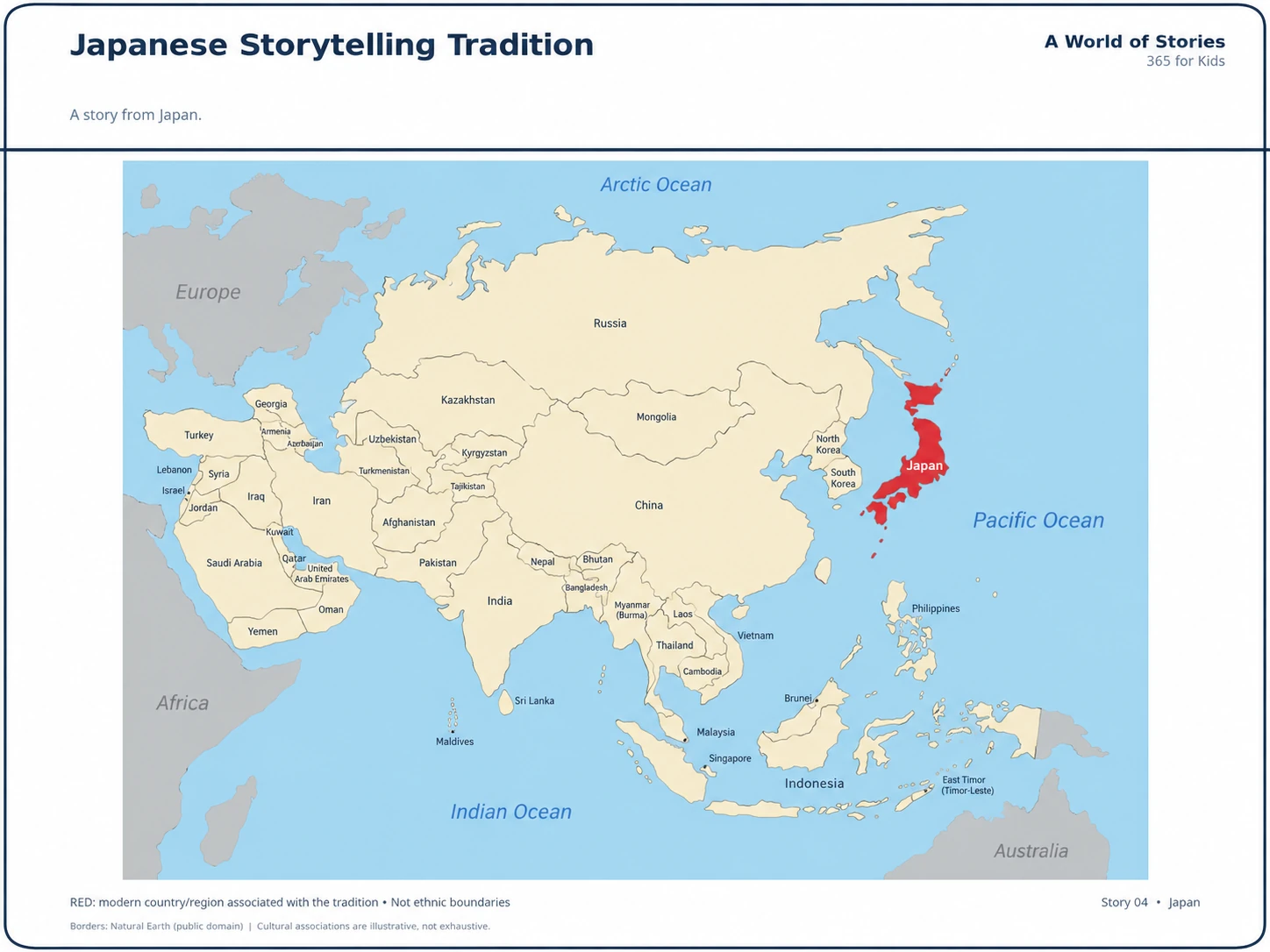
1. Find Japan on a map of Asia and draw its flag. Is Japan made up of one large landmass or many islands?
2. Where did the bamboo cutter find Kaguya-hime, and what unusual changes came to his household after he brought her home?
3. Name any three of the five treasures Kaguya-hime asked her suitors to find. Why did none of the suitors succeed?
4. Why did Kaguya-hime grieve when she looked at the Moon? What does the Emperor’s decision about the elixir tell you about what he valued?
Inspired by this story? Create your illustration!
KOREA — Heungbu and Nolbu
Long ago, in a village on the Korean Peninsula, two brothers grew up in the same household. The elder was named Nolbu; the younger was named Heungbu. Although they belonged to the same family, their hearts were very different. Nolbu thought constantly about what he owned and what more he might acquire. Heungbu cared for his wife and children, worked as best he could, and was ready to help others even when he had little to spare.
When their parents died, the family property should have provided for both brothers. But Nolbu seized the inheritance for himself. He took the house and the wealth, and he drove Heungbu, his wife, and their children away. Heungbu could not persuade his brother to share what had been left to them. The family went to live in a poor little dwelling, where every day brought the same question: would there be enough food for everyone?
Heungbu worked hard, but hardship followed hardship. The children’s clothes grew worn, and the rice jar was often nearly empty. His wife tried to stretch what they had, yet there came a time when nothing remained for the evening meal. Heungbu looked at his hungry children and knew that he must ask someone for help. He did not wish to return to the brother who had treated him so cruelly, but there was no other choice he could see.
He went to Nolbu’s prosperous house and begged for a little rice. His brother would not give him any. Nor did Nolbu’s wife show kindness. She was cooking rice when Heungbu approached her, and instead of sharing even a handful, she struck his cheek with the wooden paddle she was using. Heungbu left without the food he had hoped to carry home. His family remained hungry, and the fine house behind him remained full.
Spring eventually returned. Under the eaves of Heungbu’s small home, a pair of swallows began to build a nest. They carried bits of earth and straw to the shelter of the roof and, before long, there were chicks inside. Heungbu watched the birds with pleasure. Their home was small and their food was scarce, but he was glad that the swallows had found a safe place to raise their young.
One day, a snake began to climb toward the nest. Heungbu saw it making its way closer to the young birds and rushed to chase it away. In the confusion, one of the little swallows fell to the ground. Its leg had been hurt, and the chick could not return to the nest by itself. Heungbu carefully lifted the trembling bird. The injury was small enough to fit in his hand, yet serious enough to keep the young swallow from flying.
Heungbu bound the injured leg gently with a strip of cloth and cared for the chick until it grew stronger. His wife helped him tend it. He did not expect the bird to bring him anything in return. To him, the swallow was a living creature in need of help, and that was reason enough. In time the bird recovered and rejoined the others. When the seasons turned and the swallows flew south, Heungbu watched them go, hoping they would travel safely.
Winter passed. When spring arrived again, swallows appeared beneath the familiar eaves. One of them flew down near Heungbu and dropped a single seed. It was a gourd seed, small and ordinary-looking. Heungbu remembered the injured chick he had cared for the year before. He and his wife planted the seed beside their house and waited to see what would grow.
The seed sprouted. A green vine stretched across the ground, climbed upward, and spread over the roof. Leaves opened along its length, and large gourds began to swell beneath them. The gourds became so enormous that the family could hardly believe their eyes. Heungbu and his wife were pleased: an ordinary gourd could be useful in many ways, and they were grateful for anything that might help their household.
When the gourds were ready, Heungbu and his family set about cutting them open. The first shell yielded an astonishing sight. Instead of the simple contents they expected, it held riches. Other gourds revealed still more wonders—rice and treasures far beyond anything the family had ever possessed. There was enough food to fill their empty stores and enough wealth to free them from poverty. Heungbu and his wife, who had so often worried over a single meal, could scarcely take in what had happened.
Their lives changed. Heungbu no longer had to see his children go hungry. Yet his good fortune did not make him forget the days when he had needed kindness himself. The gift had begun with a wounded bird, and it was a gift he had never sought. The news of his astonishing harvest soon traveled beyond the walls of his home, until it reached the ears of his elder brother.
Nolbu could hardly believe what he heard. The younger brother he had sent away was now prosperous, and the wealth had come from a seed brought by a swallow. He wanted the same reward—and more. He went to Heungbu and demanded to know how the miracle had happened. Heungbu told him about the nest beneath his roof, the snake, the injured chick, and the seed that had appeared the following spring.
Nolbu listened closely, but he heard only the part of the story that promised riches. He did not consider why Heungbu had helped the swallow, or how much patience it had taken to nurse the small bird back to health. Instead, he returned home thinking of gourds full of treasure. If one rescued swallow could bring such a gift, he reasoned, then he must obtain a wounded swallow for himself.
He searched for swallows and watched their nests. But he did not wait for an accident. When he found a young bird, he deliberately broke its leg. Then he bound the injury, imitating what Heungbu had done. The bird had not been saved from danger: Nolbu had caused the suffering himself. Still, he expected a reward, as though the outward appearance of kindness were the same as kindness of the heart.
When spring came round again, a swallow brought Nolbu a gourd seed. He planted it at once. A vigorous vine grew, and on it appeared large gourds. Nolbu gazed at them with delight. Surely there would be gold and silver inside, just as there had been for Heungbu. He could hardly bear to wait until the fruits were ready to cut.
At last Nolbu and his wife opened their gourds. But there were no chests of treasure, no overflowing stores of rice. Out of the gourds came trouble. In one familiar telling, robbers and stern officers burst forth, damaging Nolbu’s house and sweeping away his possessions. The fine property he had guarded so jealously was ruined. The man who had wanted wealth beyond his brother’s found that he had lost even the riches he once owned.
Nolbu’s first thoughts had been of how to become richer than Heungbu. Now he had little left and nowhere to turn. He could no longer hide from what he had done: he had kept the family inheritance, refused food to hungry children, and injured an innocent bird in pursuit of a prize. Wealth had not made him generous, and trying to purchase good fortune through cruelty had brought him nothing but misery.
At last Nolbu went to his younger brother’s home. This time he did not arrive to demand a secret or to ask for treasure. He came to seek help. Heungbu had every reason to remember the day he had stood hungry outside Nolbu’s house and had been sent away. Yet he did not answer cruelty with cruelty. He welcomed his brother and his sister-in-law and gave them care and shelter.
In the traditional ending, Nolbu comes to regret the wrong he has done. The brothers are reconciled, and their families can live without the bitterness that once divided them. Heungbu’s greatest gift, after all, is not the gold in his gourds. It is the kindness he offers when someone is suffering—even when that someone once refused to help him.
And that is why, in Korea, people have told the story of Heungbu and Nolbu for generations. They remember the little swallow with the broken leg, the seed carried beneath its wings, and the gourds that revealed the difference between kindness given freely and kindness imitated for reward. Two brothers began their lives beneath one roof. What made them different was not how much they owned, but what they chose to do with what they had.
Heungbu and Nolbu (흥부와 놀부; also romanized Heungbo and Nolbo) belongs to a shared Korean storytelling tradition that predates the modern division of the Korean Peninsula, and is a major subject of pansori (Heungbuga, 흥보가). This newly written English literary adaptation follows a common narrative line documented by KBS World and Korea.net. The contents of Nolbu’s gourds differ by telling (robbers/officers vs. goblins/shamans in other versions); this adaptation follows the robber-and-officer version. The ending may emphasize repentance or generosity differently across tellings; the present ending follows the widely told reconciliation version.
After the Story: Read · Create · Reflect · Share
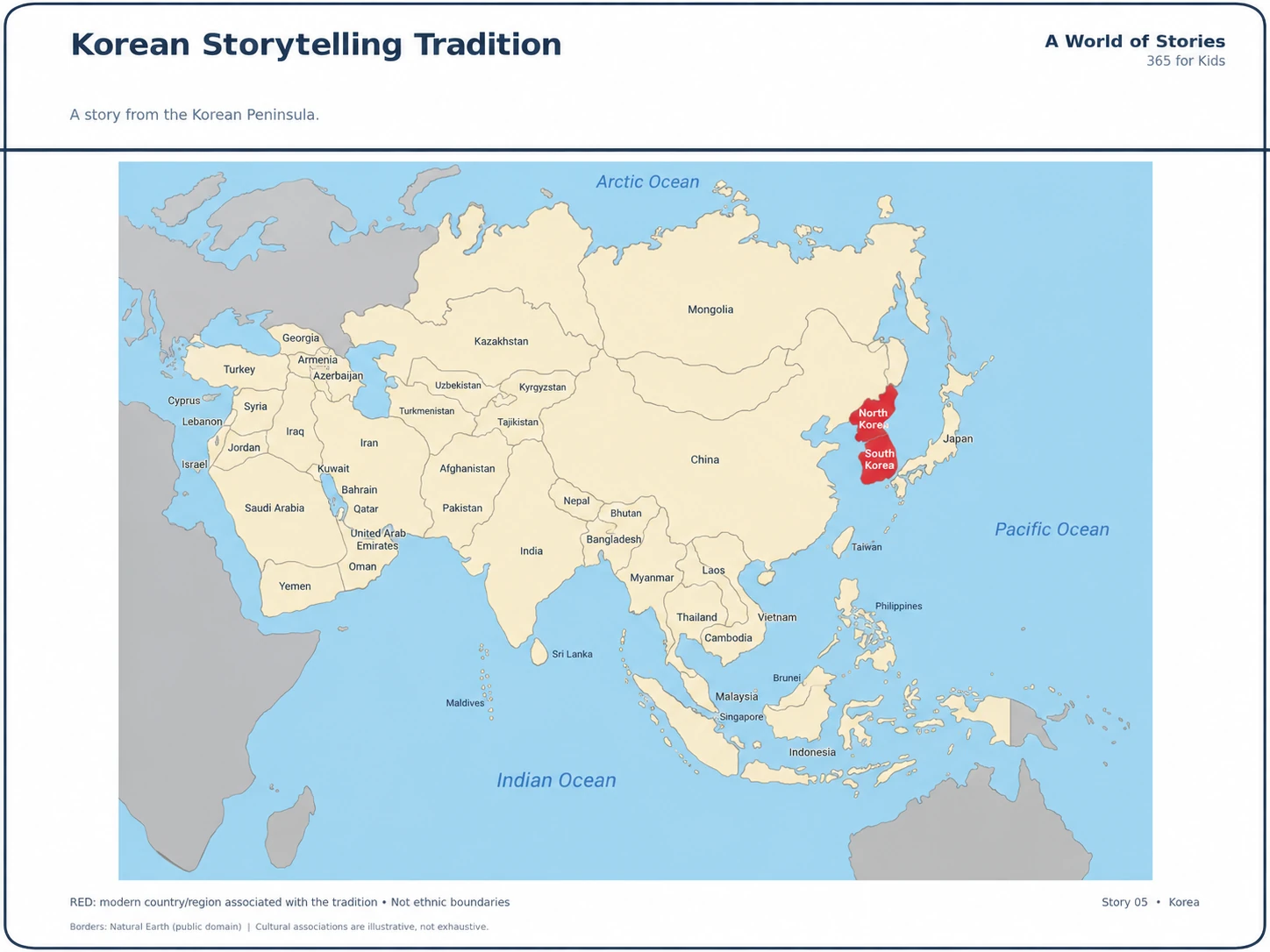
1. Find the Korean Peninsula on a map of East Asia. Which two countries are located there today? Choose one and draw its flag.
2. What happened to Heungbu’s family after Nolbu took the inheritance? How did Nolbu and his wife respond when Heungbu asked for rice?
3. Why did the swallow bring Heungbu a seed? How was Nolbu’s treatment of another swallow different, even though both brothers bandaged a bird’s leg?
4. What came out of the brothers’ gourds, and how did the story end? What is the difference between doing something kind to help another being and doing it only because you want a reward?
Inspired by this story? Create your illustration!
KOREA — Sister Sun and Brother Moon
Long ago, in a mountain village on the Korean Peninsula, a mother lived with her two children, an older brother and his younger sister. Their home was small, and their family had little money. Each day the mother went out to work, sometimes far from the village, while the children waited for her return. No matter how tired she was, she thought of them as she made her way home.
One evening, after a long day’s work, she set out along a mountain path. She carried a bundle of tteok, Korean rice cakes, which she had saved to share with her children. The path crossed several hills before it reached the village. Darkness was drawing close, and she walked as quickly as she could.
As she came over the first hill, a great tiger stepped out of the trees. His eyes were fixed on the bundle in her hands. “Give me a rice cake,” he demanded, “or I shall eat you instead.” The mother was frightened, but she thought of the children waiting at home. She gave him a cake and hurried onward, hoping that would be the end of it.
At the next hill, the tiger appeared again. He demanded another cake, and then another. Each time she surrendered part of what she carried, he let her pass; each time she hoped she would never see him again. But the tiger’s hunger was never satisfied. At last the rice cakes were gone. Still he followed her. The gifts she had saved for her children could no longer protect her, and the tiger killed the mother on the lonely road.
He was not content even then. He knew there were children at the end of the path. Putting on the mother’s clothes, he went to their little house and knocked at the door.
“Open the door,” he called. “Your mother has come home.” Inside, the brother and sister looked at one another. The voice outside was rough and strange. Their mother’s voice was not like that.
“Why does your voice sound so different?” the brother asked. “I have been working all day,” answered the tiger. “My throat is sore.” He tried to speak more softly, but he could not make the growl disappear.
The children remained uneasy. “Show us your hand,” said the brother. Through a gap in the door, the tiger thrust a paw. It was coarse and covered with fur. Their mother had hands worn by work, but she did not have a tiger’s paw. The children stepped back. They would not unfasten the door.
The tiger was furious. He forced his way into the house. The children knew now that the creature wearing their mother’s clothes was no mother at all. Their hearts beat wildly, but they did not surrender to fear. The brother asked to go outside to the outhouse, and the tiger let them pass. The moment they were beyond his reach, the two ran toward the yard.
Beside a well stood a tall tree. They climbed as fast as they could, gripping the trunk and pulling themselves upward until they were hidden among its branches. From there they could see the little house, the well, and the darkening path. They scarcely dared to breathe.
The tiger came out searching for them. He looked this way and that, then peered into the water of the well. There, far below, he saw two small faces. “So that is where you are hiding!” he roared. But the faces in the water were only reflections of the children above him. For a moment the brother and sister could not help laughing at the tiger’s mistake. Hearing them, he looked up and found them in the tree.
“How did you climb so high?” the tiger demanded. The older brother thought quickly. “We rubbed oil on the tree,” he said. “That made climbing easy.” The tiger coated the trunk and his paws with oil and tried to scramble upward. But the slippery bark defeated him. Up he went for a little way; down he slid again. The children held fast to their branches.
Then the younger sister, forgetting how dangerous the tiger was, cried out, “You could cut footholds in the trunk with an axe!” Her brother could not take the words back. The tiger seized an axe and began to chop footholds into the trunk. With each blow he made another place to stand. Slowly he climbed higher. Soon he would be close enough to reach them.
There was no branch left to climb. The children looked above the treetop into the wide sky. They could not escape by running, and the tiger was still coming. The brother and sister joined their hands and called toward heaven, asking for a strong rope if they were to be saved.
A rope descended from the sky. It was firm and sound, and it hung within their reach. The children caught hold of it and began to climb. The tree fell farther and farther below them; the well became a dark little circle; the mountains spread beneath their feet. At last the children passed beyond the tiger’s reach and into the heavens.
When the tiger saw what had happened, he raised his head and demanded a rope of his own. Another rope came down. This one was old and rotten, but the tiger was too eager to notice. He seized it and climbed. Higher he went, until the tree and the well were far beneath him. Then the worn rope snapped. The tiger fell from the sky into a field of sorghum and died there. In the old story, that is why the stalks of sorghum are said to have a reddish color.
The brother and sister, meanwhile, had reached the sky. They were safe from the tiger, but the heavens were unlike the home they had known. One would have to light the world by day, and the other would shine over it at night. The younger sister was afraid of the darkness. When the brother learned of her fear, he agreed that she could take the place of the Sun while he became the Moon.
And so, according to this Korean folktale, the sister became the bright Sun that travels across the daytime sky, and her brother became the Moon that watches over the night. They could no longer return to their little house in the mountains, but they remained above the same earth where their mother had loved them.
When people looked up, they saw the two children transformed. The Sun shone on the mountain paths and the village roofs; the Moon rose when evening came. Their places in the sky were different, yet neither light was forgotten. And whenever the old tale was told, listeners remembered how the brother and sister had faced the tiger together and found their way beyond his reach.
Sister Sun and Brother Moon is usually called Haewa Dari Doen Onui (해와 달이 된 오누이) or Haenim Dalnim (해님 달님). It is a story from Korean cultural heritage across the Korean Peninsula, not a tale that originated with the modern separation of North and South Korea. This original English literary adaptation follows the traditional narrative sequence documented in the Korea.net account “Celestial Siblings” (2014), cross-checked against KBS World’s retelling and the Academy of Korean Studies’ scholarly encyclopedia entry. The mother’s death is narrated without the graphic bodily details preserved in some tellings. Traditional variants differ: some have three children (including a baby); in some the brother becomes the Sun first and the sister the Moon, after which they exchange places because the sister fears the dark; in others the sister becomes the Sun directly. None of these versions should be treated as uniquely definitive.
After the Story: Read · Create · Reflect · Share
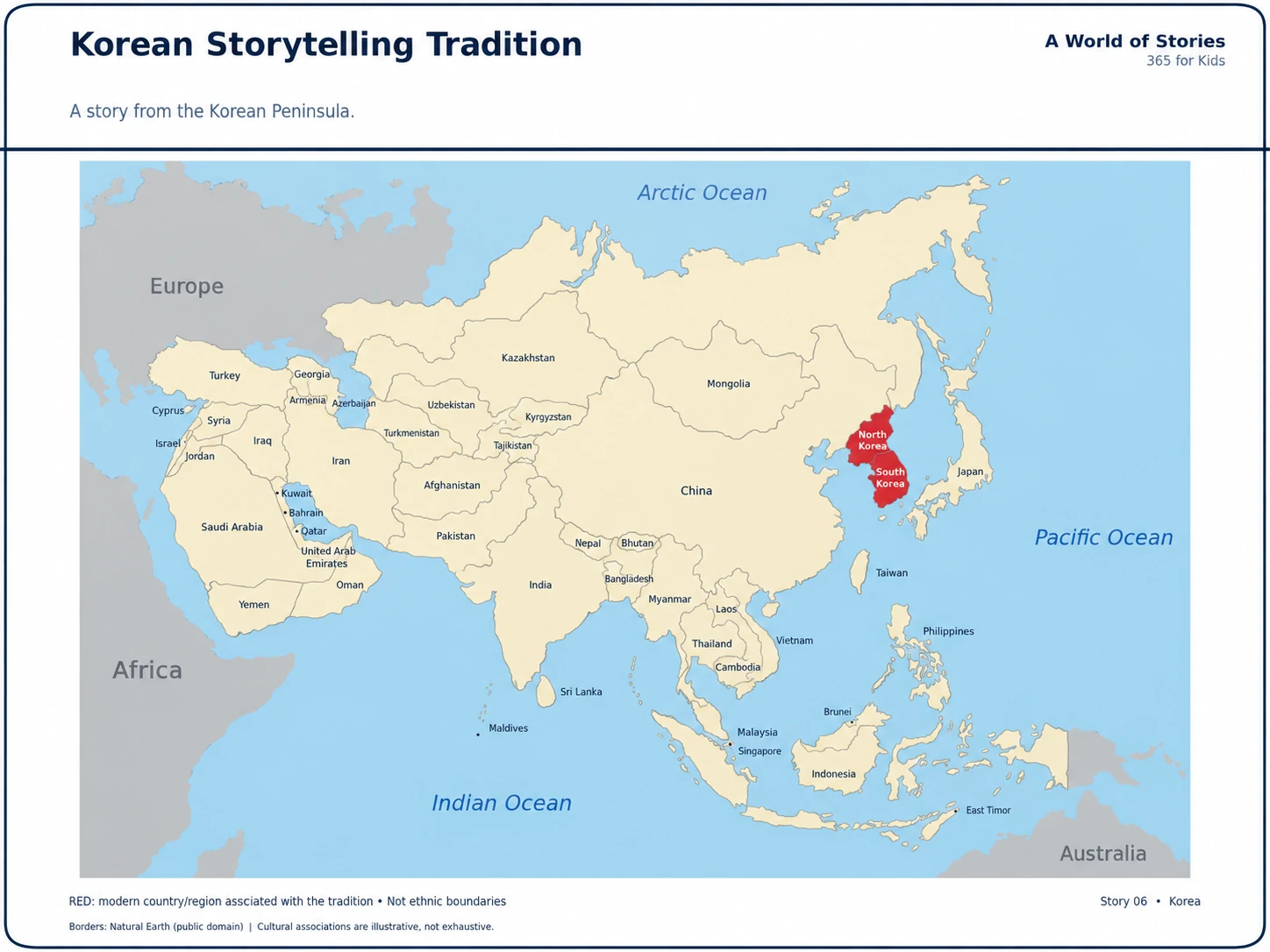
1. Find the Korean Peninsula on a map of East Asia. Which two countries are located there today? Choose one of their flags to draw.
2. What did the mother carry for her children, and how did the tiger trick the children into thinking she had returned? What clues made them suspicious?
3. How did the brother and sister try to escape when the tiger followed them to the tree? What happened to the two ropes that came down from the sky?
4. Why did the sister become the Sun and the brother the Moon in this telling? What does the story suggest about helping someone who is frightened?
Inspired by this story? Create your illustration!
MONGOLIA — Erkhii Mergen — The Archer and the Seven Suns
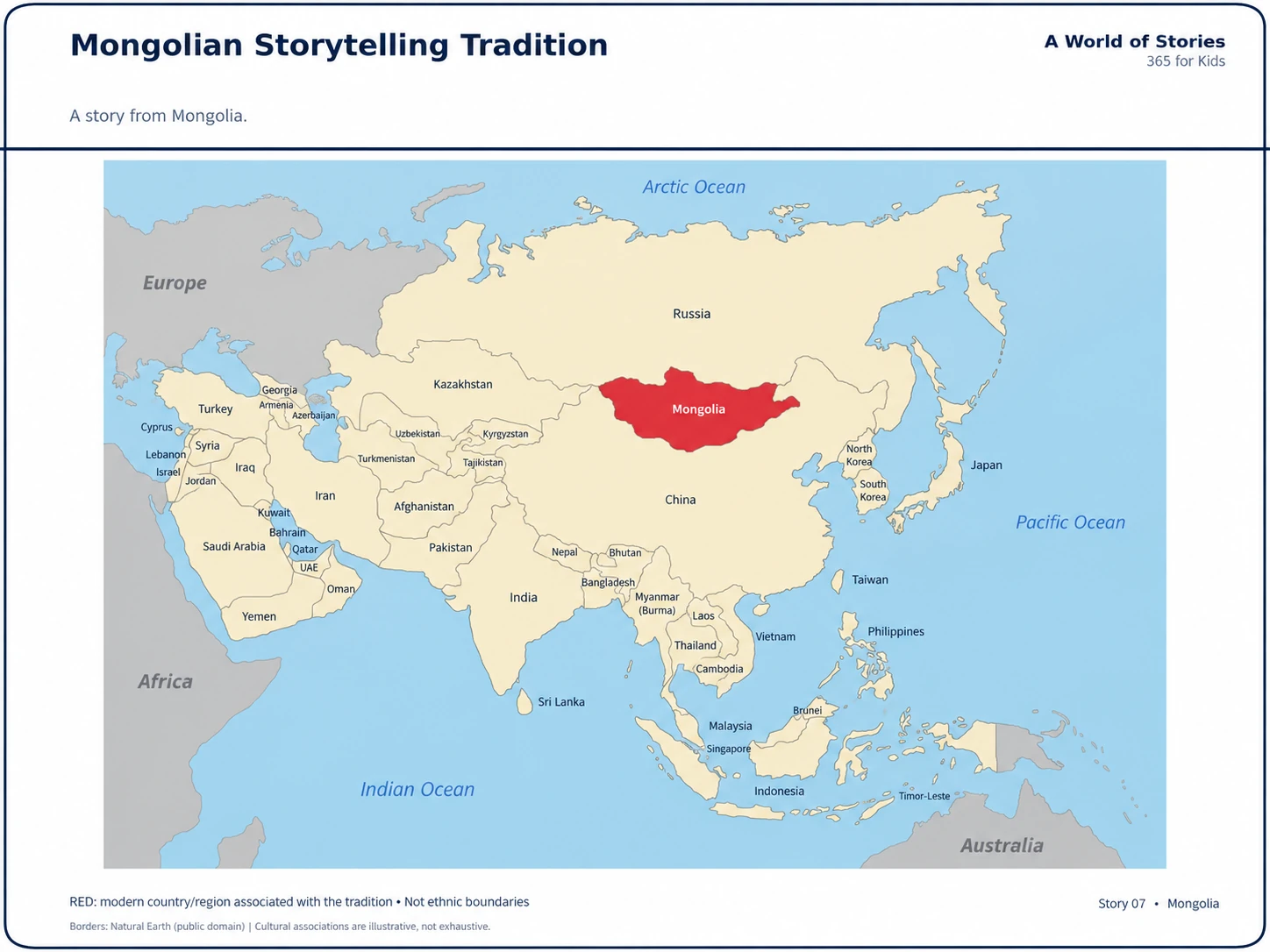
Long ago, when the world was still young in the telling of stories, seven suns burned in the sky. Their heat poured over the wide grasslands, the hills, and the distant mountains. Rivers dwindled. The earth grew hard and dry. Grass withered where animals had once grazed, and people searched in vain for water and shade.
The seven suns blazed from the east to the west, and their fierce light left the land no rest. Neither people nor animals could live easily beneath them. At last, the people thought of the one person whose arrows were said to fly with unfailing skill: a young archer named Erkhii Mergen.
They came to him and asked for help. If he could bring down the suns, they said, the earth might live again.
Erkhii Mergen was brave. He was strong, and he trusted his own skill more than almost anything else. When he heard their plea, he took up his bow and made a solemn promise: he would shoot down all seven suns with seven arrows, one arrow for each sun. If even a single arrow failed, he would give up his life as a man. He would cut off his thumbs and become a creature that lived underground, away from the light and the open sky.
It was a terrible promise. But Erkhii Mergen did not take it back.
He stood facing the burning heavens. The suns stretched across the sky from east to west. He set the first arrow to his bowstring, drew it back, and let it fly. The first sun fell. He took a second arrow, aimed, and sent it upward. The second sun disappeared.
A third arrow brought down the third sun. A fourth brought down the fourth. Then the fifth and the sixth vanished before his extraordinary aim. With each success, the fiery burden upon the land grew lighter. Six arrows had found their marks. Only one sun remained.
Erkhii Mergen lifted his bow for the seventh and final time. He studied the last bright circle in the sky. His arrow was ready. One more shot would complete the task, and he was certain that he would not miss.
Just then, a swallow swept across the sky. It passed between the archer and the last sun at the very instant he released the string.
The arrow flew true toward the place he had aimed—but the small bird was there. Instead of striking the sun, the arrow caught the swallow’s tail and split it into two narrow points. That, the old story says, is why swallows have forked tails to this day.
The seventh sun had seen the fate of the other six. Frightened of the archer, it hurried toward the western mountains and hid beyond them. Erkhii Mergen lowered his bow. He had shot six suns with six arrows, but his seventh arrow had missed its mark. The promise he had made still stood.
Yet instead of accepting his failure at once, he became furious with the swallow. He mounted his swift horse, Qarcagai-Alag, and set off in pursuit. The bird darted ahead while the horse raced across the open land.
The horse, eager to prove its speed, had made a boast as bold as its master’s: if it could not catch the swallow before dusk, Erkhii Mergen could cut away its forelegs and leave it upon the steppe. But the swallow was too swift. Evening drew near, and still the horse could not overtake it.
When the chase was over, Erkhii Mergen held his horse to its promise. In the legend, he cut away its forelegs, and the horse became a jerboa, a small jumping animal with much shorter front legs than hind legs. Even now, the story says, the swallow flies near riders and calls as though it were teasing them: “Can you catch me?”
There was another promise to be kept. Erkhii Mergen had declared that if he failed to strike every sun, he would give up his human life. He cut off his thumbs and was transformed into a marmot, a burrowing creature of the grasslands. The old tale points to the marmot’s four claws and its underground home as reminders of the archer’s vow.
And so Erkhii Mergen, who had once stood tall with a bow in his hands, lived beneath the earth. He came out near sunrise and sunset, still watching the one sun he had failed to bring down.
The last sun, so the legend tells us, had never forgotten the six that were lost. Each evening it fled beyond the western mountains. Each morning it appeared again above the land. Thus the old Mongolian story explains why day gives way to night, why the swallow has a divided tail, why the jerboa has short front legs, and why the marmot lives in a burrow.
One sun remained above the world, and the grasslands were no longer scorched by seven. But the archer who had saved the land from the terrible heat never became a man again.
Erkhii Mergen (also transliterated Erkei-Mergen or Erxii Mergen) is a figure in Mongolian traditional mythology; the tale is best described as an origin legend rather than a historical account. This is an original English literary adaptation of the seven-sun narrative documented by Nassen-Bayer and Kevin Stuart in Asian Folklore Studies (1992), citing Gadamba and Čerensodnom’s 1984 collection. The severe consequences of the two vows are described without graphic detail. The flying bird is called a “martin” in the 1992 English translation and a “swallow” in several other English retellings; both belong to the swallow family. The story also survives in versions with different numbers of suns or shorter accounts that omit the horse; this adaptation follows one coherent seven-sun version rather than combining incompatible plotlines.
After the Story: Read · Create · Reflect · Share
1. Find Mongolia on a map of Asia. What countries border it? Draw the Mongolian flag and look closely at the symbol on its left side.
2. Why did the people ask Erkhii Mergen for help? What promise did the archer make before he began shooting at the seven suns?
3. What happened when the swallow flew across the seventh sun? How does the legend explain the swallow’s tail, the jerboa’s legs, and the marmot’s home?
4. Erkhii Mergen was exceptionally skilled, but he also made a dangerous boast. What is the difference between having confidence in your abilities and being too certain that you cannot fail?
Inspired by this story? Create your illustration!
TAIWAN THAO — The White Deer and Sun Moon Lake
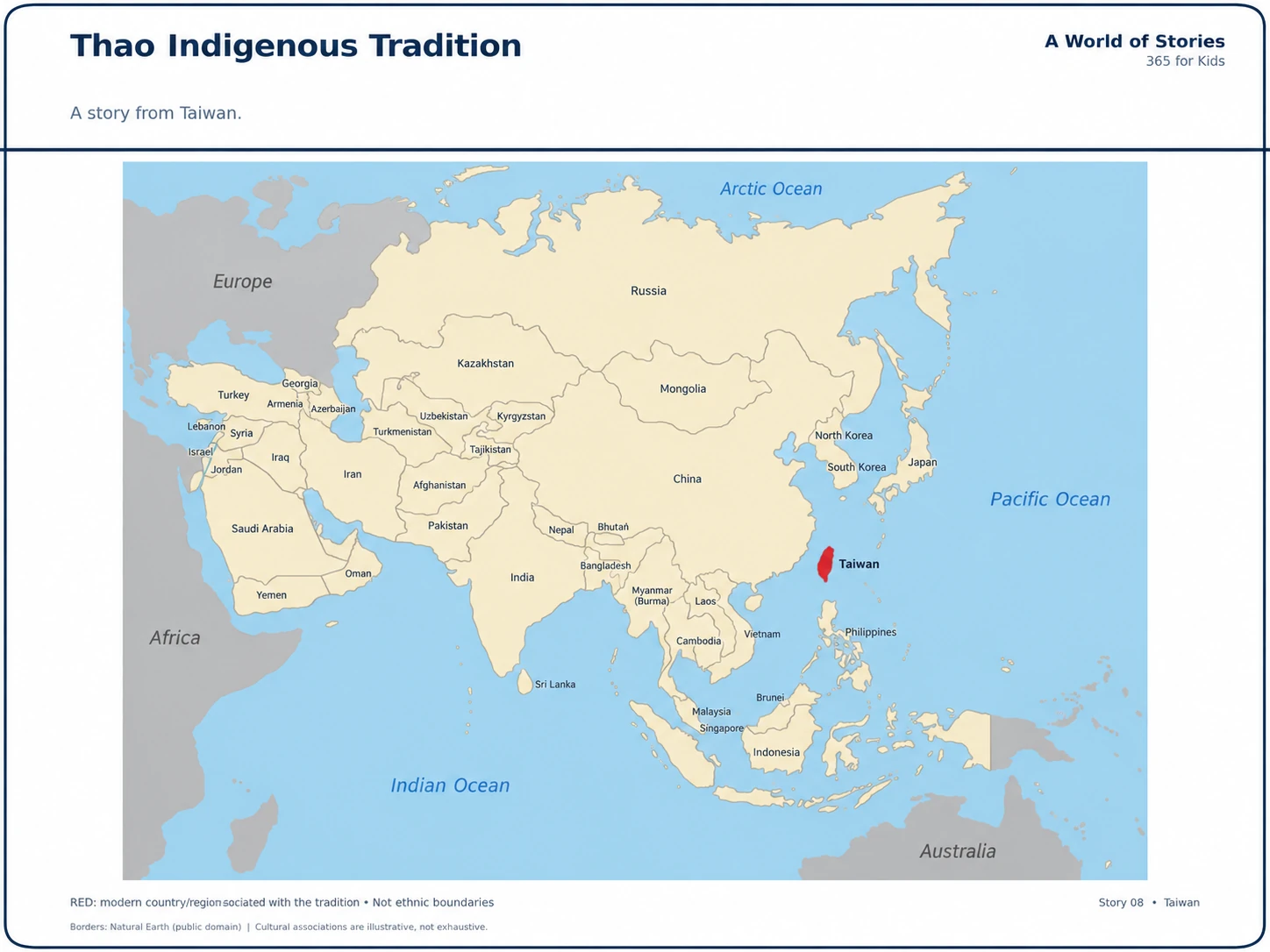
Long ago, before the ancestors of the Thao people made their home beside Sun Moon Lake, they lived in another part of Taiwan. Mountains rose between their village and the country beyond, and there were valleys and forests they had never crossed.
One day, a group of hunters went into the mountains in search of game. They followed the paths that ran beneath the trees, looking carefully through the leaves and listening for movement in the undergrowth.
Then they saw something extraordinary.
Ahead of them stood a deer as white as a cloud. Its pale coat shone against the deep green forest. The hunters had seen deer before, but none like this one. It was rare, beautiful, and impossible to overlook.
The moment they approached, the white deer turned and bounded away. The hunters hurried after it. But the animal was swift, and every time they drew close, it went farther into the mountains.
They followed it over ridges and through valleys. Sometimes the path climbed steeply; sometimes it wound beneath dark branches. Their journey carried them farther and farther from the place they knew. Still the white deer ran ahead, and still the hunters followed.
The days passed. The men grew weary, and the mountain trails were not always easy to recognize. They knew that even if they caught the deer, they would have to find their way back through all the country they had crossed. So they took care to leave signs behind them. With their hunting knives they made marks on the bark of trees. Along the route they tied small bundles of grass, so that the way home would not be lost.
At last, after a long pursuit, they reached a height known as Puzi. The white deer was still ahead of them. But beyond the hill, where they had expected only more mountains, the land suddenly opened.
Below them lay a vast lake, surrounded by wooded slopes. Its water held the colors of the sky, and the hills stood all around it. The hunters stopped in astonishment. They had traveled for so many days through the mountains, yet they had never imagined such a place was hidden among them.
The white deer raced down toward the shore. Before the hunters could reach it, the animal sprang into the lake and vanished from sight.
For a while the hunters watched the water. Then they looked about them. They could see fish in the lake, and the surrounding land was rich and green. Here were water and fertile ground. Here was a place where people might hunt, fish, and grow food. The journey that had seemed only a chase had brought them somewhere remarkable.
That night, as the hunters rested, an elder among them had a dream.
In the dream a beautiful woman appeared, dressed entirely in white. She revealed that she was the white deer they had followed through the mountains. She had not fled because she wished to escape them. She had led them onward so that they might discover this fruitful land and bring their people here.
When morning came, the elder told the others what he had dreamed. Now the long journey took on a different meaning. They had set out in search of an animal, but the white deer had shown them a place that could become their home.
The hunters agreed to return for their families. They followed the marks on the trees and the bundles of grass they had left along the trail. Because they had remembered to mark their route, they could find their way back through the forests and across the ridges.
At their village, they told their people about the lake among the mountains: the clear water, the fish, and the fertile land. Then families prepared to travel. Together they made the long journey by the same mountain route the hunters had followed.
They came to the lakeside and settled there. The water and the surrounding land became part of their lives, and the place became an ancestral home of the Thao people.
The lake was known in the Thao language by names remembered in the old telling, including Zintun. Today it is widely called Sun Moon Lake.
And the story of how the people came there was told again and again: a white deer appeared in the forest; the hunters followed it across the mountains; and what seemed at first to be a pursuit became the discovery of a new home.
That is why the white deer remains an important figure in the Thao story of Sun Moon Lake. Its journey is remembered not simply as a hunt, but as the way the ancestors were led to the waters and mountains with which their people are still connected.
The Thao (also spelled Thau) are an Indigenous people of Taiwan associated with Sun Moon Lake in Nantou County. The White Deer Chase is a Thao cultural tradition, not a legend shared by every culture on the island; it should not be treated as a verified historical account of one migration. This original English literary adaptation follows the dream version documented by the Sun Moon Lake National Scenic Area Administration. Other recorded versions differ — in one, the hunters catch the deer in the lake and discover its plentiful fish; these variants are not blended into this adaptation. The place-names “Puzi” and “Zintun” are spelled as in the chosen published version.
After the Story: Read · Create · Reflect · Share
1. Find Taiwan on a map of East Asia. Look for Sun Moon Lake in Nantou County. Draw Taiwan’s flag and locate the island’s central mountain region.
2. Why did the hunters follow the white deer? What did they do along the journey so that they could find the way back?
3. What did the hunters discover when the deer leapt into the lake? What did the woman in white explain in the elder’s dream?
4. The Thao people tell this legend as a story about finding an ancestral home. How can a landscape, a place-name, or a traditional story help a community remember its past?
Inspired by this story? Create your illustration!
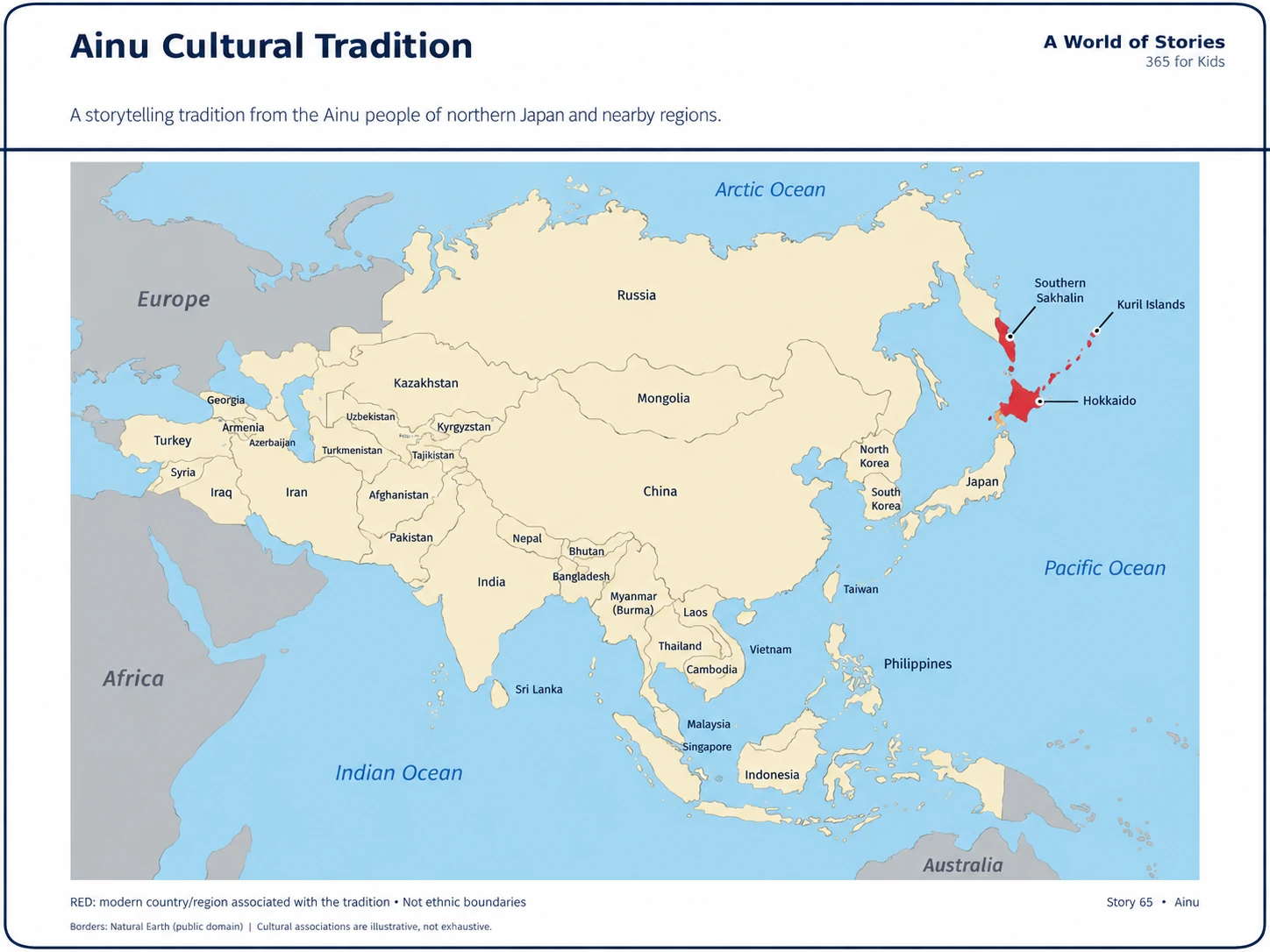
AINU — The Owl God and the Kind Boy
I am the Owl, guardian of the village. In the old song, I tell what I saw when I flew above a river and watched the lives of the people below.
The village had changed. Families who once possessed much had become poor, while others who had once struggled now lived in fine houses. I saw the difference in their clothing and in the way their children treated one another. From high above, nothing was hidden from my eyes.
Near the river, a group of boys were practicing with little bows and arrows. Some carried shining bows and richly made arrows. They looked up when they noticed me passing over their heads and decided to test their skill against the bird in the sky.
One after another, the boys released their arrows. I turned through the air and let every fine arrow pass. They tried again, certain that their costly weapons ought to be the best. Their arrows passed without touching me.
Among them stood a boy whose bow was simple and whose arrows were plain. His clothes showed that his family had little money. Yet I could see dignity and steadiness in the way he held himself. He wished to try, just as the others had tried.
The wealthier children laughed at him. If even their costly arrows could not reach the bird, they said, what hope could there be for a boy carrying such a poor bow? Their mockery became rough treatment. But the boy stayed with his purpose and prepared his arrow.
Looking down, I felt compassion for him. He had been given no kindness by the others, and still he had not turned away from the challenge. So I circled slowly, waiting until he was ready.
He planted his feet firmly, drew the string, and released his little arrow. I chose to receive it. Then I swept down from the sky and fell to the ground where the children were watching.
At once they ran toward me. The boy with the plain bow reached me first and held me close. The others, angry that he had succeeded, pushed at him and tried to take me. He shielded me from them and ran away, carrying me safely to his home.
It was a very small house. He brought me inside with care and told the elderly man and woman there what had happened. Their clothing was poor, yet the welcome they offered was full of respect. They understood that an owl could be more than an ordinary bird: I was a kamuy, a spirit-being whose visit must be received with honor.
The old man bowed to me. He explained that the family had once known better days but had fallen into hardship. They could not offer magnificent gifts, he said, yet they would shelter me for the night and prepare what they could for a proper farewell.
The old woman made a place for me near the honored part of the room. After the family fell asleep, my spirit rose while my bird-body remained where they had laid it. I moved about the quiet house, unseen by the sleeping people.
As I passed from one side of the room to the other, the dimness seemed to brighten. Precious things appeared where there had been little before. The small dwelling grew rich with treasures and fine furnishings. What had been a humble home became a splendid one. Then I returned to my resting place.
I let the family understand the reason through a dream. I had seen the cruelty shown to their child. I had also seen his courage and the respect with which the household had welcomed a visitor. My gift was not a reward for a fine bow or a rich house. It answered the kindness of people who had little to give.
When morning arrived, the family opened their eyes and scarcely recognized their home. They looked at the beautiful things around them and understood that the owl’s visit had changed their fortunes. The old man bowed with gratitude; the old woman wept with wonder.
They did not forget their promise. The old man prepared carefully carved inau, sacred wooden offerings used in Ainu ceremonies. The family also made ready a feast so that I could be honored in the way their traditions required.
When everything was prepared, they invited the people of the village. The boy went out to carry the invitations wearing his old clothes. Some neighbors remembered the family’s poverty and expected to find nothing worthy of a feast. They came prepared to make fun of the invitation.
But when the visitors saw the transformed house, their laughter stopped. The family welcomed them inside instead of turning them away. The old man spoke of their hardships and of the gift they had received. He asked the neighbors to leave their old quarrels behind and live as friends.
The visitors were ashamed of their unkindness. They apologized, and the gathering became a true celebration. People who had looked down on one another sat together, shared food, and made peace. I was glad to see that the gift had brought more than possessions: it had brought the village closer together.
After the ceremonies and celebration, I returned to the realm of the kamuy. There, I received the offerings that the people had sent and told the other spirits what had happened in the village by the river.
The boy grew older, and his family continued to remember me with gratitude. The village remained at peace, and I continued to watch over the people. That is the tale I, the Owl, have sung: of a modest arrow, a respectful welcome, and a kindness whose effects reached far beyond one little house.
The Ainu are an Indigenous people of northeastern Asia, with historical homelands including Hokkaido, Sakhalin, and the Kuril Islands; these lands now lie within Japan and Russia. This particular song was preserved in a Hokkaido Ainu tradition, not as a generic Japanese or Russian national fairy tale. A kamuy is a powerful spirit-being; a kamuy yukar is a traditional narrative song told in the voice of such a being — here the Owl speaks in the first person. The ceremony of making and giving inau (carved wooden offerings) is an important element of the original account. The Ainu scholar Chiri Yukie (1903–1922) wrote down thirteen such chants in the Ainu language with Japanese translations; her collection, Ainu Shin’yōshū, was published in 1923, and the Owl’s song is its opening piece. This is an original prose retelling based on the traditional narrative sequence, not a line-by-line translation of Chiri Yukie’s song or of any modern English translation. It uses a first-person narrator to retain the distinctive voice of a kamuy yukar and omits the repeated sung refrain. No new characters, quests, or plot events have been introduced.
After the Story: Read · Create · Reflect · Share
1. Find Hokkaido (Japan), Sakhalin, and the Kuril Islands on a map of Asia. Locate Japan and Russia, and draw the flag of Japan, where this version of the song was recorded.
2. Why did the Owl choose to receive the poor boy’s arrow rather than the expensive arrows of the other children?
3. How did the boy and the elderly couple treat the Owl? What mattered more in the tale than money or fine possessions?
4. Why did the family invite their neighbors after their fortunes changed? How did the ending show that friendship was as important as treasure?
Inspired by this story? Create your illustration!
GESAR — Gesar and the Horse Race for the Throne of Ling
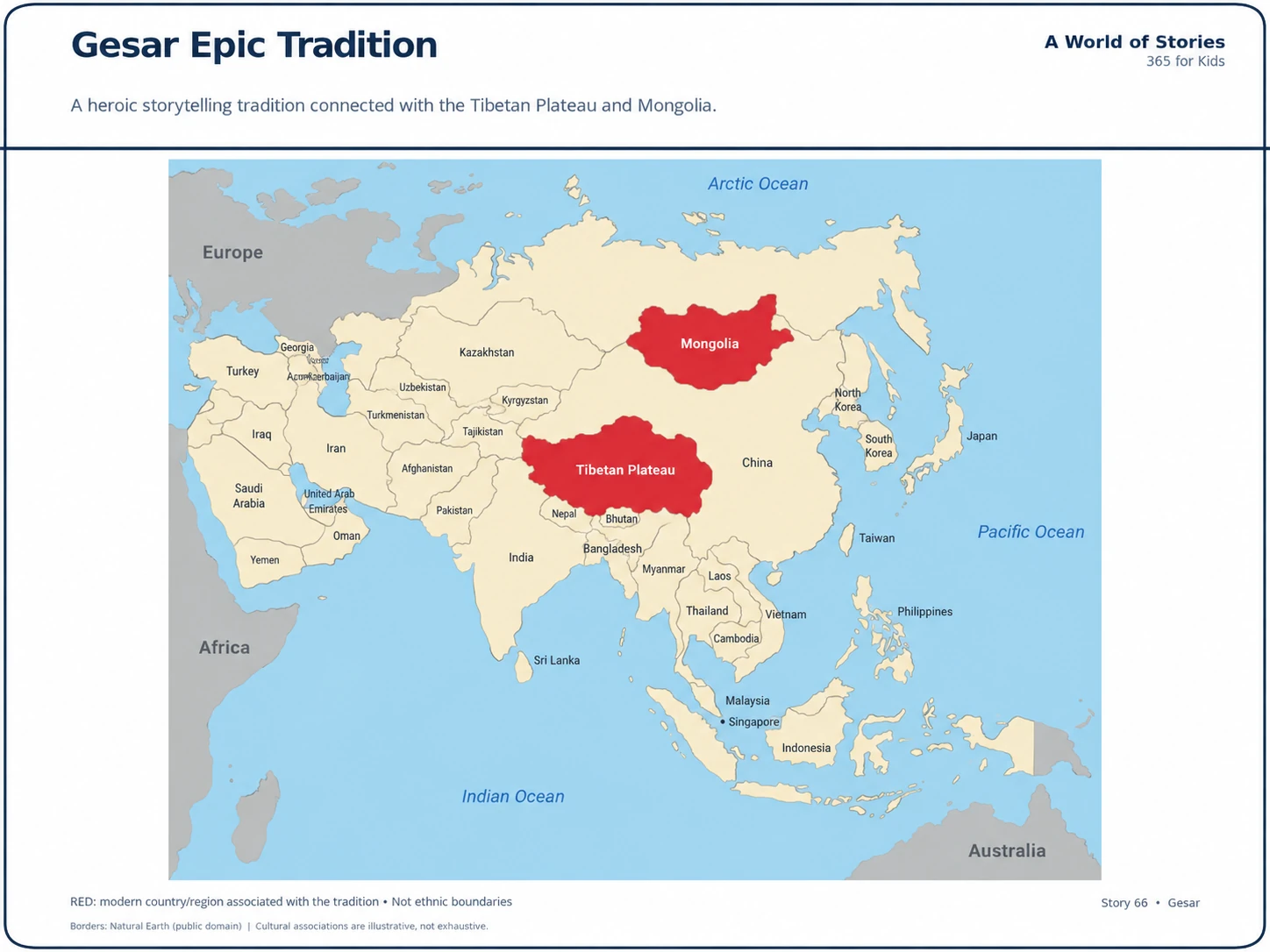
Long ago, the people of Ling needed a ruler who would protect them. Their world was troubled by powerful enemies, and the weak had few defenders. In the old epic, the heavenly beings heard the people’s suffering and sent a remarkable child into the human world.
The child was called Joru. He was destined for greatness, but hardly anyone who looked at him could imagine a splendid king. He behaved strangely, dressed poorly, and did not resemble the noble warriors whose names were spoken with admiration.
Among the powerful men of Ling was his uncle Khrothung. The uncle feared that Joru would one day take the throne he wanted for himself. His attempts to destroy the boy failed, yet his hostility did not end. Joru and his mother were driven away from Ling and made to live far from the people who should have been their own.
In exile, Joru grew up without the honors that belong to a prince. His clothes were rough, and his home was far from the great gathering places of Ling. Those who judged people by their appearance had little reason to think of him as a future king. But the old songs tell us that Joru’s true nature was hidden, not absent.
A guardian deity watched over him. Her name was Nene Namen Karmo, and she was like a heavenly aunt to the young hero. When the right moment arrived, she brought him a message: the time had come to leave exile, return to Ling, and claim the place that awaited him.
Yet the throne could not simply be taken. Khrothung was powerful, proud, and unwilling to surrender his hopes. Nene Namen Karmo instructed Joru to use his unusual abilities and persuade his uncle to arrange a horse race.
So Joru took the form of a crow and approached Khrothung with what appeared to be a message from a divine power. The message called for a great race among the riders of Ling. Khrothung heard what he most wished to hear: that the victory, and with it the kingdom, would surely be his.
His uncle did not know that the strange visitor was the very nephew he had tried to keep away. Believing the race would bring him the crown, Khrothung agreed to hold it.
A great reward was set before the competitors. The fastest rider would rule Ling and marry Drukmo, the daughter of a noble family. Drukmo’s name was already celebrated in the stories of the land. This was no ordinary contest of speed: the future of the kingdom rested upon its outcome.
The horse race drew the warriors and noble riders of Ling. Strong horses and experienced riders seemed certain to lead. Everyone could understand why the most powerful men expected to win. Everyone, that is, except the young exile whose coming would change the story.
Joru returned wearing the appearance that had so often invited contempt. Beside the fine horses of the nobles, his own steed seemed unimpressive. In some tellings the horse is known as Kyang Go Karkar. Neither rider nor horse revealed at first the marvelous strength they possessed.
Those who looked only at fine clothing and proud bearing might have passed the pair without a second glance. Yet the hero had not come to be admired before the race. He had come to ride it.
When the contest began, the riders of Ling urged their horses forward. Hooves beat against the ground. The great company swept across the racecourse, each rider determined to reach the goal before the rest.
Joru did not at once appear to be the champion people expected. In some versions he seems to hold back until his divine protector reminds him of his purpose. The horse that looked so ordinary had not yet shown its power.
Then Joru rode in earnest. He and his steed moved with a speed that ordinary riders could scarcely match. The horses ahead of him could not hold their places. One after another, the proud competitors were left behind.
The miracle was not only that Joru rode faster than the others. It was that the child whom many had dismissed was showing who he truly was. His strength had been present even while he lived in exile, concealed beneath the very appearance that made others doubt him.
At the finish, Joru was the winner. The race had been proclaimed before all of Ling; its reward could not now be given to someone else merely because he had seemed the least likely champion.
His poor appearance fell away, and his splendid identity was revealed. The young outsider stood before the people as Gesar, the destined ruler of Ling. The horse too showed its extraordinary nature. Those who had seen only a ragged youth and an unremarkable mount now saw a hero and his remarkable steed.
Khrothung had expected the contest to secure his own power. Instead, the plan he had embraced had opened the way for his nephew’s return. He had helped arrange the very race that took the throne beyond his reach.
Gesar became king, and according to the traditional episode he married Drukmo. The youth who had grown up far from Ling was now recognized as the leader of the people from whom he had once been separated.
But the horse race was only a beginning. In the countless songs that follow, King Gesar confronts terrifying enemies, overthrows cruel powers, and comes to the aid of those who cannot protect themselves. His adventures stretch far beyond one valley or one kingdom.
The tale of the race has also traveled. In different places, storytellers sing different details, use different spellings, and sometimes arrange the events in different ways. Still, the heart of this famous episode remains: a boy whom others underestimate returns, wins the race, and becomes King Gesar of Ling.
And when the story is sung again, the old question returns with it: how much can we really know about a person from the way that person first appears?
The Epic of King Gesar (also spelled Kesar) is a vast living oral tradition associated especially with Tibetan communities and also preserved among Mongolian and Tu communities; the stories do not belong exclusively to the boundaries of any single modern country. This adaptation follows the widely known Tibetan “Horse Race” episode. Names, ages, horses, magical details, and the order of events vary among oral and written tellings. The race’s marriage reward reflects the conventions of the traditional epic, not a model for choosing a marriage today. The Gesar epic is still recited and sung by storytellers, sometimes with music, gestures, and ritual practices; UNESCO inscribed the Gesar epic tradition on the Representative List of the Intangible Cultural Heritage of Humanity in 2009. This episode is only one small part of the much larger cycle. This is an original English prose retelling of a documented episode, not a translation of one complete performance or a combination of newly invented adventures.
After the Story: Read · Create · Reflect · Share
1. Find the Tibetan Plateau and Mongolia on a map of Asia. Locate China and Mongolia, two modern countries in which Gesar traditions are preserved. Draw the flag of one of them.
2. Why did Khrothung agree to organize the horse race? What did he expect would happen?
3. What changed when Joru won the race? Why had many people failed to recognize his abilities earlier?
4. The story is told in more than one country and in different versions. What does this show us about how stories can travel across borders?
Inspired by this story? Create your illustration!
Southeast Asia
BRUNEI — Nakhoda Manis and Jong Batu
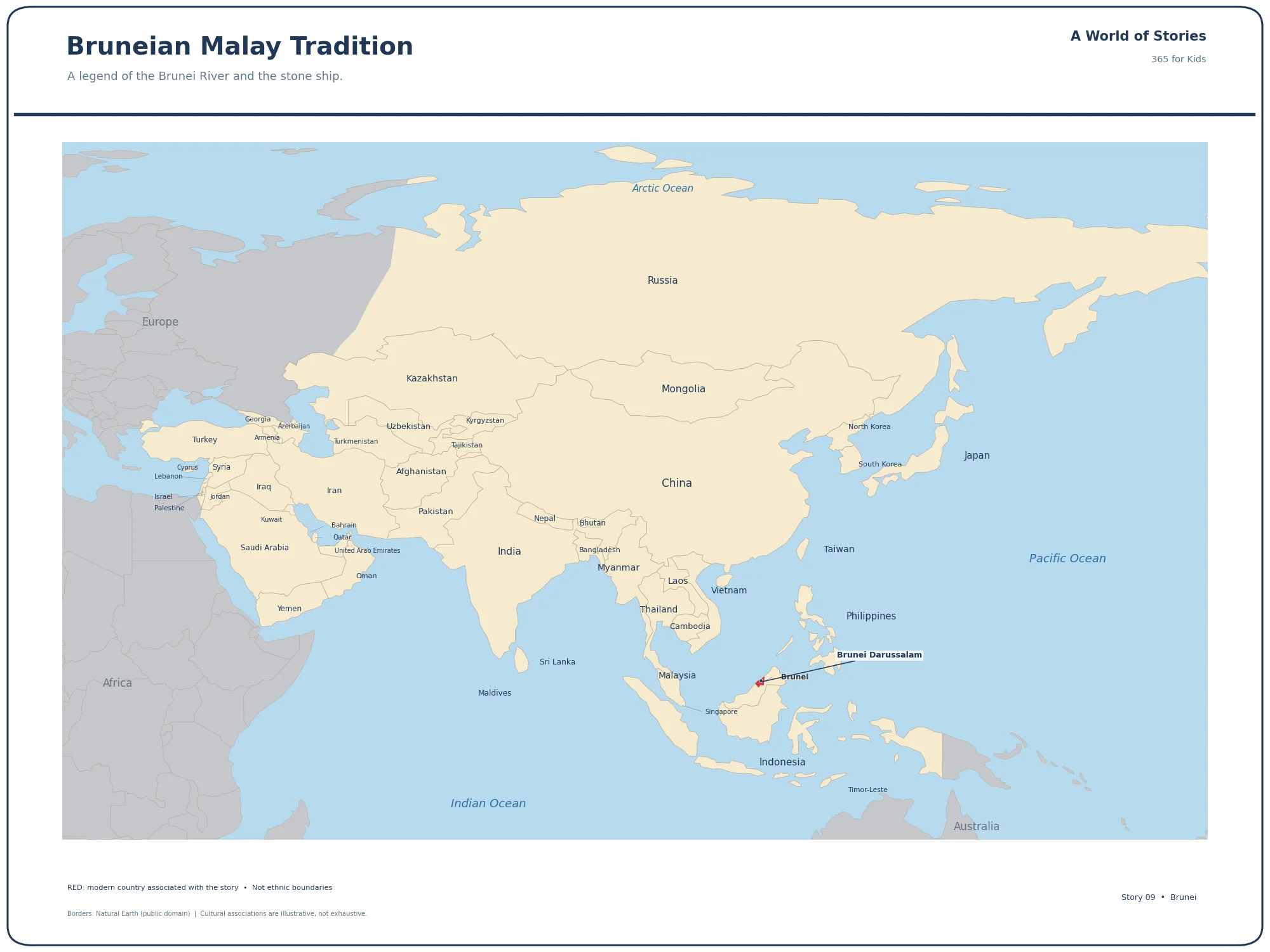
Long ago, on the banks of the Brunei River, where houses stood above the water and boats carried people from one shore to another, there lived a young man named Manis. His mother, Dang Ambun, was a widow. Manis’s father had died when the boy was very young, leaving behind a fine house, shops, and ships. Dang Ambun had plenty to live on, but of all her treasures, none was dearer to her than her only son.
She raised Manis with care. As he grew, she imagined the comfortable life that lay before him. One day, she thought, he would inherit the family’s wealth, make a home of his own, and live near the river where he had grown up. She hoped he would never need to know the hardship that came with journeys into the unknown.
But Manis had listened to sailors telling stories of distant shores. Their accounts of strange harbours and lands beyond the horizon had awakened in him a wish that no fine house or full storehouse could satisfy. He wanted to travel, to learn, and to see the world beyond Brunei.
At last he told his mother that he intended to leave with other young men who knew the sea. Dang Ambun begged him to reconsider. She reminded him that he had everything he needed at home. Yet Manis would not change his mind. He promised that he would remember her and that his absence would not be long.
The day of departure came. Manis took leave of his mother and boarded a sailing ship with his companions. Dang Ambun watched the vessel move down the river and out toward the open sea. She had agreed to let him go, but her heart remained troubled. She prayed that he would be kept safe until he returned.
The first days passed, then the months, and then the years. No message came to tell Dang Ambun where Manis had gone. Still she continued to pray for him. According to the old tale, she arranged prayers and thanksgiving gatherings at the mosques, asking that her son be protected wherever he sailed.
To pay for them, she began selling her possessions. A shop was sold, and then another. Ships that had once belonged to the family passed into other hands. Dang Ambun grew older and weaker, but she did not stop asking for her son’s safe return. At last, the wealth that had once surrounded her was gone. The woman who had lived in comfort now depended upon the kindness of relatives for food.
Time changed the son as well as the mother. Far from Brunei, Manis had become a prosperous seafarer and the master of a great ship. He was now called Nakhoda Manis — Captain Manis. He had married, and the life he led seemed very different from the one he had left behind. Nearly twenty years had passed since his departure.
One day, an extraordinary vessel entered the Brunei River. Its size and beauty drew the attention of people along the water. As Dang Ambun heard the crowd talking, she caught a name that made her forget her weariness: Nakhoda Manis. The ship belonged to her son. After all those years, he had come home.
She could scarcely believe it. With the strength that joy gave her, she climbed into her small boat and paddled toward the magnificent ship. From below its high sides she called to him. “Manis! My son! It is your mother. I have waited so long to see you.”
On board, the captain heard a familiar voice. For a moment he recognized it and felt the excitement of reunion. Then he looked down. The woman in the little boat was old and thin. Her clothes were worn and patched. She did not resemble the wealthy mother he had described to his wife.
Instead of welcoming her, Nakhoda Manis was ashamed. He could not bear the thought of his wife seeing that his mother had become poor. When Dang Ambun called again and asked to be allowed aboard, he told his crew to push her boat away.
Dang Ambun tried to make him understand. She told him that she was indeed his mother, that she had spent her wealth praying for him, and that she had longed for this day. But Manis refused to acknowledge her. The sailors obeyed their captain’s command, and her little boat was forced away from the ship.
It was a terrible meeting: the mother who had waited for years was sent away by the son whose return she had prayed for. Slowly, Dang Ambun brought her boat back toward the riverbank. She could still see the great ship standing in the water. Her son was so close, yet he had turned away from her.
Heartbroken, she spoke of what Manis had done. She had given up so much in the hope of seeing him safely home, but now he would not even call her his mother. In the telling of the legend, her grief became a prayer that he should face the consequences of his ingratitude.
Then the sky darkened. A violent storm rose over the river, and the water heaved beneath the ship. Wind tore across the decks. Rain fell, thunder sounded, and the great vessel was thrown about by the waves.
Only now did Nakhoda Manis understand what he had done. He called out to Dang Ambun, admitting that she was his mother and begging for her help. But the storm was already upon him. The splendid ship could not escape it.
When the wind finally died and the river grew quiet, the ship was gone. In its place stood a great rock, shaped like a vessel that had become still forever. In the legend, the captain, his wife, and the crew had all been turned to stone. The rock was called Jong Batu — the Stone Ship.
People in Brunei still tell the story when they speak of the rock in the Brunei River. It is a tale of a son who returned with wealth but had forgotten the love that had sustained him. And it asks a question that outlives the storm: what is the worth of success if it teaches us to be ashamed of those who cared for us?
Cultural & Editorial Note: Country and tradition. Brunei Darussalam is a country in Southeast Asia, on the island of Borneo. Nakhoda Manis is a Bruneian Malay legend associated with a real rock formation in the Brunei River. In Malay, nakhoda means a ship’s captain; Jong Batu is commonly understood as “Stone Ship.” The legend is a traditional explanation of the rock, not a verified historical account of a ship becoming stone.
Variant selected. This adaptation follows the version presented by Brunei’s Ministry of Culture, Youth and Sports (2020): Dang Ambun begins as a wealthy widow, gradually loses her possessions while arranging prayers for her absent son, and is rejected when he returns as a successful captain. Other retellings begin with a poor mother or differ in smaller details. Her name is also spelled Dang Ambon in some sources. The fundamental sequence and tragic ending have been retained; dialogue and descriptive transitions are newly written for this educational adaptation.
Shared motif. Related stories about a prosperous son who rejects his mother are found elsewhere in the Malay-speaking world, notably Si Tanggang (Malaysia) and Malin Kundang (Indonesia). They share a theme but are distinct local traditions; this text is specifically the Bruneian Nakhoda Manis legend.
After the Story: Read · Create · Reflect · Share
1. Find Brunei Darussalam on a map of Southeast Asia. Which large island is it on?
2. Draw the national flag of Brunei. What colours and symbols can you identify?
3. Why did Dang Ambun lose the wealth she once had? Why did Manis refuse to recognize her when he returned?
4. What does the legend say about Jong Batu? How might the reunion have been different if Manis had welcomed his mother?
Inspired by this story? Create your illustration!
CAMBODIA — Judge Rabbit and the Tree Spirit
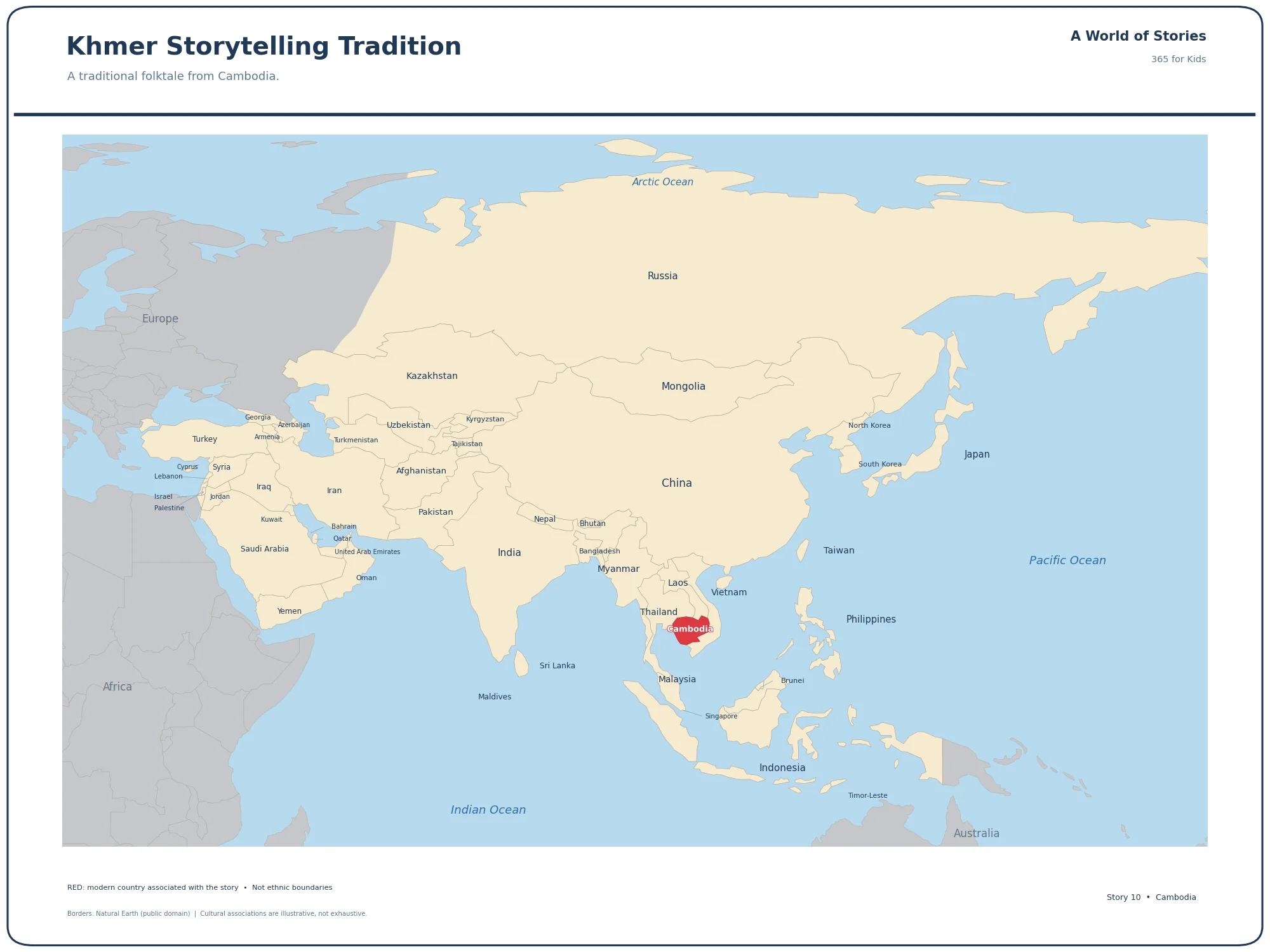
Long ago, in a village in Cambodia, a young husband and wife lived together in peace. Their home was a simple one, but they were content. They had begun to build a life side by side, and neither imagined how soon they would be parted.
Then a summons came from the king. Men were needed to defend the country, and the young husband was required to join them. He prepared to leave, though his heart was heavy at the thought of going away from his wife.
When the moment of parting arrived, he set out along the road. Yet he had not travelled far before he turned and looked back. He thought of the home he was leaving and the woman who would be waiting there. He turned back toward his house more than once, until at last he gathered his courage and continued on his way.
Beside the road stood a great banyan tree. Within it lived a spirit who had watched the husband’s sorrowful departure. The spirit wondered what drew this young man so powerfully toward the home he had left behind. Curious, it followed the path through the village and discovered the young wife waiting alone.
At once the spirit understood that the husband had found something precious. But instead of respecting the couple’s bond, it decided to claim the husband’s place. A tree spirit could take on another shape, and this one made itself look exactly like the absent man.
The false husband appeared at the door. He looked so familiar that the woman had no reason to suspect a stranger stood before her. He told her that he had returned. Grateful that the separation seemed to be over, she welcomed him inside.
Days passed, then many more. The tree spirit remained in the house, pretending to be the man who had gone away. The woman believed she was living with her husband. She did not know that the real man was still serving far from home.
At last the fighting ended, and the true husband came back to the village. He had thought of his wife throughout his absence. Now, after his long journey, he went straight to the home they shared.
But when he entered, he saw a man who had his own face. The stranger stood as though he belonged there. His wife looked from one to the other in astonishment: two men, alike in appearance, each insisting that he was her husband.
The real husband declared that he had been away in the king’s service and had only just returned. The spirit denied the accusation and continued to claim the household as its own. The woman could not tell them apart by sight, and the argument brought her no closer to the truth.
What was she to do? If the two men had the same face and voice, how could anyone decide which one was human and which one was not? Their dispute needed a judge wiser than appearances.
And in Cambodian stories there is a judge known for solving the knottiest problems. He is not a powerful king or a mighty warrior. He is a rabbit: small, watchful, and wonderfully quick of mind.
The troubled husband sought out Judge Rabbit and explained what had happened. The rabbit listened. A creature capable of borrowing a human face, he reasoned, must have powers that an ordinary man did not possess. Perhaps those very powers would reveal the impostor.
Judge Rabbit agreed to hear the case. When the two claimants stood before him, he studied them carefully. Their faces offered him no clue. Nor could he settle the matter by asking them to repeat their claims: each could say the same thing.
Instead, the rabbit produced a little bottle. He placed it where both men could see it and announced a test. The man who could enter the bottle, he said, would prove himself the rightful husband.
The real husband stared. He was a grown man. No matter how hard he tried, he could never fit inside so small a vessel. For a moment he could not understand why the judge had chosen such an impossible test.
But the tree spirit heard something different. It thought of its secret ability to change shape. Here was an easy way, it believed, to defeat its rival before everyone. Without considering why a clever judge might ask such a question, the spirit made itself tiny and slipped into the bottle.
That was exactly what Judge Rabbit had hoped it would do. He closed the bottle at once, trapping the shape-changing intruder inside. Then he turned to the couple and told them what the test had revealed.
An ordinary man could not shrink himself and enter a bottle. Only a spirit could perform such a feat. The one who had rushed to prove his claim had instead given himself away.
The wife now knew which man had truly returned from the king’s service. The false husband could no longer deceive her. Freed from the spirit’s pretence, the couple were reunited, and their long confusion came to an end.
As for Judge Rabbit, he had settled the dispute without a contest of strength. The spirit possessed unusual powers, yet those powers were no match for a thoughtful question and a little patience. That is why, when people tell tales of the wise rabbit of Cambodia, they remember not his size but the sharpness of his mind.
Cultural and Editorial Note: Judge Rabbit (also called Judge Hare in English-language collections) is a recurring clever figure in Khmer oral storytelling. The tale is linked to Cambodia and belongs to a larger tradition of narratives in which the rabbit settles disputes by reasoning rather than force.
This is an independently written English literary adaptation of the traditional plot, not a translation or reproduction of Lina Mao Wall and Cathy Spagnoli’s 1991 bilingual picture book. The core events retained here are the husband’s departure for the king’s service, the spirit’s impersonation, the return of the real husband, the dispute, the small-bottle test, and the couple’s reunion. Details and emphasis vary across tellings.
The story involves deception within a marriage, but it is told here without graphic or inappropriate detail. Readers may discuss why appearances alone are not always reliable and why the judge’s test works.
After the Story: Read · Create · Reflect · Share
1. Find Cambodia on a map of Southeast Asia and look at its national flag. Which countries share a border with Cambodia?
2. Why did the tree spirit take the husband’s appearance? How did this choice affect the young couple?
3. What did Judge Rabbit ask the two men to do, and why did that test reveal the truth?
4. Judge Rabbit did not defeat the spirit with strength. What does this story suggest about observation, patience, and clever thinking?
Inspired by this story? Create your illustration!
INDONESIA — Malin Kundang — The Ungrateful Son
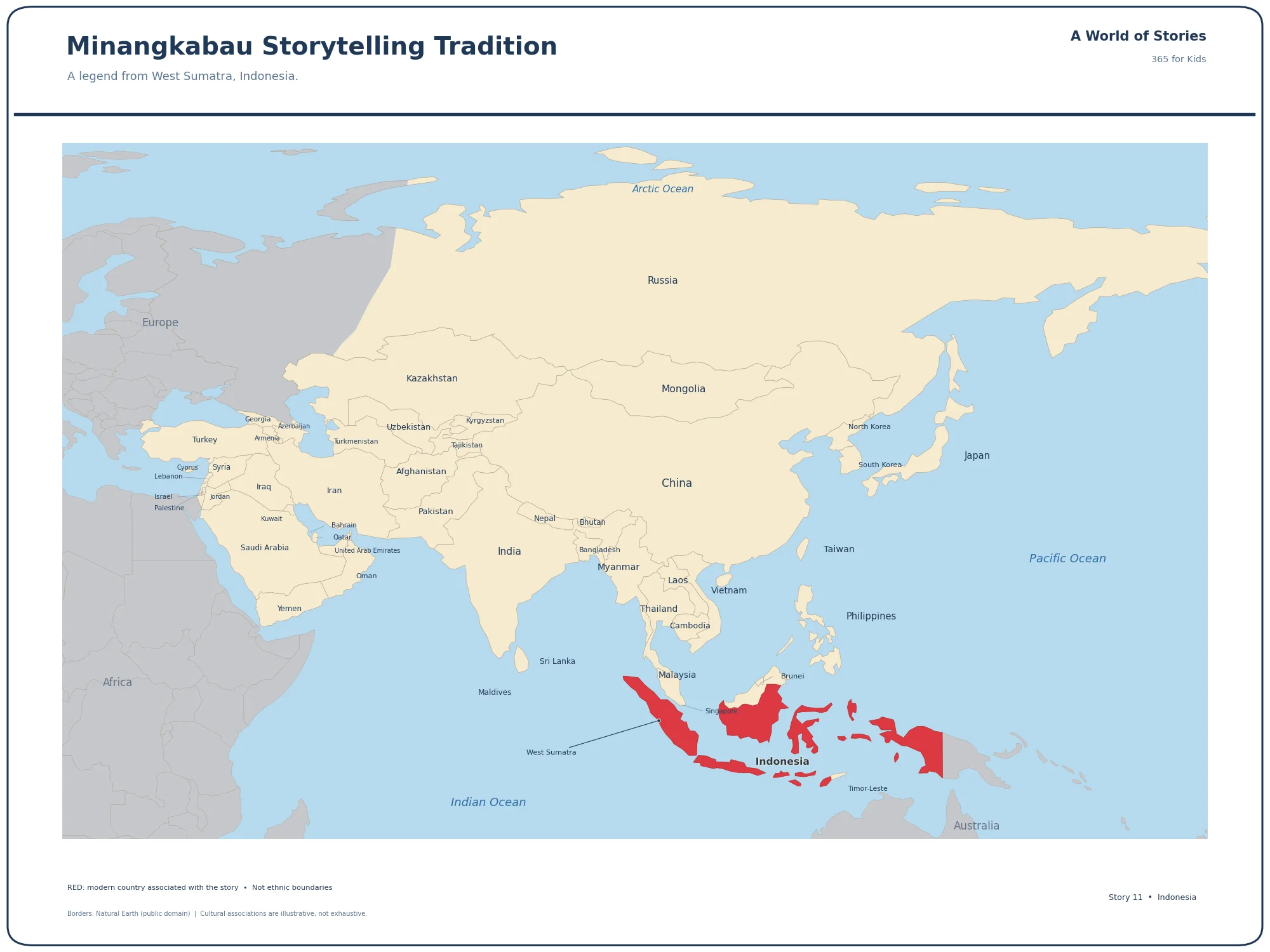
Long ago, on the western coast of Sumatra, there lived a woman named Mande Rubayah and her only son, Malin Kundang. Their home stood not far from the sea, where fishing boats came and went and larger trading ships sometimes appeared beyond the waves.
Mande Rubayah had little money. She worked hard to keep food on the table and to care for her child, and Malin grew up knowing how much she did for him. He saw the long hours she worked and the tiredness she tried to hide. Yet she never stopped hoping that he would have a better life.
As the years passed, Malin became a young man. He listened to tales of merchants who travelled across the sea and returned with fine goods and great fortunes. At last he decided that he, too, must seek his future away from the village.
One day a trading ship came to the shore. Malin asked his mother for permission to sail with it. The thought of his departure filled her with fear. The sea could carry a traveller toward opportunity, but it could also carry him far beyond the reach of those waiting at home.
‘Must you go so far?’ she asked. ‘We have little, but we have each other.’
Malin told her that he wanted to earn enough to lift them out of poverty. He promised that when he was successful he would return. At length Mande Rubayah gave her consent, though her heart was heavy. She watched the ship leave the shore until it became a small shape on the horizon and disappeared.
Far from home, Malin worked among traders. He learned the ways of buying and selling, travelled between ports, and gradually made his fortune. In time he became a prosperous merchant, with a fine ship and people who served aboard it. He married the daughter of a wealthy merchant, and his life was surrounded by comforts he had once only imagined.
But as his wealth grew, so did his pride. He began to think less and less about the poor village where he had been raised. The woman who had cared for him through his childhood no longer seemed to belong to the grand life he had built for himself.
In West Sumatra, meanwhile, Mande Rubayah waited. Season followed season. She watched the ships arriving at the coast and listened for news of her son. Whenever a sail appeared offshore, hope stirred in her heart. Yet Malin did not come home.
Many years passed before a magnificent ship anchored near the village of Air Manis. Its appearance drew attention along the shore. The vessel was far grander than the boats the villagers usually saw, and word spread that a rich merchant and his wife were aboard.
When Mande Rubayah heard the merchant’s name, she could scarcely believe it. Malin Kundang! Her son had returned at last.
She hurried to the beach. Age and years of labour had changed her face and worn her clothes, but nothing had dimmed her love. She looked toward the ship and saw a richly dressed man standing beside an elegantly dressed woman. She knew him at once.
‘Malin!’ she called. ‘My son! You have come home!’
The merchant turned. In the poor old woman approaching him he recognised his mother. For one brief moment there was no mistaking her. Then he noticed the eyes of those around him and the fine clothes of the wife beside him. Shame rose where joy should have been.
Mande Rubayah came closer, reaching toward the son she had dreamed of embracing for so many years. But Malin stepped away. He would not acknowledge her before his wife and the people of his ship.
‘You are mistaken,’ he said. ‘I do not know you.’
His mother stopped. She had thought of this reunion a thousand times. Never had she imagined that her child would look at her as though she were a stranger.
‘Malin,’ she pleaded, ‘I am your mother. I cared for you when you were small. I waited for you all these years.’
But Malin denied her again. He was ashamed of her poverty and refused to admit that the woman in worn clothing had raised him. He spoke as though she were a beggar who had mistaken him for someone else. In his eagerness to hide his past, he turned his back on the person who had loved him longest.
Mande Rubayah was left on the shore, overwhelmed by grief. The son for whom she had sacrificed so much had returned with wealth and honour, yet he would not give her even the simple honour of calling her his mother.
As the ship prepared to depart, she raised her hands and prayed. She called upon God to judge the man who had rejected her. If this wealthy stranger truly was her son, Malin Kundang, she asked that his terrible ingratitude should not go unanswered.
Then the sky darkened. Wind swept across the water, and waves rose against the ship. Thunder rolled above the coast. What had been a proud vessel was tossed helplessly by the storm, until it broke apart among the crashing waves.
Malin could no longer hide behind his riches. The sea that had once carried him toward his fortune now swept away all that fortune had brought him. In the traditional telling, he was struck by his mother’s curse and changed to stone, bent low as though in the act of begging forgiveness.
When the storm had passed, the people of the coast spoke of a strange stone on the beach and of broken shapes nearby that reminded them of a wrecked ship. They said these were the remains of Malin Kundang and his vessel.
And so the story was told from one generation to the next: of a boy who sailed from a humble home, of a mother who never forgot him, and of a grown man who had gained great wealth but lost sight of the love that had sustained him. On the shore of Air Manis, the legend of Malin Kundang still reminds listeners that prosperity cannot erase the past—and pride can cost far more than it gives.
Cultural and Editorial Note: Malin Kundang is a well-known legend of the Minangkabau cultural tradition in West Sumatra, Indonesia. It is particularly associated with Air Manis Beach near Padang. The mother is often named Mande Rubayah; the legend is traditionally used to reflect on family obligations, gratitude, pride, and social change.
This independent English literary adaptation follows the established narrative: Malin is raised by his mother, leaves by sea to earn a living, grows rich and marries, returns home, refuses to recognise his mother, and is turned to stone after she prays and a storm destroys his ship. Retellings differ about the father’s absence, Malin’s adventures before becoming wealthy, whether he pushes his mother, and the precise order of events. Those details have not been treated as fixed facts.
Visitors to Air Manis Beach can see a stone sculpture representing Malin and the wrecked ship. It is a modern artistic representation connected to the legend, not historical evidence that a person turned to stone. The tale is presented here as traditional storytelling, not as a factual historical event.
The ending is deliberately sorrowful because the transformation into stone is central to the traditional legend. The adaptation preserves this outcome without graphic descriptions.
After the Story: Read · Create · Reflect · Share
1. Locate Indonesia in Southeast Asia and find the island of Sumatra. Look at the Indonesian flag. What two colours does it have?
2. Why did Malin Kundang leave home? How did his feelings about his origins change after he became wealthy?
3. What happened when Mande Rubayah recognised her son on the shore? Why did his response hurt her so deeply?
4. The legend links the sea with both opportunity and danger. How does the sea shape Malin’s journey, and what do you think the story teaches about gratitude and pride?
Inspired by this story? Create your illustration!
LAOS — Xieng Mieng Follows the King Exactly
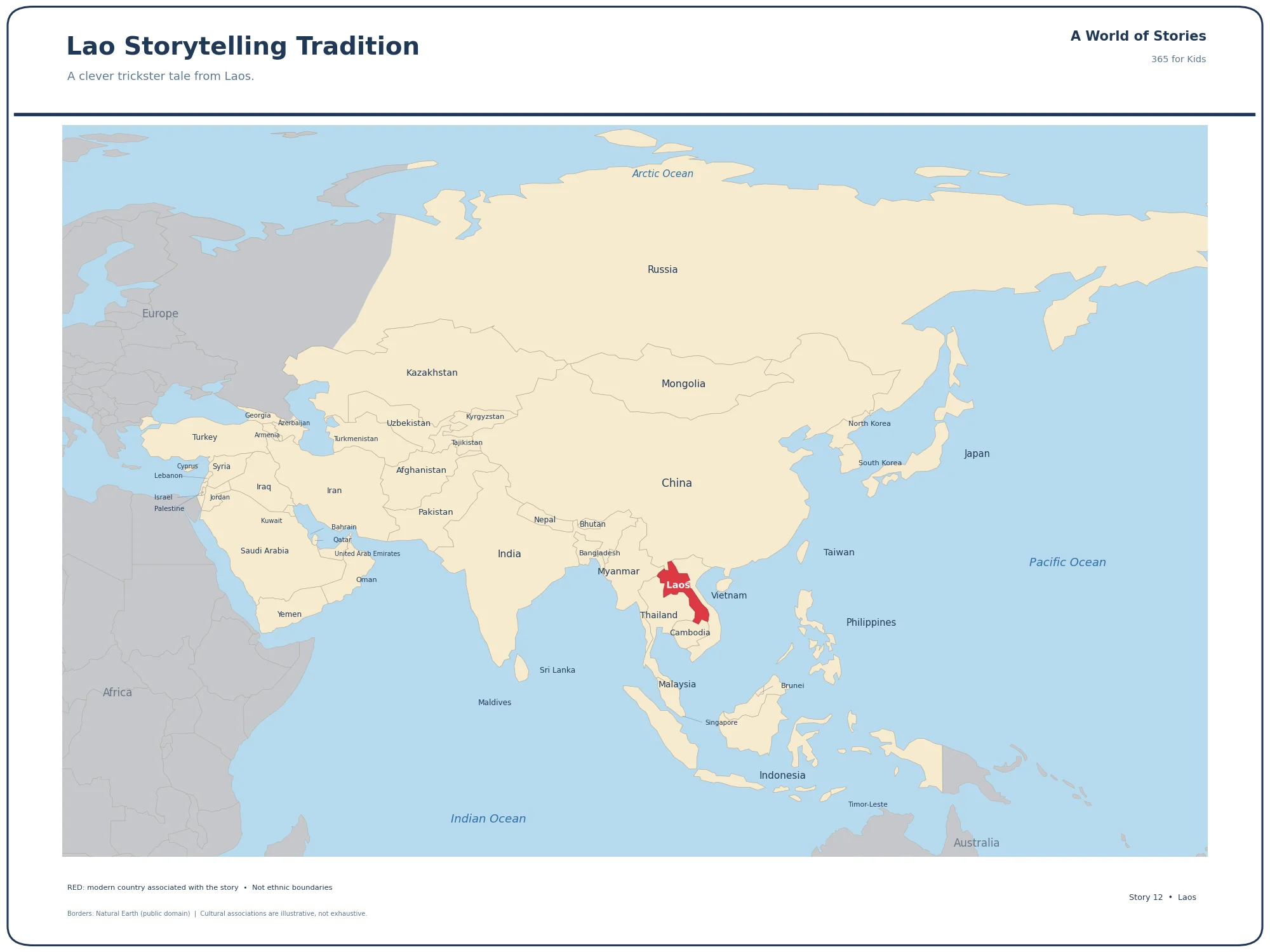
In Laos, people have long told stories about a man named Xieng Mieng. He was neither the richest man in the kingdom nor the strongest. He had a different gift: he could hear every word of an order and discover a meaning that everyone else had overlooked.
The king knew all about Xieng Mieng’s cleverness. Sometimes it amused him. At other times, especially when the joke was at his expense, it made him furious.
One day, the king prepared to attend the horse races. He would ride his fine white horse, while Xieng Mieng would go on foot. Before leaving, the king handed him a bag of betel nuts, which he liked to chew while watching the races.
‘Bring these to the races,’ the king ordered. ‘Follow me.’
Xieng Mieng accepted the bag. The king mounted his horse and rode ahead. Xieng Mieng followed—at the comfortable pace of a man who had heard nothing about hurrying.
He walked along the road. When he saw flowers, he stopped to enjoy them. When he felt tired, he rested. At last, he found a place to sleep for a while. The sun climbed higher while the king’s horse carried its rider steadily toward the racing ground.
By the time Xieng Mieng arrived, eight races had finished. The ninth and final race was about to begin.
The king had spent the day waiting for his betel nuts. He stared at the late arrival.
‘Where have you been?’ he demanded. ‘I told you to follow me!’
‘And I did, Your Majesty,’ said Xieng Mieng. He lifted the bag to show that it was still with him.
‘But you took nearly the whole day!’
‘You told me to follow you,’ Xieng Mieng answered, ‘but you did not tell me how quickly.’
The king could not deny the words. He was determined not to make the same mistake again.
The next week, another day of horse racing arrived. Once more, the king rode his white horse, and once more Xieng Mieng was to bring the betel nuts.
This time the instructions were very clear.
‘Follow me as quickly as possible,’ said the king. ‘Do not dawdle. Do not stop along the way.’
Xieng Mieng nodded. As soon as the king set off, he began to run.
He ran past the places where he had lingered the week before. He did not pause to admire the flowers. He did not sit down to rest. He kept his eyes on the road and his feet moving toward the races.
But as he hurried, betel nuts spilled from the bag onto the ground. Some rolled away from the path. Xieng Mieng saw them fall and kept running.
He reached the racing ground quickly, just as the king had wished. Yet when the king asked for his betel nuts, the bag was almost empty.
‘Where are they?’ the king cried.
‘They fell out on the way,’ replied Xieng Mieng.
‘Then why didn’t you stop to pick them up?’
‘Because you told me to follow you as quickly as possible,’ Xieng Mieng said. ‘If I had stopped, I would not have arrived so quickly.’
The king was angrier than before. First his servant had been too slow; now he had been fast and had lost the betel nuts. The king decided that his next instructions would leave no room for such answers.
On the third race day, the king gave Xieng Mieng another bag of betel nuts.
‘Listen carefully,’ he said. ‘You must follow me as quickly as possible. And if anything falls on the road, you must pick it up. Everything that drops. Do you understand?’
‘Everything that drops,’ repeated Xieng Mieng. ‘Yes, Your Majesty.’
The king rode away on his white horse, and Xieng Mieng hurried after him. This time he watched the bag and the road with great care.
The horse, of course, left something behind as it went along. Whenever droppings fell onto the road, Xieng Mieng stopped long enough to gather them up. Then he put them into the bag with the betel nuts and hurried on after the king.
At the racing ground, the king was pleased to see him arrive with a full bag.
‘At last!’ he exclaimed. ‘Give me my betel nuts.’
He reached into the bag. Instead of the treat he expected, his fingers closed around a handful of horse manure.
The king pulled back his hand in disgust. ‘What is this?’ he shouted.
Xieng Mieng looked at him calmly.
‘Your Majesty said that I should follow as quickly as possible and pick up everything that dropped. I did exactly as you told me.’
The king had given an order with no exception, and Xieng Mieng had obeyed it with no exception. That was the last answer the king had expected.
And that is why people tell this story of Xieng Mieng: a man who could turn the king’s own words into the cleverest trick of all.
Culture & Editorial Note: Xieng Mieng (also spelled Xiang Miang or Xiangmiang) is a celebrated trickster in Lao storytelling. His tales often show how a clever ordinary person can challenge someone with greater power. This episode is a humorous story about the difference between the literal words of an instruction and its intended meaning. Betel nuts (areca nuts) are associated with a traditional chewing custom found in parts of Southeast Asia.
This is an original English literary adaptation of a traditional Lao tale, not a translation or reproduction of a modern copyrighted retelling. It follows the established three-journey sequence: late arrival, lost betel nuts, and the king’s instruction to collect everything that falls. Dialogue and description are newly composed to make the traditional action readable; they should not be treated as a verbatim historical telling.
After the Story: Read · Create · Reflect · Share
1. Find Laos on a map of Southeast Asia. Which countries share a border with it? Draw the flag of Laos.
2. What did the king ask Xieng Mieng to do on each of the three journeys? How did his instructions change?
3. Why did Xieng Mieng put horse droppings into the bag? Which words of the king made his answer possible?
4. Does following an instruction word for word always mean understanding what the speaker intends? Explain your answer.
Inspired by this story? Create your illustration!
MALAYSIA — The Legend of Mahsuri
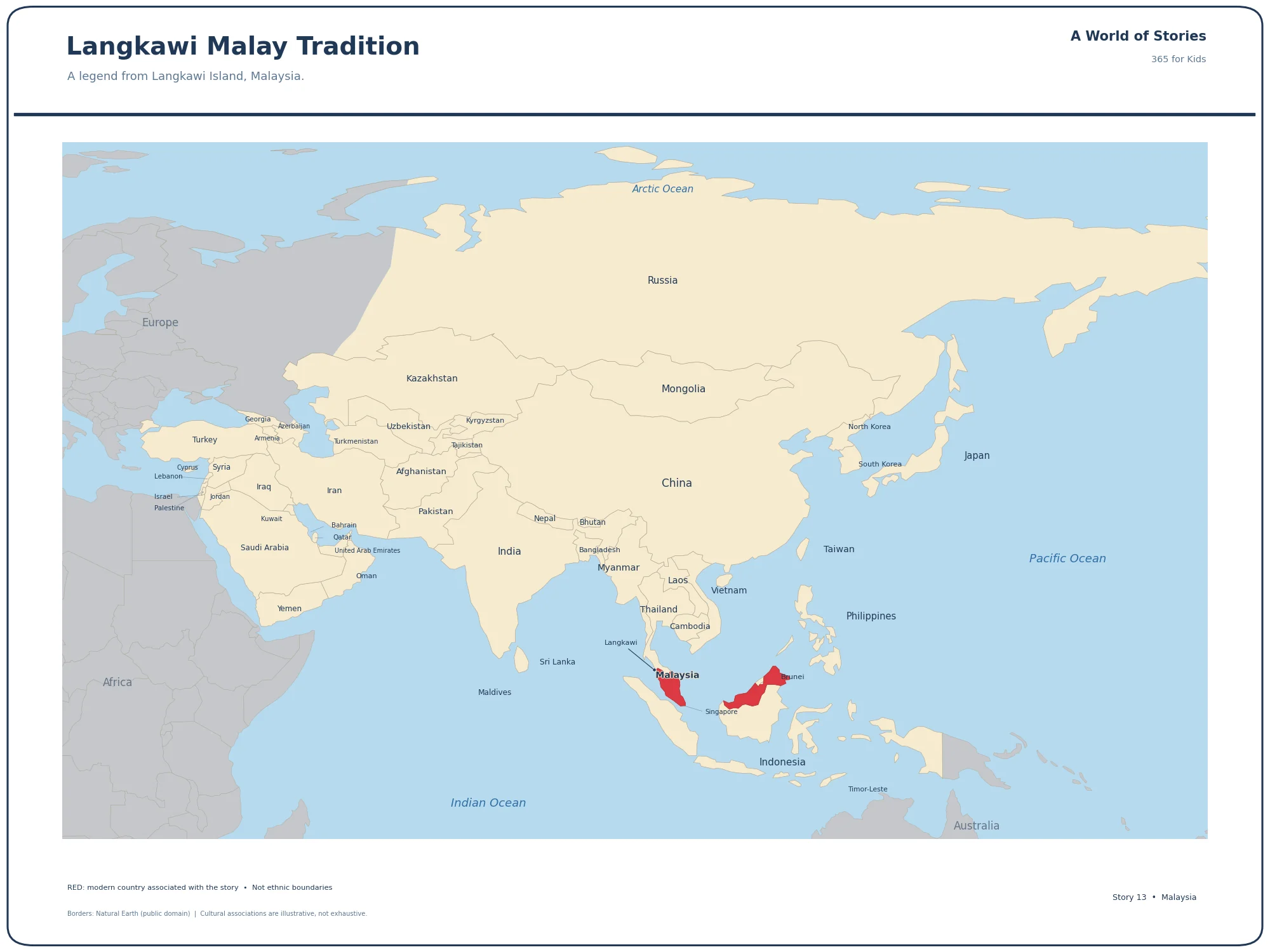
Off the northwestern coast of the Malay Peninsula lies Langkawi, an island of green hills, rice fields, and shores washed by the Andaman Sea. Among the stories handed down there, none is remembered more sorrowfully than the legend of Mahsuri.
Long ago, according to the tale, a girl named Mahsuri grew up on the island. Her parents were Pandak Mayah and Cik Alang. As she became a young woman, people spoke of her remarkable beauty. Yet beauty, which brought her admiration, also awakened envy.
Mahsuri married Wan Darus, a young warrior and the brother of a village leader. The two began their life together, but peace did not last. War threatened the region, and Wan Darus departed to fight against the forces of Siam. Mahsuri remained behind on Langkawi, waiting for the day he would return.
While her husband was away, a wandering storyteller named Deraman came to the island. He travelled from place to place with stories to tell, and Mahsuri became his friend. The friendship was innocent. In a village where news passed swiftly from house to house, however, an ordinary meeting could soon become the beginning of a rumour.
Among those who watched Mahsuri was Wan Mahora, the wife of the village chief. The legend remembers Wan Mahora as jealous of Mahsuri. She accused the young woman of being unfaithful to her absent husband. What began as an accusation spread through the village, gathering strength each time it was repeated.
Mahsuri denied the charge. She had done nothing wrong. But denial was not enough to silence those who had already decided what they wanted to believe.
The villagers took her into custody. In the telling preserved on Langkawi, she was bound to a tree and left beneath the burning sun as she awaited her punishment. She continued to insist upon her innocence. The judgment against her did not change.
At last Mahsuri was condemned to die.
Then, the legend says, a strange thing happened. The weapons brought against her could not harm her. Blades that should have ended her life failed. Only one weapon, Mahsuri said, could do so: the ceremonial keris belonging to her family.
A keris is a traditional dagger, often with a distinctive shape and a richly worked hilt. In this story it became the instrument of a terrible injustice. When the family keris was brought and used against Mahsuri, her blood flowed white instead of red.
Those who saw it understood what the extraordinary sign meant in the language of the legend. Mahsuri had spoken the truth. She was innocent, and the village had condemned her unjustly.
But the truth had come too late to save her.
With her final breath, Mahsuri pronounced a curse upon Langkawi: for seven generations, the island would know hardship rather than prosperity. The words were not a blessing to be carried forward but a cry of grief against a wrong that could no longer be undone.
The legend continues beyond Mahsuri’s death. People later linked the island’s suffering—war, failed harvests, drought, and other misfortunes—to her curse. For generations, the story was retold whenever people spoke of Langkawi’s troubled past. The association belongs to the legend; it does not prove that a curse caused those events.
Time passed. New generations were born, and Langkawi changed. The tale of Mahsuri did not disappear. Her name remained tied to the island, where a tomb and cultural centre, known as Makam Mahsuri or Kota Mahsuri, continue to preserve her memory.
Those who tell her story today remember more than the mysterious white blood or the seven generations of misfortune. They remember a woman whose voice was ignored, an accusation allowed to stand in place of proof, and the terrible cost of believing a rumour because it is easy to repeat.
And so the legend of Mahsuri is still told beside the green hills and shining waters of Langkawi—not as a happy ending, but as a warning about jealousy, injustice, and the importance of hearing the truth before it is too late.
Culture and Story Notes: Origin and genre: A traditional Malay legend associated specifically with Langkawi Island in Kedah, Malaysia. It is a legend, not an established historical account of the supernatural events described.
Traditional elements retained: Mahsuri and Wan Darus; the wandering storyteller Deraman; the jealous accusation associated with Wan Mahora; Mahsuri’s protest of innocence; her condemnation; the family keris; white blood as a sign of innocence; and the curse of seven generations.
Variant note: Versions differ about some family relationships, Mahsuri’s background, the circumstances of the trial and execution, and later events. This adaptation follows the narrative presented by Langkawi’s official tourism portal, without combining conflicting plotlines. The prose is an original literary adaptation rather than a translation of any single published version.
For younger readers: This legend includes a false accusation, an unjust execution, and grief. It is most suitable for a guided reading with an adult, especially for children at the younger end of the 6–17 age range.
Vocabulary: keris — a traditional dagger found in parts of Southeast Asia; Langkawi — an island group and major island in Kedah, northwestern Malaysia.
After the Story: Read · Create · Reflect · Share
1. Find Malaysia on a map of Southeast Asia. Where is Langkawi, and what are the main colours and symbols on Malaysia’s flag?
2. Who was Mahsuri, and what accusation was made against her while Wan Darus was away?
3. In the legend, what did the white blood signify? Why had the discovery come too late?
4. What can this story teach us about rumours, jealousy, and listening fairly to someone who has been accused?
Inspired by this story? Create your illustration!
MYANMAR — The Two Brothers and the Shwedagon Pagoda
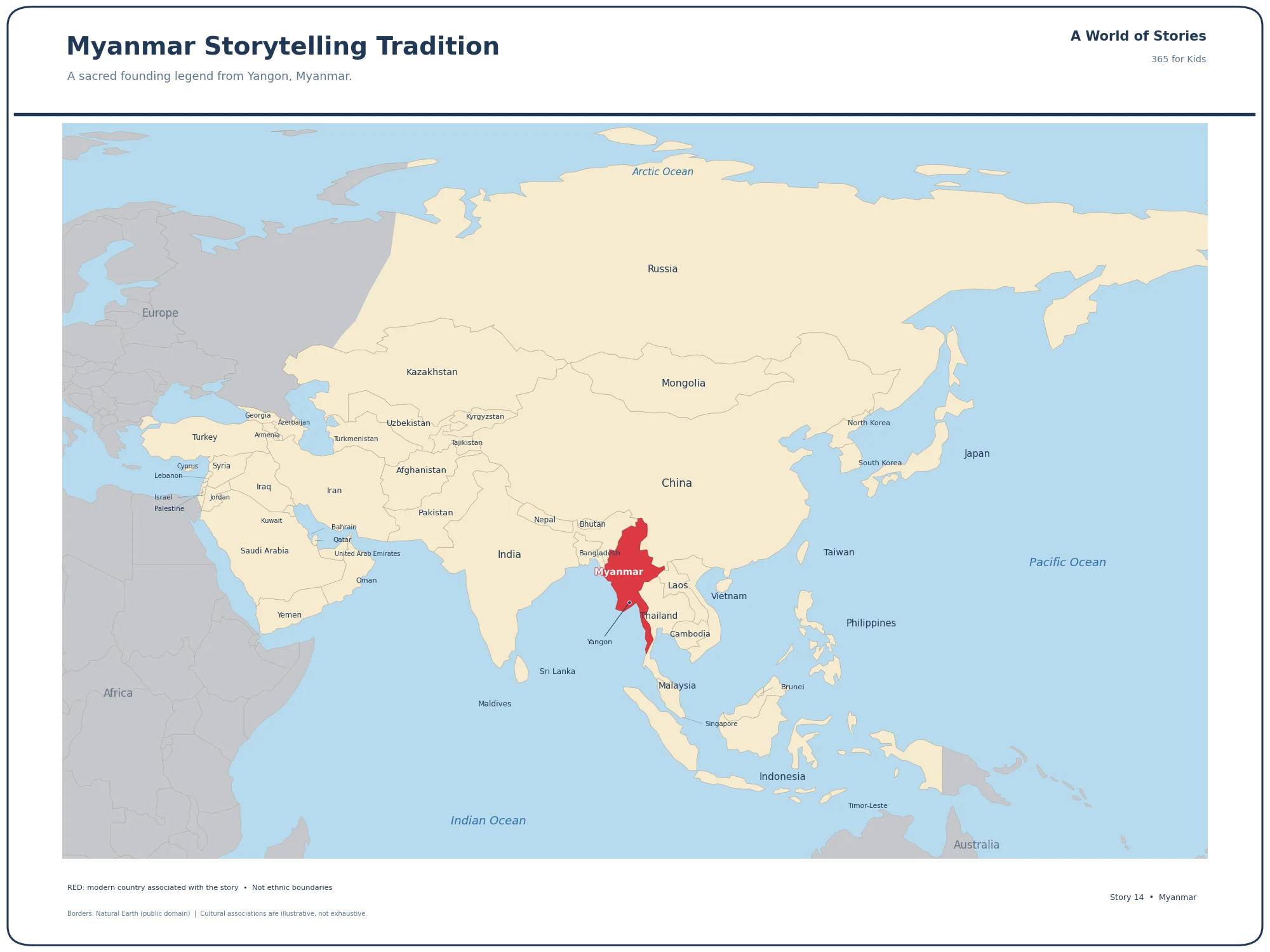
On a hill above the city now known as Yangon stands the Shwedagon Pagoda, its golden spire rising high above the surrounding streets. For generations, people in Myanmar have told a sacred story about how the hill first became the resting place of precious relics. It is the story of two brothers, a long journey, and a gift that they carried home.
Long ago, according to this tradition, the land of Ukkalapa was ruled by King Okkalapa. The king knew that Singuttara Hill was sacred. It was associated with relics of three Buddhas of earlier ages, yet the exact place where those relics rested had become difficult to find. The king hoped that a new sacred gift would one day be brought to the hill.
At that time, two brothers named Tapussa and Bhallika lived in the region of Ukkalapa. They were merchants, accustomed to travelling far from home to trade. Their journeys took them across great distances and, on one particular journey, into the lands of India.
In the story told in Myanmar, a nat—a spirit believed to have been their mother in a previous life—guided the brothers toward an extraordinary meeting. They came upon Gotama Buddha, who had recently attained enlightenment. He was resting beneath a rājāyatana tree after the weeks that followed his awakening.
The brothers were carrying food. They offered the Buddha rice cakes and honey, a simple gift freely given to one whom they held in great respect. The food was not a king’s treasure, nor was it an object of dazzling beauty. Its importance lay in the care with which it was offered.
The Buddha accepted their gift. In the founding legend of the Shwedagon, he then passed a hand over his head and gave the two merchants eight strands of his hair. To the brothers, these were not ordinary hairs. They were sacred relics to be guarded and honoured.
Tapussa and Bhallika began the journey home with the eight strands. They had travelled abroad with goods to trade; they were returning with something that no market could value. Their responsibility was to deliver the relics safely to Ukkalapa.
When word of their return reached King Okkalapa, the king went to receive the brothers and the sacred gift. The people of the land joined in welcoming the relics. Yet receiving them was only the beginning. The king and the brothers still had to find the holy place where the relics should be enshrined.
They searched for Singuttara Hill. The story says that no person could tell them precisely where to look. The relics of the three earlier Buddhas had been hidden there in ages so distant that even the knowledge of their resting place had faded.
Help came from the unseen world. Sakka, a powerful celestial being known in Buddhist tradition, guided the searchers to the hill. Other nats were said to remember where the earlier holy objects had been kept. Piece by piece, what had been forgotten was revealed.
The sacred objects of the three earlier Buddhas were remembered: the staff of Kakusandha Buddha, the water filter of Koṇāgamana Buddha, and a piece of the robe of Kassapa Buddha. Now, according to the legend, the eight strands from Gotama Buddha could be placed with them on Singuttara Hill.
King Okkalapa and the two brothers took part in the enshrinement. The relics were laid within a sacred chamber, protected beneath a monument raised in reverence. Above the chamber stood the shrine that the tradition remembers as the beginning of the Shwedagon Pagoda.
For the brothers, the journey had reached its end. They had offered food to a traveller of extraordinary wisdom; they had received a gift; and they had brought it to their people. The king’s long hope for the sacred hill, the brothers’ act of generosity, and the care of those who received the relics had come together in a single story.
The pagoda did not remain unchanged through the centuries. Rulers and ordinary worshippers repaired it, enlarged it, and offered gold. What people see in Yangon today is the result of a long history of devotion, rebuilding, and craftsmanship.
Visitors now climb the covered stairways of Singuttara Hill and walk around the great golden stupa. Some come to pray, some to make offerings, and some to understand the place that has mattered to so many generations. The legend of Tapussa and Bhallika is still told beside this living monument.
It reminds its listeners that a gift need not be costly to be meaningful—and that the greatest value of a journey may lie in what travellers bring back for others.
Cultural and Editorial Note: Cultural origin: This is a traditional Buddhist founding legend associated with Ukkalapa and the Shwedagon Pagoda in Yangon, Myanmar. The two merchants are named Tapussa and Bhallika; spellings vary in English (for example, Taphussa/Ballika). A nat is a spiritual being in Myanmar traditions; Sakka is a celestial figure in Buddhist cosmology.
Genre and historical distinction: The meeting of the Buddha and the two merchants appears in early Buddhist literature. The eight hair relics, their return to Ukkalapa, and the founding of the Shwedagon are elements of a later local religious tradition. The tale should be introduced as a sacred legend, not as a verified eyewitness account of events in the sixth century BCE. In Myanmar’s 2018 UNESCO World Heritage tentative-list submission, historical and archaeological scholarship places the first construction of the monument between the sixth and tenth centuries CE.
Version selected: This adaptation follows the core founding tradition documented by the Shwedagon Pagoda’s Board of Trustees and the Yangon City Development Committee: the merchants’ offering, eight strands of hair, return to Ukkalapa, the king’s reception, the guidance of spiritual beings, and enshrinement on Singuttara Hill. Some extended chronicles add episodes in which strands of hair are taken on the journey and later restored; those episodes have not been combined with this version. The three earlier relics are identified consistently with the 2018 UNESCO tentative-list description.
Adaptation method: This is an original English literary retelling of traditional narrative elements, not a translation of a specific canonical text. Descriptive transitions have been added for readability, without inventing new characters, conflicts, miracles, or a different ending. The account is presented respectfully as the belief and storytelling heritage of its community.
After the Story: Read · Create · Reflect · Share
1. Find Myanmar on a map of Asia. Which city is home to the Shwedagon Pagoda, and what is the name of the hill on which it stands?
2. Draw the flag of Myanmar. Which three colours appear in its horizontal stripes, and what shape is in the centre?
3. What did Tapussa and Bhallika offer the Buddha, and what did they receive according to the legend?
4. Why was it important to find Singuttara Hill? What can this story teach us about generosity, care, and the way traditions are passed from one generation to another?
Inspired by this story? Create your illustration!
PHILIPPINES — The Monkey and the Tortoise
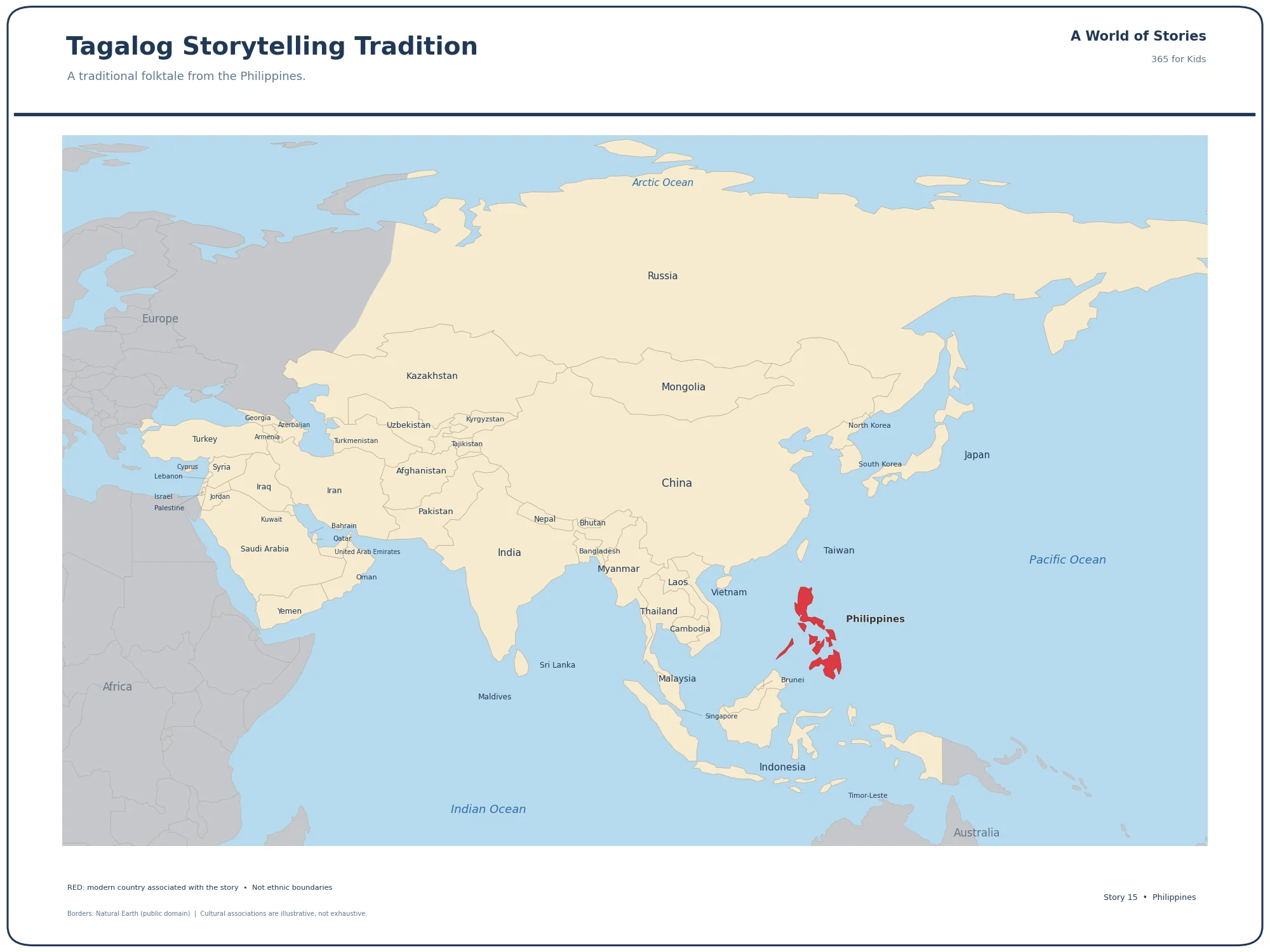
A river wound through the green countryside, carrying fallen leaves, twigs, and whatever the rain had swept into its current. One day a monkey and a tortoise saw something much larger floating toward them: a banana plant, torn from the ground, its broad leaves still green and its roots trailing in the water.
They pulled it onto the bank and looked at their unexpected find.
‘We could plant it,’ said the tortoise. ‘Let us divide it, and each of us can grow a share.’
The monkey looked at the strong green leaves. He looked again at the muddy roots. He was much bigger than the tortoise and could easily claim the part he wanted.
‘I shall take the top,’ he declared. ‘It already has leaves. Your share can be the roots.’
The tortoise accepted the lower half. It did not look nearly so splendid as the monkey’s leafy portion, but she planted it carefully in the earth. The monkey took his upper half and planted it too.
Days passed. When they met again, the tortoise asked, ‘How is your banana plant growing?’
The monkey’s face fell. ‘It has withered,’ he said. ‘The leaves have dried, and nothing more has come of it. What about yours?’
‘Mine has grown,’ said the tortoise. ‘It has leaves now, and fruit as well. The bananas are ripe, but there is one difficulty: I cannot climb the plant to reach them.’
At once the monkey became interested. He knew how to climb, and the thought of ripe bananas pleased him very much.
‘I shall fetch them for you,’ he offered.
The tortoise was glad of his help, and together they went to the place where her plant had grown tall. Beneath its leaves hung a fine bunch of yellow bananas.
The monkey scrambled up the stem. Before the tortoise could say another word, he pulled off a banana, peeled it, and ate it. Then he took a second, and a third. He ate so quickly that his cheeks were full.
From the ground, the tortoise watched the yellow fruit disappear.
‘Please pass some down to me,’ she called. ‘After all, these bananas grew from my half of the plant.’
But the monkey went on eating. He had climbed up to help her, yet now he wanted every banana for himself.
‘Will you leave me any?’ the tortoise asked again.
The monkey refused even to spare her a peel. High among the leaves, he finished the fruit without sharing a single piece.
The tortoise was angry. She had cared for the roots that he had not wanted, and now he had taken the harvest. Because she could not climb, he believed there was nothing she could do.
But the tortoise began to think.
She went to the river and found sharp, pointed snails near its edge. She placed them around the foot of the banana plant, their points turned upward. Then she drew herself beneath an empty coconut shell and waited.
At last the monkey began to climb down. He was so pleased with his feast that he scarcely looked at the ground. As he stepped away from the stem, the sharp points pricked his feet. He cried out, stumbled, and looked about him in fury.
‘Who has done this?’ he shouted.
He searched around the banana plant and soon discovered the tortoise beneath the coconut shell.
‘So it was you!’ he cried. ‘I shall punish you for this.’
The monkey seized her. He was strong and very angry, and he thought he could choose exactly what would happen next.
‘I shall give you a choice,’ he said. ‘Shall I crush you in a mortar, or throw you into the river?’
The tortoise knew something the monkey had forgotten: she was at home in water. She needed to make him choose the river without realizing why.
‘Oh, do not throw me into the river!’ she pleaded. ‘I am terribly afraid of drowning. If you must punish me, use the mortar instead.’
The monkey was delighted. What better choice, he thought, than the one she feared most?
‘Afraid of the river, are you?’ he said. ‘Then into the river you shall go!’
He carried the tortoise to the bank and flung her into the water.
For a moment she vanished beneath the surface. The monkey stood above the current, certain that he had finally won.
Then a small head appeared among the ripples.
The tortoise was swimming. She lifted her face toward the bank and laughed at the monkey who had believed every word she said.
The monkey had claimed the finest-looking part of the plant, eaten the fruit that was not his, and tried to punish the tortoise for resisting him. Yet the tortoise, smaller and slower though she was, had escaped through her cleverness.
And the river carried her safely away.
Cultural and Editorial Note: This is a literary adaptation of the Tagalog tale often called ‘Ang Buhay ni Pagong at ni Matsing’ (‘The Tortoise and the Monkey’). It is part of the wider oral storytelling traditions of the Philippines. In 1889, Filipino writer and artist José Rizal published an English telling and compared it with a Japanese animal fable. The National Museum of the Philippines documents Rizal’s role in bringing the story to a wider audience.
The present adaptation follows the sequence preserved in Rizal’s published version: a banana plant is divided; the monkey takes the leafy top while the tortoise plants the roots; the monkey eats all the bananas; the tortoise places sharp river snails around the plant and hides beneath a coconut shell; the monkey threatens to crush or drown her; she pretends to fear the river and escapes by swimming. The dialogue and descriptive language are newly written; no separate episodes have been added.
Philippine versions of this animal tale differ in their tricks and endings. This text deliberately follows one identifiable Tagalog telling rather than combining elements from different regional variants. The English title retains Rizal’s word ‘tortoise,’ although many other English tellings say ‘turtle’; in this folktale the animal swims. The threat of violence is presented without graphic detail.
After the Story: Read · Create · Reflect · Share
1. Find the Philippines on a map of Asia. Which seas surround this island country?
2. Draw the flag of the Philippines. What shapes and colors can you identify on it?
3. Why did the monkey choose the leafy top of the banana plant? What happened to his share and to the tortoise’s?
4. The monkey refused to share, and the tortoise answered with a trick of her own. Were their choices fair? What could each have done differently?
Inspired by this story? Create your illustration!
SINGAPORE — Sang Nila Utama and the Lion

Long ago, in the islands and seas of the Malay world, there lived a prince named Sang Nila Utama. His home was connected to Palembang, on the island of Sumatra, a place of rulers, sailors and journeys across the water. Stories about him were passed down for generations, until they became part of the great Malay chronicles.
One day, the prince was visiting the island of Bintan. During a hunting expedition, he came upon an enormous stone rising above the surrounding land. He climbed it and looked out across the sea. Far away, beyond the shining water, he saw the pale gleam of another shore.
The sand on that distant island seemed almost white against the darker green of the land. The prince called to one of his companions, Indra B’hupala, and asked what place lay across the water.
It was Temasek, he was told: an island across the strait.
The prince wanted to see it for himself. He decided to cross the sea, and soon a vessel was carrying him and his companions toward the distant beach.
At first, the island seemed to wait peacefully on the horizon. But out on the water, the weather changed. The wind rose. Waves struck the vessel. Then came a storm so fierce that water began to pour inside.
The men struggled to keep the boat afloat. They tried to empty the water, but more rushed in. The vessel rode lower and lower, and the shore that had seemed so close was now terribly difficult to reach.
There was only one way to lighten their burden. The prince and his companions began throwing their belongings overboard. The sea swallowed the cargo, piece after piece. Still the water rose.
At last, the story tells us, only the prince’s precious crown remained. It was no ordinary possession. A crown was a sign of royal authority, something that marked the person who wore it as a ruler. But the boat was still in danger.
Sang Nila Utama ordered the crown to be cast into the sea.
The heavy ornament disappeared beneath the waves. And then, as the old legend tells it, the storm stopped. The waters grew calm enough for the sailors to bring their battered vessel to shore.
At last they reached Temasek.
The prince stepped onto the sand. Here was the island he had seen from the high stone: a place of sea and land, open shore and green growth. The party walked across a plain near the mouth of a river, exploring the place where the storm had brought them.
Suddenly, something moved ahead of them.
It was an animal unlike any the prince knew. The old chronicle describes it as swift and striking, with a reddish body, a black head and a white breast. It was larger than a he-goat and moved with remarkable speed. For a moment the visitors could see it clearly; then it darted away and vanished among the trees.
The prince was astonished. What kind of creature had they seen? He asked his companions, but they could not agree. At last he asked Demang Lebar Daun, who knew descriptions preserved in old accounts. The creature, Demang Lebar Daun said, resembled a singa — a lion.
The prince thought about the animal that had appeared before them and vanished so quickly. He took its presence as a favourable sign. An island where such a powerful creature could be found, he believed, was a place worthy of a new beginning.
He decided not to return to Bintan. Instead, he would remain on Temasek and establish his settlement there. He sent Indra B’hupala back to Bintan to tell his mother-in-law that he would not return.
And he gave the island a name that would outlast the voyage, the storm and even the story of the lost crown: Singapura — the Lion City.
According to the Malay Annals, Sang Nila Utama became its ruler and was given the title Sri Tri Buana. Over many centuries the name Singapura became Singapore, the name by which the island nation is known today.
No one can now tell us exactly what animal the prince may have seen, or whether the meeting happened as the legend describes. But the story has endured. A prince looked across a stretch of water; a crown sank into the sea; a mysterious creature ran through the trees; and a name was born.
Even today, when people call Singapore the Lion City, they remember the old tale of Sang Nila Utama and the animal he believed was a lion.
Cultural and Editorial Note: Cultural origin: Malay literary and historical tradition of the Malay world; associated especially with the island now known as Singapore. The legend is preserved in the Sejarah Melayu (Malay Annals), also known as Sulalat al-Salatin. Sang Nila Utama is linked to Palembang (present-day Indonesia) and Bintan before reaching Temasek.
Genre and historical context: This is a founding legend, not a verified eyewitness account. In the Malay Annals, the prince names the settlement Singapura after seeing a creature believed to be a lion. The passage describes the animal in unusual colours; its real identity is uncertain. Archaeological evidence confirms that Singapore had a significant pre-colonial settlement, but it does not establish that every event in the legend happened as told.
Adaptation approach: This English narrative follows the sequence in the John Leyden version of the Malay Annals as quoted by the National Library Board of Singapore: the lookout toward Temasek, the dangerous crossing, the casting away of the crown, the animal sighting, the naming of Singapura and the decision to remain. Descriptive language is original and intended to support reading aloud. The text is not a verbatim translation. Other manuscript versions have differences in the prince’s genealogy and titles.
After the Story: Read · Create · Reflect · Share
1. Find Singapore on a map of Southeast Asia. Which large peninsula is nearby, and which country lies just to its north?
2. Draw the flag of Singapore. Then write the traditional name Singapura beside it and explain what that name means.
3. Why did Sang Nila Utama throw his crown into the sea? What happened immediately afterward, according to the legend?
4. What made the strange animal important in the story? How can a legend help people remember the name and identity of a place?
Inspired by this story? Create your illustration!
THAILAND — Sang Thong — The Prince of the Golden Conch
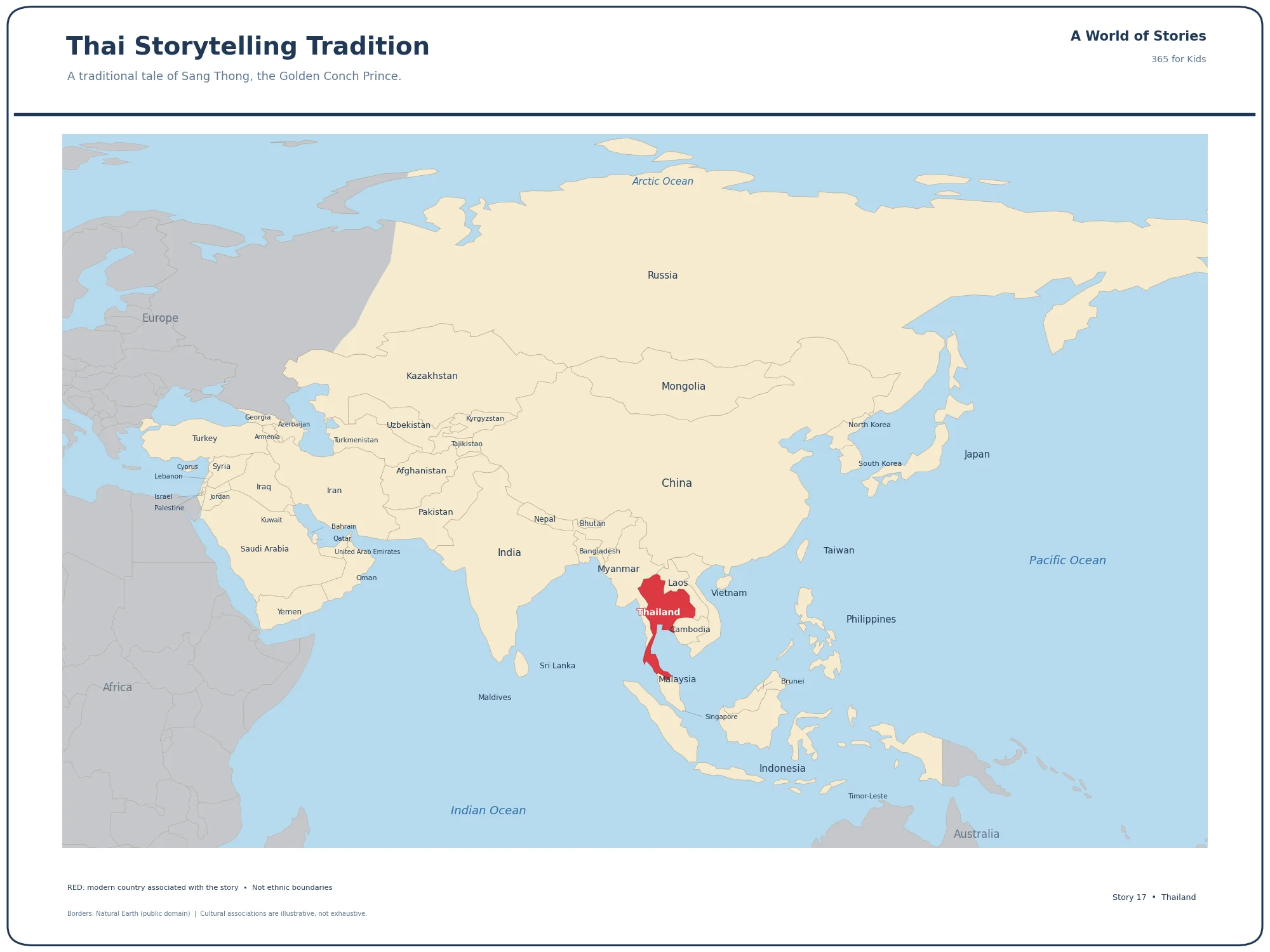
Long ago, in a kingdom ruled by King Yotsawimon, a queen named Chanthawi waited for the birth of her child. The palace was full of expectation. But when the day came, the queen did not hold an ordinary baby in her arms. Instead, she gave birth to a conch shell.
The king was bewildered. Another woman at court, Chantha, who envied the queen, used the strange birth to turn him against her. She persuaded him that the shell would bring misfortune upon the kingdom. Rather than protect his wife and child, the king ordered them away.
So Queen Chanthawi left the palace carrying the shell that held her son. Far from the royal halls, an elderly couple gave her shelter near the forest. The former queen worked as she could, gathering firewood and helping in the humble household. She never abandoned the mysterious shell.
One day, when she went out to work, a little boy stepped out of the conch. He cleaned the house, prepared what he could, and slipped back inside before his mother returned. The next day the same wonderful thing happened. Soon Chanthawi began to wonder who was helping her.
At last she pretended to leave, but quietly returned. There stood the boy, busy at the work she had expected to find undone. She knew at once that he was her child. Overcome with joy, she broke the shell so that he would no longer have to hide in it. He was called Phra Sang, the prince who had come from the conch.
For a little while, mother and son lived together in peace. Yet the court’s jealousy reached even their distant home. Phra Sang was seized and cast into the water. Beneath the waves, however, he did not perish. A king of the nagas, powerful serpent beings of the waters, saved the boy and sheltered him. Later the prince was taken to the care of Nang Phanthurat, the ruler of a land of giants.
Phanthurat loved him as a foster mother. She and those around her took human appearance so he would not be afraid. But the prince eventually discovered the truth about the place where he was growing up. In a part of the palace he had never visited, he found signs of the giants’ fierce nature. Frightened, he resolved to escape.
Before leaving, he found a magical pool of gold. He entered its waters, and his body took on a radiant golden beauty. He also obtained an enchanted disguise known in the tale as the form of Chao Ngo, and a magical means of flight. Hidden beneath that strange covering, he could appear to be someone very different from the golden prince inside.
Phra Sang flew away. Phanthurat followed him, desperate not to lose the child she had raised. She could not reach him where he had gone. Yet before they parted, she taught him the Maha Chinda spell, a charm that could summon creatures from forest and water. In this version of the story, grief overcame Phanthurat, and she died. Though the prince had fled her kingdom, her gift would remain with him.
His wandering brought him to the kingdom of King Samon. There the king and Queen Montha had seven daughters. Six were already ready to choose husbands from the noble young men who presented themselves at court. The youngest, Princess Rojana, would not choose any of them.
Her father grew impatient. At last he ordered that Chao Ngo—the oddly dressed stranger living far from the palace—be brought before her. Perhaps he expected this to shame his daughter into making another choice. But Rojana looked at the newcomer and saw what others could not. Through the disguise she perceived the golden prince. She placed her garland upon him, choosing him as her husband.
King Samon could scarcely believe it. He was furious that his youngest daughter had chosen a stranger whom the court mocked rather than a prince in splendid clothes. He sent the couple away to live in a little hut beside the rice fields. Rojana went with Phra Sang, and the two made their home there.
In time Rojana came to know the person beneath the covering more fully. She saw the golden form he kept hidden and wished he would cast aside the disguise. But Phra Sang continued to wear it. To the court, he remained Chao Ngo, the son-in-law they thought least worthy of respect.
King Samon was not satisfied with banishing them. He devised a harsh contest for his seven sons-in-law. Each must bring back a great catch of fish. The six richly dressed husbands went out with all the advantages of their station. Chao Ngo went too—but he carried the secret gift of Phanthurat.
Using the Maha Chinda spell, Phra Sang summoned the fish to him. The others could find almost none. Desperate to complete the king’s order, they begged the stranger for a share. In the old telling, he demanded a painful and humiliating price: each had to surrender a small part of his nose. Their pride had led them into a bargain they would bitterly regret.
The king then ordered a second contest, this time for game from the forest. Again Phra Sang used the charm he had been taught, and again the other husbands failed. They turned to him for help and paid another harsh price, this time from their ears. Still the king would not admit that he had misjudged his youngest daughter’s husband.
At last Indra, lord of the heavens in the tale, came to intervene. Taking the form of a powerful challenger, he threatened King Samon’s kingdom and demanded a contest of polo. The six older sons-in-law could not defeat him. The king had no one left to call upon except the husband he had despised.
Phra Sang agreed to play. He removed the disguise and appeared in his shining golden form. Those who had laughed at Chao Ngo now saw the prince Rojana had recognized from the beginning. In the contest he matched the heavenly challenger. Indra allowed him the victory, and King Samon’s kingdom was saved.
The king could no longer deny what had happened. He welcomed Phra Sang and Rojana back from the rice fields and honored them as members of the royal family. The princess had trusted what she saw beneath the outward appearance of a stranger, even when everyone around her had mocked her choice.
Yet another part of Phra Sang’s story remained unfinished. Back in his first kingdom, King Yotsawimon learned the truth about the wrong done to Chanthawi and their son. He found the queen, and together they went in search of Phra Sang. To reach him without being recognized, they traveled in humble dress.
Chanthawi found work in the palace kitchen. There she carved the story of her lost son’s life into pieces of a gourd that were served with his meal. Phra Sang recognized the events shown upon the food before him. The signs led him to the mother from whom he had been separated so long ago.
Mother and son were reunited. The king who had once believed a cruel accusation could no longer hide from the truth. Phra Sang was restored to his family and to his rightful place, and the long wanderings that began with a little conch shell at last came to an end.
So the tale of Sang Thong is remembered: a child rejected because he seemed strange, a prince concealed beneath a disguise, and a princess who recognized what others failed to see. The golden prince had been there all along. The hardest thing was teaching the world to look beyond appearances.
Cultural & Editorial Note: Sang Thong (สังข์ทอง), often called The Golden Conch Prince in English, is a celebrated Thai tale with roots in the Suwanna Sang Jataka tradition. It was also developed into a famous Thai verse drama associated with King Rama II and court poets. This is a new, independent English literary retelling of the broad traditional storyline, not a translation of any modern adaptation or a reconstruction of a single original manuscript.
Several scenes and character names differ among oral, literary, and performance versions. This telling follows the widely documented sequence of the conch birth, exile, foster mother Phanthurat, golden body and disguise, Rojana’s garland, the fishing and hunting challenges, Indra’s polo match, and the reunion through a carved gourd. The naga rescuer’s name and other details vary across sources.
The Chao Ngo disguise has been portrayed in traditional performance using visual stereotypes associated with Indigenous peoples of the region. This adaptation avoids treating any real community’s skin, hair, or appearance as evidence of inferiority. The king’s prejudice is part of the story, not a judgement endorsed by the retelling. The hunting-and-fishing punishments and Phanthurat’s death are included briefly because they belong to the traditional plot.
After the Story: Read · Create · Reflect · Share
1. Find Thailand on a map of Asia. Which other countries are close to it?
2. Why did Queen Chanthawi leave the palace, and how did she discover the boy inside the conch shell?
3. What did Rojana understand about Chao Ngo that the king and the court did not?
4. Phra Sang was helped by several people, including his mother, the naga king, and Phanthurat. How did their actions shape his journey?
Inspired by this story? Create your illustration!
TIMOR LESTE — The Crocodile That Became an Island
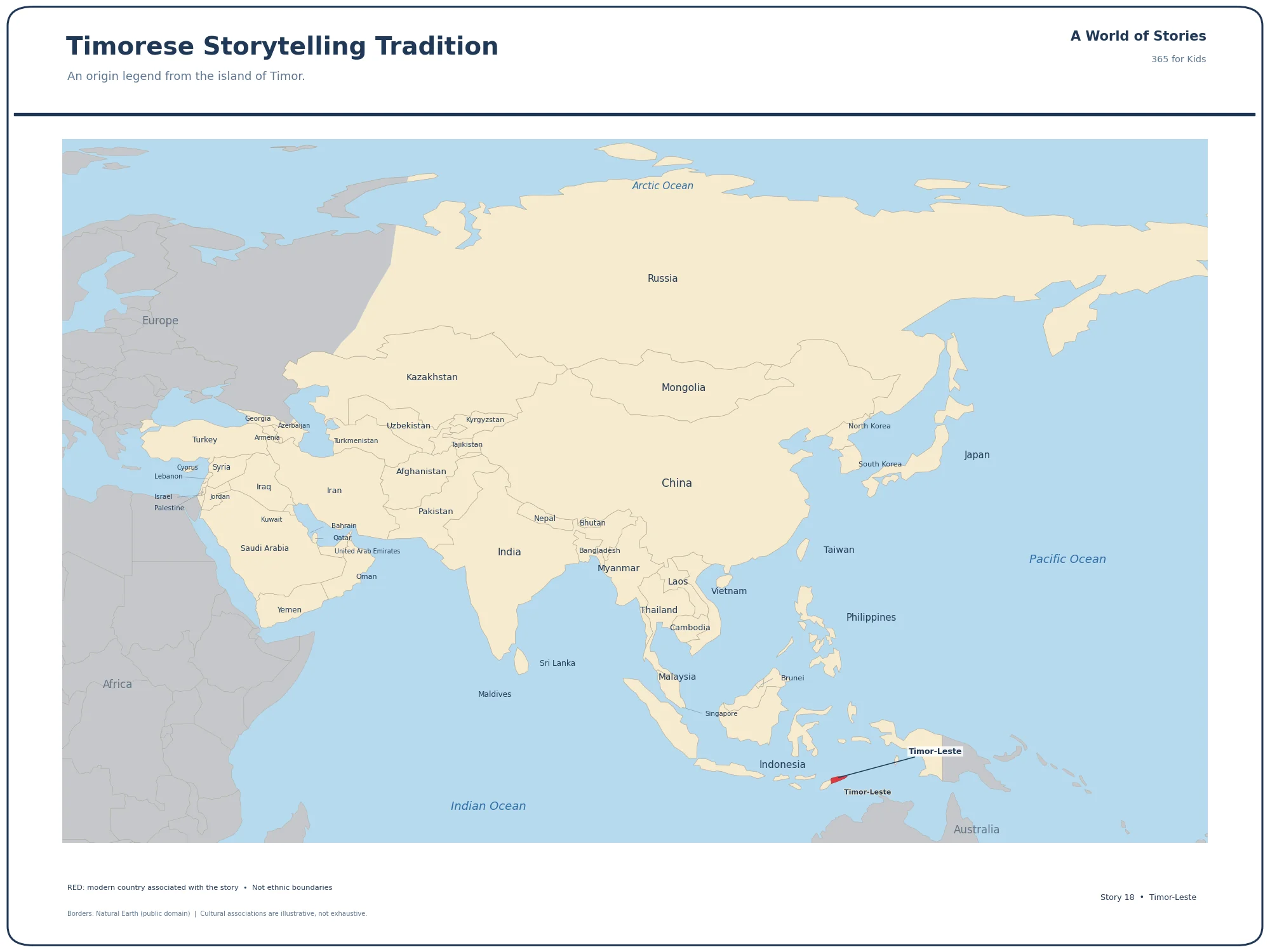
Long ago, before the island of Timor had taken its familiar shape, a little crocodile lived in a place far from the open sea. The world beyond the water where he had grown up seemed immense, and he longed to reach it. But the way to the ocean was difficult for such a small creature.
One day the crocodile found himself stranded on dry ground. The heat pressed down upon him. He struggled forward, but the sea was still too far away. His strength ebbed until he could scarcely move. There he lay, unable to return to the water that would save his life.
A boy came upon him. He saw the terrible teeth and the powerful jaws that even a little crocodile possessed. He also saw an animal in distress. Instead of leaving the creature to die, the boy lifted him and carried him toward the sea.
The journey to the water was hard, but the boy did not give up. At last he reached the shore and lowered the crocodile into the waves. The creature felt the water around his body again. Slowly his strength returned.
The crocodile knew that the boy had saved him. He promised that he would remember this kindness. If the boy ever wished to make a journey, he need only come to the shore and call for him three times. The crocodile would return to help.
Time passed. The small crocodile grew stronger and larger. The boy, meanwhile, remembered the promise. There was a whole world beyond the shore, and he wanted to see it. One day he came down to the water and called for the crocodile three times.
The crocodile answered. He had not forgotten the boy who had carried him to safety. Now he was strong enough to bear a passenger upon his back. The boy climbed on, and the two set out over the sea.
They travelled far across the wide waters. Islands appeared beyond the horizon and slipped behind them. The boy saw places he had never imagined, while the crocodile swam through the world he had once been too weak to reach. The journey that began with a rescue became a long companionship.
Yet the crocodile was still a crocodile. One day, as they travelled together, he felt an awful desire to eat the boy who rode on his back. The thought disturbed him. How could he wish to harm the very person who had saved him? The boy had trusted him, and the crocodile had given his word.
Troubled by what he felt, the crocodile sought advice from other animals. He asked the whale. He asked the tiger and the water buffalo. He asked others, too. Their answers reminded him of the kindness he had received and the promise he had made. It would be wrong, they told him, to repay a good deed with harm.
At last he turned to a monkey, hoping for a different answer. But the monkey condemned the crocodile’s ingratitude so fiercely that the crocodile felt ashamed. He could no longer pretend that his hunger excused a betrayal.
And so he made his choice. He would not eat the boy. The friendship begun beside the sea mattered more than the passing desire that had tempted him to break his promise. He returned to travelling with his companion, carrying him safely over the water.
The years went by. The crocodile, once a helpless creature stranded far from the waves, grew old. At last he knew that his life was drawing to an end. He had seen distant shores with the boy, but he still wished to repay a kindness that he could never forget.
He told his friend that his time was near. Then he made one final promise: when he died, his body would become land. It would be a place where the boy and the generations who followed him could live.
The crocodile died, and something wondrous happened. His body grew and spread across the water. His ridged back rose into mountains; his broad form became a great island. The sea surrounded the land that had been made from the crocodile himself.
That island, the legend tells us, was Timor.
The boy’s descendants made their lives upon the land. And the story of how their home came to be was remembered: a child had shown mercy to a creature in need, a creature had faced the temptation to betray him, and in the end a promise of gratitude had become an island.
In Timor-Leste, the crocodile holds a special place in cultural memory. People speak of the ancestral crocodile as a grandfather, and the great island’s long shape still recalls the animal from the story. The tale is not an account of how islands form in nature. It is a way of remembering a bond between kindness, loyalty, and the land itself.
Cultural & Editorial Note: The Crocodile That Became an Island is an origin legend closely associated with Timor-Leste. Its crocodile is sometimes called lafaek diak (the good crocodile). The tale helps explain the cultural importance of crocodiles and the island’s crocodile-like outline. The geographic island of Timor is shared today by Timor-Leste and Indonesia; the legend is not a scientific explanation of its formation.
This original English literary adaptation follows the extended traditional plot summarized in Timor-Leste’s Fifth National Report to the Convention on Biological Diversity (2015, p. 38): a boy saves the stranded crocodile; the crocodile later carries him on journeys; the animal is tempted to eat him and consults the whale, tiger, water buffalo, monkey, and other animals; he refuses to betray the boy; and his body becomes the island. Other published tellings omit the episode of the animals’ advice or describe the sea journeys differently. This adaptation does not combine conflicting endings.
The crocodile’s respectful place in the legend should not be taken as a suggestion to approach real crocodiles. Saltwater crocodiles are powerful wild animals and can be dangerous. The story is offered as cultural heritage for learning and discussion.
After the Story: Read · Create · Reflect · Share
1. Find Timor-Leste on a map of Southeast Asia. On which island is it located, and which neighboring country shares that island?
2. Look at the flag of Timor-Leste and draw it. What colors and shapes do you notice?
3. How did the boy help the crocodile, and what promise did the crocodile make in return?
4. Why did the crocodile ask the other animals for advice? What did he choose, and what does his choice tell us about gratitude and keeping a promise?
Inspired by this story? Create your illustration!
VIETNAM — The Legend of Betel and Areca
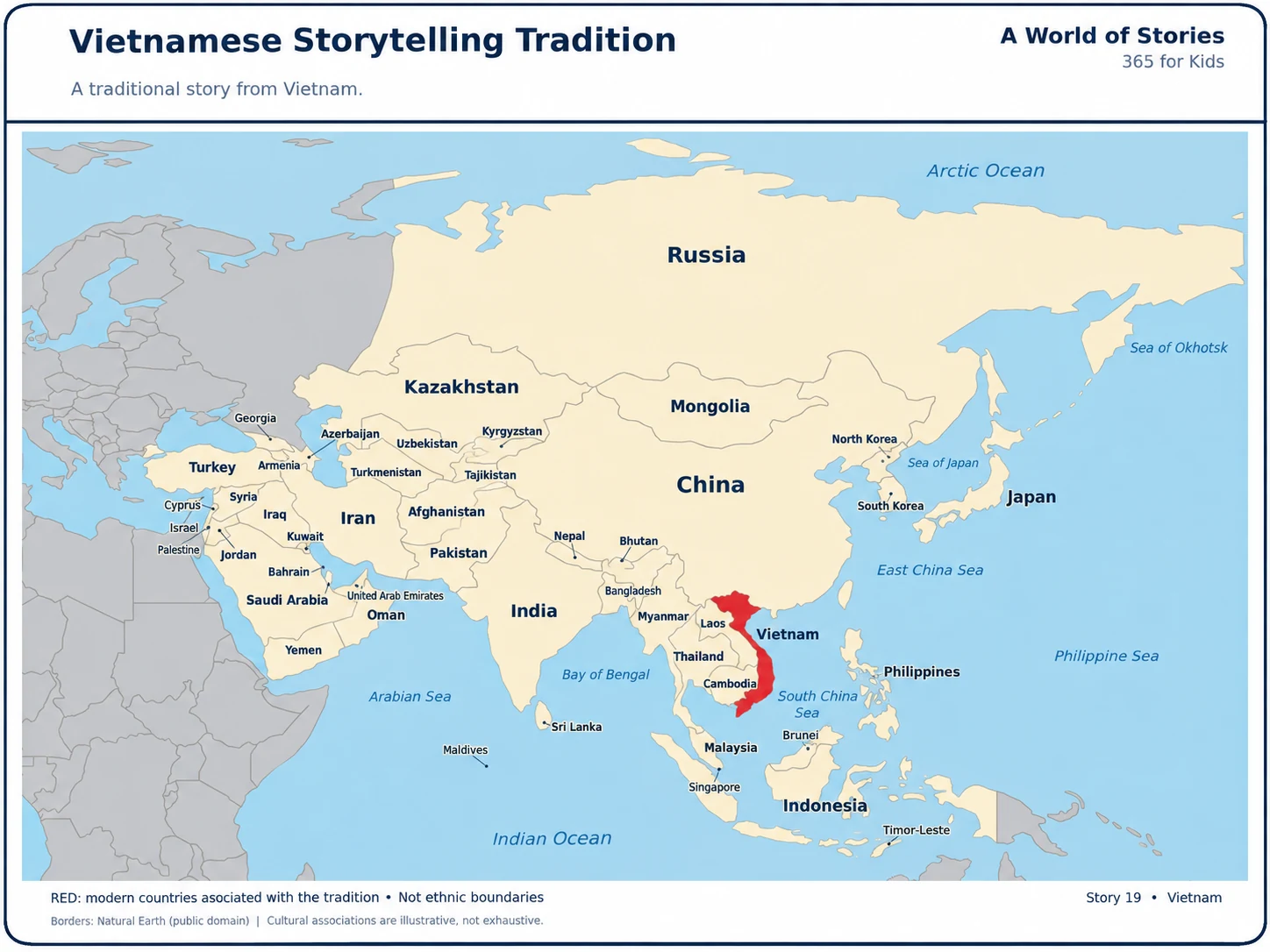
Long ago, in the days remembered in Vietnamese legend as the age of the Hùng Kings, there lived two brothers of the Cao family. The elder was named Tân, and the younger was named Lang. They looked so much alike that a stranger could hardly tell them apart. But the brothers themselves had never had any doubt: Tân was the elder, Lang the younger, and from childhood they had been close companions.
After their parents died, the brothers went to study with a Daoist teacher named Lưu. In his household they found a place to learn and live. The teacher had a daughter, a young woman who came to know the two brothers well. As time passed, she wished to marry one of them. Yet their faces were so nearly identical that she could not be certain which brother was older.
One day she placed a bowl of soup and a single pair of chopsticks before the two young men. Then she watched to see what they would do. Lang, the younger brother, offered the food to Tân first, showing the respect traditionally given to an elder sibling. At once she understood which was which. She told her parents that she wished to marry Tân, and they agreed to the marriage.
Tân and his wife grew deeply attached to one another. Their days together were happy, but slowly something changed between the brothers. Tân gave much of his attention to his new household, and Lang began to feel that there was no longer a place for him beside the brother he loved. What had once seemed an unbreakable closeness had become an uneasy silence.
Lang kept his sorrow to himself. He did not know how to bring back the old affection, and Tân did not see how deeply his younger brother was hurting. At last Lang left the house and walked away.
He travelled into the countryside until he came to a broad stretch of water. There was no boat waiting at the bank and no way for him to cross. He sat beside the water, far from home, and wept for the brother he believed he had lost. His grief was so great that his life came to an end there, on the lonely bank.
Then, says the legend, a strange change took place. Where Lang had died, a tall, slender palm rose toward the sky. Its trunk was straight; high above the ground it carried a crown of leaves and clusters of fruit. The younger brother had become an areca palm.
At home, Tân discovered that Lang was gone. The absence of his brother troubled him, and he went out to search for him. He followed the path into the countryside and came at last to the water’s edge. There he saw a palm unlike any he remembered, growing beside the place where the path stopped.
Tân understood that his search had brought him to the end of his brother’s journey. Overwhelmed by grief and regret, he fell beside the tree. His life ended there too. And where he had fallen, a great pale stone appeared, lying close against the roots of the palm. Tân had become limestone, while Lang stood above him as the areca tree.
Back in the teacher’s house, Tân’s wife waited for her husband. When he did not return, she went to find him. She followed the same road and reached the same quiet bank. There she found a solitary palm and a great stone nestled at its roots. She understood that the people she loved were lost to her. She sank down beside the stone, and her life, too, came to an end.
From that place grew a green vine. It wound itself about the stone and climbed the trunk of the palm, joining the two together. Its glossy leaves held a warm, sharp fragrance. The wife had become the betel vine.
Thus three people, separated by sorrow, stood together again in the shapes of a tree, a stone, and a climbing plant. The teacher Lưu and his wife later came searching for their daughter. At the water’s edge they learned of the three deaths and the strange transformations. In their sorrow they raised a small shrine, and those who passed it remembered the love between the brothers and the devotion of the husband and wife.
One hot season, a Hùng King was travelling through the region. He paused near the shady place beside the shrine and asked why it was honored. People told him the story of Tân, Lang, and the daughter of Lưu. The king looked at the palm, the stone, and the vine that bound them together, and he was moved.
He ordered attendants to gather fruit from the areca palm and leaves from the betel vine. As the old story tells it, when he tried them and the juice touched the limestone, a vivid red color appeared. The king then had some of the stone made into lime and combined it with the fruit and leaves. The mixture left his lips red.
To the king, the three things belonged together, just as the three people had belonged to one another. He ordered that betel, areca, and lime should be presented at weddings, gatherings, and important ceremonies. In this way, the legend says, a private story of love and loss became part of the customs of a whole country.
To this day, betel leaves and areca nuts remain familiar symbols of marriage, family ties, and hospitality in Vietnamese cultural tradition. The old legend asks its listeners to remember not only devotion, but also the sorrow that can grow when people who love one another cease to understand one another.
Cultural & Editorial Note: This is a traditional Vietnamese origin legend, known as Sự tích trầu cau. The adaptation follows the version preserved in Lĩnh Nam Chích Quái (a classical collection of Vietnamese stories): the younger brother Lang becomes the areca palm, the elder brother Tân becomes limestone, and the wife, identified as the daughter of the teacher Lưu, becomes the betel vine. Her personal name is not specified in the text used for this adaptation.
Other widely circulated versions exchange the transformations of the brothers: Lang becomes stone and Tân becomes the areca palm. These are genuine differences in the tradition, not errors to be silently combined. The Hùng King belongs to the traditional setting of the tale; the events are presented as legend, not verifiable history.
Betel and areca have long been associated with welcoming guests, family ceremonies, and weddings in Vietnam. This story explains the symbolism of a historical custom; it is not an activity for children to imitate. Modern medical evidence establishes that chewing areca nut, including betel quid without tobacco, can cause cancer. The educational value here is cultural understanding, not consumption.
After the Story: Read · Create · Reflect · Share
1. Find Vietnam on a map of Southeast Asia. Which countries border it, and which sea lies along much of its eastern coast?
2. Look at the flag of Vietnam and draw it. What are its two colors, and what shape is in the center?
3. Why did Lang leave home? In the version you read, what did Lang, Tân, and Tân’s wife each become?
4. Why did the Hùng King connect the tree, stone, and vine with marriage and family? What might Tân and Lang have done differently before their misunderstanding grew?
Inspired by this story? Create your illustration!
MARANAO — Bantugan and the Journey to the Sky World
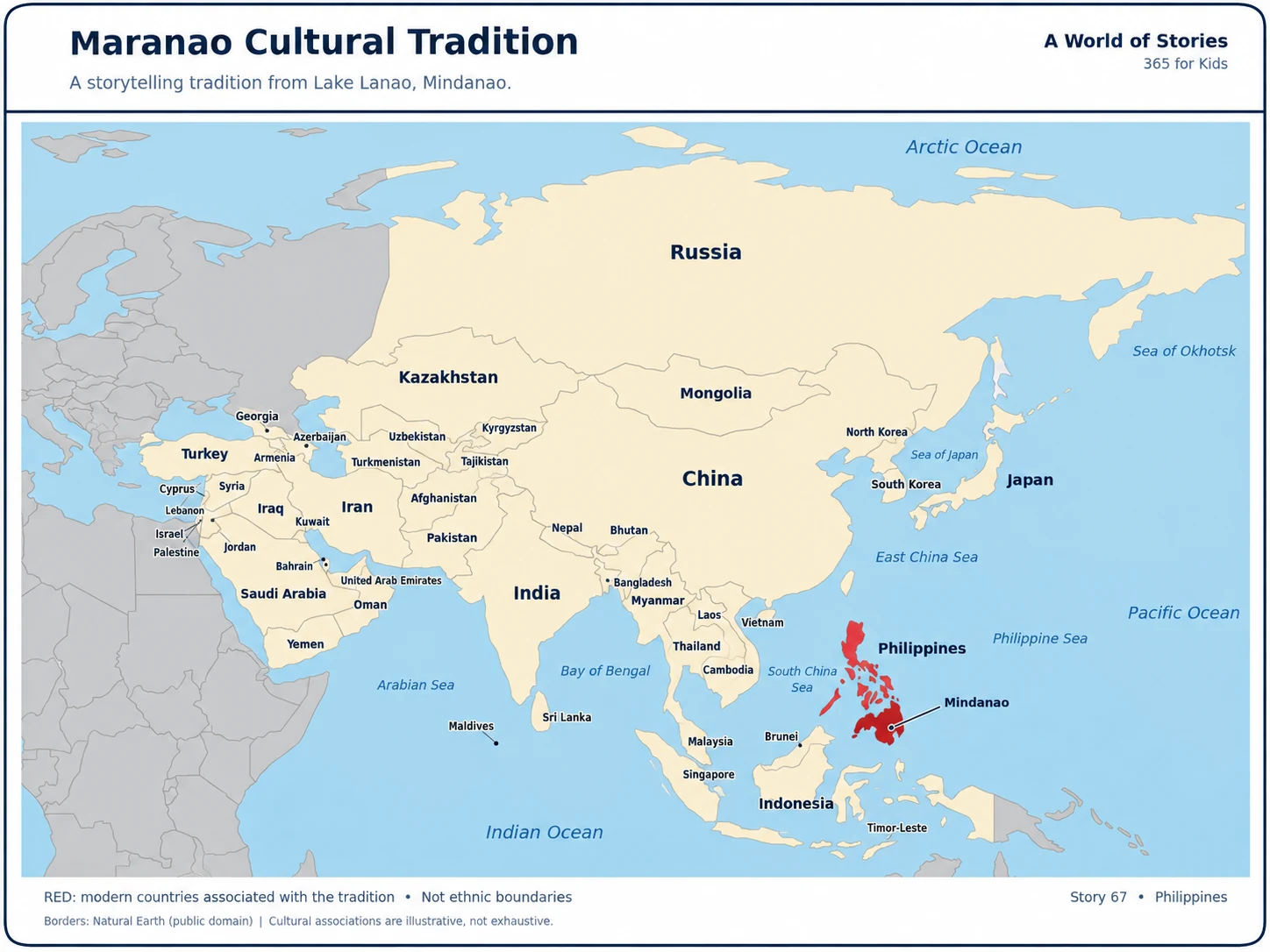
Among the Maranao people of the land around Lake Lanao, the long songs of the Darangen tell of mighty rulers, distant kingdoms, brave warriors, and the powerful feelings that can change a family’s fate. One of their best-known heroes is Prince Bantugan, the defender of a splendid kingdom called Bumbaran.
Bantugan was admired for his courage. In battle he stood before his people, and in distant places the names of his victories were known. He was also celebrated for his grace and noble bearing. Yet the admiration given to the younger prince troubled the heart of his elder brother, the ruler of Bumbaran.
When the king heard that Bantugan was visiting the courts of other kingdoms, his jealousy became bitter. He gathered his counselors and declared that when the prince returned, no one in Bumbaran was to speak to him. Even the people who had known Bantugan all their lives were ordered to greet him with silence.
The counselors were dismayed. They reminded the king that Bantugan had faced danger to protect the kingdom. They warned that a warrior abandoned by his own people might choose never to come home again. But the ruler would not withdraw his command. No one dared disobey.
Bantugan knew nothing of the order. He returned expecting the familiar voices of Bumbaran. The sound of his approach announced that the prince was near, yet those who saw him said nothing. He spoke to people he trusted. They looked away. He tried again, but the silence followed him through his own home.
At first he feared that some terrible disaster had struck the city. Then the truth became clear: the people were silent because his brother had demanded it. Bantugan, who had defended Bumbaran with his strength, found that he could not command even a greeting from those he loved.
The prince went to his family. His little son wanted him to stay, and his sister attended him with tender care. She combed his hair as he prepared to leave. But Bantugan could not bear to live where every conversation with him was forbidden. He said farewell to his son and sister, and set out from Bumbaran alone.
The journey did not bring him peace. Rain overtook him. His grief and weariness grew until he rested beneath a baliti tree. The old song tells that Bantugan called upon the unseen guardians who had aided him before. They carried the exhausted hero toward a palace in the distant Land Between Two Seas.
There Princess Datimbang was at her work when the suffering stranger arrived. She saw that he was gravely ill. She offered him a place to lie down, brought him what comfort she could, and summoned someone skilled in healing. The prince was received with kindness, although no one knew who he was.
But even the princess’s care could not save Bantugan. Far from his family and the kingdom he had protected, the great warrior died. The people of the palace grieved for the unknown guest and wondered what land had lost so noble a man.
The ruler of the Land Between Two Seas ordered Bantugan’s body to be placed upon a royal bed. Flowers and banners adorned the hall. Gongs called people together, and visitors came in great numbers, hoping that someone would recognize the stranger. Yet none could tell his name.
Then a parrot arrived. It was Bantugan’s own bird, searching for its master. At the sight of the still figure, the bird was overcome. When it had recovered, it told those gathered who lay before them: the stranger was Prince Bantugan of Bumbaran.
Now the mystery was solved, but the sorrow became greater. A message was sent home with the parrot, and the news swept through Bumbaran. Bantugan’s family mourned. The king heard what had happened to the brother he had cast aside, and the jealousy that once seemed so important was replaced by regret.
The prince’s body was prepared for the journey back to his homeland. But two heroes of the epic, Mabaning and Madali, would not allow grief to be the end of the story. In the old songs, the souls of the dead have a place beyond the ordinary world. The two companions resolved to find Bantugan’s soul and bring it back.
They rose into the sky upon their enchanted shields. Far above the earth they traveled toward the realm where souls were kept. They passed a gate and then continued toward another, facing a journey unlike any that had carried them between earthly kingdoms.
At last Mabaning found a way to approach the keeper of the dead. He took the appearance of a beautiful young woman and distracted the guardian with a question about a mysterious fruit of the heavenly realm. When the keeper went away to seek an answer, Mabaning entered the place where many souls were held in stoppered bottles.
How could he find one soul among so many? He called Bantugan’s name. From within a bottle came a faint reply. The voice was small, but Mabaning knew it. He took the vessel containing his friend’s soul and hurried back to Madali.
Together the companions descended from the sky, their shields carrying them toward Bumbaran. There the people had gathered around Bantugan’s body. His loved ones could mourn him, but they could not yet welcome him. Everything depended on the fragile treasure that Mabaning had brought home.
Mabaning opened the bottle. The soul was released and returned to its proper place. Life came back to Bantugan, and the prince awoke among the people who had believed him lost forever.
Grief changed to astonishment, then to celebration. The warrior had crossed the boundary between life and death in the old song, and the loyal companions who had gone in search of him had not returned empty-handed. His home was no longer a place of silence.
The Darangen tells many more adventures of Bantugan and the other heroes of Bumbaran. The episode of his death and return is remembered not only for its marvels, but also for the wound caused by envy and the extraordinary lengths to which loyalty can go. In the telling of the Maranao singers, a kingdom’s greatest defender could be lost through one cruel command—and welcomed again through courage, remorse, and devotion.
Cultural Note: The Darangen is a long, living epic-song tradition of the Maranao (also spelled Mëranaw or Maranaw), whose homeland surrounds Lake Lanao in Mindanao, in the southern Philippines. The word Darangen refers to narrating or singing a story. It is much more than a single folktale: the epic consists of many connected cycles and preserves ideas about family, leadership, honor, customary law, love, and conflict.
This prose adaptation presents the well-documented episode commonly described as “How Bantugan Died” and “How Bantugan Came Back from Heaven.” It follows the sequence summarized by folklorist E. Arsenio Manuel: the king’s decree, Bantugan’s departure, the princess’s hospitality, the recognition by a parrot, and the sky-world quest of Mabaning and Madali. Other retellings use different spellings and may describe the roles or names of these heroes differently. This version ends with Bantugan’s return to life; the larger cycle continues beyond that moment.
The Darangen is traditionally chanted by skilled performers, not merely read silently. The United Nations Educational, Scientific and Cultural Organization (UNESCO) inscribed it on the Representative List of the Intangible Cultural Heritage of Humanity in 2008, following an earlier proclamation in 2005.
After the Story: Read · Create · Reflect · Share
1. Find the Philippines on a map of Asia, then locate the island of Mindanao and Lake Lanao. Draw the Philippine flag and describe its colors and symbols.
2. Why did Bantugan leave Bumbaran, even though he had defended the kingdom?
3. Who identified the unknown prince in the distant palace? How did the news reach his home?
4. Mabaning and Madali took great risks for their companion. What does their journey suggest about loyalty? What might the king have done differently?
Inspired by this story? Create your illustration!
IBAN DAYAK — Siu and Seragunting — How Rice Came to the Iban
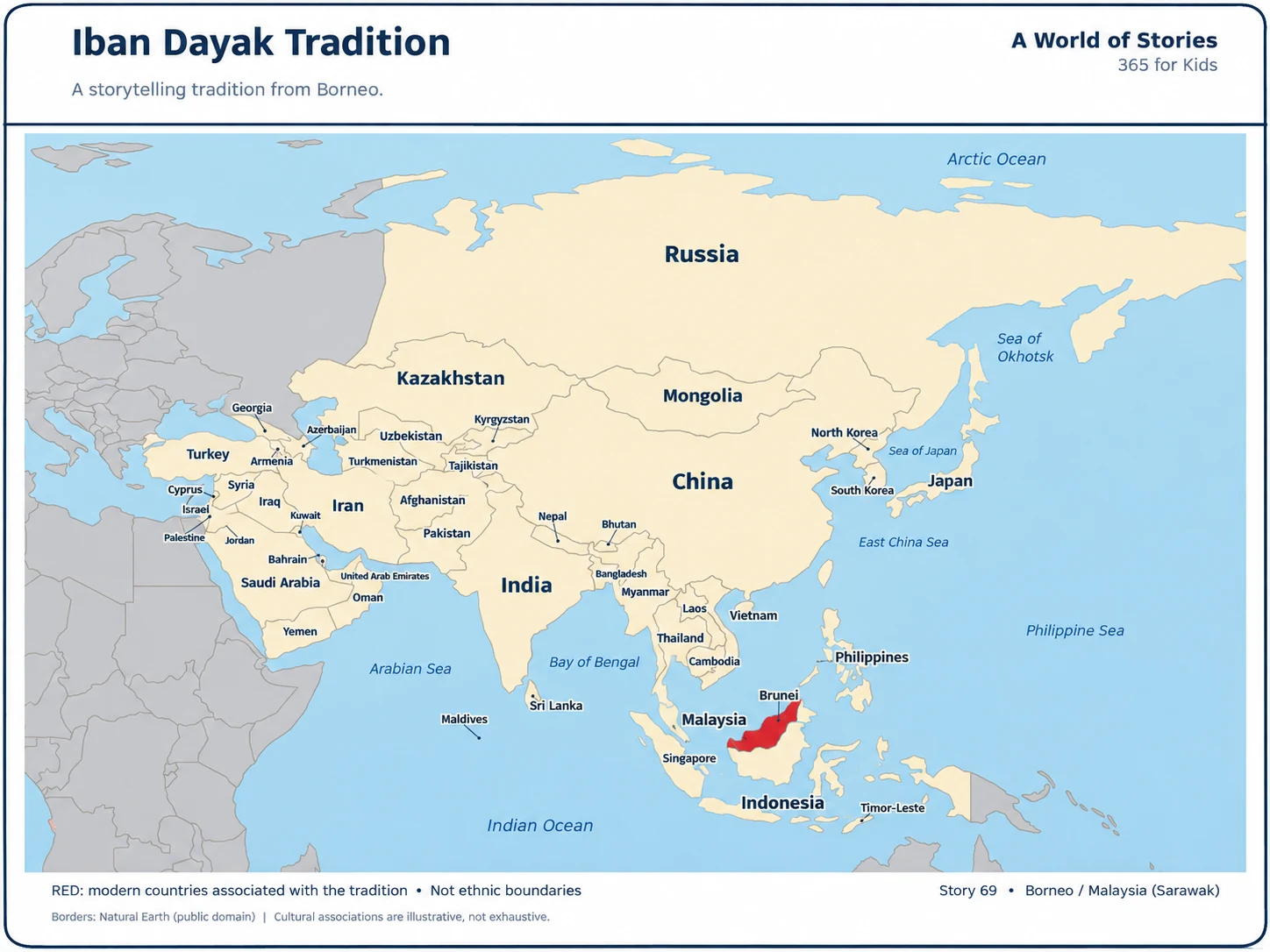
Long ago, according to an Iban legend from Borneo, people did not yet plant paddy, the rice that would become so important in their lives. They gathered fruit in the forest and grew yams and other roots. In those days there lived a young man named Siu, whose father had been a chief. Siu lived with his mother in a great longhouse shared by many families.
One morning Siu and the young men of the longhouse went into the forest to hunt birds. They separated beneath the trees, each taking a different path. Siu walked for hours without seeing anything he could catch. At last he came upon a wild fig tree heavy with ripe fruit. Birds crowded its branches, so many that the tree seemed alive with wings.
Siu aimed his blowpipe and sent a dart toward one bird. To his astonishment, several birds fell together. He tried again, and more fell. Soon he had gathered as many birds as he could carry. But the forest paths confused him. He turned one way, then another, until evening began to darken the trees. The path to his longhouse was lost.
Just when he feared he would have to sleep in the forest, Siu found a garden path. It led to a well and, beyond it, a longhouse. He left his birds and hunting things beside the well, climbed the steps, and called to ask whether a stranger might enter.
A voice welcomed him inside. Yet the large communal hall was empty and strangely quiet. Following a light, Siu reached a room where a young woman greeted him by name. She offered him food and asked about his people. How did she know who he was? Why had she seemed to expect him? Siu could not understand it.
The young woman listened when Siu told her that his village had suffered a poor harvest of roots. She invited him to stay for a while, and he remained seven days. During that time they grew fond of one another. At last Siu asked if she would marry him and return to his home.
She agreed, but first she asked him to make two promises. He must keep secret what he had seen in her household. And he must never harm a bird or even take one into his hands. Siu promised both things.
Only then did she tell him who she was. Her name was Bunsu Burong, also called Bunsu Katupong. She was the youngest daughter of Singalang Burong, the powerful ruler of the spirit world. Members of her family could appear as people in their longhouse or fly through the forest in the shape of birds. Their home had been quiet because the family was in mourning.
Siu remembered the birds he had shot beside the fig tree. He thought of the birds hidden near the well, and of the promise he had just made. He said nothing about his hunt.
Siu and Bunsu Burong were married. After some weeks, they travelled back through the forest to Siu’s longhouse. His family had feared him lost forever. His mother was delighted to welcome him home, and she welcomed her new daughter-in-law too.
In time they had a son, Seragunting. The boy grew with astonishing speed. By the time he was only three, he was already tall and strong. His mother loved him dearly, and he was never far from her thoughts.
Then one day a man passed through the longhouse carrying birds he had caught in a trap. Siu looked at them, forgot the promise he had made, and lifted one bird into his hands. He stroked its feathers. Bunsu Burong saw him. He had broken his word.
She took the water vessels and left as though she were going to the well. There she set the vessels down. Instead of returning, she disappeared into the forest, on her way to the home of her father.
When Seragunting could not find his mother, he and Siu went to the well. Her water vessels were there, but she was gone. The next day they set out to find her. They crossed the forest, sleeping beneath trees at night. Each morning a little bundle of food wrapped in leaves appeared beside Seragunting. He shared it with his father, though neither knew who had left it.
After many days they came to the seashore. Siu wanted to turn back, but Seragunting would not abandon the search. They waited by the water until a dark shape appeared in the distance. As it drew near, it became a gigantic spider. The spider brought food and clothing and told them it had come to guide them across the sea.
The spider went ahead. When Siu and Seragunting followed, the water beneath their feet became firm enough to walk upon. They crossed to the far shore, where they found another settlement of longhouses. At the largest house, Seragunting finally saw his mother.
Bunsu Burong embraced her son. She told him that she had left the food for him each night and had sent the spider to bring them safely across the sea. She had not forgotten him. Siu, too, was welcomed, although the promise he had broken could not simply be undone.
Some of Bunsu Burong’s relatives doubted that Seragunting could truly be the grandson of Singalang Burong. They set him difficult trials to prove who he was. Seragunting passed them, and at last the family accepted him.
Siu missed his own mother and wished to go back to his people. Bunsu Burong chose to remain in her father’s home. Before Siu and Seragunting returned, however, they spent a full year learning things that would help their longhouse. Among these were the methods of planting, caring for, and harvesting paddy.
At the end of that year, Singalang Burong called them before him. He gave them paddy seed to carry home. He also taught them to listen to the calls of certain birds, whose voices, in the legend, brought guidance and warnings from the spirit world.
Then Siu and Seragunting left the longhouse of the bird spirits. A mysterious power carried them swiftly through the air, and they arrived back among their own people. Neighbours gathered to hear about their journey. The two travellers showed the new seed and explained how to grow rice. They also told the people what they had learned about the birds.
And so, the old Iban tale says, rice planting and the listening to bird calls became part of the knowledge handed from one generation to another. What began with a lost path in the forest ended with a gift brought home for an entire community.
Cultural Note: The Iban are one of the Indigenous Dayak peoples of the island of Borneo. Many Iban communities live in Sarawak, Malaysia, and Iban communities also live in Indonesian Borneo. “Dayak” describes many distinct Indigenous peoples; this particular legend is associated with the Iban, not with every Dayak community. The historical English term “Sea Dyak,” found in the source, is an older name used for the Iban.
In this origin legend, paddy means rice in the husk or rice grown as a crop. Singalang Burong is a major spiritual figure in traditional Iban narratives, and bird calls are linked with omens. The story is a traditional explanation of how knowledge and custom came to the community—not a historical claim that rice was literally introduced by one person.
The tale was recorded in English by Edwin Herbert Gomes in the early twentieth century. His books reflect the language and outlook of their time; this adaptation avoids outdated generalizations. It follows the main events and ending of the recorded tale while presenting the prose freshly for children. It does not claim to represent every version of the Iban oral tradition.
After the Story: Read · Create · Reflect · Share
1. Find the island of Borneo on a map of Southeast Asia. Locate Sarawak in Malaysia and Kalimantan in Indonesia. Draw the flag of Malaysia. Why can a people’s stories extend beyond one country’s borders?
2. What promises did Siu make to Bunsu Burong? Which action broke one of those promises, and what happened afterward?
3. How did Seragunting and Siu find Bunsu Burong? What help did they receive along the way?
4. What two kinds of knowledge did Siu and Seragunting bring back to their people? Why might a community preserve a story like this for many generations?
Inspired by this story? Create your illustration!
South Asia
AFGHANISTAN — Buz-e-Chini: The Mother Goat and the Wolf
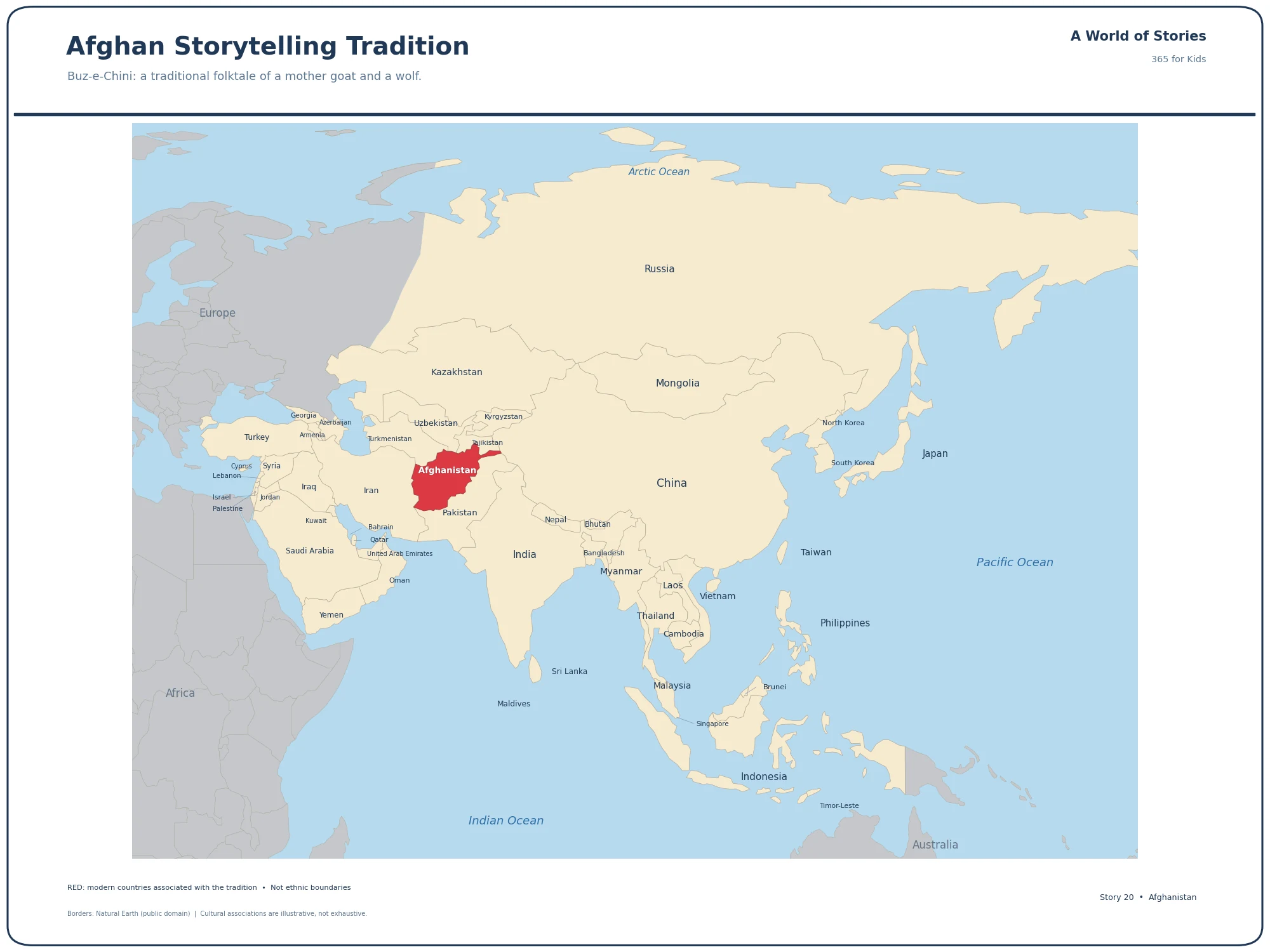
Once upon a time, among the hills of Afghanistan, there lived a mother goat whom everyone called Buz-e-Chini. She had three children: Angak, Bangak, and the youngest, Kola Sangak. Their home was a safe place, and the three little goats knew that their mother would always return to them, even when she went far away to find food.
Before leaving, Buz-e-Chini gave the same warning every time. ‘Keep the door closed,’ she told them. ‘Do not open it to anyone else.’ The little goats promised to remember. They watched their mother set off, then settled inside to wait for her return.
But a wolf had seen her leave. He came to the door and knocked. ‘Who is there?’ the little goats called. The wolf made his voice sound as much like Buz-e-Chini’s as he could. Hearing what seemed to be their mother’s voice, the children opened the door.
The moment it swung wide, the wolf sprang inside. Angak and Bangak had no time to escape. He swallowed them both. Little Kola Sangak, however, managed to hide behind a stone where the wolf could not see him. The wolf searched, but at last he went away, thinking no one remained.
When Buz-e-Chini returned, she knocked and called for her children. No answer came. She called again, more urgently. At last the youngest goat crept out of his hiding place and opened the door. When he saw his mother, he ran to her and told her what had happened.
Buz-e-Chini was overcome with grief. But she would not give up on Angak and Bangak. She set out to learn who had taken them. First she questioned the fox. The fox denied it. She went on to the lion, and then the leopard; neither had taken her children. Finally she made her way to the wolf’s home.
Buz-e-Chini climbed onto the roof and stamped until dust shook down into the room below. The wolf called up angrily, asking who was disturbing his roof and spoiling the food he had prepared. Buz-e-Chini answered with a challenge: she was the mother with two horns above her nose, and she wanted to know whether he had eaten Angak and Bangak.
‘Yes,’ said the wolf. He did not even try to hide what he had done.
‘Then tomorrow you must face me,’ said Buz-e-Chini. The wolf agreed. He was sure that a goat would be no match for him.
Buz-e-Chini went to a blacksmith and brought him a jug of milk. ‘Please sharpen my horns,’ she asked. The blacksmith accepted the milk and worked carefully until her horns were sharp and ready for the contest.
The wolf also went to the blacksmith, carrying a jug that he claimed was filled with milk. But he had put earth inside instead. ‘Sharpen my teeth,’ he demanded. When the blacksmith discovered the deception, he grew angry. He removed the wolf’s teeth and replaced them with teeth made of charcoal. The wolf left believing himself prepared for the fight, though the blacksmith’s work had given him no strength at all.
The following day, Buz-e-Chini and the wolf met for their contest. The wolf attacked first, rushing toward her with his jaws open. Yet his charcoal teeth could do nothing. He could not bite the mother goat.
Now it was Buz-e-Chini’s turn. She lowered her head and ran straight at him. Her sharpened horns struck his belly, and the wolf fell to the ground. In the strange and wonderful way of old folktales, Angak and Bangak came out alive, calling to their mother. Buz-e-Chini gathered all three of her children close.
Together they returned home. The door closed behind them, and at last the little goats were safe with their mother again. They had learned why her warning mattered; and they would never forget how bravely she had come to find them.
Buz-e-Chini (also written Buzak Chini or Buz-e Chini) is a widely told Afghan animal folktale. It is especially familiar through Dari- and Hazaragi-language storytelling. Some sources render the name as “The Chinese Goat,” but this is an Afghan folktale, not a story from China.
This adaptation follows the narrative sequence in the Afghan Ministry of Education’s Dari fourth-grade textbook, Lesson 28: the three young goats, the wolf’s imitation of the mother’s voice, the hidden youngest child, the mother’s inquiries, the challenge, the blacksmith’s sharpened horns and the wolf’s false jug, and the children’s rescue. Their names are transliterated here as Angak, Bangak, and Kola Sangak. Other Afghan versions use names such as Algag, Bulgag, and Chulgag and may change the hiding place or the wolf’s fate. These alternatives have not been blended into the story.
The account contains the traditional danger of being swallowed by a wolf and a fight that ends in a magical rescue. It is presented without graphic detail. The language is an original English literary retelling, not a line-by-line translation of a modern publication.
After the Story: Read · Create · Reflect · Share
1. Find Afghanistan on a map of Asia. Which countries share a border with it?
2. What were the three little goats called? Where did Kola Sangak hide when the wolf entered their home?
3. What did Buz-e-Chini bring to the blacksmith, and how did the wolf try to deceive him? How did those choices change the contest?
4. What do Buz-e-Chini’s actions teach us about courage and caring for others? What could the little goats have done to stay safe?
Inspired by this story? Create your illustration!
BENGALI — The Seven Champa Brothers
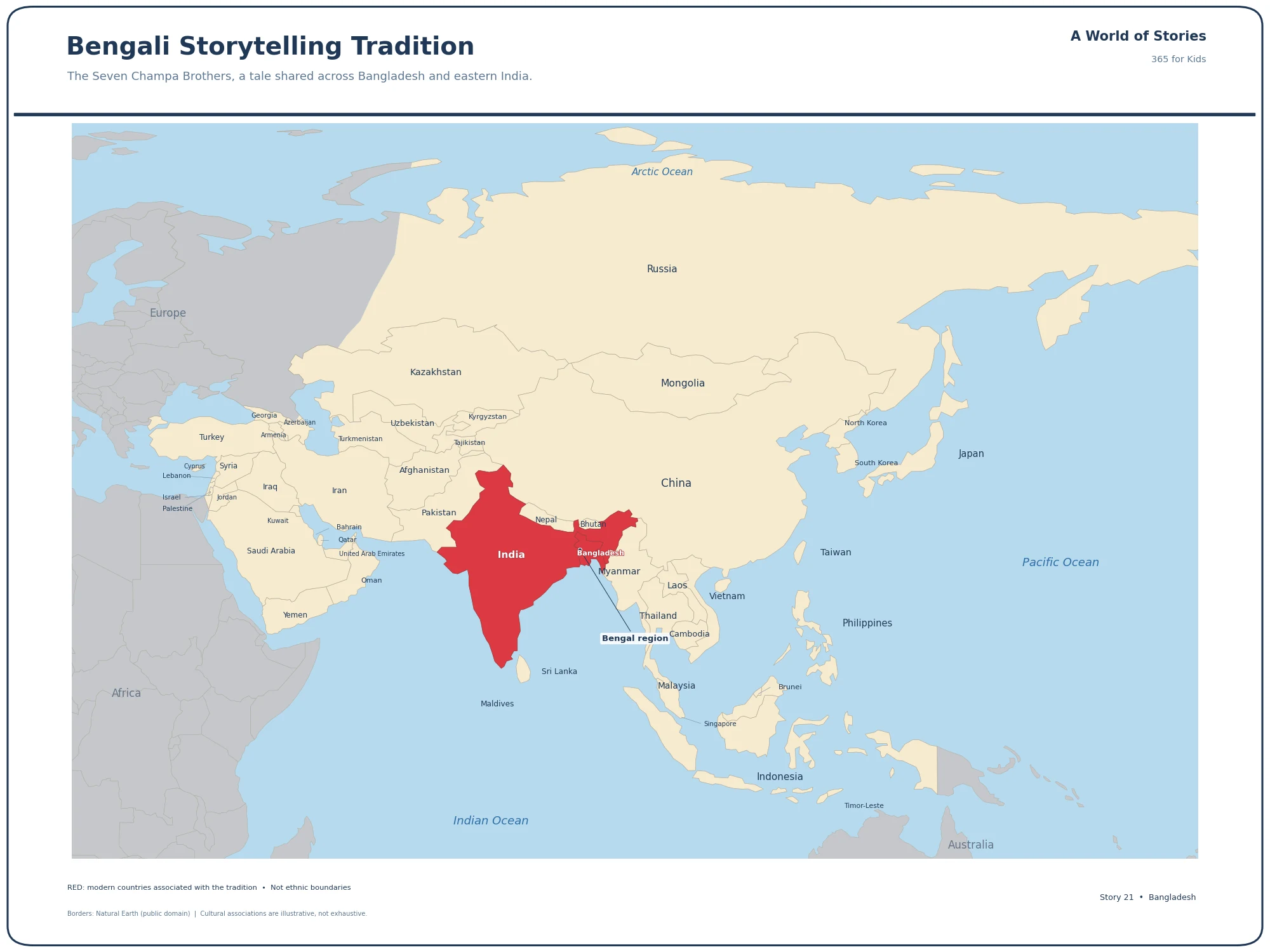
Long ago, there lived a king who possessed a great kingdom and seven queens. The eldest six queens were proud of their rank and splendour, but the youngest was gentle and quiet. The king loved her dearly. Yet, for all the riches in his treasury, one sorrow remained: he had no children to follow him.
The years passed. Then, one day, news came that the youngest queen was expecting a child. Joy swept through the palace. The king opened his stores of sweets and treasures and gave gifts throughout the kingdom. But in the hearts of the six elder queens, jealousy began to grow. They could not bear the thought that their youngest rival might become the mother of the royal heirs.
The king was so eager to hear of the birth that he arranged a golden chain with one end tied at his waist and the other at hers. When the child arrived, the chain was to be shaken, and he would come at once. The elder queens volunteered to attend the mother. But before the children were born, they shook the chain twice. Each time the king hurried from his duties, only to discover that there was no news. Angry at being deceived, he returned to court.
At last the youngest queen gave birth—not to one child, but to seven sons and a daughter. The babies were beautiful. Their mother, weak and exhausted, begged the other queens to let her see them. Instead, they told her a terrible lie: she had brought into the world only small creatures, mice and frogs. The shock overcame her.
While she lay unconscious, the jealous queens hid the eight children in earthen pots and buried the pots beneath a heap of discarded ashes near the palace kitchens. Then they shook the golden chain again.
The king came running, expecting to see his children. The elder queens showed him the mice and frogs they had prepared and declared that these were the youngest queen’s offspring. The king believed their story. In his disappointment and rage, he drove the innocent queen from the palace.
The youngest queen lost everything. She wandered from place to place, collecting and making dried cow-dung cakes that people used as fuel for their cooking fires. Her fine clothes were gone; her hands were rough from work. She knew nothing of the fate of the children she had never been allowed to hold.
Meanwhile, sadness settled over the palace. The king had his riches and his court, but no peace of mind. Even the royal garden seemed to share his grief: its flowering plants ceased to bloom.
One morning, the gardener came before the king with an unusual report. Flowers were needed for the king’s daily worship, yet none could be found in the garden. Only near the old heap of ashes had something astonishing appeared: seven champa blossoms and one parul flower, growing where no one expected anything beautiful to live.
“Bring me those flowers,” the king ordered.
The gardener went to the place and stretched out his hand. Before his fingers reached the flowers, the parul blossom stirred and called to the seven champas:
“Seven brothers, wake and hear!”
“We hear you, sister Parul,” answered the champas. “Who has come?”
“The king’s gardener has come for flowers. Shall he gather us?”
“Not yet,” the brothers replied. “Let the king himself come first.”
As the gardener watched, the blossoms rose beyond his reach. He hurried back to the palace, astonished, and told the king about the speaking flowers. The king, surrounded by his courtiers, went to see the marvel for himself.
Again Parul called to her brothers. Again they answered. But when she asked whether they would allow the king to gather them, the seven blossoms rose higher still.
“Let the eldest queen come,” they said.
The eldest queen arrived, certain that the flowers would obey her. They did not. Instead, they called for the next queen. One by one, all six elder queens were summoned. Each time, the parul flower called to her brothers, and each time the champas refused to be plucked. Higher and higher they climbed, until they seemed like little stars in the sky.
The king stared upwards, bewildered. Then the voices of the flowers rang down once more:
“Bring us the woman who gathers dung for fuel—the queen who was sent away.”
Servants searched for her, and a royal palanquin was sent to bring her back. The youngest queen arrived in her worn clothes, with the marks of hard work upon her hands. She did not look like a queen. She had not even known why the king wanted to see her again.
But as soon as she approached the flowers, the seven champas began to descend. Down they came from the height of the sky. The parul blossom joined them. Before the watching court, the eight flowers changed into seven boys and a girl.
“Mother! Mother!” the children cried, rushing into her arms.
The youngest queen held them close. For so long she had lived without knowing what had happened to them. Now she saw seven sons and a daughter before her, alive and calling her their mother.
The king wept. The truth, hidden for years beneath the ashes, had finally come into the light. The six elder queens trembled, for their cruelty had been revealed. The king ordered that they be buried in a pit lined with thorns.
Then the king welcomed the youngest queen and all eight children into the palace. Drums of celebration sounded through the kingdom. The seven champa brothers and their sister Parul had returned to their mother, and the long silence of the royal garden was broken.
Cultural tradition. Saat Bhai Champa (সাত ভাই চম্পা) is a Bengali folktale shared in Bangladesh and the Bengali-speaking regions of India. Champa and parul are flowers named in the traditional story; Parul is also the name by which the sister is known. The story appears in Dakshinaranjan Mitra Majumder’s collection Thakurmar Jhuli (1907), and in F. B. Bradley-Birt’s Bengal Fairy Tales (1920).
Choice of version and age guidance. This is an original English literary adaptation following the older printed storyline: the seven sons and one daughter are hidden in pots, later appear as seven champa blossoms and a parul blossom, and are restored when their mother arrives. The older text ends with the severe punishment of the six elder queens; that event is retained without graphic elaboration. Some present-day classroom retellings instead have the elder queens expelled from the palace. Themes include infant endangerment and cruelty, so younger readers may benefit from an adult reading alongside them. The tale is traditional storytelling, not a historical account.
After the Story: Read · Create · Reflect · Share
1. Find Bangladesh and India on a map of South Asia. Why do we describe this as a Bengali story shared across modern borders?
2. What did the six elder queens do to the children, and why did the king believe their story?
3. Why did the champa flowers refuse the gardener, the king, and the elder queens, but come down when their mother arrived?
4. Draw the flag of Bangladesh. Then draw seven champa blossoms and one parul flower, and explain what they represent in the tale.
Inspired by this story? Create your illustration!
BHUTAN — The Four Harmonious Friends
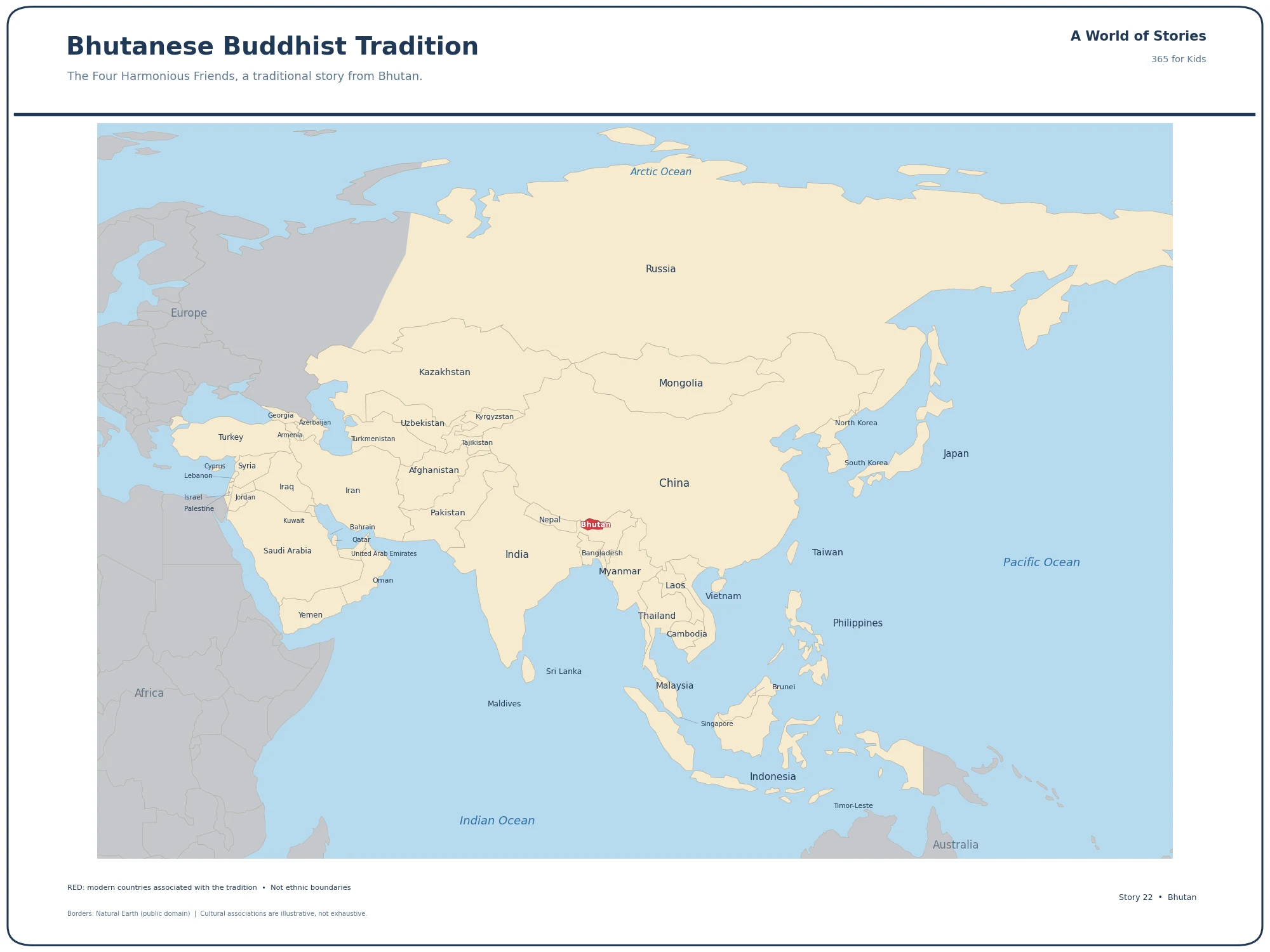
In a forest, where trees spread their branches toward the sky and fruit ripened above the green earth, four animals lived near a great fruit tree. They were an elephant, a monkey, a rabbit, and a small bird. Each knew the tree well. Each had found nourishment there. Yet they did not always agree about how its fruit should be shared.
The elephant was the largest. With his powerful body and long trunk, he seemed to occupy the most important place beneath the branches. The monkey was quick and nimble, able to climb where the elephant could not. The rabbit was smaller and kept close to the ground. The bird was smaller still, but the highest branches were within reach of its wings.
When they gathered beneath the tree, each considered what he could do and what he deserved. The elephant was proud of his strength. The monkey trusted his clever movements. The rabbit remembered how long he had lived near the tree. The bird, looking down from a branch, knew something none of the others had yet considered.
At last, instead of continuing to disagree, the four began to talk. They would try to discover which of them had known the tree the longest. Perhaps its history could teach them how to treat one another.
The elephant was the first to speak. ‘I remember this tree from the days when I was only a calf,’ he said. ‘Even then, it was a tree with branches rising above me. I have known its shade for a very long time.’
The monkey nodded, but he remembered something earlier. ‘When I was small, the tree was still young,’ he said. ‘I remember its narrow trunk and branches that had not yet reached so high.’
Then the rabbit lifted his ears. ‘When I first came here,’ he said, ‘this tree was scarcely more than a tender young shoot. I remember it before it had become a tree such as you see today.’
The others looked at him with surprise. It seemed that the rabbit had known the tree longer than either the monkey or the elephant. But the bird had not yet spoken.
‘I remember a time before this tree grew at all,’ said the bird.
The elephant, the monkey, and the rabbit turned toward their smallest companion.
‘Before it grew?’ asked the monkey. ‘How could you have known a tree before it was here?’
The bird told them about a different fruit tree from long ago. The bird had eaten its fruit and carried its seeds away. One of those seeds had passed through the bird and fallen onto this very patch of ground. From that seed, the tree beside them had begun to grow.
There was a moment of silence beneath the branches. The great elephant had not been there at the beginning. Neither had the lively monkey nor the watchful rabbit. The little bird had known the tree from the seed that gave it life.
Now the four understood their order: the bird was the eldest, then the rabbit, then the monkey, and finally the elephant. The largest animal was the youngest. The smallest was the oldest.
They decided to honour the bird’s greater age and experience, and to show one another more consideration. They did not need to be alike in size or ability to live peacefully together. Each had a place among the others.
But understanding the past was only part of their lesson. The fruit still hung high among the leaves, and the four friends still needed to share it. Looking at the tree, they began to see their differences in a new way—not as reasons to quarrel, but as ways to help.
The elephant’s strong back could support the monkey. The monkey could hold the rabbit. The rabbit could offer a resting place for the bird. One above another, they formed the remarkable tower that people still picture when they tell their story: elephant at the bottom, monkey above, rabbit next, and bird at the very top.
From there the bird could reach the fruit among the upper branches. The monkey helped pass it down; the rabbit received and gathered what came within reach; and the elephant helped make sure that all four had a share. No one could have made such a tower alone. No one’s strength or smallness made the others unnecessary.
Together, they enjoyed the fruit of the tree. The elephant was still strong, the monkey still agile, the rabbit still attentive, and the bird still able to fly. Nothing about their bodies had changed. What had changed was the way they treated one another.
In time, their friendship became a picture of harmony: four different animals, resting one upon another, beneath a tree heavy with fruit. The image reminds those who see it that respect and cooperation allow everyone to benefit, and that even the smallest member of a community may have something precious to offer.
Cultural tradition. Thuenpa Puen Zhi (also written Thuenpa Puenzhi or Thuenpa Puen Zhi) means ‘Four Harmonious Friends’ or ‘Four Harmonious Siblings’ in Bhutanese usage. The image of an elephant supporting a monkey, a rabbit, and a bird is widespread in Bhutanese paintings and carvings and expresses cooperation, mutual respect, and interdependence. This story is part of a wider Buddhist storytelling tradition shared across several Himalayan and Asian cultures.
Choice of version. This original English literary adaptation follows the Bhutanese account published by the Department of Culture and Dzongkha Development: the animals compare their memories of the fruit tree, discover that the bird knew it from its seed, agree to honour the eldest, and cooperate to share its fruit. Other widely told versions focus on planting and tending the tree; their events have not been mixed into this retelling. The older Tittira Jataka features three animals—partridge, monkey, and elephant—while the four-animal image is especially familiar in Bhutanese and Himalayan art.
Reading and cultural guidance. In the traditional Buddhist context, the friends’ recognition of seniority teaches respect for elders. The story can also open a discussion about respect for every person regardless of age or size, and about the practical value of cooperation. The animals and the fruit tree are part of a moral tale, not a literal historical report.
After the Story: Read · Create · Reflect · Share
1. Find Bhutan on a map of Asia. Which two large countries lie on either side of Bhutan? Draw the flag of Bhutan and notice the dragon in its design.
2. What did each animal remember about the tree? Put the elephant, monkey, rabbit, and bird in order from youngest to oldest.
3. Why did the others recognize the bird as the eldest? What does this tell you about judging others by their size or strength?
4. Draw the four friends standing one above another beneath the fruit tree. What could each one contribute to a shared task in your classroom or family?
Inspired by this story? Create your illustration!
INDIA MONKEY CROCODILE — The Monkey and the Crocodile
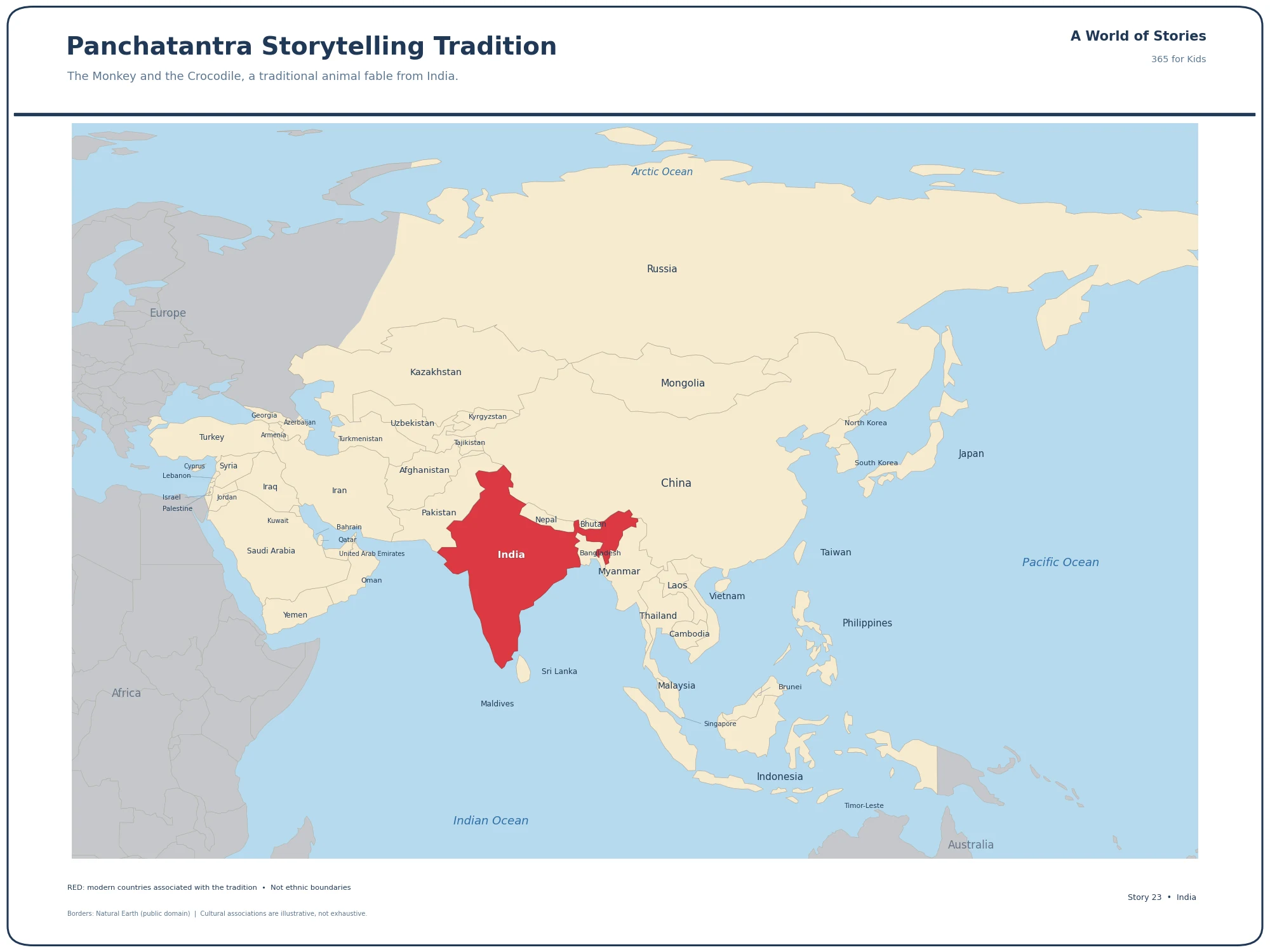
Beside the sea stood a great rose-apple tree, its branches spreading wide above the shore. In every season it bore delicious fruit. Among its leaves lived a monkey called Raktamukha, or Red-Face, who had all the food and shelter he needed.
One day, a crocodile named Karalamukha came up from the water and rested on the sand beneath the tree. Red-Face looked down at the stranger and greeted him kindly.
‘You have come to my home,’ said the monkey. ‘Please share my fruit.’ He picked the ripest rose-apples and dropped them to the ground.
The crocodile tasted one, then another. He had never eaten anything quite so sweet. Soon the two were talking as comfortably as old companions. When evening came, the crocodile returned to the water, and the monkey watched him go.
After that, Karalamukha visited the tree often. The monkey welcomed him with fruit, and they spent long hours in conversation. In time, their pleasure in one another’s company grew into friendship.
Whenever Karalamukha returned home, he took some of the rose-apples to his wife. At first she simply enjoyed them. Then one day she asked where such wonderful fruit could be found.
‘A generous monkey called Red-Face gives them to me,’ answered the crocodile. ‘He lives in a tree on the shore. He is my good friend.’
His wife thought for a while. ‘If the fruit he eats is so sweet,’ she said, ‘then his heart must be sweeter still. Bring it to me, and I shall eat it. Perhaps it will keep me young and free from illness.’
Karalamukha was appalled. ‘How can you ask that of me? The monkey has welcomed me and fed me. He is like a brother. I cannot kill a friend who has shown us such kindness.’
But his wife would not be persuaded. She demanded the monkey’s heart again and again. At last she declared that she would refuse all food until Karalamukha brought it to her.
The crocodile was deeply troubled. He knew what his friend deserved, yet he feared his wife’s anger. Instead of standing by his first refusal, he allowed himself to be led into a cruel plan.
When he next reached the rose-apple tree, the monkey noticed that he was unusually quiet. ‘Why are you so sad today?’ Red-Face asked. ‘Has something happened?’
‘My wife has been scolding me,’ the crocodile replied. ‘She says it is shameful that I enjoy your hospitality every day but never invite you to ours. She has prepared a fine welcome and is waiting for you. Will you come home with me?’
The monkey was delighted by the invitation, but he hesitated. ‘You know I live among branches,’ he said. ‘Your home is in the water. How could I possibly visit?’
‘Climb onto my back,’ replied Karalamukha. ‘I will carry you safely.’
Trusting his friend, Red-Face climbed down and settled on the crocodile’s back. Karalamukha swam away from the shore. The tree grew smaller behind them, and the sea became deep beneath the monkey’s feet.
As the waves rose around them, Red-Face grew frightened. ‘Please swim more gently,’ he called. ‘I am not accustomed to such deep water.’
The crocodile knew that the monkey could not escape in the open sea. He decided there was no longer any reason to hide the truth.
‘I must tell you something,’ he said. ‘My wife wants to eat your heart. I have deceived you, and I am taking you to her.’
The monkey felt a terrible fear. He was far from any branch or rock, and the water stretched all around him. Yet he did not cry out or try to fight the crocodile. He understood that his only hope was to think quickly.
‘My friend,’ he said, trying to sound calm, ‘why did you not tell me this before we left? I would gladly have brought what your wife asks for. Unfortunately, I left my special heart in a hollow of the rose-apple tree.’
Karalamukha listened in surprise. ‘You left your heart in the tree?’
‘Of course,’ replied Red-Face. ‘It is much too precious to carry about when I leap from branch to branch. Turn back, and I shall fetch it for you.’
The crocodile, eager to satisfy his wife, believed every word. He turned and swam straight toward the shore.
As soon as they reached the tree, Red-Face sprang from his back and scrambled up the trunk. Higher and higher he climbed, until he was safe among the branches. Only then did he look down.
‘Now, my friend,’ said Karalamukha from below, ‘bring me the heart you left behind. My wife is waiting.’
‘Foolish crocodile!’ the monkey answered. ‘How could anyone leave a heart hanging in a tree? You were ready to sacrifice a friend who trusted you. I told you what I had to tell you to save my life. You will get no heart from me.’
Karalamukha was ashamed that he had let the monkey escape. But even then he tried once more to deceive him. ‘I was only joking,’ he called. ‘There is no danger. Come now, and let us go to my home as guests and friends.’
Red-Face did not climb down. ‘No,’ he replied. ‘I trusted you once, and you showed me what you meant to do. I shall not place myself in your power again.’
The monkey remained safe in his rose-apple tree. The crocodile had gained neither the heart his wife demanded nor the friendship he had once enjoyed. By betraying a generous companion, he had lost something he could not recover with another promise.
Cultural tradition. This tale comes from the Panchatantra, a classical Indian collection of interconnected animal fables traditionally associated with Vishnusharman. It opens Book IV, usually titled “Loss of Gains” (Labdhapranasham). The monkey’s Sanskrit name, Raktamukha, means “Red-Face”; the crocodile is called Karalamukha, rendered by Ryder as “Ugly-Mug.” The rose-apple or jamun tree is part of the traditional setting.
Choice of version. This original English literary adaptation follows the central narrative translated by Arthur W. Ryder in 1925 from the Panchatantra tradition: the offered rose-apples, the wife’s demand for the monkey’s heart, the sea journey, the monkey’s claim that his heart is in the tree, and the crocodile’s unsuccessful attempt to lure him back. The full book surrounds the story with verses and additional embedded fables, which are not reproduced here. The characters are animals, and the episode is a fable rather than a historical event.
Reading guidance. The original is direct about the intention to kill the monkey; this adaptation keeps that danger without graphic description. Children can consider hospitality, how pressure may lead someone to betray a friend, quick thinking in an emergency, and the importance of judging trust through actions rather than promises. Related monkey-and-crocodile narratives also appear in Buddhist Jataka traditions, but this adaptation is specifically based on the Panchatantra version.
After the Story: Read · Create · Reflect · Share
1. Find India on a map of Asia. Which ocean lies to its south? Draw India’s flag and identify its three colours and the wheel in the centre.
2. How did the monkey and the crocodile first become friends? What did the crocodile’s wife ask for, and why?
3. What did Red-Face say to persuade the crocodile to return to the tree? Why was that a clever solution to his danger?
4. Why did the monkey refuse the crocodile’s second invitation? Discuss the difference between forgiving someone and trusting them with your safety.
Inspired by this story? Create your illustration!
INDIA LION MAKERS — The Lion-Makers
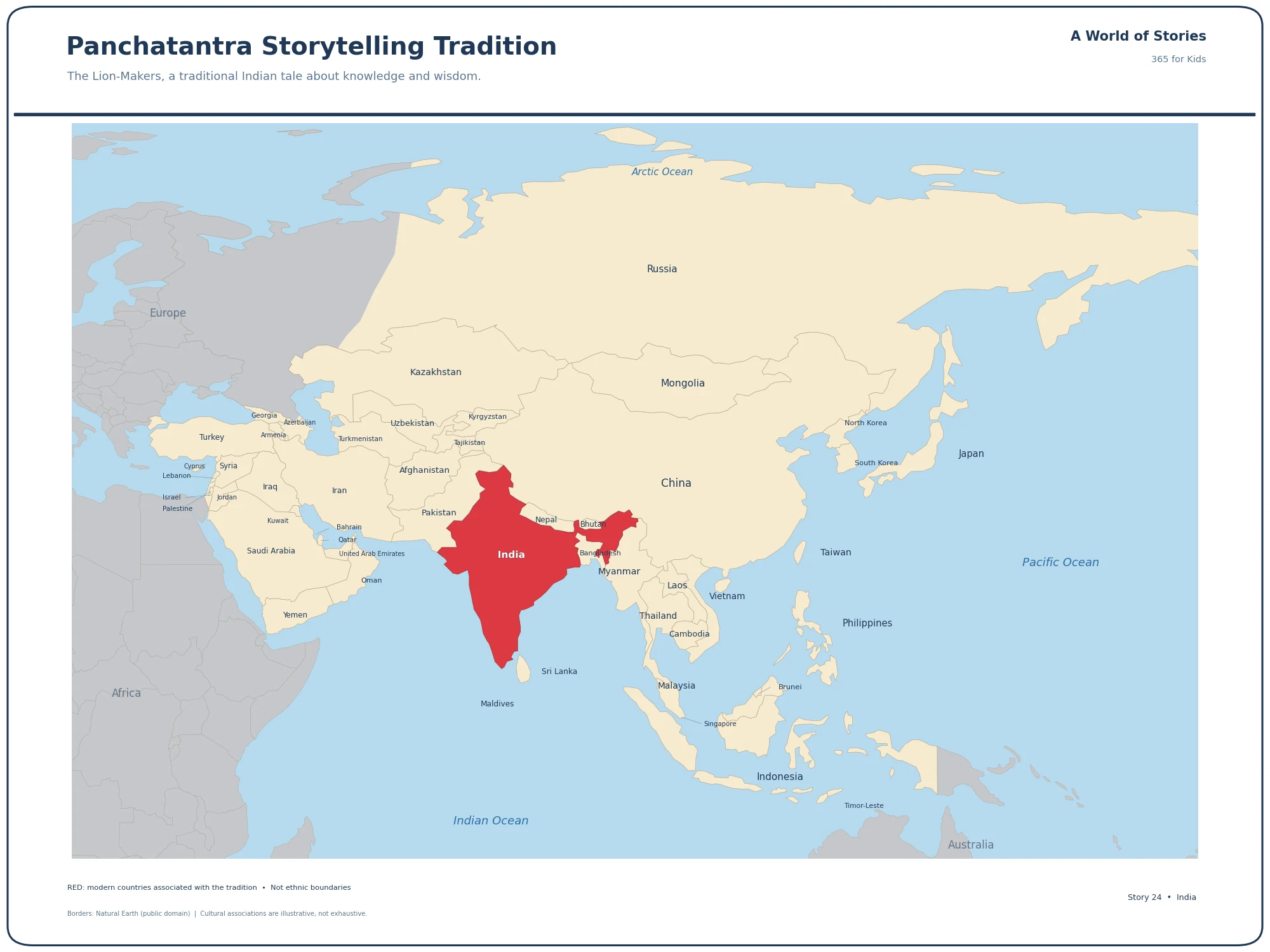
In a town in India, four young Brahmin men had grown up together as friends. They had shared the same games in childhood, but as they grew older, their interests took different paths.
Three devoted themselves to learning. They studied for years and mastered remarkable skills. There was scarcely a subject they did not wish to discuss, and they were proud of what they knew. The fourth friend had little taste for long study. Yet he possessed a different gift: he could see what a situation required and judge what might happen next.
One day the four friends met to consider their future.
“We have learned so much,” said one of the scholars. “What good will our knowledge do if we stay here? We should travel to other lands, find favour with kings and make our fortunes.”
The others agreed, and the four set off together.
They had not travelled far when the eldest scholar began to question the decision.
“Our fourth companion has no great learning,” he told the others. “A king will reward people for their knowledge, not simply for good sense. Why should we divide the wealth we hope to earn with someone who cannot help us win it?”
The second scholar agreed. He turned to their friend and suggested that he should return home.
But the third scholar would not hear of it.
“We have been friends since we were children,” he said. “Is that worth nothing? He has walked beside us all this way. Let him continue, and let him share whatever we may earn.”
At last the others accepted this, and the four companions went on together.
Their road took them into a forest. Tall trees stood close on either side of the path, and fallen leaves covered the ground. As they walked, they noticed a scattered heap of bones.
The three scholars stopped to examine them.
“Here is an opportunity,” said the first, “to discover how powerful our learning has become. Let us put this dead creature together and restore it to life.”
“I can fit every bone into its proper place,” the first scholar declared.
“And I can give the body flesh, blood and skin,” said the second.
“Then I shall give it the breath of life,” announced the third.
The first scholar began his work. Bone by bone, the scattered pieces came together until a complete skeleton lay before the friends. The second used his extraordinary knowledge, and the bare bones were covered with flesh and skin.
Now the fourth friend could see plainly what creature they had made. It had powerful limbs, great paws and the unmistakable shape of a lion.
He stepped forward at once.
“Please stop,” he warned. “This is a lion. If you bring it back to life, it will attack us. Think what you are doing before you go any further.”
The third scholar refused to listen.
“After all the years I have spent learning this skill, do you expect me to leave my work unfinished? I shall not waste my knowledge now.”
The fourth friend knew that he could not persuade him. He looked around and saw a tree close by.
“Then wait just a moment,” he said. “Let me climb this tree first.”
The scholars allowed him to do so. He climbed until he was safely above the forest floor and settled among the branches.
Below him, the third scholar began the final part of his work. He used all his skill to return life to the motionless animal.
The lion stirred.
Its eyes opened. Its great body rose from the ground. And, in an instant, the living lion attacked the three men standing beside it. None of the scholars survived.
High in the tree, their friend remained still. He had warned the others, but they had valued the display of their knowledge more than the danger before them. He could do nothing now but stay out of the lion’s reach.
At last the animal moved away into the forest. Only when it had gone did the fourth friend climb down. He left the place behind and returned safely to his home.
The three scholars had possessed extraordinary learning, but had failed to ask the simplest question: what would happen if their plan succeeded? Their friend had no such power, yet his good judgment had saved his life.
Cultural tradition. “The Lion-Makers” (also published as “The Story of the Brahmins Who Made a Lion”) belongs to the Panchatantra, a classical Sanskrit collection of linked fables and teachings from India. It appears in Book V, generally titled “Ill-Considered Action” (Aparīkṣitakāraka). In the traditional account the four friends are Brahmins, a term connected with a long-standing social and religious tradition in South Asia. The story is a fable, not a historical record.
Choice of version. This original English literary adaptation follows the sequence preserved in the Purnabhadra recension and translated by Arthur W. Ryder: four childhood friends; three learned scholars and a fourth with practical judgment; the dispute about sharing future rewards; a journey through the forest; the restoration of a lion from its bones; the warning, the tree, and the fatal outcome. Descriptive passages and dialogue have been retold for a modern young audience, without changing the events or inventing a happier ending.
Reading guidance. The fable contains the deaths of three characters but no graphic violence is needed to understand its meaning. The point is not that education is useless: it is that knowledge should be joined to foresight, sound judgment and a willingness to listen to others. The story also invites discussion about loyalty and the way people treat someone whose abilities differ from their own.
After the Story: Read · Create · Reflect · Share
1. Find India on a map of Asia. Draw its flag and identify the three horizontal colours and the wheel in the centre.
2. Why did the first two scholars want their fourth friend to return home? What did the third scholar say in his defence?
3. What did each of the three scholars contribute to bringing the lion back to life? How did the fourth friend recognise the danger?
4. What is the difference between knowing how to do something and deciding whether it is wise to do it? Give an example from everyday life.
Inspired by this story? Create your illustration!
MALDIVES — Rannamaari — The Sea Demon
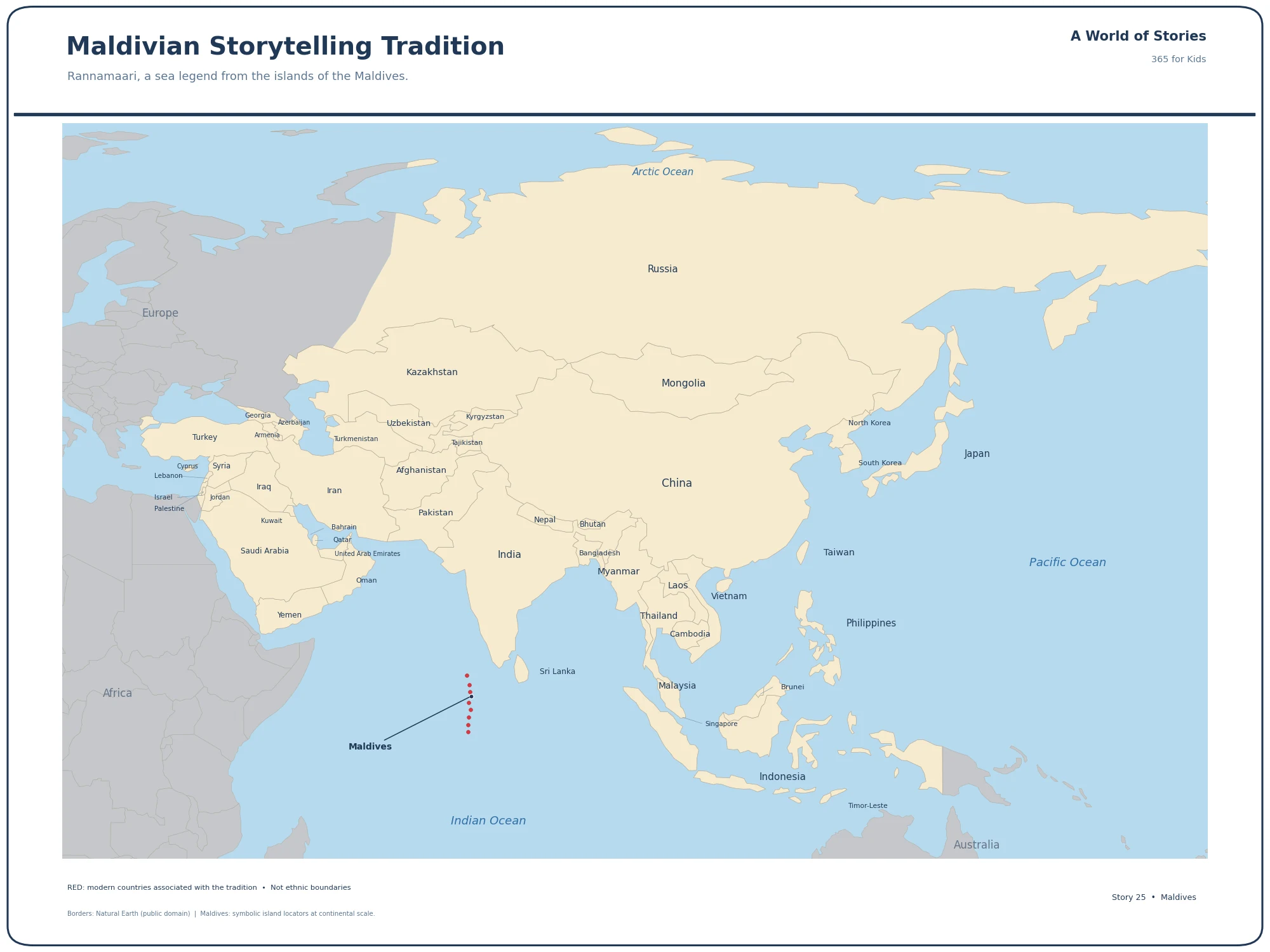
In the islands of the Maldives, the sea has always been a part of daily life. It gives fish to the people, carries boats between their homes, and stretches in every direction beyond the coral reefs. But in an old legend told on the islands, the sea once brought something the people feared.
Once each month, a strange light appeared upon the water near Malé. From a distance it looked like a ship filled with burning lamps. Yet, according to the people who told the story, it was no ship at all. They believed it was Rannamaari, a powerful spirit that came from the sea.
The islanders dreaded its visits. In the version of the legend recorded many centuries ago, they believed that the only way to keep the spirit from harming their community was to leave a young woman alone in a temple beside the shore. Each month a family was chosen by lot. When the people returned at dawn, the young woman was dead.
No household knew when its turn would come. Every new month brought the fear of another name being chosen.
One day the lot fell upon an elderly woman who lived on the island of Malé. She had only one daughter. The woman knew what the choice meant, and grief filled her house. Her relatives gathered around her, weeping together.
At that time a traveller named Abu al-Barakat al-Barbari was staying with the woman. He had come from the Maghreb, the region of North Africa far to the west of the islands. He was a learned Muslim who knew the Qur’an by heart.
When he saw the sorrow in the house, he asked what had happened. At first he could not understand the explanation, for he did not speak the language of his hosts. Then an interpreter told him about the lights at sea, the terrible custom, and the woman’s daughter.
Abu al-Barakat listened. He understood that, unless something changed, the daughter would be taken to the temple that very night.
He told the woman that she need not send her child. He would go in the girl’s place.
The traveller made his preparations. He washed as he did before prayer and, when the appointed hour came, allowed himself to be taken to the temple on the shore. He was young-looking and without a beard, so he could take the place of the person the people expected to leave there.
Inside the temple was a window facing the water. Beyond it lay the dark sea, where the mysterious lights had appeared before.
Abu al-Barakat began to recite verses from the Qur’an. He continued as the night deepened. He did not leave the temple, and he did not stop his recitation.
Then the lights appeared.
Far across the water they shone like lamps upon a vessel. The bright shape moved towards the island. As it drew nearer, Abu al-Barakat could see it through the window. Still he continued to recite.
According to the legend, when the spirit came close enough to hear the words, it turned away. The strange brightness withdrew from the shore and disappeared into the sea.
The traveller remained where he was until morning.
At dawn the woman’s family and other islanders came to the temple. They had expected a dreadful sight. Instead they found Abu al-Barakat alive, sitting where he had spent the night, still reciting the Qur’an.
They were astonished. The story of what had happened was carried to the king, whose name is given in the old account as Shanurazah.
The king listened to the traveller and heard about the faith that had sustained him through the night. Abu al-Barakat invited him to accept Islam. The king wanted to be certain that the danger had ended. He asked the traveller to remain on the island until the next visit of the spirit and to face it once more.
Abu al-Barakat agreed to stay.
Before that month was over, the king and his household accepted Islam, as the legend relates. When the next month began, the traveller returned to the temple. Again he spent the night reciting the Qur’an.
This time, no spirit appeared.
When morning came, the king and his people found the traveller unharmed. In the telling recorded by the fourteenth-century traveller Ibn Battuta, the old temple was then pulled down, and the people sent messengers to other islands to tell them of the change of faith.
The legend says that the islands embraced Islam, and the dreadful custom of leaving a young woman on the shore came to an end.
Generations later, the people of the Maldives continued to tell the story of Rannamaari: of the lights that once seemed to rise from the sea, of the frightened islanders, and of the traveller who offered to take a young woman’s place.
Like many legends, it carries the memory of a great turning point in a country’s life. It also leaves the listener with a question: what can change when someone decides that an old and frightening custom must not continue?
Cultural tradition. Rannamaari (also written Ranna Māri) is a well-known Maldivian legend associated with the arrival of Islam in the islands. It is a religious foundation narrative, not a historically verified report of a supernatural event. The Maldives is an island country in the Indian Ocean; its national language is Dhivehi.
Choice of version. This original English literary adaptation follows the core sequence of the legend as reported by the fourteenth-century traveller Ibn Battuta and reproduced in Xavier Romero-Frias’s Folktales of the Maldives, pp. 74–75: the monthly spirit; the chosen daughter; Abu al-Barakat volunteering in her place; the first night of Qur’an recitation; the king’s request; a second night without an appearance; and the islanders’ religious change. The name Rannamaari comes from Maldivian tradition; Ibn Battuta described a sea-spirit or jinn.
History and belief. The Maldives’ conversion to Islam during the twelfth century is a historical subject, but the sea-demon episode belongs to legend. Modern scholars note that the conversion involved a more complex social and political history than any single supernatural tale can explain. The story’s description of the earlier religious community should not be treated as evidence that their beliefs caused the deaths described in the legend.
Reading guidance. This version does not describe sexual violence or death graphically, but it does refer to girls losing their lives. Because of its frightening subject, it is most suitable for older children or guided reading with a parent or teacher. The Qur’an is Islam’s sacred scripture; its recitation is presented here as a significant element of the traditional account, not as an instruction to readers.
After the Story: Read · Create · Reflect · Share
1. Find the Maldives on a map of South Asia and the Indian Ocean. Draw its flag. What shape and colours can you see?
2. What did the islanders believe Rannamaari looked like when it approached from the sea? Why were they so afraid of its visits?
3. What did Abu al-Barakat offer to do for the elderly woman and her daughter? What happened during his first night in the temple?
4. This story is a legend about a religious change, not a proven account of a sea creature. Why is it important to distinguish traditional beliefs from historical evidence while respecting the people who tell the story?
Inspired by this story? Create your illustration!
NEPAL NEWAR — Majipa Lakhe — The Guardian of Kathmandu’s Children
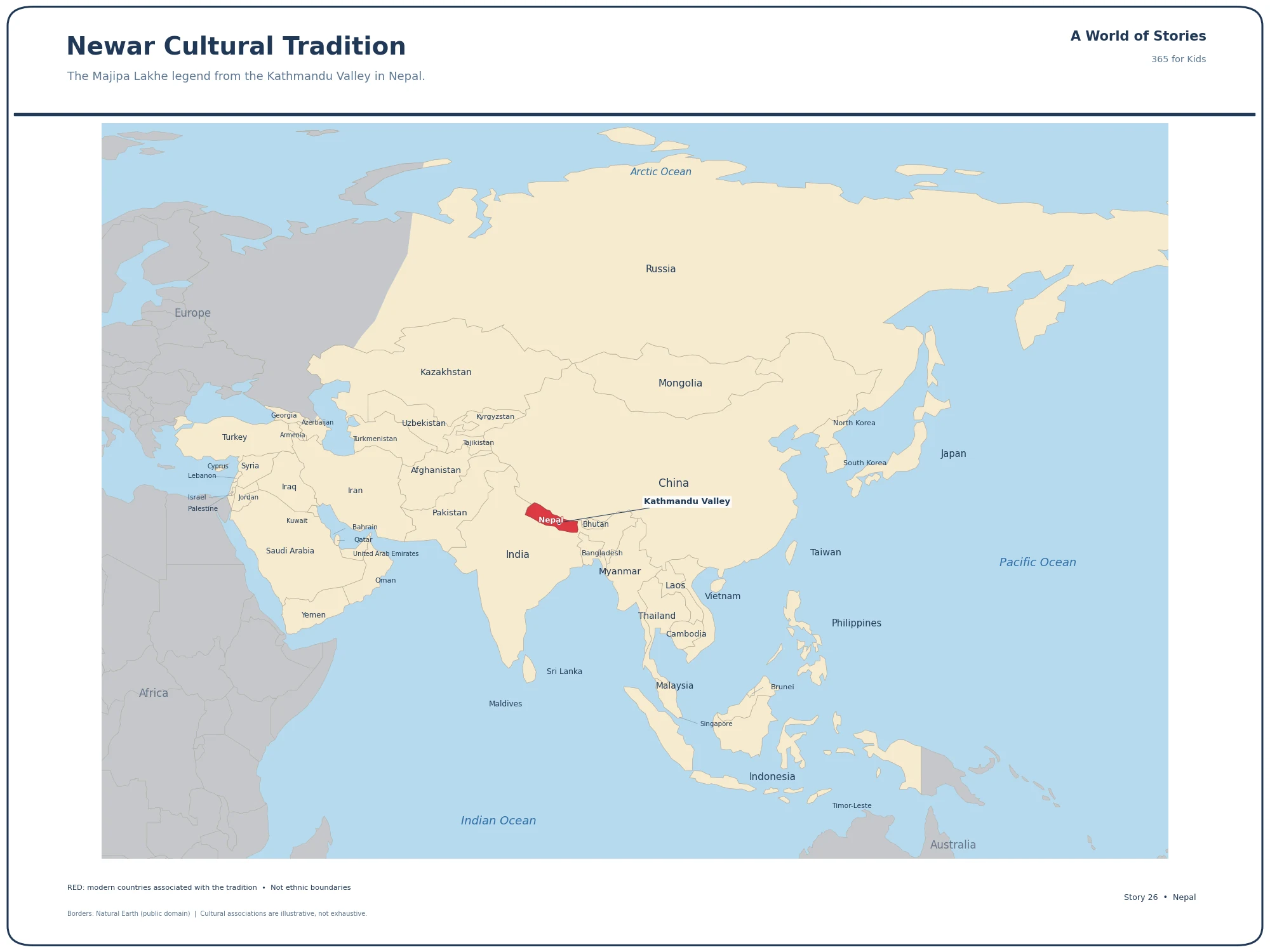
Long ago, in the Kathmandu Valley, people told stories of beings called lakhes. They were powerful, fearsome creatures, said to dwell beyond the safety of the town. People were afraid to meet one, for the old tales warned that some lakhes fed upon human flesh.
Near the part of old Kathmandu called Majipa, one of these beings came to care for a young woman who lived among the people. In the tale, the lakhe fell in love with her. Yet he knew that if he appeared before her in his frightening form, the townspeople would never let him approach their homes.
So he took the shape of an ordinary man and came into the town to see her.
To those who passed him in the streets, he seemed no different from anyone else. No one could see the powerful being hidden beneath the human appearance. For a time, his secret remained undiscovered.
But secrets do not always stay hidden. In the end, the people learned that the visitor was a lakhe. Fear spread through the neighbourhood. They seized him and brought him before the king.
The king had to decide what should happen. The people knew the old stories about lakhes, and they feared what this one might do. Yet the being standing before the king had come into the town because he loved a woman who lived there.
In the version of the legend told in Majipa, the king did not order the lakhe to be killed or driven away. Instead, he offered him a choice. He could remain among the people and live near the woman he loved, but only if he abandoned his appetite for human flesh and promised to protect the children of the town.
It was no small promise. A creature that people had feared would have to become the very one they could trust when danger threatened their children.
The lakhe accepted the king’s condition.
From that time, the legend says, Majipa Lakhe was no longer remembered only as a frightening being from the world beyond the town. He became a guardian. His strength, once a cause of fear, was now bound to a promise of protection.
The people did not forget what he looked like. Nor did they make him gentle in appearance. In the tradition that continues in Kathmandu, Majipa Lakhe still wears a startling face: wide eyes, great teeth, and a blaze of red hair. His appearance reminds people of the power he possesses; his story reminds them what he has chosen to do with it.
Every year during Yenya, also called Indra Jatra, the great festival of the Kathmandu Valley, the Majipa Lakhe dance can be seen in the streets. A performer wears the extraordinary mask and moves to the beat of traditional drums and cymbals. The dance is a treasured part of the Newar community’s living heritage.
Another figure, a mischievous childlike character known as Jhyalincha, darts about and teases Lakhe during the dance. Lakhe pursues him through the lively celebration. The playful chase belongs to the festival as it is performed today; different storytellers give different explanations for how it began.
The dancer’s movements are fierce. The mask may look terrifying. But the families who gather to watch know the name by which the guardian is affectionately addressed: Lakhe Aju — an honoured elder.
And so the tale of Majipa Lakhe has been handed down: not as a story of a monster defeated, but as the story of a fearsome being who was allowed to make a different choice. He made a promise to guard the children of his community, and his dance still reminds Kathmandu of that promise.
Cultural tradition. Majipa Lakhe (also written Majipa Lakhey) belongs to the Newar cultural heritage of the Kathmandu Valley in Nepal. This is a traditional account about a protective supernatural being, not a description of a historical individual. Lakhe Aju is honoured in the local community, and his dance remains part of Yenya (Indra Jatra).
Choice of version. This original English literary adaptation follows the widely reported Majipa oral legend in which a lakhe falls in love with a local woman, enters the town in human form, is captured, and receives permission from the king to remain only after promising to stop harming people and protect children. No extra magical trials or acts of rescue have been added.
Variants. The origin stories are not uniform. Other accounts link the protective Lakhe to the goddess Taleju and the living goddess Kumari; some give a different explanation of why Lakhe dances. The Jhyalincha chase is described here as part of the living festival, not treated as a proven episode of the chosen origin tale. Names and spelling vary: Lakhe / Lakhey; Majipa / Majipat; Yenya / Indra Jatra.
Heritage today. The distinctive mask, the musical accompaniment, the local performers and their community organisations are living cultural practices. The account should not be presented as a folk tradition of all Nepalese peoples, or as evidence that the legendary events literally occurred.
After the Story: Read · Create · Reflect · Share
1. Find Nepal on a map of South Asia and draw its flag. What makes the shape of Nepal’s flag unusual?
2. Why did Majipa Lakhe enter the town in the form of an ordinary man? What happened when the people discovered who he was?
3. What two conditions did the king place on Majipa Lakhe if he wished to stay? How did these conditions change his role in the community?
4. Why might a guardian be shown with a frightening mask? How can a person’s actions tell us more about them than their appearance?
Inspired by this story? Create your illustration!
PAKISTAN SINDHI — Umar and Marvi
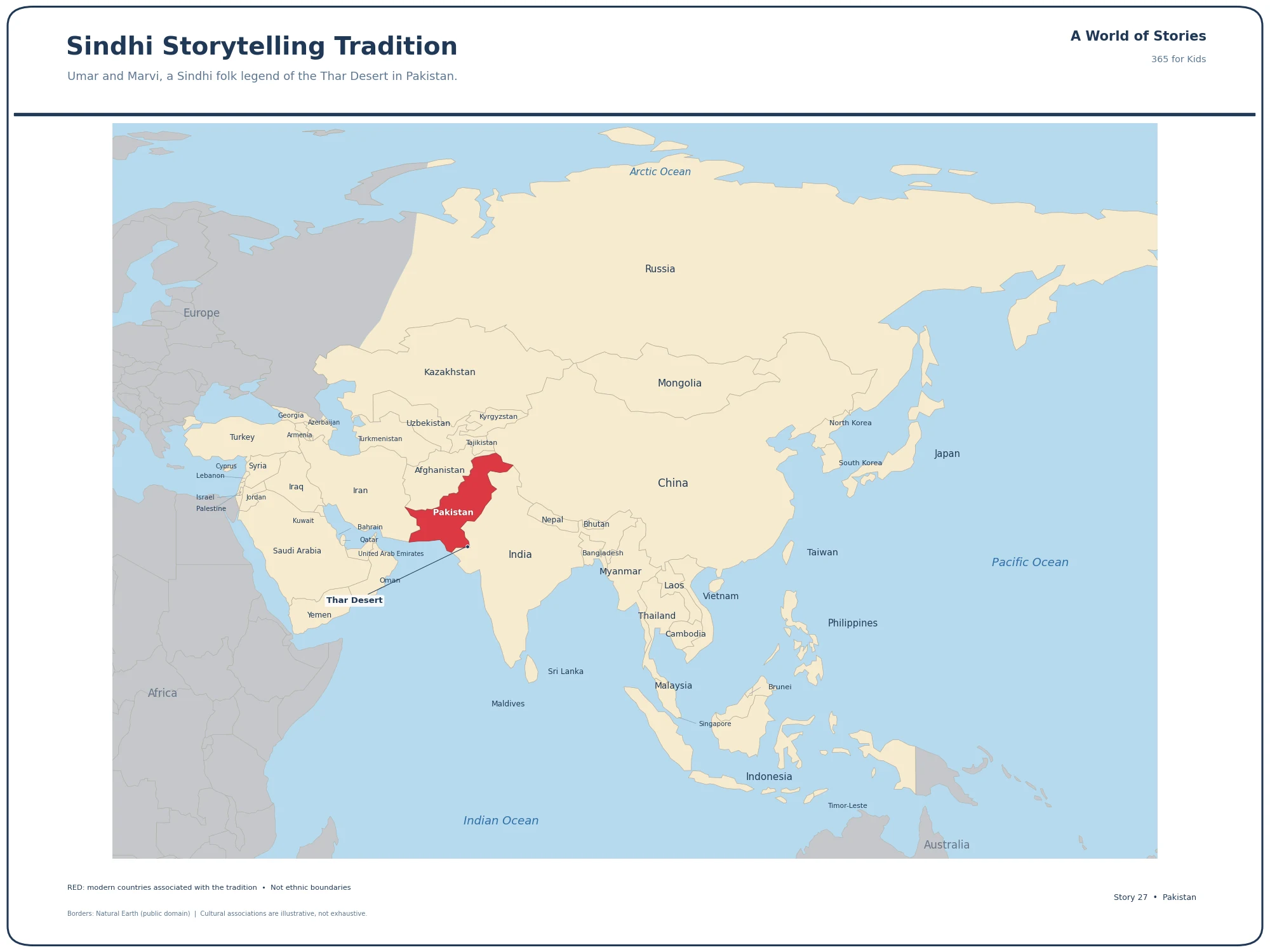
In the Thar Desert, where the land stretched towards the horizon in long reaches of sand and scrub, a young woman named Marvi lived among her family and neighbours. Their village was known in the old songs as Malir. The people kept their animals, drew water from wells and knew how precious a season of rain could be. Life was not easy, but it was their life, shaped by familiar paths and by the care they gave one another.
Marvi loved that country. She knew its dry earth, its brief green seasons and the voices of the people who had known her since childhood. She wore the simple clothes of her community and a woollen shawl of the kind worn by the women of the desert. What mattered to her was not the value of the cloth but the home and the people it represented.
She also loved a young man named Khet. They hoped to share a future together. In the village, Marvi’s days passed among the ordinary duties and pleasures of the place she called home.
Far away, the ruler Umar Soomro lived in the fortified town of Umerkot. His halls held fine garments and jewels; he could command servants and send riders wherever he pleased. When word reached him of Marvi’s beauty, he decided that she should become his queen.
One day Marvi went to the village well to draw water. Umar came there and saw her. He spoke of marriage and the riches that would be hers if she went with him. But Marvi did not want his offer. Her heart and her future were already bound to the life she had chosen.
Umar would not accept her refusal. He seized Marvi and carried her away from the well to Umerkot. The familiar desert lay behind her, and the walls of his stronghold rose ahead. She had not agreed to come. The ruler had taken her from her people against her will.
At Umerkot, Umar offered her what he believed anyone would desire. There were beautiful clothes, shining ornaments and rooms far grander than the home she had left. If she married him, he promised, she would be a queen.
Marvi refused.
She had not asked to be a queen, and no gift could make her forget how she had come there. The ruler spoke of silk; she thought of the woollen shawl of the Thar. He spoke of jewels; she thought of the people waiting for her at home. He could fill a palace with splendid things, but he could not make it the place she loved.
Umar kept her in the fort, hoping that time would change her mind. Days passed, and then weeks. Marvi had no freedom to return to Malir. She would not exchange her old garments for the costly clothes he offered, nor pretend that captivity was happiness simply because its walls enclosed luxury.
She remembered her parents, her neighbours and Khet. Above all, she remembered that she belonged among people who knew her not as an ornament for a palace but as one of their own.
The seasons changed beyond the walls. When the time of the monsoon came, Marvi thought of the desert receiving rain. She imagined the thirsty land turning green and the people of Malir rejoicing. For them, rain meant water for the animals and hope for the months ahead. For Marvi, the thought of home made her longing sharper.
A traveller’s news of the desert would have been worth more to her than a chest of precious stones. Even the dust of her homeland was dearer to her than the treasures of Umerkot.
Umar continued to offer comfort and rank, but Marvi’s answer did not change. She would not marry him. She would not choose wealth in place of freedom. In her eyes, there was no shame in a simple life; the wrong was to believe that another person’s wishes could be purchased or commanded.
Her captivity grew so painful that she spoke of death. If she died so far from home, she asked that her body be returned to the land and people she loved. She wished to rest in the soil of the Thar, not beneath the splendour of a palace that had become her prison.
Those words showed Umar something his wealth had never taught him. He had imagined that fine things could replace everything Marvi had lost. Yet she had asked for no reward. She wanted only the right to return to her own life.
At last Umar understood that he could not win her affection by holding her prisoner. He could command a fort, but he could not command her heart. He gave up his demand and agreed to release her.
Marvi was allowed to return to her people. In a familiar telling of the legend, Umar also assured her community that she had remained true to her decision throughout her captivity. The wrong that had taken her away could not be undone, but the freedom she had demanded was finally hers again.
She left behind the rich rooms of Umerkot and went back towards the village well, the rough paths and the people she had never ceased to remember. To others, the desert might have seemed poor beside the ruler’s palace. To Marvi, there was no comparison. She was going home.
And so the people of Sindh remembered her. The lasting hero of the tale was not the ruler who possessed jewels and power, but the young woman who refused to surrender her choice, her love for her people or her freedom. Her story continued in spoken tradition and in poetry, carried from one generation to the next across the land she loved.
Cultural tradition. Umar–Marvi (also written Umer–Marui or Umar–Marui) is an important Sindhi folk legend associated with the Thar Desert and Umerkot in what is now Pakistan. Marvi is remembered as a figure of steadfastness, love of homeland and resistance to coercion.
Choice of version. This original English literary adaptation follows the principal narrative recorded in Pakistan’s National Register of Intangible Cultural Heritage: Marvi is taken at the village well, rejects the ruler’s gifts and marriage proposal, remains imprisoned at Umerkot and is eventually released. The details about Khet, her woollen shawl and the changing seasons are supported by Sindhi heritage accounts and the literary tradition.
Places and variants. Marvi’s home is often called Malir in poetry, while the associated well and cultural site are in Bhalwa, Tharparkar. Versions differ in introductory episodes, the circumstances of her return and later events. This adaptation does not merge those conflicting additions into a new plot.
Literary heritage. Shah Abdul Latif Bhittai (1689–1752) celebrated Marvi in ‘Sur Marui’ within the Sindhi poetic collection Shah Jo Risalo. The legend predates that poetic treatment and is not presented here as a literal translation of Bhittai’s verses.
Reading guidance. The story includes abduction and captivity but no graphic violence. The emphasis is on Marvi’s dignity, her refusal of an unwanted marriage, her love for her home and the importance of respecting consent. The dialogues are literary paraphrases of traditional motives, not quotations from a single historical witness.
After the Story: Read · Create · Reflect · Share
1. Find Pakistan on a map of South Asia and draw its flag. Which part of Pakistan is the Thar Desert in?
2. Where was Marvi taken from, and what did Umar offer her in Umerkot? Why did she refuse?
3. What did Marvi remember about Malir when the rainy season came? What did she ask Umar to do if she died far from home?
4. Marvi had little power over her situation, yet she held firmly to her decision. What does this story teach about freedom, belonging and respecting another person’s choices?
Inspired by this story? Create your illustration!
SRI LANKA — Andare and the King’s Jambu
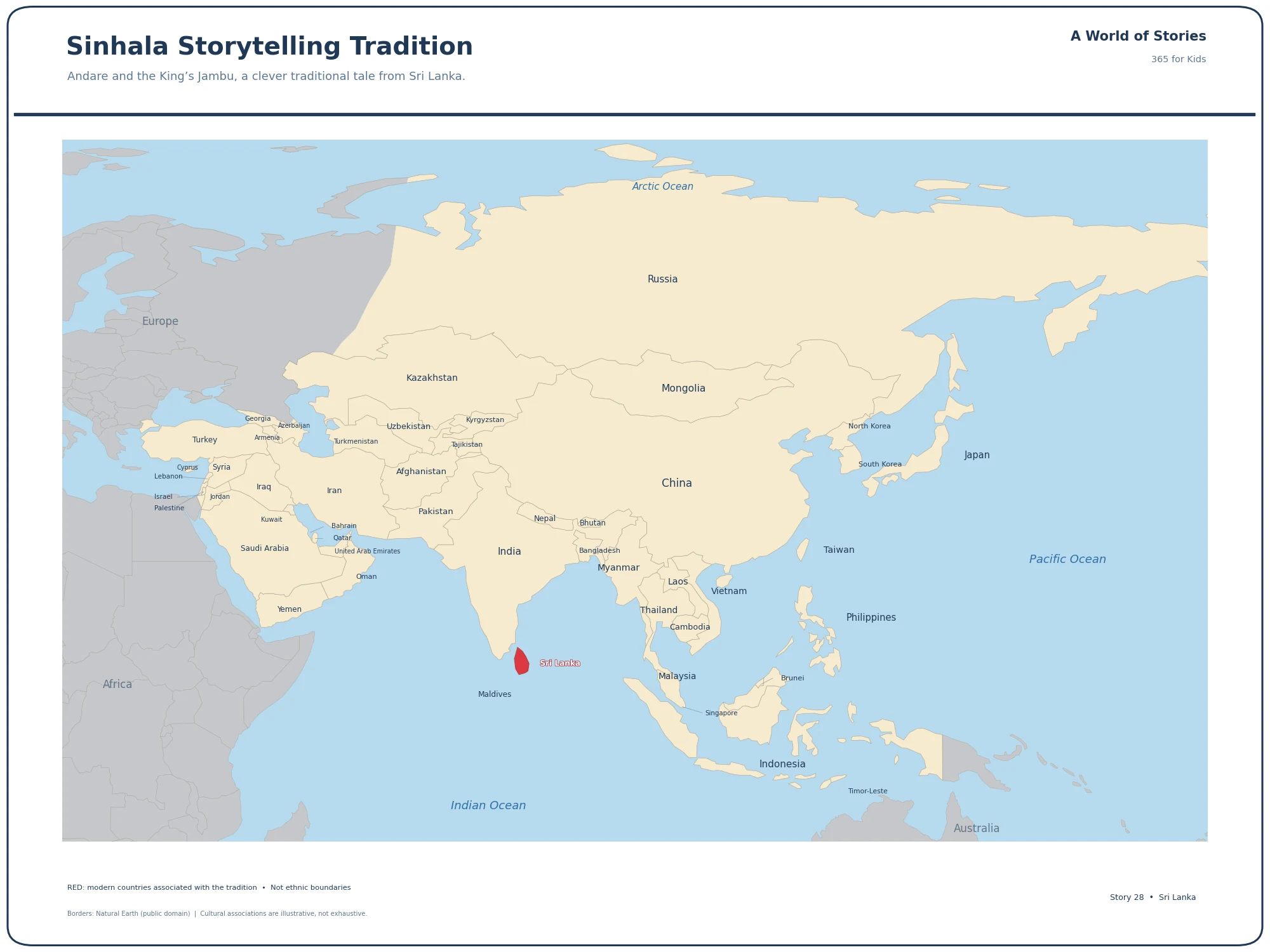
In the courtyard of a royal palace in Sri Lanka grew a jambu tree laden with fruit. When the fruit ripened, its branches seemed to offer their sweetness to everyone who passed beneath them. But the king had given a very particular command: no one was to look at the jambu fruit or touch it.
Now, among the people who came and went at the palace was Andare, the king’s quick-witted jester. He was famous for listening closely to what people said—and for noticing what they had forgotten to say. When he learned of the king’s command, the thought of the delicious jambu fruit stayed with him.
How could he enjoy some without looking at it or touching it?
Andare considered the king’s words carefully. Then a mischievous idea came to him. He took a piece of cloth, tied it over his eyes, and placed both hands firmly behind his back. Like that, he made his way beneath the tree. He could not see the fruit, and his hands could not reach for it. But whenever a ripe jambu came close enough to his mouth, he could take a bite.
So Andare ate some of the fruit. He neither looked at the jambu nor picked it with his hands. When he had finished, he left the courtyard.
Later that day the king noticed that fruit was missing from his prized tree. He was not pleased. He ordered the palace guards to find the person who had taken it.
The following day, Andare returned. Once more he covered his eyes, folded his hands behind his back, and approached the jambu tree. This time the guards caught him. They brought him before the king to answer for what he had done.
“Andare,” said the king, “I forbade anyone to look at my jambu or to touch it. Yet you have been eating the fruit. Why have you disobeyed me?”
Andare did not deny that he had eaten it. Instead, he answered calmly, “Your Majesty, you commanded us not to look at the fruit or touch it. I did neither.”
The king looked at him in surprise. “Then explain how you ate it.”
“I can show you,” replied Andare.
He tied the cloth across his eyes again. Then he clasped his hands behind his back and demonstrated how he had walked beneath the branches and taken the jambu fruit directly into his mouth. The king watched, first in astonishment and then with growing amusement.
At last he burst out laughing. Andare had obeyed the exact words of his order while doing precisely what the king had hoped to prevent.
The king decided not to punish his clever jester. Instead, he sent Andare home with gifts. And so another tale of Andare’s quick thinking passed from one listener to the next—a reminder that words can sometimes mean more than they first appear to say.
Andare (අන්දරේ) is the witty court jester of a long-lived Sinhala storytelling tradition. Stories about his jokes and clever answers are familiar to generations of Sri Lankan children. Jambu is a local name used for a crisp, watery fruit often described in English as rose apple or Java apple. The figure of Andare belongs to folklore; details of his life and the precise historical setting of each anecdote are not firmly established.
This original English adaptation follows the version taught in Sri Lankan educational materials: the king forbids both looking at and touching the fruit; Andare covers his eyes and keeps his hands behind his back; guards catch him on his return; and the amused king gives him gifts rather than punishment. The dialogue and descriptive language are literary retelling, not quotations from a historical record.
After the Story: Read · Create · Reflect · Share
1. Locate Sri Lanka on a map of South Asia. Which ocean surrounds the island?
2. Draw the flag of Sri Lanka. What shapes and colors do you notice?
3. What did Andare do so that he could eat the jambu without using his eyes or hands?
4. Did Andare follow the king’s words, the king’s intention, both, or neither? Explain your answer.
Inspired by this story? Create your illustration!
SANTAL — The Crow and the Egret — The Unfair Judgment
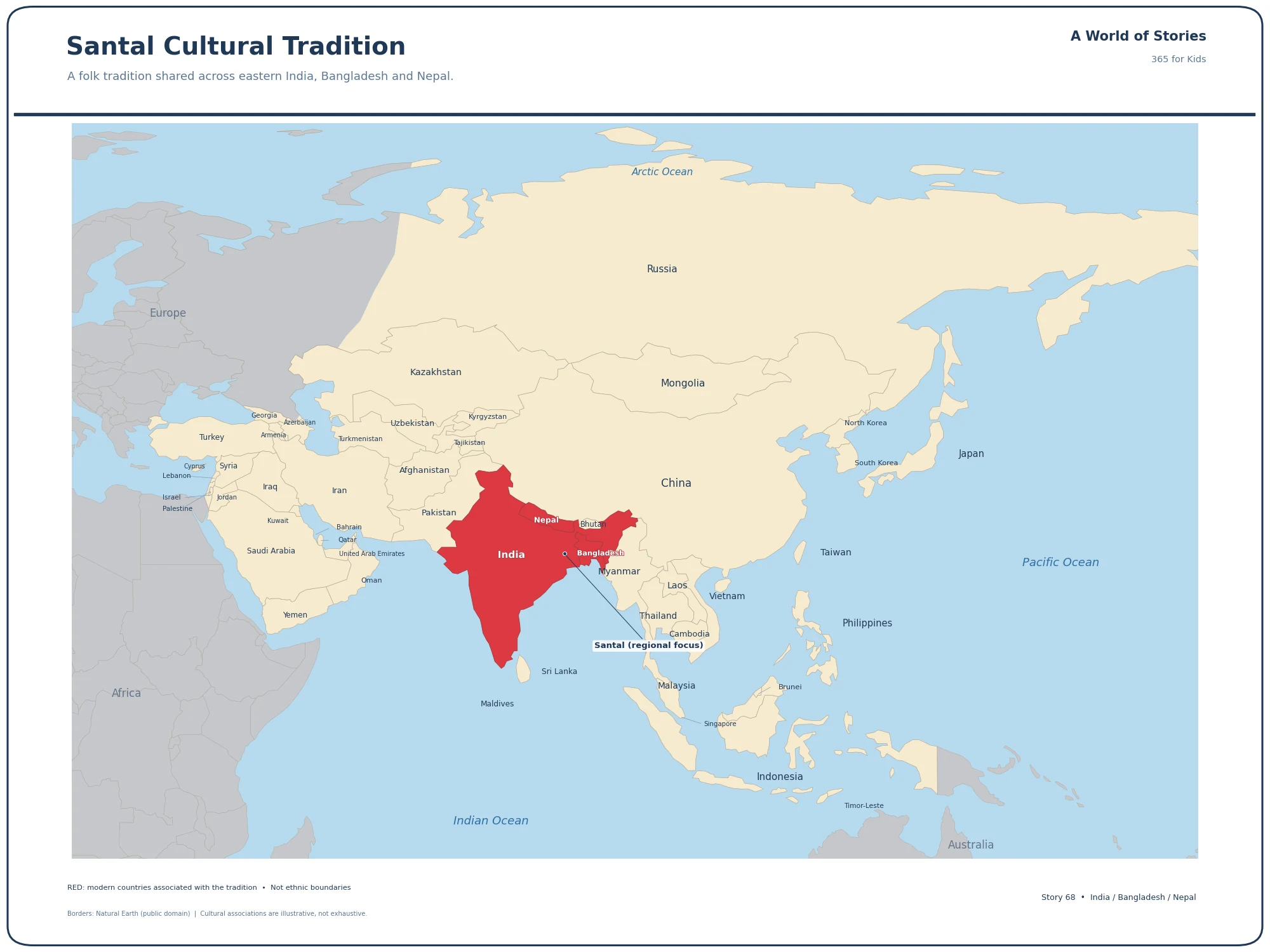
Long ago, a crow and a white egret made their nests in the same tree. The branches held two families of young birds, and each mother flew out to find food for her nestlings. From a distance their homes looked much alike. Up close, the little birds were very different: the crow’s young were black, while the egret’s were dressed in soft white feathers.
As the nestlings grew, the crow began to watch her neighbor’s family with envious eyes. She thought the white chicks so beautiful that she wished they were her own. Instead of caring for the young birds she already had, she kept comparing them with the egret’s.
One day, when the egret had flown away, the crow acted on her wish. She lifted the egret’s white nestlings from their nest and carried them to hers. Then she moved her own black nestlings into the egret’s place. When she had finished, the two families had been exchanged.
The egret returned to a bewildering sight. The chicks in her nest were black. Her own white young had vanished. She looked toward the crow and saw the birds that should have been under her own wings.
“Those are my children,” she said. “You have changed our nestlings. Please give them back.”
But the crow would not admit what she had done. She insisted that the white nestlings belonged to her and refused to return them. The two birds argued for a long time. Neither could persuade the other, and there was no peace in the branches of their shared tree.
At last they agreed to ask someone to judge the dispute. A moneylender lived close to the tree. Surely, they thought, he could listen to both sides and decide which young birds belonged to which mother. The crow went down and asked him to come.
Before he would hear a word of the case, however, the moneylender wanted to know what each bird would give him for his trouble. He did not begin by asking what had happened. He began by asking for a reward.
The egret promised him a fine rohu fish, one of the fish she knew how to catch. The crow promised him a golden necklace. The moneylender told them to bring their gifts first; only then would he give his decision.
The egret flew off, caught a large fish, and brought it to him. The crow went to a riverbank where a raja, a ruler, was bathing. While he was in the water, she stole the gold chain he had left on the bank and carried it to the moneylender.
Now the two gifts lay before him: the fine fish and the shining gold. He looked at them and chose the necklace. The decision that followed had little to do with the truth.
He announced that the white nestlings would stay with the crow. The black nestlings would remain with the egret. The egret cried out in protest. How, she asked, could she have white young one day and black young the next?
The moneylender brushed aside her question. A white cow, he said, could have a dark calf; why could a white egret not have dark chicks? He would hear no more. He sent the birds away with his unfair judgment.
The egret was heartbroken and angry. She knew her own children, but the person who was meant to settle the quarrel had listened to the value of a gift rather than to the evidence before his eyes.
While she was wondering what to do, a jackal came hurrying along the path. He had just escaped from hunters and was running as fast as he could. The egret called to him and asked where he was going in such a hurry.
“I must pay the rent I owe the raja,” the jackal answered, still eager to be on his way. But the egret begged him to listen. She explained how the crow had taken her white nestlings, how the judge had demanded gifts, and how the golden necklace had won a false decision.
The jackal was indignant. A judge who called black white and white black merely because of a gift was no judge at all, he declared. He could not stop that moment, but he would return the following day and look into the matter. He even threatened to fill the dishonest judge’s mouth with filth as a punishment for such a disgraceful ruling.
Unknown to the jackal, the moneylender had heard what was said. The words struck him harder than the egret’s arguments had done. He imagined how shameful it would be for everyone to learn that he had sold his decision for a necklace.
He called for the crow at once and made her give the white nestlings back to their mother. The black nestlings, too, were returned to the proper nest. The exchange that had begun with envy was finally undone.
When the jackal came back the next morning, there was no longer a case to decide. The egret had her children again. The moneylender had reversed his unjust ruling, not because the gold had lost its shine, but because his own dishonesty had been exposed.
And so the old tale ends with a simple question for anyone who must judge between others: will you listen to what is true, or will you listen to what someone offers you?
The Santal (also spelled Santhal) are an Indigenous people of South Asia. Santal communities live chiefly in eastern India, with communities also in Bangladesh and Nepal. Their language is Santali. These modern borders do not contain the whole cultural tradition.
“The Crow and the Egret” was recorded from Santal storytelling in the Santal Parganas region of eastern India. Its plot criticizes envy and the buying of a decision: the crow steals another mother’s young, and the moneylender takes the more valuable gift rather than seeking the truth. The raja is a ruler; rohu is a freshwater fish.
This version follows the sequence and ending of the documented tale. The English prose and dialogue have been freshly written for young readers; no additional characters or adventures have been introduced. It represents one recorded telling, not all Santal traditions.
After the Story: Read · Create · Reflect · Share
1. Find eastern India, Bangladesh, and Nepal on a map of South Asia. Draw the flag of India or Bangladesh. Why might one cultural tradition be shared across several modern countries?
2. What did the crow want, and what did she do while the egret was away? How did envy affect her choices?
3. Why did the moneylender give the wrong judgment? What could a fair judge have done instead?
4. What changed after the jackal spoke up? Have you ever seen someone help another person by questioning an unfair decision?
Inspired by this story? Create your illustration!
Central Asia
KAZAKHSTAN — Aldar Köse and the Greedy Bai
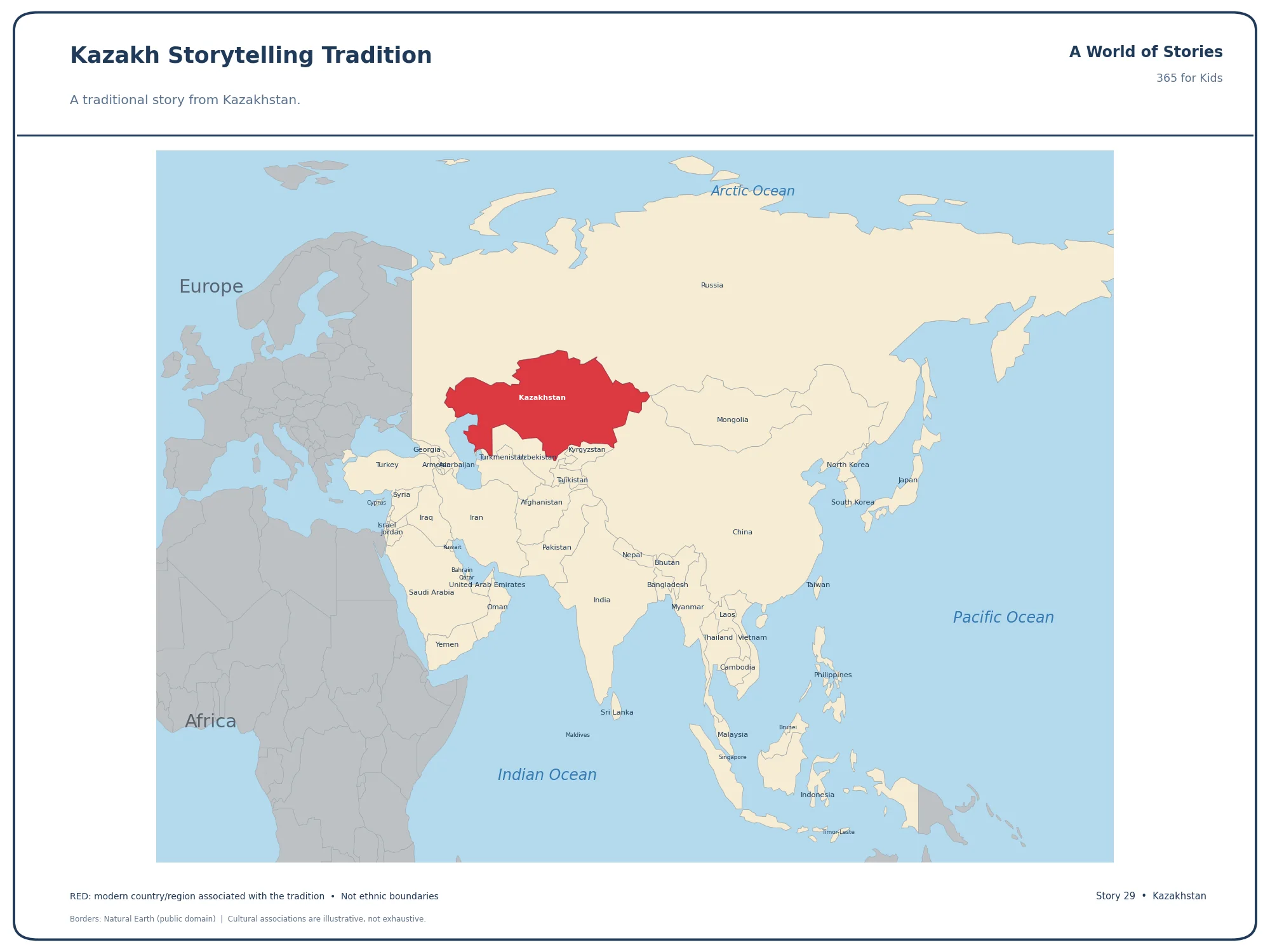
Across the wide Kazakh steppe, people told stories about Aldar Köse, a man who could find a clever answer where others saw no way forward. And they also spoke of Shygaybai, a rich man whose possessions were plentiful but whose generosity was not. His neighbors had given him a name that meant, in effect, the man who would not give away even a drop.
Shygaybai had livestock, provisions, and more than enough to eat. Yet he dreaded the sight of a traveler approaching his home. A visitor might ask for water. Worse still, a visitor might be hungry. Shygaybai could not bear the thought of sharing a meal.
When Aldar Köse heard how fiercely the wealthy man guarded his food, he resolved to visit him. He wanted to discover whether a guest could eat beneath Shygaybai’s roof after all.
He arrived at the rich man’s yurt and, before entering, quietly glanced inside. What he saw was not an empty kitchen. Shygaybai was cutting kazy, a traditional sausage; his wife was preparing dough; other members of the household were busy with meat and poultry. A fine meal was clearly underway.
Then Aldar stepped into the yurt and offered a cheerful greeting. In an instant, the food disappeared. Hands moved quickly, dishes were covered, and everyone pretended there was nothing worth mentioning.
Shygaybai smiled at his visitor. He spoke politely enough, but there was little warmth in his welcome. He said that he would gladly offer something to eat, if only there were any food in the house.
Aldar did not argue. He settled himself comfortably and listened as his host asked for news from the road. Shygaybai wanted to know what interesting things Aldar had seen on his journey.
Aldar thought for a moment. He said he had come upon a remarkable snake, thick and curled like the sausage that Shygaybai had so carefully put out of sight. He went on to speak of other wonders: a shape resembling the hidden meat, another as flat as the dough, and still another like the bird whose feathers had just been plucked.
No one in the yurt could mistake what he meant. The master’s face grew hot with annoyance. Aldar had seen everything; their secret feast was no secret at all.
At last the family brought the food out and placed it in the cooking pot. But Shygaybai was not ready to admit defeat. His wife declared that the meat should be left cooking for five months. Surely no guest would sit waiting so long for supper.
Aldar remained untroubled. If the meal required five months, he replied, he could stay for ten. He took off his boots and made himself at ease, as though the waiting were the most natural thing in the world.
The family had hoped that their visitor would give up and go. Instead, the hours passed, the pot stayed on the fire, and eventually everyone grew sleepy.
During the night, while the household slept, Aldar rose quietly. He lifted the cooked food from the pot, ate his fill, and set aside what remained. In its place he left pieces of tough leather. Then he lay down again.
Before long, Shygaybai woke and decided that this was the moment for a private feast. He went to the pot without inviting his guest. But the food would not yield to his teeth or his knife. He tried once, then again. What had become of the tender meat? He could scarcely believe it. His carefully protected supper had turned into something he could not eat.
Aldar, meanwhile, had already enjoyed the meal Shygaybai had been so determined to hide.
The following morning, Shygaybai prepared to leave home. He still refused to share a morsel with the troublesome guest, and so he tucked a freshly baked flatbread beneath his clothing, hoping to carry it away unseen.
But Aldar noticed. With great friendliness he went to say goodbye and embraced his host. The flatbread, still warm from the fire, pressed against Shygaybai’s chest. The rich man tried to endure the heat, but at last he pulled out the bread and thrust it away.
Aldar was happy to accept it. Shygaybai had hoped to keep every bite for himself, yet the stranger he would not feed had eaten his supper and was leaving with his bread as well.
So this tale of Aldar Köse is remembered not for a treasure won or a mighty enemy defeated, but for a greedy host who discovered that a locked heart could make even a well-stocked home seem poor.
Aldar Köse (also spelled Aldar Kose, Aldar-Köse, or Алдар көсе) is a celebrated trickster in Kazakh oral storytelling and related Turkic traditions. A bai was a wealthy man or livestock owner in traditional Central Asian society. The story humorously criticizes stinginess and the refusal to extend hospitality; it is not a claim that all wealthy people behaved in this way.
Kazy is a traditional sausage commonly made from horsemeat. A yurt is a portable felt-covered dwelling associated with life on the Central Asian steppe. Names and spellings vary in transliteration: Shygaybai is also written Shigai Bai or Shyghai Bai, while his mocking nickname appears as Shykbermes (someone who gives nothing).
This is a literary adaptation of one self-contained episode of the traditional Aldar Köse–Shygaybai cycle. It follows the episode documented by Qazaq Culture, including the hidden feast and hot flatbread. Kazakhstan’s Institute for Early Childhood Development reproduces a shorter telling that concludes with the trick at the cooking pot. Longer variants continue with further episodes; those have not been combined into this telling. The language is newly written in English, not a verbatim translation.
After the Story: Read · Create · Reflect · Share
1. Find Kazakhstan on a map of Central Asia. What other countries border it?
2. Draw the flag of Kazakhstan. Which colors and symbols does it feature?
3. What food did Aldar notice before he entered the yurt, and how did he reveal that he knew it was hidden?
4. Was Aldar right to trick his host? How might Shygaybai have welcomed a traveler differently? Explain your opinion.
Inspired by this story? Create your illustration!
KYRGYZSTAN — The Birth of Manas
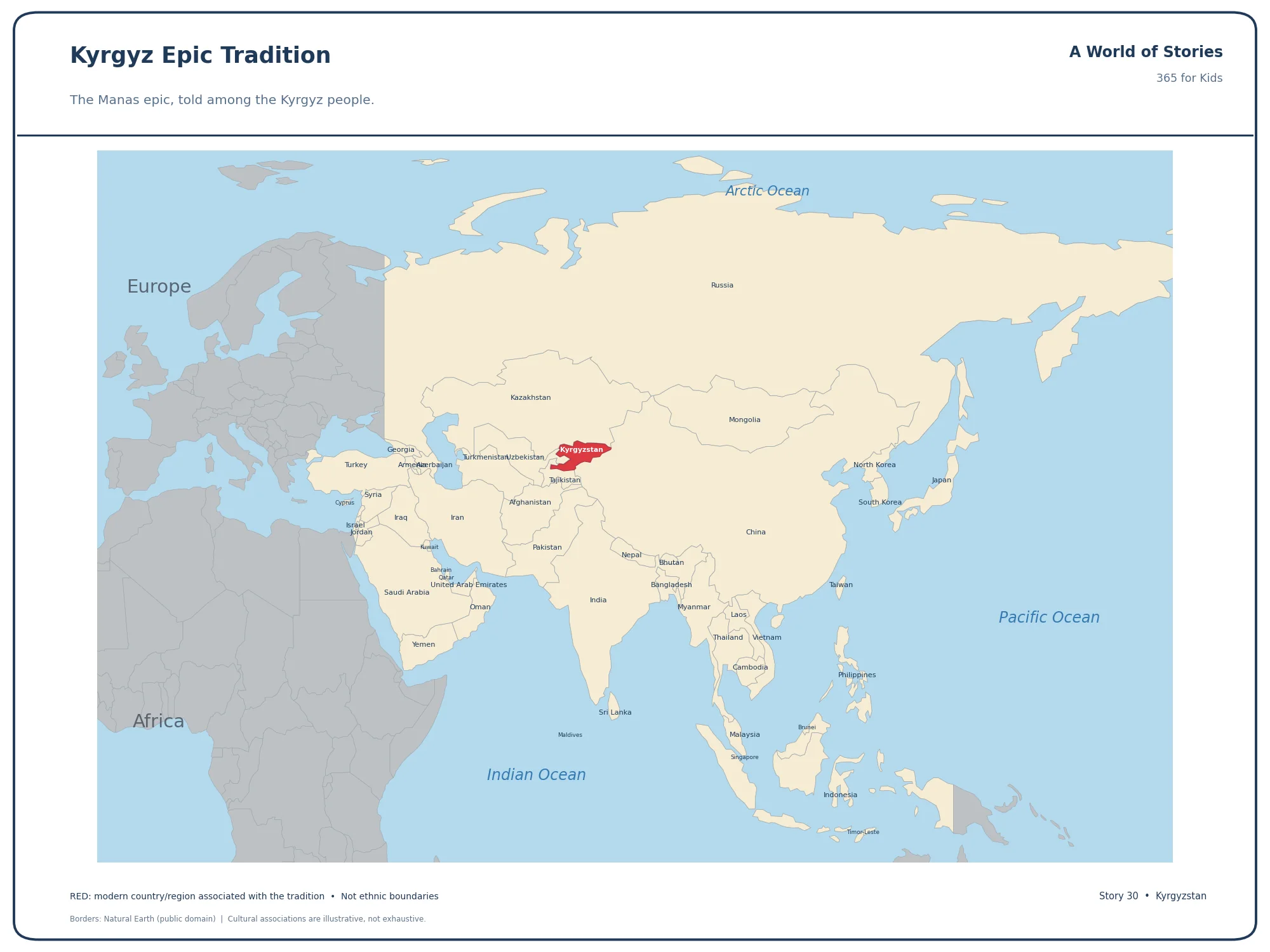
Long ago, in the world remembered by the Kyrgyz epic Manas, a community lived far from the mountains it called home. Its people spoke of the Ala-Too ranges with longing. They kept their herds, raised their families, and hoped that one day they might return together to the land of their ancestors.
Among them was Jakyp, a man whose pastures were crowded with horses, sheep, and camels. His stores were full and his possessions many. Yet he was troubled by something that all his wealth could not give him: he had no child. He and his wife Chiyyrdy had grown old waiting. His second wife, Bakdoolat, had no child either. Jakyp wondered who would remember him, and who would care for the people after he was gone.
Chiyyrdy knew his sorrow. She also knew how quickly it could make him angry and forget what he already possessed. Rather than quarrel, she urged him to pray and to share with those who had less. Bakdoolat, too, encouraged him to look beyond his storehouses. In the years that had passed, the longing for a child had become part of the life of their home.
Then Jakyp had an extraordinary dream. In his hands he held a young eagle whose feathers shone like gold. Its talons seemed harder than iron, and no creature could challenge it. Jakyp stood on the summit of a high mountain with a mighty sword. When he raised the sword, the rocks around him seemed to burst into blue flame. In his dream he held the sun in one hand and the moon in the other.
The dream was so vivid that Jakyp could not keep it to himself. He went to Akbalta, a respected elder among the Kyrgyz, and asked him to gather the families. Guests sat together, food was shared, and the elders listened as Jakyp told them what he had seen.
For a time the gathering was silent. Then Akbalta rose. To him the golden eagle was a sign of a child yet to be born: a son who might grow into a powerful leader. The mountain, the sword, and the two lights of the sky seemed to promise that the scattered people might be gathered again and led toward their homeland. The families offered their blessings. For the first time in many years, Jakyp dared to hope.
Chiyyrdy, who had also experienced a remarkable dream, urged Jakyp to remember the generosity he had spoken of. What use was treasure locked away, she asked, if it could not bring comfort to other people? At first Jakyp hesitated, reluctant to part with the wealth he had spent his life collecting. But Chiyyrdy and Bakdoolat continued to persuade him, and preparations were made to feed the community and give to those in need.
Before long, the household had news even greater than the dream: Chiyyrdy was expecting a child.
During the months that followed, the epic describes strange signs of the child’s coming strength. Chiyyrdy developed an unusual craving for the heart of a tiger. Hunters were sent to find one, and at last she ate it. To those around her, the deed seemed a sign that the child she carried would have a tiger’s courage. The elders warned that the news should not reach those who might wish the family harm.
Nine months and nine days passed. As the time of birth approached, Jakyp grew so anxious that he went out among his horses. He could scarcely remain still. At last he lay down to rest, and in a second dream a white-bearded holy man appeared before him.
The visitor told Jakyp that his long-awaited son was near. The child would be called Manas and would grow into a defender of his people. The holy man also spoke of a gray mare that would give birth to a foal on the very day the child was born. That horse, he said, would one day serve the hero. Jakyp was warned to protect his son while he was still young.
When Jakyp awoke, he hurried to the grazing animals. There, beside a gray mare, stood a newborn foal. The sign from his dream seemed to be taking shape before his eyes.
Back at the camp, Chiyyrdy was enduring a long and painful labor. Bakdoolat and the other women stayed beside her. At last a baby’s cry rang out so powerfully that, as the epic tells it, the yurt itself seemed to tremble. The child had been born — a son.
The women marveled at his strength. In another wondrous moment of the telling, a lion and a spotted wild cat came to the newborn, gently touched him with their tongues, and then disappeared. The women were astonished. To them these extraordinary visitors were further signs that this was no ordinary child.
Akbalta rode to find Jakyp and brought him the news. Jakyp could hardly believe what he was hearing. He asked again whether Chiyyrdy was safe. When Akbalta assured him that she was alive and the baby was well, Jakyp’s fear finally gave way to joy. The two men hurried back to the camp.
Jakyp took the child into his arms. He looked at the face he had waited so many years to see, and tears came to his eyes. The herds outside were still his, and his treasure chests had not disappeared, but none of them seemed as precious as the life he now held.
In the autumn, a great celebration was arranged. Messengers rode to invite relatives and neighbors from distant places. Yurts spread across the plain; guests arrived, shared meals, greeted old friends, and watched contests and horse races. The gathering was not only a father’s rejoicing. It was a rare chance for families separated by distance to meet as one community.
At last Jakyp carried his son before the elders and asked them to choose a name worthy of the child. The guests considered the question, but no one could settle upon an answer.
Then a white-bearded dervish appeared among them. When he learned why the elders had gathered, he offered a name: Manas. The people accepted it with blessings, and Chiyyrdy gave the visitor a fine robe in gratitude. In the telling, the mysterious man departed as suddenly as he had come.
So the child was named Manas. His father had dreamed of a golden eagle; his mother had carried him through an extraordinary birth; an unknown visitor had given him his name. The elders believed that his strength would one day belong not merely to himself, but to the people who had waited so long for hope. His great adventures were still ahead. For now, the epic’s mighty story began with a child’s first cry and a name spoken in a circle of families.
Manas is a monumental Kyrgyz oral epic and the first part of the Manas–Semetey–Seytek trilogy. The epic tells of Manas, his son, and his grandson, and is associated with the struggle to reunite scattered Kyrgyz communities. It is performed by epic storytellers known as manaschys. UNESCO inscribed the trilogy on its Representative List of the Intangible Cultural Heritage of Humanity in 2013.
This selected episode concerns the birth and naming of Manas. It follows a documented prose presentation of one traditional version, rather than attempting to summarize the entire epic. Across the oral tradition, the order of events, details of the dreams, and descriptions of Manas’s early life differ. The prose above is a new literary adaptation, not a direct translation of a manaschy’s performance or a reproduction of an existing English retelling.
Cultural terms: Ala-Too refers to the mountain homeland remembered in the epic; a yurt is a portable dwelling used by many pastoral communities of Central Asia; an aksakal is a respected elder. Spelling of personal names varies in English: Chiyyrdy is also written Chiyrdy or Chyyyrdy; Jakyp may appear as Jaqyp; Akbalta as Ak-Balta. The story’s prophetic dreams and extraordinary animals belong to epic tradition, not to verifiable historical biography. Peoples and conflicts described in the epic reflect the world of its tellers and should not be used to characterize modern communities.
After the Story: Read · Create · Reflect · Share
1. Locate Kyrgyzstan on a map of Central Asia. Which mountain ranges can you find in the country?
2. Draw the flag of Kyrgyzstan. What are its main colors and symbols?
3. What did Jakyp see in his first dream, and how did Akbalta interpret the golden eagle?
4. Why do you think the naming feast brought so many families together? What responsibilities should a strong leader have toward others?
Inspired by this story? Create your illustration!
UZBEKISTAN — Alpamysh and Barchin’s Four Challenges
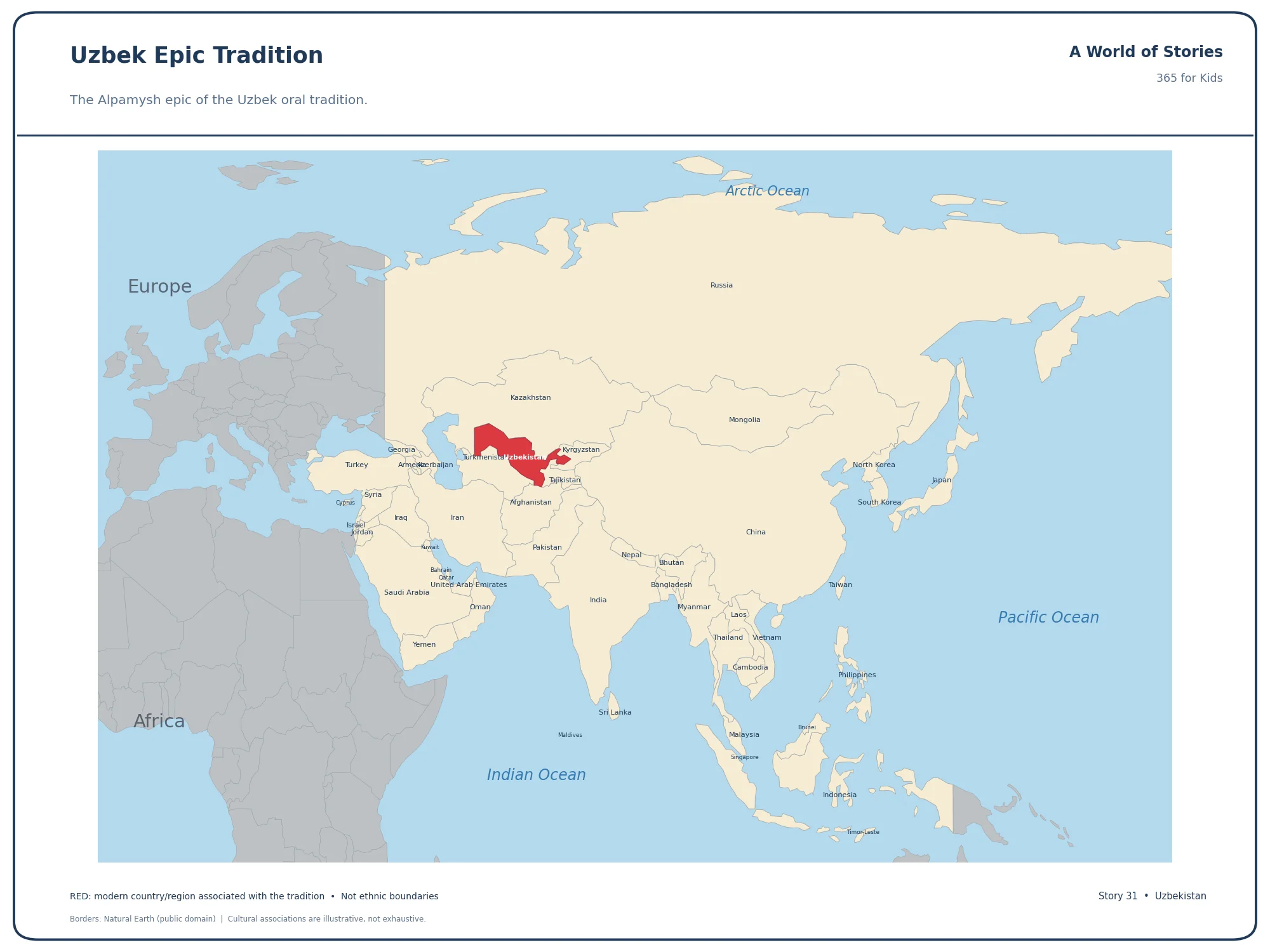
Across the wide grasslands of Central Asia, where summer pastures stretched toward distant hills, the people of the Qungrat knew the name of a young hero: Alpamysh. They also remembered Barchin, the daughter of his father’s brother. The two had been promised to one another when they were children, but the years had carried their families far apart.
A quarrel between their fathers had changed everything. Barchin’s father, Baysari, had left with his household and followers to live in another land. There Barchin grew into a brave young woman, admired not only for her beauty but for her spirit. Powerful warriors began to demand her hand. Some were so certain of their strength that they behaved as though her wishes mattered little.
Barchin would not be hurried into a marriage she did not want. She asked for time and sent word to the land she had left behind. Then she declared that the men who sought to marry her must face four challenges: a race of horses, a test with a warrior’s bow, a shot at a distant target, and a wrestling match.
The warriors heard her conditions and began to prepare. They had splendid horses, strong arms, and reputations that filled the camp with noise. Yet Barchin had gained something precious: time, and the chance for Alpamysh to learn where she was.
Far away, Alpamysh heard of Barchin’s danger. His sister, Kaldyrgach, urged him not to forget the promise between their families. His father was reluctant to let him go, for the journey led into unfamiliar country. But Alpamysh made his decision. He would travel to Barchin and face the challengers.
He needed a horse. In the herd he saw magnificent animals that seemed born for racing. Yet when he cast his lasso, it fell again and again upon the same rough-looking colt. This was Baychobar. His shaggy coat and unremarkable appearance hid a strength that ordinary eyes could not recognize.
Alpamysh took Baychobar and his grandfather’s powerful bow. Together they set out over the steppe, past distant hills and long stretches of open ground, until at last they came near the country where Barchin was waiting.
There he met a warrior named Karajan. Karajan belonged to the people among whom Barchin was living, and at first he might easily have been Alpamysh’s rival. Instead, the two recognized courage in one another. They became friends. Karajan welcomed Alpamysh and helped carry news to Barchin.
Barchin was cautious. She had heard promises before. But when she learned that Alpamysh had truly come, and that Karajan stood beside him as a loyal friend, hope returned to her heart. The day of the contests was near.
First came the horse race. Riders gathered in the open country with animals they had trained for speed and endurance. Dust rose under many hooves. Everyone watched for the horse that would arrive before all the others.
Karajan rode Baychobar on Alpamysh’s behalf. The other champions were determined that this stranger’s horse should not win. During the contest, Karajan was seized and bound, and Baychobar was cruelly injured. To those watching, it seemed impossible that horse and rider could still finish the race.
But Baychobar was no ordinary horse. In the old epic he is a tulpar, a wondrous steed. He found strength where none seemed left. He drove forward and passed the other horses, until he had won the race despite the harm done to him.
A great shout rose from the spectators. Some cheered; others stared in disbelief. One challenge had been met, and Karajan’s loyalty had proved as valuable as Baychobar’s extraordinary power.
The next two trials tested a different kind of strength. A warrior’s bow had to be drawn without being broken. Then came the test of striking a small target at a very great distance. The old singers devote far less time to these trials than to the race and the wrestling, but they are part of Barchin’s four conditions. Alpamysh proved equal to them.
At last came the wrestling. The remaining champions stepped forward, confident that no newcomer could withstand them. Karajan faced many of the opponents, fighting for the friend he had chosen. But one champion still remained: Kokaldash, the eldest and strongest of the brothers who had sought Barchin’s hand.
Alpamysh stepped into the wrestling ground. Kokaldash was powerful, and the struggle lasted a long time. Neither man yielded easily. Around them, the crowd waited to see who would prevail.
Barchin watched the contest. She was no silent prize to be handed from one warrior to another. In the traditional account, she called out to Alpamysh, challenging him not to lose heart. Her words roused him to one final effort.
Alpamysh gathered his strength and threw Kokaldash down. The last contest was over. The assembled people acknowledged him as the victor.
The challenges had begun under the shadow of fear and unwanted demands. They ended with Alpamysh and Barchin reunited. After their wedding celebration, they travelled toward their homeland, and Karajan went with them. The companion who had once seemed a possible rival had become a trusted friend.
The storytellers of Central Asia continue to remember more than the strength of Alpamysh. They remember the wisdom and courage of Barchin, the loyalty of Karajan, and the surprising power of Baychobar. For even in a tale of mighty champions, a victory may depend upon those who stand beside the hero.
“Alpamysh,” also written “Alpomish,” is a heroic doston: a long epic performed and transmitted by storyteller-singers, often called bakhshi. It is a living Uzbek cultural tradition with related versions among other Turkic-speaking peoples. This is one episode from the epic, not the entire work.
This retelling follows the four-contest sequence associated with the Uzbek version performed by Fazil Yuldash-oghli (Fozil Yo’ldosh o’g’li), as discussed in H. B. Paksoy’s comparative study and corroborated by an Uzbek school textbook. The long horse race, Karajan’s assistance, Baychobar’s extraordinary nature, Barchin’s encouragement, and the final wrestling match are traditional elements. The epic also contains episodes of violence; this adaptation conveys the events without graphic detail.
Other oral versions have different contests, different details about Karajan, or even different numbers of challenges. The names Baychobar / Boychibor, Karajan / Qorajon, Barchin / Barchinoy, and Alpamysh / Alpomish reflect varying transliterations. “Kalmyk” is a traditional term used for opponents in the epic; it should not be understood as a statement about present-day peoples.
The story is an original English literary adaptation of traditional narrative material. Its descriptive sentences are newly written; they are not presented as a translation of the epic’s original verse.
After the Story: Read · Create · Reflect · Share
1. Find Uzbekistan on a map of Asia. Which countries border it, and why might horses have been important to people living across the Central Asian steppes?
2. What four challenges did Barchin announce? Which one tested the qualities of Baychobar, and which involved Karajan most directly?
3. How did Karajan show friendship and loyalty to Alpamysh? Why is his role important to the outcome?
4. Imagine illustrating one moment from this epic. Would you show Barchin announcing her conditions, Baychobar in the race, or the final wrestling match? Explain your choice.
Inspired by this story? Create your illustration!
TAJIKISTAN — Gurughli — Avaz Defends Chambul
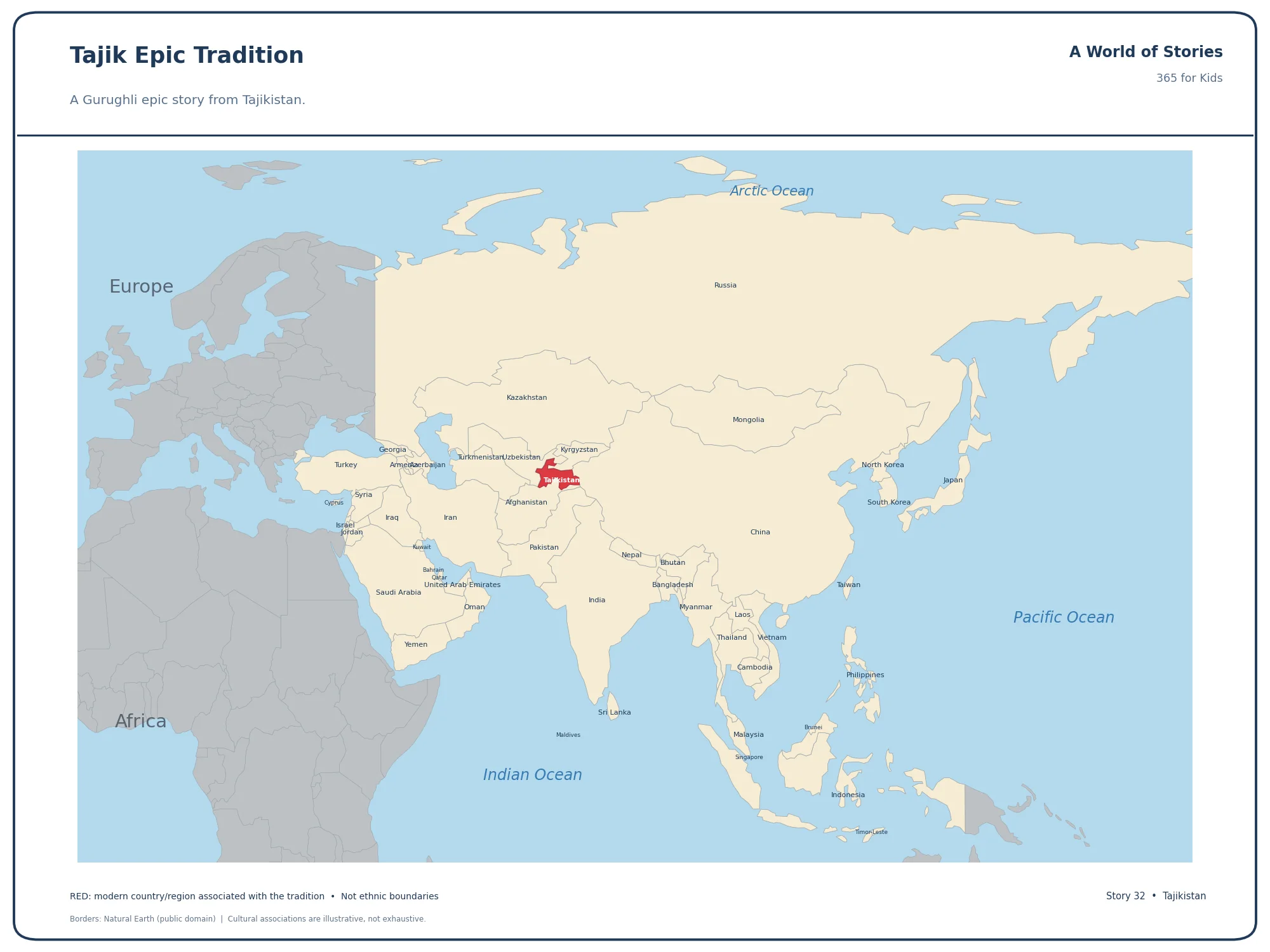
In the old songs of the Tajik storytellers, there is a city called Chambul. The bards describe it as a flourishing place, where people gathered for music and celebrations and where the fields beyond the city sustained the herds. Over Chambul ruled Gurughli, whose name was known through many tales of courage and adventure.
Yet the songs do not belong to Gurughli alone. Among the bravest defenders of Chambul was Avaz, the young warrior whom Gurughli had raised as his son. Many stories follow Avaz as he rides beyond the city to face those who threaten its peace.
One such danger came from Gavdar Shah, a formidable warrior whose men had pressed into the grazing lands of Chambul. The pasture was precious to the people who depended on their animals. With Gavdar’s fighters there, the land could no longer be used in peace.
Avaz would not ignore the challenge. He prepared to ride out and confront the intruders. He put on his armor and made himself ready for combat. Before he departed, he received the blessing of Gurughli. The people of Chambul gave him their support, and the beat of drums accompanied his departure.
The young warrior rode toward the men who had entered the land. Before him stood a band of eighty fighters. They saw a lone challenger approaching and greeted him with scorn. They expected the sight of so many armed men to shake his courage.
But Avaz did not turn away. He answered their taunts by declaring who he was: Avaz of Chambul, son of Gurughli. He had not brought gifts to purchase his safety, and he had not come to deceive anyone. He was ready to face their champion openly.
The challenge led him to Gavdar Shah himself. Gavdar was no ordinary opponent, and the meeting of the two warriors became the kind of contest that storytellers sing about for generations. Their horses surged forward. Their weapons met with tremendous force. In the language of the epic, even the earth seemed to tremble beneath them.
Gavdar struck powerfully, but Avaz endured the blows. Each time the battle pressed against him, he held his ground and continued the contest. The young defender had to rely on strength and skill together; bold words alone would not protect Chambul.
At last, Avaz gained the advantage. Gavdar could no longer overcome him. The challenger who had arrived to seize the advantage on Chambul’s land now had to acknowledge the courage of the warrior who stood before him.
And then the tale takes an unexpected turn. Gavdar did not demand another fight. Instead, he recognized Avaz’s valor and offered to become an ally of the heroes of Chambul. Avaz accepted the offer.
The confrontation had begun with threats over the grazing land. It ended with former opponents choosing an alliance rather than continuing the struggle. In the Tajik epic, courage is shown in the contest itself—but also in what a warrior does when victory is already his.
So this episode of Gurughli remembers Avaz not simply as the young man who could win a fierce battle, but as a defender who knew when the fighting could end. And the name of Chambul, the city he defended, continued to live in the songs of its storytellers.
Gurughli (also transcribed Gurghuli or Gūrūḡlī) is a cycle of oral heroic narratives performed by Tajik bards, especially in the south of Tajikistan and neighboring parts of Afghanistan. In the Tajik tradition, the exploits of Avaz, Gurughli’s adopted son in many versions, are central to the cycle. Chambul is a legendary city within the epic, not a modern city to locate on a map. The episode adapted here is the battle of Avaz against Gavdar Shah (also transcribed Gāvdār or Govdor), preserved in the repertoire of the Tajik bard Boboyunus Khudoydodzoda (Xudoydodzoda).
This is an original English prose adaptation of one documented episode, not a translation of the entire epic or a verbatim rendering of its Tajik verses. The main sequence is retained: Gavdar’s incursion onto Chambul’s grazing land; Avaz’s preparation and blessing; the encounter with the eighty fighters; the duel; Gavdar’s defeat and offer of alliance; and Avaz’s acceptance. The descriptive language is newly composed for young readers. Other Tajik, Uzbek, and Turkmen versions of the larger epic differ.
After the Story: Read · Create · Reflect · Share
1. Locate Tajikistan on a map of Asia. Draw its flag and identify one country that borders it.
2. Why were the grazing lands outside Chambul important, and why did Avaz decide to defend them?
3. What did Gavdar Shah do after Avaz defeated him? How did Avaz respond?
4. Do you think accepting an offer of friendship after a conflict can require courage? Explain your answer using the story.
Inspired by this story? Create your illustration!
TURKMENISTAN — Görogly and the Stolen Horse Gyrat
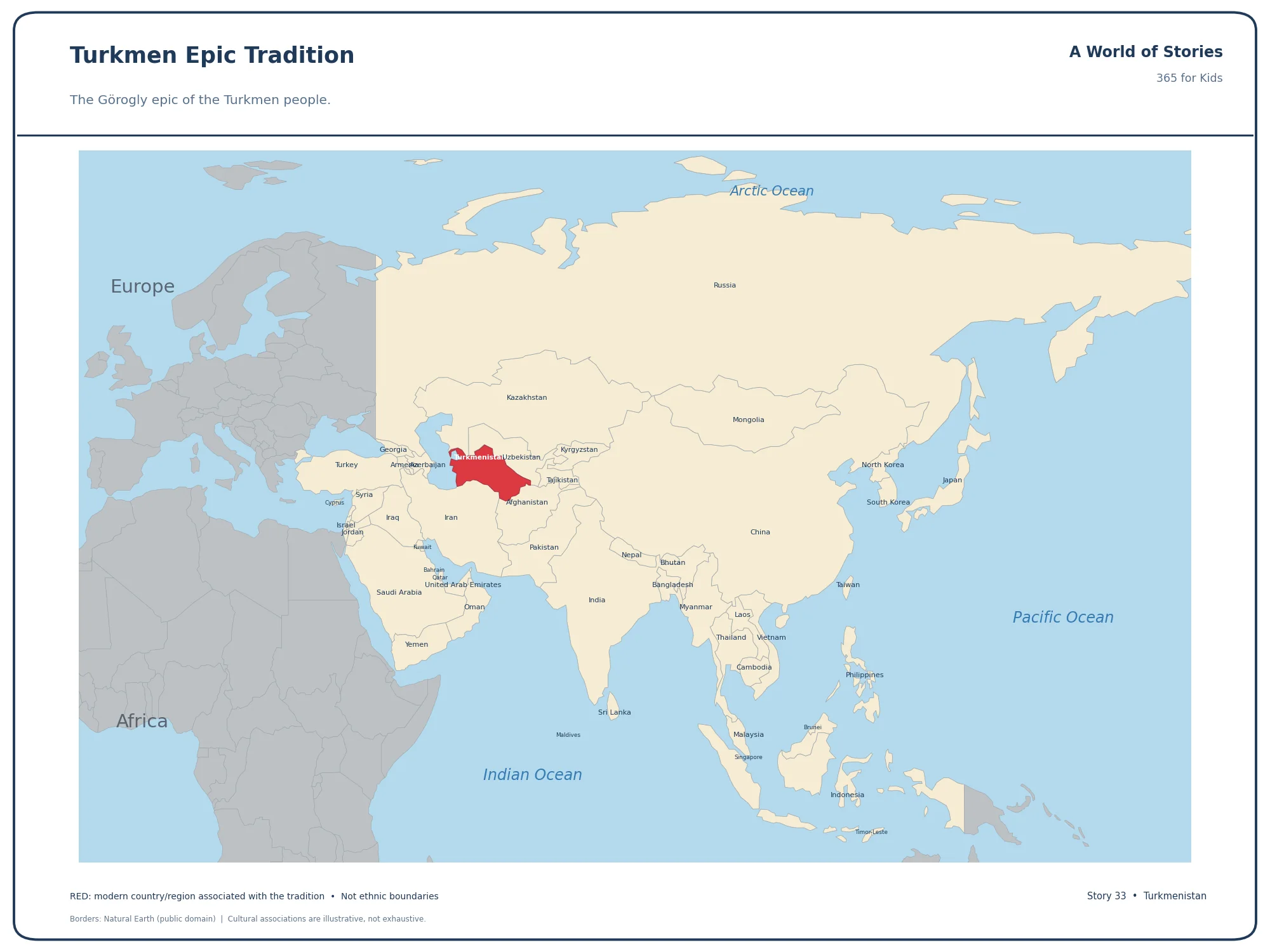
High among the mountains of Chandybil lived Görogly, the hero celebrated in the songs of the Turkmen people. Many tales were told of his courage and of the riders who stood beside him. Yet whenever storytellers spoke of Görogly, they spoke, too, of Gyrat, his extraordinary horse.
Gyrat was a pale-coated steed whose speed seemed almost beyond nature. To Görogly, he was far more than a fine animal to be admired or a powerful horse to be ridden into danger. The two had shared the hardships of long journeys and the peril of battle. Horse and rider understood one another through years of companionship.
Their bond was so famous that the ruler Balybek heard of it. He was told that much of Görogly’s strength came from his remarkable horse. The thought troubled Balybek. If Gyrat could be taken from Görogly, perhaps the fearless hero would no longer seem so formidable.
Balybek wanted the horse for himself. But how could anyone steal Gyrat from a man who guarded him so faithfully? The ruler’s followers saw little hope of succeeding by force. Instead, a cunning plan was devised. An old woman agreed to carry it out, provided that Balybek would reward her for many years.
The woman approached Görogly pretending to be weak and in need of shelter. Görogly was not a man to turn away someone asking for help. He welcomed her into his home.
When morning came, the visitor was gone. So was Gyrat.
For Görogly, the empty place where his companion should have been was a bitter discovery. His horse had not simply wandered away. The stranger had deceived him, and Gyrat had been stolen.
Agayunus, Görogly’s wise wife, understood what had happened. She warned him that the woman had taken advantage of his kindness and offered to help him recover the horse. Görogly did not deny the trick. Yet he decided to go after Gyrat himself. The loss had come about while he was responsible for his companion, and he would do what he could to bring him home.
Görogly made his way to Balybek’s palace. The ruler received him politely, as though he knew nothing of the deceit. But when Görogly demanded the return of Gyrat, Balybek refused to accept his word. Anyone, he suggested, might claim such a magnificent horse. Görogly would have to prove that Gyrat truly belonged with him.
It seemed a simple test. Surely a horse would recognize the person who had cared for him for so long.
But the test did not unfold as Görogly expected. He stood before his companion wearing splendid unfamiliar clothes, and Gyrat did not respond as the ruler had anticipated a loyal horse would. For a moment it seemed that Balybek’s scheme might succeed after all.
Görogly had not forgotten the deeper bond between them. He knew that Gyrat had heard his voice over many journeys. He also knew that songs belonged to their life together. So he asked for a dutar, the long-necked, two-stringed instrument beloved in Turkmen musical tradition.
With the instrument in his hands, Görogly began to sing. His song spoke of a rider and the horse without whom his journeys would be incomplete. It carried the feeling of the open road, of shared courage, and of the faithful companion he had come so far to find.
Gyrat heard the familiar voice. Then came the melody that he knew. Whatever the fine clothes had hidden from his eyes, the music brought back to him. The horse responded to Görogly’s call.
There, before Balybek, was the answer no trick could replace. Gyrat knew his rider. Görogly had found the companion taken from him, and the two were reunited.
The tale does not remember Görogly only for strength or daring. It remembers the friendship between a human being and an animal, and the way a song can speak when appearances mislead. Balybek had tried to seize a splendid horse. What he could not steal was the trust built between Gyrat and Görogly.
Görogly (also spelled Gorogly, Gerogly, or Gyrogly) is the central figure of a Turkmen oral epic tradition. His horse appears in different transliterations, including Gyrat and Gairat. The epic is performed through a combination of storytelling, song, poetry, and instrumental music; the dutar is a traditional long-necked lute. UNESCO inscribed the epic art of Gorogly on its Representative List of the Intangible Cultural Heritage of Humanity in 2015.
This is an original English prose adaptation of the documented episode in which Gyrat is stolen and later recovered. The core events follow descriptions published by Turkmen cultural sources: Balybek plots to take the horse, an old woman deceives Görogly, Agayunus offers help, and the hero wins back his companion when Gyrat responds to his voice and the dutar. Some details, especially the test involving fine clothing and the sung recognition, are documented in reporting about a 2026 theatrical presentation of the episode. The prose is not a translation of an individual bard’s performance, and versions of the wider epic differ among Turkmen and neighboring traditions.
After the Story: Read · Create · Reflect · Share
1. Locate Turkmenistan on a map of Central Asia. Draw its flag and identify one neighboring country.
2. Why did Balybek want Gyrat, and how did the old woman deceive Görogly?
3. How did the sound of the dutar help Görogly prove his bond with Gyrat?
4. What does this story suggest about loyalty, trust, and the power of music? Which moment best shows these ideas?
Inspired by this story? Create your illustration!
SHARED TRADITION — Nasreddin Hodja and the Smell of Soup
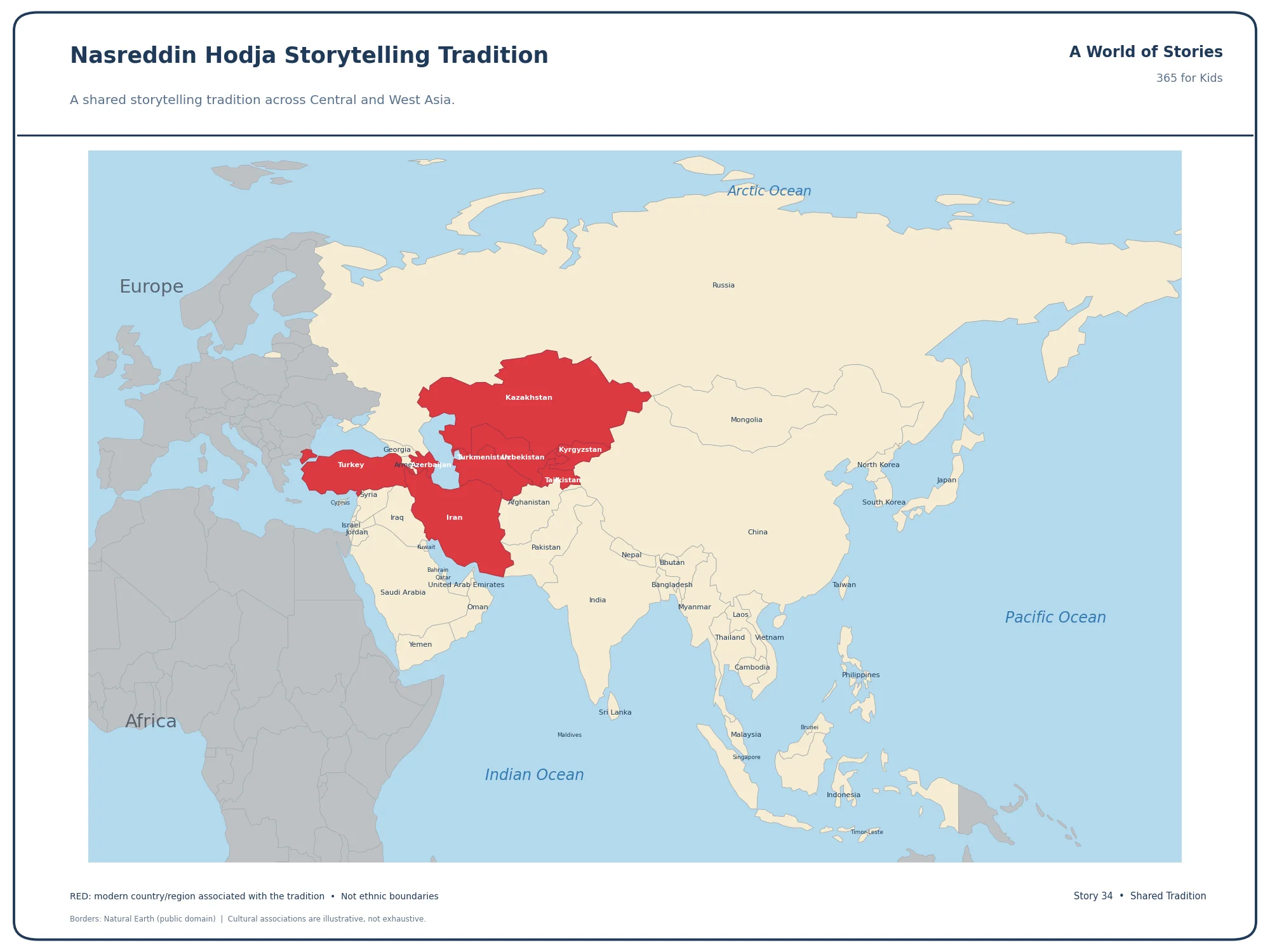
A poor traveler had been given a piece of bread. It was all he had to eat that day, and it was so dry that every mouthful seemed to take a great deal of chewing.
As he passed an inn, a wonderful smell reached him. By an open window stood a pot of hot soup. Steam rose from it in gentle clouds, carrying the rich scent of the meal into the street.
The traveler stopped. He had no money for soup, but the steam itself cost nothing—or so he thought. Holding his bread above the rising vapor, he waited until it grew a little softer and took on some of the delicious smell. Then he ate it, grateful for the small comfort.
The innkeeper had watched from inside. Before the traveler could go on his way, the man hurried out to stop him.
“You have enjoyed my soup!” the innkeeper declared. “Now you must pay.”
“But I have not taken a single spoonful,” the traveler answered. “I only held my bread above the steam.”
“That steam came from my soup,” insisted the innkeeper. “You owe me for it.”
The traveler had no coins to offer. Still determined to collect his payment, the innkeeper took the matter to Nasreddin Hodja, who was serving as a judge.
Nasreddin heard the innkeeper’s complaint. Then he listened to the traveler. He did not interrupt either man. When they had finished, he turned to the innkeeper.
“Let me be sure I understand,” he said. “This man did not taste your soup, did not carry any of it away, and did not touch your pot. You demand money because he enjoyed its smell?”
“Exactly,” the innkeeper replied. “A smell is worth something.”
Nasreddin reached into his pocket and brought out two coins. The innkeeper leaned forward, ready at last to receive his payment.
But Nasreddin did not place the coins in his hand. Instead, he held them close to the man’s ear and shook them together. They made a bright, clear jingle.
“There,” said Nasreddin. “You have been paid.”
The innkeeper stared at him. “Paid? You have given me nothing! I heard only the sound of money.”
“And the traveler had only the smell of your soup,” Nasreddin replied. “The sound of money is fair payment for the smell of food.”
With that, he put the coins back into his pocket. The traveler was free to go, and the innkeeper had nothing more to demand.
Nasreddin Hodja is a wise and humorous figure whose anecdotes are told under different names across many communities. In 2022, UNESCO inscribed the telling tradition as shared intangible cultural heritage of Azerbaijan, Kazakhstan, Kyrgyzstan, Tajikistan, Türkiye, Turkmenistan and Uzbekistan. This does not mean that every individual anecdote is told in exactly the same form in all seven countries. The present story follows the widely recorded “smell of soup / sound of money” plot, including versions published in Azerbaijan and educational folktale collections. The dialogue and descriptive wording are newly written for this English literary adaptation; the central events and humorous judgment remain those of the traditional anecdote. It is a folktale, not a verified historical court case.
After the Story: Read · Create · Reflect · Share
1. On a map of Asia, find Türkiye and one of the Central Asian countries where Nasreddin stories are told. Can you draw the flag of either country?
2. What did the traveler take from the innkeeper’s soup—and what did he not take?
3. Why did Nasreddin decide that the sound of coins was a fair answer to the innkeeper’s demand?
4. What can this story teach us about fairness and the way we treat someone who has very little?
Inspired by this story? Create your illustration!
West Asia
IRAN — Zal and the Simurgh
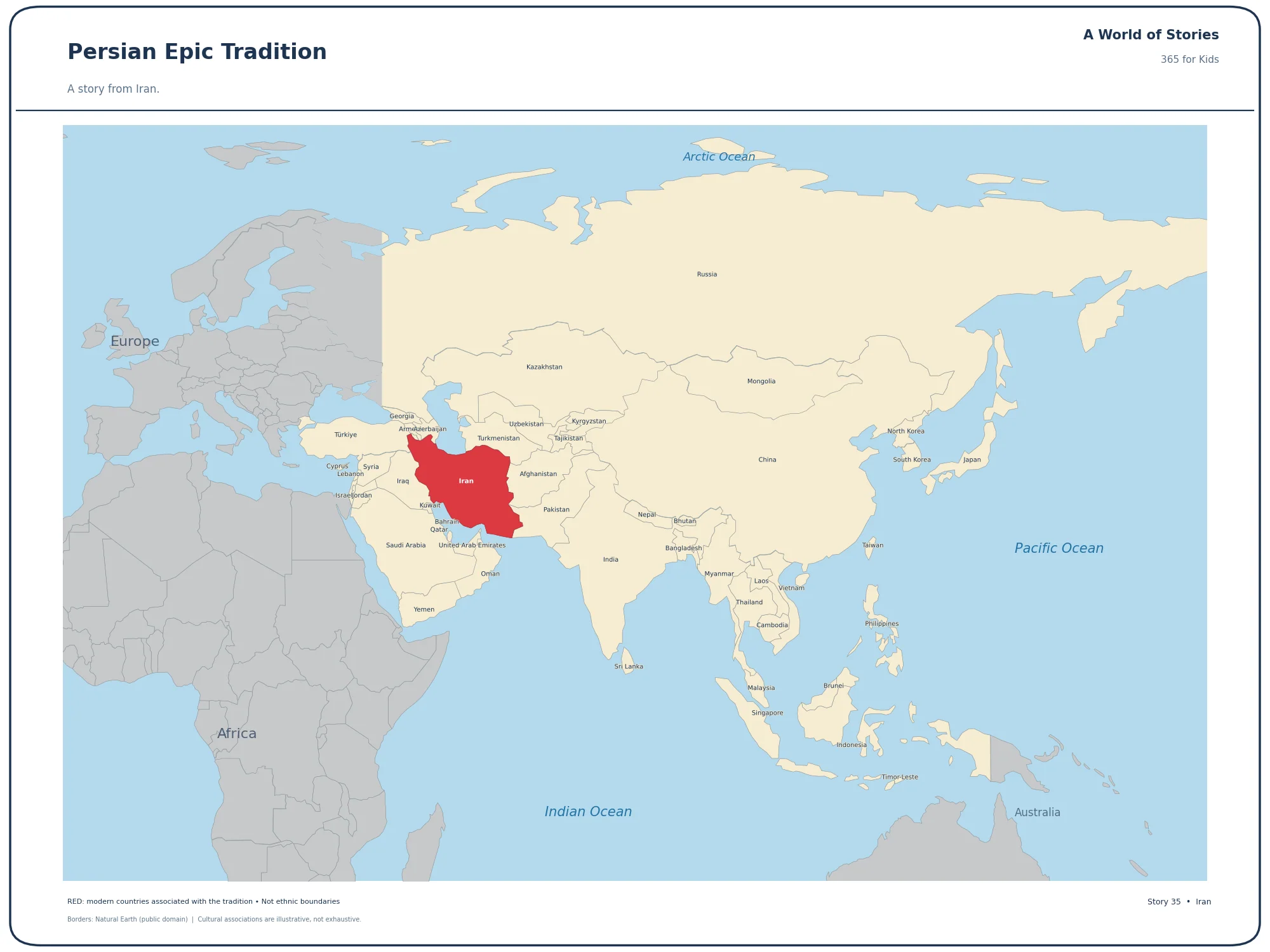
Long ago, in the land of Sistan, the great warrior Sam was known for his courage. He had faced enemies on the battlefield and commanded mighty armies. Yet for many years he longed for something that no victory could give him: a child to carry on his family’s name.
At last a son was born. The infant was beautiful, with bright eyes and a healthy, strong body. But there was one thing that made him different from other newborn children. Every hair on his head was white, as though winter had laid a covering of snow upon it.
The women of Sam’s household hesitated to bring him the news. They knew how much he cared about what others thought of him. Only after several days did one of them find the courage to tell him that he had a son. She asked him to welcome the child with gratitude, whatever his appearance.
Sam went to see the baby. Instead of rejoicing, he grew afraid. He imagined what his enemies might say about a child with the hair of an old man. He feared that they would call it an evil sign. In his shame, he made a terrible decision: he ordered the child to be carried away and left upon the slopes of Mount Alborz.
Far from the villages and gardens, the mountain rose into a world of cold stone and distant clouds. There, among the rocks, the helpless baby was abandoned. He cried with hunger, and there was no human voice to answer him.
But high above the mountain lived the Simurgh, a wondrous bird whose great wings could carry her across the sky. She had built a nest upon the heights, and within it her young waited for food. When the Simurgh flew out in search of something to bring them, she saw the child on the rocks below.
She descended and lifted the baby in her powerful claws. At first, she had meant to carry him back as food for her young. But as she looked at his helpless face, pity stirred within her. She would not allow the child to be harmed. Instead, she brought him safely into her nest and cared for him beside her own fledglings.
Days became seasons, and seasons became years. The boy grew among the birds under the Simurgh’s watchful care. She fed and sheltered him, and her young accepted him as one of their own. His arms grew strong, his face handsome, and the white hair that had frightened his father still shone upon his head.
Travelers passing below the mountain began to tell an astonishing story. They had seen a young man upon the heights, living near the nest of a gigantic bird. He had the bearing of a prince, though he dwelt in a place where no human family could live. Word of him traveled from one caravan to another until it reached Sam himself.
Then one night Sam dreamed that a rider had come with news of his long-lost son. The dream did not bring him peace. Instead, it forced him to remember what he had done. How could he, a man so proud of his bravery, have been frightened by a newborn child’s appearance?
Sam asked the wise men around him whether the youth on the mountain could truly be his son. They did not flatter him. They reminded him that even wild creatures cared for their young. He had cast away his own child because he feared the judgment of other people. Their words filled him with remorse.
Sam gathered his followers and journeyed toward Mount Alborz. At last he looked up and saw the great nest, with the white-haired youth nearby. The mountain was so steep that Sam and his men could not reach the summit. The father who had once ordered the child to be taken away now could do nothing but stand far below and ask forgiveness.
From her high home, the Simurgh saw the travelers and knew why they had come. She turned to the boy whom she had raised.
‘Your father has come to seek you,’ she told him. ‘The time has arrived for you to return to your own people.’
The young man was overcome with sorrow. The nest had been his home for as long as he could remember. The Simurgh had been the mother who protected him. Why should he leave the one who had shown him kindness for a father he did not know?
The Simurgh assured him that she was not sending him away because her love had ended. He had a place among people as well as among birds, and a life awaited him beyond the mountain. The parting would be painful, but it would not break their bond.
Before he left, she gave him a feather from her great wing. If ever he faced a danger too great to overcome, he must place the feather in a fire. She would see the sign and come to help him. It was a promise that her care would follow him, even where her wings could not always shelter him.
Then the Simurgh lifted the young man and carried him down from the heights. Sam bowed before the bird in gratitude. When he looked closely at his son, he saw not the frightening sign he had imagined years before, but a brave and noble youth. The white hair was unchanged. It was Sam’s heart that had changed.
He asked his son to forgive him and promised never again to turn away from him. The young man left the mountains with his father, dressed now in the garments of a prince. Sam gave him the name Zal, a name connected with his white hair.
News of the reunion spread, and King Manuchehr summoned Zal to his court, where he recognized the young man’s strength and wisdom. Back in Sistan, the people welcomed Zal with music and celebration. He learned the ways of the court and grew into a just and capable leader.
Yet the mountain and the wondrous bird were never forgotten. The feather he carried was a reminder of the Simurgh, who had seen a forsaken child and chosen to become his family. Long after he had left her nest, that promise of help remained part of Zal’s story.
Zal (Zāl), Sam (Sām), and the Simurgh (Simorgh / Simorḡ) are figures from the Shahnameh, or The Book of Kings, the great Persian epic composed by the poet Ferdowsi around the turn of the 11th century. This is a literary-epic episode, not an anonymous folktale. Its setting includes Sistan, a historical region that today extends across parts of Iran and Afghanistan, and the legendary heights of Mount Alborz. This original English prose adaptation follows the Zal episode in Helen Zimmern’s public-domain English retelling, checked against scholarly accounts and museum descriptions. The order of events is preserved: Sam rejects the white-haired baby, the Simurgh raises him, Sam repents and seeks him, the Simurgh gives Zal a protective feather, and the father and son are reunited. The descriptive phrasing and dialogue here are newly written and are not presented as quotations from Ferdowsi. In different translations and visual retellings, Zal receives one feather or more than one. This version follows the single-feather telling. The Simurgh is a mythical bird of Iranian literature; she is not simply an ordinary eagle or a real animal. Modern readers may recognize Zal’s white hair as a feature associated with albinism. The epic depicts Sam’s fear and prejudice, not a reason to judge a child by appearance.
After the Story: Read · Create · Reflect · Share
1. Find Iran and Afghanistan on a map of Asia, and draw the flag of Iran; locate the Alborz mountain range.
2. Why did Sam abandon his son? What did he come to understand when the wise men challenged his decision?
3. Why was Zal reluctant to leave the Simurgh? What did the feather promise him?
4. Who shows compassion or courage in this story? How does the meaning of Zal’s white hair change for his father?
Inspired by this story? Create your illustration!
IRAQ — Gilgamesh and the Search for Immortality
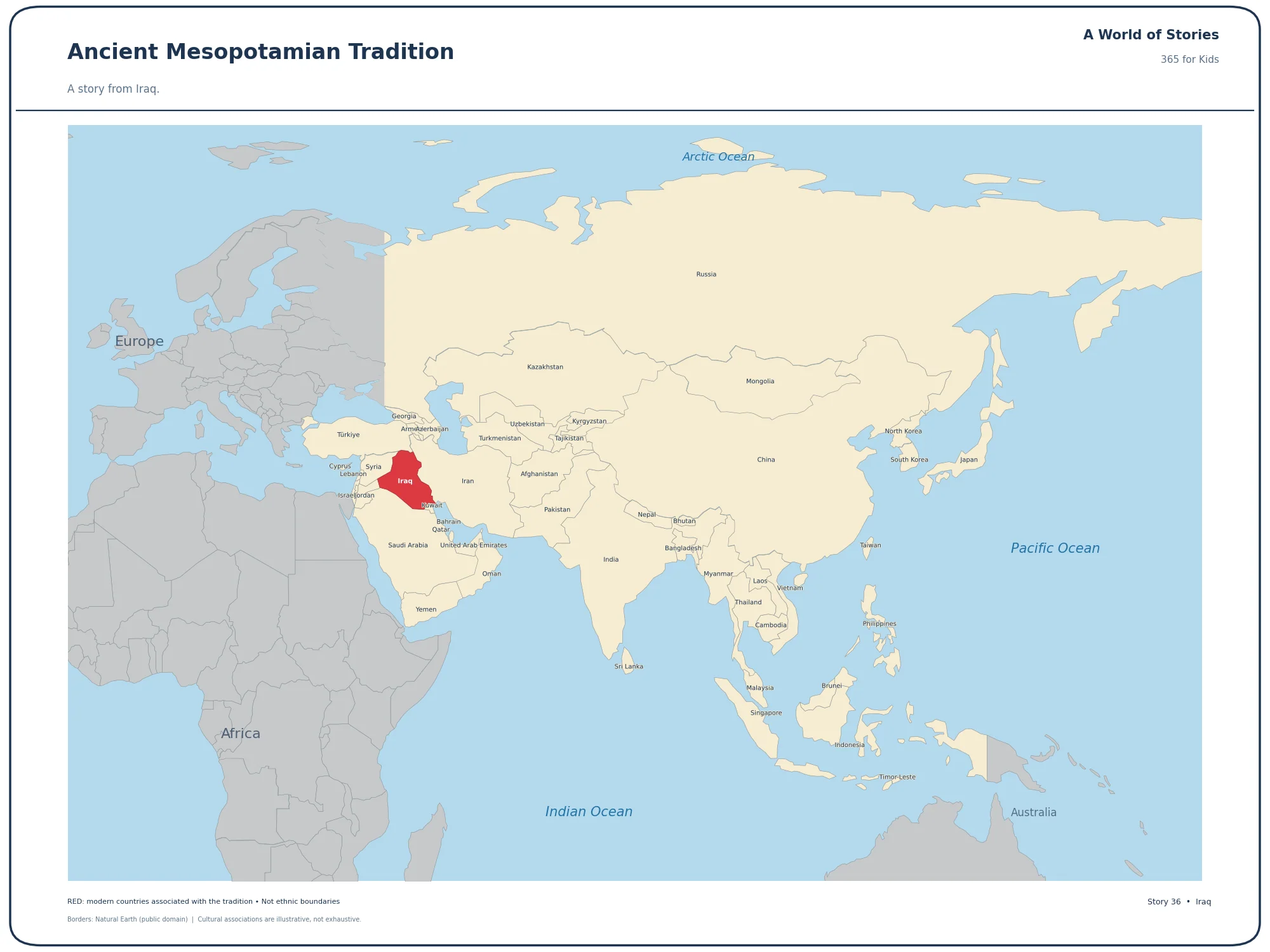
In the ancient city of Uruk, where broad walls rose above the river plain, there lived a king named Gilgamesh. People spoke of his extraordinary strength and his daring deeds. He had faced dangers that would have frightened other warriors, yet no victory had mattered to him as much as the friendship he shared with Enkidu.
Enkidu had once lived among wild creatures, far from city gates and crowded streets. When the two men first met, they struggled fiercely against each other. But rivalry gave way to respect, and respect grew into a friendship that changed them both. Together they had crossed distant lands and faced terrible enemies. Gilgamesh had believed that, whatever came, his friend would always walk beside him.
Then Enkidu became ill and died.
Gilgamesh mourned him. The king who had never feared a powerful enemy could scarcely bear to look upon the stillness of his friend. He wandered beyond the city, wearing rough skins and grieving. A question troubled him more than any monster had ever done: if Enkidu could die, must the same thing one day happen to Gilgamesh?
He had heard of one man who had escaped the fate of ordinary mortals: Utnapishtim, who lived far away beyond the waters no traveler easily crossed. The gods had granted this man everlasting life long ago. Gilgamesh resolved to find him and learn whether death could be defeated.
He traveled through wild country until he reached the great mountain called Mashu. Its gates were guarded by fearsome scorpion beings. They watched the weary traveler approach. Gilgamesh told them why he had come: he sought Utnapishtim, for the death of his friend had filled him with fear. At last they allowed him to pass along the dark road of the sun.
The way lay in deep darkness. Gilgamesh went forward though he could not see what lay ahead. Hour followed hour. At last the darkness ended, and he came to a wondrous garden where precious stones shone among the branches. Yet even such splendor could not turn his thoughts from his journey.
Beyond the garden lay the sea. There Gilgamesh encountered Siduri, a wise keeper of an inn. She saw his tired face and the marks of a long road upon him. He told her of Enkidu and of the life he hoped to find. Siduri knew that people must live the days given to them, but Gilgamesh was not ready to abandon his search. He continued until he found Urshanabi, the boatman who knew the passage across the dangerous Waters of Death.
The crossing was long and perilous. Urshanabi guided the boat, and Gilgamesh followed his instructions. Together they reached the distant shore where Utnapishtim lived with his wife.
Gilgamesh stood before the immortal man in wonder. Utnapishtim did not appear to be a mighty giant or a shining god. He looked like a man. How, Gilgamesh asked, had someone so like himself obtained a life without end?
Utnapishtim answered by telling a story from the far past. The gods had decided to bring a terrible flood upon the world, but the god Ea warned Utnapishtim to build a great boat. He followed the warning. He brought his family aboard and sheltered living creatures from the storm. Rain and wind swept over the land, and the waters rose. When the flood at last subsided, the boat came to rest. Utnapishtim released birds to discover whether dry land had appeared.
Afterward, the gods granted Utnapishtim and his wife a life that would not end. It had been an extraordinary gift, not a secret that every traveler could claim. Listening, Gilgamesh began to understand that the man before him had not won immortality through strength or courage alone.
Still, Utnapishtim offered him a test. Could Gilgamesh remain awake for six days and seven nights? If he could not overcome sleep, how could he hope to overcome death?
Gilgamesh sat down to try. Almost at once, sleep overcame him.
Day after day he slept. Utnapishtim instructed his wife to bake a loaf of bread each day and place it beside the sleeping king, so that the changing loaves would reveal how much time had passed. When Gilgamesh woke, he believed only a moment had gone by. But the loaves showed the truth: even this strongest of heroes could not command his own need for sleep.
It was time to return home. Utnapishtim had him bathed and dressed in clean garments for the journey. Urshanabi would guide him back. But Utnapishtim’s wife, knowing how far Gilgamesh had traveled, urged her husband not to send him away empty-handed.
Then Utnapishtim revealed one final secret. Deep beneath the water grew a thorny plant with the power to restore youth to the old. It would not make a person immortal, but it could make an aging person young again.
Gilgamesh would not let that chance escape. He fastened heavy stones to his feet and descended into the depths. There he found the plant, though its thorns scratched his hands. He took hold of it, freed himself from the stones, and rose to the surface carrying his prize.
Hope returned. He planned to bring the plant to Uruk, where an old person could try its power before Gilgamesh used it himself. At last, he thought, his terrible journey might bring a gift not only to him but to the people of his city.
On the way home, Gilgamesh stopped beside a pool of cool water and went in to bathe. While he was away from his belongings, a snake caught the scent of the plant. It crept near, took the precious leaves, and vanished. As it went, it shed its old skin.
When Gilgamesh returned, the plant was gone. He looked at the place where it had rested, and grief overcame him once more. All his travel, all the dangers, all the hope he had carried from the distant shore—and now the gift of renewed youth had disappeared. He could not bring it back.
There was nothing to do but continue toward Uruk.
At last the city rose before him. Its great walls encircled the homes, gardens, and temples of his people. Gilgamesh invited Urshanabi to look at the brickwork and the strength of the city. These were things human hands had built, and people after them would see the work.
Gilgamesh had not found a way to live forever. He had discovered something more difficult to accept: even the strongest king could not escape the limits of human life. Yet he had also returned to the city he was responsible for, and to the world of people whose lives, work, and memories mattered.
The ancient epic ends this part of his journey where it began—at the walls of Uruk. The king had searched across the earth for immortality. He came home knowing that a life could be remembered for what one made of it, even when that life could not last forever.
Origin and genre. This is an adaptation of a portion of the ancient Mesopotamian literary epic, not a modern Iraqi folktale. Uruk lay in what is now southern Iraq. Older Sumerian stories and later Akkadian versions of Gilgamesh circulated across the ancient Near East. Textual approach. The narrative follows the broad sequence of the Standard Babylonian epic, principally the later tablets describing Enkidu’s death, Gilgamesh’s journey, the meeting with Utnapishtim, the failed sleep test, the plant and the serpent, and the return to Uruk. It is a new English retelling, not a direct translation of ancient Akkadian or a reproduction of a modern published translation. Some descriptive sentences and dialogue transitions are literary paraphrase; no separate adventures have been added. An important distinction. The gods grant Utnapishtim and his wife eternal life in the flood tradition. The underwater plant sought by Gilgamesh offers renewed youth, not literal immortality. The snake’s shedding of its skin is associated with the loss of that plant. For younger readers. The story includes the death of a close friend and the fear of mortality. Younger children may benefit from reading it with an adult. The literary adaptation avoids graphic details while preserving the central themes.
After the Story: Read · Create · Reflect · Share
1. Find Iraq on a map; where was ancient Uruk?
2. Why did Enkidu’s death make Gilgamesh begin his journey?
3. What happened to the plant of renewed youth and the snake?
4. What did the city walls help Gilgamesh understand about life and what people leave behind?
Inspired by this story? Create your illustration!
TURKIYE — Keloğlan and the Chickpea
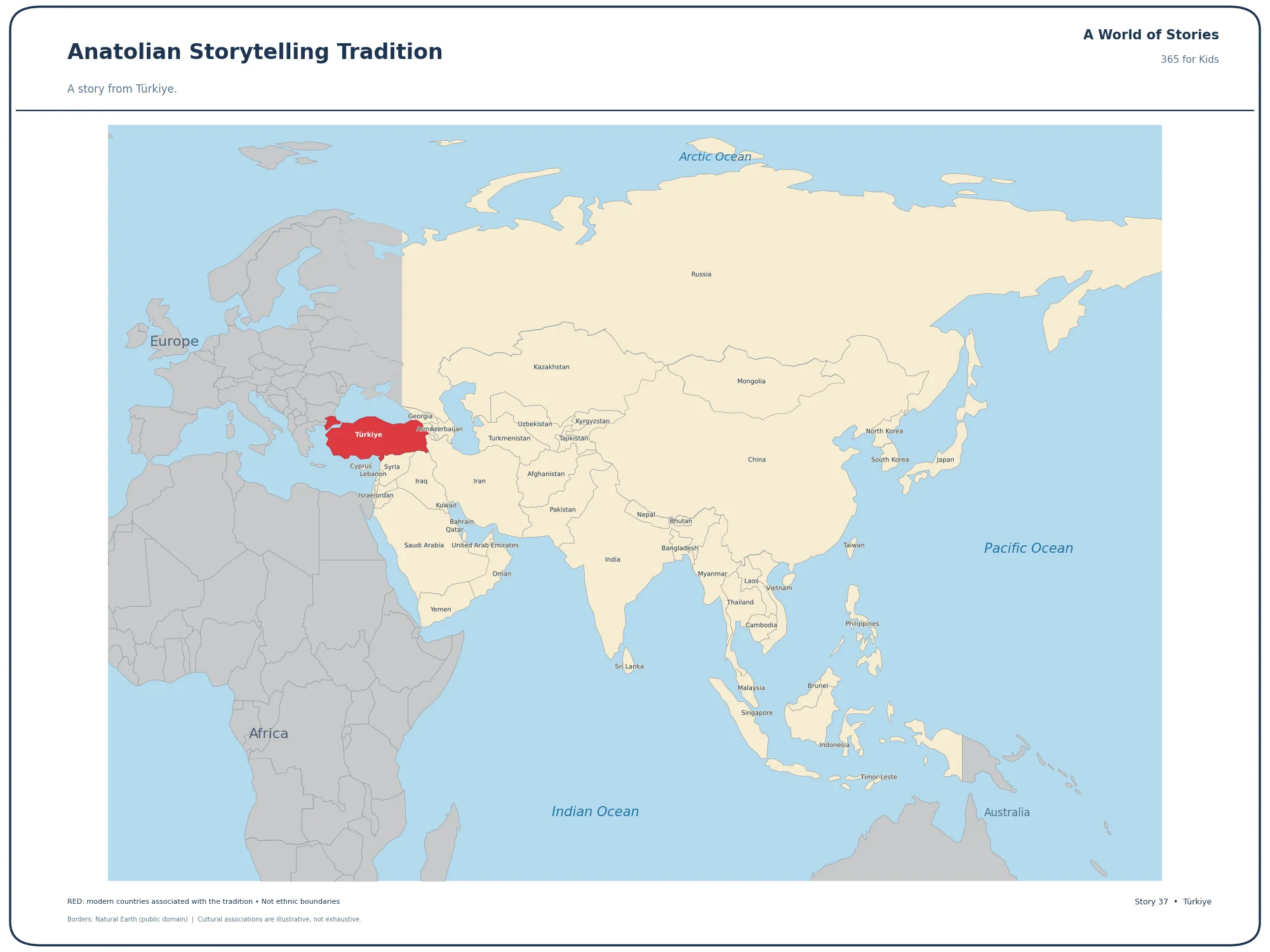
Once upon a time, a mother lived with her son, Keloğlan. His name meant “Bald Boy,” and although he possessed little, he had a quick mind and an imagination that could make a very small thing seem enormous.
One day, while playing beside a rubbish heap, Keloğlan noticed a chickpea. It was only one little grain, the sort of thing most people would have passed without a second glance. He picked it up and began to count in his head. One chickpea might become ten; ten might become a whole measure; many measures might become sacks; and sacks, he thought, might fill a caravan.
By the time Keloğlan had finished calculating, that lonely chickpea had become five hundred camel-loads in his imagination. He kept the little grain and set out to see what fortune he might make from such grand thoughts.
He stopped outside the house of a wealthy man. When the owner came to the door and asked what he wanted, Keloğlan told him a startling tale. He said that he had been traveling toward Aleppo with five hundred camel-loads of chickpeas when robbers attacked his caravan, killed his attendants, took his goods, stripped him of his fine clothes, and abandoned him far from the road.
None of this had happened. But Keloğlan spoke so confidently that the rich man believed him. He welcomed the supposed merchant into his house, gave him fresh clothing, and allowed him to remain as a guest. After several days Keloğlan asked leave to continue his journey. His host even gave him a horse.
And so Keloğlan rode toward Aleppo, a city of merchants and markets. There he repeated his claim: an enormous caravan of chickpeas was on its way, and he was a man with goods beyond counting. Traders lent him money against the merchandise they believed would soon arrive. His reputation grew, although not a single camel-load of chickpeas belonged to him.
Before long, the governor heard of this remarkable merchant and invited him to a feast. Keloğlan went with a servant, to whom he gave money to distribute among the governor’s attendants. The generous gifts made his arrival seem all the more impressive. The governor was persuaded that Keloğlan was rich and important; soon afterward, he offered his daughter in marriage. Keloğlan accepted, and their wedding celebrations lasted forty days and forty nights.
For a time, the young man lived as though his dreams had become real. Yet a story built on borrowed money could not last forever. The merchants eventually stopped lending him anything more, and his money ran out. The grand wedding was over, and the household found itself in need even of firewood.
One day his wife asked him for five lira so that she could go to the public baths. Keloğlan tried to obtain the money, but nobody would lend him another coin. With no wood left to burn, the household began cutting the large mulberry tree in the courtyard.
Then something extraordinary happened. As the tree was cut, gold began to pour from its trunk. Here, at last, was treasure that nobody had expected: not in a camel caravan, not in a merchant’s storehouse, but hidden inside an ordinary tree.
Keloğlan did not tell the governor the truth about this discovery. Instead, he began striking the wall with a stick, making a great commotion. The governor came running to learn what had happened. Keloğlan explained that the money from the sale of his five hundred camel-loads of chickpeas had finally been delivered, and that the commotion was over the payment.
The gold was gathered, and Keloğlan was wealthy again. This time he opened a shop and began trading. Then he took out the single chickpea he had saved from the beginning of his adventures. He looked at it and declared that this small grain had made him rich. With that, he put it into his mouth and ate it.
So ends the tale of Keloğlan and the chickpea: a little grain, a great deal of pretending, and a piece of luck greater than any plan. Whether Keloğlan was wise, dishonest, fortunate—or all three at once—is a question the storyteller leaves for listeners to decide.
Keloğlan (“Bald Boy”) is a well-known character in Turkish folk storytelling. Depending on the tale, he may be resourceful, naïve, mischievous, dishonest, courageous, or simply lucky. Unlike a flawless fairy-tale hero, he invites listeners to think critically about his actions. This adaptation follows the episode published under the Turkish title “Keloğlan Masalı,” collected by Salih San and printed in Türk Folklor Araştırmaları, issue 54 (1954). “Keloğlan and the Chickpea” is a descriptive English editorial title, not a claim that the source bore this exact name. The story includes deceptive acts; we have not changed them into acts of honesty or supplied an invented moral ending. An earlier working catalogue proposed “Keloğlan and the Tarhana Soup.” A dependable traditional text for that exact episode was not established, so the present story replaces it with a documented version. Aleppo, where part of the tale takes place, is in present-day Syria; the narrative remains part of Turkish folklore.
After the Story: Read · Create · Reflect · Share
1. Find Turkey on a map and draw its flag; in which present-day country is Aleppo located?
2. How did one chickpea lead to the wealthy man, the merchants, and the governor?
3. Which of Keloğlan’s choices were wrong, and why?
4. Why did Keloğlan credit the chickpea for his fortune when the gold came from the mulberry tree?
Inspired by this story? Create your illustration!
QATAR — Mai and Ghaylan — The Legend of the Sail
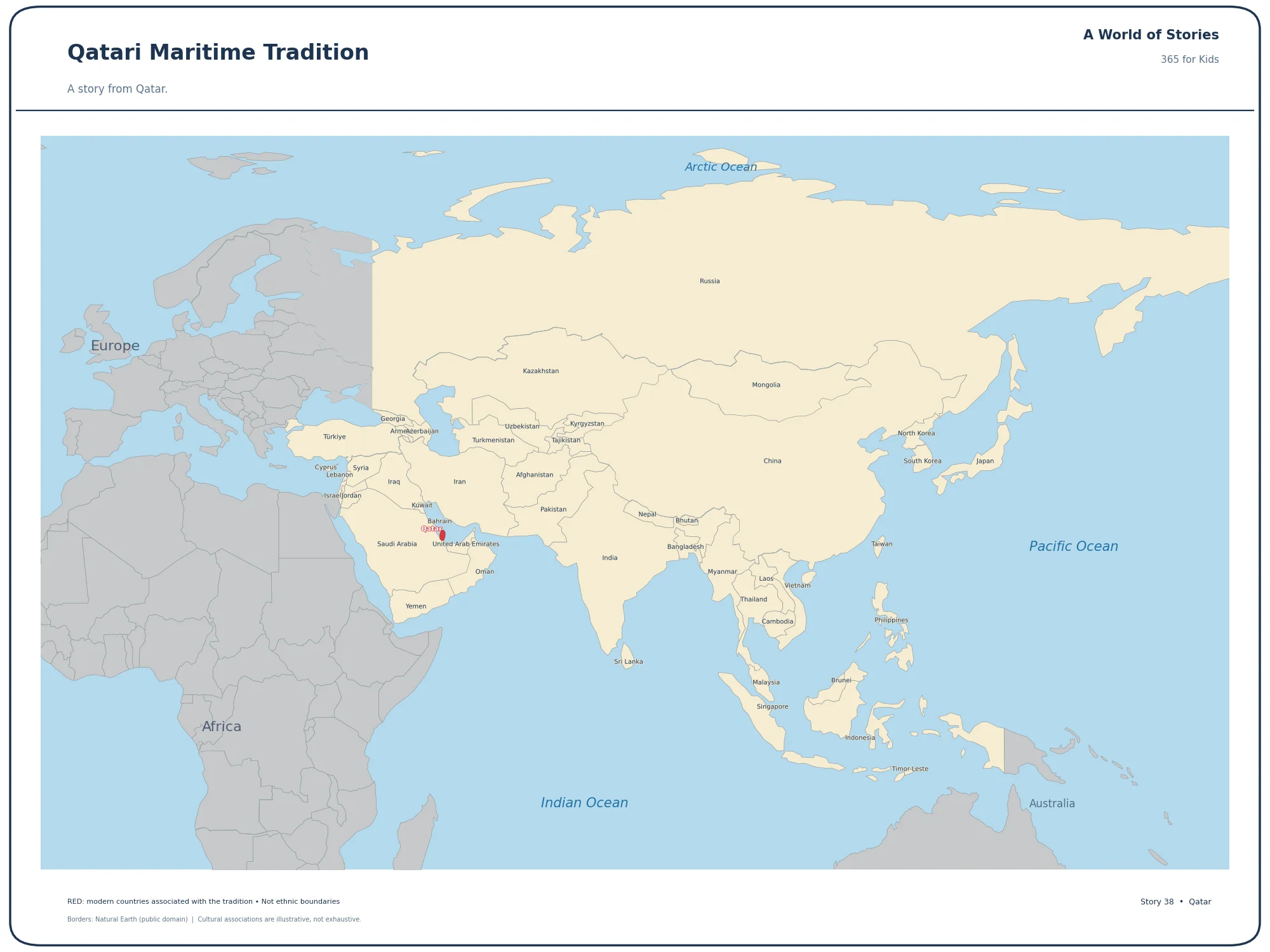
Long ago, on the northern coast of Qatar, the people of Khor al-Mahandah knew the sea as well as they knew the land. Wooden boats left the shore in search of pearl oysters. Beneath the waves lay the oyster beds the divers hoped to reach, and the journey there demanded strong arms and skillful crews.
Among the owners of pearl-diving boats was a man named Ghaylan. He had many vessels and men accustomed to the hard work of the sea. For a long time, his boats were the ones others tried to match. He was a man of influence, and he was used to leading the way.
Then Mai appeared.
Mai was bold, determined, and the owner of pearl-diving boats of her own. Her crews were strong, and their experience showed in the rhythm of their rowing. When her boats and Ghaylan’s boats set out toward the same pearl banks, Mai’s men pulled their oars through the water with such power that her fleet drew ahead.
Ghaylan watched the distance grow between them. His rowers labored, but the boats in front were moving faster.
He called across the water to Mai, asking her to tow his boats.
Mai, pleased with her advantage, called back that the power to move a boat lay at the end of the oar. Her meaning was plain: if Ghaylan wanted to keep up, his men would have to row harder.
And so it went. Whenever the two fleets made for the pearl grounds, Mai’s stronger rowers carried her boats ahead, while Ghaylan struggled to follow. Being overtaken troubled him more each time. He had boats and sailors; what he lacked was a way to travel faster.
Ghaylan began to look for an answer.
One day he noticed a grasshopper. Its wings caught his attention. As he watched the small creature, an idea came to him: perhaps a boat could take advantage of the moving air, just as a wing did.
Until then, in the telling of this legend, the race had depended on oars and the strength of those who pulled them. But the wind was moving above the water whether anyone rowed or not. Could it help carry a boat forward?
Ghaylan turned the thought into a new way of sailing. He had sails fitted to his boats, broad surfaces that could catch the wind above the deck. Now his vessels would not have to depend on the rowers alone.
When Mai and Ghaylan next set out for the pearl banks, Mai expected the familiar sight of his boats falling behind. Her crews rowed as skillfully as ever. But this time something was different.
Ghaylan’s boats moved ahead.
The wind pressed against their sails, and the vessels passed Mai’s fleet on the open water. She looked on in surprise. The rowers who had beaten him so often could not give her the same advantage now.
Mai called to Ghaylan, asking him to tow her boats.
From the vessel moving before hers came his proud reply: the power to pull a boat, he told her, was now at the top of the mast.
And there the old story ends: with two rivals upon the water, the strength of the oar answered by the power of the sail, and an idea born from watching the wings of a grasshopper.
Cultural origin. This is a Qatari maritime legend, or hikaya, associated particularly with Khor al-Mahandah (the Al Khor area) in northern Qatar. Pearl diving shaped the region’s coastal life for generations. The characters are called Mai (also May) and Ghaylan (also Gilan or Ghilân) in English-language sources. Story version. This adaptation follows the five-part narrative recorded and analyzed by ethnographer Anie Montigny: Ghaylan’s early success, Mai’s stronger crews, the exchange about towing, the grasshopper-inspired sail, and the second exchange when Ghaylan passes her. The ending has not been expanded with an invented reconciliation or further adventures. Different versions. Other documented tellings credit Mai with developing a smaller sail and Ghaylan with a larger one. The present story does not combine that variant with Montigny’s version. The sail’s invention here is a folkloric explanation, not a historical claim that sails were first invented in Qatar. Literary approach. This is an original English retelling of a traditional narrative, not a line-by-line translation of the ethnographic transcription or a reproduction of Qatar Museums’ modern animated film or contemporary illustrated books.
After the Story: Read · Create · Reflect · Share
1. Find Qatar on a map; which gulf borders it? Draw its flag.
2. Why were Mai’s boats faster at the beginning?
3. What did Ghaylan notice about a grasshopper?
4. What is the difference between friendly competition and making someone feel small?
Inspired by this story? Create your illustration!
BAHRAIN — Dilmun and the Gift of Fresh Water
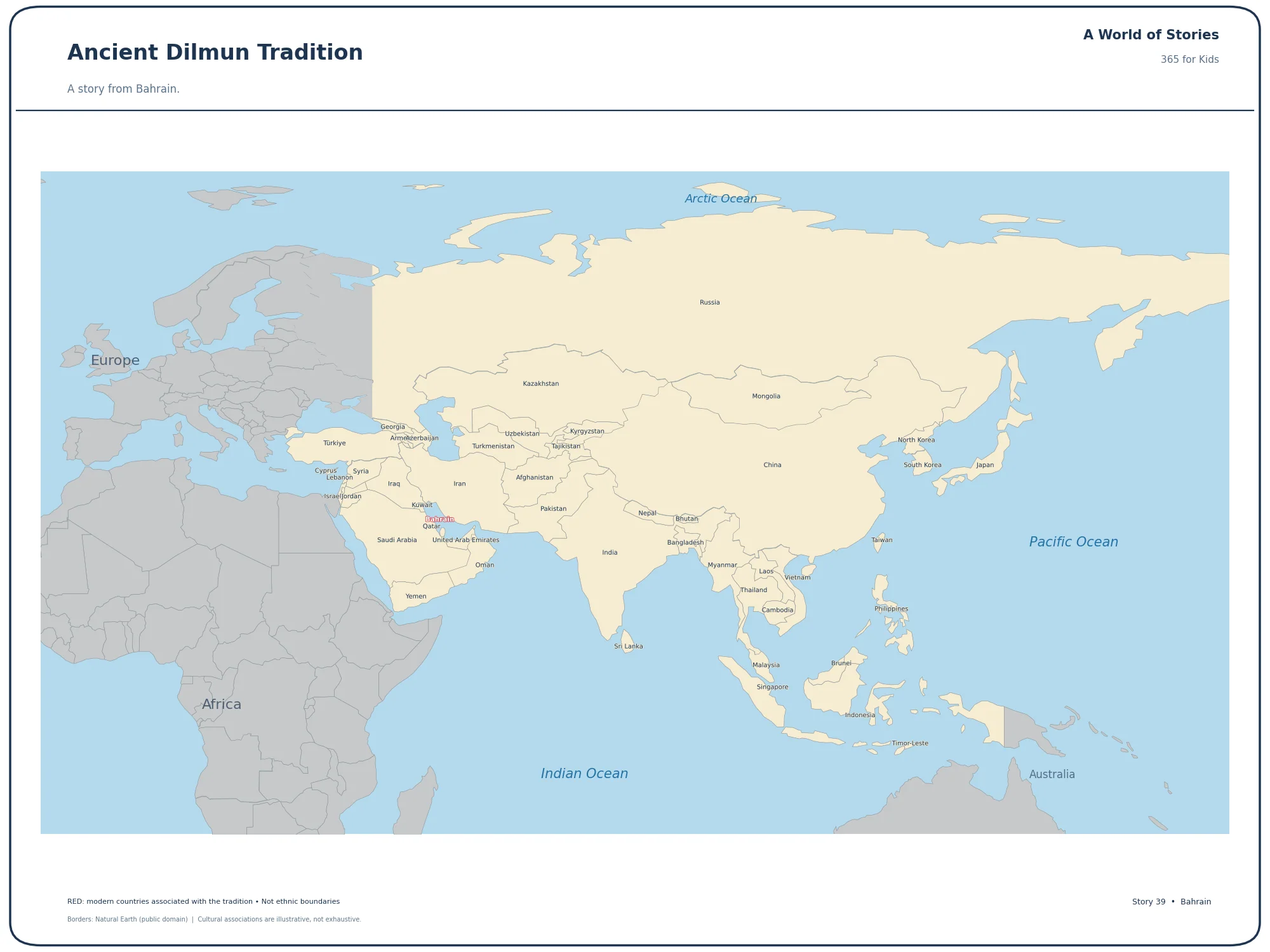
Long ago, the poets of Sumer told of a land called Dilmun. They described it as pure and unspoiled, a place unlike the lands where people struggled with sickness, sorrow, and danger.
In Dilmun, the raven did not yet give its harsh cry. The partridge did not call. The lion did not kill, and the wolf did not carry away the lamb. The dog did not frighten young goats, and the pig had not learned to eat the grain. No one spoke of aching eyes or a pounding head. No old man or old woman complained of the burdens of age. No cries of mourning were heard at the edge of the city.
Such was Dilmun in the ancient song: peaceful, untouched, and free of many of the troubles known elsewhere.
Yet the land was missing something essential.
A city had been given to the goddess Ninsikila. It was a remarkable gift, but the land around it did not yet have the fresh water and cultivated fields that could make the city flourish. There was no proper river landing where goods might be gathered, and no furrows promising a harvest. A peaceful land was not necessarily a fruitful one.
So Ninsikila spoke to Enki, the god associated with wisdom and the waters beneath the earth. She reminded him that he had given her Dilmun, but asked what use the gift could be without the things a city needed to thrive.
Her question returned again and again in the old poem: a city had been granted, but where were its fields? Where was the fresh water that would sustain it? How would it become a place where people could live and trade?
Enki answered with a promise.
When Utu, the sun god, rose into the sky, fresh water would come up from beneath the ground. It would flow into great basins. The city would have water enough to drink. Pools that had held salt water would be filled with sweet water instead. The land would produce grain, and the city would become a place where the goods of distant regions could be brought together.
The promise was not simply for a beautiful city. It was for a living one, sustained by water and connected to other lands.
Then came the moment described by the Sumerian singers.
Utu rose into the heavens. From the hidden waters beneath the earth, fresh water came forth. It rose into the basins of Dilmun, and the city had water in abundance. Where the pools had been salty, there was now water fit for use. The land’s fields and furrows yielded grain.
With water came a new kind of richness. Dilmun could support its people and welcome the exchange of goods. The city that Ninsikila had questioned was now a thriving centre on the shore.
The ancient poem repeats the great change as if to let its listeners hear the wonder twice: Dilmun drank deeply. Its fields produced grain. Its waters were sweet. And the city became a place of trade.
That is where this part of the story rests. The longer myth continues with other gods, plants, illness, and healing. But the opening episode leaves us with the image that mattered so much to the people who told it: a land between sea and desert, blessed not merely with peace, but with the fresh water that allowed life to flourish.
Cultural and geographical context. This is a Sumerian literary myth from ancient Mesopotamia, not a folk story created in modern Bahrain. Its setting is Dilmun, an ancient Gulf region strongly associated with present-day Bahrain. Bahrain’s National Museum describes the islands as the heart of Dilmun and its political centre during much of the second millennium BCE. Exact scope of this adaptation. The text retells only the self-contained opening episode (approximately lines 1–62) of the composition known in English as Enki and Ninhursag (also spelled Enki and Ninhursanga). Ninsikila, the goddess who asks Enki for water, appears in this episode; Ninhursag becomes especially important in later parts of the myth. This is not presented as a retelling of the entire ancient composition. Why this episode was selected. The later parts of the original composition describe complicated divine relationships, sexual encounters within successive generations, the birth of plants, illness, and healing. Rather than alter those events or pretend they are absent, this educational edition selects the complete opening water episode for young readers. Older readers and educators can consult the complete translated text in the source below. Textual approach. The narration closely follows the sequence preserved in the Electronic Text Corpus of Sumerian Literature at the University of Oxford: Dilmun’s ideal condition; Ninsikila’s request; Enki’s promise; the rising of fresh water; the growth of grain; and the prosperity of the port. Some details in ancient manuscripts are damaged or vary between witnesses. The descriptions here are original English prose, not a line-by-line translation, and no additional plot events have been introduced. History and myth. The spring and water imagery belongs to an ancient religious poem, not a literal historical report. Archaeological evidence nevertheless confirms the importance of Dilmun as a Gulf trading civilization. UNESCO recognizes Bahrain’s Dilmun Burial Mounds as World Heritage.
After the Story: Read · Create · Reflect · Share
1. Find Bahrain on a map; which gulf surrounds its islands? Draw its flag.
2. How did the poem describe Dilmun before fresh water appeared?
3. What did Ninsikila say was missing, and what happened when Utu rose?
4. Why is fresh water important for a community — drinking, farming, trade?
Inspired by this story? Create your illustration!
SAUDI ARABIA — Hatim al-Tai and the Guest
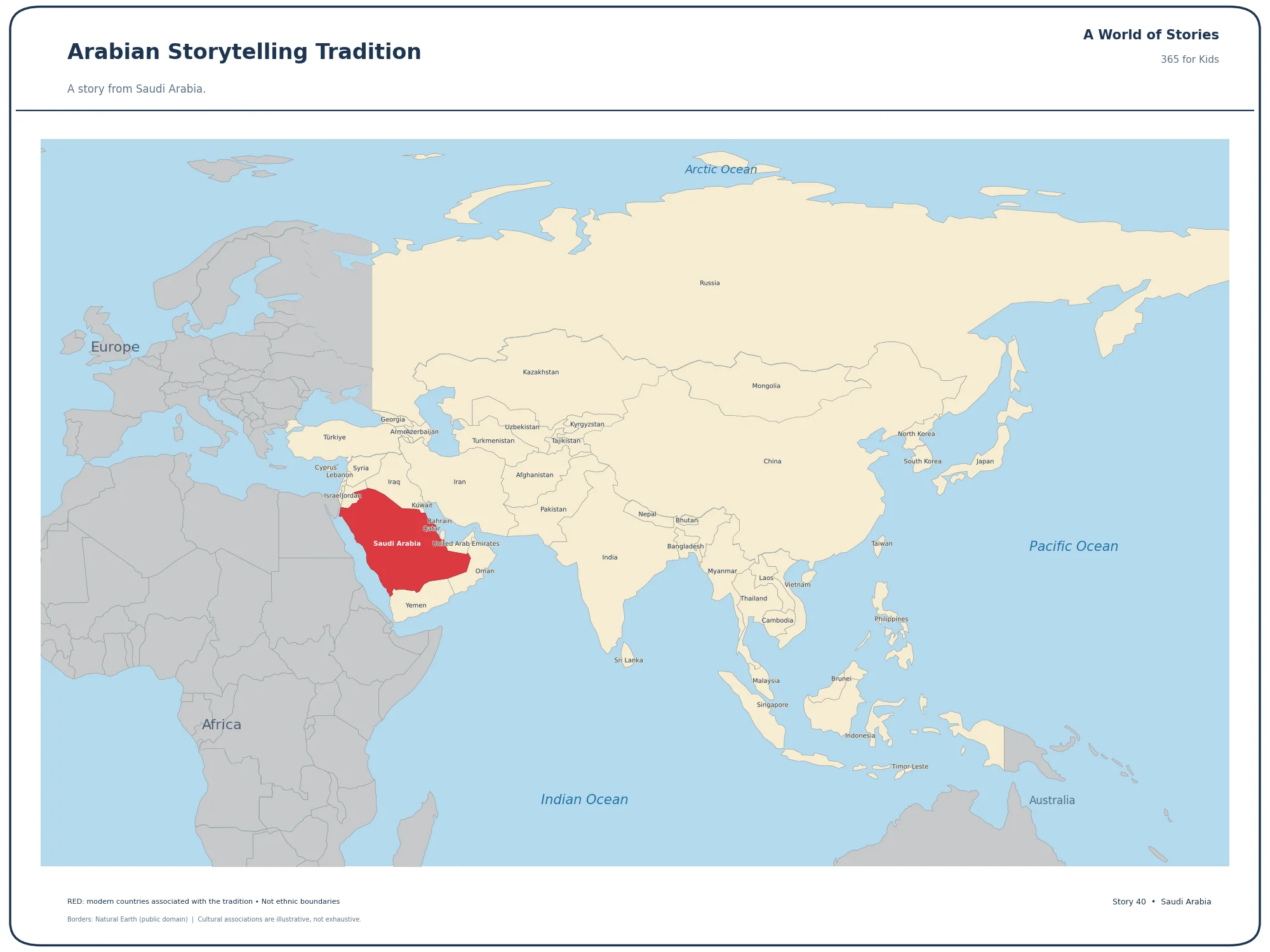
Long ago, among the tribes of Arabia, there lived a man named Hatim al-Tai. His name travelled far beyond his own people, carried from one gathering to another by merchants, travellers and storytellers. They spoke of his open hand and his unfailing welcome. Wherever Hatim’s name was mentioned, the word generosity was never far behind.
Hatim owned a remarkable horse. It could cross the open country with astonishing speed, so swiftly that storytellers compared it to the morning wind. Yet the horse was not the only reason people spoke of its master. They said Hatim would never willingly let a traveller leave his dwelling hungry.
Word of Hatim and his horse eventually reached a distant sultan. He heard praise upon praise: no man, he was told, was more generous than Hatim, and no horse ran more quickly than Hatim’s own.
The sultan wondered whether such stories could possibly be true. If Hatim truly valued generosity above possessions, would he give away even the horse for which he was famous? The ruler decided to find out. He sent a messenger, accompanied by ten men, to ask for the treasured animal.
After a long journey, the eleven travellers arrived at Hatim’s dwelling. Their host welcomed them without waiting to discover what had brought them so far. To Hatim, they were guests, and guests should be fed and treated with honour.
But there was a difficulty. His flocks were away at pasture, and there was no other animal nearby from which he could prepare a meal. Only his cherished horse stood beside the dwelling.
Hatim had to choose. He could send the weary travellers away without supper, or he could surrender something precious in order to provide for them. In the old telling, he chose hospitality. He had the horse prepared as food, and a feast was served to the strangers. The guests ate and rested, still unaware of the costly gift hidden in their meal.
The following morning, when the travellers were ready to speak of their business, the messenger presented the sultan’s request. The ruler wished to receive Hatim’s famous horse—the very animal whose speed was praised across distant lands.
Hatim was overcome with sorrow.
“If only you had told me why you had come!” he exclaimed. “I would gladly have given the horse to the sultan. But I had nothing else with which to feed you last night. How could I allow my guests to go hungry?”
His distress was not that he had lost the horse. It was that he could no longer give the sultan the gift he had asked for. The messenger now understood what kind of welcome the travellers had received. Hatim had given up the very thing they had been sent to request—before he even knew they wanted it.
Hatim did not send his visitors away empty-handed. He gave the men money and fine robes for their journey, and they departed carrying a story greater than the gift they had hoped to bring home.
When the sultan heard what had happened, he praised Hatim’s character. The ruler had sent his messenger to test a reputation; the messenger returned with an account that made that reputation seem more extraordinary still.
And so, as the story was told and retold, Hatim al-Tai’s name became a way of speaking about generosity itself—a reminder of how deeply the obligation to welcome a stranger was valued in the world of the old storytellers.
Cultural origin. Hatim al-Tai (also Hatem Tai or Ḥātim al-Ṭāʾī) is remembered in Arabic and Persian storytelling as an exemplary generous host. He is associated with the Tayy tribe of pre-Islamic Arabia and with the region of Hail in what is now Saudi Arabia. The anecdote is included here as a tradition connected to this region, not as the exclusive heritage of one modern nation. Type of text. This is a literary retelling of a traditional anecdote, not an independently verified account of an event. The central story follows the episode “Story of Hātim Tai” in Saadi’s thirteenth-century Bustan, Book II (Benevolence), represented here through A. Hart Edwards’s public-domain English translation (1911). The original account is brief; this adaptation expands its language and atmosphere without adding new plot events. Variants. Other retellings identify the foreign ruler as the King of Rum and extend the ending with additional gifts or a friendship alliance. We have followed Saadi’s ending, in which Hatim gives the messengers money and fine robes and the ruler praises his generosity, rather than combining different versions. For younger readers. The original tale includes an animal being killed for a feast. It is told here without graphic detail. This choice belongs to the historical storytelling context; readers are invited to consider kindness to people and kindness to animals together, rather than treating Hatim’s action as a model to imitate today.
After the Story: Read · Create · Reflect · Share
1. Find Saudi Arabia and the Hail region on a map; what is the flag like?
2. Why did the sultan send a messenger, and why did the travellers not receive the horse they requested?
3. What troubled Hatim most when he learned the purpose of the visit?
4. How could we show generous hospitality today while also caring for animals and our own limits?
Inspired by this story? Create your illustration!
YEMEN — Bilqis — The Queen of Sheba
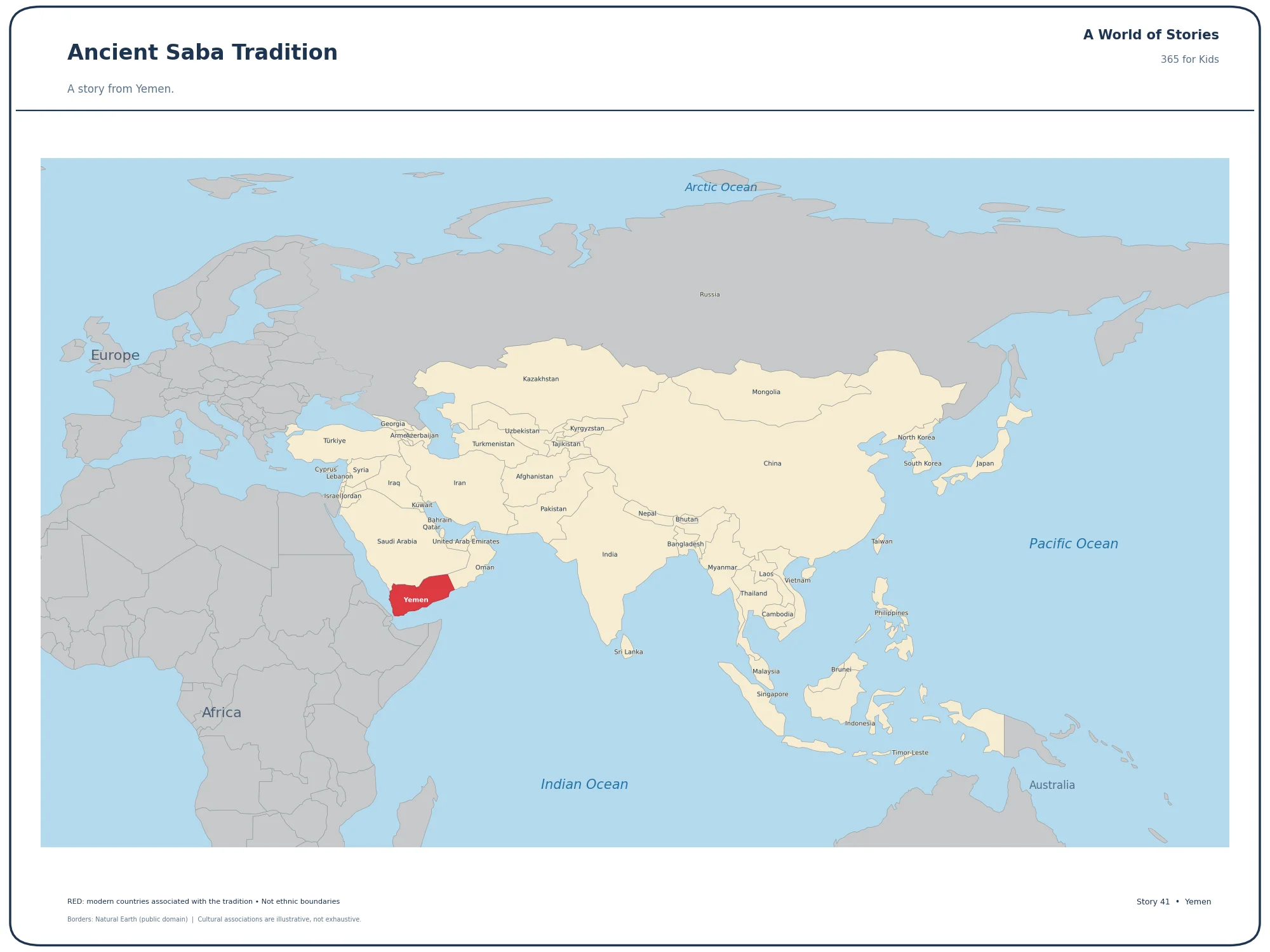
In an ancient sacred story, a queen ruled over the land of Sheba. Her people possessed a splendid throne, and her kingdom was known far beyond its borders. Later Arabic and Persian storytellers would call her Bilqis, though the oldest account of this encounter does not give her a name.
Far away, the prophet-king Solomon had been given an extraordinary gift: he could understand the speech of birds. One day he gathered his birds and noticed that the hoopoe, a small bird with a striking crest, was missing. Solomon demanded to know why it had not appeared. Unless the hoopoe had a sound reason, he would have to answer for its absence.
Before long the hoopoe returned. It had been to Sheba and brought unexpected news. There, it said, a woman governed a great people. She possessed a magnificent throne. Yet the queen and her subjects bowed before the sun rather than worshipping the one God.
Solomon listened to the bird. He would not accept the report without testing it. So he gave the hoopoe a letter and instructed it to carry his message to the queen, then withdraw and observe her answer.
The letter reached the court of Sheba. Its opening invoked God, the Most Merciful, and it called upon the queen not to resist Solomon’s summons, but to come to him in submission. The message was brief, yet its consequences could be enormous.
The queen did not rush to decide. She summoned her leading advisers and told them that an important letter had arrived. She asked for their counsel, saying that she did not settle great affairs without hearing those who shared responsibility for her kingdom.
Her advisers replied that they commanded strength and were prepared for battle. Nevertheless, they placed the final decision in her hands.
The queen considered what war might mean. Powerful kings, she observed, could enter a city, lay it waste and bring its honored people low. She wanted to learn more about Solomon before exposing her people to such danger. Instead of sending an army, she sent envoys bearing a gift, to discover what answer would come back.
But Solomon did not welcome the gift as a price for changing his demand. He sent the messengers away with a firm warning: his wealth was not what mattered, and if Sheba resisted, it could face a force it could not defeat.
The queen would go to meet Solomon herself. As her arrival drew near, a strange event took place at his court. Solomon asked who among those assembled could bring him the queen’s throne before she came. A powerful jinn offered to do it before Solomon rose from his place. Another, described in the sacred account as possessing knowledge from the Scripture, promised to bring it even sooner.
And suddenly the throne stood before Solomon. The king recognized this extraordinary deed as a favor from God and a test of his own gratitude. Then he ordered that the throne be altered in appearance, so that the queen’s response might be observed when she arrived.
At last the queen of Sheba entered Solomon’s court. Before her stood a throne remarkably like her own. She was asked whether it resembled her throne. She looked carefully and answered with caution: it seemed to be the very one. She did not claim certainty where certainty was difficult.
There was still another astonishing sight ahead. The queen was invited into the palace. Before her stretched a floor so clear and shining that she mistook it for a pool of water. Thinking she must step into it, she lifted the hem of her garment. Solomon explained that the floor was not water at all, but smooth glass.
Then came the turning point of the ancient account. The queen acknowledged that she had been mistaken in her worship and declared her submission, together with Solomon, to God, the Lord of all worlds.
Origin and setting. Sheba (Saba) was a real ancient South Arabian kingdom, with an important center at Marib in what is now Yemen. Its existence is supported by archaeological evidence. The individual Queen of Sheba described in sacred and literary traditions, however, has not been securely identified in ancient inscriptions. The association with Yemen is cultural and geographical, not proof that this particular encounter happened. Genre and primary version. This is a respectful literary retelling of the encounter between Solomon (Sulayman) and the Queen of Sheba as narrated in the Qur’an, Surah al-Naml (The Ant), 27:20–44. It is a religious narrative, not an anonymous secular folktale. The events and ending follow that account; the prose is newly written and is not a translation of the sacred text. The name Bilqis. The Qur’anic text calls her the queen of Sheba but does not name her. Bilqis (also Balqis or Belqis) is her familiar name in later Islamic, Arabic and Persian traditions; the title uses that traditional name while the narrative keeps this distinction clear. Other traditions. The Hebrew Bible also tells of the Queen of Sheba meeting Solomon, but the details differ. In Ethiopian tradition she is often known as Makeda. This adaptation does not combine those accounts or add later stories about a marriage or descendants. For younger readers. The passage contains a threat of military force and a religious change of belief. These themes are presented without sensational detail. Readers can discuss the queen’s consultation, diplomacy and intellectual openness while respecting that this is a sacred story for many people.
After the Story: Read · Create · Reflect · Share
1. Find Yemen on a map and locate Marib.
2. Why did the queen consult her advisers, and what danger did she hope to avoid by sending a gift first?
3. What news did the hoopoe bring? Why was she surprised by the throne?
4. What did the queen mistake for water, and how does the ending show reconsidering a belief after learning something new?
Inspired by this story? Create your illustration!
SHARED ARABIC — Joha and His Donkey
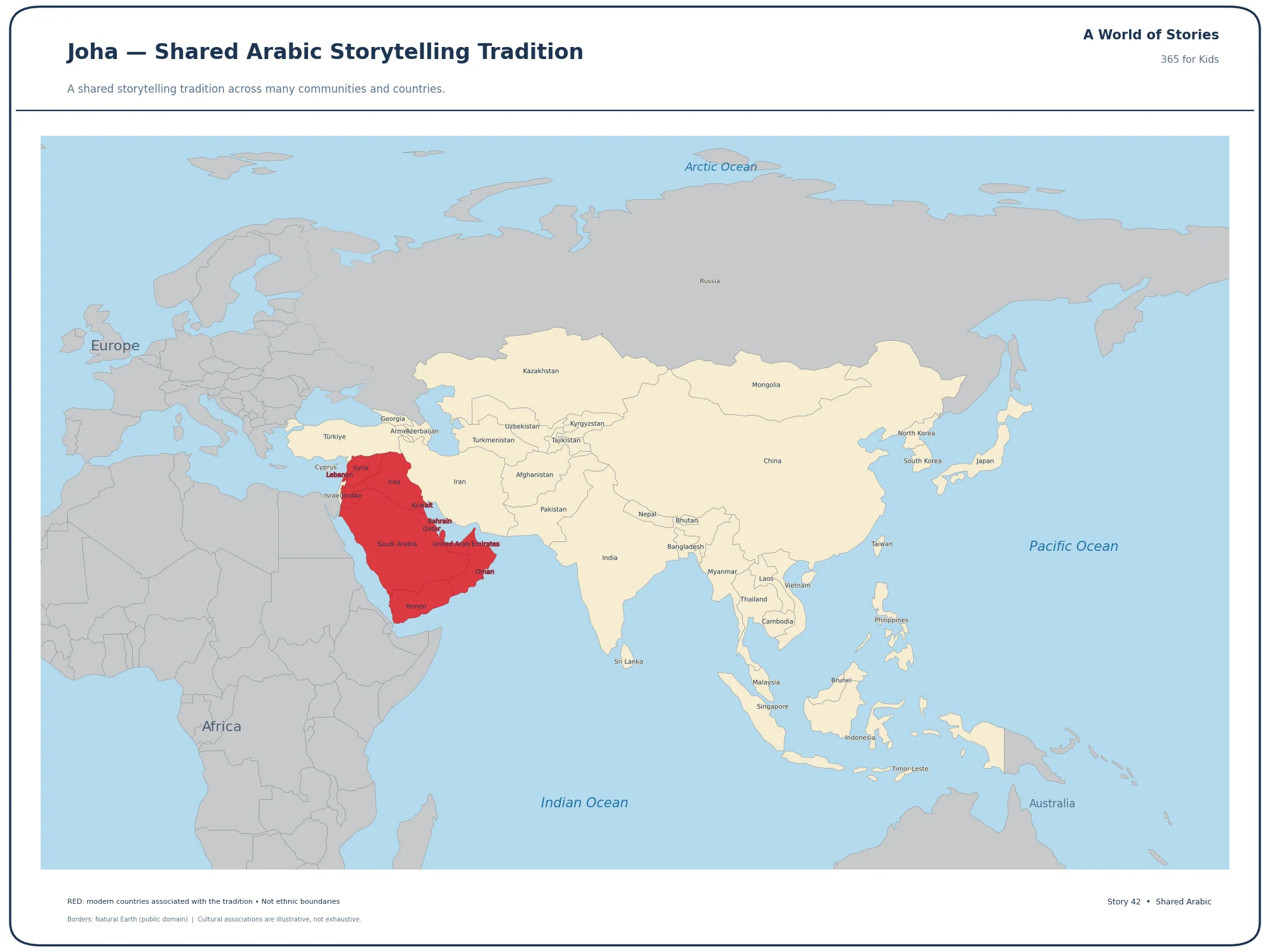
Joha had a son who was troubled by what other people thought of him. A careless remark could make the boy doubt a decision he had made only moments before. If someone laughed, he worried that he had done something foolish. If someone disapproved, he wondered whether he ought to behave differently.
Joha decided to show his son how difficult it was to live according to everybody else’s opinions. One day, he saddled his donkey and set out with the boy toward a neighboring village.
At first, Joha rode the donkey while his son walked beside him. They had not gone far when they passed a group of people who shook their heads.
‘Look at that father!’ the people said. ‘He lets his child walk while he rides in comfort. Has he no pity for the boy?’
Joha heard them. He climbed down and told his son to take his place on the donkey. The boy mounted, and the two continued along the road.
Soon they came upon another group. These travelers were no more pleased than the first.
‘What an ill-mannered son!’ they exclaimed. ‘He rides while his older father must walk. Where is his respect?’
Now the boy was embarrassed. Joha considered the complaint, and they changed places once more. But instead of having only one of them ride, Joha climbed up behind his son so that both father and boy sat upon the donkey.
Surely, they thought, no one could complain that either of them had been left to walk.
Yet the next people they met were horrified.
‘Two riders on one poor donkey!’ they cried. ‘What a heavy burden for the animal! Have these travelers no kindness?’
So Joha and his son got down. This time they walked, leading the donkey along the road. The animal carried neither the father nor the boy.
But before long, more people noticed them and burst into laughter.
‘What fools!’ they said. ‘Here are two people wearing themselves out while a perfectly good donkey walks without a rider!’
Joha stopped to think. They had tried having the father ride, having the son ride, riding together, and walking together. Every choice had brought a different complaint.
‘Well, my son,’ he said at last, ‘there is one thing we have not tried.’
Together they lifted the donkey and began to carry it along the road themselves.
The sight was so extraordinary that the next group of passersby laughed harder than any of the others.
‘Look at them!’ the people called. ‘Instead of letting the donkey carry them, they are carrying the donkey!’
Joha and his son put the donkey down. Then Joha turned to the boy, who had now heard every possible judgment of their journey.
‘You see,’ Joha told him, ‘whatever you do, you cannot please everyone.’
And that was the lesson he had wanted his son to learn.
Joha (also spelled Juha or Goha) is a comic character in Arabic oral storytelling. Comparable stories are told under the names Nasreddin Hodja and Mulla Nasruddin in other languages and regions. His humor often exposes the contradictions in everyday behavior. The story of Joha, his son, and their donkey is widespread, including in the Arabic-speaking Levant. It cannot be assigned exclusively to any single present-day country. The episode is presented here as a shared storytelling tradition, not as a historical event. This original English literary adaptation follows the documented sequence: Joha rides; his son rides; both ride; neither rides; then they carry the donkey. It retains the traditional ending about the impossibility of pleasing everyone. Some retellings vary in the order of the travelers’ choices. The wording and dialogue here are newly composed rather than taken from a modern published retelling. The theme also appears in traditions outside the Arabic-speaking world. Its inclusion should be understood as one living Arabic version of a widely traveled narrative.
After the Story: Read · Create · Reflect · Share
1. Find the Levant on a map; name two countries there; why is this described as a shared Arabic tradition rather than belonging to one country?
2. What were the five ways they tried to travel with the donkey, in order?
3. Why did passersby criticize them regardless of what they did?
4. How could you make a thoughtful decision without trying to please everyone? Draw one scene.
Inspired by this story? Create your illustration!
OMAN — The Two Sisters and the Wall of Bahla
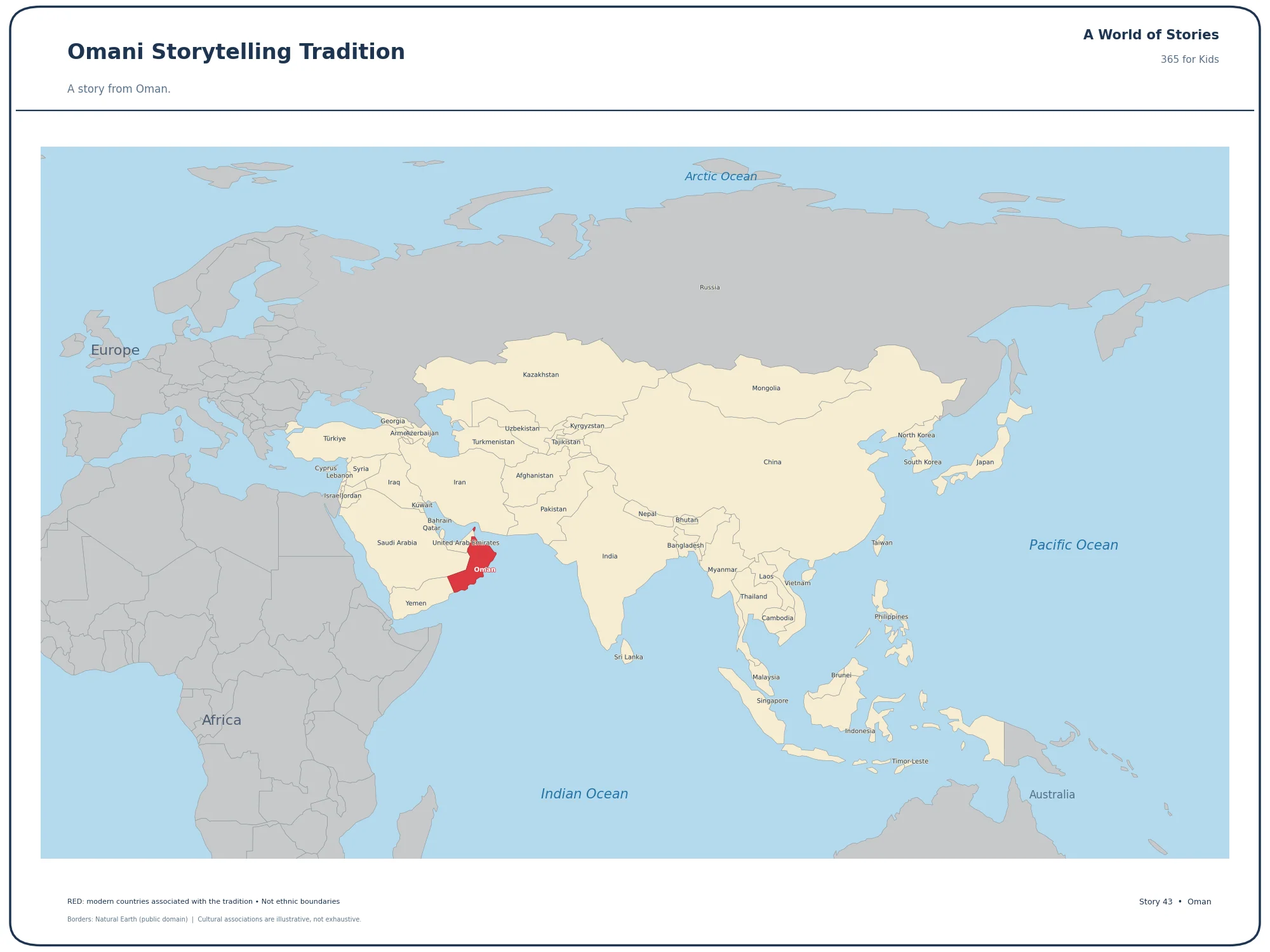
In the heart of Oman, between the mountains and the dry lands, lies the ancient oasis town of Bahla. Date palms grow there, and water is precious. Around the old settlement stand walls and towers that have guarded its houses, gardens, and narrow streets for generations.
The walls are real. Yet the people of Bahla have also told a remarkable story about how they came to be.
Long ago, the legend says, the town lived under the threat of a powerful ruler from a neighboring place. He demanded payment in return for leaving Bahla in peace. The people paid, but the burden grew heavier, and they feared what might happen if they could no longer give him what he wanted.
In Bahla lived two sisters, Maitha and Ghaitha. They were known for their knowledge of mysterious arts. Unlike the frightening figures who sometimes appear in tales of magic, these sisters were remembered for using what they knew to help their neighbors.
When the people of the town sought their help, the sisters understood what was at stake. Bahla needed more than another payment. It needed a way to protect itself.
According to this version of the legend, Maitha and Ghaitha called upon the jinn — supernatural beings who appear in many traditional stories of the Arabian Peninsula. Under the sisters’ direction, the jinn began the extraordinary task of raising a defensive wall around Bahla.
It happened in a single night.
While the town slept, the great barrier took shape. By morning, the houses and palm groves stood within a mighty ring of fortifications. The people awoke to find that what had seemed impossible the evening before was now before their eyes: a wall surrounding their home.
They had known the two sisters as helpers. Now, the legend says, those sisters had given Bahla a shield.
When the ruler’s men returned to collect their payment, they did not find the unprotected town they remembered. They found a settlement behind strong defenses. Faced with the new wall, they turned back without taking the money they had come to demand.
The people of Bahla could at last look upon their town with a different feeling. The gardens, the wells, the streets, and the homes were still the same, but the fear that had hung over them was no longer the whole story.
Many years passed. Generations came and went. The great wall became part of the landscape of Bahla, and the story of Maitha and Ghaitha traveled from one storyteller to another.
No one needs to believe that a wall can rise by magic overnight to understand why such a legend endures. It remembers a community’s wish to live in safety — and it places two women at the heart of that hope.
Even today, the old walls of Bahla stand beside a living tradition of stories. Stones, earth, water, and human skill belong to its history. The two sisters and their wondrous night belong to its legend.
Bahla is a historic Omani oasis. Its fort, defensive wall and falaj irrigation channels are part of the UNESCO World Heritage Site inscribed in 1987. A falaj carries water to homes and farmland. Our narrative follows the magical sisters and overnight wall variant: Maitha and Ghaitha summon jinn against a ruler demanding payments. The sequence is documented in an Arabic VICE retelling (2022), but is legend, not verified history. Variants differ: Oman Daily (2019) recounts two women engineers, Maitha (water channel) and Ghaitha (wall), working for a year. An AFP oral account (2023) calls the sisters jinn, one responsible for the wall and one for irrigation. These alternatives are not mixed into our story. Names and spellings vary. This is an original English adaptation of a reported oral legend, not a translation of a single ancient text. The real wall’s construction cannot be dated from the story.
After the Story: Read · Create · Reflect · Share
1. Find Oman on a map and draw its flag; where is Bahla?
2. Why did the people ask the sisters for help, and what did the sisters do in this version?
3. What happened when the ruler’s men returned?
4. How can we enjoy a traditional story while distinguishing legend from historical evidence?
Inspired by this story? Create your illustration!
ARMENIA — David of Sassoun Defends His Homeland
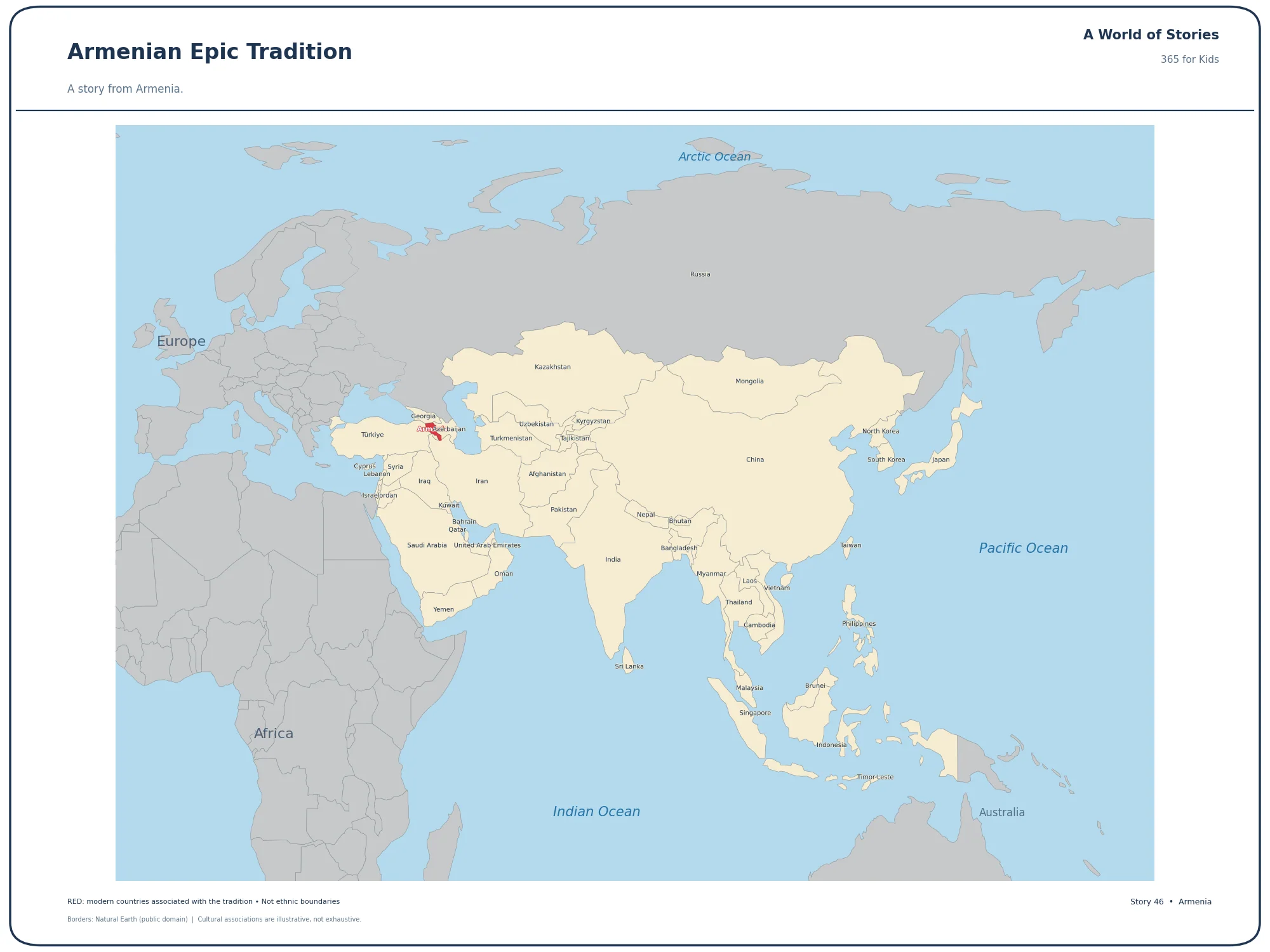
High in the mountains of Sassoun, where steep paths wound between the rocks and the villages clung to the hillsides, the people remembered a mighty defender called Lion Mher. For many years he had guarded their land. After his death, his young son David grew up under the care of his uncle Ohan, whose voice was said to carry across the mountains. David inherited his father’s great strength, but he was still learning what that strength should be used for.
Beyond Sassoun ruled a powerful king called Msra Melik. He believed that the people of Sassoun must bow to him and give him tribute. His officers came demanding gold, animals, and even people to serve in his household. Ohan feared the king’s anger. He wanted to surrender the tribute rather than bring a great army against the mountains.
David would not agree. The treasure belonged to the people of Sassoun, he said, and no one had the right to carry their daughters away. He confronted the king’s collectors, freed those they had detained, and drove the officers from the land. They returned to their master without the tribute they had come to take.
When Melik heard what had happened, his anger grew. He called together an enormous army and marched towards Sassoun. Soon tents spread over the plain as far as the eye could see. From the heights they looked like a fresh fall of snow. Ohan climbed to look at the camp, and his courage almost failed him. How could one young man stand against so many soldiers?
David went to an old woman and asked her for whatever battered weapons she could spare. She was astonished. Had he forgotten who his father was? Lion Mher had not ridden to battle on a donkey with scraps of iron, she told him. He had owned a splendid horse, a strong suit of armor, and a sword called the Lightning Sword. David hurried to his uncle and asked for his father’s things. Ohan brought them out at last, and David put on the armor, took the sword, and mounted the powerful horse.
Before riding down to the plain, David called out to the army. Those who were sleeping should wake, those who were awake should stand, and those who had not armed themselves should prepare. He did not wish anyone to say that he had attacked without warning. Then he rode forward, and the clash of battle shook the plain.
David was so strong and fierce that the soldiers could scarcely withstand him. Yet in the midst of the fighting an old man stepped into his path. He did not threaten David or boast of his own courage. Instead, he spoke of the soldiers’ families: old parents waiting for sons, wives waiting for husbands, children waiting for fathers. Many of the men, he said, had been ordered to march by their king. Why should they suffer for his ambition?
David listened. His anger had been directed at the invasion, but the old man’s words made him see the people caught inside it. He lowered his weapon. If Melik had brought this army, David would seek Melik himself. The soldiers were to be spared. He asked where their king was, and the men pointed to the largest tent in the camp.
Inside it, Melik was sleeping a sleep so deep that his attendants struggled to wake him. When he finally opened his eyes and saw David standing before him, he tried to appear friendly. Why rush into a fight? Surely they could sit and talk first. David dismounted and entered the tent. He did not know that beneath its bright coverings Melik had hidden a deep pit. As David stepped onto the carpet, the ground gave way. He fell into darkness, and a great millstone was rolled across the opening above him.
That night, far away in Sassoun, Ohan dreamed of a shining sky over Melik’s land and a dark cloud above his own mountains. He woke afraid for David. When the dream returned, he could remain at home no longer. He went to the stable, where the fastest of his horses carried him towards the plain with astonishing speed. On a mountain height Ohan drew a deep breath and called David’s name. His great voice traveled over the tents and down into the buried pit.
David heard him. He remembered his father’s faith, the holy cross, and the protection he had called upon in danger. Gathering his strength, he rose against the stone that sealed the opening. The millstone broke, and David climbed back into daylight. Melik could no longer hide behind a friendly smile. David demanded that they face one another openly.
Melik insisted on striking first. David agreed. The king mounted his horse, rode far across the plain, and thundered back with his lance. The blow raised such a cloud of dust that no one could see what had happened. Melik announced that David must surely be dead. But from the dust came David’s voice: he was still standing.
Melik charged again, this time from even farther away. The earth shook under the force of the second blow. Again the king claimed victory; again David answered him. At last Melik rode all the way from his own distant country and returned at full speed for a third attack. Dust covered the countryside, and for three days the people wondered whether David had survived. When the dust settled, he was there, upright and unbroken, like a mountain rising through the mist.
Now it was David’s turn. Melik’s confidence vanished. He climbed down into a deep hiding place and ordered forty layers of thick hides and forty heavy millstones placed above him. His mother and sister came forward to plead with David and delay his blow. David did not strike them. But he would not abandon the contest that Melik himself had begun.
David mounted his father’s horse once more and raised the Lightning Sword. With a mighty stroke the blade passed through the stone and the hides and reached the ruler hiding beneath them. Melik’s challenge was over. The soldiers, who had seen their king fall, waited in fear for what David might do next.
But David had not fought to make servants of another people. He told them to be unafraid and return to their homes, fields, and families. They must never again come with weapons to seize the freedom of Sassoun. Then the army turned back along the road by which it had arrived, and the mountains were at peace.
The people remembered David’s courage, his father’s Lightning Sword, and the horse that carried him into danger. Yet they also remembered the old soldier whose words had stopped the fighting. In the epic of Sassoun, defending one’s homeland required enormous strength. Knowing when to put the sword down required another kind of strength altogether.
Cultural origin and genre. This is an Armenian heroic-epic episode from Sasna Tsrer (The Daredevils of Sassoun), also known as David of Sassoun. It belongs to an Armenian oral storytelling tradition, not to a modern eyewitness account. Sassoun (Sasun) is a historical mountainous region of the Armenian Highlands, today within southeastern Türkiye. It is presented in the Armenia collection because of its Armenian literary and cultural identity. Chosen version. This original English prose adaptation follows the main sequence of the David–Msra Melik confrontation in Hovhannes Tumanyan’s early twentieth-century retelling: the demand for tribute, the inheritance of Mher’s arms, David’s warning to the army, the plea of the old soldier, the concealed pit, Ohan’s rescue call, the repeated blows, Melik’s hiding place, and David’s mercy to the soldiers. The epic exists in many oral versions. The narrative does not attempt to combine their different episodes into a single historical chronology. Names and beliefs. David’s father is Lion Mher; his uncle is Ohan, known for his powerful voice. The king’s name appears in English transliterations including Msra Melik and Musra Melik; his realm is called Msr in the epic. David’s horse is often called Kurkik Jalali in the wider tradition. The inherited Lightning Sword and the Christian protective imagery are integral to the epic and have been retained rather than replaced with modern inventions. Editorial treatment. The episode includes warfare and the defeat of a ruler. The violence is described without graphic detail, but the ending has not been rewritten into a false reconciliation. This is an independent literary adaptation of traditional narrative events, not a quotation or translation of the modern English rendering by Aram Tolegian. Suitable for children with adult guidance where appropriate.
After the Story: Read · Create · Reflect · Share
1. Locate Armenia and draw its flag; find Türkiye too, where Sassoun now lies.
2. Why did David refuse to surrender the tribute? Name two things he inherited from his father.
3. What did the old soldier tell David, and how did it change his decision?
4. Why did David let the defeated soldiers go home? What does this show about courage vs. cruelty?
Inspired by this story? Create your illustration!
ISRAEL — The Rock in the Cave
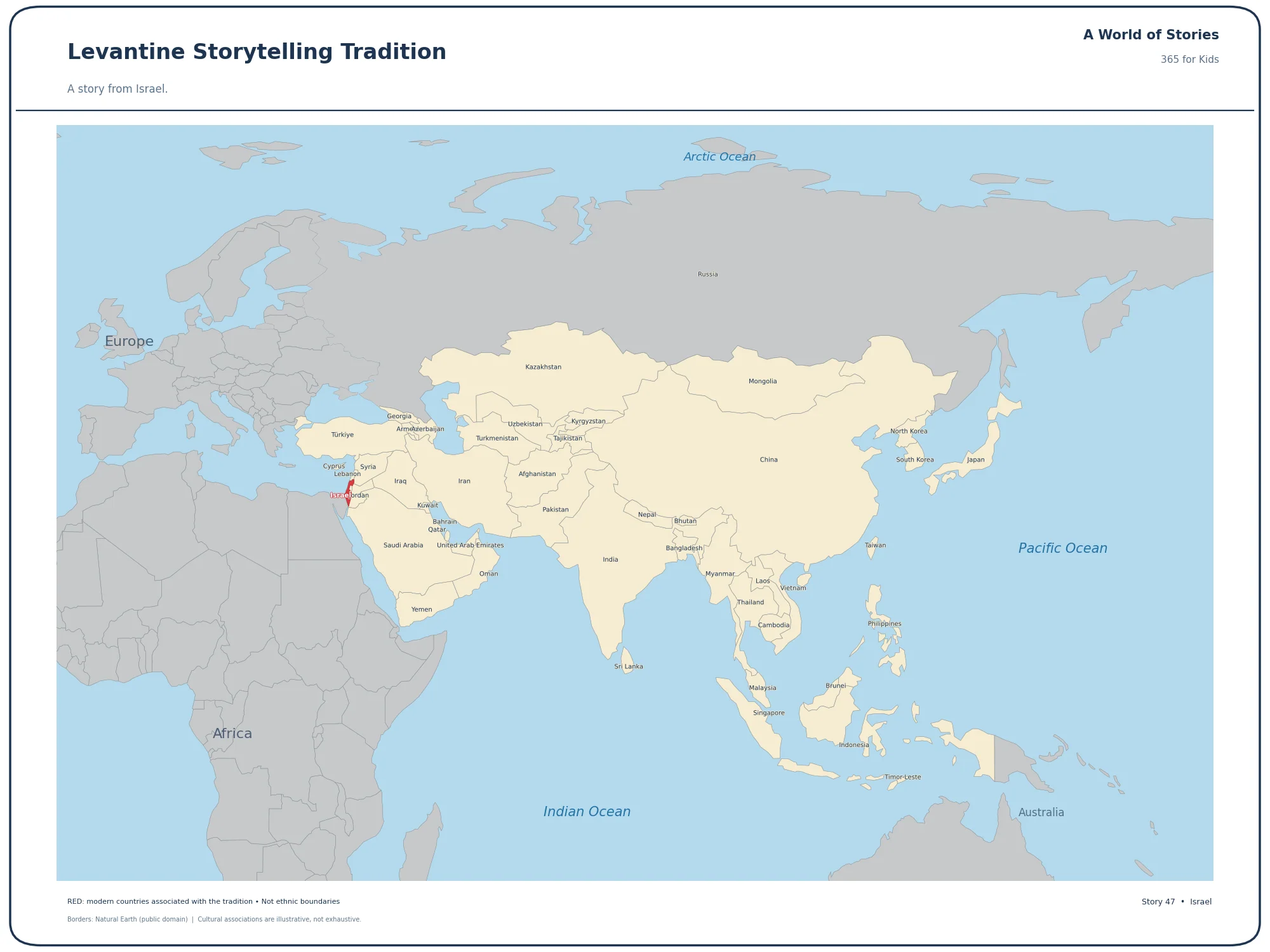
East of a village stood a large, deep cave. The way into it was a flight of steps, but no one had brought stones there to build them. Each step had been cut from the rock itself.
Farther inside stood two stone pillars. One was finished, every part of it carefully shaped. The other was almost the same, except for a little piece of stone that still rose from its top. It was such a small thing that anyone could have imagined a worker returning to remove it in a moment. Yet there it remained.
People who visited the cave noticed the difference. As children, they asked their parents why a place so carefully carved had been left unfinished in just that one spot. Their parents answered with an old story.
Long ago, they said, an elderly stoneworker had been shaping the cave. He had spent his strength cutting the steps and forming the pillars. By the time only that small piece of rock remained, he was very old. Still, he went on with his tools, determined to finish what he had begun.
One day, while he was working, hunger overtook him. He sent his wife home to bring him something to eat and asked her to return without delay.
She set off as he requested. But on her way she learned that a young son in a neighboring family had died. She felt she could not simply pass by their house. The neighbors were grieving, and custom called for her to visit them rather than appear indifferent to their loss.
So she went to the grieving family and stayed for a while. Afterward, she returned to her own home, prepared food for her husband, wrapped it up, and carried it to the cave.
The old worker was still waiting among the stone steps and pillars. When he saw her, he wanted to know why she had taken so long.
She told him what had happened: a neighbor’s son had died, and she had stopped to visit the bereaved family before bringing his meal.
The old man was startled. A young man had died? He asked her whether death could come even to someone who had not yet grown old.
Yes, she told him. Death comes to every human being.
The worker thought of his own great age. If even the young could die, then surely his own life would end one day too. He asked his wife if that was true. She answered that it was.
For a while he considered what she had said. He had been working so hard to complete the cave. Yet he himself would not live forever. Suddenly, the effort seemed pointless to him.
He put aside the work. He cast down his tools, left the last small piece of stone where it was, and went home. He would not return to finish it.
And so, according to the old tale, one pillar remained complete while the other kept its little uncut stone. The people of the village passed down the story of the unfinished work from one generation to the next.
This is a Druze oral folktale recorded in Israel and preserved by the Israel Folktale Archives (IFA), University of Haifa, as tale no. 907. The archive credits Salman Falah with recording it. The story belongs to a specific recorded tradition; it should not be presented as the belief of every member of the Druze community. The archival account does not identify the village, date the events, or name the stoneworker and his wife. These details have deliberately not been invented. This is an original English literary retelling of the documented sequence: a cave with carved steps and two pillars, the wife’s delayed return after a neighbor’s death, the worker’s realization of mortality, and his choice to leave one stone unfinished. The original ending is left open to interpretation rather than replaced with a modern moral.
After the Story: Read · Create · Reflect · Share
1. Find Israel on a map and draw its flag; which neighboring countries can you locate?
2. What could visitors see inside the cave, and what detail made them ask questions?
3. Why did the wife return later than expected, and what did her explanation make the worker realize?
4. Do you agree with the stoneworker’s decision to abandon his work? Why or why not?
Inspired by this story? Create your illustration!
JORDAN — The Fox and the Gardener
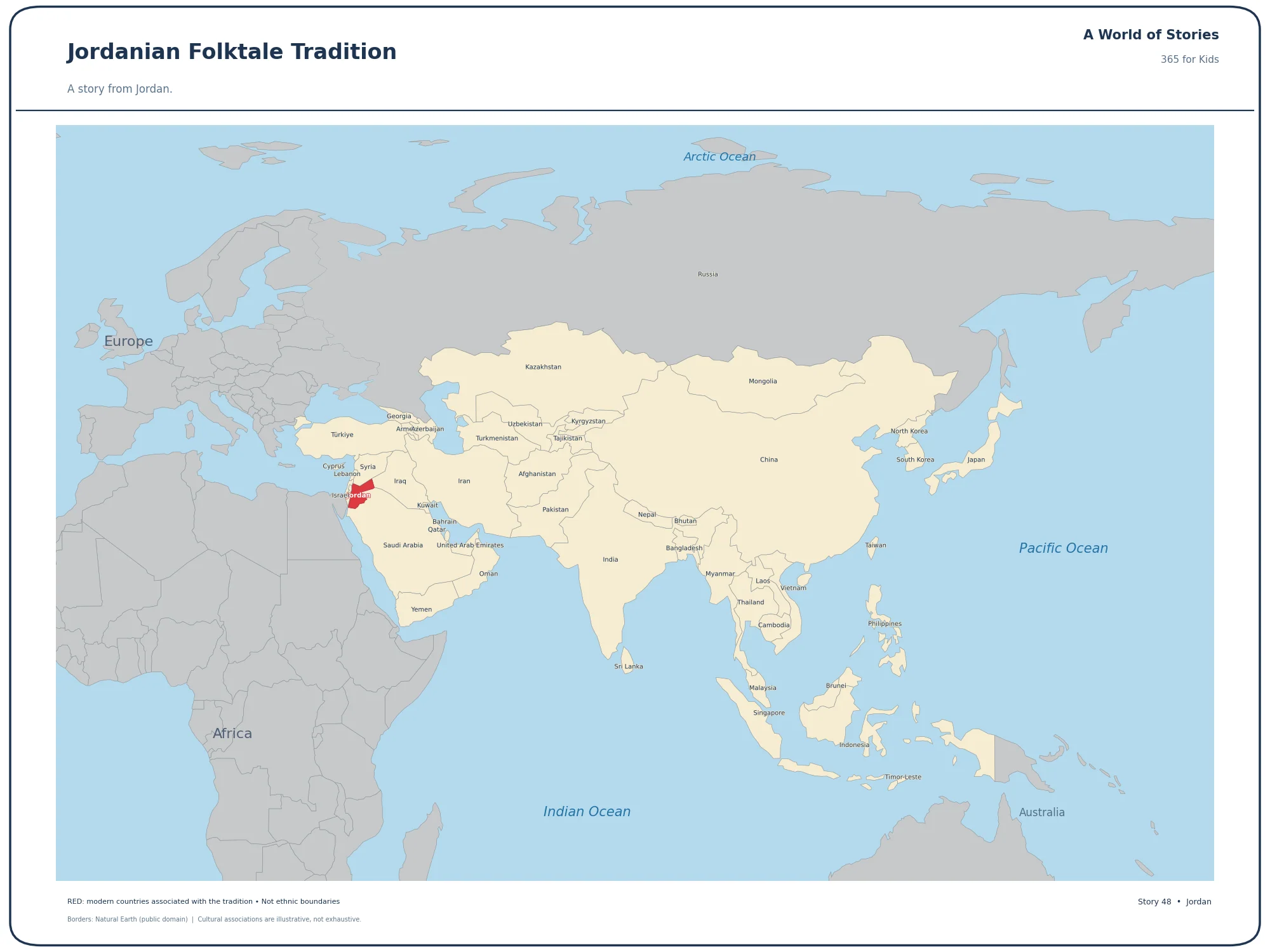
Long ago, there was a gardener who cared for a large orchard. Day after day, he watered the trees, loosened the earth around their roots, trimmed their branches, and pulled out the weeds. He looked after every part of the garden with patience, and, in time, the trees rewarded his work.
Their branches grew heavy with ripe fruit. Above the garden wall, the leaves stirred; inside, the fruit waited to be gathered.
One day, a hungry fox came by. The sight of so much fruit was too tempting to ignore. The fox circled the orchard, looking for a way to reach the branches. The garden was enclosed by a wall, but at last he found a small opening and squeezed through.
Once inside, he managed to reach the fruit. He ate and ate, pleased with his good fortune. A little more, he thought, and then a little more again. Soon his empty stomach was empty no longer. It was so full that his belly had swollen round.
At last the fox was ready to leave. He went back to the opening in the wall and tried to squeeze out the way he had come. But the gap that had been wide enough for a hungry fox was much too narrow for a fox who had eaten his fill.
He was trapped inside the orchard.
The fox thought hard. Then a clever plan came to him: he would lie on the ground and pretend to be dead. When the gardener found him, surely the man would not want a dead fox lying among his trees. He would throw the fox over the wall, and the fox would be free.
So the fox stretched himself out and lay perfectly still.
Before long the gardener came and saw him. But he did not do what the fox had hoped. Instead of carrying the animal outside, the gardener decided that a dead fox ought to be buried so that it would not smell in the orchard.
The fox heard this and was frightened. Being thrown over a wall was one thing. Being buried beneath the earth was quite another! He sprang up and fled from the gardener as quickly as he could.
Yet the wall still surrounded the garden, and his swollen belly still would not pass through the narrow opening. There was nothing to do but wait.
He stayed there until morning. Slowly the fruit he had eaten was digested, and his stomach returned to its usual size. Now, at last, he could slip back through the same gap in the wall.
Outside the orchard, the fox looked back. He had found all that fruit, eaten until he could eat no more, and spent the night unable to escape. And now, after all his trouble, he was just as hungry as when he arrived.
‘I went in hungry,’ he told himself, ‘and I came out hungry.’
This story is recorded as “The Fox and the Gardener” (Arabic: Qissat al-Thaʿlab wa al-Bustani) in Jordan’s official Intangible Cultural Heritage inventory under Mafraq Governorate. The record presents it as a bedtime tale remembered from a mother’s storytelling. In the recorded version, the fox’s folk nickname is Abu Ali al-Husayn. This English literary adaptation follows that single documented storyline: the carefully tended orchard; the hungry fox entering through a gap; the fruit and swollen belly; his unsuccessful pretence of death; the gardener’s plan to bury him; and his escape after waiting until morning. Descriptive phrasing and dialogue have been newly composed for reading aloud, without adding new plot events. The final line preserves the traditional irony. The tale is a folktale, not a factual account of animal behavior. It is presented here as a Jordanian oral version; similar animal-story motifs may appear in other storytelling traditions.
After the Story: Read · Create · Reflect · Share
1. Find Jordan on a map; which region is it in? Draw its flag.
2. What work did the gardener do?
3. Why could the fox enter but not leave immediately, and what happened with his pretending to be dead?
4. Did the fox’s clever plan turn out to be wise? What does the ending suggest?
Inspired by this story? Create your illustration!
KUWAIT — Bu Darya: The Spirit of the Sea
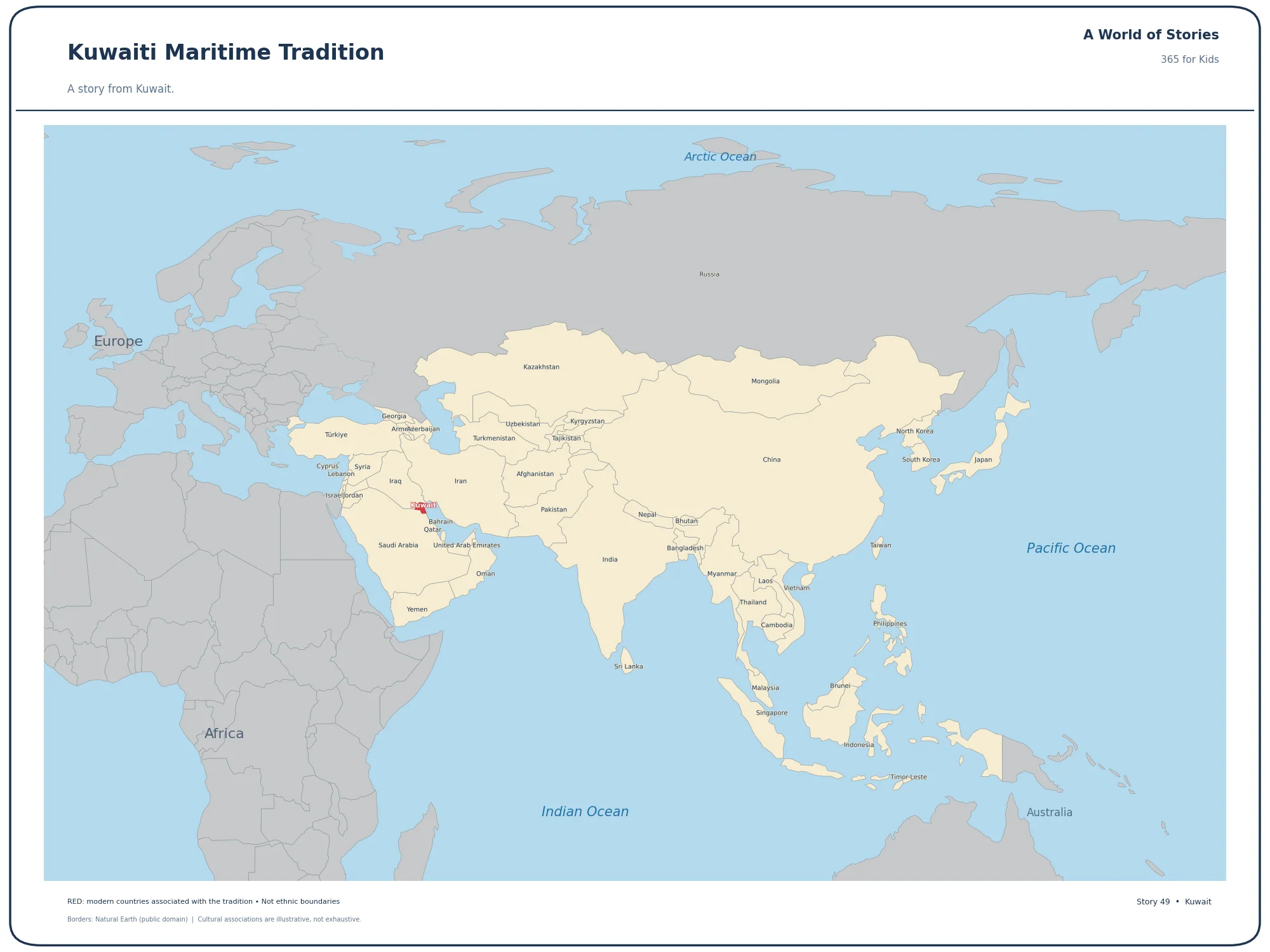
In the days when Kuwait’s wooden boats crossed the Gulf in search of fish and pearls, the sea was both a giver of life and a place of great uncertainty. Sailors knew its winds, its changing waves, and the darkness that fell far from shore. They also knew the old warnings told about Bu Darya.
Bu Darya, whose name was understood as “Father of the Sea,” was no ordinary creature. In the stories of Kuwait’s seafaring people, he was a frightening being of the water. Some described him as shaped partly like a man and partly like a fish. Others said that, in the darkness, he looked almost human. No one could agree exactly what he looked like, for his appearances belonged to the blackest hours of night.
One warning concerned a cry that rose above the waves. A sailor might hear a voice calling desperately for help, as though someone were struggling to stay afloat. To anyone with a generous heart, the sound would be difficult to ignore. Yet the older sailors warned that such a cry could belong to Bu Darya himself.
According to the tale, the creature waited until someone came near to rescue him. Then the seeming victim revealed his terrible nature, seized the would-be rescuer, and pulled him beneath the water. A voice that sounded like a plea for kindness could hide a deadly danger.
But the stories did not end there. Bu Darya was also said to climb aboard ships under cover of darkness. He might seize an unsuspecting sailor and drag him into the sea. This was why sailors remained watchful through the night, particularly when the water around the boat was silent and no shore could be seen.
What could they do if the feared visitor appeared? Kuwaiti storytellers remembered sailors raising their voices together and brandishing knives to frighten him away. At the shouts and the sight of the blades, Bu Darya was said to retreat into the water and disappear.
The legend passed from one generation to another among people whose lives depended on the sea. It gave a name and a shape to the fears of long voyages, dark waters, and dangers that could not always be seen. It also reminded listeners that courage did not mean ignoring a warning, and that even the most familiar waters deserved respect.
Today, Bu Darya belongs to Kuwait’s rich tradition of maritime folklore. His cries are heard in stories rather than on the decks of sailing boats, but the legend still speaks of the time when the sea held both a family’s livelihood and its deepest mysteries.
Bu Darya (also written Abu Darya or Bu Daryah) is a legendary sea being in Kuwait and elsewhere in the Gulf. Different oral accounts describe his appearance and behavior differently. This retelling brings together well-attested Kuwaiti motifs rather than presenting one fixed historical account. The creature is part of folklore, not a real animal.
After the Story: Read · Create · Reflect · Share
1. Find Kuwait on a map; which body of water lies beside its coast?
2. Draw the flag of Kuwait.
3. What two different dangers did sailors associate with Bu Darya?
4. Why do you think people who spent their lives at sea told and remembered this legend?
Inspired by this story? Create your illustration!
LEBANON — The Legend of Adonis and the River
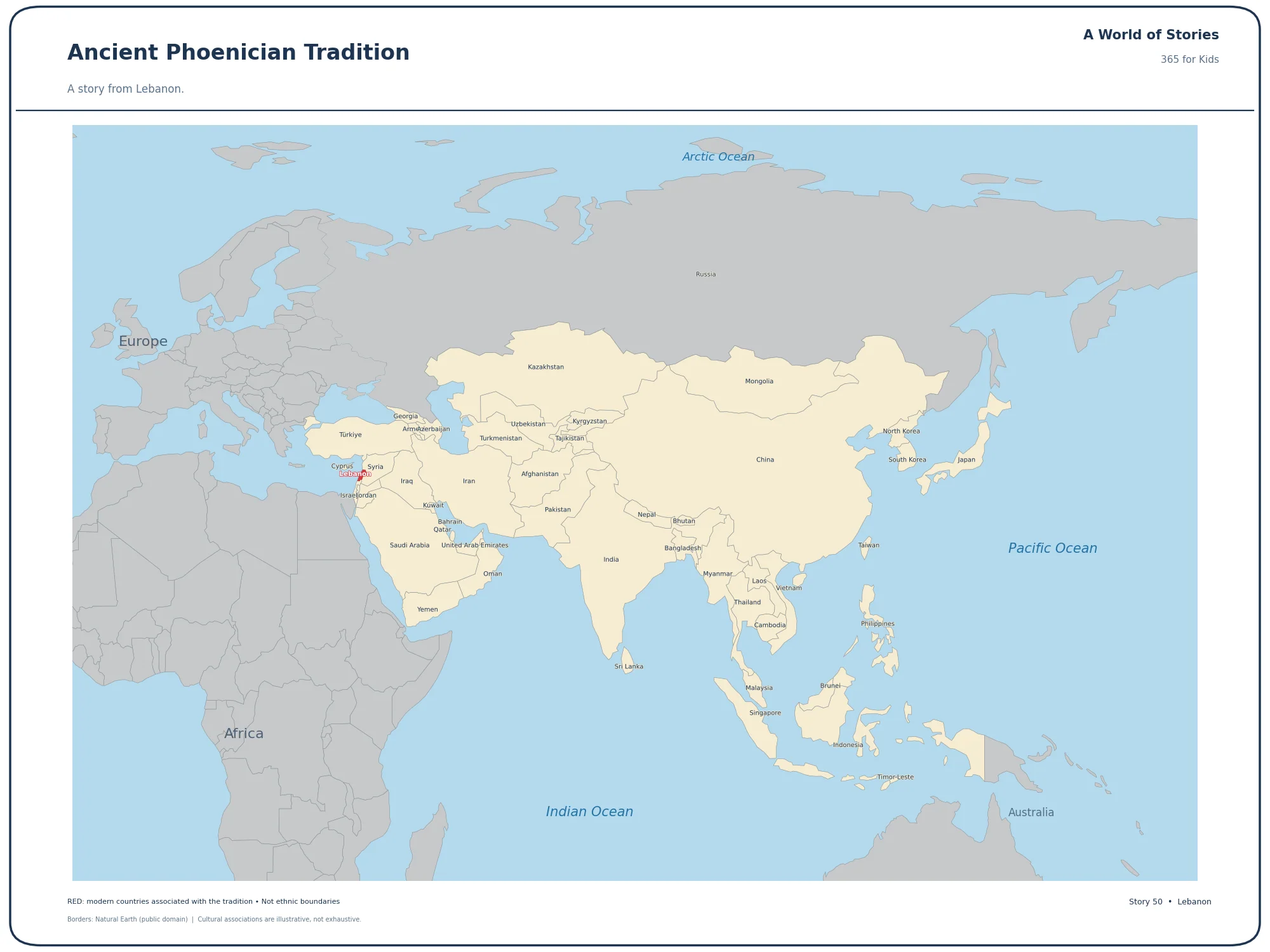
In the mountains of Lebanon, above the ancient coastal city of Byblos, there is a place called Afqa. Water flows from a great cave in the rock and begins a journey down toward the sea. Today the river is known as Nahr Ibrahim. In ancient times it was also called the River Adonis.
Long ago, the people of this region told a story about Adonis, a beautiful young figure associated with the growing life of the earth, and Astarte, a goddess of love and fertility. In the story, Astarte loved Adonis dearly. Their happiness, however, was not to last.
One day, while Adonis was hunting in the mountains, a wild boar attacked him. He was wounded so terribly that he died. When Astarte learned what had happened, she was overcome with sorrow. She searched for him and mourned him among the rocky heights and valleys of Lebanon.
The legend says that the blood of Adonis reached the waters flowing from Afqa. Each year, when the river turned reddish after winter, people remembered his death. Some tellings also say that flowers sprang up where his blood touched the ground. The red anemone became one of the signs associated with his story.
But the story did not end with sorrow alone. Astarte pleaded for Adonis to return from the world of the dead. Her grief and devotion moved the powers that ruled below the earth. According to a widely told version, Adonis was allowed to return for part of each year. When he came back, the fields and hills awakened with new growth; when he departed, the land entered its season of decline.
For people who lived close to the land, the story gave shape to something they saw year after year: plants wither and return, winter passes, and spring comes again. The death and return of Adonis became a way of speaking about loss, renewal, and the changing seasons.
At Byblos and Afqa, people once observed ceremonies connected to Adonis and Astarte. The river and the sacred spring remained at the heart of the tradition. When the water ran red, storytellers could point to it and recall the ancient tale.
Today, we know that the reddish color sometimes seen in the river comes from earth and sediment washed down by rain and melting snow. Yet the legend preserves another kind of truth: for thousands of years, people have looked to rivers, flowers, and the return of spring to understand the cycles of life.
This is an adaptation of the ancient Adonis–Astarte myth as connected with Afqa and Byblos in present-day Lebanon. Versions differ in the names of the deities, the details of Adonis’s return, and the flowers associated with the story. The narrative is a myth, not an account of historical events.
After the Story: Read · Create · Reflect · Share
1. Find Lebanon on a map; where are the mountains and the Mediterranean Sea?
2. What happened to Adonis, and how did Astarte respond?
3. Why did ancient people connect the river’s red color with the legend?
4. What changes in nature tell you that spring has arrived where you live?
Inspired by this story? Create your illustration!
OMAN — The Two Sisters of Bahla
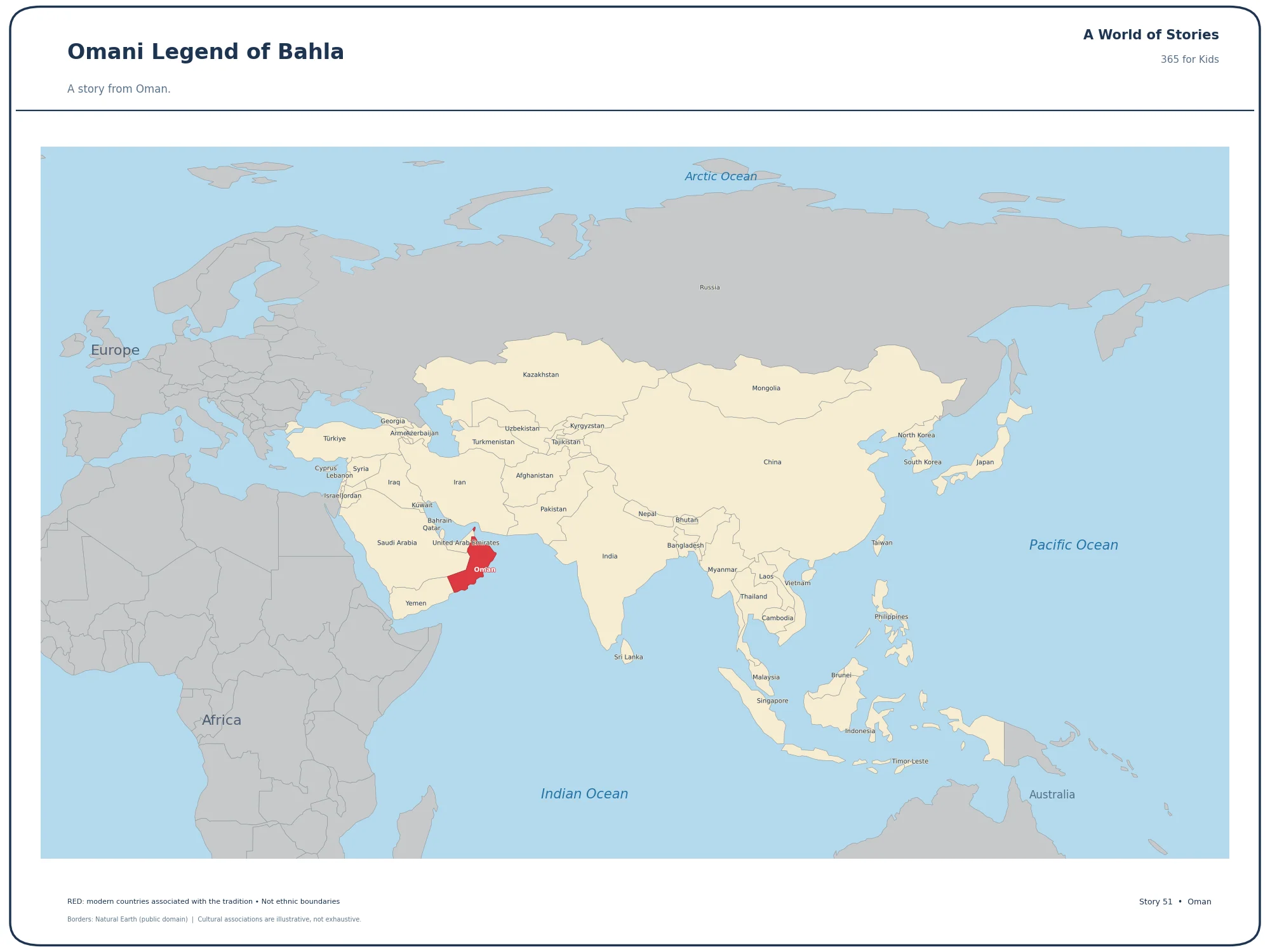
In the interior of Oman, where date palms rise beside old houses of earth and stone, stands the oasis town of Bahla. Around its gardens and dwellings stretches a great wall. Water travels through channels to the cultivated land. For generations, people have told a remarkable story about how these works came to be.
Long ago, so the legend says, two sisters possessed extraordinary powers. Their names are sometimes given as Maitha and Gaitha. Some storytellers say that the sisters were skilled in magic and called upon jinn—supernatural beings known in Arabian tradition—to help them. Other storytellers remember the sisters themselves as jinn.
The people of Bahla needed protection. The oasis held homes, palm groves and precious water, and a wall could guard it against danger from outside. According to the story, one of the sisters undertook the task of protecting the settlement.
It was no ordinary undertaking. A wall reaching around an entire oasis would require immense labour and time. Yet the legend says that with supernatural help, the wall rose in the space of a single night. By morning, a barrier encircled the town.
The other sister, the tale continues, turned her powers toward the life of the gardens. She made an irrigation system that carried water to the crops. In a dry land, such channels are as vital as strong walls: people need both safety and the means to grow food.
There are different versions of the legend. In one, the sisters summon jinn to accomplish the work; in another, each sister is herself a powerful spirit. But the two achievements remain at its heart: a wall to shelter the oasis, and channels to bring it water.
Today, the fort and old settlement of Bahla are real places that visitors can see. The wall and water system belong to the town’s history, while the story of the sisters belongs to its folklore. Whether the tale is told beside the palms or in the shadow of the fort, it recalls how important protection and water have always been to life in Bahla.
Bahla is a historic oasis settlement in Oman, known for its fort, defensive walls and traditional irrigation. A falaj (plural: aflaj) is a channel system used to distribute water. Jinn are supernatural beings that appear in many Arabian traditions. The sisters and the overnight building of the wall are elements of oral legend, not verified historical events. Accounts differ about whether the sisters were jinn or summoned jinn.
After the Story: Read · Create · Reflect · Share
1. Find Oman on a map; what countries and seas lie near it?
2. Draw the flag of Oman.
3. What did each sister create, and why were both creations important?
4. Why do you think people remembered this story about walls and water?
Inspired by this story? Create your illustration!
PALESTINE — The Little She-Goat
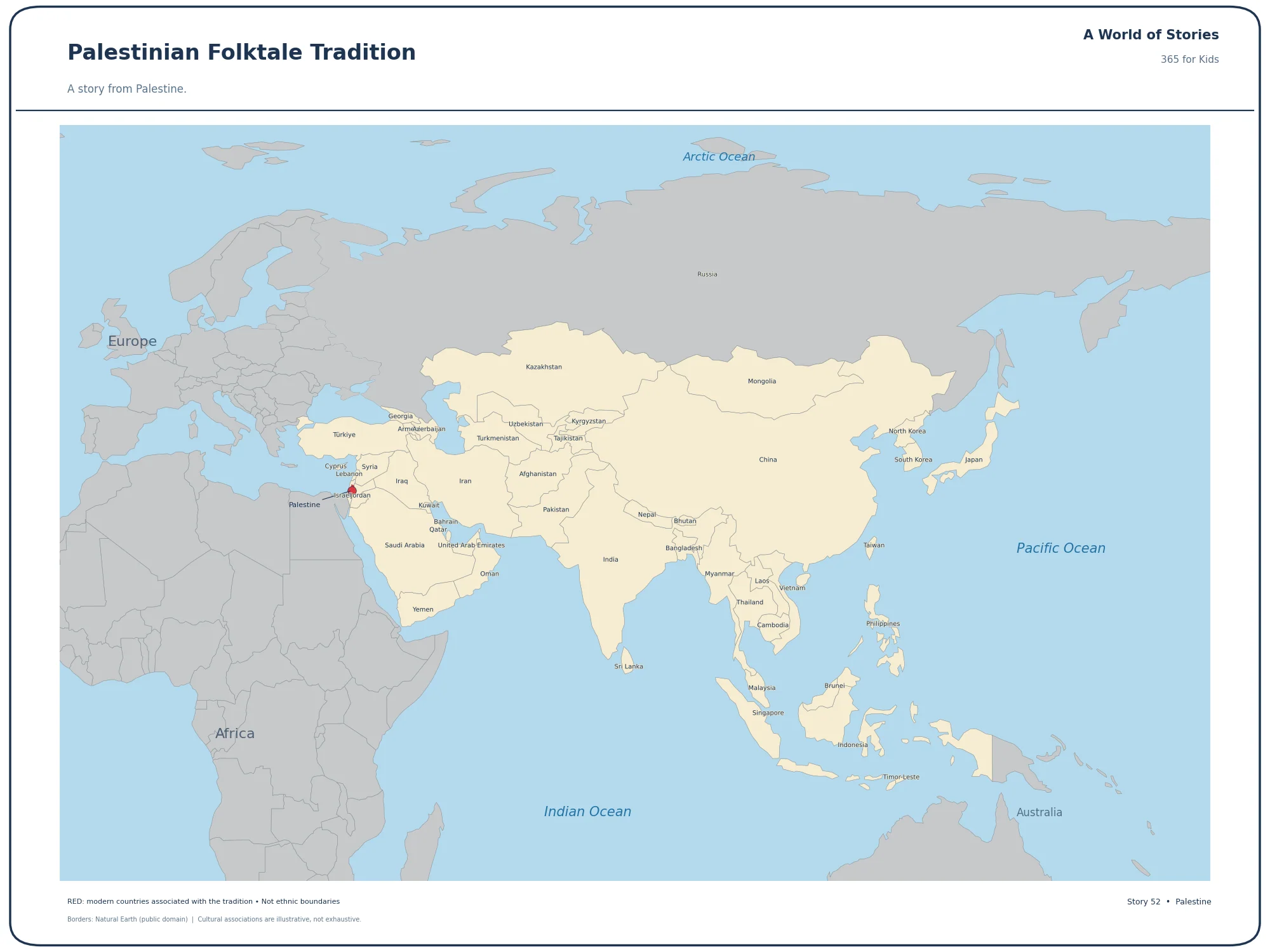
Once there was a mother goat who lived with her three little kids. Each morning she went out to graze and gather fresh grass. Before leaving, she told her children to stay inside and never open the door to a stranger.
The children knew how to recognize her. She returned with grass on her horns and milk for her young, and she had a short, cut-off tail. Whenever she called from outside, the kids first asked to see her tail. Only then would they let her in.
A hyena saw the goat leaving home and discovered where the kids lived. He hurried to their door and tried to imitate their mother’s call. But when the three kids asked to see his tail, they noticed that it was long and whole. They refused to open.
The hyena decided to change his appearance. He asked an ant to cut off his tail. The ant demanded a measure of wheat in return. At the threshing floor, the hyena learned that he would have to bring oxen to tread the grain before he could have the wheat. The oxen, in turn, wanted water from the spring before they would work.
The hyena went to the spring, which allowed the oxen to drink. Then the oxen worked at the threshing floor, the threshing floor supplied the wheat, and the ant finally cut the hyena’s tail.
Now the hyena returned to the kids’ door. Once again he pretended to be their mother. The children asked to see his tail. This time it looked just like their mother’s, so they opened the door. The hyena sprang inside and swallowed all three kids.
When the mother goat came home, she found her house empty. She learned what the hyena had done and went to the blacksmith. She asked him to make her a pair of strong, sharp iron horns.
With her new horns she went straight to the hyena’s home and challenged him to come outside. He emerged to fight her, but the mother goat stood firm. Using the iron horns, she defeated the hyena and opened his belly. Out came her three children, rescued at last.
The mother gathered her kids close. The danger had passed, and together they returned home.
This folktale is recorded under the title “The Little She-Goat” (Il-‘anze l-i’neziyye) in a collection of Palestinian oral narratives. The story features village life, a threshing floor, a spring and a blacksmith. Similar goat-and-predator tales exist in many cultures, but this version includes a distinctive chain of requests and the mother goat’s iron horns. This retelling preserves the principal events while using new English prose for young readers.
After the Story: Read · Create · Reflect · Share
1. Find Palestine on a map; which sea lies along its western coastline?
2. Draw the Palestinian flag.
3. How did the kids recognize their mother, and how did the hyena deceive them?
4. What did the mother goat do to save her children? What does this suggest about courage and caring for family?
Inspired by this story? Create your illustration!
SAUDI ARABIA — Zarqa al-Yamama and the Moving Trees
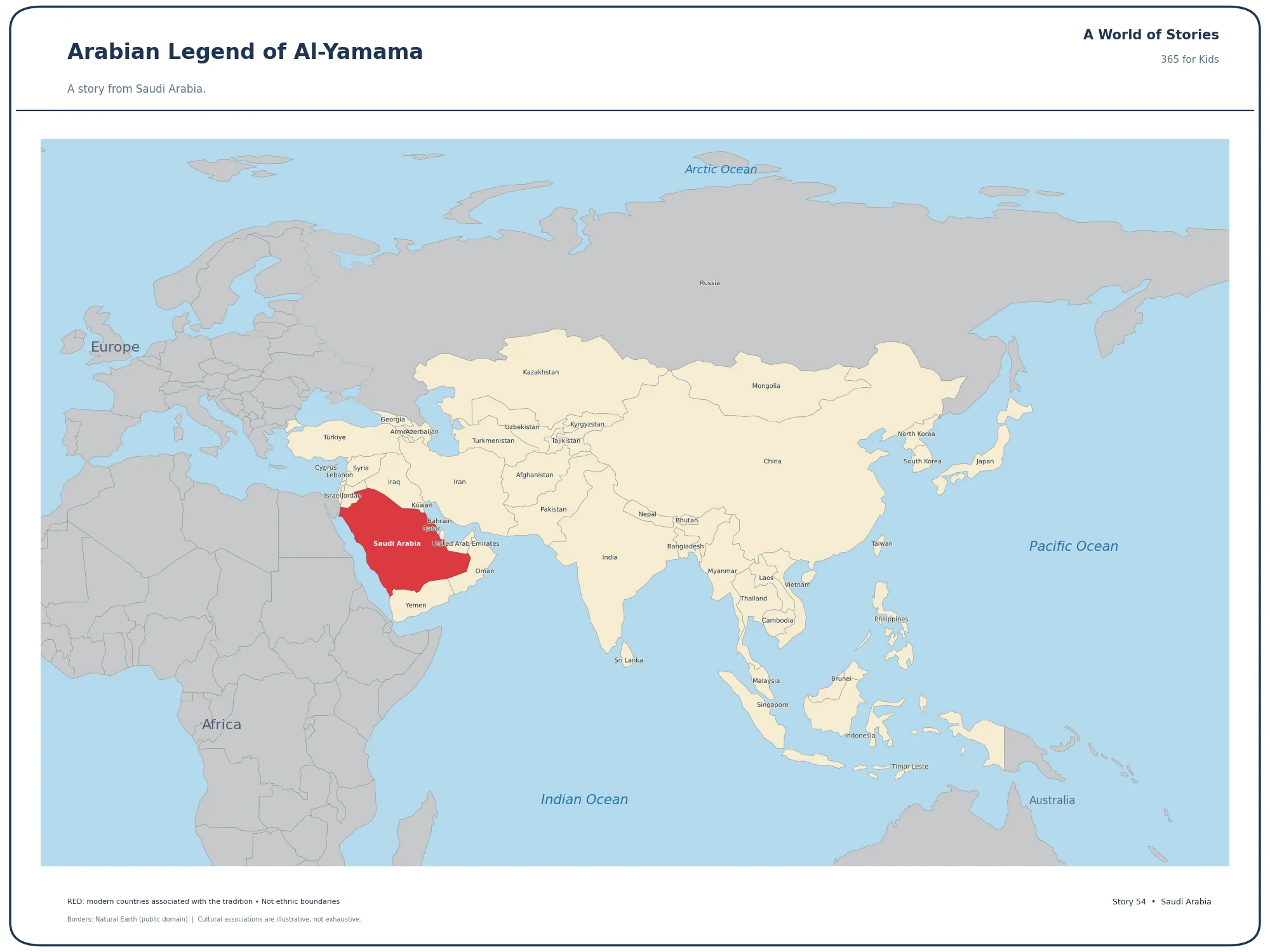
Long ago, in the region of al-Yamama in the heart of the Arabian Peninsula, there lived a woman named Zarqa al-Yamama. She belonged to the ancient people of Jadis. Her name, Zarqa, recalled her striking blue eyes, and stories said that no one could see as far as she could.
From a great distance, Zarqa could make out what others could not. According to the old tellers, she could spot a rider days before the rider arrived. When danger threatened, she would warn her people, giving them time to prepare.
But a hostile army was approaching al-Yamama. Its leaders had heard of Zarqa and feared that she would see them coming. They thought of a way to hide their advance. The men cut branches from trees and carried them in front of their bodies as they marched.
When Zarqa looked out toward the distant land, something strange caught her attention. The trees themselves seemed to be moving closer.
“I see trees walking toward us,” she told her people. “There are men behind them. Be on your guard!”
The people did not believe her. Trees could not walk, they replied. Some thought that even Zarqa’s remarkable sight had finally deceived her. Though she repeated her warning, they did not prepare for the danger.
The army continued its approach beneath the cover of branches. By the time the attackers reached al-Yamama, the warning had gone unheeded. They struck, and the people of Jadis suffered a terrible defeat.
The oldest versions of the legend tell of a tragic fate for Zarqa as well. Yet her name endured long after the disaster. In Arabic storytelling, her extraordinary vision became a symbol of seeing danger before others recognize it.
The tale of Zarqa al-Yamama still asks a difficult question: What happens when someone speaks a warning that others find impossible to believe?
Zarqa al-Yamama is a legendary figure of pre-Islamic Arabian tradition associated with the al-Yamama region, in present-day Saudi Arabia. Accounts differ in details, including the distance she could see and the names of the people involved. This adaptation follows the shared traditional episode of the advancing army concealed by branches, Zarqa’s warning about “moving trees,” and the warning being ignored. The violent ending is summarized rather than described graphically for younger readers. The tale is folklore, not a verified historical account.
After the Story: Read · Create · Reflect · Share
1. Find Saudi Arabia on a map; where is al-Yamama?
2. Draw the flag of Saudi Arabia and look up its symbols’ meaning.
3. How did the advancing army try to hide from Zarqa’s sight?
4. Why did Zarqa’s people ignore her warning? What can this teach about listening carefully?
Inspired by this story? Create your illustration!
SYRIA — Hab el Loz — The Almond Girl
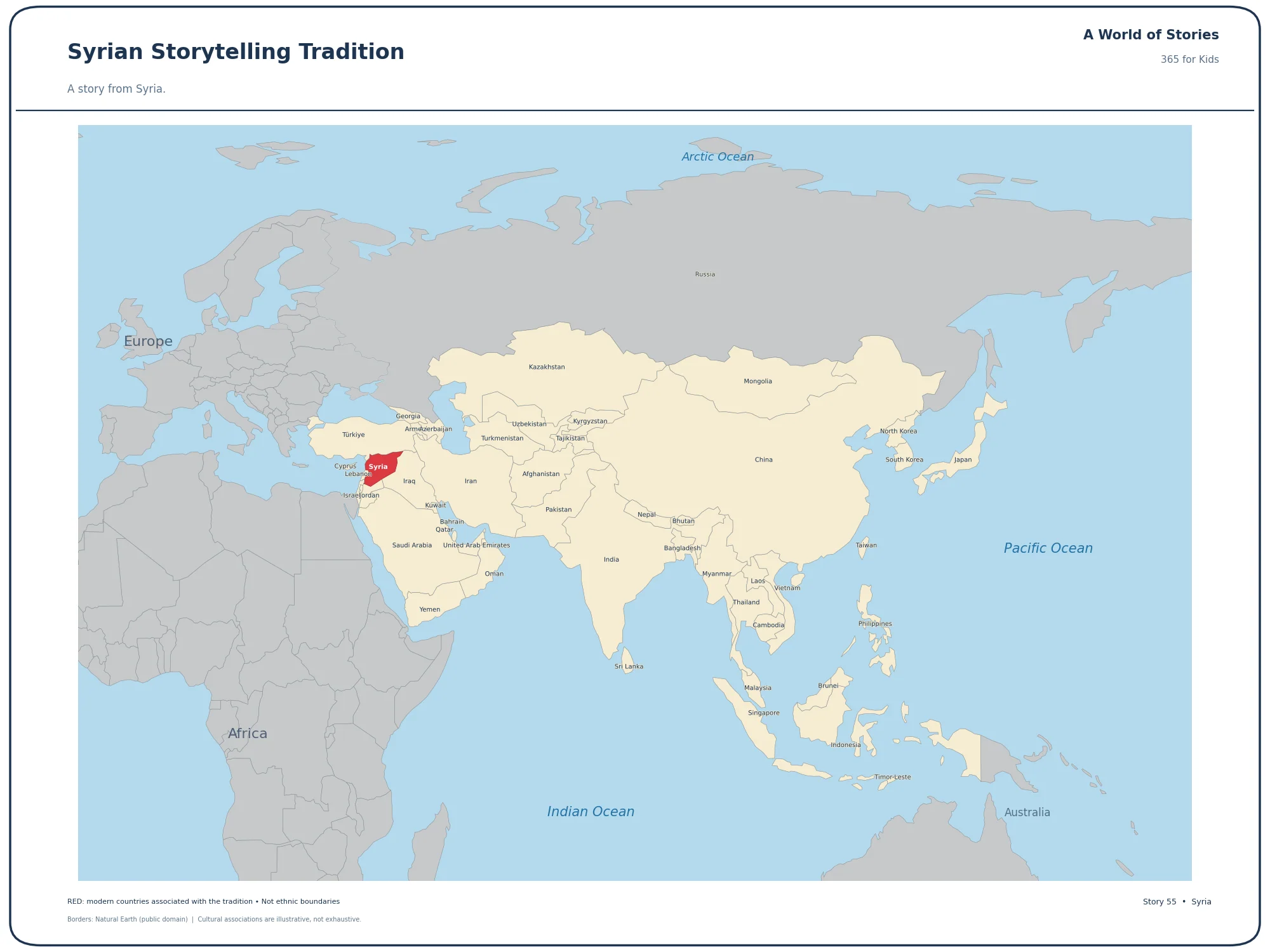
Once, a mother sat on her doorstep cracking almonds. She already had two daughters, but longed for another child. Looking at the almonds in her hands, she wished for a daughter of remarkable beauty and promised to call her Hab el Loz — Almond Girl.
In time, her wish came true. Hab el Loz grew into a lovely young woman, and her older sisters grew jealous of the affection she received. One day, they invited her to gather hawthorn fruit in the woods. While she climbed a tree, they loaded her basket with heavy stones, hiding the stones beneath the fruit. Then they hurried away.
When Hab el Loz descended, she could scarcely lift the basket. She discovered the stones and threw them out, but her sisters were already far ahead. Alone among the trees, she met an ogre. He wanted to take her as his wife. Hab el Loz refused and escaped to her mother’s house.
Later, preparations began for Hab el Loz to marry her cousin. A white horse arrived to carry her, but it swept her away instead. The horse was the ogre in disguise. In his cave he again asked her to marry him. Again she refused.
Angered, the ogre placed a spell on her. She became a limping dog, and he declared that only someone more powerful than himself could undo the enchantment. He gave her twenty moons before she must return.
Hab el Loz wandered for a whole moon before reaching a royal garden. There she found swans, who somehow recognized the young woman hidden beneath the dog’s appearance. They welcomed her, and she cared for them. Because the swans laid many eggs, the queen began to value the strange little dog and ordered that no one should harm her.
When Hab el Loz was alone with the swans, she could remove the enchanted dog skin and appear in her human form. One day, as she bathed in a pool, the prince saw her. She told him about her sisters, the ogre, and the spell. The prince offered to marry her and promised to face the danger.
The queen learned the truth and agreed to the wedding. As the newly married couple returned to the palace, the ogre appeared disguised as a swan. The prince called to Hab el Loz to cast off the dog skin. He caught it and threw it over the false swan. At once the enchantment changed places: the ogre was trapped in the shape of the limping dog, and Hab el Loz was free.
The prince’s cousin heard how a dog had become a beautiful bride and imagined he could obtain the same good fortune. He found an ordinary dog and arranged a wedding of his own. But when he commanded his bride to remove her dog skin, she only barked. When he struck her, she bit him. It was a foolish end to a foolish imitation.
Hab el Loz means “almond seed” or “almond kernel” in Arabic. This Syrian folktale belongs to the living tradition of spoken storytelling. Its ogre, enchanted animal skin, royal garden, and final comic twist reflect familiar patterns of traditional tales. Versions may differ between tellers.
After the Story: Read · Create · Reflect · Share
1. Find Syria on a map; which countries border it?
2. Draw the flag of Syria and look up its colors and symbols.
3. Why did Hab el Loz’s sisters leave stones in her basket, and what happened because of their jealousy?
4. What does the ending suggest about courage, kindness, and trying to copy another person’s good fortune?
Inspired by this story? Create your illustration!
YEMEN — The Spirit of the Well
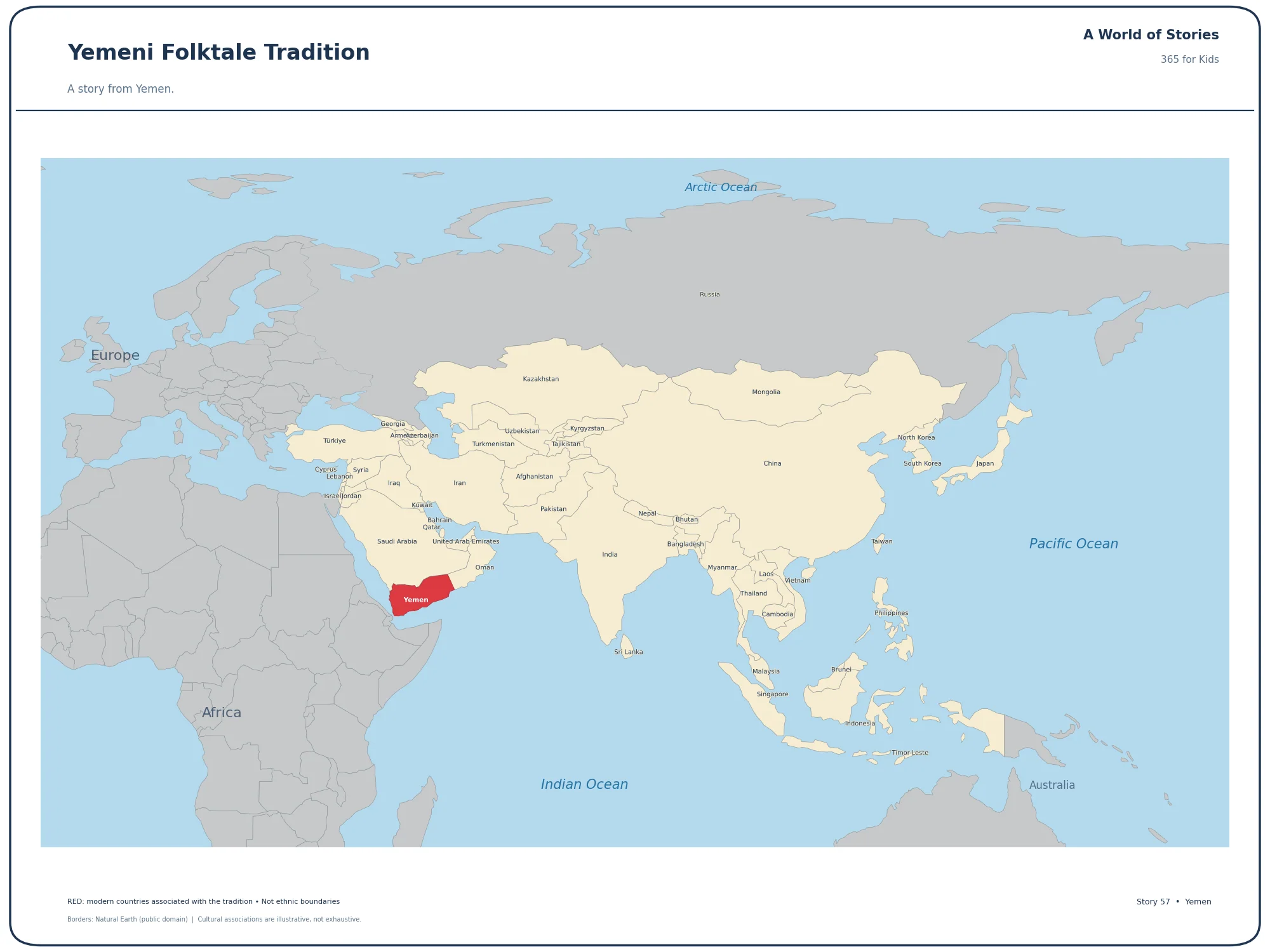
Once, a man sat beside a well, eating qala, a simple food made from pulses. As he ate, a single piece slipped from his hand and fell into the deep water. He leaned over the edge, but it was gone.
Instead of leaving, he began to cry out, “My qala! Give me back my qala!” He called so loudly and for so long that a spirit rose from the well.
“What has happened?” she demanded. “Your shouting will not let me rest!” The man explained that he had lost his food and wanted it back. The spirit could hardly believe that one little morsel had caused such a commotion.
“Wait here,” she said. “I will bring you something better.” She disappeared beneath the water and returned with a ram. This was no ordinary animal: when given a special command, it produced gold.
The man took the ram home, tried the command, and watched with amazement as gold filled a large dish. Overjoyed, he decided to visit the public bathhouse. He took the ram with him and entrusted it to the bathhouse keeper while he washed. He even warned the keeper not to say the magical words.
But curiosity and greed overcame the keeper. He learned the ram’s secret, found another ram that looked much the same, and exchanged them. The man went home with the ordinary animal. No matter how often he spoke the command, no gold appeared.
Back he went to the well. Again he called for his lost qala. The spirit emerged, irritated to see him. When he complained that the ram had worked only once, she brought him another gift: a pan that would fill with delicious food when addressed with the proper words.
At home, the man commanded the pan, and a wonderful meal appeared. He ate happily. Later, he went to the same bathhouse, carrying his remarkable pan. Once more he left it in the keeper’s care and warned him not to try its magic.
The keeper secretly replaced the pan with an ordinary one. That evening, the man spoke to his pan and waited. Nothing happened. He tried again, but the pan remained empty.
The following morning, the man returned to the well and resumed his cries. This time the spirit brought him a heavy wooden club. “This will help you recover what you have lost,” she told him. “But do not test it here. Take it home first.”
The man carried the club home and pronounced its command. At once the club began to strike him. He pleaded for it to stop, but it kept going. Bruised and aching, he thought that a visit to the bathhouse might bring him relief.
He left the club with the same keeper and, as before, warned him not to say the words. The keeper could not resist. When he gave the command, the club sprang into action and struck him again and again.
“Stop! Stop!” cried the keeper. At last, desperate to escape, he confessed that he had taken the magical ram and the food-giving pan. He returned both stolen treasures. Only then did the beating end.
The man collected the ram, the pan, and the club and went home, delighted to have recovered what was his. As for the keeper, he had learned that another person’s trust was not something to steal.
This folktale is told in the Sana’a region of Yemen. The original account uses local expressions and mentions familiar everyday settings, including a well, a bathhouse, and foods such as qala. The magical animal, food-producing pan, and punishing club belong to a wider family of folktale motifs found in many cultures. This adaptation follows the events in the recorded Yemeni version. The spirit and objects are elements of folklore, not claims about real events. [Editorial note: the source version describes the ram producing gold in a deliberately earthy way; this children’s adaptation describes that moment without the explicit bodily detail.]
After the Story: Read · Create · Reflect · Share
1. Find Yemen on a map and identify the Arabian Peninsula.
2. Draw the flag of Yemen; what are its three colours?
3. Which three magical gifts did the spirit bring, and what happened to the first two?
4. What did the bathhouse keeper do wrong, and how could he have acted differently?
Inspired by this story? Create your illustration!
TURKIYE — Keloğlan and the Golden Nightingale
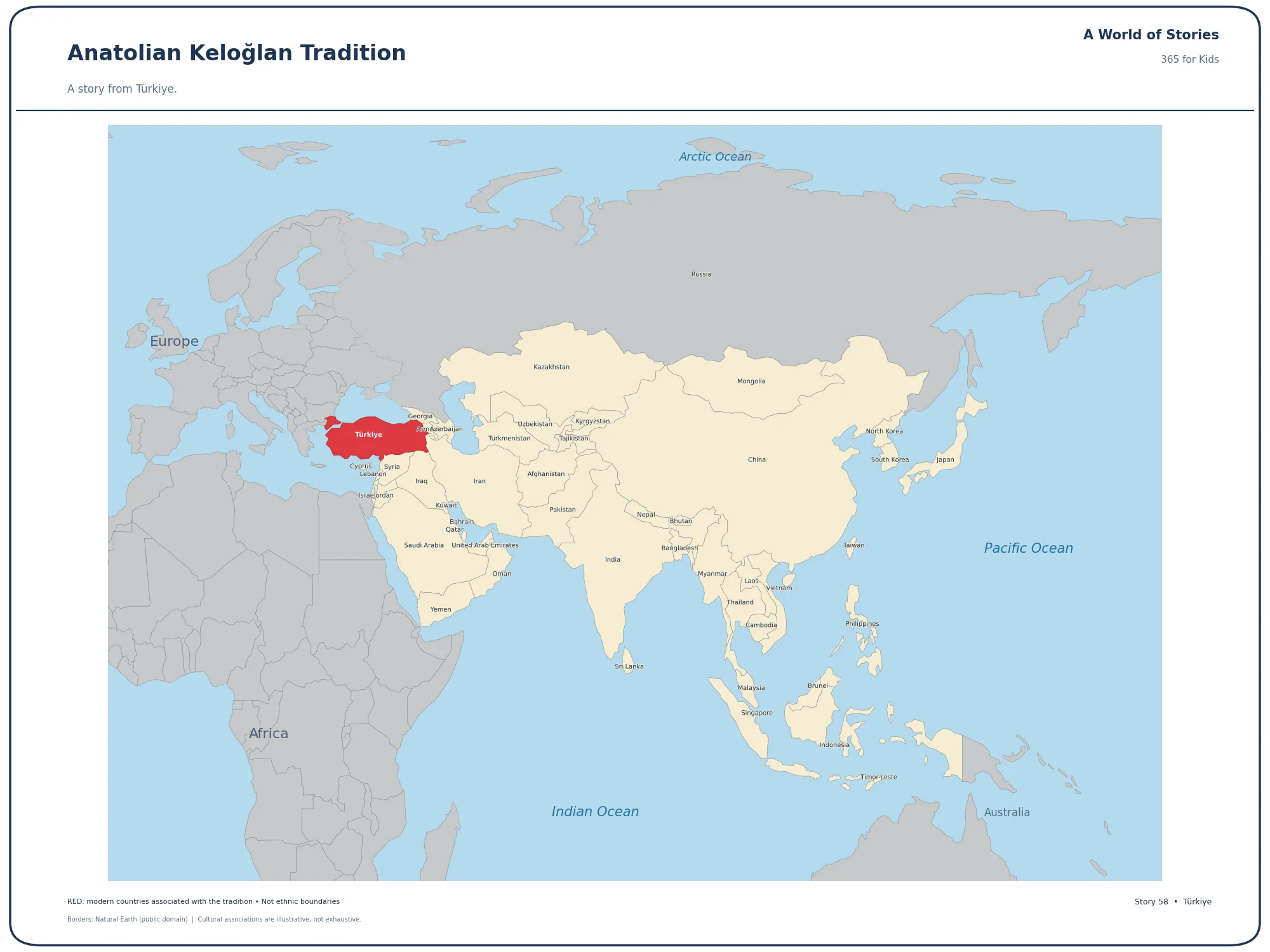
Long ago, there lived a sultan who built a beautiful mosque entirely of glass. One Friday, as he came out of it, an old man with a white beard appeared before him. The building would be complete, the stranger said, only if the sultan brought the Golden Nightingale from beyond Mount Qaf and placed it beside the mosque. Then the old man vanished.
The sultan could think of little else. At last he told his sons what troubled him. All of them promised to seek the mysterious bird and rode away together. After a long journey they reached three roads. The eldest chose the first, the middle brother the second, and the youngest was left with the road through the marshes.
The older brothers found that their roads joined again near a city. When their money ran out, one took work at an inn and the other at a restaurant. The youngest, meanwhile, struggled through thorns and lonely country until he came to a spring. There he met a white-bearded elder, who listened to his story and warned him how difficult the journey would be.
But the young man would not turn back. He had given his father his word. The elder stroked his back three times, and the young traveler went on.
Weak from hunger and thirst, he eventually came to the palace of a giant who had seven lives. He defeated the giant and met a fairy maiden there. Farther on, he encountered a giant with eight lives and overcame him too. In that palace another fairy maiden learned of his quest. She explained where the Golden Nightingale was kept and how he might protect himself against the giant with nine lives.
The youngest brother continued to the third palace, overcame its nine-lived giant, and found himself faced with ninety-nine rooms. Which one held the bird? A cat showed him the way. Following its sign, he found the Golden Nightingale at last.
On the return journey he visited the old man at the spring and left some of the treasures from the palace in his care. Then he found his brothers in the city, bought each of them a horse, and returned to the spring to collect the bird.
The three brothers rode home together, but jealousy took hold of the elder two. They threw the youngest into the water and carried the Golden Nightingale to their father themselves. The young man survived. Soaked and alone, he met a shepherd and bought a sheep. He covered his head with its stomach skin, so that he looked like Keloğlan, the bald boy of Turkish folktales.
He came to another town and found work at an inn. One day the innkeeper fell seriously ill. The town’s healers could not help him. An old man said that a sip of water from a certain sultan’s mosque might restore his health. The young servant went at once to fetch it.
As soon as he entered the mosque, the Golden Nightingale began to sing. It had remained silent when the older brothers presented it to the sultan, and it had not sung for anyone since. The sultan summoned people one after another, but the bird was silent until the young stranger approached. Again it sang.
The young man removed his strange head covering, and his father recognized his youngest son. Now the sultan knew who had truly brought back the bird. The jealous brothers were sent away from the palace, and the youngest son’s courage and perseverance were finally acknowledged.
Keloğlan (“bald boy”) is a well-known figure in Turkish oral storytelling, often associated with cleverness, determination, and the triumph of a seemingly ordinary young person. This version of the Golden Nightingale tale explains how the youngest prince came to appear as Keloğlan. Mount Qaf is a legendary mountain in Middle Eastern storytelling, not a geographical destination. Türkiye spans Europe and Asia; this story is included here as an Anatolian Turkish folktale. Based on “Keloğlan ve Altın Bülbül Masalı,” collected by Osman Saygı, Türk Folklor Araştırmaları Dergisi, no. 240 (1969), reproduced by the Republic of Türkiye Ministry of Culture and Tourism, Kültür Portalı. This English text is a new condensed literary retelling of the documented plot, not a translation of the website wording. Some traditional elements, including confrontations with giants and the sheep-stomach disguise, are retained.
After the Story: Read · Create · Reflect · Share
1. Find Türkiye on a map; which parts lie in Asia, which in Europe? Draw its flag.
2. Why did the youngest son continue his journey after the old man’s warning?
3. What helped him find the Golden Nightingale among ninety-nine rooms?
4. Why did the bird sing only for the youngest son? What does the ending suggest about jealousy and truth?
Inspired by this story? Create your illustration!
North Asia and Siberia
SAKHA — Nurgun Botur the Swift — The Rescue of Aitalyyn Kuo

In the old songs of the Sakha people, the universe was made of three worlds. Above was the Upper World, home of the aiyy, the heavenly beings. In the Middle World lived humankind, surrounded by forests, rivers, open grasslands and the changing seasons. Far below lay the Lower World, where the fearsome abaasy warriors dwelled.
When the people of the Middle World suffered from the attacks of the abaasy, the heavenly powers sent a protector: Nurgun Botur the Swift. He came with his younger brother, Yurung Uolan, and his younger sister, Aitalyyn Kuo. Nurgun was strong enough to face the enemies of the three worlds, yet his task was not to seek glory. He had come to defend those who could not defend themselves.
Nurgun was given a mighty horse, the faithful companion of his journeys. He also obtained the weapons and armour a defender would need. His brother soon rode away on a mission of his own, hoping to rescue a young woman named Tuiaaryma Kuo from captivity. Nurgun remained in the Middle World, where his sister Aitalyyn Kuo was living.
Then danger came close to home. An abaasy warrior called Esekh Kharbyyr appeared in a monstrous, eight-legged form. He seized Aitalyyn Kuo and carried her away toward the Lower World.
When Nurgun discovered that his sister had vanished, he did not hesitate. He mounted his horse and followed the trail of the kidnapper, leaving the familiar lands of the Middle World behind. Down he went, toward a realm of darkness, strange creatures and the terrifying Sea of Fire.
Near that sea, Nurgun caught up with the abaasy. The enemy travelled with a monstrous three-headed serpent. Nurgun overcame the serpent and reached his sister before her captor could escape. At last Aitalyyn Kuo was free from the monster’s grasp.
But the danger was not over. The abaasy warrior still had to be faced, and a battle in that dreadful country could bring ruin far beyond the two opponents. Nurgun’s first thought was to place his sister safely beyond its reach. Through the magic of the epic world, he made Aitalyyn Kuo small enough to shelter in his horse’s ear. Then he sent his faithful horse back toward the Middle World, with instructions to return when called.
Only after she was on her way to safety did Nurgun turn to the abaasy warrior. The two mighty figures fought with such force that the Lower World itself was shaken. Its ruler, Arsan Duolai, feared the destruction of his realm and appealed to the powers who governed the fate of the worlds.
The battle was moved away from the inhabited country. Still the combat went on, across a sacred mountain and finally toward a lonely rocky place beside the Sea of Fire. Nurgun would not leave while the raider remained a threat to his family and the people of the Middle World.
At the hardest moment, help came from his elder sister, Aiyy Umsuur, a powerful heavenly shaman. With her aid, Nurgun defeated the abaasy warrior and survived the struggle. The long pursuit and terrible contest had ended.
Nurgun rose from the depths of the Lower World and returned to the land of human beings. He called for his horse, just as he had promised. The faithful animal came, bringing Aitalyyn Kuo safely back to him.
Brother and sister were reunited. Nurgun had crossed into the realm of danger, but he had not forgotten what mattered most: to bring the person he loved home. In the great Olonkho, more journeys and battles still awaited him. This rescue, however, had reached its joyful ending.
Olonkho is the heroic epic storytelling tradition of the Sakha (Yakut) people of northeastern Siberia. Skilled performers, called olonkhosuts, preserve these stories through a combination of spoken and sung narration. UNESCO inscribed the Olonkho tradition on its Representative List of the Intangible Cultural Heritage of Humanity in 2008 (following its 2005 proclamation). This is an original English prose adaptation of one complete episode — the abduction and rescue of Nurgun’s sister, Aitalyyn Kuo — from the wider Nurgun Botur epic. It is not a translation of the full work. Spellings of characters’ names and some details differ across oral tellings and editions. This text follows the episode outline published by the Olonkho Theatre and the extended folklore synopsis, without combining it with later adventures. The Sakha Republic (Yakutia) is a federal republic within the Russian Federation, not an independent country. The story belongs specifically to Sakha cultural heritage. The aiyy and abaasy are beings of the epic’s traditional worldview, not historical people.
After the Story: Read · Create · Reflect · Share
1. Look at a map. Where is the Sakha Republic (Yakutia), and what present-day country is it part of? Can you find Siberia?
2. Draw the flag of the Sakha Republic or the flag of Russia. What can you learn about the Sakha people and their language?
3. What did Nurgun Botur do to keep Aitalyyn Kuo safe before he continued the battle?
4. Nurgun needed help from his horse and his elder sister. Why can accepting help be as important as being brave?
Inspired by this story? Create your illustration!
CHUKOTKA — Raven Shapes the World
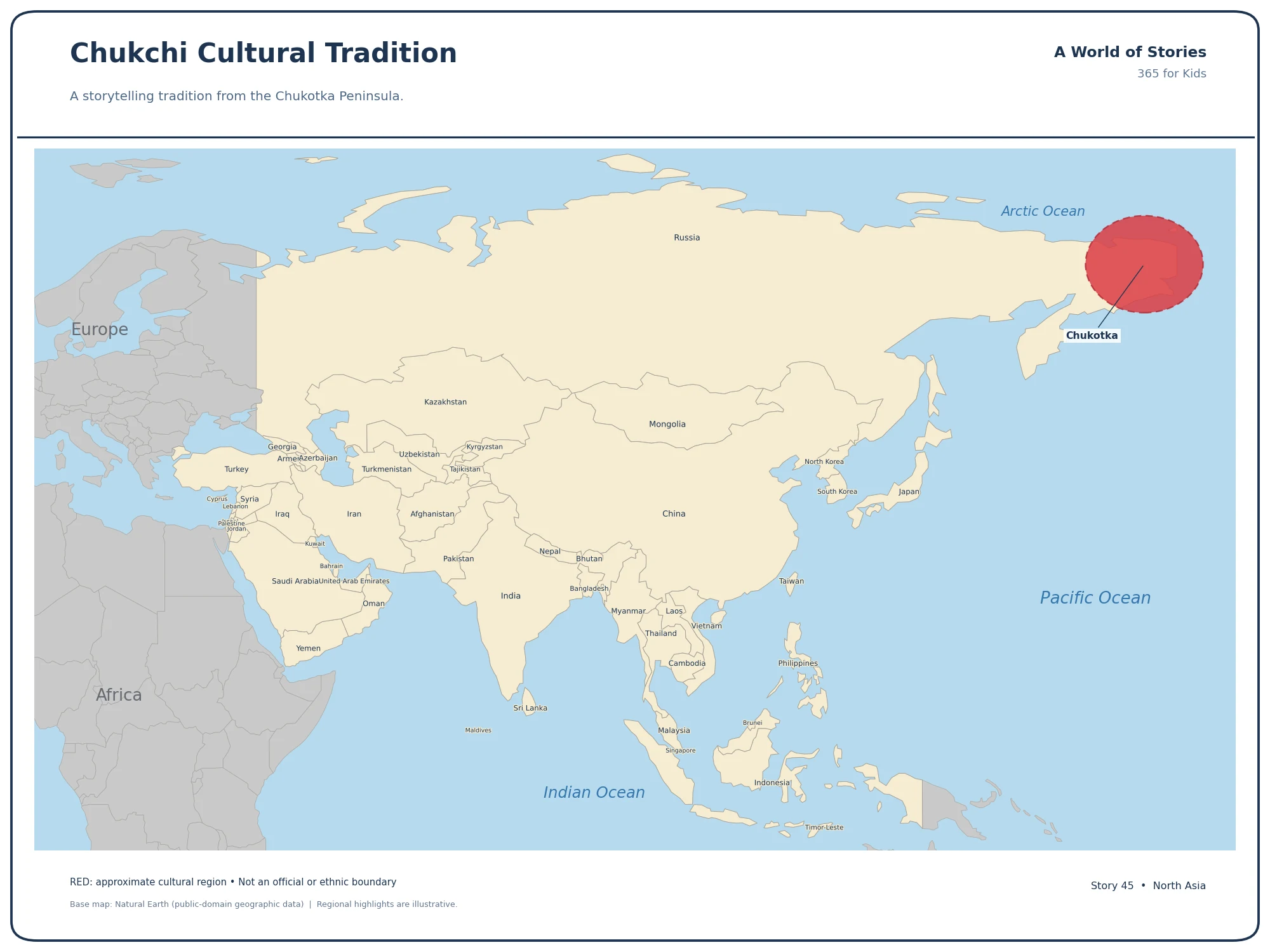
At the beginning of the story, the world was almost empty. There was only a little ground, just enough for two creatures to live upon, with water stretching beyond it. No reindeer crossed the land. No walruses rested by the shore. There were no whales, seals, fish, or people.
On that small patch of ground lived Ku’urkil, the Raven, and his wife. Ku’urkil was said to have come into being by himself. Yet even a self-created Raven could grow weary of an empty world.
One day his wife spoke to him. They were alone, she said; there was no one to talk to and almost nothing to see. Would it not be better if he tried to make the earth larger?
Ku’urkil answered that he did not know how. His wife urged him to try, but he insisted that he could not do it. At last she said that she would see whether she could create a companion for them, even if he could not create the world.
She lay down and fell asleep. Ku’urkil stayed awake to watch. At first nothing happened. Then her raven’s feet began to change. Her feathers disappeared, and her body took human form. Ku’urkil looked at his own black wings and talons, but no matter how he tugged at his feathers he could not change himself.
Before his astonished eyes, his wife brought forth twin boys. The children looked like people, while their father was still a Raven. When they saw him, they laughed at his feathers and his harsh cry. Their mother told them to show respect. The boys listened and fell silent.
Ku’urkil had seen his wife bring new life into the world. He decided that now he must try to make more of the earth.
He flew away and sought advice from the kindly powers. He asked Dawn. He asked Sunset, Evening, Midday, and Zenith. None could tell him what to do. So he kept flying until he reached the distant place where the sky and the ground met.
There he came upon a dwelling filled with strange beings. Ku’urkil peered inside, then drew back in alarm. One of its inhabitants came out and spoke to him. The beings, the stranger explained, had arisen from the dust made where sky rubbed against earth. They might become the ancestors of many people—but there was hardly any land on which they could live.
Ku’urkil announced that he would try to create it. The stranger went with him to watch.
As Raven flew over the water, he let droppings fall. In this unusual way, according to the old tale, every piece grew into solid ground. More and more land rose from the water until there were wide stretches of earth and many islands.
His companion looked around. There was land now, but no fresh water and no mountains. So Ku’urkil made water as he flew: where drops fell, lakes appeared; where it ran in a stream, rivers took shape. Then he dropped harder pieces of waste, which turned into mountains and hills.
The stranger was still worried. What if the waters rose so high that even the hills disappeared? Ku’urkil flew on and made more ground and higher places, working until he had exhausted himself. At last his companion admitted that, if a great flood came, at least the mountain peaks might remain above the waves.
But the world had another problem. What would its people eat? No animals lived upon it.
Ku’urkil found trees and took up his hatchet. As he cut, he sent the wood chips into the water. The shavings of pine became walruses. Those of oak became seals. The pieces of stone pine turned into polar bears, while the chips of small black birch became great whales.
From other pieces of wood came fish, crabs, worms, and many more creatures of the sea. Animals also appeared on land: wild reindeer, foxes, bears, and the creatures that people would one day hunt.
Now Ku’urkil could tell the first people that there was food in the world.
This is how one Chukchi telling describes the making of land, rivers, mountains, and living creatures: not in a single moment, but through the strange, exhausting work of Raven, who began in a world where almost nothing lived.
The Chukchi are an Indigenous people of northeastern Siberia, especially the Chukotka Peninsula. This story belongs to the Chukchi Raven cycle and is a creation myth, not a scientific account of the origins of the Earth. This literary adaptation follows the first version of “Raven Tale” recorded by Waldemar Bogoras from a Maritime Chukchi storyteller, Aettin-qeu (transliterations vary), at Mariinsky Post in October 1900. It selects the episode about the first companions and Raven’s creation of land, fresh water, mountains and animals. The longer original continues with accounts of the origins of human families and includes explicit adult material; those later events are not retold here. The old story uses bodily humor to explain the shaping of the world. That unusual detail has been retained rather than replaced with invented magic. Bogoras also recorded separate second and third versions of “Raven Tale.” Their events have not been combined with this narrative. Names and pronunciations vary in English transliteration. The 1910 English record is an early ethnographic transcription of an oral telling, not the only Chukchi version.
After the Story: Read · Create · Reflect · Share
1. Find the Chukotka Peninsula in far northeastern Asia. What sea and what continent lie across the Bering Strait?
2. What happened when Ku’urkil’s wife tried to create companions? How did the young boys react when they first saw Raven?
3. In the legend, what became lakes and rivers, and what became animals such as walruses, seals, polar bears, and whales?
4. Why might people tell stories about how the world began? Choose one scene from this myth and draw how you imagine it.
Inspired by this story? Create your illustration!
BURYAT — Alamji Mergen and His Little Sister Agui Gokhon
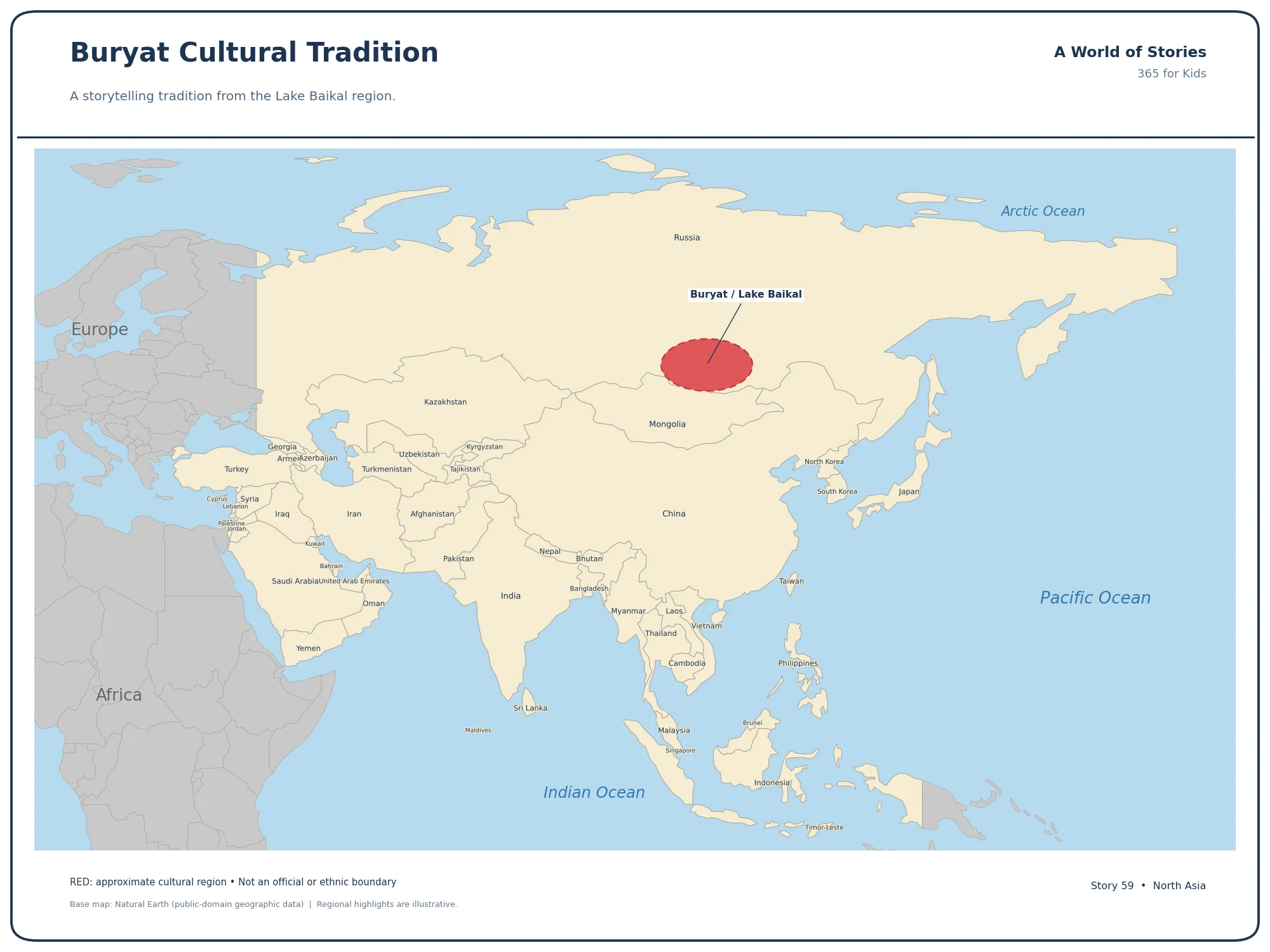
In a country of wide grasslands, wooded hills, and distant mountains, a brother and a sister grew up together. Their names were Alamji Mergen and Agui Gokhon. They had lost their parents while still very young, and each was the other’s closest companion. Alamji grew into a great warrior, strong enough to defend his people and wise enough to care for the land under his protection. Agui Gokhon, though younger, possessed a courage and intelligence equal to his own.
But not everyone welcomed Alamji’s strength. Two of his uncles, Khara Zutan and Shara Zutan, looked upon his good fortune with envy. They urged him to ride out and confront a fearsome mangadhai, one of the powerful monsters that appear in Buryat heroic tales. Alamji did not refuse the challenge. He prepared his horse and weapons, said farewell to his sister, and set out.
The journey led him into the country of his enemy. There he faced the mangadhai and defeated it in a terrible struggle. Alamji had overcome the danger that waited beyond his homeland. Yet the greatest danger was not beyond the mountains at all: it came from his own family.
When he returned, the two uncles offered him a poisoned drink. Alamji trusted the older men because they were his relatives, and he drank it. The poison took his life. The warrior who had survived a monster could not defend himself against betrayal.
Agui Gokhon mourned her brother. She carried his body to a sheltered place in the mountains and laid him there. But she would not accept that his story must end in that lonely place. She knew of Bulad Khurai, the youngest daughter of Dalai Bayan Khan, who possessed extraordinary healing powers. If anyone could restore Alamji Mergen, it would be she.
Agui Gokhon took on the appearance of her brother and prepared to travel in his place. To everyone who met her, the rider would appear to be Alamji Mergen himself. She mounted his remarkable pale-gold horse, Nariikhan Sharga, whose wisdom was as valuable as its speed. The horse could speak and could warn its rider when danger lay ahead. Together they went in search of Dalai Bayan Khan’s distant country.
Their road was no ordinary road. Agui Gokhon passed through wild lands and changed her shape when her journey demanded it. In one adventure, she confronted an old man who was not what he seemed: he was a mangadhai in disguise. Farther on she faced giant frogs, creatures as strange and dangerous as anything her brother had encountered. With quick thought, courage, and the help of her horse, she survived the trials.
Then she came upon a dreadful sight. A many-headed serpent had risen from dark waters and threatened three daughters of Khan Eagle, the great bird of the sky. The serpent had twenty-three heads.
Agui Gokhon did not turn away. Still appearing as Alamji Mergen, she fought the monster and freed the three young women. In gratitude, Khan Eagle became her ally, helping her along the difficult way.
The journey continued toward a vast stretch of water. There Agui Gokhon discovered an enormous burbot, a fish in desperate need of help. She saved it rather than leaving it behind. The grateful creature repaid her kindness by carrying her and her horse across the great waters to the land of Dalai Bayan Khan.
At last the disguised traveler reached the khan’s home. Dalai Bayan Khan would not give his daughter Bulad Khurai in marriage without testing the one who sought her. Powerful rivals and difficult contests awaited the visitor. But Agui Gokhon was no ordinary traveler. She met the challenges with strength and cleverness, while her faithful horse helped her through moments when even a mighty warrior might have failed.
The tests were passed. Agui Gokhon could now return with Bulad Khurai, the woman whose gift for healing had brought her all this way. The journey home led back through the same enormous world of mountains, forests, and water. Behind Agui Gokhon lay the dangers she had overcome; ahead lay the one task that mattered more than all the others.
Bulad Khurai came to the place where Alamji Mergen rested and used her extraordinary powers to bring him back to life. The brother who had been lost opened his eyes again. Agui Gokhon’s journey had not been in vain. Through her bravery, the help of loyal companions, and Bulad Khurai’s healing, the warrior was restored.
Alamji Mergen and Bulad Khurai were joined in marriage. Agui Gokhon, having completed the task she had undertaken in her brother’s name, returned to her own path. Alamji then faced his treacherous uncles, Khara Zutan and Shara Zutan, and punished them for their betrayal. The wrong that had shattered the family did not remain unanswered.
And so the old Buryat epic remembers two heroes, not one. Alamji Mergen met the monster with the strength of a warrior. Agui Gokhon crossed a world of extraordinary trials with courage, wisdom, and love for her brother. The story belongs to both of them.
The Buryats are a people with deep historical ties to the lands around Lake Baikal; Buryat communities also live beyond the borders of present-day Russia. An uliger is a traditional Buryat heroic epic, performed by a skilled storyteller rather than simply read as a short fairy tale. This story comes from the Ekhirit-Bulagat tradition of the Kuda Valley in today’s Irkutsk region. The recorded epic runs to more than 5,000 lines and includes elaborate poetry, magical transformations, monsters, speaking animals, and two equally important heroic figures. A mangadhai is a monstrous antagonist in Buryat epic storytelling. A burbot is a large freshwater fish; its enormous size and the seas it crosses belong to the legendary world of the epic. This is a newly written, substantially shortened English literary retelling for young readers, not a translation or reproduction of the 5,297-line epic. The main events follow the version told by Shalbykov. Secondary episodes, epic repetitions, and detailed ceremonial descriptions have been condensed; no new adventures have been added.
After the Story: Read · Create · Reflect · Share
1. Find Russia and Lake Baikal on a map of Asia. Locate the Irkutsk region where this version of the epic was recorded. Draw the Russian flag.
2. What happened to Alamji Mergen after he defeated the mangadhai? Why was that danger harder to recognize?
3. Name two beings Agui Gokhon helped or befriended during her journey. How did kindness return to her?
4. Why do you think this epic names both the brother and his little sister? What different kinds of courage do they show?
Inspired by this story? Create your illustration!
EVENKI — Brave Sodani — An Epic of the Middle and Lower Worlds
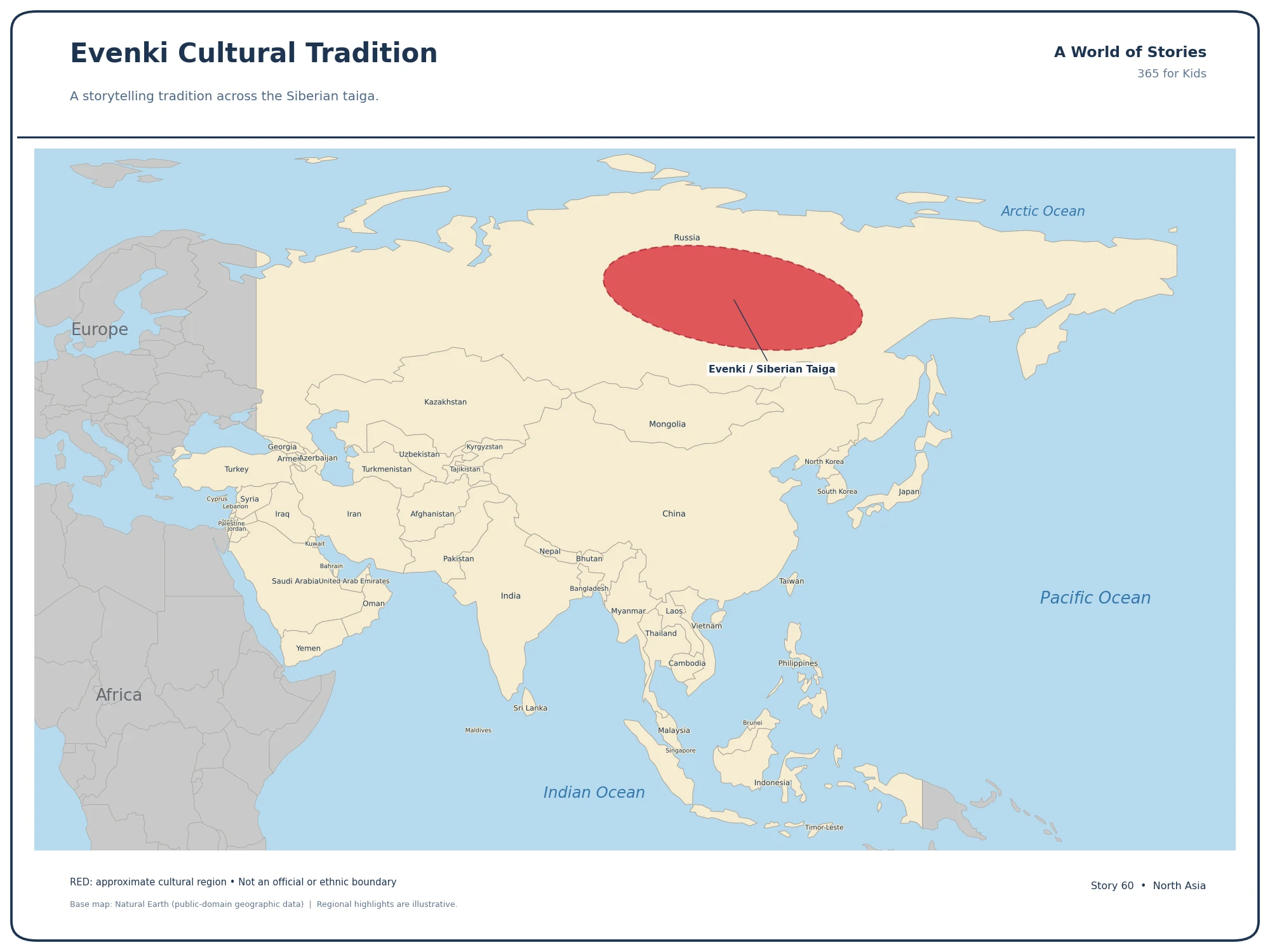
Long ago, in the world remembered by the Evenki storytellers, there was a Middle Land beneath the sun. It was a land of broad rivers, wooded mountains, tall grasses, and animals moving through the forest. Above it lay the Upper World; far below it was the Lower World. The three worlds belonged to the same great tale, but they were not all places of peace.
In the Middle Land lived a mighty young hero named Sodani and his sister, Ayakchan Ivekchan. They had no father or mother beside them and believed themselves alone in the world. The old tale tells of Sodani’s extraordinary strength and the splendid home in which the brother and sister lived. It also tells of the special place reserved for them in the future of their people. Sodani was destined to defend life in the Middle Land; Ayakchan Ivekchan was precious to the generations yet to come.
Yet trouble rose from below. A fearsome warrior of the Lower World, Seleme Devinder, sought Ayakchan Ivekchan for himself. Sodani stood against the danger. He would not simply surrender his sister to a threatening stranger from the world beneath the earth.
The two warriors met in battle. Sodani fought with the courage for which he was known, but the contest ended in sorrow. Seleme Devinder overcame him, and the brave hero died. The strength of Sodani, celebrated at the beginning of the tale, had not been enough to protect him from every enemy.
For a moment, the future of the Middle Land seemed uncertain. But the story of Sodani did not end with his death. Another hero, Irkinichen, entered the tale. He was Sodani’s brother, although the family had not known of one another. Irkinichen traveled on a wild reindeer with newly bared antlers. In the long heroic songs, his name and the image of his reindeer told listeners who he was whenever he appeared.
Irkinichen learned of the danger that had struck his family. He confronted Seleme Devinder, the warrior who had defeated Sodani, and overcame him. But there was still someone to save. Ayakchan Ivekchan had been carried away by another enemy from the Lower World, the fearsome Seleme Dygiyandya.
Irkinichen set out to bring his sister home. His journey took him away from the familiar forests of the Middle Land and toward the hidden world below. The path was hard and made of iron. Strange obstacles guarded the way, and even a hero who could defeat powerful opponents had to find a way through them.
To enter that frightening country, Irkinichen changed his form. Instead of walking openly as a warrior, he became a smooth, round stone called Bulteriken. As a stone he rolled downward into the Lower World, passing where a human traveler might have been stopped.
The Lower World was a place unlike his sunlit home. A heavy mist hung over it. He came upon an iron dwelling inhabited by dangerous beings. The sounds within were so strange that they scarcely seemed like ordinary speech. Yet Irkinichen did not forget why he had come. Somewhere in that world, Ayakchan Ivekchan was being held against her will.
Farther on, the search brought him to a struggle between warriors. One was Kherkinindya, a hero linked to the Upper World; the other was the enemy Irkinichen had followed. Irkinichen made clear that he had come to find his stolen sister, not to seize a kingdom or win a reward. The heroes joined their strength against the dangerous warrior of the Lower World.
The enemy was defeated, and at last Irkinichen reached Ayakchan Ivekchan. Her captivity was over. The long passage downward had led him to his sister; now the task was to return with her to the land of daylight.
Irkinichen carried her safely through the passage from the Lower World. When he emerged again, the wide land lay beneath the sun: the open valleys, the forest, and the living grasses of home. He took back his own shape and brought Ayakchan Ivekchan out into the sunlight. She was overwhelmed with joy at seeing the Middle Land once more. In the old epic, her return is described almost as a second birth.
When they arrived home, the family’s story was still unfolding. During Irkinichen’s long absence, his daughter, Tulivchan, had been born and had grown up. Her mother was Solkondor. Tulivchan possessed a rare gift: she could foresee what lay ahead and had the power to restore life. She became a shaman, a person whose special knowledge connected the worlds of the story.
Irkinichen, Ayakchan Ivekchan, Solkondor, and Tulivchan were brought together. Their homecoming was celebrated, and the sorrow that had filled the beginning of the tale gave way to the hope of a new generation.
At the end of the epic, Tulivchan offered a blessing for the Evenki people: that they might continue to live and flourish in the Middle Land. Sodani’s courage, Irkinichen’s long journey, Ayakchan Ivekchan’s return, and Tulivchan’s wisdom all became part of one remembered story — a story not only of battles, but of family, homeland, and the protection of life.
The Evenki are an Indigenous people whose communities and cultural traditions extend across northern Asia, particularly parts of Siberia and the Russian Far East, with related communities beyond Russia. An Evenki heroic epic is called a nimngakan. These long oral narratives were traditionally performed by skilled storytellers; heroes often travel between the Middle, Upper, and Lower Worlds. The version retold here was preserved by the Evenki storyteller Nikolai G. Trofimov (1915–1971), of the Buta clan, and published with Evenki text and Russian translation in 1990. The words “Middle World” and “Lower World” describe realms within the traditional narrative, not geographical divisions of modern Russia. This newly written English literary retelling condenses a lengthy oral epic for young readers. It preserves the central sequence documented by the editors: Sodani’s death, Irkinichen’s victory over the first foe, the journey to the Lower World, the rescue of Ayakchan Ivekchan, and Tulivchan’s blessing. The original storyteller’s poetry and repeated formulas are not reproduced; no independent adventures have been added.
After the Story: Read · Create · Reflect · Share
1. Find Russia and Siberia on a map of Asia. Locate the broad region where Evenki communities live, and draw the Russian flag.
2. Why did Irkinichen enter the Lower World? What form did he take to pass through its dangerous entrance?
3. Which characters helped protect the family and its future? Think about the courage of the warriors and the wisdom of Tulivchan.
4. Why might the storyteller have described Ayakchan Ivekchan’s return to the sunlight as being born a second time?
Inspired by this story? Create your illustration!
NENETS — The Girl with the Gilded Knife — A Legend of the Sikhirtya
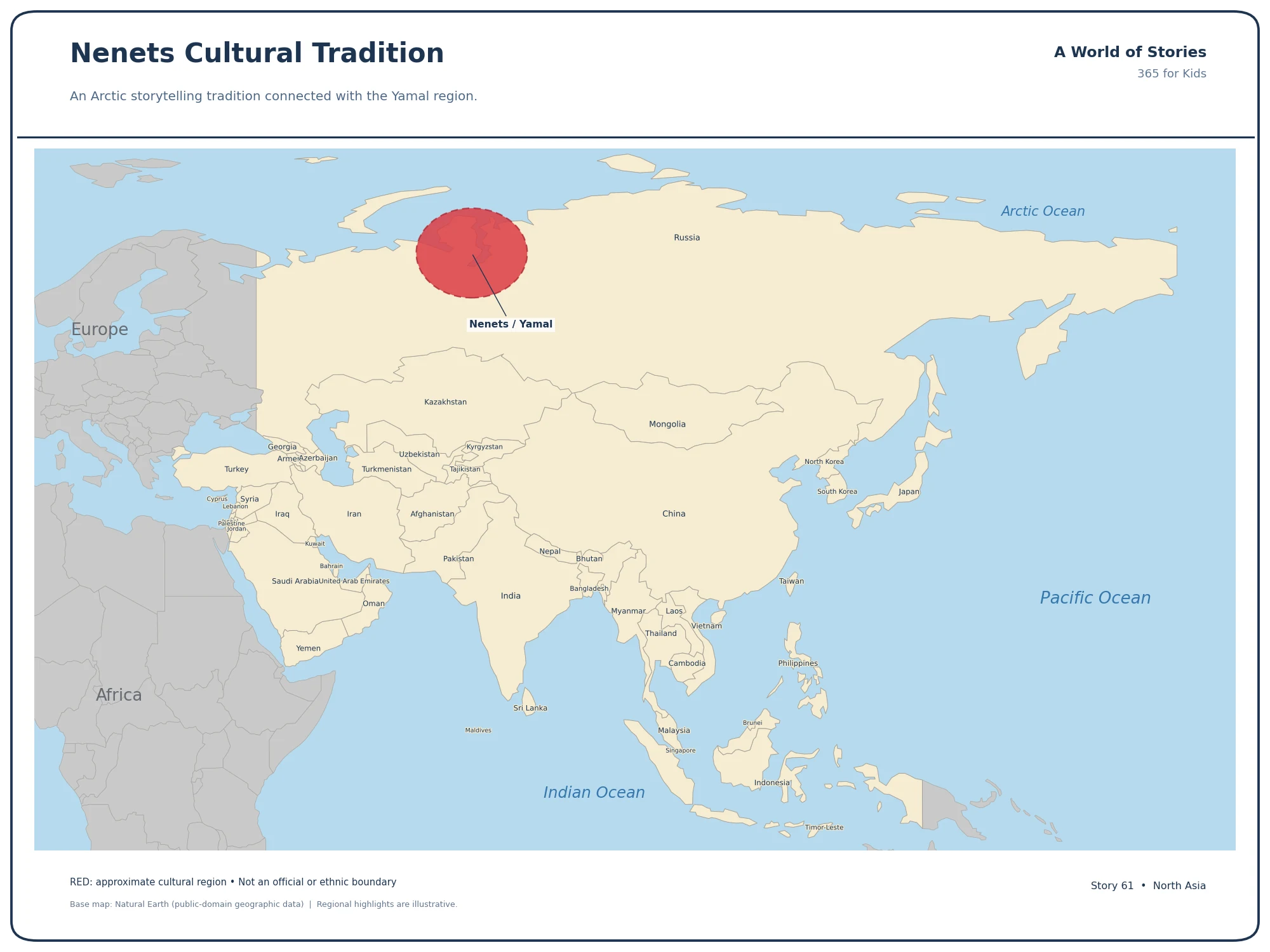
On the wide tundra of the Yamal Peninsula, near a great lake, a young Nenets man lived with his mother. They kept reindeer, animals well suited to the northern land. Much of the young man’s time was spent with the herd, among the low hills that rose from the open country.
One day, while watching the reindeer near a hill, he noticed someone he had not seen before. A girl was sitting quietly and sewing. Beside her was a striking knife, beautifully made, with a gleam of gold upon it. It was the kind of knife used for cutting animal hides, but this one was unlike any he knew.
The young man was fascinated by the knife. Wanting to see it more closely, he began to move toward the girl without announcing himself. Yet before he could reach her, she disappeared. One moment she had been there, sitting and working; the next, there was no one to be seen.
He could not understand what had happened. The hill was still there. The tundra stretched away as before. But the girl and her shining knife were gone.
Later he saw the same mysterious girl again. She was once more at her work, with the wonderful knife nearby. Once more he tried to approach her. And once more, before he could come close enough, she vanished.
Time passed. On another day, the young man was making his way back to the camp where he and his mother lived. He was tired, so he stopped to rest near a hill and fell asleep.
Something awakened him. When he opened his eyes, a young stranger stood beside him. The stranger had a sled, but the animals harnessed to it were not reindeer. They were mammoths — huge creatures of a kind the Nenets knew in their traditional stories as the earth’s reindeer.
The stranger beckoned him to follow. Together they went toward the hill and entered an opening in it. Inside, the young Nenets found people gathered: an old man, an old woman, and the girl he had seen sewing on the tundra. Here she was again, no longer alone on the hillside but among her own people.
The old man ordered that the guest be given food. A young man brought out an enormous fish and began to cut it into portions. He worked with a fine, gleaming knife. The visitor watched it closely. Its beauty had captured his attention just as the girl’s knife had done before.
The guest ate among the people of the hill. After the meal he fell asleep again. When he awakened, he was no longer inside their hidden dwelling. He was back at his own camp, in the familiar world of his mother and their reindeer.
Had he truly entered the hill? He remembered the girl who could disappear, the stranger with mammoths, the old couple, the great fish, and the bright knife. All of it had seemed real, but the hidden dwelling was now far away from him.
The next day he returned to the place where he had first seen the girl sitting and sewing. There, on the ground, lay a beautiful knife. He picked it up and took it with him. The elders saw the knife too.
The Nenets tell of the Sikhirtya, mysterious people who live within the hills and beneath the tundra. Some stories say they come out when the light is dim and can vanish in an instant. In the world of this legend they travel with mammoths, while the Nenets travel with reindeer.
The old account does not explain who left the knife on the ground, or why. It leaves that question with the listener: a shining object from a hidden world, found where a girl had once appeared and disappeared.
The Nenets are an Indigenous people of the Russian Arctic whose communities live across both the European North and Siberia. This particular legend is associated with the Yamal Peninsula in North Asia. In Nenets oral tradition, the Sikhirtya (also written Sihirtya or Sirtya) are mysterious beings believed to dwell in hills or below the ground. They are not a modern nation or a geographical region. Stories often describe their sudden appearances, their finely made metal objects, and their extraordinary mammoth-drawn sleds. The Nenets word chum refers to a traditional portable dwelling; the reindeer are important to many Nenets communities. This narrative describes a legendary encounter, not a verified historical event. “The Girl with the Gilded Knife” is a descriptive English editorial title, not a claim about a fixed traditional title. This newly written adaptation preserves the recorded plot: the girl and her knife; her two disappearances; the stranger with mammoths; the meal in the hill; awakening at camp; and finding the knife. No additional adventure or explanation of the knife has been invented.
After the Story: Read · Create · Reflect · Share
1. Find Russia and the Yamal Peninsula in northern Siberia on a map. Which ocean is to the north? Draw the Russian flag.
2. What was the girl doing when the young man first saw her? What happened each time he tried to approach?
3. What unusual animals pulled the stranger’s sled? How were they different from the animals the young man kept?
4. Who do you think left the knife on the ground? What does the legend tell us, and what does it leave unexplained?
Inspired by this story? Create your illustration!
TUVA — Ak-Sagysh and Kara-Sagysh — The Two Brothers
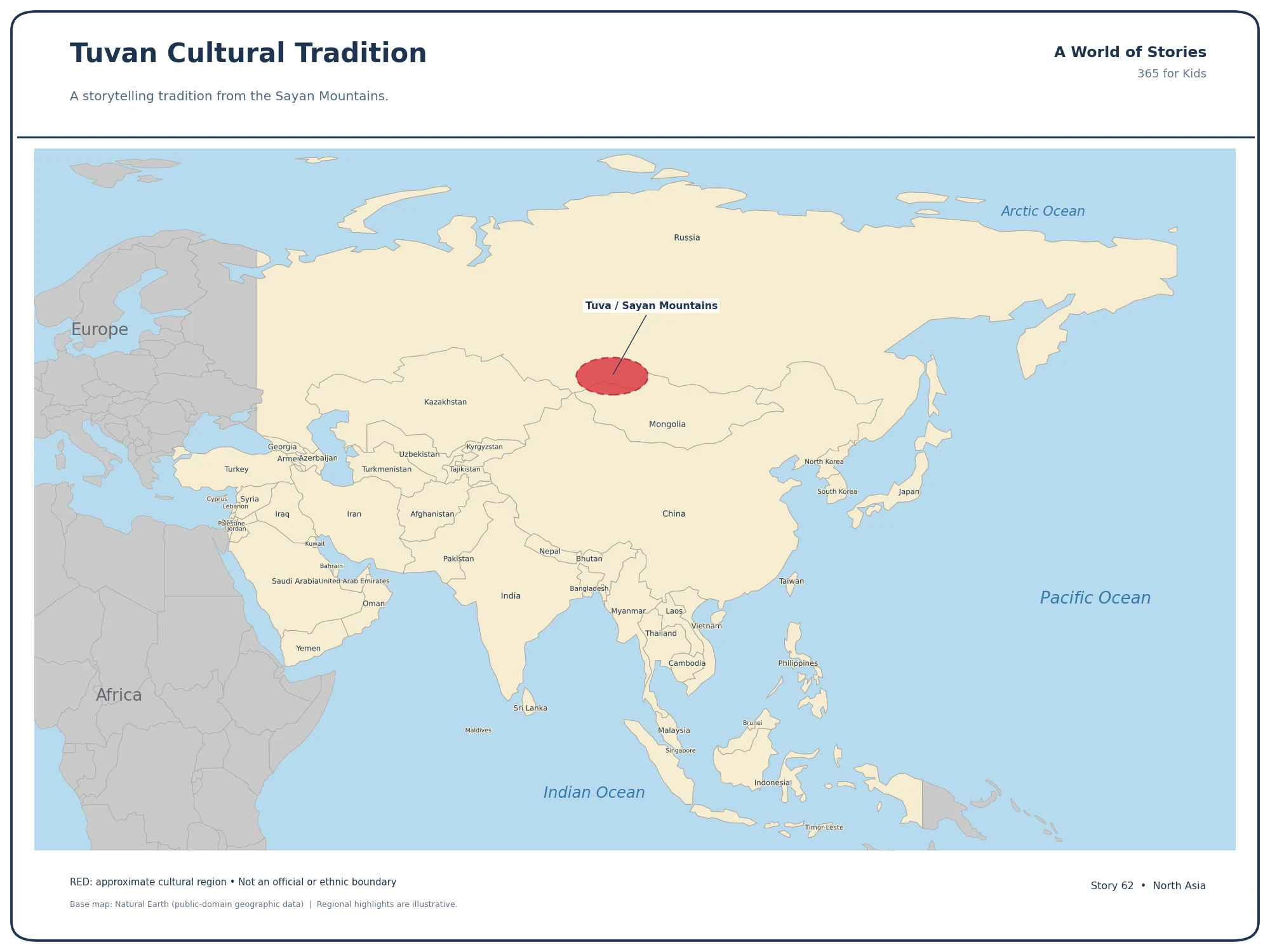
Long ago, two brothers named Ak-Sagysh and Kara-Sagysh traveled from one aal to another across the country of the Tuvans. They had little to call their own. Ak-Sagysh rode a white horse, and Kara-Sagysh rode a black one. When they reached a settlement, kind people shared food with them, and then the brothers went on their way.
One day a heavy fog spread over the steppe. The brothers lost their way. They wandered until they were desperately hungry, but the mist did not lift, and there was no settlement in sight.
Kara-Sagysh turned to his brother. ‘We have two horses,’ he said. ‘Let us use yours for food. Afterward we can both travel on mine.’ Ak-Sagysh trusted him. They killed the white horse and ate. Then they let the black horse graze nearby, laid their saddles beneath their heads, and went to sleep.
But Kara-Sagysh did not keep his promise. He waited until Ak-Sagysh was sleeping, mounted his own horse, and rode away. In the morning Ak-Sagysh woke to find himself alone. At first he thought his brother had gone to search for the horse. He waited, then went looking for them. When neither appeared, he understood that he had been abandoned.
With no horse left, Ak-Sagysh continued on foot. He traveled toward the upper reaches of the Kara-Sug River. There, in a lonely place, he found an unusual tent built with bark and the heads of horses. No one seemed to be inside. He entered and hid beneath an orun, a low platform made of boards, to see who might return.
As evening came, four animals entered the tent: a bear, a wild boar, a fox, and a wolf. They settled down and began speaking about what each had eaten that day. From beneath the platform, Ak-Sagysh listened without making a sound.
The bear had enjoyed the nuts of a cedar tree. The fox had caught ground squirrels. The boar had dug up so many sarana bulbs that he could eat no more. He had used a silver rod to loosen them from the earth.
‘Take care of that rod,’ the bear warned. ‘Someone might steal it.’ The boar was certain it was safe: he had hidden it beneath a log beside the tent.
Then the wolf spoke. He had found food near the lands of Karaty Khan. The people and their animals there were suffering terribly. Their spring had stopped flowing, and the herds were dying of thirst.
‘Where did the water go?’ the fox wanted to know.
The boar knew the answer. A great black boulder, as large as a cow, had rolled across the spring. His silver rod, he said, could move the stone from its place. At once the bear cautioned him not to tell such secrets, even with the door shut.
At last the animals fell asleep. Ak-Sagysh quietly slipped out from beneath the boards and left the tent. He found the silver rod where the boar had hidden it, under the log outside. Taking it with him, he set out for the settlement of Karaty Khan.
When he reached the khan’s yurt, the attendants gave the traveler a little whey and tried to send him away. Ak-Sagysh asked them to let him help. He had come, he said, because he knew how to bring back the water.
Karaty Khan heard him and offered a bargain. If Ak-Sagysh freed the spring and saved the herds, he would be rewarded with livestock, possessions, and the khan’s daughter in marriage. But if he failed, the khan warned, he would pay with his life. Ak-Sagysh accepted the dangerous task.
He went to the blocked spring and placed the silver rod beneath the enormous black stone. With its help, he rolled the boulder away. Water began to pour from the opening. The spring ran freely again, spreading across the dry ground, and the thirsty animals hurried to drink.
Karaty Khan kept his promise. Ak-Sagysh married the khan’s daughter and received livestock and other gifts. The brother who had been left alone on the steppe now had a home and enough to share with others.
A long time afterward Kara-Sagysh came to Ak-Sagysh’s settlement, hungry and tired from wandering. When he recognized the brother he had deserted, he was startled and afraid. Yet Ak-Sagysh welcomed him and gave him food.
Kara-Sagysh could hardly believe what he saw. ‘How did you become so prosperous?’ he asked. Ak-Sagysh told him about the animals’ tent, the silver rod, and the spring that had been hidden beneath the stone.
Instead of being glad that his brother was alive, Kara-Sagysh grew envious. He wanted riches for himself. So he hurried to the place by the Kara-Sug River, found the animals’ tent, and hid beneath the same wooden platform.
That evening the bear, boar, fox, and wolf returned. Their day had not gone well. The boar complained that his silver rod was missing and he had barely managed to dig up a single sarana bulb. The fox had caught only one little mouse. The wolf had found almost nothing to eat: water was flowing again at the khan’s settlement, and the animals there were healthy.
The bear had his own troubles. He had tried to reach a cone high in a cedar tree, but a sudden wind had thrown him down. He was hungry and sore. With a heavy groan, he dropped onto the wooden platform, making the boards shake.
Kara-Sagysh was frightened. He sprang from his hiding place. The hungry animals rushed toward him, ready to attack. Just then a gunshot rang out. Ak-Sagysh had come looking for his missing brother. The sound frightened the animals, and they scattered.
Kara-Sagysh remained trembling where he stood. Ak-Sagysh had saved him, though he had once been abandoned by him. The younger brother’s final words were a warning: ‘Do not be ruled by envy or greed.’
The Tuvans (Tyvalar) are a Turkic-speaking people of southern Siberia. Many live in the Republic of Tuva, which is part of Russia, while Tuvan communities also live in Mongolia and China. This is a story from the Tuvan oral tradition, not a tale representing every culture of Russia. An aal is a small settlement or group of households, often associated with yurts; an orun is a raised wooden sleeping or sitting platform. Sarana is a traditional name for certain wild plants with edible bulbs or roots. The names Ak-Sagysh and Kara-Sagysh are explained in a published Russian-language version as “white thought” and “black thought,” suggesting contrasting ways of thinking rather than the appearance of the brothers. Folk stories with similar characters and lessons may be told in different forms across the wider Altai–Sayan region. This is a newly written English retelling of the Tuvan version published in 1958 and reprinted in 1988, not a direct translation of those publications. It keeps the recorded story’s essential events and its ending, including Ak-Sagysh’s rescue of Kara-Sagysh. Other Tuvan and neighboring Altai tellings differ in details and outcomes; their episodes have not been combined here.
After the Story: Read · Create · Reflect · Share
1. Find Russia on a map of Asia, then locate the Republic of Tuva in southern Siberia near Mongolia. Draw the Russian flag. Is Tuva a separate country or a region within Russia?
2. What promise did Kara-Sagysh make about the horses? How did his actions break that promise?
3. What secret did Ak-Sagysh learn in the animals’ tent, and how did it help the people and animals of Karaty Khan’s settlement?
4. Why did the brothers’ visits to the animals’ tent end differently? What do you think Ak-Sagysh’s final warning means?
Inspired by this story? Create your illustration!
NANAI — Ayoga — The Girl Who Became a Goose

In a Nanai settlement near the Amur River lived a girl named Ayoga. She was beautiful, and people often told her so. Whenever she heard a compliment, she was pleased. Soon she began to think about her beauty more than anything else.
Ayoga liked to gaze into a polished copper basin. She admired the face that looked back at her. At the river, she leaned over the water to watch the same face tremble in the current. She could have watched her reflection all day.
Before long, there was little time left for ordinary work. Her mother was busy with the household, but Ayoga would not lift a hand to help.
One day her mother asked her to bring fresh water from the river.
Ayoga did not move. She was sure that carrying water would be much too difficult. What if she slipped on the bank and fell in?
Her mother suggested holding on to a bush beside the path. Ayoga thought the bush might come loose. Then choose a stronger one, said her mother. Ayoga worried that its branches would scratch her hands. Her mother suggested wearing mittens. Ayoga was certain that the mittens might tear. They could be mended, her mother replied. But what if the needle broke?
For every answer there was another objection. Ayoga was determined not to go. And while they spoke, her eyes kept turning toward her reflection in the copper basin.
A girl who lived nearby heard the conversation. She offered to fetch the water herself. She went to the river, filled the vessels, and carried them back to Ayoga’s mother. The water was ready, and the work was done.
With the water brought in, the mother prepared dough and baked round, flat cakes over the hot hearth. Their warm smell filled the home. Ayoga forgot about her reflection for a moment. She wanted a cake.
But when she asked her mother for one, her mother reminded her of all the reasons she had given for avoiding work. Wasn’t the cake too hot for hands as delicate as hers? Ayoga said she could use her mittens. But the mittens might need drying, her mother observed. Then perhaps they would become stiff and need softening. Wouldn’t all that effort tire Ayoga’s hands?
The words sounded very familiar to Ayoga. Her mother was using the same excuses that Ayoga had offered when she was asked to help.
Instead, the mother gave a cake to the neighbor girl who had brought the water. The girl accepted it with thanks.
Ayoga felt anger rise inside her. She had been praised for being beautiful; surely the best cake should have been hers! She left the house and went to the river. There, as before, she looked down at her own face in the water.
Not far away, the neighbor girl was eating her cake. Ayoga kept turning her head to watch her. Her neck stretched farther and farther as she stared.
The neighbor noticed. She did not wish to quarrel. She offered Ayoga a piece of the cake.
But Ayoga was too proud to accept something that another girl had already tasted. In her fury she flung out both arms, as though she could sweep the offer away. Her fingers spread; her arms changed into wings. Her neck grew long, and her body took on the shape of a bird.
Ayoga lost her footing on the bank and splashed into the water. Where a girl had stood, a goose now floated.
Still she was pleased with her appearance. She swam about, calling proudly, as if she wanted everyone to notice how lovely she was.
In time the goose forgot the words of the Nanai language. She could no longer speak with her family or neighbors. Yet one word remained in her memory: her own name. Whenever she saw people nearby, she called it out in a goose’s voice:
“Ayo-ga-ga! Ayo-ga-ga!”
And that, the old tale says, is how Ayoga’s name became part of a goose’s cry.
The Nanai are an Indigenous people of the Amur River basin in the Russian Far East. Nanai communities live along the Amur and nearby rivers, and related Hezhen communities live across the border in China. The Amur River has long connected people, fishing grounds, settlements, and oral traditions. “Ayoga” is widely presented as a Nanai folktale and became especially familiar through the 20th-century literary retelling by Dmitriy Nagishkin. It is one story associated with Nanai storytelling, not a description of the whole Nanai culture. In the tale, the goose’s repeated “ga-ga” sound is joined playfully to Ayoga’s name. This is an original English literary adaptation of the well-documented Ayoga plot. It is not a translation of Nagishkin’s published prose. The retelling retains the central events: Ayoga’s delight in her reflection, her excuses for refusing to fetch water, the neighbor’s kindness, the mother’s lesson involving a cake, the transformation by the river, and the goose’s cry. The known printed text is a 20th-century literary treatment of a traditional tale; it should not be presented as a verbatim transcript of a historic oral performance.
After the Story: Read · Create · Reflect · Share
1. Find the Amur River in the Russian Far East. Which two modern countries does it border along part of its course? Locate Russia on a map of Asia and draw its flag.
2. What excuses did Ayoga give when her mother asked for water? What did she seem most worried about?
3. How did the neighboring girl behave toward Ayoga and her mother? What was different about the two girls’ choices?
4. Why does Ayoga remember only her own name after becoming a goose? What is the story suggesting about beauty, kindness, and pride?
Inspired by this story? Create your illustration!
ALTAI — Ochi-Bala — The Warrior Woman of Altai
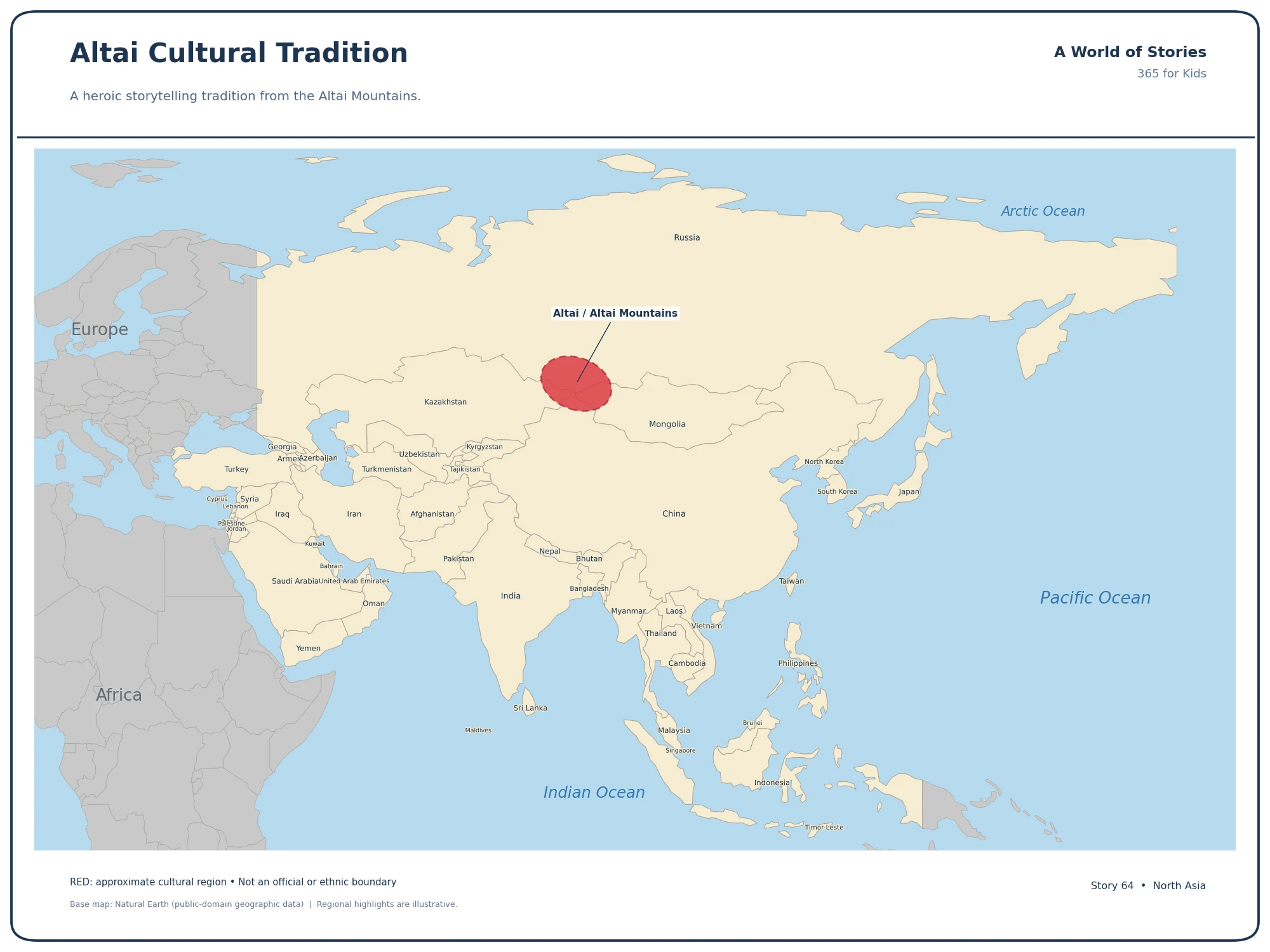
Among the mountains of Altai, a story has long been told of a warrior called Ochi-Bala. In the world of the epic, mountains, rivers, animals, and mighty heroes belong to a landscape where ordinary life and wonder meet. Ochi-Bala is remembered not for seeking a throne or a treasure, but for defending the land and the people who lived there.
Ochi-Bala was a skilled hunter. She went into the mountains with her bow and arrows and knew the paths of wild creatures. The old song describes her letting young animals go before their coats had fully grown. She was strong enough to fight, yet she did not need to prove her strength against everything she encountered.
Her closest companion was her remarkable horse, Ochi-Jeren. He was no ordinary horse. In the epic, his mane and tail flash with the brilliance of lightning, and he can understand dangers hidden from human sight. He knows the roads that cross the mountains and the powers that wait beyond them. Above all, he cares for the warrior who rides him.
One day, at the beginning of a new moon, Ochi-Bala rode out to hunt as she often did. But Ochi-Jeren sensed something more urgent than the movements of birds or mountain animals. A terrible danger was gathering against their homeland.
Far away, an enemy ruler named Kan-Taady-Biy wanted to seize Altai. He desired its pastures and herds, its people, and the freedom that Ochi-Bala guarded. His son, Ak-Dzhala, led warriors toward her land. The enemy threatened to make Ochi-Bala a servant and reduce her magnificent horse to a helpless colt.
When Ochi-Bala learned of their plans, she did not hide among the mountains. She rode out to meet the advancing force. The valley that had been a place for grazing animals and traveling hunters became a battlefield. Ochi-Bala fought Ak-Dzhala and the warriors who had come to conquer her homeland.
Her strength was greater than the invaders expected. Ak-Dzhala fell, and the enemy was driven back. The people of Altai were safe for the moment.
Yet the danger was not over. Kan-Taady-Biy possessed extraordinary powers. He brought his fallen son back to life, and an army threatened Altai again. Ochi-Bala had to defend her home a second time. Again she met the attackers. Again she held them back.
Two victories might have seemed enough. But Ochi-Jeren knew that the enemy ruler had not abandoned his plans. As long as Kan-Taady-Biy kept his mysterious power, another force could come down upon Altai. Ochi-Bala understood that waiting for each new attack would never bring peace.
This time she chose a different road. Instead of fighting only at the borders of her own land, she would go toward the enemy’s stronghold and learn what made him so difficult to defeat. Ochi-Jeren carried her away from the familiar hunting grounds into a country of strange trials.
On the journey, they faced beings belonging to the mythic world of the epic. One of the most fearsome was Kok-Buka, the Blue Bull, connected with Erlik, the ruler of the lower world. This was no animal like those Ochi-Bala had known on her hunts. The bull stood between her and the enemy she was determined to confront.
Strength alone could not answer every danger. Ochi-Jeren guided her, and Ochi-Bala used a power of transformation. In one telling, she took the form of a great eagle and overcame the Blue Bull. The same story that praises a warrior’s courage also shows the importance of listening to a wise companion.
Beyond this trial lay the country ruled by Kan-Taady-Biy. Ochi-Bala now faced an enemy whom she could not defeat simply by riding into battle. He had already restored Ak-Dzhala to life. Whatever sustained his power had to be uncovered first.
So the warrior changed her appearance. Instead of approaching as the famous defender of Altai, she entered the ruler’s household disguised as a servant. The mighty warrior was not recognized. She could stand near the ruler, observe him, and discover what open battle had not revealed.
In the old account, Ochi-Bala served drink, singing and moving among the people around the ruler. She used cleverness rather than a drawn weapon. Kan-Taady-Biy grew careless, and at last the secret of his power came within reach.
It was not kept in an army or a great fortress. The secret lay in a blue stone with nine sides, hidden inside a golden chest. So long as he possessed that object, Kan-Taady-Biy was protected by the mysterious strength that had made him so dangerous.
Ochi-Bala obtained the stone. Now she could face the ruler without the enchantment that had sheltered him. Kan-Taady-Biy was defeated, and the threat to Altai was broken.
The victory did not make Ochi-Bala cruel. The ruler’s people had lived under his command, but they were not the enemy she had set out to destroy. His animals, too, had done her no wrong. She would not have innocent people harmed, their herds taken away, or their land burned merely because their ruler had been defeated.
That choice completed her triumph. Ochi-Bala had gone out to protect her people, not to make strangers suffer in return. She had fought the invaders, outwitted a dangerous ruler, and spared those who did not deserve punishment.
The epic ends with an image larger than any earthly battle. In the telling preserved by Altai singers, Ochi-Bala is associated with the moon, and her faithful Ochi-Jeren with a star shining in the sky. Their journey has become part of the heavens themselves.
And when the moon appears above the mountains, the story remembers the warrior who guarded Altai — and the extraordinary horse who never left her side.
The Altai people are an Indigenous Turkic-speaking people of the Altai Mountains in southern Siberia, within present-day Russia. Their culture has a rich tradition of heroic epics. An epic singer, known as a kaichi, performs these long narratives in a special style of vocal singing called kai, traditionally accompanied by the two-stringed topshuur. Ochi-Bala is a heroic woman, or warrior-maiden, in one such epic. Her horse Ochi-Jeren is a companion with wisdom and powers of his own. The story was recorded in different performances by the celebrated singer Aleksei Kalkin and published in a scholarly bilingual edition in 1997. The epic is much longer than this prose version. Some performances and published summaries differ in details, including which star is associated with the horse in the ending. The Altai cultural region extends across mountains near several modern countries; this particular epic is part of the Altai people’s living cultural heritage. This is an original English prose adaptation of a traditional, much longer performed Altai heroic epic, not a verbatim translation of any modern printed edition. It preserves the documented main sequence: Ochi-Bala’s hunting and her horse’s warning; two defenses against the invading khan and his revived son; the journey to the khan’s territory; the Blue Bull and the heroine’s transformation; her disguise as a servant; the secret of the nine-sided blue stone in a golden chest; the defeat of the enemy; mercy toward his innocent subjects; and the moon-and-star ending. Details of performance vary among recorded versions, so the narrative avoids identifying a particular star as the only authentic interpretation.
After the Story: Read · Create · Reflect · Share
1. Find the Altai Mountains in southern Siberia on a map of Asia. Which modern countries meet near this mountain region? Find Russia and draw its flag.
2. Why did Ochi-Bala decide to travel into the enemy ruler’s territory after she had already defended her homeland twice?
3. How did Ochi-Jeren help Ochi-Bala? What changed when she relied on cleverness instead of strength alone?
4. After defeating Kan-Taady-Biy, why did Ochi-Bala protect his people and herds? What does that choice tell us about her idea of justice?
Inspired by this story? Create your illustration!
Key Dates
April 30, 2027
Submission deadline (or earlier, once 500 eligible artworks are received)
June 1–30, 2027
Virtual exhibition
Jun 1, 2027
Online gallery and digital catalog
Questions Parents Ask
Who can participate?
Children and teens ages 6–17 who live in the United States. A parent or legal guardian submits the artwork.
Does it cost anything?
No. Participation is completely free, and no purchase is ever necessary.
Can my child submit more than one artwork?
One artwork per child for each exhibition. Your child is welcome to take part in all six continents.
What kind of artwork is accepted?
Original artwork made by hand with traditional materials — pencils, crayons, markers, paints, collage and more. Artwork that is AI-generated, traced or copied, or made mostly by an adult cannot be accepted.
Is this a contest?
No. There are no rankings and no winners. The first 500 eligible submissions for each continent are accepted, in the order they are received.
What information is shown publicly?
Only your child’s first name or a nickname, an optional last initial, age group, city (optional), and state — never addresses, phone numbers, or emails.
Who owns the artwork?
Your child keeps the copyright. You give 365 for Kids permission to display and publish the image only in the ways you choose in the form.