
A World of Stories · Volume VI
Folk Tales and Legends from OCEANIA
Travel across Oceania through its folk tales and legends. Read a story from a country that interests you, imagine its characters and places, and bring it to life in your own illustration.
Free
No purchase necessary
Ages 6–17
Children living in the U.S.
Oct 31, 2027
Submission deadline
How to Participate
1
Explore the folk tales and legends from Oceania below.
2
Choose your favorite story and read it.
3
Create your own illustration of it — by hand, with any art materials.
4
Ask a parent or guardian to submit a photo of your artwork.
Participation is free. One artwork per child. Participation rules
What Happens to Your Child’s Artwork
- It is shown in an online gallery on our website — and stays there.
- It joins a national virtual exhibition, December 1–31, 2027.
- It appears in a digital exhibition catalog you can download — and, with your permission, in a printed catalog.
- Every accepted participant receives a personalized Certificate of Participation.
- With your permission, it may be selected for an illustrated book of these stories.
Not a contest: the first 500 eligible submissions are accepted, in the order received.
Explore the Stories
42 folk tales and legends from across Oceania, grouped into eight regions. Tap a region or story to read it.
About This Collection
Across the Blue Pacific
Oceania stretches across an extraordinary part of our planet. It includes Australia, Aotearoa New Zealand, New Guinea, and thousands of islands scattered through the Pacific Ocean. Some islands rise high above the sea, with green mountains and forests. Others are small coral atolls surrounded by lagoons. Their landscapes may look very different, but the ocean has long connected their peoples through travel, navigation, trade, and storytelling. Oceania is not one country or one culture. It is home to many nations, communities, languages, and living traditions. Stories have been shared across generations in different ways—through spoken words, song, performance, and family and community teaching.
How We Explore Oceania
For this collection, we have arranged 42 stories into eight cultural and geographical groups: Aboriginal Australia; the Torres Strait Islands; Aotearoa / New Zealand; New Guinea; the Melanesian Islands; Micronesia; Western Polynesia; and Eastern Polynesia. We use these regions to help young readers explore the collection, not to suggest that everyone within a region shares the same beliefs or traditions. Cultural identities do not always follow modern national borders, and the regions are a guide for exploring, not rigid boundaries between cultures.
Stories, Sources, and Respect
Our stories are based on documented folktales, legends, and traditional narratives. They are adapted into accessible English for young readers while seeking to preserve the essential events, characters, and meaning of the versions used. We do not invent new adventures to make a traditional story more exciting, and we do not shorten it merely to fit a fixed length. The stories in this collection are invitations to discover living cultures, not complete accounts of them.
Read, Create, Reflect, Share
As you travel through Oceania with these stories, notice what makes each one distinctive. How does the ocean shape the adventure? What do animals, plants, mountains, and stars mean to the characters? Each story includes ideas for illustration and questions for reflection. Our hope is that these 42 stories open a door: to curiosity about other peoples, respect for cultural differences, and the joy of creating something of your own.
Aboriginal Australia
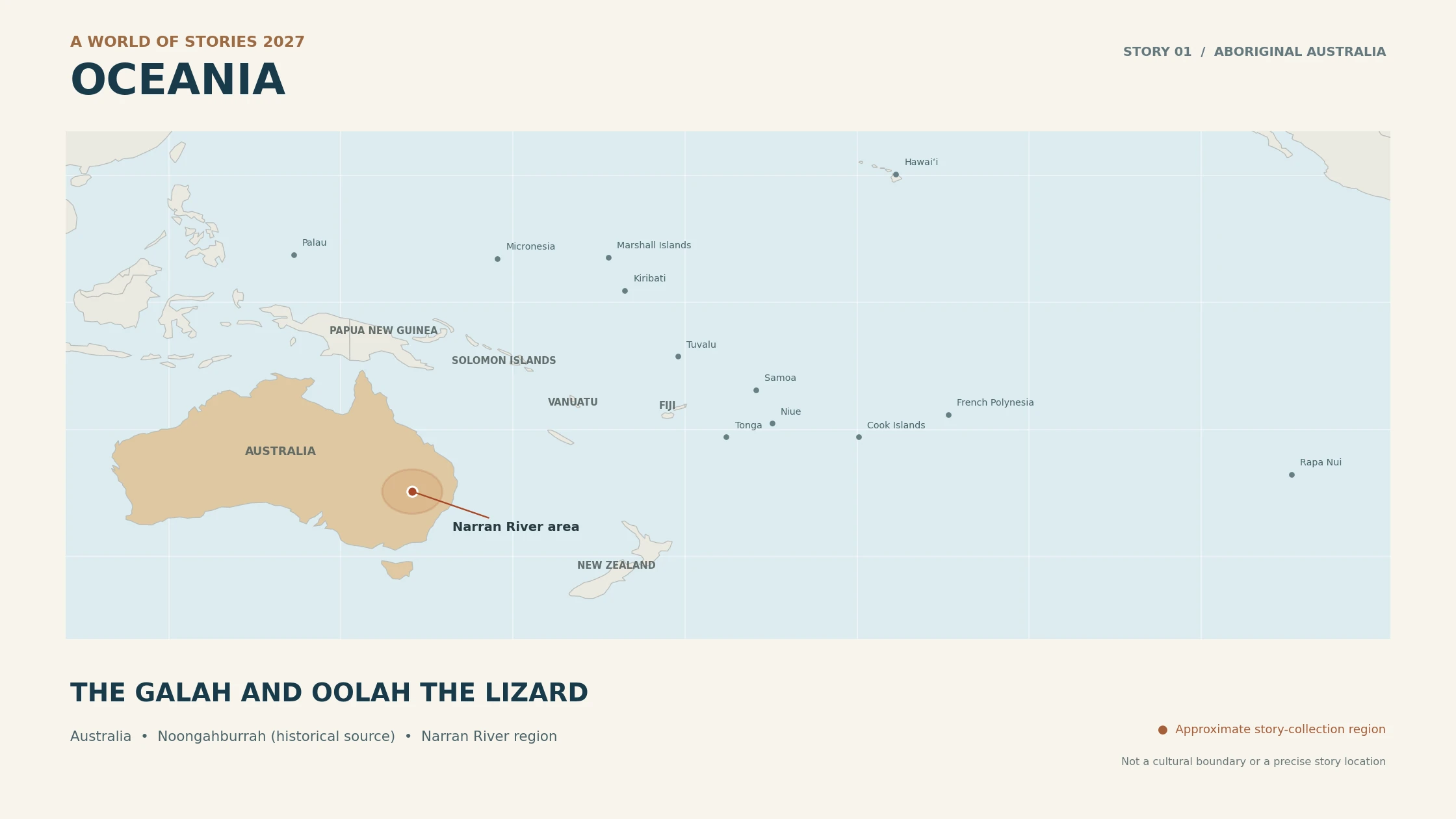
AUSTRALIA — The Galah and Oolah the Lizard
Oolah the lizard had grown tired of lying in the sun with nothing to do. "I will go and play," he said. He brought out his boomerangs and began practising his throws.
Before long, a galah came near and stood watching. Oolah was throwing bubberahs—small, strongly curved boomerangs that, when skilfully thrown, could fly back to the person who had thrown them.
Oolah was proud to have the galah watching his skill. Eager to show what he could do, he gave a bubberah an extra twist and threw it with all his strength. Whizz! It flew through the air, turned, and came rushing back. As it passed the galah, it struck the top of her head, tearing away feathers and skin.
The galah let out a terrible, harsh cry. She flew about, shrieking and croaking, and every few moments she struck her sore head against the ground. When Oolah saw the blood flowing from her head, he was frightened by what he had done. He slipped away and hid beneath a bindeah bush.
But the galah had seen him. Still crying out, she followed him to the bush. She seized Oolah in her beak and rolled him against its sharp prickles until they pierced his skin. Then she rubbed her bleeding head against him.
"Now, Oolah," she said, "you shall always carry these prickles on your body—and the stain of my blood."
Oolah hissed as the prickles stung him. "And you," he answered, "shall have a bald patch on your head for as long as I am a red, prickly lizard."
And so, the story says, beneath a galah’s crest there is a bare patch where Oolah’s bubberah struck her. In the galah’s country, too, live reddish-brown lizards with spines like the prickles of a bindeah bush.
Source: This is a newly worded English adaptation of "The Galah, and Oolah the Lizard," recorded in Katie Langloh Parker’s Australian Legendary Tales (1896). Parker identified the collected narratives as those of the Noongahburrah people around the Narran River. Its explanation of animal features belongs to the traditional story; it is not a scientific account. The historical publication reflects a colonial-era perspective and is not a substitute for contemporary community voices.
After the Story: Read · Create · Reflect · Share
Explore: Which detail tells you Oolah wanted to impress the galah?
Reflect: How might Oolah have responded when he saw that the bird was hurt?
Think & Share: Tell someone how the tale explains the features of two animals.
Create: Draw your favorite scene from this story and imagine what happens next.
Inspired by this story? Create your illustration!
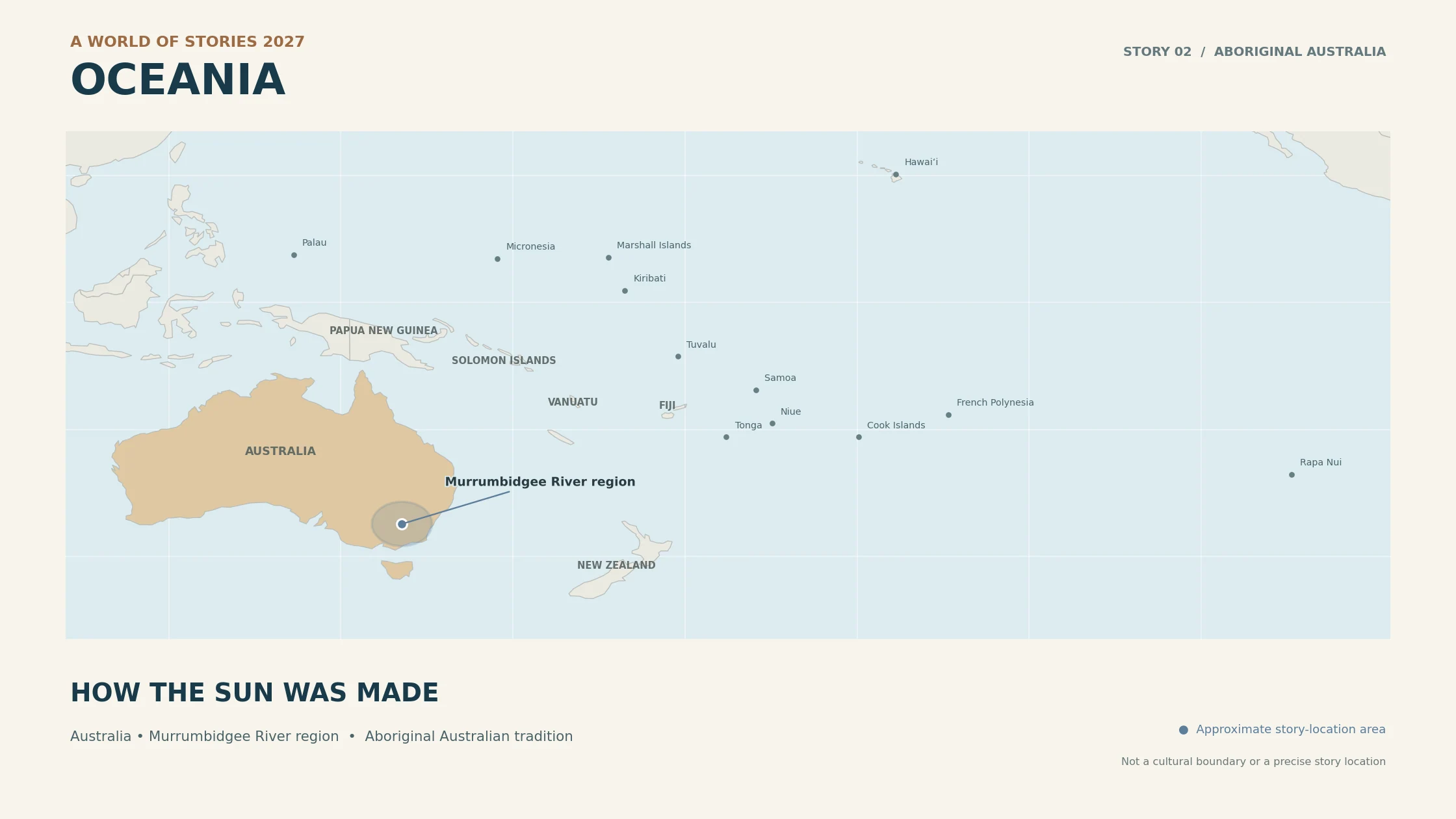
AUSTRALIA — How the Sun Was Made
Long ago, before there were people on the earth, there was no sun. The moon and the stars shone above the world, but the land below knew only their dim light. Birds and animals lived there, and in those distant days they were much larger than the creatures we know now.
One day, on a great plain near the Murrumbidgee River, Dinewan the emu and Bralgah the brolga were quarrelling. Their argument grew into a fierce fight. In her anger, Bralgah ran to Dinewan’s nest, seized one of the enormous eggs, and hurled it with all her strength into the sky.
Up flew the egg until it struck a heap of firewood in the heavens. It broke, and its golden yolk spilled across the wood. At once the whole heap burst into flame.
A brilliant light poured down upon the earth. The birds and animals stared in astonishment. Accustomed as they were to the faint light of the moon and stars, they could hardly bear the sudden brightness.
A good spirit who lived in the sky looked down and saw how beautiful the earth appeared in the light of the fire. He decided that there should be such a light every day. From then on, he and the other spirits gathered wood throughout the night and piled it high for the next morning.
When the woodpile was almost ready, they sent the morning star to warn the creatures below that the fire would soon be lit. But many were asleep and never saw the star. The spirits knew that the morning needed another kind of warning: a sound loud enough to wake the sleepers.
For a long time they could not decide which creature should announce the coming light. Then, one evening, they heard the ringing laughter of Gougourgahgah, the kookaburra, carrying through the air.
"That is the sound we need," said the spirits.
They told Gougourgahgah to laugh as loudly as he could each morning, when the morning star was fading and day was about to begin. His call would wake the sleeping creatures before the sun-fire rose.
Gougourgahgah agreed. From that time onward, his great laughter rang out at dawn. And so, the story tells us, the light of day was saved for the world.
At first, when the spirits kindle the morning fire, its warmth is gentle. As the pile of wood blazes higher, the heat grows stronger, until at midday it is fierce. Then the flames slowly sink. By evening, only glowing red coals remain. Most fade away, but the spirits hide a few beneath the clouds, keeping them safe to kindle the next day’s fire.
So each morning, as the morning star disappears, Gougourgahgah laughs again, and the great fire of the sky begins to shine.
Source: Adapted from "How the Sun Was Made," in K. Langloh Parker, More Australian Legendary Tales (1898), a historical collection of oral accounts. Parker’s collection draws from several Aboriginal communities, especially Euahlayi-speaking people. As an early colonial-era transcription, Parker’s version should not be treated as the definitive form of a living tradition.
After the Story: Read · Create · Reflect · Share
Explore: Why did the morning star alone fail to wake everyone?
Reflect: Why was Gougourgahgah’s voice so important in the story?
Think & Share: What details in the story help explain sunrise, midday heat, and sunset?
Create: Draw your favorite scene from this story and imagine what happens next.
Inspired by this story? Create your illustration!
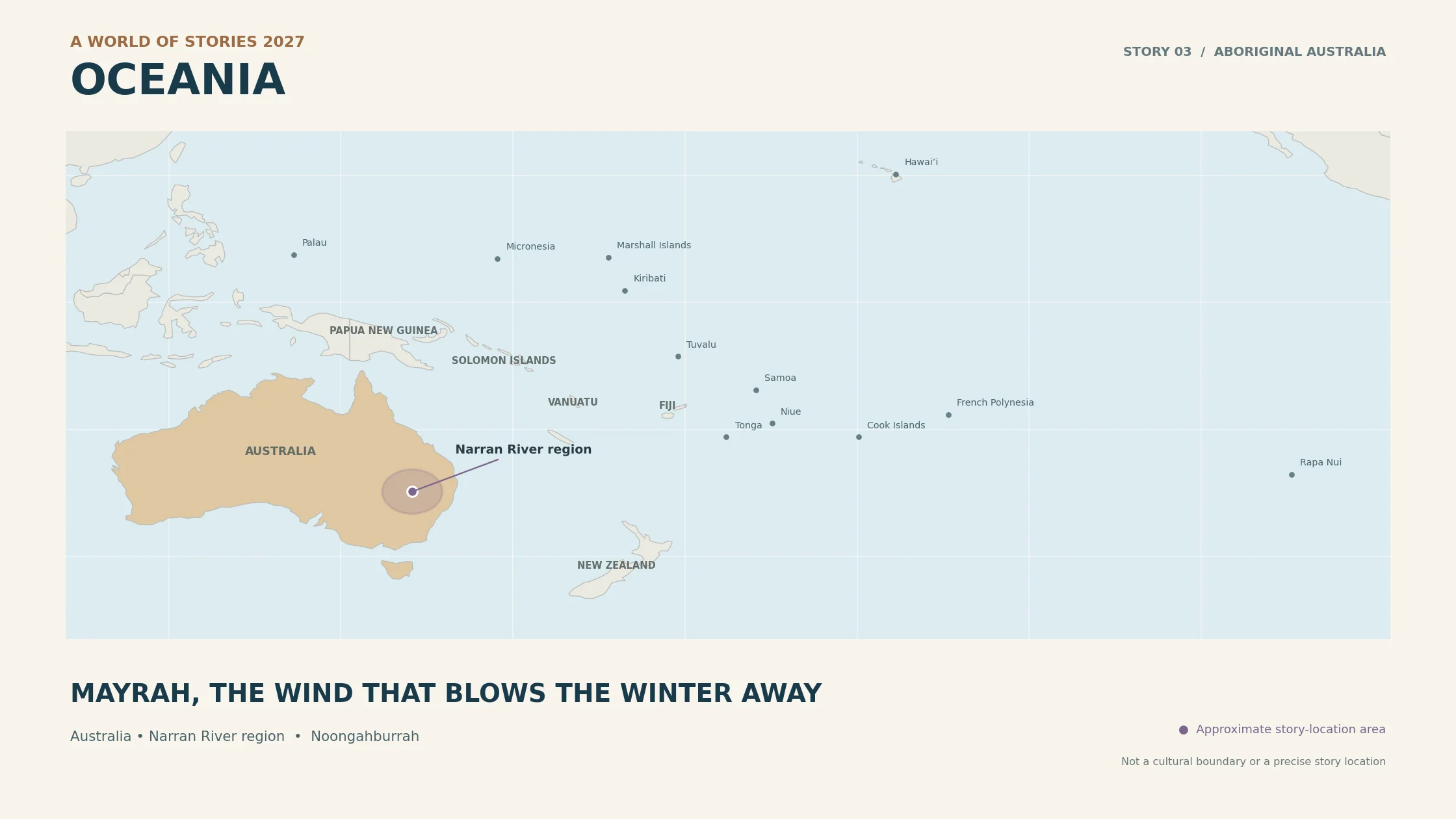
AUSTRALIA — Mayrah, the Wind That Blows the Winter Away
At the beginning of winter, the iguanas disappear into their homes beneath the sand. They dig deep passages and cover the entrances behind them. The black eagle-hawks settle into their nests, while the garbarlee, the shingleback lizards, creep into hollow logs scarcely larger than their own bodies. There they stay through the cold season, waiting for Mayrah, the wind that blows winter away.
Mayrah does not announce her coming quietly. First she sends a thunderstorm across the country.
When the iguanas hear the thunder rolling overhead, they know that spring cannot be far away. They begin to clear the passages leading out of their sandy shelters. Yet they do not emerge at once. They wait for another sign.
At last the curreequinquin, the butcherbirds, begin to sing, calling again and again throughout the day.
Now the iguanas know that Mayrah truly has driven winter away. The birds are preparing to find mates and build their nests. The lizards open their eyes and come out once more upon the green earth.
When the people hear the curreequinquin singing, they too recognize the change of season. They know they can again find the iguanas, now fatter than when they vanished at the start of winter.
It is also the time when the piggiebillahs—echidnas—hurry away from their young. The little ones have grown prickles that begin to hurt their mothers as they are carried. The mothers leave them in the sand to manage on their own, knowing they will meet them again when they are bigger.
Mayrah continues to blow, but now her wind is gentle. One by one the flowers open. Bees come out to gather honey. The birds wear their brightest feathers and sing their sweetest songs. Soon they are gathering in pairs and building nests.
The country grows full of food and life as Mayrah moves across it. But her time does not last forever. Yhi, the sun, chases the gentle wind back to the place from which she came. Under Yhi’s heat, the flowers droop, and the birds save their songs for the early morning.
Yhi rules until storms return to cool the land. Winter comes again—and when its season has passed, Mayrah will return once more, the much-loved wind that brings abundance.
Source: Adapted from "Mayrah, the Wind that Blows the Winter Away," collected by K. Langloh Parker in Australian Legendary Tales: Folk-Lore of the Noongahburrahs (1896). This adaptation retains the sequence and seasonal details of the published tale while using accessible contemporary English. The original publication is a colonial-era record; its terminology should not be treated as a complete or authoritative description of living communities.
After the Story: Read · Create · Reflect · Share
Explore: Which sounds tell the animals that the seasons are changing?
Reflect: How do the different creatures prepare for winter and spring?
Think & Share: What signs of a new season do you notice where you live?
Create: Draw your favorite scene from this story and imagine what happens next.
Inspired by this story? Create your illustration!
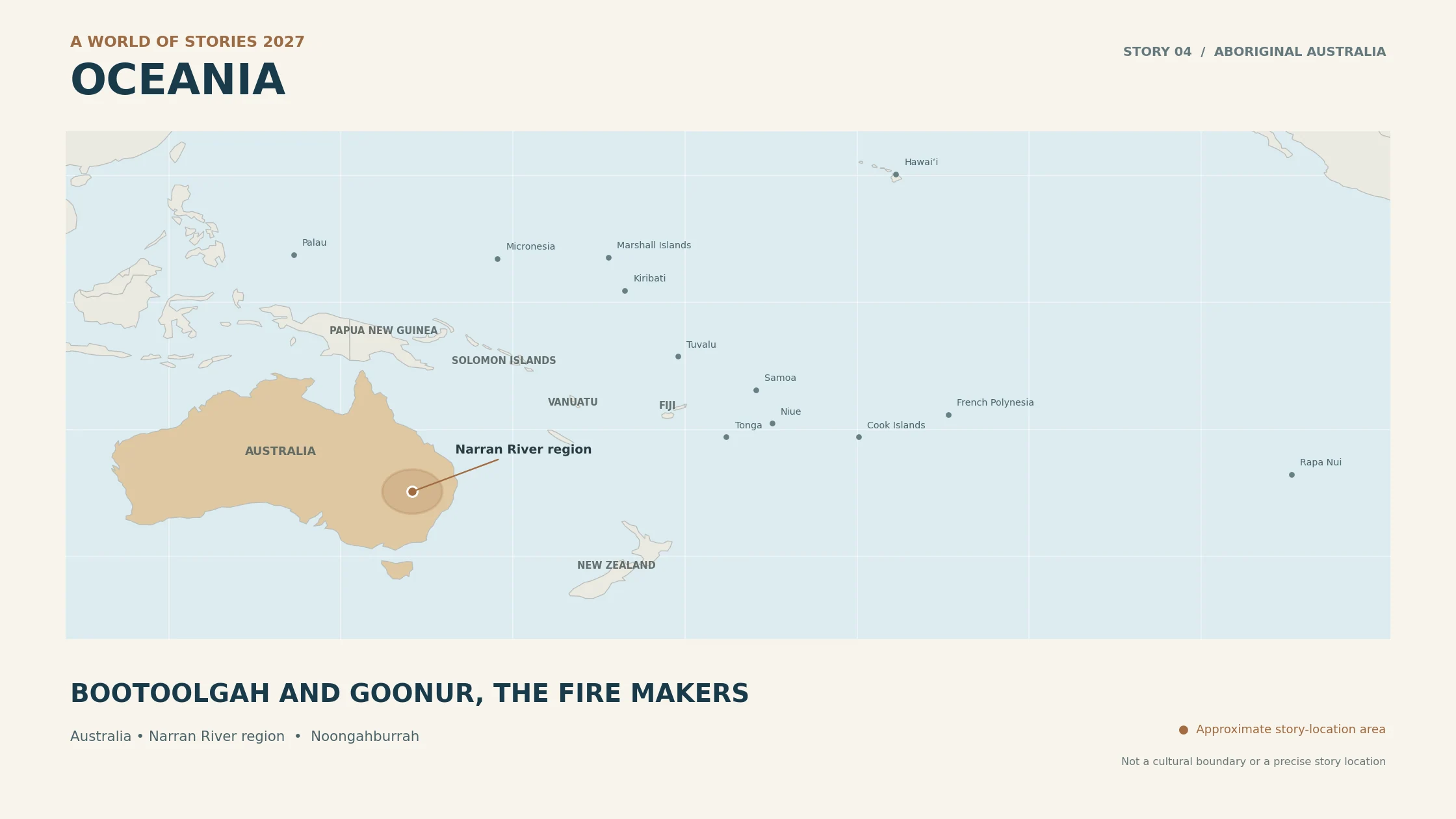
AUSTRALIA — Bootoolgah and Goonur, the Fire Makers
Long ago, in the country where Bootoolgah the crane and Goonur the kangaroo rat lived, people did not know how to make fire. Their food was eaten raw or laid out beneath the sun until it dried. Then, one day, Bootoolgah was rubbing two pieces of wood together when he noticed something remarkable: a wisp of smoke rising between them.
He called Goonur to look. If wood could make smoke, he wondered, might it also make the fire that would cook their food? Goonur thought carefully. She suggested splitting the wood and putting dry grass and bark into the opening, so that even the smallest spark might catch. Bootoolgah followed her advice. He rubbed and rubbed. At last a flame appeared among the grass and bark. Together, the two had discovered how to make fire.
They cooked the next fish they caught, and it tasted so good that they decided to keep their discovery to themselves. Whenever they wanted to prepare a meal, they slipped away into a thicket of bingahwingul bushes. There they kindled their fire. They concealed fire-sticks inside the large, open seed-pods of the bushes, and kept a glowing stick in a carrying bag, called a comebee, so that they could light a new fire when they needed one.
Their neighbours soon began to ask questions. The fish Bootoolgah and Goonur brought home looked nothing like ordinary sun-dried fish. How had they prepared it? "In the sun," the pair insisted. But their companions were not convinced. Day after day, the two went off with their fish and returned with food that looked different—and tasted better.
At last, the others decided to discover the secret. They asked Boolooral the owl and Quarrian the parrot to follow the couple. The two watchers tracked Bootoolgah and Goonur to the thick bushes. Unable to see inside, they climbed a tall tree nearby. From its branches they watched the couple take a fire-stick from their bag, blow on it, and place it among leaves and twigs. A flame leapt up. Larger sticks fed the blaze; when it settled into hot ashes, the fish went in to cook. Boolooral and Quarrian hurried back to tell everyone what they had seen.
Now the gathered people understood: Bootoolgah and Goonur had kept fire to themselves. They wanted to share it, but how could they get the precious fire-stick? A plan was made to hold a great corroboree—a gathering with dancing—and invite people from far and near. The dancers would be so entertaining, they hoped, that the fire-makers would forget to guard their bag. Beeargah the hawk would pretend to be ill and lie close beside them, ready to snatch it.
The gathering was magnificent. Group after group arrived in striking painted designs. The black cockatoos appeared with flashes of orange-red; the pelicans wore white; the black divers gleamed; other birds and animals displayed many colours and patterns. The tall bralgahs, or brolgas, were especially welcome, for their dancing was famous.
Bootoolgah had warned Goonur to take no part in the celebrations. They must sit quietly and watch, he said, because the bag had to be kept safe. Goonur held the comebee close. For a while she remembered her duty, even when the crowd grew excited. Once the bag slipped from her arm, but Bootoolgah noticed and helped her secure it again. Nearby, Beeargah moaned as though terribly unwell. All the while, he watched.
Then the bralgahs entered the dancing space. They stepped forward, bowed, and withdrew. Again they approached, and again they bowed. Their movements grew faster; their long necks craned and their solemn faces made their increasingly funny steps seem funnier still. Soon the spectators were laughing helplessly. Even Bootoolgah and Goonur forgot everything except the dance.
Goonur leaned back in laughter. The bag slipped from her arm. In an instant Beeargah sprang up, seized it, cut it open and pulled out the fire-stick. He lit the dry grass that lay ready beside him. Before Bootoolgah and Goonur understood what had happened, a fire was burning.
Bootoolgah chased the hawk, but Beeargah was quicker. As he ran, he touched his burning stick to the grass, making fire in place after place. Bootoolgah finally stopped. There were flames all around, and there was no longer any way to hide the secret. Fire had passed from the keeping of two to the use of everyone gathered there.
Source: Recorded by K. Langloh Parker in Australian Legendary Tales (1896), a collection identified in the publication as folklore of the Noongahburrah people. This is a modern English literary retelling of the published narrative, not a claim to represent every version of the tradition. The corroboree is kept as a culturally specific gathering and dance, rather than translated as an ordinary party.
After the Story: Read · Create · Reflect · Share
Explore: Why did Bootoolgah and Goonur want to keep fire a secret?
Reflect: How did the other animals work together to find out what the couple knew?
Think & Share: What changes when something useful is shared with a whole community?
Create: Draw your favorite scene from this story and imagine what happens next.
Inspired by this story? Create your illustration!
AUSTRALIA — Borun the Pelican
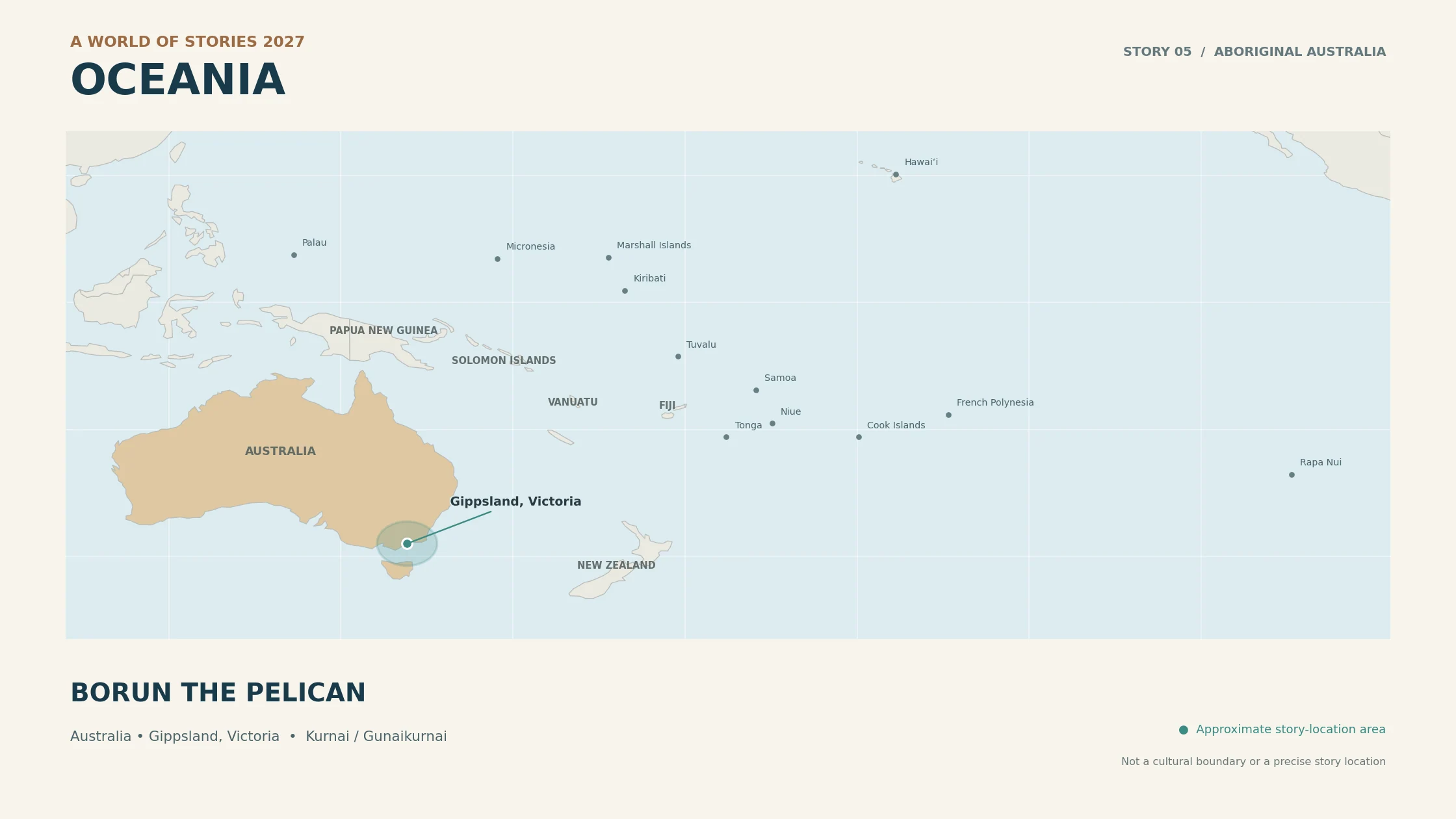
People had gathered from the mountains and the low country near Lake Tyers. They were going to Yiruk, where they hoped to enjoy a great feast of fish and other food. But first they needed a way to cross the water.
They turned to Borun the Pelican and asked him to bring a canoe. Borun agreed. He carried the travellers out to an island in the sea, close enough to Yiruk that they could still see the shore. There they made their camp for the night.
In the morning, Borun began taking everyone from the island to the land. He carried the men across first. When one woman was left waiting, he told her there had not been enough room for her in the canoe. Then he returned to take her on the last crossing.
As they rounded the end of the island, the woman broke the bottom of the canoe. Water began to pour in. She told Borun that the boat must have been damaged because he had carried so many people at once.
The canoe leaked so badly that Borun had to go ashore and repair it. They camped there another night. In the morning, while he worked on the canoe, the woman made a plan. She cut off some of her hair and fastened it to a piece of wood near the fire, so that from a distance it would seem someone was sleeping there.
Then she quietly slipped into the sea. She swam all the way to Yiruk, where the other travellers had already arrived.
At last Borun finished his work and reached Yiruk in his canoe. But he arrived alone. The men believed he had gone away with the woman, and he found himself facing a fight with them.
That is where this old recorded account ends: with the travellers reunited on the shore and Borun facing the anger of the men. It leaves us to wonder what happened after the quarrel.
Source: Kurnai (often written Gunaikurnai today) is the cultural attribution of this historical record from eastern Victoria, Australia, recorded by Alfred William Howitt. The text is a modern English retelling of an archival transcription, not a version authorised or reviewed by Gunaikurnai cultural custodians.
After the Story: Read · Create · Reflect · Share
Explore: Why did the travellers need Borun’s help at the beginning?
Reflect: How did the woman escape from the shore while Borun repaired the canoe?
Think & Share: What might have changed if the travellers had asked Borun what happened before becoming angry?
Create: Draw your favorite scene from this story and imagine what happens next.
Inspired by this story? Create your illustration!
AUSTRALIA — Mirram and Warreen
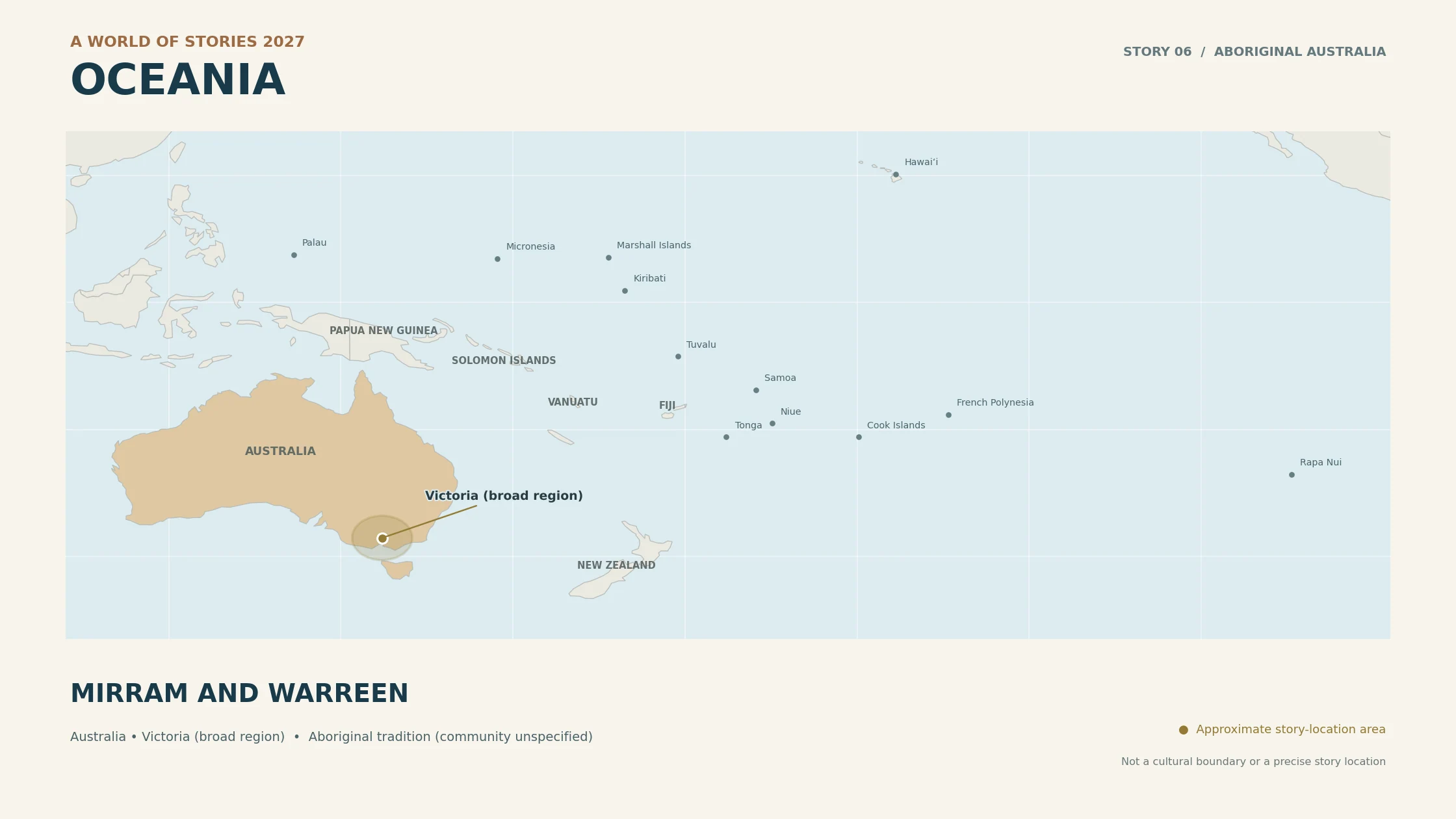
Long ago, Mirram the Kangaroo and Warreen the Wombat were men, and the two were good friends. They lived near one another, but their homes were very different. Warreen had built himself a comfortable shelter of bark, called a willum. Mirram had no shelter at all. He slept outdoors, beneath the open sky.
When the weather was fine, this suited Mirram perfectly. Warreen enjoyed the warm, clear nights too, and sometimes he came out of his shelter to sleep beside his friend. But fine weather does not last forever.
One day, heavy rain began to fall. Warreen went inside his bark shelter, made a good fire, and lay down where it was warm and dry. Outside, the rain poured onto Mirram until his fire went out. He was soaked through and shivering with cold.
Mirram sat in the rain for a long time, hoping Warreen would invite him indoors. No invitation came. At last, when he could bear the cold no longer, Mirram went to the shelter and asked if he might sit in an empty corner.
"I need that corner for my head," Warreen replied. He turned over and placed his head in the space.
Mirram pointed to another part of the shelter. "Never mind. I can sit here."
"I need that place for my feet," said Warreen, stretching his feet across it.
Mirram tried once more, pointing to the spot Warreen had just left. But Warreen shifted again and lay down in front of the fire. He said he needed that place too.
The rain was still falling outside. Mirram had asked for so little, yet his friend would not make room for him. Angry at last, he went out, found a stone, and quietly returned. He struck Warreen on the forehead with it, flattening his brow.
"Your forehead will always be flat," Mirram declared, "and you will live in a dark hole."
And that, the old story says, is why the wombat has a broad, flat forehead and makes its home in a burrow beneath the ground.
But the quarrel was not over. Later, Warreen found his chance to strike back. He took a spear and threw it at Mirram. The spear struck Mirram at the bottom of his backbone and remained fixed there.
"That shall always stay there as your tail," Warreen told him. "You will use it when you run, and you will never have a bark shelter of your own."
The story says that this is how the kangaroo came to have its strong tail, which helps it balance as it bounds across the land. And while the wombat rests in a burrow, the kangaroo still sleeps out in the open.
Source: This story is presented in Robert Brough Smyth’s 1878 compilation of traditions from Aboriginal peoples of Victoria. The passage does not clearly attribute "Mirram and Warreen" to a particular named nation. This is a respectful English retelling, not a community-authorised version.
After the Story: Read · Create · Reflect · Share
Explore: Why did Mirram expect Warreen to invite him into the shelter?
Reflect: How did Warreen respond each time Mirram asked for a place to sit?
Think & Share: What might the two friends have done differently before their quarrel grew worse?
Create: Draw your favorite scene from this story and imagine what happens next.
Inspired by this story? Create your illustration!
AUSTRALIA — Bunnyyarl the Flies and Wurrunnunnah the Bees
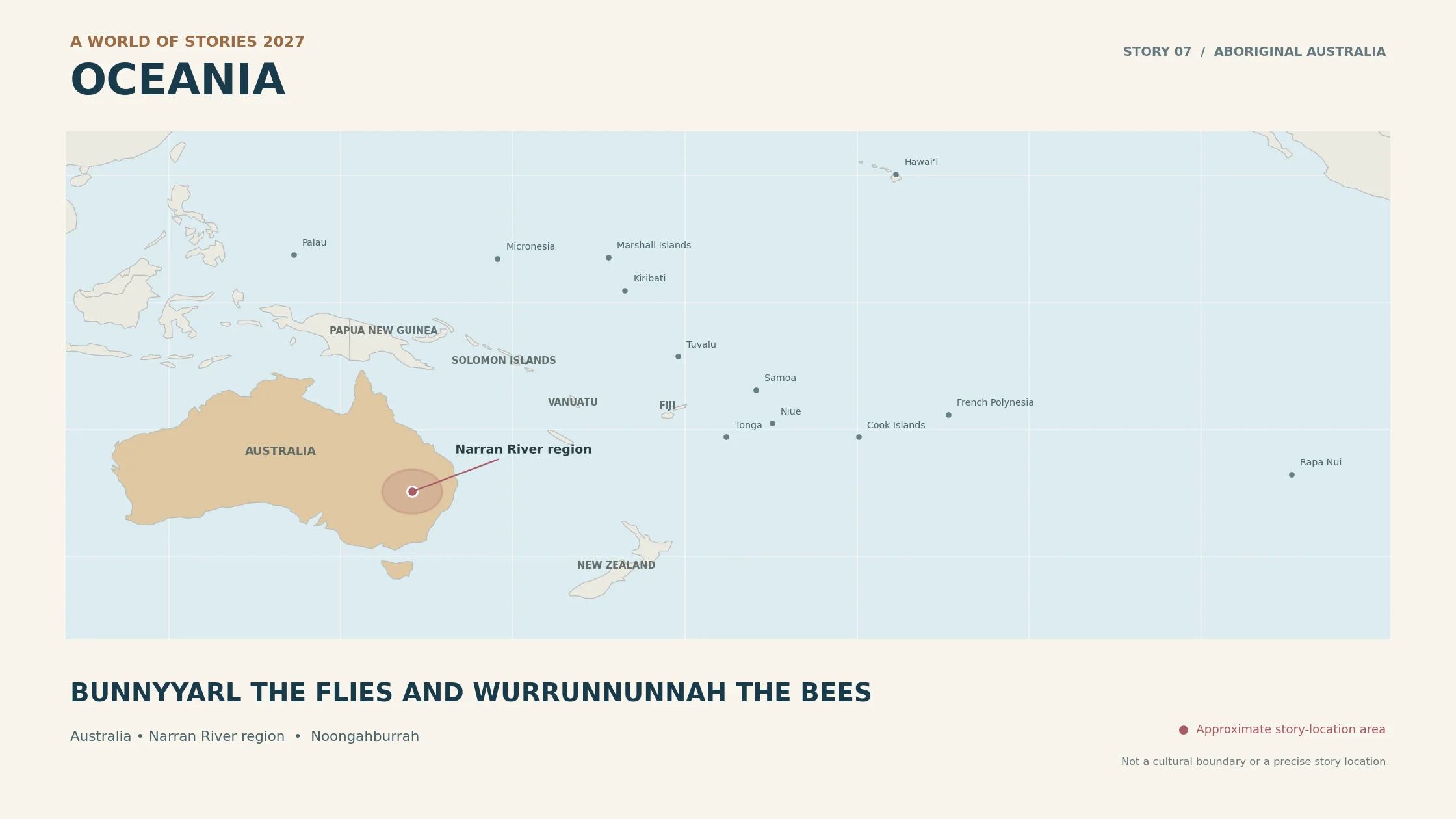
Long ago, Bunnyyarl and Wurrunnunnah were relatives who lived together in one camp. Yet they did not spend their days in the same way.
The Wurrunnunnah worked hard whenever food was plentiful. They gathered what they could and stored some away, knowing that a season of hunger might come. The Bunnyyarl, however, did not trouble themselves about the future. They spent their time playing around the rubbish near the camp instead of collecting provisions.
One day the Wurrunnunnah called to their relatives. "Come with us and gather honey from the flowers," they said. "Soon the winter winds will blow the flowers away. Then there will be no honey left for us to gather."
But the Bunnyyarl would not go. "No," they answered. "We have something to look to here." And back they went to turning over the rubbish, paying no attention to the warning.
They were not worried about going hungry. Whenever the Wurrunnunnah returned with food, the Bunnyyarl expected that it would be shared with them.
So the Wurrunnunnah went out without their relatives. They gathered flowers and stored the honey for the time when it would be needed. But they grew weary of doing all the work while the Bunnyyarl wasted their days. At last, the Wurrunnunnah decided not to return to live with them.
And as time passed, the Wurrunnunnah became the little wild bees, still busily gathering from flowers. The Bunnyyarl became flies, still turning about among rubbish rather than making stores for the future.
That is how the old story explains the different ways of the bees and the flies.
Source: This is an adaptation of a story collected by K. Langloh Parker among the Noongahburrah people in the Narran River area of New South Wales, in her 1896 collection Australian Legendary Tales. This adaptation has not been reviewed by community representatives.
After the Story: Read · Create · Reflect · Share
Explore: Why did the Wurrunnunnah gather and store food while flowers were plentiful?
Reflect: What made the Bunnyyarl think they did not need to prepare for winter?
Think & Share: How can sharing and taking responsibility work together in a family or community?
Create: Draw your favorite scene from this story and imagine what happens next.
Inspired by this story? Create your illustration!
Torres Strait Islands
AUSTRALIA — TORRES STRAIT — The Adventure of Gabakwoikai
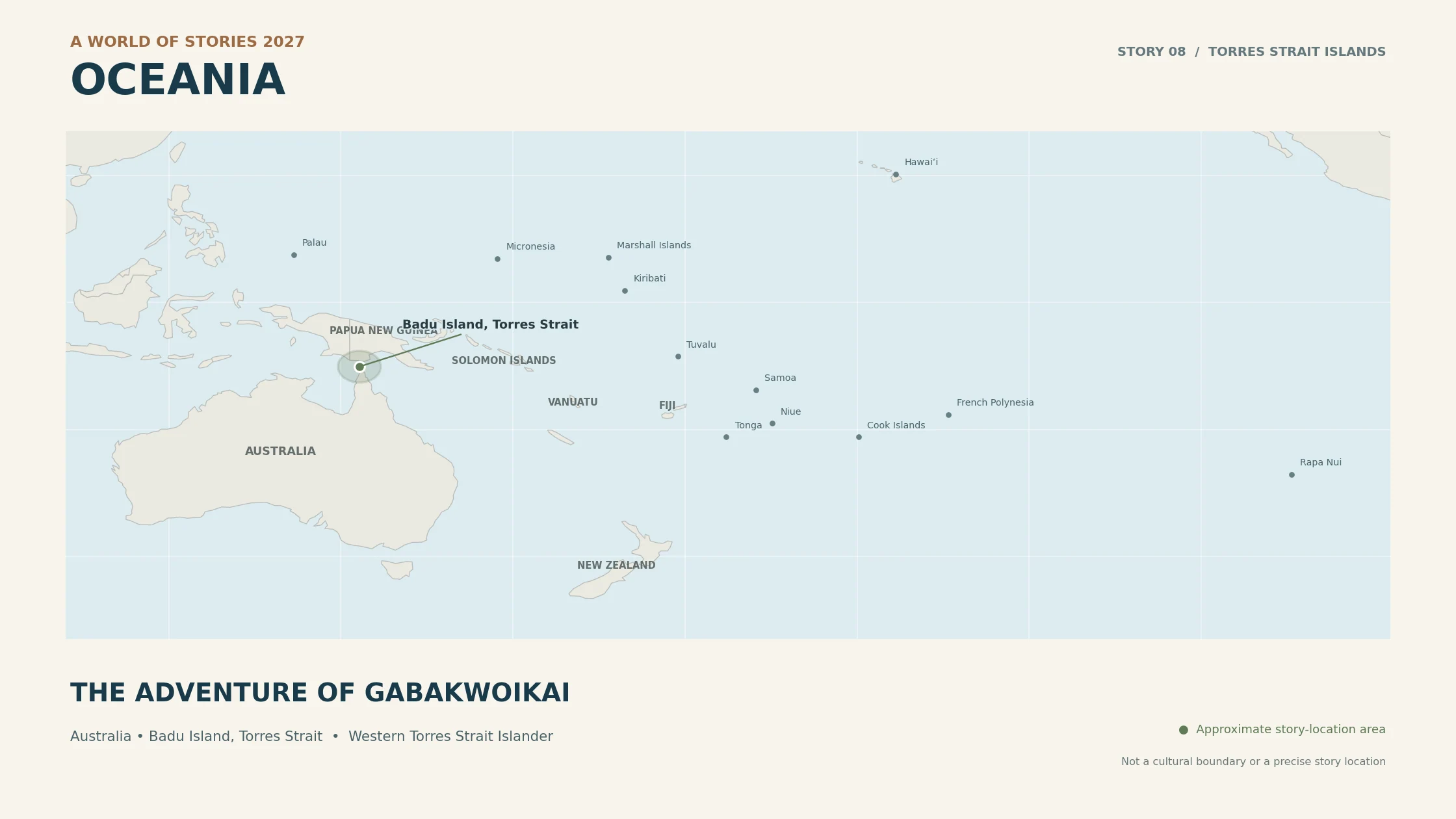
Off the southern shore of Badu lay two small islands, Zurat and Kwoberkelbai. Sea turtles often came to their beaches, and the islanders knew where to search for their eggs. On Kwoberkelbai lived a man named Gabakwoikai.
One morning, men from his village told him that turtle tracks had been seen on the sand at Zurat. "All right," said Gabakwoikai. "I will go." Instead of taking a canoe, he sat on a canoe’s steering-board, called a walunga, and paddled himself across the water.
He found the turtle eggs, dug them out of the sand, and wrapped them in a bundle of grass. Leaving the bundle safely on the shore, he went to look for fruit.
On the far side of the island lived a Dorgai, a fearsome being in this tradition. She had prepared a basket for gathering fruit and then slept for a week, expecting plenty of ripe fruit to have fallen by the time she woke. That very day, she rose and made her way to the trees.
Gabakwoikai had already collected the fruit lying on the ground. To gather more, he climbed a tree. He had not noticed the Dorgai approaching.
"Where has all the fruit gone?" she called when she saw the empty ground. Gabakwoikai heard her voice, looked down, and was terrified. The Dorgai had an enormous body, long legs, little feet, and ears so large that, the story says, she could sleep on one and cover herself with the other.
"What shall I do now?" Gabakwoikai whispered. But the Dorgai heard him and looked up.
"Who told you to come here?" she demanded. "This place belongs to me. You have taken my fruit. Throw it down!"
Gabakwoikai refused to surrender everything he had gathered. At last the Dorgai told him to give her the unripe fruit so she could fill her basket.
He dropped one fruit close beside her. She reached for it. He threw the next farther away, and she had to take two steps. The third landed farther still, and she walked four steps to pick it up. Then he hurled another fruit onto the top of a tree near the Dorgai’s house.
While she went to retrieve it, Gabakwoikai scrambled down the trunk, hurried to the beach, picked up his bundle of turtle eggs, and paddled away on the steering-board.
When the Dorgai returned and found him gone, she followed his footprints to the shore. She called for him to come back, but he would not. Across the water, people on Kwoberkelbai saw him fleeing and understood that the Dorgai had frightened him.
Gabakwoikai reached home and gave the eggs to the old men. Then he placed red paint in the kwod, the men’s gathering place. His brother-in-law took some of the paint and declared that they would confront the Dorgai. The men took their fishing spears and dugong harpoons and crossed to the island.
They found the Dorgai asleep in her dwelling. Gabakwoikai aimed a harpoon, but its dart struck her arm. Startled awake, she ran, while the men clung to the rope attached to the dart. She sank into the ground, and at that spot, the story says, a waterhole appeared. Then she rose and fled again.
When she sank into soft ground a second time, the men wound the rope around a tree and pulled with all their strength. Her arm was torn away. The men carried it to the shore and cast it into the sea. There, at low tide, a rock could be seen standing above the reef. The story names that rock Dorgai Zug.
The Dorgai did not return. And the rock remained, a landmark connected in the telling with Gabakwoikai’s frightening encounter.
Source: Adapted from "The Adventure of Gabakwoikai," told by Kirer of Badu and recorded by Alfred C. Haddon in "Legends from Torres Straits," Folk-Lore, vol. 1 (1890). This is an adaptation of a colonial-era recording, not a community-reviewed contemporary retelling.
After the Story: Read · Create · Reflect · Share
Explore: How did Gabakwoikai use quick thinking to escape from the Dorgai?
Reflect: Why do you think the story connects an unusual rock with the events of the tale?
Think & Share: What changes when the villagers decide to confront the Dorgai together?
Create: Draw your favorite scene from this story and imagine what happens next.
Inspired by this story? Create your illustration!
AUSTRALIA — TORRES STRAIT — The Birth of Kusa Kap
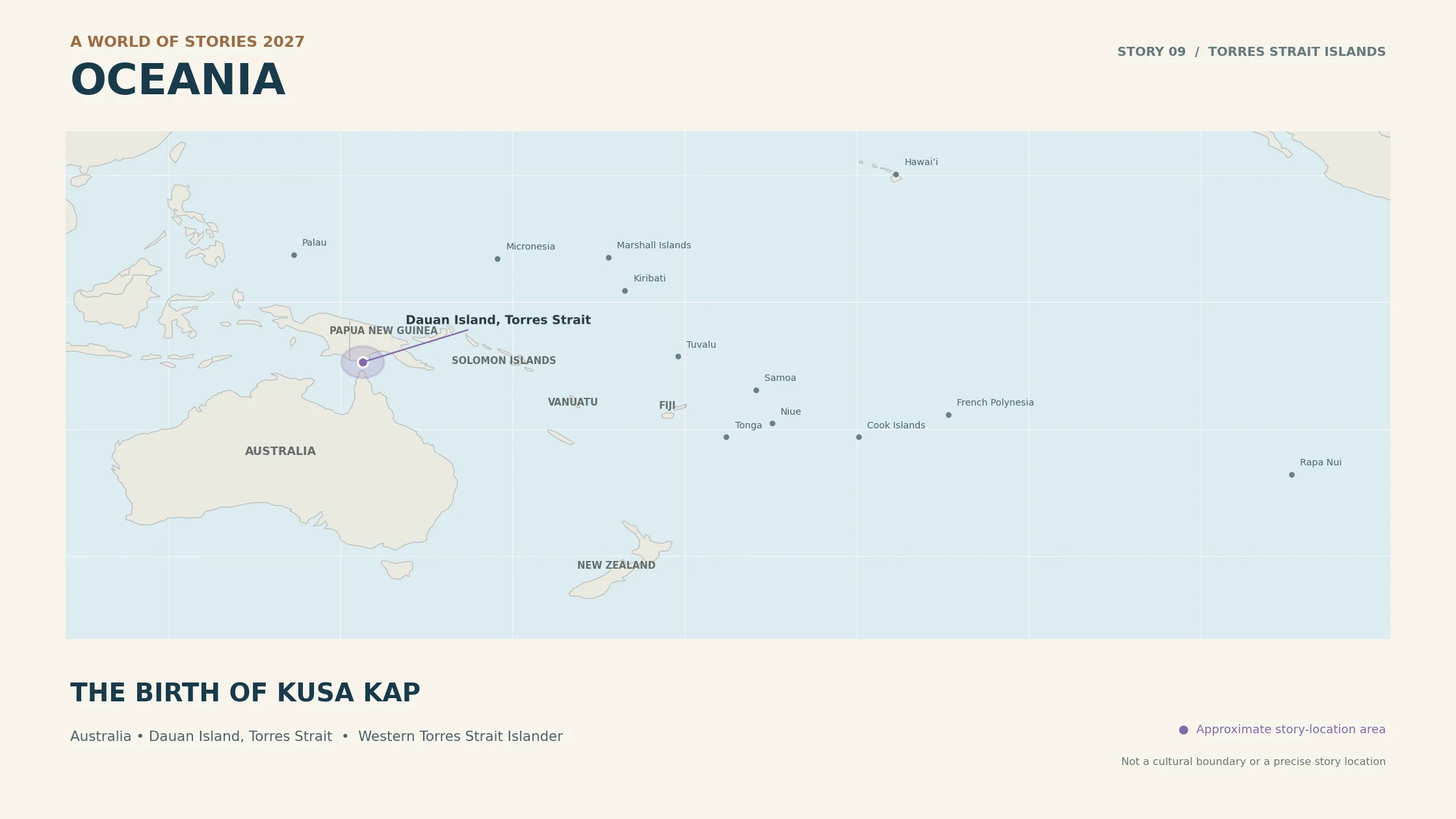
On the island of Dauan lived a man named Maiwasa and his wife, Bukari. One day they went out along the reef. Maiwasa was searching for a place where dugongs had been feeding, while Bukari wore a pair of fine earrings decorated with seeds called kusa.
From a tall tree, a Dorgai named Gidzo watched them. She wanted Maiwasa for herself. When he went farther along the reef to look for signs of dugongs, Bukari stayed behind to fish among the rocks.
Gidzo carried a great drum to a dry place and changed herself into an octopus. When Bukari reached beneath the rocks with her fishing spear, the Dorgai sprang up in her own form. She trapped Bukari beneath the drum, exchanged faces with her, and sent the drum drifting out to sea. Then Gidzo took Bukari’s place beside Maiwasa.
Maiwasa soon noticed that the woman who looked like his wife behaved very differently. He became troubled and suspected that she was a Dorgai, though he did not know where Bukari had gone.
The drum drifted until it washed ashore on a small island near Boigu. Bukari climbed out and looked across the water toward Dauan. She was far from her husband, and there was neither food nor drinking water on the island. To survive, she began eating the seeds from her earrings, two in the morning and two in the evening.
When she had almost finished the seeds, something extraordinary happened: Bukari laid an egg. She kept it warm, and a bird hatched from it. She named him Kusa Kap, "fruit of the seeds," because he had come from the seeds of her earrings.
At first Kusa Kap could not fly. But he quickly grew strong and began bringing fish to his mother. Bukari was desperately hungry, yet she would not eat the fish uncooked. Each time she gave it back, the bird ate it himself. Day after day he grew larger, until he became an enormous bird.
One morning Kusa Kap brought Bukari a dugong. She had no bamboo knife with which to cut it, so the bird used his beak to prepare the meat. He brought her more dugongs, but still she needed fire and water.
Bukari tied a little seed to Kusa Kap’s leg so that her relatives would recognize him. She sent him across the sea to her two uncles on the New Guinea coast. When the uncles saw the seed, they understood who had sent him. They loaded him with water containers and gave him a burning stick and a bamboo knife. At last Bukari could cook, drink, and regain her strength.
Then Bukari asked Kusa Kap to find Maiwasa on Dauan. She told the bird to show him the seed, take hold of his canoe, and lead him back to her. Kusa Kap did as she asked. Recognizing the ornament from Bukari’s earring, Maiwasa gathered companions and sailed after the bird.
When the canoe approached the little island, the men saw dugong bones scattered thickly along the beach. Bukari ran to meet Maiwasa and told him everything: how the Dorgai had stolen her face, how she had been carried away, and how Kusa Kap had hatched and cared for her.
Before leaving, Bukari asked her bird-son to stay with her uncles across the sea. She wept as they parted. Maiwasa and Bukari then sailed home with their companions, taking the remaining dugong meat in the canoe.
Gidzo, still living in Maiwasa’s house, saw his canoe arrive and came down to greet him. Bukari had hidden herself in the boat. As Gidzo drew near, Bukari sprang up and struck her with a piece of wood, defeating the Dorgai who had taken her place.
And so, in this traditional telling, Bukari returned to Dauan after her long separation, saved by Kusa Kap—the astonishing bird born from the seeds of her earrings.
Source: Retold from A. C. Haddon, "The Birth of Kusa Kap," in "Legends from Torres Straits," Folk-Lore, Vol. 1 (1890), as told by Nagu (Wainu) of Badu. Historical wording has been adapted for modern young readers. This is a published colonial-era record, not a community-approved contemporary version.
After the Story: Read · Create · Reflect · Share
Explore: What did Bukari do to survive when she was alone on the island?
Reflect: How did Kusa Kap help his mother, and why did the seed on his leg matter?
Think & Share: Which part of this story felt most surprising or moving to you?
Create: Draw your favorite scene from this story and imagine what happens next.
Inspired by this story? Create your illustration!
AUSTRALIA — TORRES STRAIT — Kultut of the Long Arm
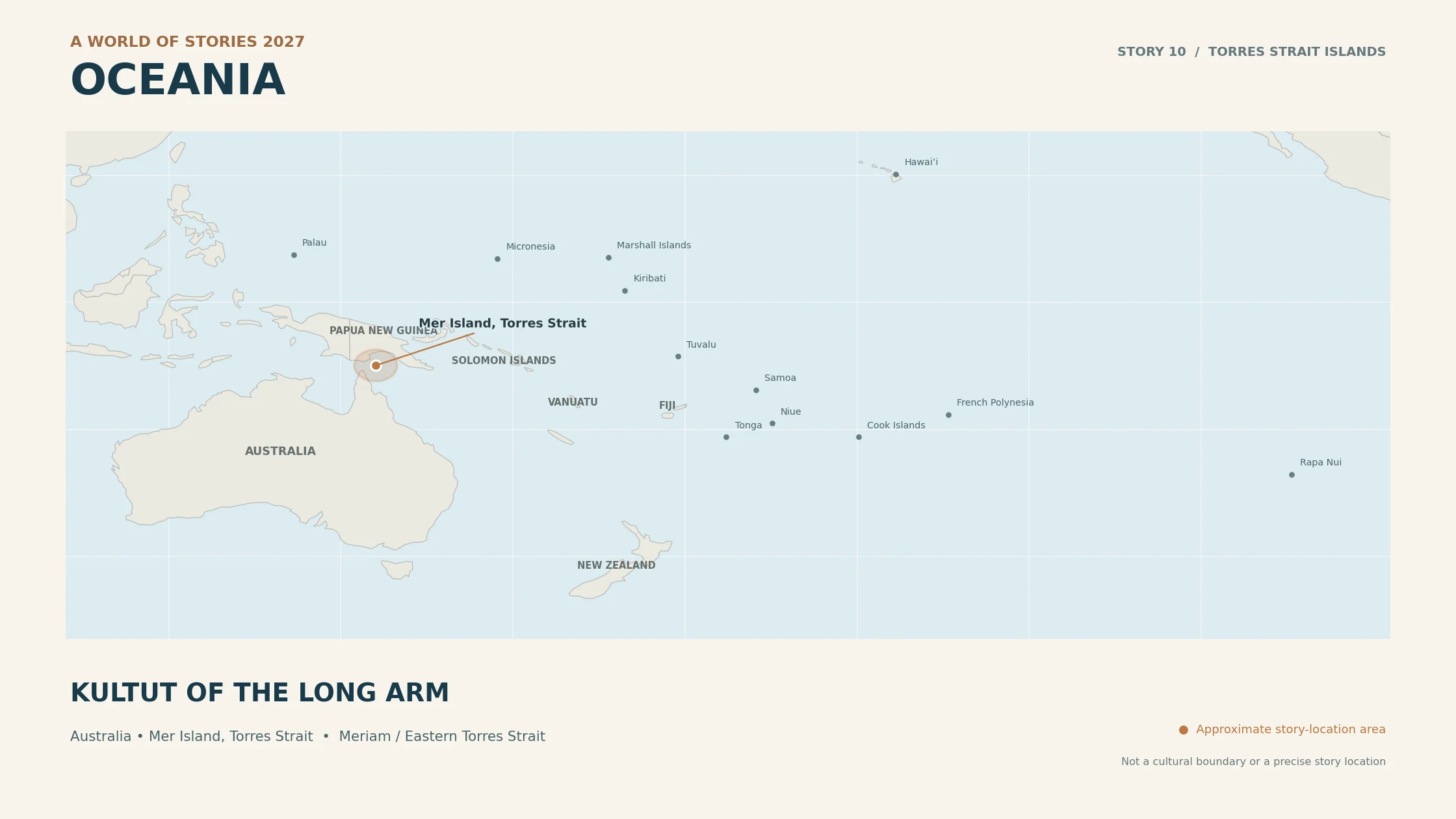
Near the beach at Wedwed, not far from Er on the island of Mer, lived a man named Kultut. He had a most unusual arm: it was so long that he could reach far beyond his home without walking to the place he wanted to touch.
One day, a group of girls prepared a large ager, a kind of plant food, in an earth-oven. They covered the hot oven and left their meal to cook while they went out to fish on the reef. Four canoes carried them away from shore.
When the girls had gone, Kultut came out of his house. Without approaching the oven, he stretched out his extraordinary arm, reached into it, and took the ager. Then he ate every bit.
When the girls returned with their canoes, they hurried to their cooking place. But the oven was empty. Their food had disappeared. They cried out in surprise, wondering who could have taken their meal.
The following day they prepared another ager in the same way. This time, the person in charge of the canoe told one girl to remain on shore and watch what happened. While the others went fishing, she hid in the bushes and kept her eyes on the oven.
Before long, Kultut appeared. Once again he stretched his long arm from his place by the beach. His hand reached into the earth-oven, took the food, and carried it back to him. He ate it all, never knowing that someone had seen him.
When the fishing party returned, the girl told her companions what she had witnessed. At last they knew who had been taking their meals.
On the third day they made another oven, but five girls stayed behind and concealed themselves nearby. Kultut reached for the food as he had done before. This time the watchers came out of hiding and confronted him.
"Why do you steal our food?" they demanded. Using sharp misor shells, they cut Kultut’s long arm at the elbow.
The story is connected with marks that can be seen on the sloping volcanic shore at Er. The old account describes the outline of a person with an exceptionally long arm, and nearby a shallow hollow with a stone inside it—said to be the oven and the ager. These features of the shore preserve the memory of Kultut and the food he took.
Source: Retold from A. C. Haddon, "Kultut of the Long Arm," in Reports of the Cambridge Anthropological Expedition to Torres Straits, Vol. VI (Cambridge University Press, 1908), pp. 11-12. Haddon attributes the story to the storyteller Mamai. The story has been adapted into accessible English without changing the main events.
After the Story: Read · Create · Reflect · Share
Explore: Why did the girls decide to leave someone behind after their first meal disappeared?
Reflect: How did the girls discover who was taking their food?
Think & Share: How does this story connect an event from long ago with a real place on the island?
Create: Draw your favorite scene from this story and imagine what happens next.
Inspired by this story? Create your illustration!
Aotearoa / New Zealand
NEW ZEALAND — Māui Slows the Sun
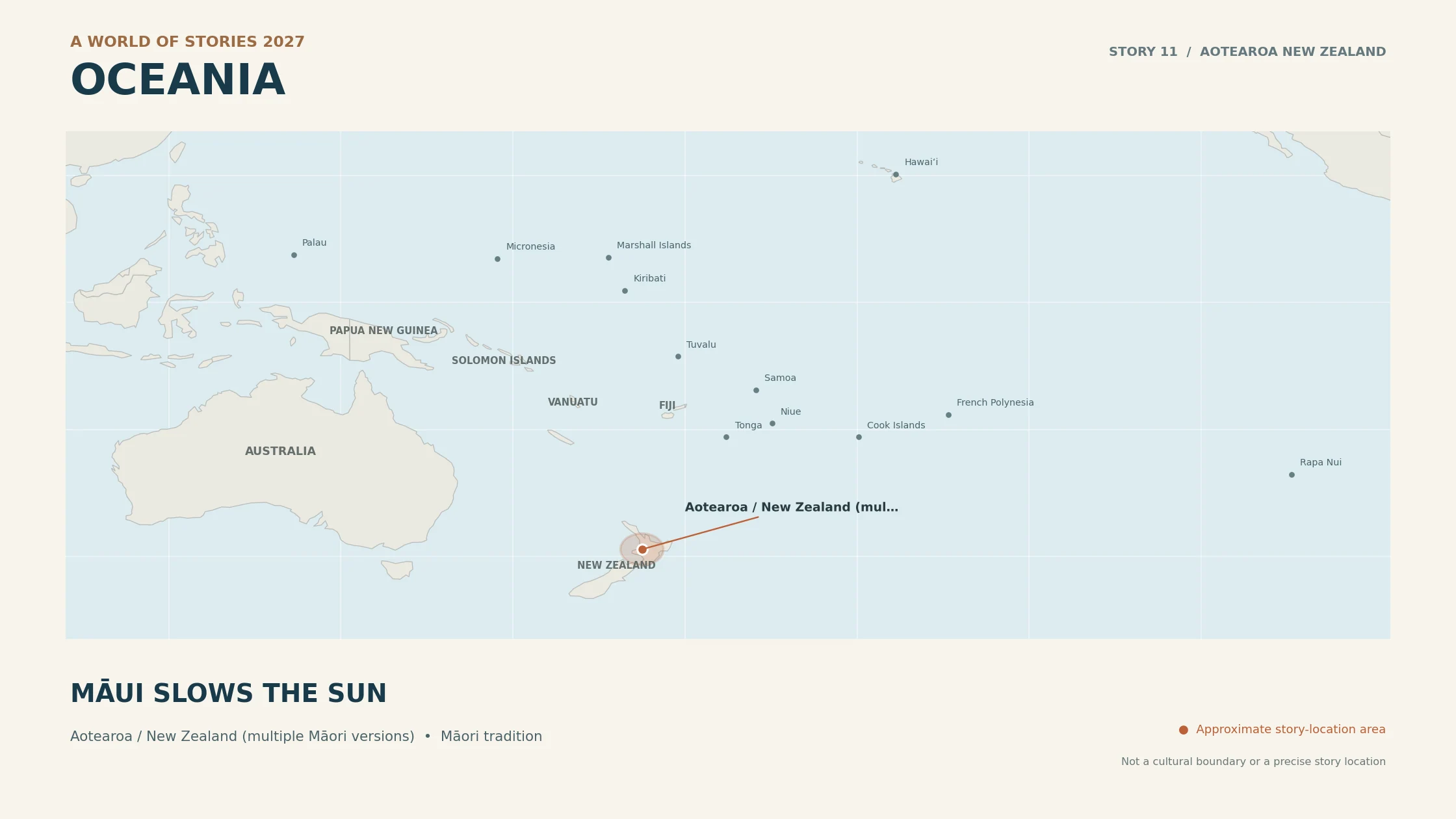
Long ago, the days were so short that people struggled to finish their work. The sun hurried across the sky, and darkness came before the cooking was done, before the fishing nets were brought in, and before the gardens could be tended. Maui watched the sun’s swift journey and decided that something must change.
He went to his brothers and told them what he intended to do. "We must catch the sun," he said, "and make him travel more slowly. Then everyone will have enough daylight for their work."
His brothers laughed. How could anyone catch the sun? Its heat was fierce, and its strength was greater than theirs. But Maui did not give up. He reminded them that bold tasks required courage and careful preparation, and at last they agreed to help.
Together they gathered the fibres of harakeke, the flax plant, and twisted and plaited them into ropes. They made the ropes thick and strong, strong enough, they hoped, to hold even the sun. Maui carried a special weapon: the enchanted jawbone of his ancestor Murirangawhenua.
When everything was ready, the brothers set out toward the east, where the sun rose each morning. They travelled under cover of darkness and kept out of sight by day, so that the sun would not discover their plan. The journey was long, but at last they reached the place where the sun emerged.
There they built a high wall of clay for shelter, with hiding places at either end. They arranged their ropes in great loops across the sun’s path. Maui told his brothers to wait until the sun was well within the nooses before pulling the ropes tight. He himself waited nearby, jawbone in hand.
At dawn, a red light appeared. The sun began to rise, spreading its fiery brightness over the land. Higher it came, until its head and shoulders were within the loops. Maui gave the signal. His brothers seized the ropes and pulled with all their strength.
The sun struggled furiously. The ropes strained, and its scorching heat made the brothers fear they could not hold on. Then Maui rushed from behind the wall. Raising the enchanted jawbone, he struck the sun while his brothers kept their grip on the ropes.
"Why do you attack me?" the sun demanded.
"Because you cross the sky too quickly," Maui answered. "People have too little time to gather their food and finish their work. You must travel more slowly."
The sun fought to escape, but Maui would not release it until it had been overcome. At last the struggle ended. The brothers loosened the ropes, and the sun climbed into the sky once more.
But now it moved slowly. The daylight lasted longer, and people had time to fish, prepare their meals, and care for their homes and gardens before evening arrived. According to this Maori tradition, that is why the sun no longer races across the sky as it once did.
Source: This adaptation follows the traditional Maori account of Maui snaring and slowing the sun, as documented in historical collections and summarized by Te Ara – The Encyclopedia of New Zealand. Variants exist across Maori traditions; no specific iwi is assigned to this version.
After the Story: Read · Create · Reflect · Share
Explore: Why did Maui believe the days needed to be longer?
Reflect: What did the brothers have to do together before they could face the sun?
Think & Share: How did planning and courage help Maui and his brothers accomplish something that seemed impossible?
Create: Draw your favorite scene from this story and imagine what happens next.
Inspired by this story? Create your illustration!
NEW ZEALAND — Rātā and the Forest Guardians
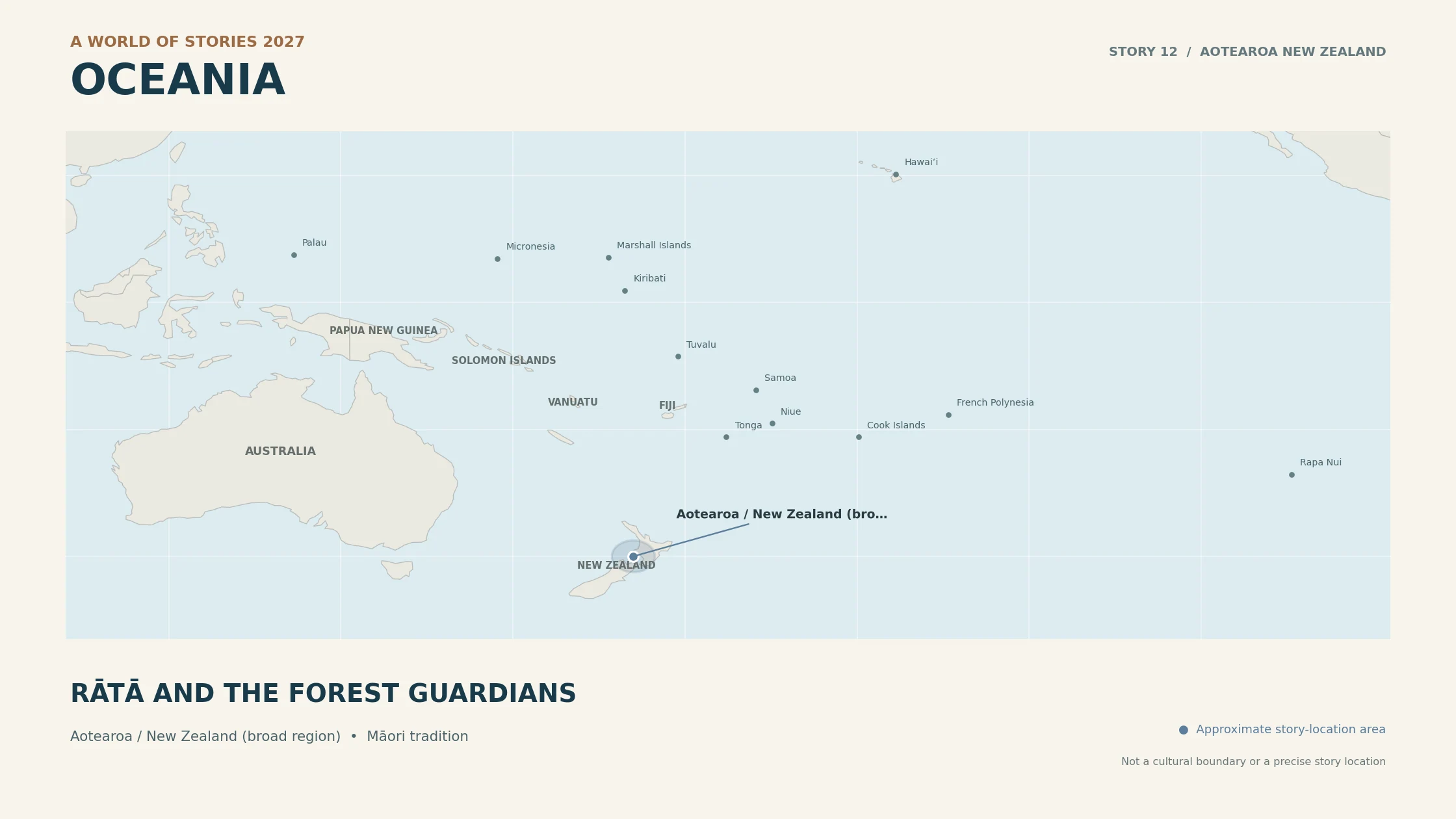
Rata had a difficult journey ahead of him. He wanted to travel across the sea to recover the remains of his father, Wahieroa, which had been taken far from home. For such a voyage, he would need a great canoe.
He entered the forest and searched until he found a tall, straight tree. Its trunk looked just right for the canoe he planned to make. Rata raised his axe and began to work. At last the tree fell. He cut off its branches and started shaping the trunk. When evening came, he left his work where it lay and returned to his village.
But the forest was not empty. The birds, insects and forest guardians known as the hakuturi had seen what Rata had done. He had cut down a tree without showing the respect owed to Tane, guardian of the forest.
When Rata had gone, the hakuturi gathered around the fallen tree. They lifted the trunk, fitted the branches into place and returned every chip and shaving to where it belonged. As they worked, their many voices rose together in a chant. By the time they had finished, the tree stood upright again, just as it had before.
In the morning Rata returned, expecting to find his unfinished canoe. Instead, the tree stood before him, whole and tall. He could scarcely believe his eyes. Yet he took up his axe and cut it down again. This time he worked on the hollow of the canoe and began shaping its curved ends. As darkness approached, he went home.
Once again the hakuturi came. Once again they gathered the scattered wood, raised the trunk and restored the tree to its place.
When Rata found the tree standing for a second morning, he was astonished. He felled it once more, but this time he did not go far. He stepped into the undergrowth and hid, determined to learn who was undoing his work.
Before long he heard the voices of the forest guardians. They were coming toward the fallen tree, ready to set it upright. Rata sprang from his hiding place and confronted them.
"So it is you who have been doing this to my tree!" he cried.
The hakuturi answered him with a question: "Who gave you the right to cut down the tree of the forest?"
Rata understood then what he had forgotten. He had taken the tree without first observing the proper customs and showing respect. He was deeply ashamed.
The guardians did not leave him without help. "Return to your village, Rata," they told him. "We will make the canoe for you."
Rata did as they asked. The hakuturi set to work, so many skilled helpers working together that the canoe was soon finished. When Rata and his people returned, they found the vessel ready. They hauled it from the forest to the water and named it Riwaru.
And so Rata gained the canoe he needed for his journey. He had also learned that even the greatest work must begin with respect for the living forest.
Source: This retelling adapts the enchanted-tree and canoe-building episode from the longer traditional narrative of Rata. Traditional source: George Grey, Polynesian Mythology and Ancient Traditional History of the New Zealanders (1855), "The Legend of Rata." The legend exists in multiple Maori and wider Polynesian versions; the wording here is newly written for young readers.
After the Story: Read · Create · Reflect · Share
Explore: Why did Rata want to make a canoe?
Reflect: What did the hakuturi want Rata to understand before taking a tree from the forest?
Think & Share: Why do you think the guardians decided to help Rata after he recognized his mistake?
Create: Draw your favorite scene from this story and imagine what happens next.
Inspired by this story? Create your illustration!
NEW ZEALAND — Hinemoa and Tūtānekai
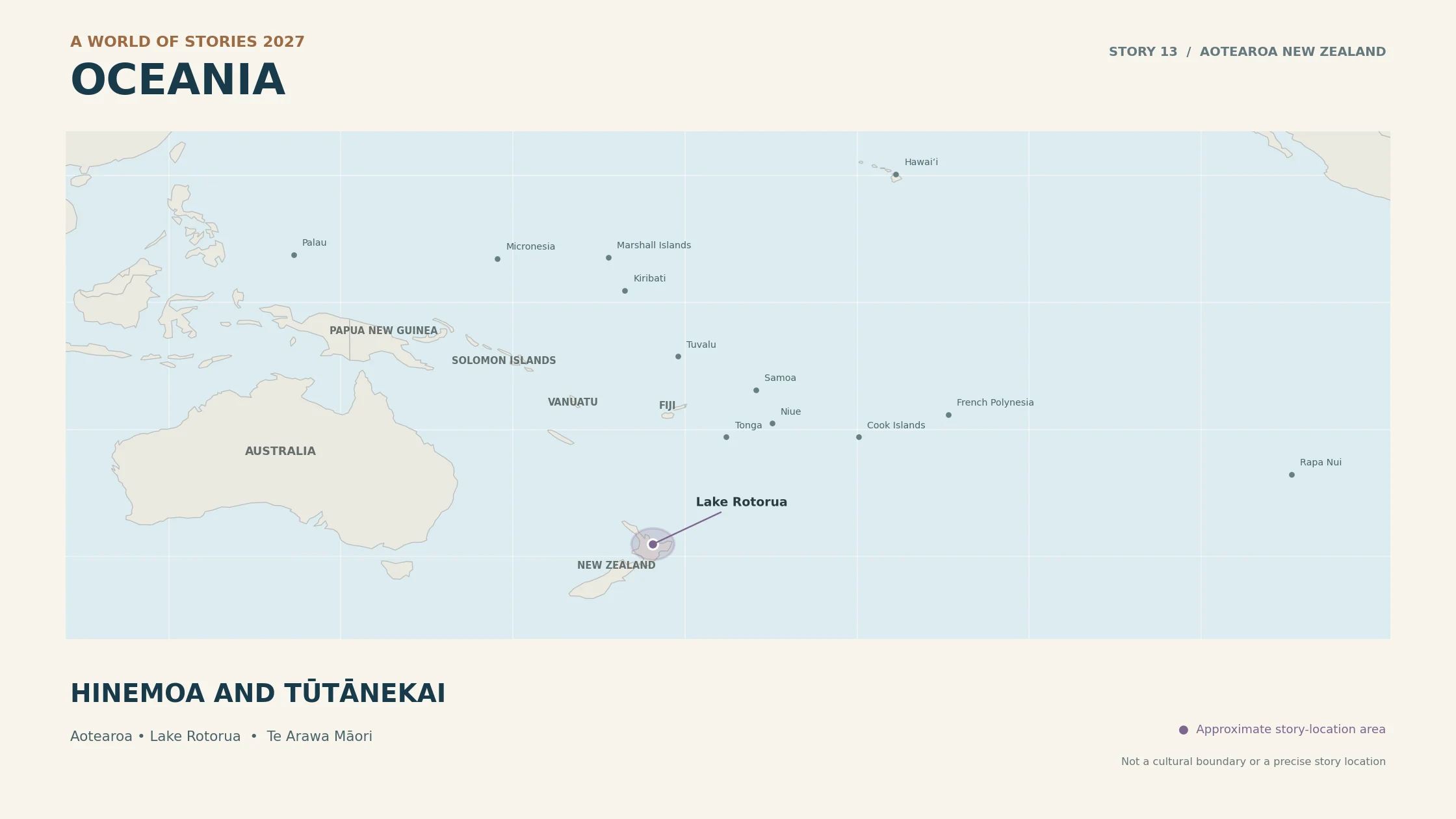
Long ago, on the shores of Lake Rotorua, lived a young woman named Hinemoa. Across the water, on Mokoia Island, lived Tutanekai. At gatherings where people from around the lake met, the two had seen one another and fallen in love. Yet neither at first dared to speak of it. Tutanekai feared that Hinemoa, whose family held her in high regard, would not choose him. Hinemoa wondered whether he truly cared for her.
At last they learned that their feelings were shared. But Hinemoa’s family did not approve of the match. They watched her carefully, determined that she should not cross the lake to meet him.
Tutanekai loved music. In the evenings he and his friend Tiki played their instruments from a raised place on Mokoia Island. On still nights the notes travelled over the water. Hinemoa listened from the distant shore, longing to reach the island. Tutanekai had told her to follow the sound, and she intended to do so in a canoe. But her family had dragged the canoes high up the beach, where she could not launch one alone.
Night after night the music came across the lake, and night after night Hinemoa remained on shore. Then she made a daring decision: if she could not cross in a canoe, she would swim.
She prepared six hollow gourds and fastened them so that they would help keep her afloat. When darkness had fallen, Hinemoa went to the water’s edge. Lake Rotorua lay wide and cold before her. She entered the lake and began to swim toward the distant music.
The journey was long. Sometimes her arms grew so tired that she had to rest, letting the gourds support her. In the darkness she could scarcely make out the island. But whenever she heard the music, she knew which way to go. She gathered her strength and swam on.
At last she reached Mokoia. Shivering from the cold water, she found a warm spring near the shore and slipped into the pool to recover. She was relieved to have arrived, but shy at the thought of meeting Tutanekai after such a journey.
Meanwhile, Tutanekai was thirsty. He sent a servant to fetch water in a gourd vessel. As the servant approached the spring, Hinemoa called from the darkness, making her voice sound deep and unfamiliar. "For whom is that water?" she asked.
"For Tutanekai," replied the servant.
"Let me drink," said Hinemoa. The servant handed her the vessel. After drinking, she broke it. The astonished servant returned without the water and told Tutanekai what had happened. He was sent back, but the stranger at the spring broke another vessel. At last Tutanekai went down to discover who was causing the trouble.
He searched in the darkness near the pool. Hinemoa remained hidden until he came close enough to find her. Then she spoke in her own voice. "It is I, Hinemoa."
Tutanekai could hardly believe that she was there. She had crossed the great lake alone, guided by the music they had shared across the water. He wrapped his cloak around her, and together they went to his home.
In the morning, the people of Mokoia wondered why Tutanekai had not appeared as usual. Someone went to see whether he was unwell—and discovered that Hinemoa was there with him. The news travelled through the village. At first some could not believe it, but when Hinemoa and Tutanekai came outside together, everyone saw that she had indeed reached the island.
The story of Hinemoa’s courage and the music that guided her across Lake Rotorua has been told for generations among Te Arawa. Mokoia Island remains a real place, and the warm spring associated with her arrival is remembered there.
Source: An original English-language adaptation of a traditional Te Arawa account, based on historical and educational retellings documented by Te Ara – The Encyclopedia of New Zealand and the Rotorua Museum. Versions differ in some details; this is not a community-authorized definitive telling.
After the Story: Read · Create · Reflect · Share
Explore: Why did Hinemoa decide to swim across the lake, and what risks did she face?
Reflect: How did the sound of music help Hinemoa during the journey?
Think & Share: What does the story suggest about courage, determination, and listening to one another?
Create: Draw your favorite scene from this story and imagine what happens next.
Inspired by this story? Create your illustration!
NEW ZEALAND — The Battle of the Mountains
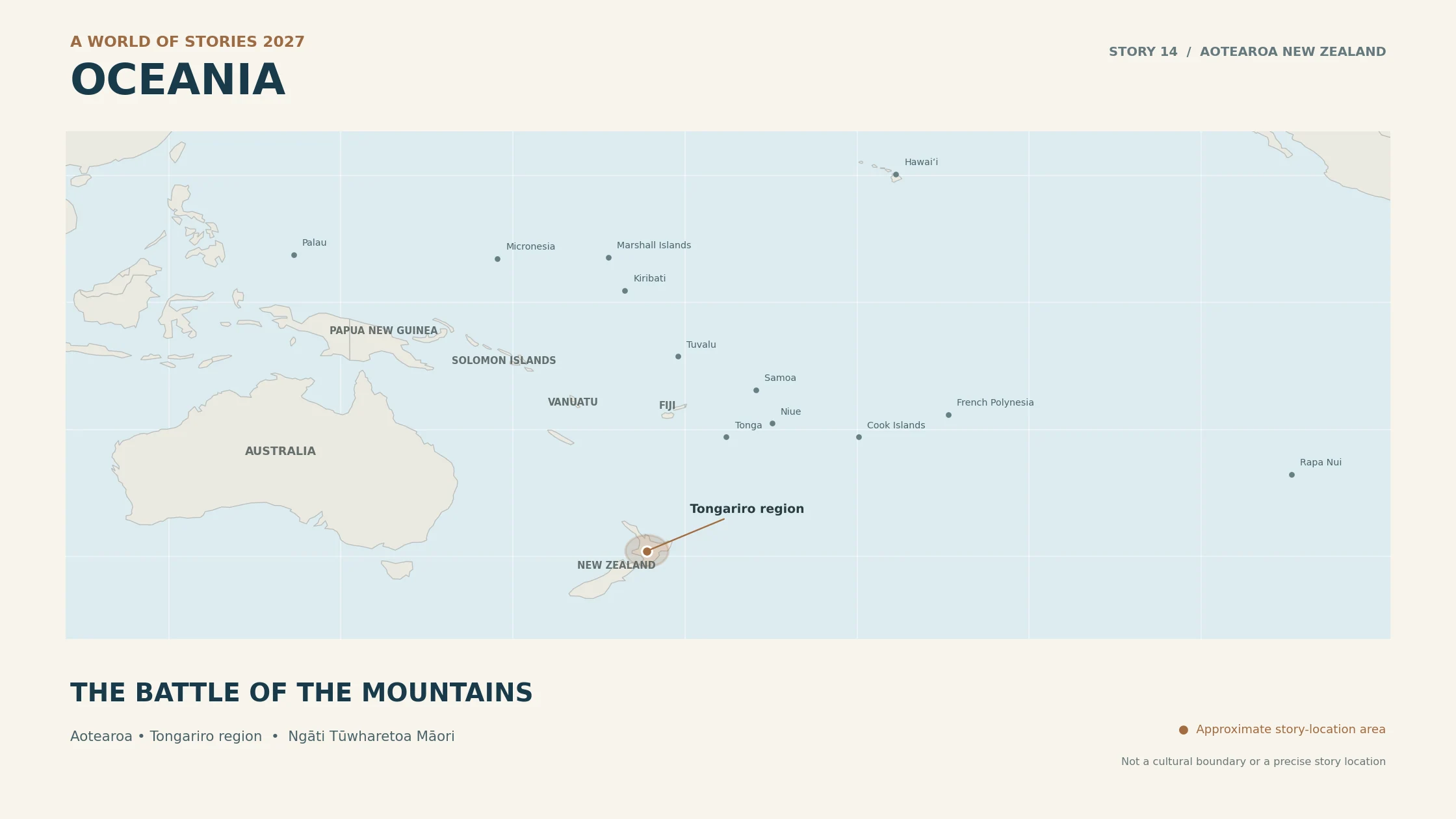
In the early days, when the land was still young, the great mountains of the central North Island stood near one another. Among them were four powerful mountain warriors: Tongariro, Taranaki, Tauhara, and Putauaki. Near them stood Pihanga, the beautiful mountain whose presence drew the warriors’ attention.
Each of the four wished to win Pihanga’s affection. Their rivalry grew into a great battle. Tongariro, Taranaki, Tauhara, and Putauaki struggled against one another, until at last Tongariro emerged victorious.
The contest had changed everything. Tongariro would remain beside Pihanga, but the three defeated mountains could no longer stay where they had once stood together. They had to leave Tongariro’s domain and find new places for themselves.
Their departure took place at night. Before the first light of morning, each mountain could travel as far as possible. But when the sun rose, the mountains would be fixed forever in the places they had reached.
Putauaki turned east. Through the darkness he made his way towards the country now known as the Bay of Plenty. When dawn arrived, he stood at Kawerau, where he remains today.
Tauhara also set out, but he found it hard to go far. Again and again he looked back towards Pihanga. His longing slowed his journey, and by sunrise he had reached only the opposite end of the lake. There he was fixed in place, not far from the mountains he had left behind.
Taranaki travelled west. He went farther away than the others, until the morning sun stopped him in the western part of the North Island. Even from there, the story says, he continues to look back towards the central mountains. He has not forgotten the battle or the home he was forced to leave, and he hopes that one day he may return to challenge Tongariro again.
Tongariro remained with Pihanga. In this version of the story, they became husband and wife, and their child was named Pukeronaki.
And so the mountains stand where people see them today: Putauaki in the east, Tauhara near the lake, Taranaki far to the west, and Tongariro with Pihanga in the central North Island. The distances between them are part of the story of their contest, their separation, and the journeys that ended at sunrise.
Source: This adaptation follows the Ngati Tuwharetoa version described by Te Ahukaramu Charles Royal in Te Ara – The Encyclopedia of New Zealand. Other iwi preserve different versions of the relationships and journeys of these mountains. Mountains are ancestral and culturally significant places; the story is presented here as a particular tradition.
After the Story: Read · Create · Reflect · Share
Explore: Why did the mountain warriors leave their first home, and how was the end of each journey decided?
Reflect: What made Tauhara’s journey different from Putauaki’s and Taranaki’s?
Think & Share: How can a traditional story help people remember the places and landscapes around them?
Create: Draw your favorite scene from this story and imagine what happens next.
Inspired by this story? Create your illustration!
NEW ZEALAND — Ngake and Whātaitai
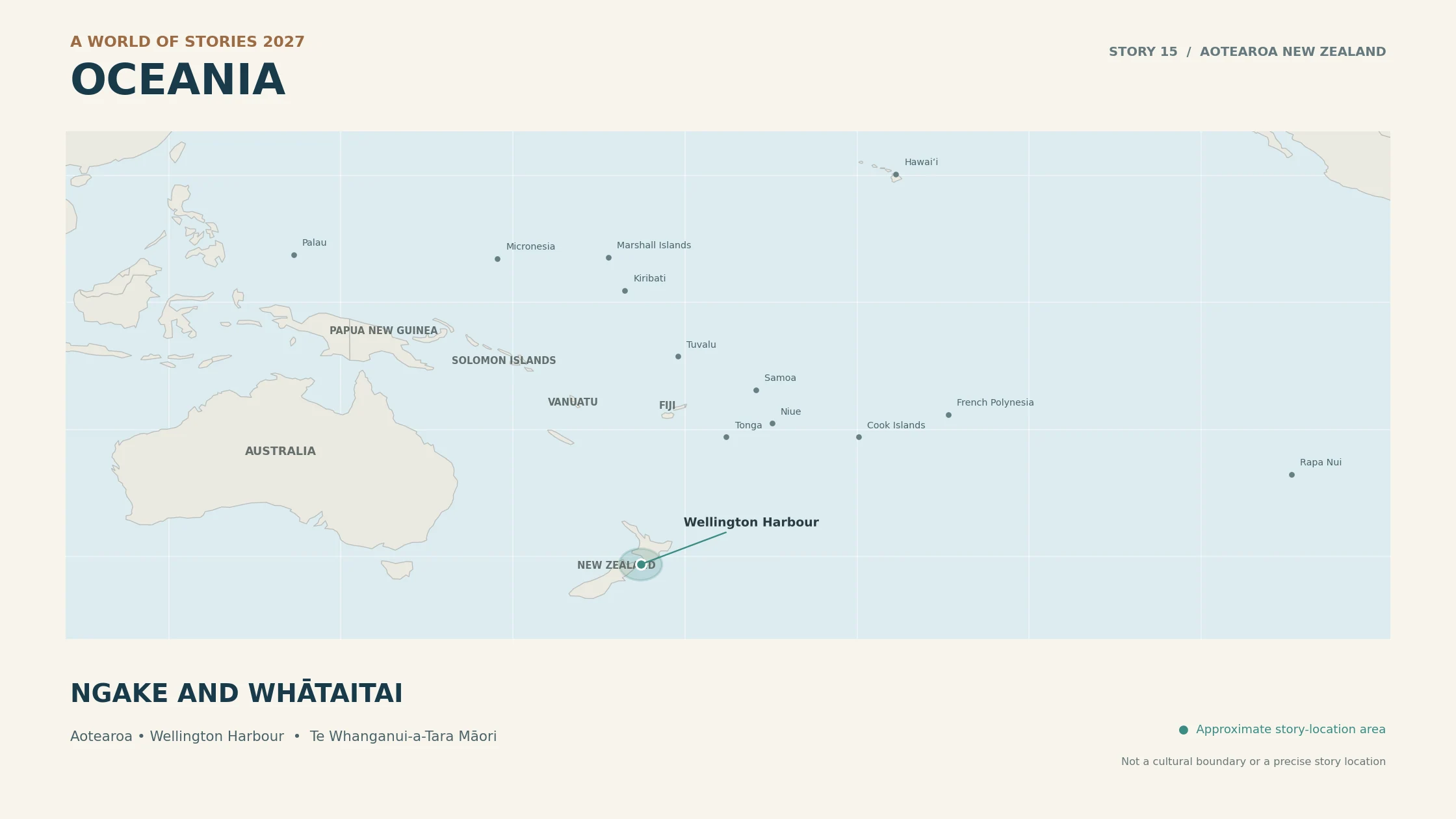
Long ago, before the harbour at Wellington opened to the sea, a great freshwater lake lay between the hills. Its waters were home to fish, eels, and birds, and beneath the surface lived two taniwha named Ngake and Whataitai.
Ngake and Whataitai shared the lake, but they were very different. Ngake was restless. He sped through the water and longed to discover what lay beyond the hills. Whataitai was content in their familiar home. He enjoyed the quiet shores and the creatures that lived nearby.
At the southern edge of the lake, the two could hear the ocean striking the land beyond. The sound stirred Ngake’s curiosity. What was that vast water like? How far did it reach? The lake, however, was enclosed by solid ground. There was no passage from their home to the sea.
At last Ngake could bear the confinement no longer. Gathering his tremendous strength, he rushed towards the barrier of land. He forced his way through, tearing open a channel to the ocean. The waters of the lake poured through the new opening. In the tradition, this breach became the entrance to Te Whanganui-a-Tara, Wellington Harbour.
Whataitai, too, wanted to reach the open sea. He tried to follow, but he did not escape. As the water shifted and the land changed, the great taniwha became stranded on the shore. Ngake was free to roam the waters beyond the harbour, while Whataitai could go no farther.
The creatures that had known Whataitai gathered near him. When his life came to an end, the story says, his spirit rose in the form of a bird called Te Keo. The bird flew to the hill now known as Matairangi, or Mount Victoria, and cried out in sorrow. The name Tangi te Keo remembers that lament.
Whataitai’s resting place became part of the land. The name Hataitai recalls him, while the channel left by Ngake remains the harbour’s entrance.
So the hills and waters around Wellington carry the memory of two taniwha: one whose strength opened a path to the sea, and one whose story remains in the shore and the name of a hill.
Source: This is a child-friendly retelling of a Maori place tradition associated with Te Whanganui-a-Tara (Wellington Harbour), following the core events documented by Te Ara – The Encyclopedia of New Zealand. Variations exist across tellings; it is not presented as an authorised version from a particular iwi.
After the Story: Read · Create · Reflect · Share
Explore: What made Ngake and Whataitai feel differently about their home?
Reflect: How can a story help people remember the names and shapes of places?
Think & Share: Why might the ending of this story feel both powerful and sad?
Create: Draw your favorite scene from this story and imagine what happens next.
Inspired by this story? Create your illustration!
New Guinea
PAPUA NEW GUINEA — How the Turtle Got His Shell
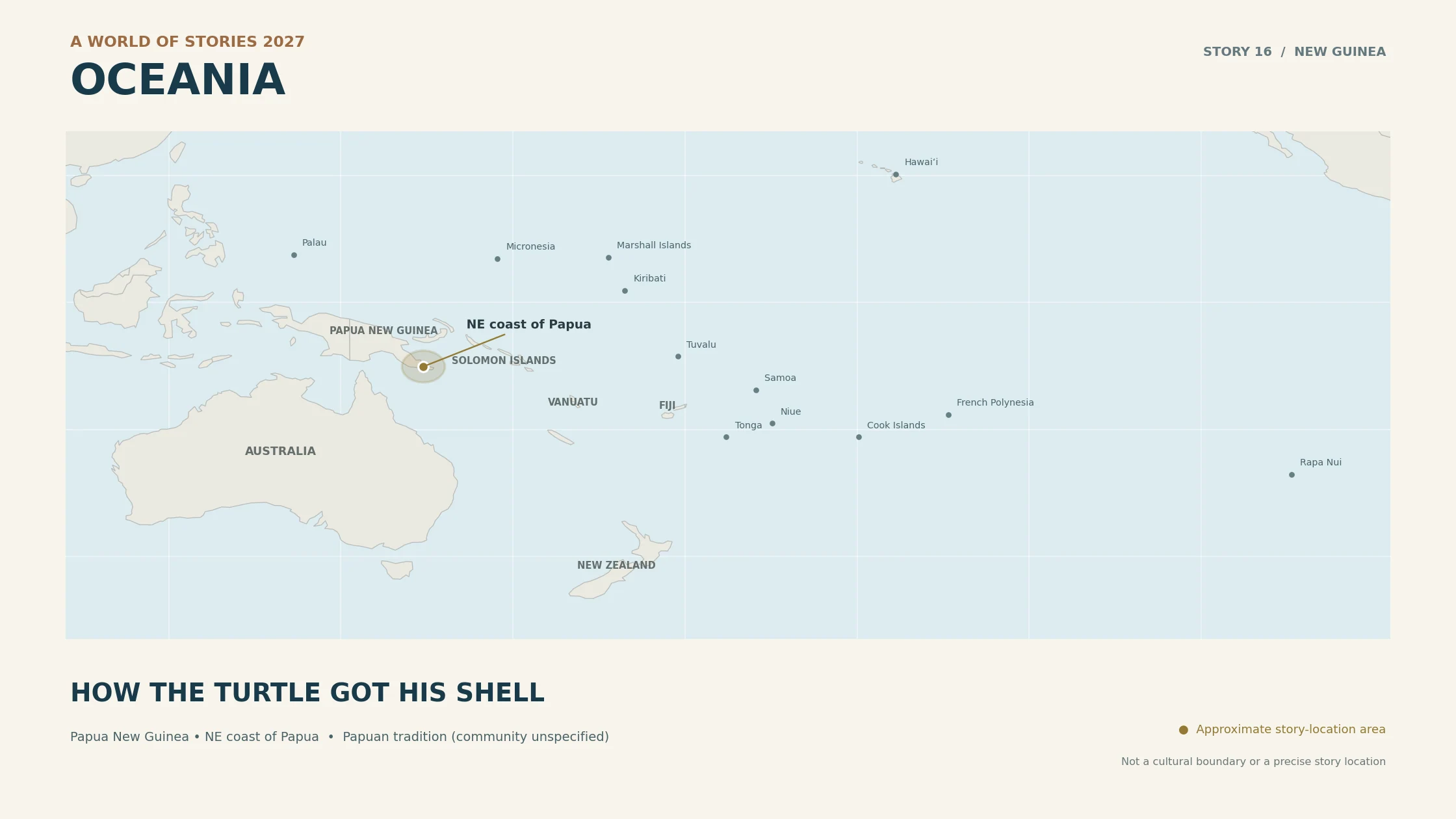
Long ago, Turtle and Wallaby were friends. One day Turtle grew hungry and suggested that they go down to the beach and then visit the garden of Binama the hornbill. There, he knew, bananas and sugarcane were growing in abundance.
The two friends entered the garden and began to eat. Wallaby bent the tall banana stalks so that Turtle could reach their fruit. He did the same with the sugarcane and with the flowering rush called orabu. They ate until their hunger was satisfied, without asking the garden’s owner.
Meanwhile, Binama and the other birds were working in their own gardens. When their work was done, they dug up taro roots, carried them home, and prepared them for cooking. Binama asked someone to fetch seawater from the beach to season their food. But one bird after another found an excuse not to go. They feared an enemy might be waiting along the path.
At last Wagtail volunteered. He hung a shell breastplate, or kada, around his neck, tied feathers about his head, and took up his spear. As he hurried toward the shore, he darted from side to side, ready to avoid anyone who might attack him. On the way he passed Binama’s garden—and there stood Turtle and Wallaby, eating the plants.
Both friends were frightened. But Turtle spoke first. He claimed that Binama himself had invited them to eat the bananas. Wagtail did not believe him. Without arguing, he filled his containers with seawater and returned to the village by another path. There he called out that Turtle and Wallaby were eating in Binama’s garden.
The birds seized their spears and surrounded the garden. Wallaby saw them and escaped with one great leap. Turtle could not jump like his friend. He hurried into a patch of yams and hid beneath the leaves, but the birds searched until they found him. When they dragged him out, he protested that Wallaby had brought him there and bent down the plants. The birds would not listen. They tied Turtle to a pole, carried him back to Binama’s house, and set him on a shelf until morning.
The next day Binama and the other birds went out to gather food for a feast. They left the children to watch Turtle. In a gentle voice, Turtle asked the children to untie him so that they could play together. They agreed. Stiff from being bound, he climbed down from the shelf and stretched his limbs.
Then Turtle asked to see their finest ornaments. The children brought him a long necklace made of shell money, two shell armlets, and a wooden bowl. Turtle wrapped the necklace around his neck, put on the armlets, and fastened the bowl to his back. He asked the children to watch him parade in his splendid decorations. They laughed as he crawled a short way and returned. He tried it again, and they laughed once more.
On the third occasion Turtle heard voices approaching. Binama and the other birds were coming home. This time Turtle did not return to the children. With the bowl still upon his back, he made for the sea as quickly as he could. The children shouted that their prisoner was escaping, and the birds gave chase.
But Turtle reached the water first. As he swam, the birds called for him to lift his head. When he did, they hurled stones at him. One stone broke his left armlet. A second broke the right one. When Turtle raised his head again, another stone snapped the string of his shell-money necklace, scattering its pieces.
The birds called a final time. Turtle lifted his head above the water, and they threw all the great stones they could find. The stones struck the wooden bowl on his back—but the bowl did not break. Turtle swam far out to sea, where Binama and his followers could no longer reach him.
And that, the old tale tells us, is why turtles still carry a hard shell upon their backs: it is the bowl Turtle took from Binama’s house long ago.
Source: Adapted from "How the Turtle Got His Shell," in Annie Ker, Papuan Fairy Tales (London: Macmillan, 1910), pp. 3-6. The book describes collection chiefly among people of a village on the northeastern coast of Papua, but does not clearly attribute this individual tale to a named people.
After the Story: Read · Create · Reflect · Share
Explore: Why do you think Wagtail chose not to argue with Turtle in the garden?
Reflect: How did Turtle use the children’s trust to escape? Was his choice fair to them?
Think & Share: What does the wooden bowl explain at the end of this traditional tale?
Create: Draw your favorite scene from this story and imagine what happens next.
Inspired by this story? Create your illustration!
PAPUA NEW GUINEA — The Two Lizards
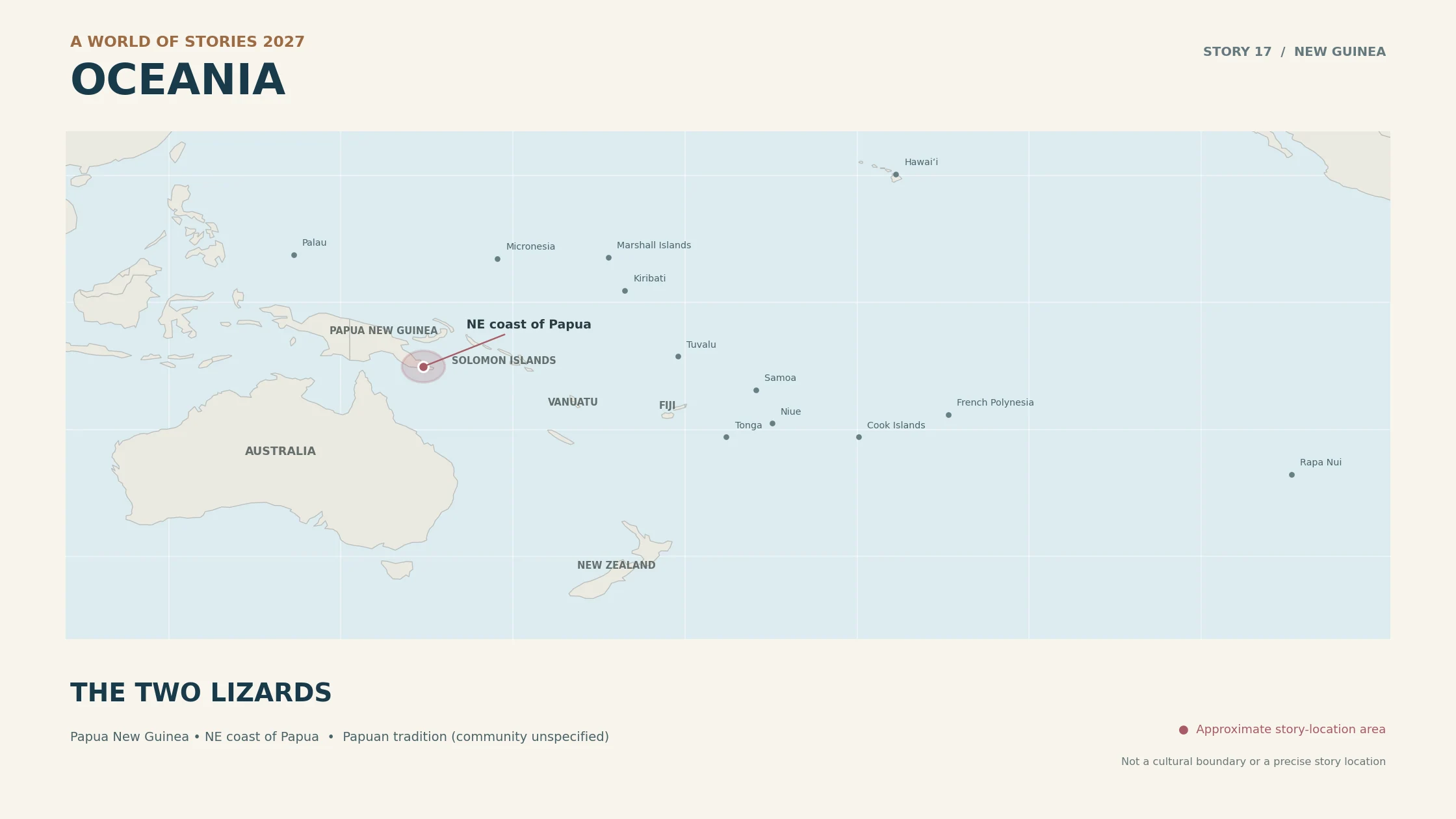
Long ago there lived two lizards named Webubu and Nagari. They were very different. Webubu could speak plainly, but he could not call out with a beautiful voice. Nagari, however, had a long neck. When he stretched it, he could make a soft, sweet sound almost like a whistle.
Nagari wished for company. So he lifted his head, stretched his neck, and sang. Women who heard the lovely call came to see him. They gathered around and listened so quietly that they might have been asleep. Nagari was delighted and sang his long note again and again.
Webubu had no such gathering. He watched and wondered how he, too, might draw listeners. "I cannot sing as Nagari does," he said to himself. "What can I do?"
Then he had an idea. He cut a slender piece of hollow bamboo and made small holes along its length. In the old tale, this was the first duraio—a flute.
Webubu carried his new instrument to the beach. There, high in a corkwood tree called a tioba, he built a platform. He climbed up, sat down, raised his flute, and began to play.
Nearby, the women were still sitting around Nagari, singing as before. But suddenly another sound floated through the air. It was Webubu’s flute, its notes high and sweet.
The women listened in delight. "Hush!" they told Nagari. "Do not drown out that wonderful new music. We want to hear it!"
Nagari was astonished. Until that moment, everyone had loved his voice. Now they hardly wished to listen.
One woman stood up. "I shall go and find where the music comes from," she said. "I will return." She followed the sound toward the beach—but did not come back.
After a while, a second woman rose, promising to return, and she too went in search of the music and remained away. One after another the women left, until at last Nagari sat alone again.
Meanwhile Webubu was happily playing his duraio on the platform in the tioba tree. Then he saw the women approaching. There were so many of them that he worried about the little platform he had built.
"Please stay on the ground!" he called. "Do not climb into the tree!"
But the women wanted to be as close as possible to the music. They began to climb. Soon they had all crowded onto Webubu’s platform.
The platform could not bear so much weight. It gave way, and Webubu, his flute, and all his eager listeners came crashing down through the branches of the tioba tree.
And that, the story says, is why the tioba trees along the shore lean down toward the earth to this day.
Source: Adapted from "The Two Lizards," in Annie Ker, Papuan Fairy Tales (London: Macmillan, 1910), pp. 1-2. Ker states that her collection was gathered chiefly from a small village on the northeastern coast of Papua. This is a literary adaptation of an early colonial-era record.
After the Story: Read · Create · Reflect · Share
Explore: Why did Webubu decide to make a flute instead of trying to copy Nagari’s voice?
Reflect: How do you think Nagari felt when his listeners walked away?
Think & Share: Why did Webubu warn the visitors not to climb onto the platform?
Create: Draw your favorite scene from this story and imagine what happens next.
Inspired by this story? Create your illustration!
PAPUA NEW GUINEA — How the Flying Fish Lived First in a Tree
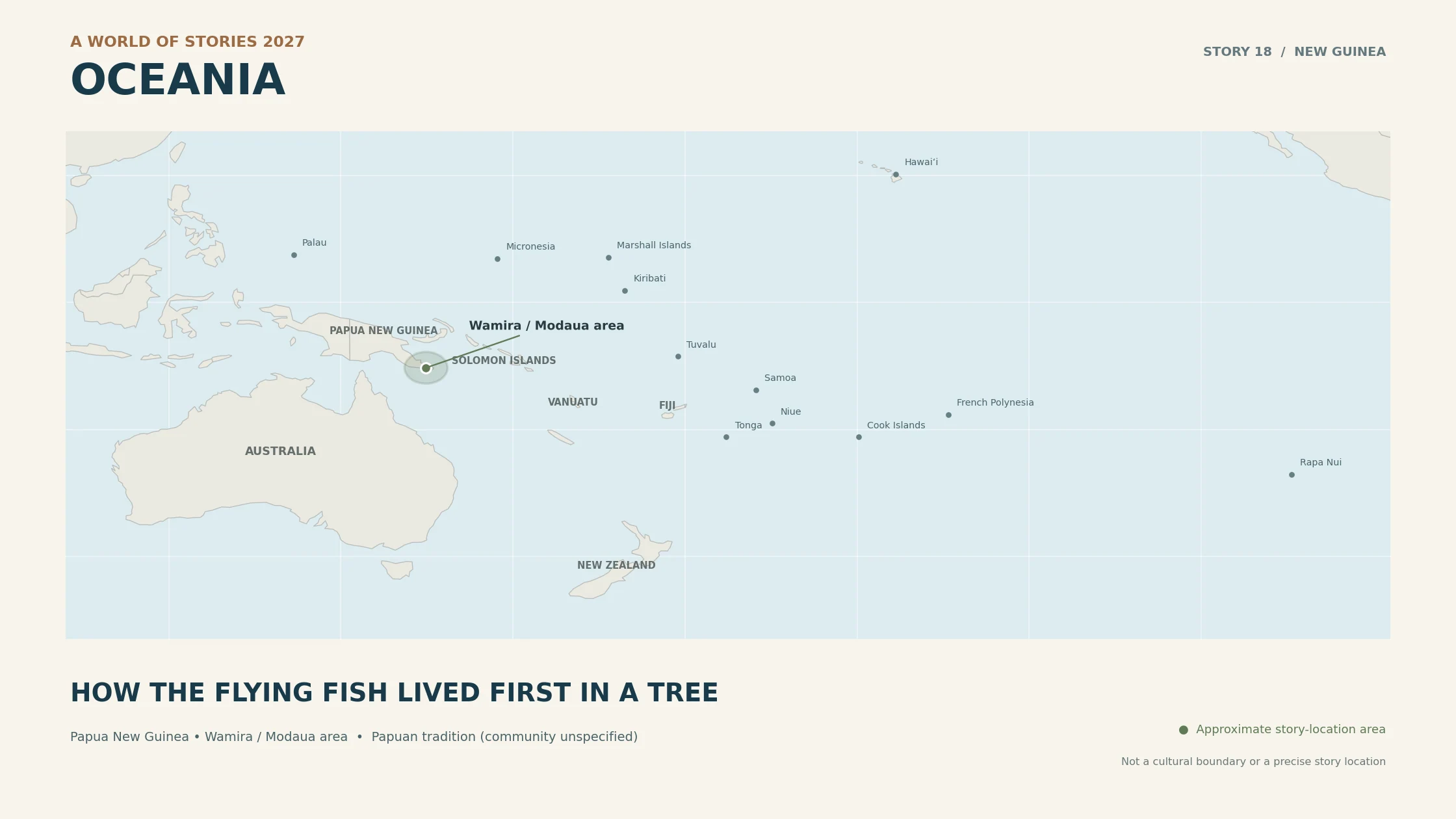
Long ago, the story says, there was dry land everywhere. The sea had not yet spread across the earth. Unknown to the people, all its waters were held inside a tree in Modaua, east of Wamira. And inside those hidden waters swam flying fish.
At that time a man lived with his wife, Kemiana. One day he was hunting with his dog when the animal disappeared. He called, but the dog did not return. At last he went to look for it.
He found the dog beneath a tree, eagerly eating small, shining white creatures scattered on the ground. The man had never seen anything like them. He did not know that waves inside the tree had washed flying fish out through a hole in its trunk.
He gathered some of the strange fish and brought them home to Kemiana. Kemiana was hungry, so she ate. Almost at once she fell into a deep sleep. When morning came she did not wake, and the children were frightened. They shook her until at last she opened her eyes.
But Kemiana was not ill. She asked what wonderful food she had eaten, for she had slept more peacefully than she could remember. When the others saw that the fish had done her no harm, they tasted them too.
Soon many people wanted flying fish. Each day a few more came through the opening in the tree, but there were never enough for everybody. "Let us cut the tree down," the men decided. "Then we shall have all the fish we need."
Two groups, the Lavarata and the Aurana, went with stone axes and provisions. The Aurana began cutting into the trunk while the Lavarata prepared food for the workers. After long, hard blows, the Aurana stopped to eat. While they rested, the Lavarata quietly took up the axes and struck the trunk themselves. With only a few more blows, the great tree fell.
Out of the fallen tree rushed an enormous flood. Water spread farther than anyone could see, carrying every kind of fish. The people watched the dry land become the sea.
The tree had fallen upon the resting Aurana, and the rushing waters swept them far from shore. According to the tale, they became seafolk who dwelt among the floating spawn of flying fish.
Yet the first sea did not look as it does today. When the water burst from the tree, it was red, the colour of blood. The Lavarata cut down an ebony tree, scraped dark shavings from its wood, mixed them with water and squeezed the mixture into the sea. The water changed, but it was not yet the familiar sea. They cut down a second tree and did the same again. This time the water turned blue and became salty, and the people were pleased.
When the sea had first rushed out, most of its fish had been carried away. But the flying fish stayed hidden in the shallow swamps near the shore. The women found them there, and each day they went fishing, from the first call of the birds until sunset. Their gardens were left untended, and weeds grew among the food plants.
The men feared the gardens would be choked. At last an old man said that he would send the flying fish away, so people would no longer find them so easily beside the land. He went to the swamps and told the fish they must live far out in the sea, coming near to be caught only in their proper seasons, and that the catch should be shared fairly.
Then the old man picked up broken pieces of coral and threw them toward the flying fish, driving them from the swamps into the open sea.
And that, the tale says, is why flying fish live far from shore and come into fishermen’s nets only at certain times. The marks on their heads are remembered as traces of the coral the old man threw when he sent them away.
Source: Adapted from "How the Flying Fish Lived First in a Tree," in Annie Ker, Papuan Fairy Tales (London: Macmillan, 1910), pp. 25-29. Ker collected most tales in the volume from narrators on the northeastern coast of Papua.
After the Story: Read · Create · Reflect · Share
Explore: Why did the people decide to cut down the tree, and what happened that they did not expect?
Reflect: What do the changes in the sea’s colour explain in this traditional story?
Think & Share: Why did the old man want the flying fish to move farther away, and what rule did he give about sharing?
Create: Draw your favorite scene from this story and imagine what happens next.
Inspired by this story? Create your illustration!
PAPUA NEW GUINEA — The Cassowary
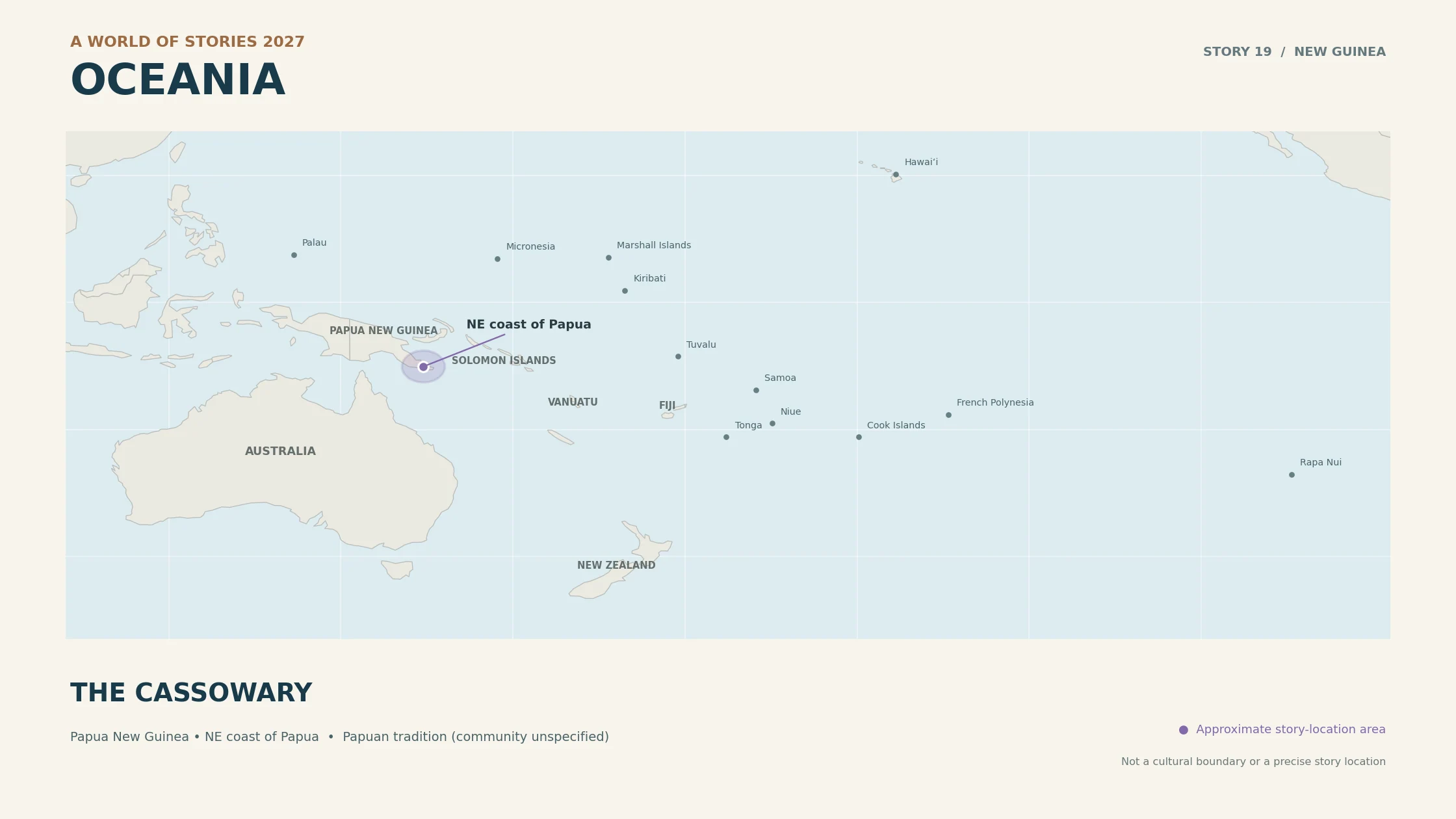
Long ago, a man and his wife lived with their baby. The woman stayed at home to care for the child, while her husband went out each day to work in their garden. Food was growing there, and much of it was ready to harvest. Yet day after day the man returned without bringing anything for his wife to eat.
At last she asked him, "Why have you brought no food for me to cook? What am I to eat?"
"Wait until tomorrow," he told her. "I will bring you food then."
But tomorrow came, and he returned empty-handed. Hungry, the woman put pebbles into a pot of water and boiled them. She drank the hot water and tipped the stones out beside the doorway. It was hardly a meal, but it was all she had.
The next day she waited again. Once more her husband came back with nothing. She boiled another pot of pebbles and drank the water. The heap of stones outside the house grew larger.
"Will you never bring me something to eat?" she asked him.
"Tomorrow," he promised again. "Tomorrow you will have enough."
Now the woman no longer believed his promises. She decided that she would leave. She took two short wooden weeding tools and fastened them to her legs, at the knees and ankles, to help make them strong for a long journey. She tied bunches of coconut-leaf fibres beneath her arms and put a rough banana-leaf skirt over her other clothing.
Then she made a large opening at the back of the house. Still, she waited one last time to see whether her husband would bring food as he had said.
When he appeared, his hands were empty.
"You may eat our food yourself," she said. "And you must care for our child. I am leaving, and I will not return."
She stooped, slipped through the opening at the back of the house, and hurried toward the bush.
Her husband was furious. He snatched up the pebbles that had gathered beside the door and threw them after her. Again and again the stones flew, but none struck her. She ran swiftly onward until the thick growth hid her from his sight.
And there, in the bush, she changed into a cassowary.
The coconut fibres beneath her arms became the stiff quills hidden under a cassowary’s wings. Her rough banana-leaf skirt became its feathers. The wooden tools fastened to her legs became the bird’s powerful legs, able to deliver a dangerous backward kick.
She stayed in the forest and never returned to the house.
Source: Adapted from "The Cassowary," in Annie Ker, Papuan Fairy Tales (London: Macmillan, 1910), pp. 90-91. Ker collected tales chiefly from communities along the northeastern coast of Papua. The recorded version reflects the language and perspective of its time.
After the Story: Read · Create · Reflect · Share
Explore: Why did the woman stop believing her husband’s promises?
Reflect: Which objects became parts of the cassowary, according to the story?
Think & Share: What responsibilities did the husband neglect, and what choices did the woman make?
Create: Draw your favorite scene from this story and imagine what happens next.
Inspired by this story? Create your illustration!
PAPUA NEW GUINEA — The Three Sisters
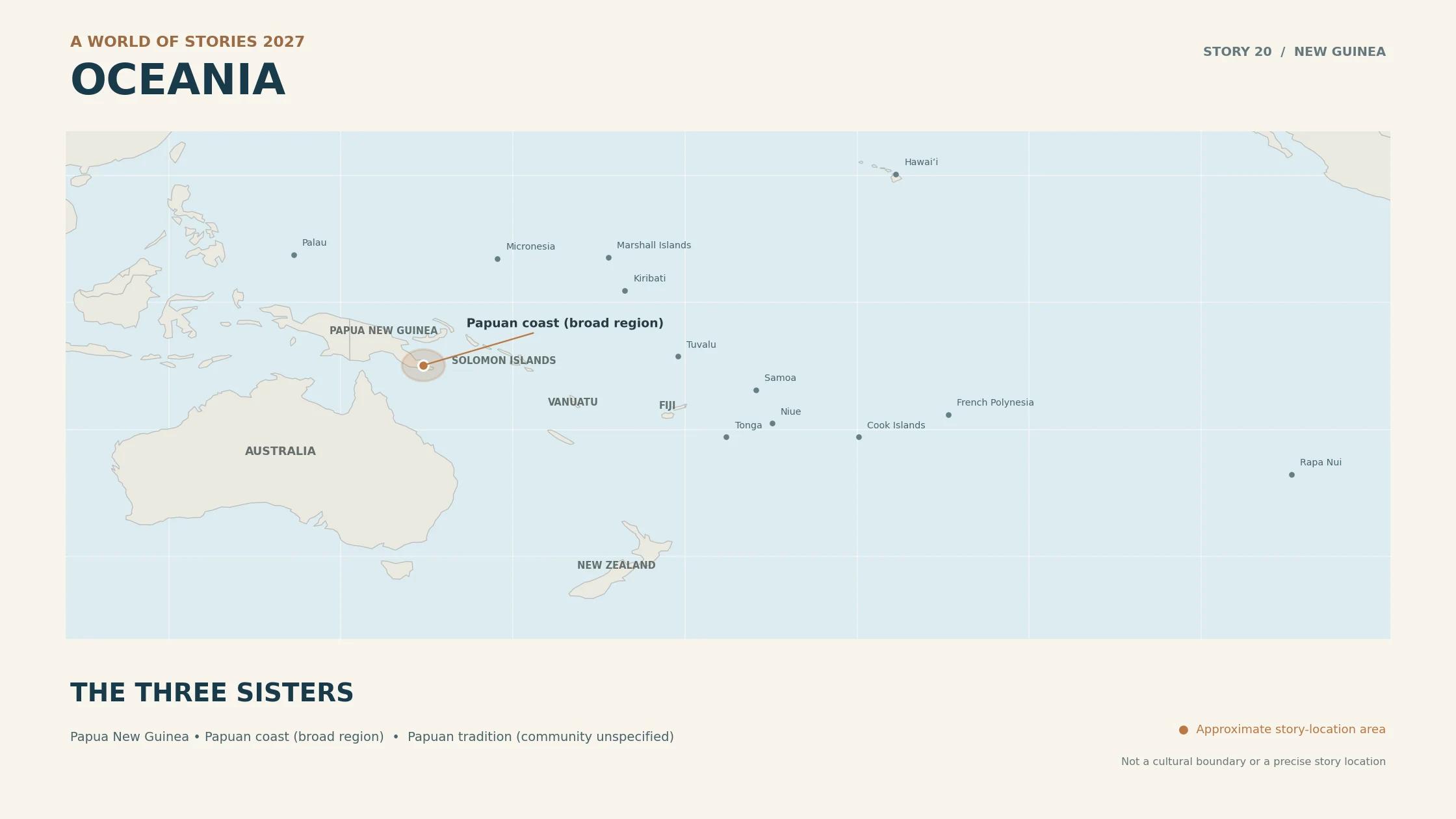
In a village in Papua, three sisters set out one day to fish in the river. The path leading to the water was so narrow that they had to walk one behind another, with the eldest sister in front.
As the eldest sister went along, she saw a snake lying beside the path. The snake spoke to her. "I am hungry," he said. "Will you chew a little of the food you are carrying and give it to me?"
"I will do no such thing," she answered. "You are only a snake. My food is not for you." And she continued toward the river.
After a while the second sister reached the same place. The snake asked her, too, if she would soften a little food for him, because he was hungry.
"No," she replied. "You are only a snake. Let me pass." She walked on after her older sister.
At last the youngest sister came along the path. Once more the snake raised his head and made his request.
"Yes," the youngest sister answered, without fear. She sat beside him, took some of the taro she carried, chewed it until it was soft, and fed it to him. When he had eaten for a while, she asked, "Have you had enough?"
"Yes," he said. "I am no longer hungry. Where are you going?"
"To the river to fish."
"Then listen to me," said the snake. "When you hear the first noise in the sky, fish. But when you hear the second, climb the hill."
The youngest sister said goodbye and went on, wondering what the snake could mean. When she reached the river, her sisters were nowhere to be seen. They had gone ahead without waiting for her.
Suddenly there was a roll of thunder. She remembered the snake’s words and began to fish. Before long, her basket was full.
Then thunder sounded a second time. At once she left the river and hurried up the hillside. From that high place she watched heavy rain fall. The river flooded, and great trees were carried away by the rushing water. She remained on the hill until the storm had passed.
When the waters had settled, she went down and started toward home. There, beside the path, lay the snake. He lifted his head when he saw her.
"Where are your companions?" he asked.
"I do not know where they are," she replied sadly. "They must have been swept out to sea when the river flooded."
"If they had given me food when I asked," the snake said, "they would still be alive."
The youngest sister opened her basket, chose some large fish, and wrapped them in a green leaf. She offered the bundle to the snake. He took it in his mouth and disappeared into the bushes.
The old storyteller ends by explaining that this was no ordinary snake. He was a bariawa, a snake who could speak as a person speaks.
Source: Adapted from "The Three Sisters," in Annie Ker, Papuan Fairy Tales (London: Macmillan, 1910), pp. 147-149. Ker gathered stories chiefly in a village on the northeastern coast of Papua.
After the Story: Read · Create · Reflect · Share
Explore: What did each sister choose to do when the snake asked for food?
Reflect: How did the youngest sister use the snake’s warning when the storm came?
Think & Share: What does the final exchange between the girl and the snake add to the story?
Create: Draw your favorite scene from this story and imagine what happens next.
Inspired by this story? Create your illustration!
PAPUA NEW GUINEA — Where the Coconut Came From
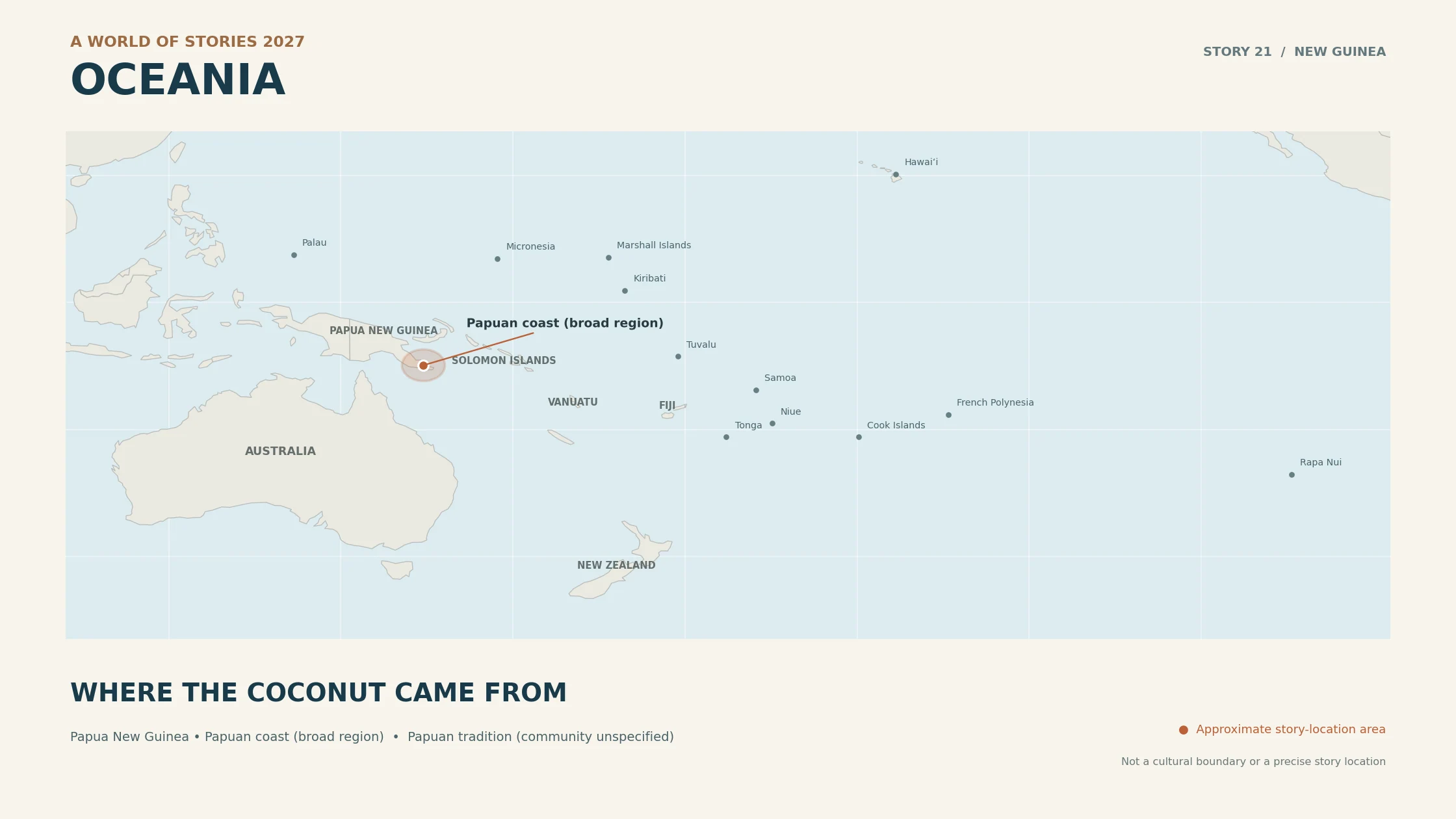
Long ago, the storytellers said, there were no coconut palms in the land. People drank water when they were thirsty, and they ate their taro without coconut milk. Because they had never known a coconut, they did not feel that anything was missing.
In one village the men went fishing almost every day. But there was one fisherman who always went alone and always returned with a basket filled to the brim. The other men wondered how he could catch so many. One day a boy offered to follow the fisherman secretly and discover what he did.
The next morning the boy crept after the fisherman to the seashore and hid behind a tioba, a corkwood tree. From there he watched the fisherman put down his basket. Then something astonishing happened. The man raised both hands to his head, pulled it from his shoulders, and laid it on the beach beside his basket.
Leaving his head behind, the fisherman walked into the sea until the water reached his waist. He bent forward. Fish swam toward him in great numbers and entered through his open throat. The boy, watching from behind the tree, was frightened by what he saw.
After a while the man came ashore, shook the fish out, picked up his head and set it back upon his shoulders. The boy ran home before the fisherman could see him.
That evening the boy would not eat any of the fish the man had brought. Later, away from the others, he told several men exactly what he had witnessed. They decided that the next day they would follow the fisherman themselves.
In the morning the men hid near the shore and watched the fisherman remove his head and walk into the water. As the fish began to swim toward him, one of the watchers rushed from hiding, seized the head from the sand, and hurled it into the bushes.
When the fisherman returned, he shook out his fish and reached for his head. It was gone. He searched the beach, feeling among the stones, but could not find it. Then, suddenly, he hurried into the sea, changed into a great fish, and disappeared beneath the water.
Many days later, the boy remembered the head that had been thrown into the bushes. Curious, he went to look. He found no head. In its place stood a slender palm tree with spreading leaves, a kind of tree that no one in the village had ever seen before.
In time the tree bore fruit, but people were afraid to eat it. At last one woman dared to taste the nuts and use their milky liquid on her skin. No harm came to her. Seeing this, the others began to use the fruit as well, and discovered that it could provide food, drink, and many other useful things.
And that, the old story says, is how the first coconut came into the world. The storyteller ends by inviting listeners to look closely at a coconut after its husk has been removed: the marks on it resemble a face, a reminder of the fisherman whose lost head became the first coconut.
Source: Retold from "Where the Coconut Came From," in Annie Ker, Papuan Fairy Tales (London: Macmillan, 1910), pp. 92-96. This is an adaptation of an early colonial-era English transcription; the story’s explanation of the coconut is traditional folklore, not a scientific account.
After the Story: Read · Create · Reflect · Share
Explore: Why did the villagers become curious about the fisherman, and what did the boy discover?
Reflect: What happened when the men took the fisherman’s head? How did that lead to the first coconut palm?
Think & Share: Why were the villagers afraid of the new fruit, and what changed their minds?
Create: Draw your favorite scene from this story and imagine what happens next.
Inspired by this story? Create your illustration!
Melanesian Islands
SOLOMON ISLANDS — Kamakajaku and the Journey to the Sun
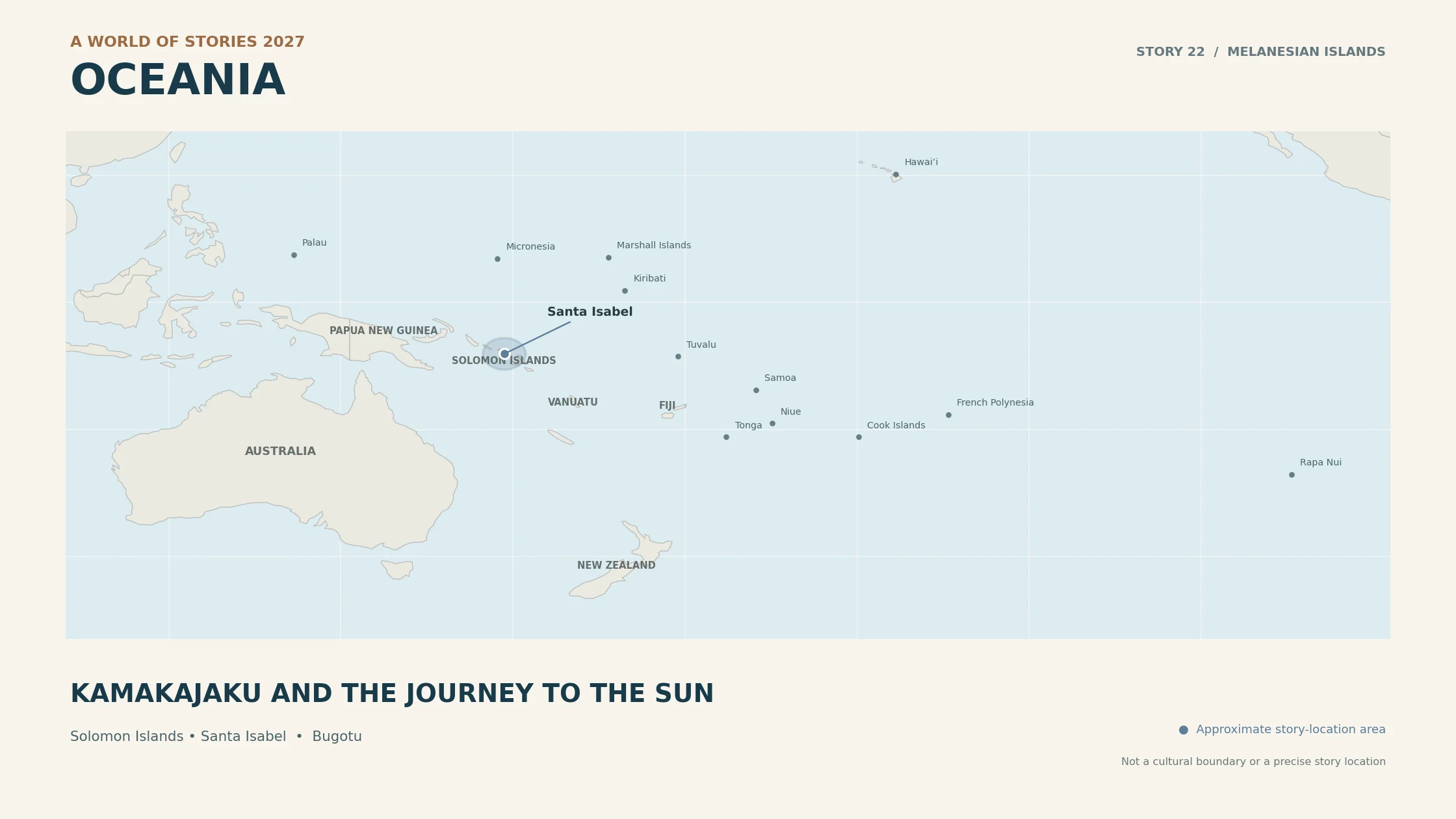
Long ago, Kamakajaku lived on a hill called Gaji. One day, while he sat repairing his fishing nets, he looked down at the sea and noticed a patch of water darker than all the rest. He wondered what made it look so strange.
His grandchildren were going to fish along the reef, so he asked them to bring back seawater from that very place. They did, but the water did not look like the dark patch he had seen from the hill.
The next morning he decided to go himself. He took a vessel for the water and tucked a sharp piece of obsidian into his ear. At the beach he laid down his bag, club, and shield, then waded out into the sea. He swam farther and farther until, looking back, he could see the hill at Gaji rising above the shore. Only then did he dip his vessel into the water.
Suddenly the sea bubbled around him. A huge kingfish, called a Kombili, came rushing through the water. Before Kamakajaku could escape, it swallowed him and carried him far to the east, toward the place where the sun rises.
Inside the great fish, Kamakajaku felt it begin to thrash in shallow water. He remembered the obsidian tucked in his ear, felt for it in the darkness, and used its sharp edge to cut his way out. He leapt free and found himself in a strange, bright place.
As he sat wondering where he had come, the Sun itself rose, rolling and moving with a tremendous sound. "Do not stand in my way," the Sun warned him. "Move to my right, or you will die." Kamakajaku hurried aside. Then, as the Sun climbed upward, he followed it into the sky.
They came at last to the village of the Sun’s children and grandchildren. The Sun went on its way, leaving Kamakajaku among them. He stayed with the Sun’s family. They ate their food raw, and Kamakajaku showed them how to use fire to cook it.
But there was one place they told him not to visit. Kamakajaku could not forget the warning. One day he went to the forbidden place and lifted a stone that covered an opening in the sky. Through it he could see his own hill at Gaji, far below. At the sight of his home he began to weep.
When the Sun’s family found him, they understood that he wished to return to the earth. They built a little house to carry him, gave him a banana and seeds used for dyeing, and fastened a long cane to the house so that it could be lowered through the opening.
Before he began his descent, they gave him careful instructions. He must not look out when he heard the cries of birds. Only when he heard cicadas and other creatures that live on the earth would he know that he was near the ground.
Down went the little house, hanging from its cane. Whenever one length of cane proved too short, the Sun’s family tied on another. Lower and lower it went until it reached the hill at Gaji and came to rest.
All this time Kamakajaku’s friends had been searching for him, believing he had died at sea. When they saw him return from the sky, their sorrow turned to joy. Kamakajaku was home again. He lived for many more years on his hill at Gaji, and there, in time, his life came to an end.
Source: Adapted from "The Story of Kamakajaku," recorded as a Bugotu story from Ysabel (now Santa Isabel) Island in R. H. Codrington, The Melanesians: Studies in Their Anthropology and Folk-Lore (Oxford: Clarendon Press, 1891), Chapter XIX. The nineteenth-century English transcription is a historical record, not a community-reviewed contemporary version.
After the Story: Read · Create · Reflect · Share
Explore: Why did Kamakajaku go into the sea himself after his grandchildren brought him water?
Reflect: What did Kamakajaku teach the Sun’s family, and what did he learn from them?
Think & Share: What made Kamakajaku want to return home, even after his extraordinary journey?
Create: Draw your favorite scene from this story and imagine what happens next.
Inspired by this story? Create your illustration!
VANUATU — Qat Brings the Night
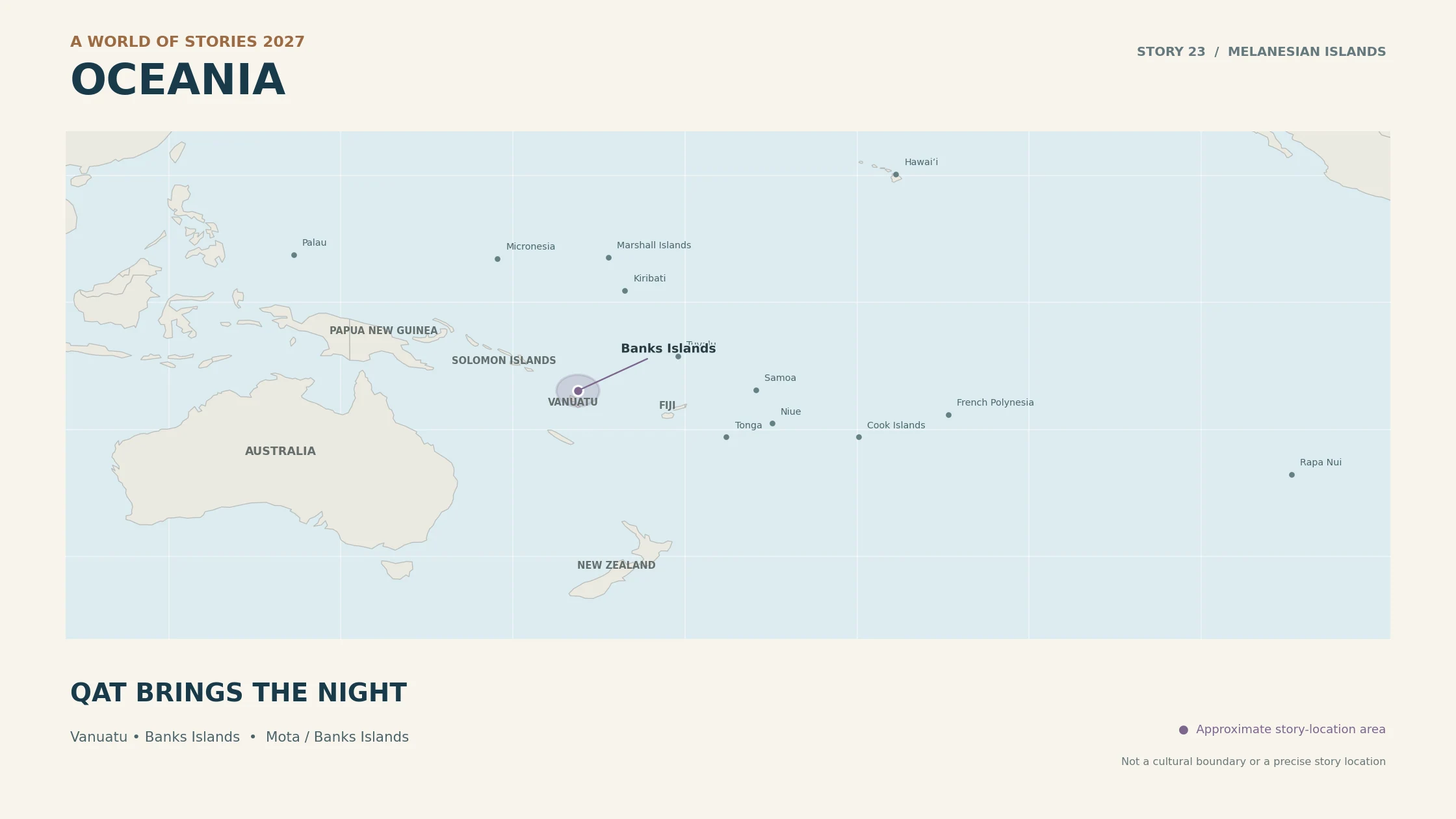
In the early days, Qat lived with his eleven brothers in the village of Alo Sepere, on Vanua Lava. Qat was a clever and powerful spirit. He made many things: people, pigs, trees and stones. But one thing was missing. There was no night. Daylight went on and on, and the brothers could never enjoy the rest that darkness brings.
At last they called to him. "Qat, this is not pleasant at all! There is nothing but day. Can you do something?"
Qat thought about their complaint. He heard that night could be found far away, at Vava in the Torres Islands. So he tied up a pig, put it in his canoe and set out across the sea. There he met I Qong—Night itself—and bought night to take home. Another telling says that he travelled to the foot of the sky, where Night darkened his eyebrows, showed him how to sleep and taught him how to bring the dawn.
When Qat returned, he brought not only the knowledge of night but also a fowl and other birds. Their voices would tell the world when daylight was coming back.
First Qat told his brothers to make places where they could lie down. They wove coconut-palm leaves together and spread them inside their house. The brothers wondered why they needed beds, but they did as he asked.
Then something extraordinary happened. The sun began to move down towards the western horizon. The brothers stared after it in alarm. "Qat! It is going away!"
"Soon it will be gone," Qat told them. "When the world changes around you, that is night."
He released the night he had brought. Darkness rose from the direction of the sea and spread across the sky. The frightened brothers cried out to Qat, asking what was covering everything. He told them to sit on either side of the house. When their eyes began to feel strange and heavy, they should lie down and be still.
The light faded. Their eyes blinked, and they grew afraid. "Qat! What is happening? Are we going to die?"
"Close your eyes," he answered. "This is sleep."
For the first time, the brothers slept. When night had lasted long enough, the fowl crowed and the birds began to call. Qat took a piece of red obsidian and cut through the darkness. Daylight shone once more, and his brothers woke to see the world again.
From then on, in this traditional story, light and darkness took turns. People could work by day and rest at night, and the birds would announce the coming of morning.
Source: Adapted from "The Story of Qat," in R. H. Codrington, The Melanesians: Studies in Their Anthropology and Folk-Lore (1891), pp. 156-157. Codrington credits an account translated from the Mota of the late Deacon Edward Wogale, of Sepere heritage.
After the Story: Read · Create · Reflect · Share
Explore: Why did Qat’s brothers want night, even though they already had daylight?
Reflect: How did the brothers react when they experienced darkness and sleep for the first time?
Think & Share: What roles do the birds and the red obsidian play in the return of morning?
Create: Draw your favorite scene from this story and imagine what happens next.
Inspired by this story? Create your illustration!
FIJI — The Turtle Women of Namuana
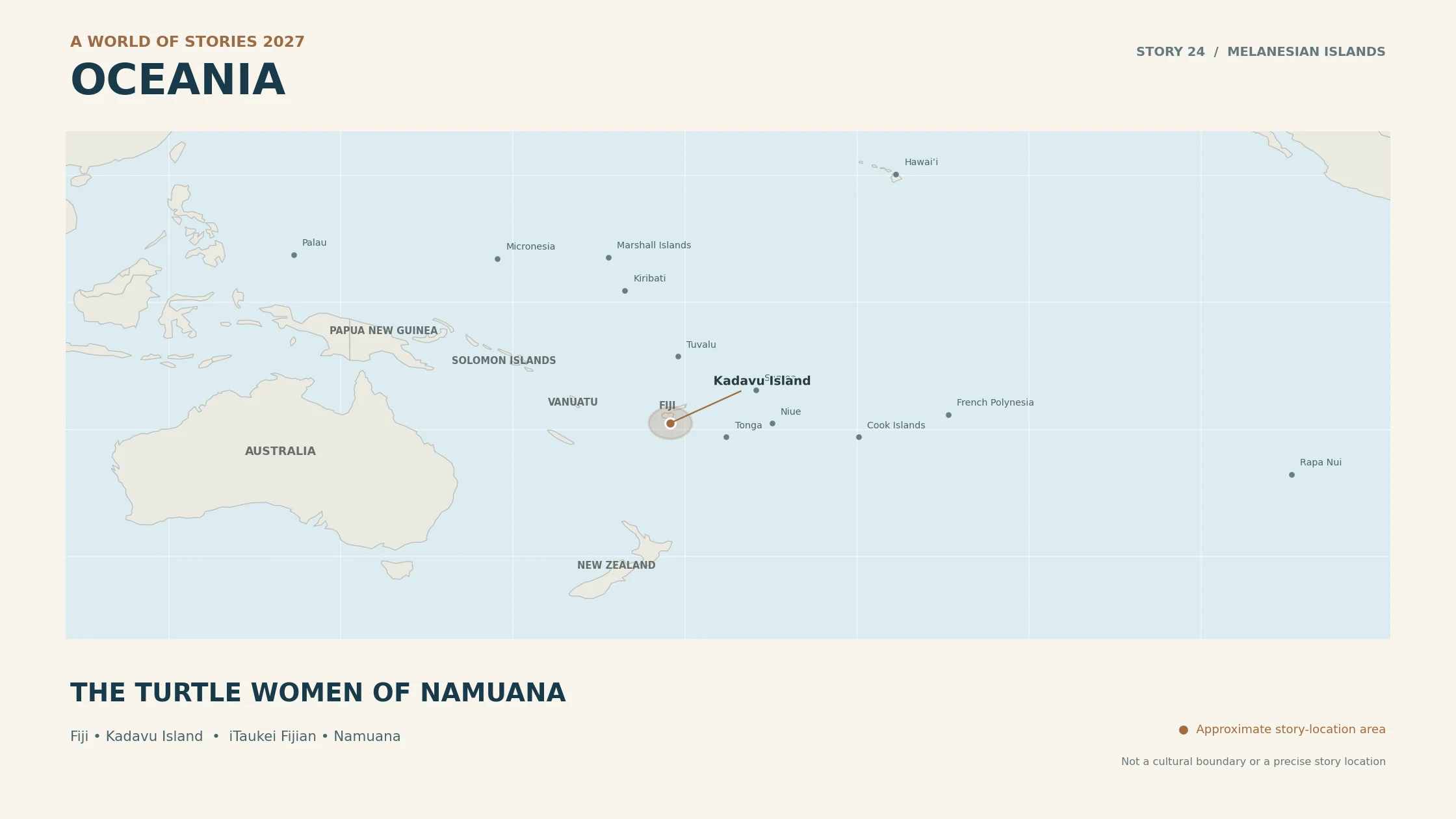
Long ago, in the village of Namuana on the island of Kadavu, lived Tinaicaboga, the wife of the village chief, and her daughter, Raudalice. The two often went fishing together among the reefs near their home.
One day, they waded farther than usual onto the reefs stretching from the headland east of the bay. Intent on their fishing, they did not see a large canoe approaching across the water. In it were men from Nabukelevu, another village on Kadavu.
The men came close without being noticed. They captured Tinaicaboga and Raudalice, tied their hands and feet with vines, and carried them into the canoe. Then they set out toward Nabukelevu.
The mother and daughter begged to be freed, but their captors would not listen. The canoe continued across the sea, taking them farther from Namuana.
Then a storm rose. The wind drove enormous waves against the canoe, and water poured inside. The men struggled as their craft was tossed about. It seemed that the sea might swallow them all.
In the midst of the storm, the men looked down into the water collecting in the canoe. Tinaicaboga and Raudalice were no longer there as women. According to the legend, the powers of the sea had transformed them into two turtles.
Terrified that the canoe would sink, the men lifted the turtles and threw them into the waves. As soon as the two entered the sea, the storm ceased. The water grew calm, and the men continued toward their village.
But Tinaicaboga and Raudalice did not return to Namuana as they had left it. The legend says that they lived on as turtles in the waters near their home, and that the turtles seen there are their descendants.
The women of Namuana kept their memory alive through a special song. Standing on the rocks above the bay, they called to Tinaicaboga and Raudalice by name and asked them to rise from the sea so that the villagers might see them again.
In the tradition told at Namuana, turtles rise to the surface when the women sing. The story connects the creatures of the bay with the two women, the village, and a song passed down through generations.
Source: This is an independent English retelling of a traditional account associated with Namuana, Kadavu, recorded in "A Folklore of Turtle Calling in Fiji," Marine Turtle Newsletter 58 (1992). The legend is not a scientific explanation of sea-turtle behaviour.
After the Story: Read · Create · Reflect · Share
Explore: What changed when the sea grew stormy, and what happened when the turtles entered the water?
Reflect: Why might the people of Namuana keep singing a song about Tinaicaboga and Raudalice?
Think & Share: How can a traditional story connect a community with the animals and places around it?
Create: Draw your favorite scene from this story and imagine what happens next.
Inspired by this story? Create your illustration!
SOLOMON ISLANDS — The Heron and the Turtle
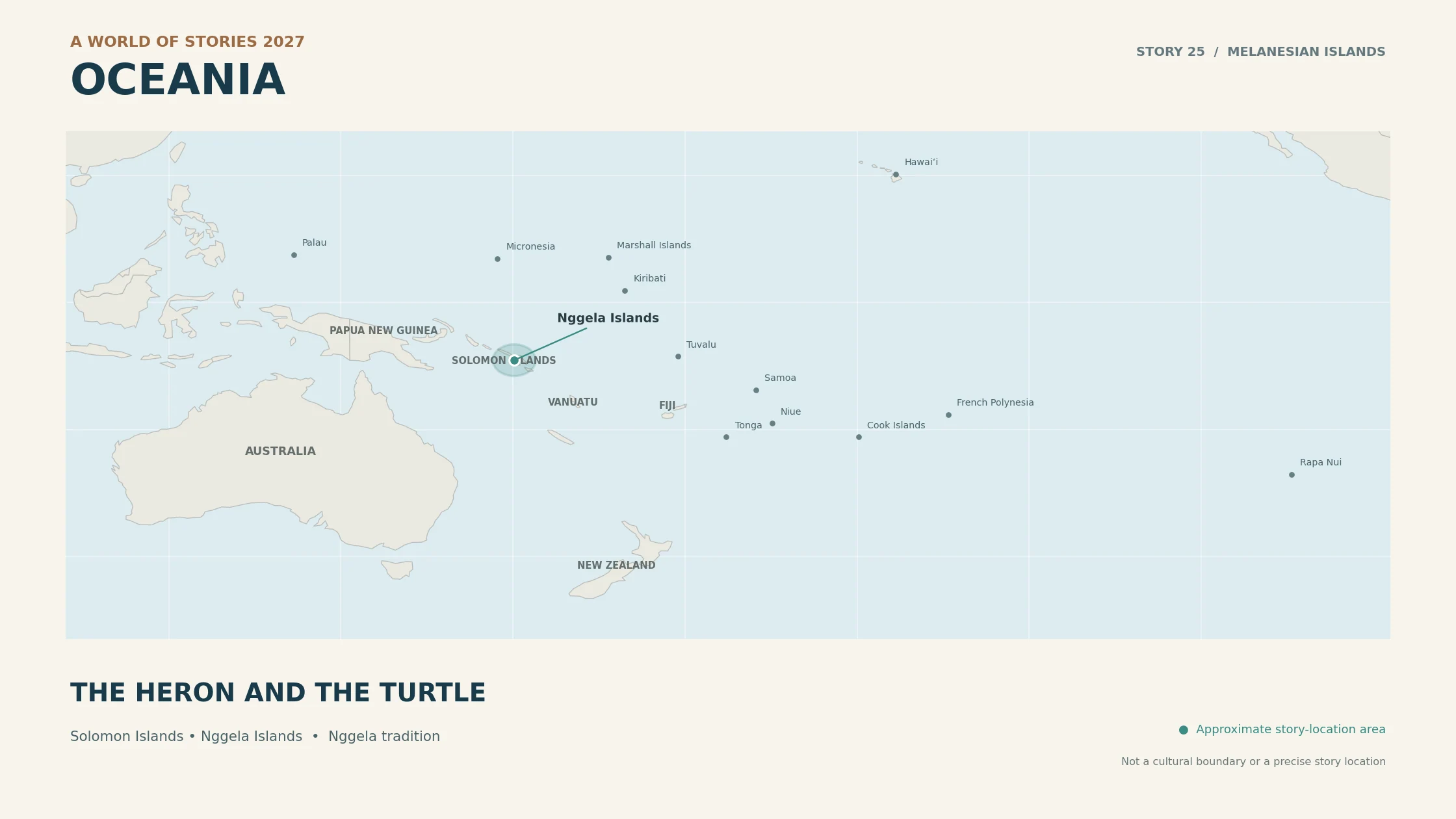
One day, a heron called Soo was walking across the coral when one of his feet became trapped between the rocks. He pulled and struggled, but could not free himself. Meanwhile, the tide was rising.
At first Soo could still keep his head well above the water. His neck was very long. But the sea climbed higher and higher, until even that long neck was nearly submerged.
A shark swam past. "Come and save me!" Soo called. The shark told him to wait and went on its way. Next came a fish, a great garfish, a rock-cod, and a crocodile. Soo appealed to each in turn. None of them freed his foot, and the tide continued to rise.
At last a turtle swam close. "Brother, come here and save my life!" cried Soo.
"What will you give me in return?" asked the turtle.
"I have nothing with me," said Soo. He offered the turtle valuable things, including ornaments made from dogs’ teeth and porpoises’ teeth. But the turtle refused them. Then Soo noticed a sea urchin beside him and offered that instead.
The turtle was delighted. He ate the sea urchin, broke apart the coral that held Soo’s foot, and set him free.
"You have saved my life," Soo told him. "If ever you are in danger, and I hear you calling, I will come to save you."
Some time later, people from Hagelonga went out to fish. They lowered a large net into the water. Many fish passed by, but finally the turtle entered the middle of the net. The fishers hauled him up, tied him securely, carried him ashore, and built a fence around him, planning a feast.
While the adults were out preparing for the feast, some boys were left to guard the turtle. Soo arrived. He had heard of the turtle’s trouble, and now it was his turn to help.
"Where have you come from?" the boys asked.
"Oh, I am just wandering about," answered Soo. "Would you like to see me dance?"
The boys eagerly agreed. Soo asked them to bring their families’ finest ornaments made of dogs’ teeth and porpoises’ teeth so that he could dress for the dance. They brought the ornaments, and Soo put them on.
He began to dance, moving step by step toward the enclosure where the turtle was held. When the turtle saw him, he called out in distress that his life was in danger.
"You saved me before," Soo answered. "Now I shall save you."
Soo kept dancing and chanting his repeated refrain. With each part of the chant, another restraint was released. First the turtle’s bound leg came free, then his head slipped loose, and soon the front and back of his body were clear.
The dance went on. Soo’s chant directed the turtle toward the path, then across the sand and down to the sea. Into the water the turtle went, diving farther and farther until he was out of sight.
The boys had been so intent on the dance that they had not stopped him. When the adults returned and found the enclosure empty, they demanded to know what had happened.
"Only a heron came here," the boys explained. "He danced for us. We gave him your ornaments, and while we watched him we did not look after the turtle."
The villagers searched the ground and saw the turtle’s tracks leading away across the sand. They understood: the turtle had escaped.
And so Soo had kept his promise. The turtle had once freed him from the coral, and when the turtle’s own life was in danger, the heron had returned to save his friend.
Source: An independent, child-accessible retelling of "The Heron and the Turtle," recorded in the Florida (Nggela) Islands, Solomon Islands, in R. H. Codrington, The Melanesians: Studies in Their Anthropology and Folk-Lore (1891).
After the Story: Read · Create · Reflect · Share
Explore: Why did the turtle accept the sea urchin when he refused the other things Soo offered?
Reflect: How did Soo use dancing and cleverness to help his friend without confronting the villagers?
Think & Share: What does this story suggest about remembering kindness and keeping promises?
Create: Draw your favorite scene from this story and imagine what happens next.
Inspired by this story? Create your illustration!
NEW CALEDONIA — The Rat and the Octopus
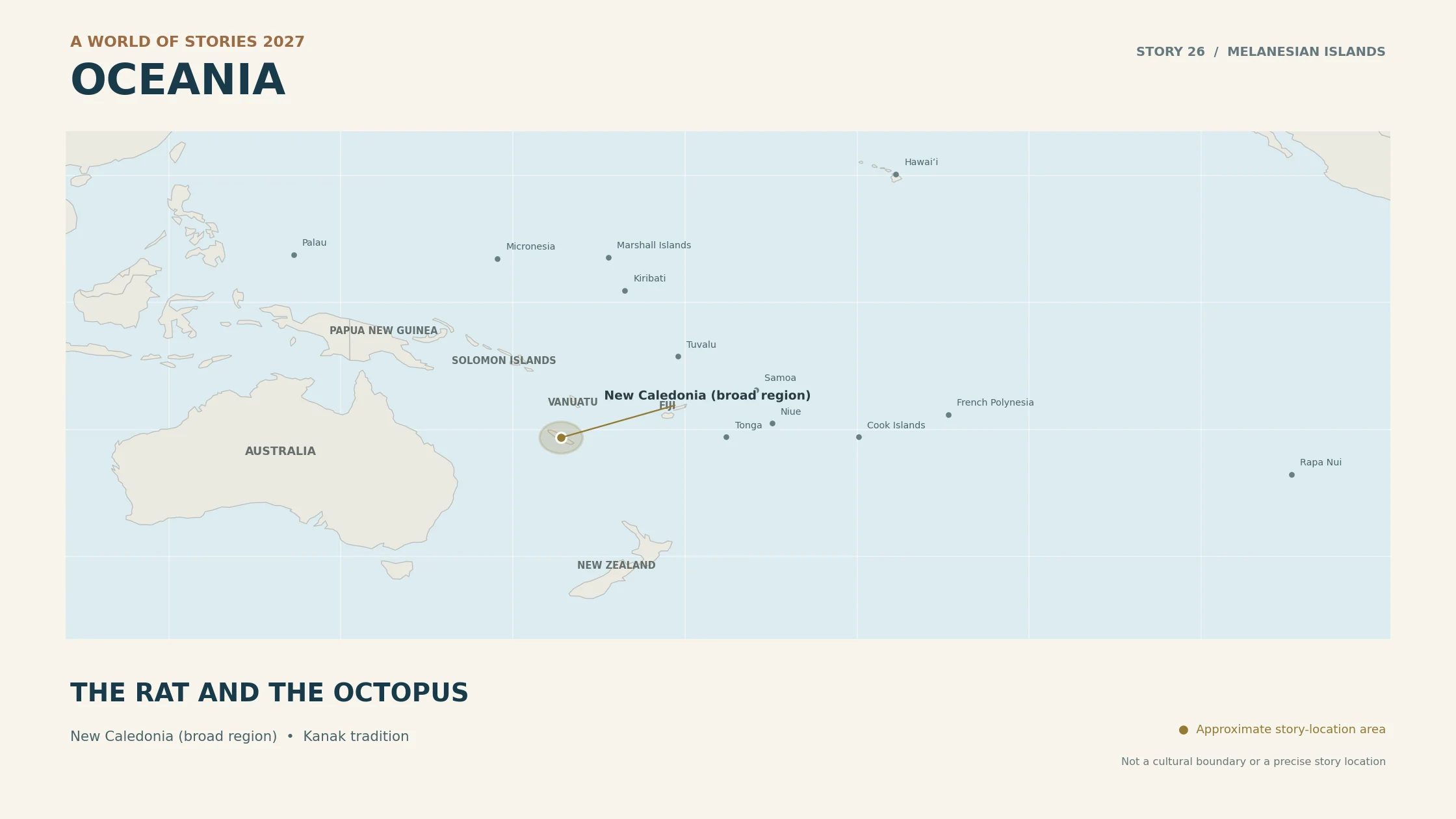
Long ago, a rat lived in friendship with two birds: a seagull and a purple swamphen. The three searched for food together, but one day they found very little to eat. At last the seagull suggested that they go fishing on the coral reef while the tide was low.
"An excellent idea," said the swamphen. The rat, however, looked troubled. "That is easy for you to say. You have wings to carry you over the sea. How am I to reach the reef?"
"We shall build you a raft," said the swamphen. So the three friends gathered sugar cane and set to work. The rat gnawed and cut the stalks into pieces, while the birds fitted them together. Soon they had made a little boat complete with a hull, mast, sail, and rudder—all from sugar cane. The delighted rat climbed aboard, and his companions flew beside him as he sailed toward the reef.
When they reached the exposed coral, the birds told him to wait. "We shall bring back fish," they promised, and away they flew.
The rat waited. And waited. Still the birds did not return. His stomach ached with hunger. At last he began nibbling the sweet sugar-cane sail. When he had eaten that, he chewed the mast, then the rudder. By the time the birds came back with their catch, nothing remained of his boat.
"Where is your raft?" cried the swamphen. The rat hung his head. "I was so hungry, and you were gone so long. I ate it." The seagull was furious. "We worked to make you a boat, and you have eaten it! Then you must stay where you are." The two birds took to the air and left him alone.
But the tide was rising. Water crept across the reef, and the rat scrambled onto the last dry rock he could find. The sea climbed higher. He called out in fear, yet no one answered—until an octopus swam past.
"Why are you sitting here, little one?" asked the octopus. The rat told him what had happened. The octopus listened and said kindly, "Climb onto my back. I am not a fast swimmer, but I can carry you to shore."
Grateful to be rescued, the rat climbed onto the octopus’s head. Slowly the octopus carried him through the water. At last the trees and stones of the shore came into view. The rat was so pleased that he began laughing and wriggling about.
But then he played a most unpleasant trick on his rescuer: he relieved himself on the octopus’s head. "What are you doing?" asked the octopus. "Oh, nothing," said the rat. "I am just so happy to see the land!" A little later he did it again. Then, as soon as they were close enough, he leapt onto the shore and mocked the octopus for the mess he had left behind.
The octopus understood at last. Angered by such ungrateful behaviour, he tried to chase the rat over the rocks. But his long arms were hurt against the sharp stones, and he had to turn back into the deep water. The rat escaped to his hiding place on land.
So ends this old tale of a clever rat who was saved by another creature’s kindness—and answered that kindness with a cruel trick.
Source: Adapted from "The Rat and the Octopus," attributed to Charles Malato and included in Louise Michel, Legendes et chants de gestes canaques (1885). The account is an historical colonial-era publication, not a contemporary community-authorized retelling.
After the Story: Read · Create · Reflect · Share
Explore: Why did the birds become angry when they returned to the reef?
Reflect: How did the octopus show kindness, even though he did not know the rat?
Think & Share: What could the rat have done to thank the octopus?
Create: Draw your favorite scene from this story and imagine what happens next.
Inspired by this story? Create your illustration!
FIJI — The Crane and the Crab
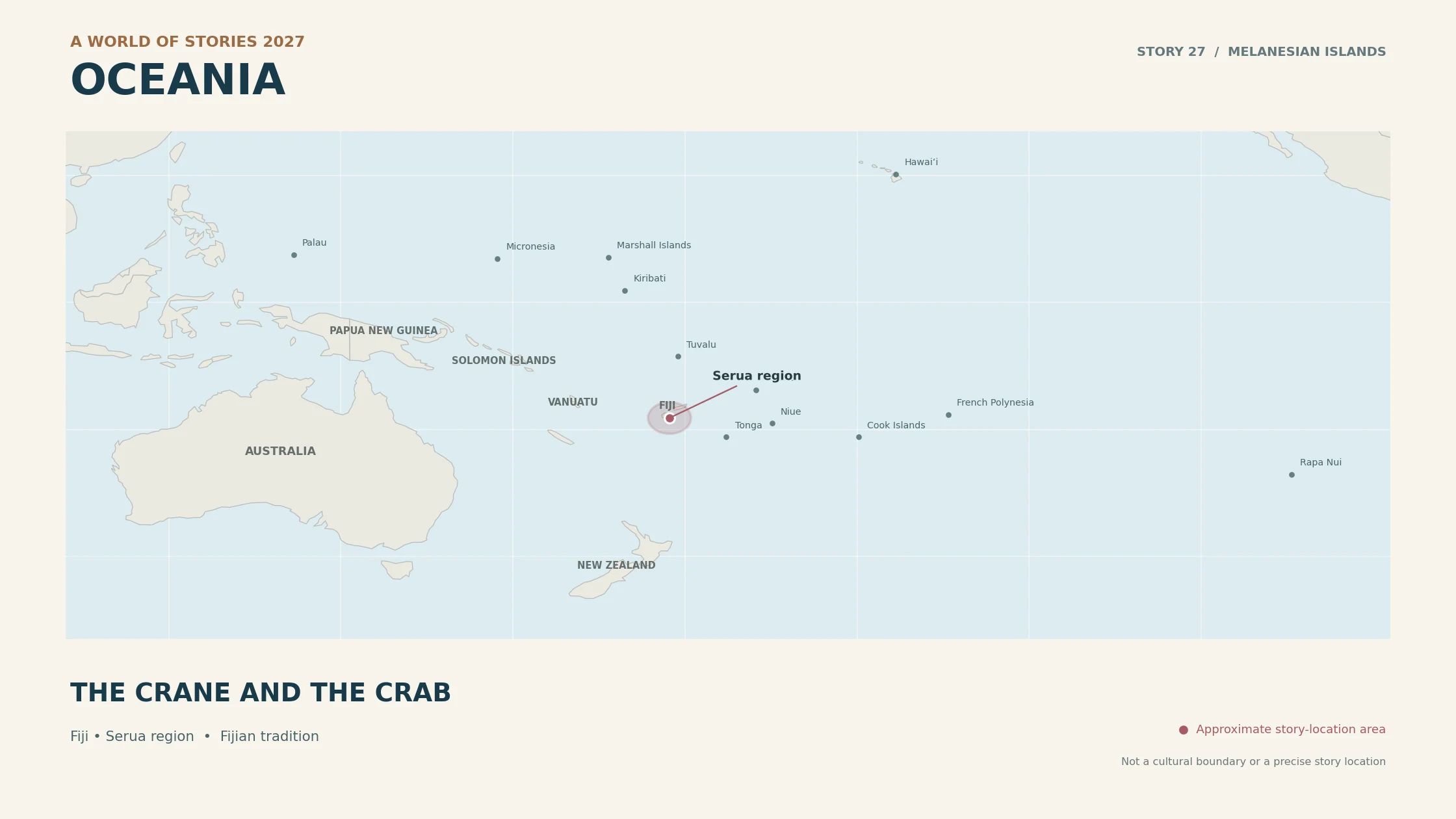
Once, in Fiji, a crane and a crab began to quarrel over which of them could travel fastest.
The crane could fly. With his strong wings he could pass straight over the water, from one point of land to the next. The crab had no wings at all. He had to make his way around the long curves of the shore.
Yet the crab insisted that he could win a race.
"Very well," the crane agreed. "I shall fly from point to point, while you go along the beach. We shall see who reaches the end first."
The crane spread his wings and took off. The crab, however, did not hurry after him. Instead, he stayed quietly in his hole.
For the shores were full of crabs. All along the coast, at one point of land after another, there were crab-holes much like his own. The crab trusted that the crane would mistake his many relatives for the same racer.
The crane swept across the first stretch of water and came down at the next point. There he found a crab-hole. He bent close and listened. From inside came a low, buzzing sound.
"That fellow is here before me!" he exclaimed.
He took to the air again and flew swiftly toward the next point. But there, too, he saw a crab-hole and heard the familiar sound. Again he believed that his opponent had arrived ahead of him.
On the crane flew, from point to point, pressing harder and harder to overtake the crab who seemed always to be waiting for him.
At last, when he reached a point above Serua, the crane was utterly exhausted. He could fly no farther. He fell into the sea and drowned.
That is how the old Fijian fable tells of a crab who won a race without travelling the shore at all—and of a crane whose confidence in his speed could not save him from a trick.
Source: Adapted from the Fijian fable "The Crane and the Crab," recorded in Sir Arthur Gordon’s private journal at Nasaucoko on July 18, 1876, and quoted by C. F. Gordon-Cumming in At Home in Fiji (1881/1882), Chapter XXVIII.
After the Story: Read · Create · Reflect · Share
Explore: Why did the crane think the crab had reached every point before him?
Reflect: Was the crab’s victory fair? What makes you think so?
Think & Share: How might the crane have acted differently when he began to grow tired?
Create: Draw your favorite scene from this story and imagine what happens next.
Inspired by this story? Create your illustration!
Micronesia
PALAU — Uab and the Birth of the Palau Islands
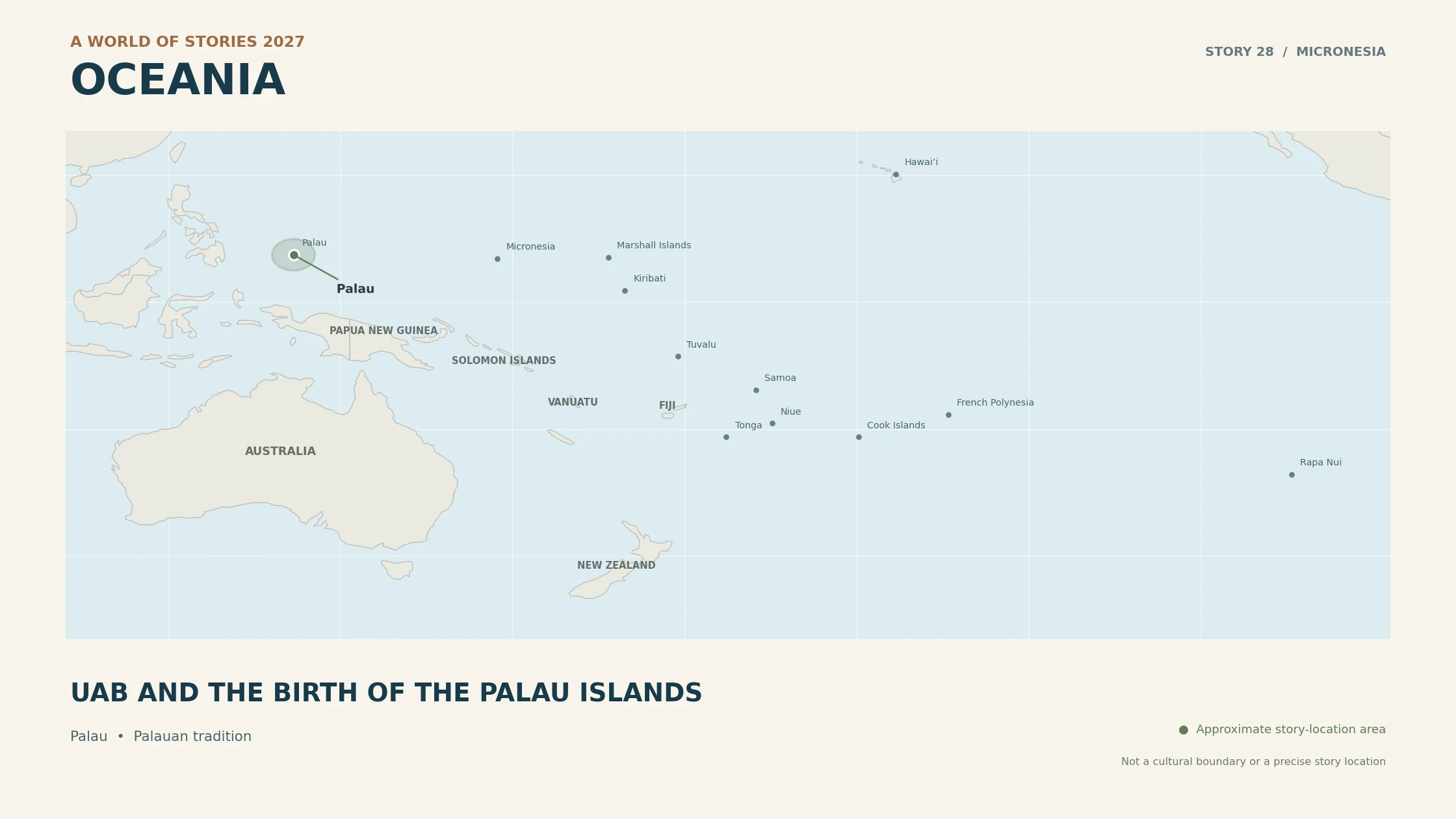
Long ago, according to a Palauan legend, the islands did not yet have the shapes and names that people know today.
A being named Uchelianged created a piece of land called Lukes, between the places now known as Peleliu and Angaur. On Lukes lived a giant clam, called a kim. From that clam came Latmikaik, and Latmikaik, in turn, gave birth to a fish.
Life multiplied on Lukes, until the land grew crowded. There was not enough room for everyone. Uchelianged told the people to gather material floating on the surface of the sea and use it to make another island. That island became Angaur. More and more people settled there, and in time they divided the island into communities and gave names to their homes.
Latmikaik also had a child named Uab. Yet Uab was unlike other children. Day after day, he grew with astonishing speed. As his body grew, so did his appetite. No amount of food seemed enough to satisfy him.
His mother did all she could. When she could no longer provide enough food, she asked the people of the island for help. They brought what they could, but Uab continued to grow, and his hunger continued with him.
The villagers became frightened. They feared that the enormous child and his endless appetite would threaten their lives. At last, they made a terrible decision: they set Uab on fire.
Uab sprang upward in agony. Then his great body fell toward the north, breaking into parts as it struck the earth. In the legend, these scattered parts became the islands of Palau.
The great island of Babeldaob was formed from Uab’s trunk. His head became part of the northern region, and the people of Ngarchelong were said to be especially intelligent because their land lay in the part formed from his head. His lower body and legs, drawn upward as he kicked, formed Aimeliik.
And so the islands spread across the sea, each with its own place and story. To this day, the legend of Uab remembers the making of the Palauan archipelago through the fate of a child whose body grew far beyond the world around him.
Source: Adapted from "Creation of Palau Island: The Legend of Uab," in Traditional Place Names of Palau: From Ridge to Reef, Ministry of Human Resources, Culture, Tourism and Development, Republic of Palau. This is a traditional account of the islands’ origins, not a scientific explanation.
After the Story: Read · Create · Reflect · Share
Explore: Why did Uab’s mother ask the villagers to help her?
Reflect: How did fear change the way the villagers responded to Uab?
Think & Share: How does the legend connect familiar places with a story about the past?
Create: Draw your favorite scene from this story and imagine what happens next.
Inspired by this story? Create your illustration!
MARSHALL ISLANDS — How the Reefs Were Formed on Majuro
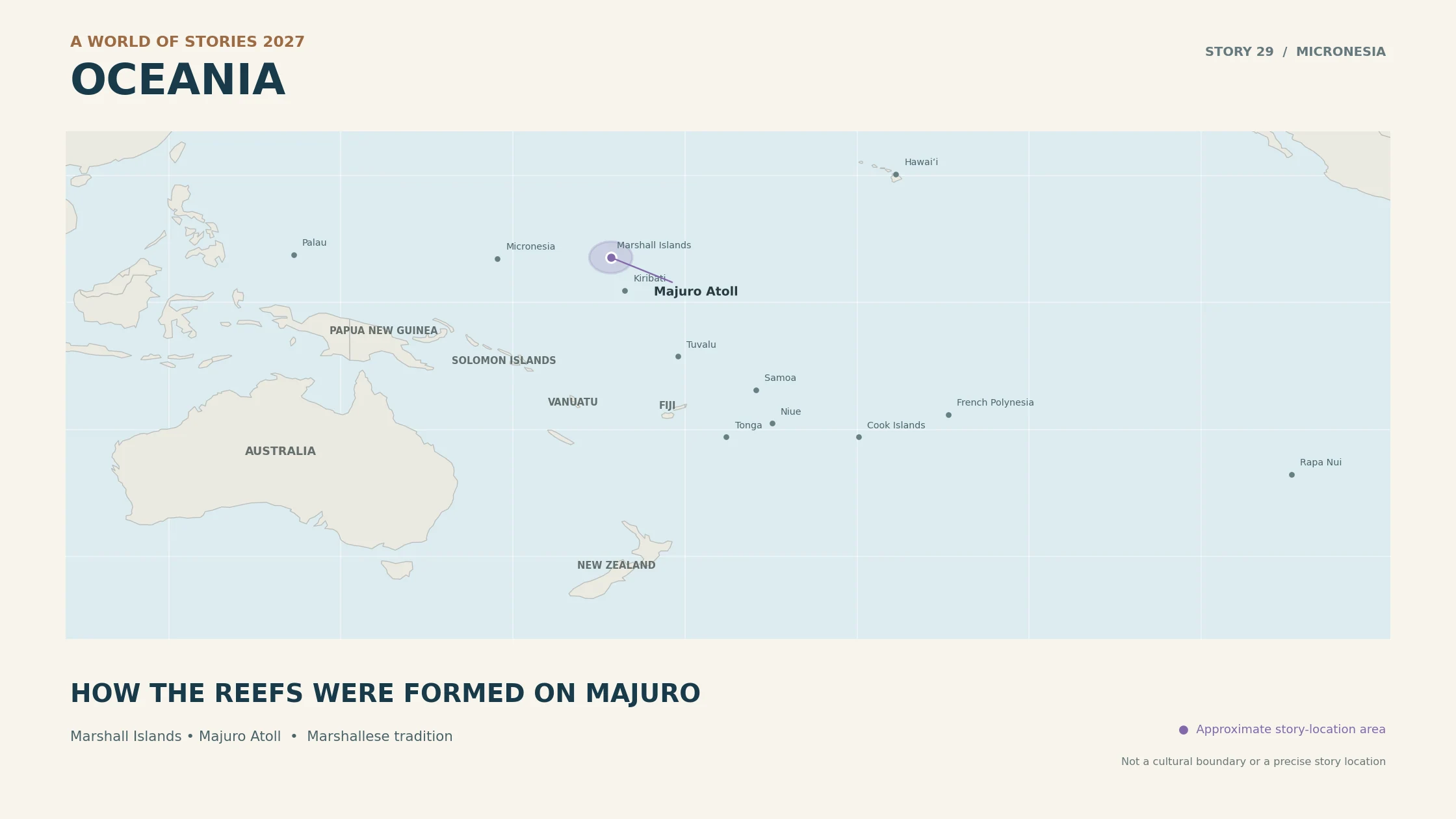
On Majuro Atoll, people told stories about Letao, a man of extraordinary strength who was even more famous for his tricks. Letao could be clever, but anyone dealing with him had to be careful: he was always looking for a chance to fool somebody.
One day, Letao saw the fine canoe belonging to the ruler of Laura. It was a proven vessel, swift and reliable on the water. Letao wanted it for himself. Instead of building an equally good canoe, however, he thought of a different plan.
He found a beautiful kind of timber called kone. Its surface was strong and gleaming, but it had one serious disadvantage: it would not float. That did not trouble Letao, because he had no intention of sailing in the canoe he made from it.
He worked carefully, shaping the timber into an impressive canoe and polishing it until it looked magnificent. Then he visited the ruler and offered to exchange his new canoe for the ruler’s own. The ruler agreed to inspect it the following morning.
After sunset, Letao dragged his heavy canoe down to the shore. When the tide was low, he piled large stones in the shallow water and rested his canoe on top of them. By morning the water had risen around the boat. From the shore, it appeared to be resting neatly on the lagoon, just like a canoe that could float.
When the ruler arrived, he admired the shining vessel. He did not test it on the water. Convinced that Letao’s canoe was better than his own, he agreed to the exchange.
Letao wasted no time. He took possession of the ruler’s trustworthy canoe and paddled away toward the passage that led from the lagoon to the open ocean.
The ruler, meanwhile, stepped into his handsome new craft and began to paddle. Nothing happened. He pushed harder, but the canoe would not move. Then it slid from the stones that had supported it and sank to the bottom of the lagoon.
Furious and dripping wet, the ruler called to his people. They launched their canoes and set off after Letao. Across the lagoon they raced, drawing nearer and nearer to the fleeing trickster.
But Letao was not finished with his tricks. As his pursuers approached, he stirred up sand and coral from the lagoon floor. In the telling of this legend, these rose into reefs and sandbars, blocking the path of the other canoes. Letao sailed on, laughing and singing, until he passed beyond Majuro and disappeared into the open sea.
That, according to the traditional story, is how some of the reefs and sandbars of Majuro came to be. The lagoon still holds the places that storytellers connect with Letao’s clever escape.
Source: A Marshallese legend retold from "How Reefs Were Formed on Majuro," in Peace Corps, Destination: Marshall Islands (1992); credited there to Never and Always, edited by Gene Ashby (Rainy Day Press, 1983). This is a traditional explanation of a landscape feature, not a scientific account.
After the Story: Read · Create · Reflect · Share
Explore: Why was the ruler impressed by Letao’s canoe, and what did he forget to check?
Reflect: How did Letao use his knowledge of the tides to carry out his trick?
Think & Share: Can someone be clever and still act unfairly? Explain your answer.
Create: Draw your favorite scene from this story and imagine what happens next.
Inspired by this story? Create your illustration!
MICRONESIA (POHNPEI) — The Twin Brothers of Nan Madol
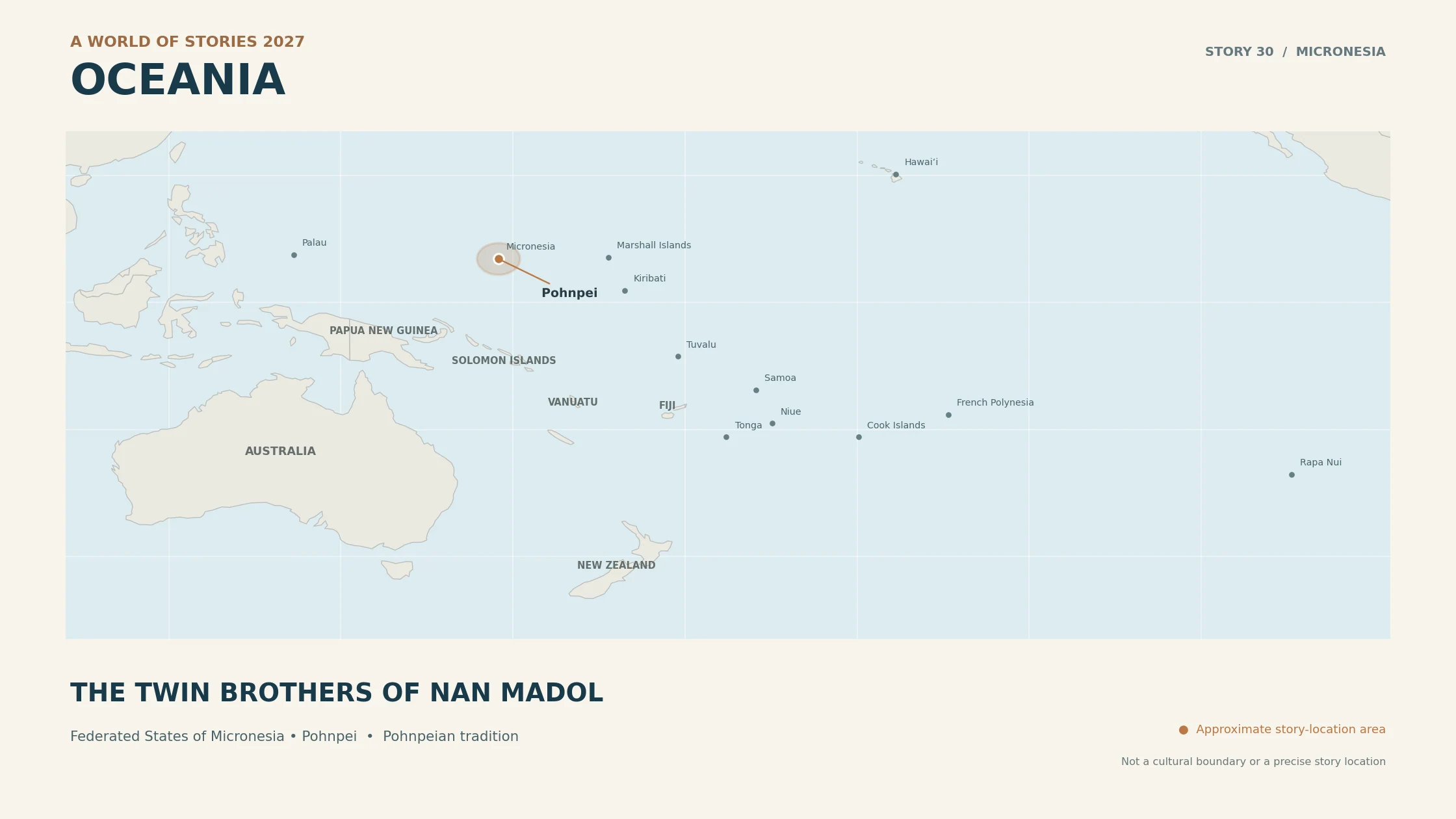
Long ago, according to a tradition told on the island of Pohnpei, two brothers named Olosihpa and Olosohpa arrived by canoe from a distant land called Katau. They were said to possess remarkable powers, and they had come in search of a place where they could establish a sacred center.
The brothers first tried to settle in the northern part of Pohnpei, near Sokehs. There they hoped to create a place for ceremonies honouring the powers of the land. But the place did not suit their purpose.
So the brothers moved on. They searched elsewhere along the island, trying more than once to establish their sacred place, until they reached the waters beside Temwen Island, on Pohnpei’s southeastern coast.
There, on the reef, they finally found the place they had been seeking. The sacred center that grew there became known as Nan Madol. Instead of standing on an ordinary stretch of dry land, it rose upon a series of small, human-made islands, with narrow waterways running between them.
The walls were built of enormous dark basalt stones, some shaped like long pillars. How could such heavy stones be carried and raised? In one version of the legend, the brothers used their powers and a flying dragon helped lift the rocks into place. Other tellings speak of magical flying stones, or of help from powerful beings.
At Nan Madol, the brothers established their place of worship. Their work was not only about stone walls: the city became a center of ceremonies and, in time, of chiefly rule.
Years passed, and Olosihpa died. Olosohpa remained and became the first ruler of the line later known as the Saudeleur. He married a woman of Pohnpei, and the line of rulers continued through their descendants.
Tradition remembers the early rulers as more generous than some who followed. In later generations, the demands placed upon the people grew heavier. Eventually, the Saudeleur rule came to an end, but the stone ruins of Nan Madol remained.
To this day, the canals and great walls can still be seen off Pohnpei. They are real places with a long history, and the story of the two brothers is one of the traditions through which people have explained how this extraordinary center began.
Source: Retold from Pohnpeian oral traditions summarized by the Federated States of Micronesia Office of National Archives, Culture & Historic Preservation, and the UNESCO World Heritage documentation for Nan Madol. Different oral versions describe the founders and the movement of the stones differently.
After the Story: Read · Create · Reflect · Share
Explore: Why did the brothers continue searching instead of staying at the first place they reached?
Reflect: What makes the building of Nan Madol so remarkable, even apart from the legend?
Think & Share: Why might people remember several different versions of the same traditional story?
Create: Draw your favorite scene from this story and imagine what happens next.
Inspired by this story? Create your illustration!
GUAM — Fo’na and Pontan
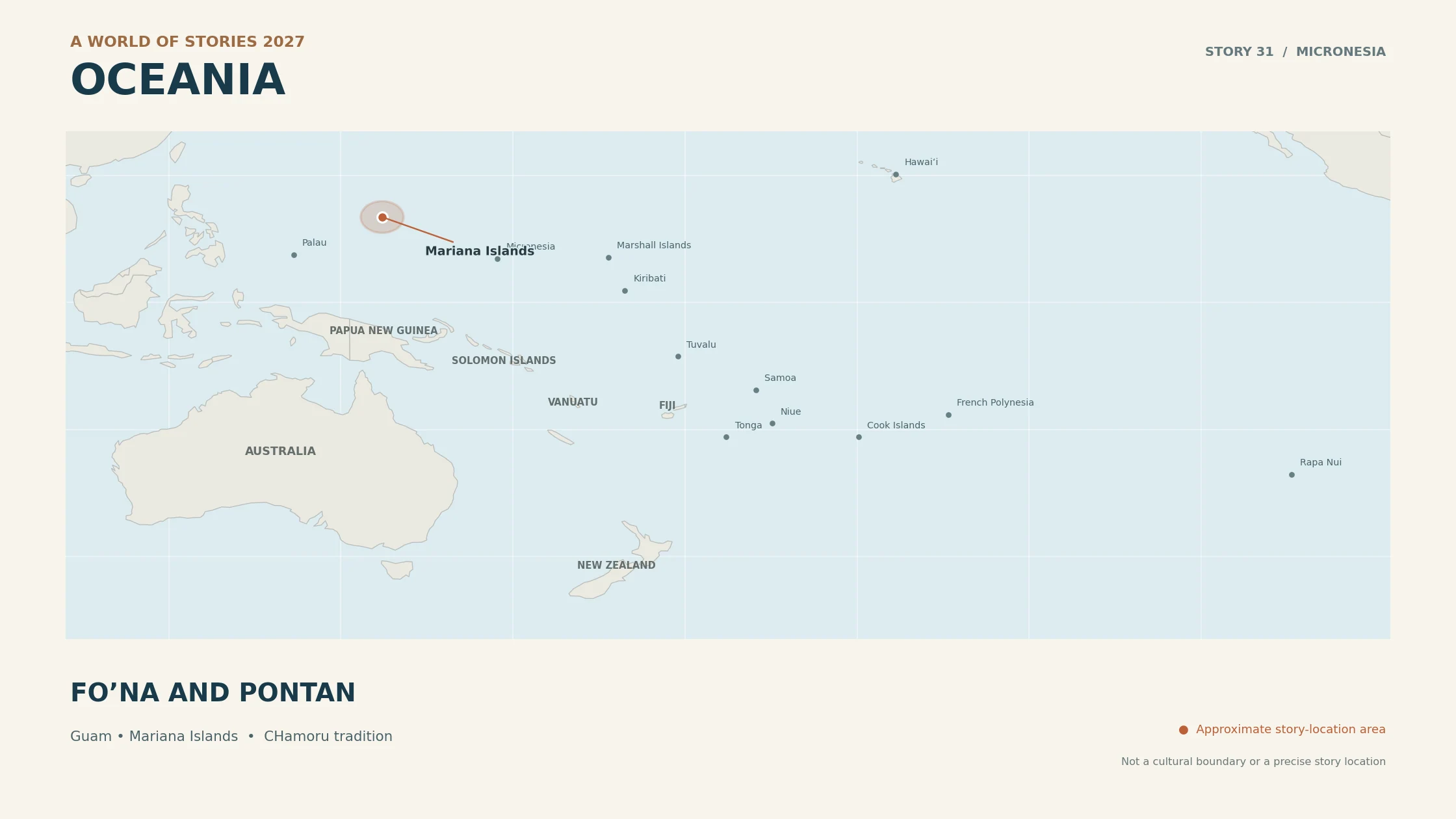
Long before the islands, the forests, or the people of the Marianas, there was no world as we know it. In that beginning were two extraordinary beings: a brother named Pontan and his sister, Fo’na. They were the first ancestors in an ancient CHamoru account of creation.
Pontan understood that a world could come into being through an extraordinary gift. He and Fo’na considered how their powers might be used to create a place where life could flourish. Pontan told his sister that his body could become the world itself. Fo’na would have the task of making that world live.
The work began. One of Pontan’s eyes became the sun, bringing daylight. His other eye became the moon, shining over the night. From his eyebrows came the rainbow, stretching its colours across the sky. His back became the land beneath all living things.
But a sun, a moon, and earth alone were not yet a living world. Fo’na brought her own power to the great work. She gave life to what had been formed from her brother: the sunlight shone, plants grew, and the world was made ready for living beings.
When her work was complete, Fo’na too gave of herself. According to the traditional account, she became a sacred rock connected with the beginning of the CHamoru people. From that place, the first human beings emerged.
For generations, the people remembered the brother and sister through stories and ceremonies. The creation account did more than explain the sun, moon, rainbow, and earth. It spoke of the bond between relatives, of the life-giving power of a woman, and of a world in which human beings and nature belong to one another.
The story has been passed down in different forms. Some historical versions call the ancestors Puntan and Fu’una; contemporary CHamoru researchers also use Pontan and Fo’na.
Source: This adaptation follows the broad CHamoru creation tradition rather than one claim to an exclusive version, drawing on Anne Perez Hattori, "Puntan and Fu’una: Gods of Creation," and related Guampedia research.
After the Story: Read · Create · Reflect · Share
Explore: How did Pontan and Fo’na work together to bring the world to life?
Reflect: Why might the bond between a brother and a sister matter in this story?
Think & Share: What does this tradition suggest about the relationship between people and nature?
Create: Draw your favorite scene from this story and imagine what happens next.
Inspired by this story? Create your illustration!
KIRIBATI — Nareau and the Raising of the Sky
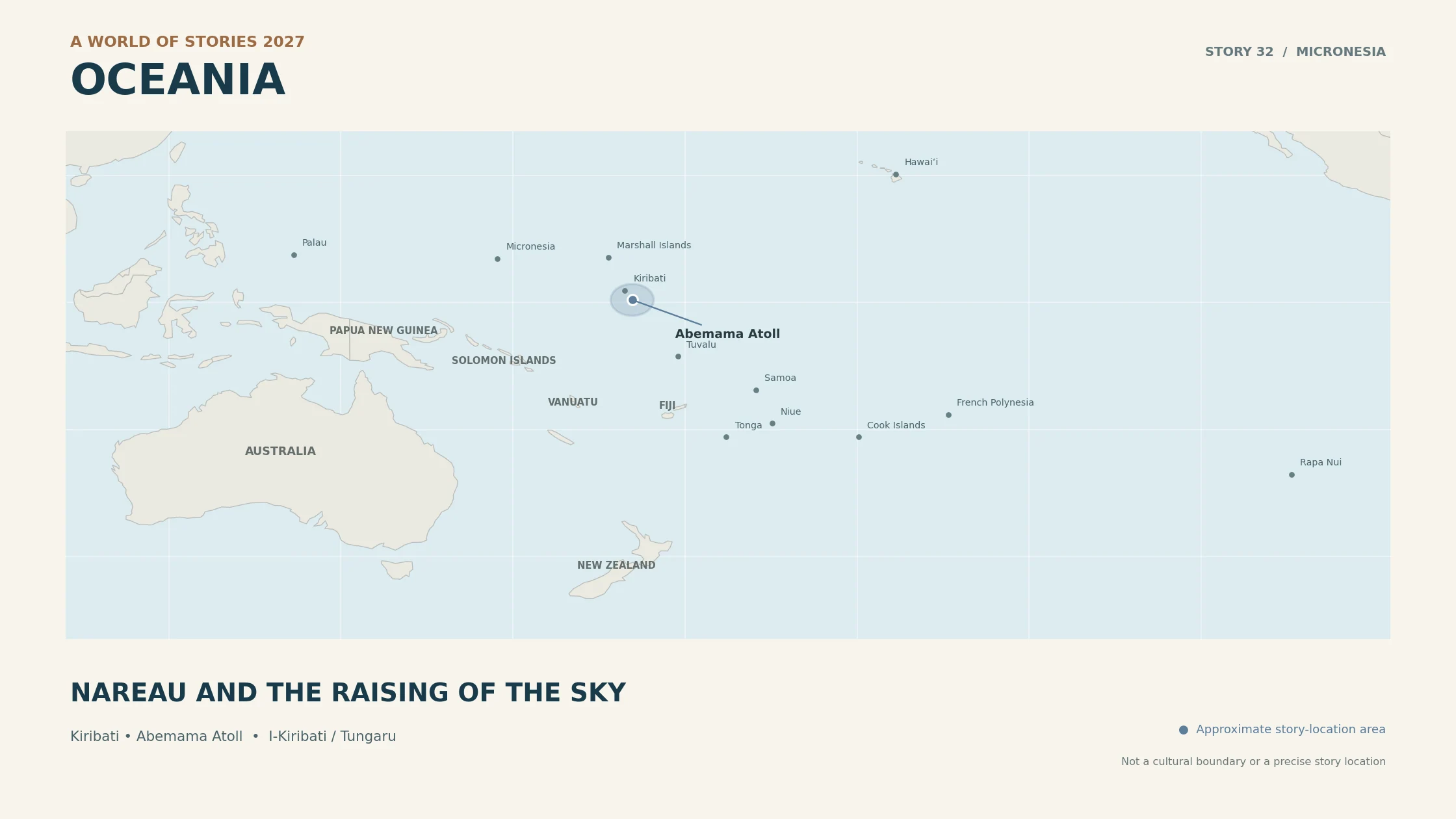
Long before the sky rose high above the sea, Nareau was already there. No one knew where he had come from or who his parents were. He moved above the closed world, where earth and sky had not yet been pulled apart.
This closed world was called te bomatemaki. Nareau came upon it as he travelled, and found a hollow place. He pierced it and carefully forced an opening until he could enter. Inside, he discovered the great eel Riki.
There was scarcely room beneath the low sky. Nareau called upon Riki to help lift it. The eel was long and strong, but the task was too great for him alone. Others would have to take part, and the roots that held the sky down would have to be severed.
Nareau directed the work. Riki stretched his enormous body to push upward, while the helpers cut away the roots that still bound the heavens. Together, following Nareau’s commands, they raised the sky into its place.
At last there was a space between the world below and the heavens above. The sea, too, was understood to have come into being when the sky was separated from the land. Nareau remained above, watching over what had been done.
But Nareau had not finished. He wished to clear the heavens of everything imperfect. He gathered trouble and suffering into a basket called te ketenaiwa: sickness, hunger, old age, toothache, grey hair, death, and other sorrows. Then he lowered the basket to the world below.
The giant eel Riki, exhausted by the labour of lifting the sky, fell. In this telling, he became the island of Nikunau. Yet the people who preserved the stories did not all agree about how Nikunau came to be; some questioned this part of the account.
When Naka saw the basket descend, he was afraid of the misfortunes within it. He fled north with his wife, Nei Nibongibong, travelling towards distant lands associated with the journey of the dead.
People told other stories, too, about the making of the islands. The storytellers did not settle every difference. But in the Abemama account, they agreed on one thing: Nareau was there at the beginning, guiding the raising of the sky.
Source: Adapted from Airam Teeko’s Abemama account as presented in Arthur F. Grimble, Tungaru Traditions: Writings on the Atoll Culture of the Gilbert Islands (University of Hawai’i Press, 1989). Other I-Kiribati creation traditions differ; this is a literary adaptation, not a community-authorised telling.
After the Story: Read · Create · Reflect · Share
Explore: Why did Nareau need Riki and the other helpers to raise the sky?
Reflect: What does the basket of troubles tell us about the way this story explains human life?
Think & Share: Why is it important to remember that people on different islands may tell different versions of the same tradition?
Create: Draw your favorite scene from this story and imagine what happens next.
Inspired by this story? Create your illustration!
Western Polynesia
SAMOA — Sina and Her Eel
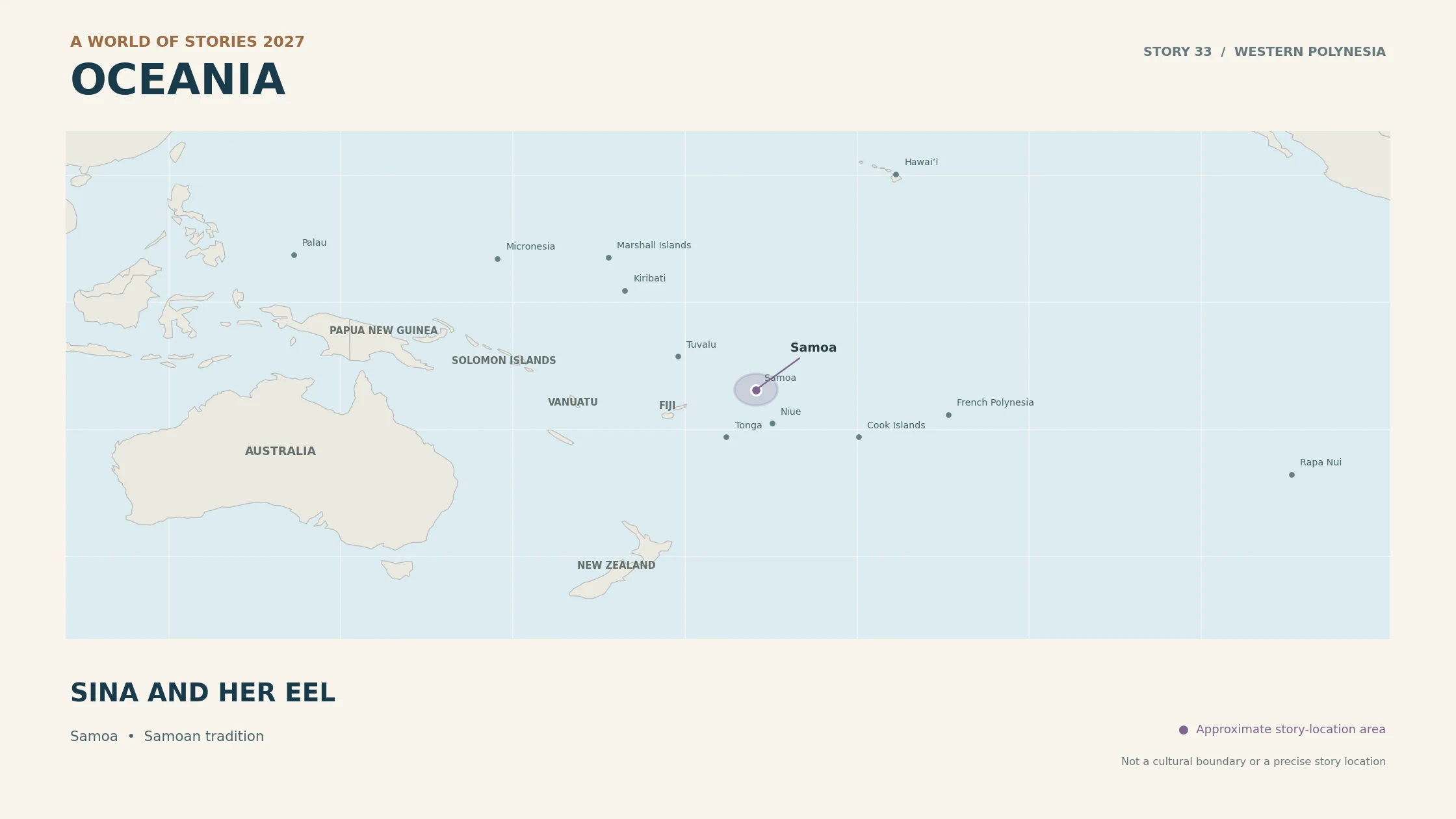
Long ago, on the islands of Samoa, there lived a young woman named Sina. Stories of her beauty travelled far across the ocean, until they reached the ruler of Fiji, known as Tui Fiti. He wished to meet Sina and marry her. Using his magic, he changed himself into a young eel and swam with the currents all the way to Samoa.
One day Sina went to collect seawater for her mother’s cooking. As she looked into a pool by the shore, she noticed a small eel. She took it home in her calabash and cared for it as a pet. At first a bowl was large enough for the little creature. But the eel grew, and Sina moved it to a spring beside the family’s fale, their house. Soon even that pool was too small. Her mother suggested the larger bathing pool used by the village, and Sina carried the eel there.
The eel found a hiding place beneath a ledge in the village pool. Strangely, although many people bathed there, it showed itself only to Sina. Whenever she entered the water, it came gliding around her. As the eel became larger, Sina no longer welcomed its attention. She stopped going to the village pool and returned to the little spring near home. But the eel appeared there too.
Sina was frightened and angry. She decided to leave the village, slipping away while the others slept. She travelled from one settlement to another. Sometimes she stopped beside a spring to drink, only to find the eel waiting in the water. She crossed from village to village and even from island to island, yet she could not escape it.
At last she reached a gathering place, a fono, and sat between two speakers. Then an enormous eel came across the open ground. The people watched in fear as it stopped before Sina. This time the creature spoke.
It told her that it was Tui Fiti, who had crossed the sea from Fiji to seek her. Its magic had failed, and it could no longer return to human form. Exhausted by the long pursuit, the eel said that its life was nearly over. It asked Sina for one final favour: when it died, she should bury its head in the ground before her fale.
From that place, the eel promised, a new tree would grow. Its leaves could be woven into a fan when the wind gave no relief from the heat. Its fruit would offer a refreshing drink. And when Sina drank, the eel said, she would remember him.
Soon the eel died. Sina buried its head as it had asked. In time a shoot appeared, and from it grew a tree unlike any the people had seen before: the first coconut palm. Its long leaves could provide shade and be made into useful things, and its fruit held water to drink.
Even today, the story says, the three marks at one end of a coconut resemble two eyes and a mouth—the face of Sina’s eel. That is why the old tale connects the coconut palm with Sina and Tui Fiti.
Source: Adapted from "Sina and Her Eel (tuna)," National Park of American Samoa, U.S. National Park Service. "Tuna" means eel; "fale" is a house and "fono" is an assembly or council. The coconut’s origin is presented as a traditional explanation, not a botanical account.
After the Story: Read · Create · Reflect · Share
Explore: Why did Sina begin to fear the eel, even though she had cared for it when it was small?
Reflect: What useful gifts does the coconut palm provide in this traditional story?
Think & Share: How does the shape of a coconut help people remember the legend of Sina and the eel?
Create: Draw your favorite scene from this story and imagine what happens next.
Inspired by this story? Create your illustration!
TONGA — Tangaloa Fishes Up the Islands of Tonga
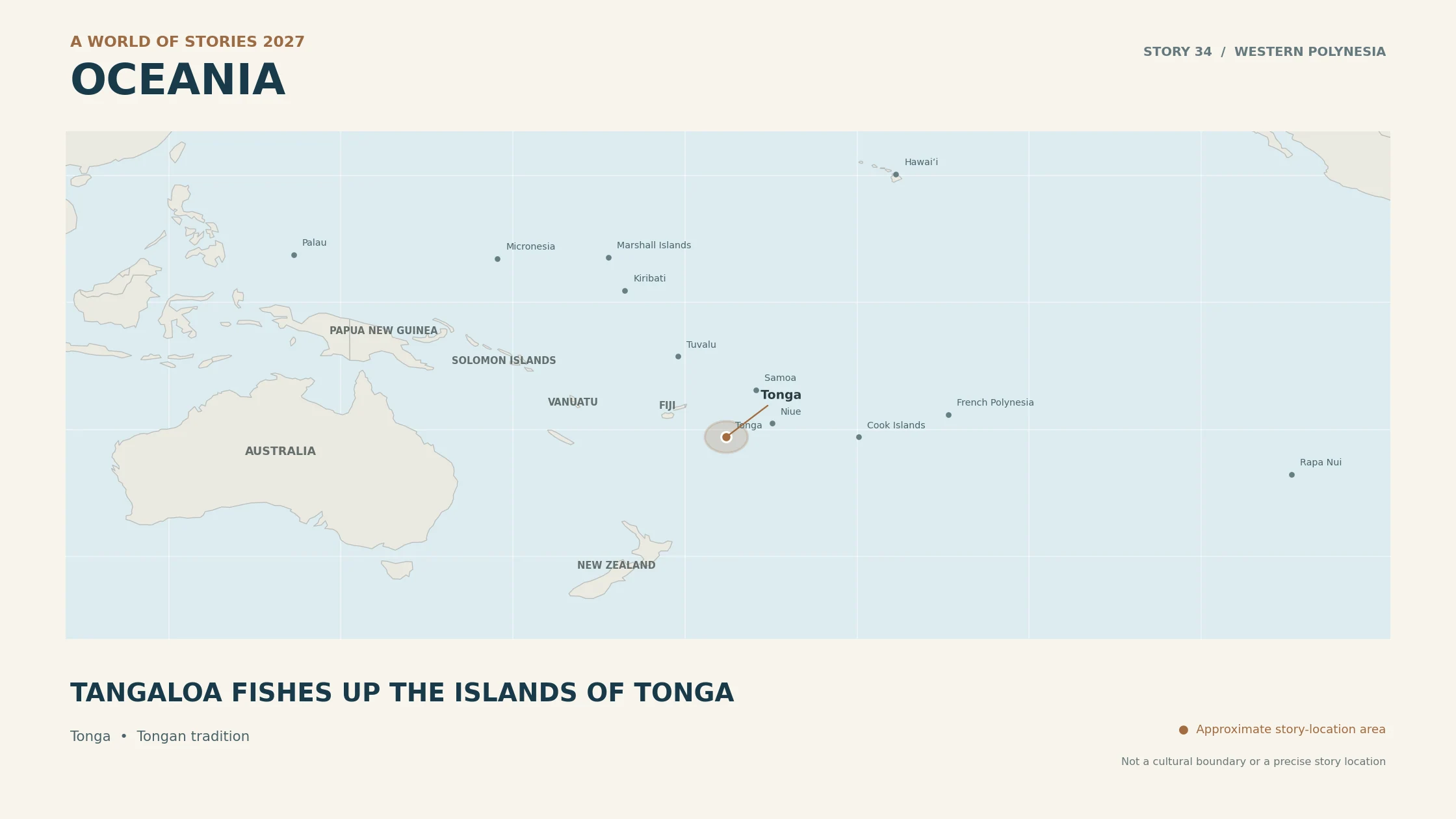
Long ago, according to a Tongan tradition, the great ocean stretched beneath the sky. The island of Bolotoo, the dwelling place of the gods, already existed, but the islands of Tonga had not yet risen from the sea.
One day Tangaloa, the god associated with arts and inventions, went fishing. From high above the water, he let his line and hook down into the ocean. Suddenly he felt a powerful pull. Something enormous had caught on the hook.
Tangaloa believed that he had hooked a mighty fish. He took hold of the line and pulled with all his strength. But what rose toward him was not a fish at all.
First, the points of rocks broke through the surface. Then more rocks appeared. As Tangaloa drew the line upward, the rocky floor of the ocean rose with it. More and more land emerged from the water. It seemed that one great stretch of land might rise from the deep.
Then, just as Tangaloa was drawing it higher, the fishing line broke.
The land could rise no farther. Instead of becoming one vast landmass, it remained a group of separate islands: the islands of Tonga.
In the old account, the hook had caught in a rock at Hunga (written "Hoonga" in the nineteenth-century text). People pointed to a hole in the rock and said that it was the very place where Tangaloa’s hook had held fast.
The tradition goes on to say that Tangaloa and the other gods brought trees, plants, and animals to the newly raised land. The islands were no longer only rocks rising above the waves. They became a place where life could grow.
Source: Adapted from a Tongan origin tradition recorded by William Mariner and compiled by John Martin in An Account of the Natives of the Tonga Islands (1817), vol. 1. This is one recorded version, not the only Tongan account of how the islands came to be.
After the Story: Read · Create · Reflect · Share
Explore: Why did Tangaloa first think that he had caught a fish?
Reflect: What changed when the fishing line broke?
Think & Share: Why might people have connected the hole in a real rock with this story?
Create: Draw your favorite scene from this story and imagine what happens next.
Inspired by this story? Create your illustration!
TUVALU — Te Pusi and Te Ali
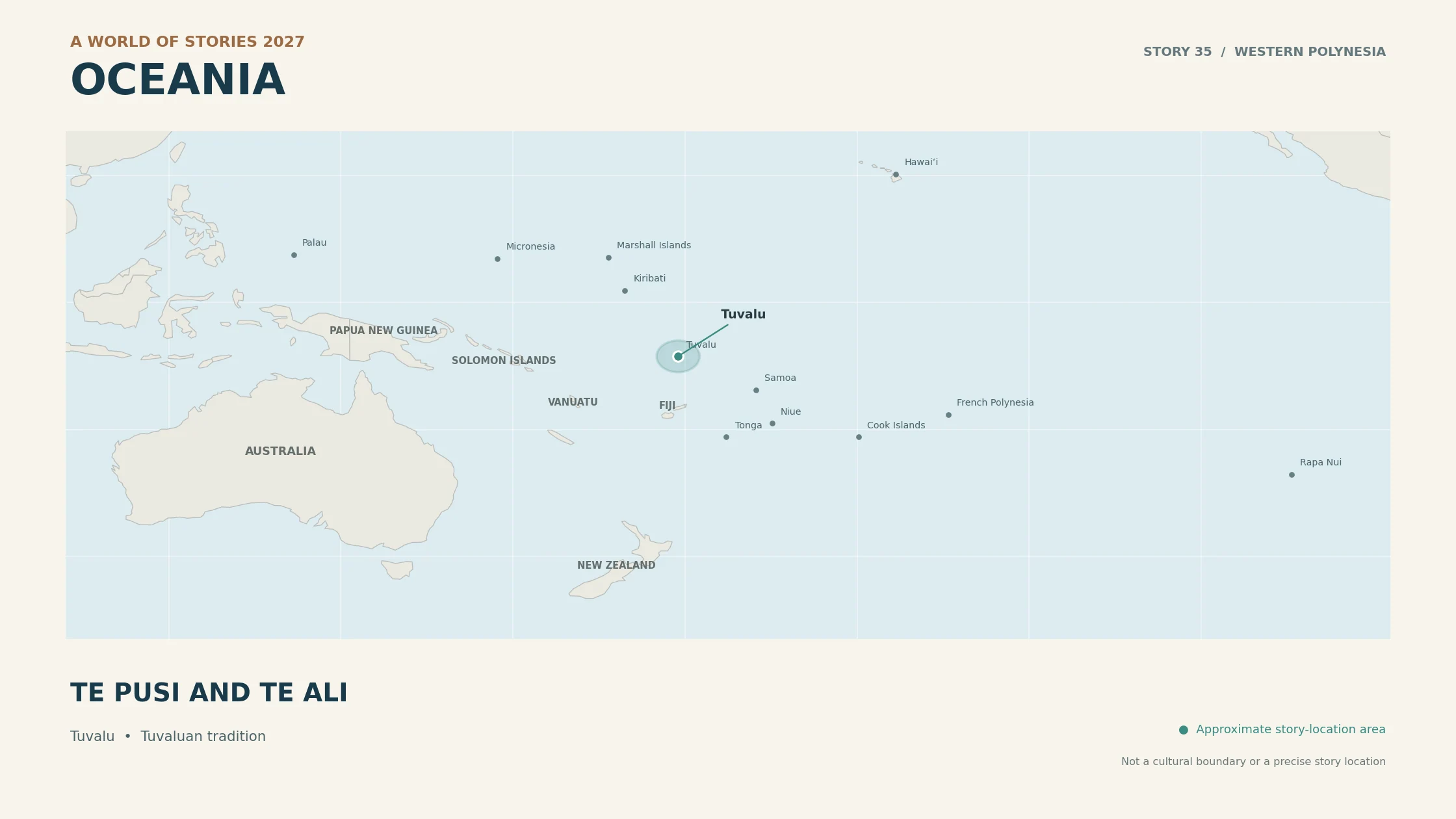
Long ago, according to a story told in Tuvalu, an eel named Te Pusi and a flounder named Te Ali were friends. They lived in a world that had not yet taken the shape familiar to the people of the islands.
One day, the two companions were carrying a great stone. They began to compete over which of them was stronger. What began as a friendly test turned into a quarrel, and the heavy stone came between them.
Te Ali was caught beneath the weight of the stone. The flounder was pressed down until its body became broad and flat. In the traditional tale, this is why the flounder has the flattened shape that it has today—and why the islands of Tuvalu lie so low and flat above the sea.
Te Pusi, too, was changed by the struggle. The eel became long and slender, and its shape was linked in the telling to the tall coconut palms that grow on the islands.
But the great stone still held more possibilities. It had three colours: blue, black, and white. Te Pusi threw it up into the air and used his power to make it fall again. When the blue part remained above, it became the sky.
Te Pusi threw the stone upward once more. This time the black side faced the world below, and darkness came: night had begun. Then the white side was turned toward the world, bringing daylight.
At last Te Pusi broke what remained of the great stone into eight pieces. These became the eight islands remembered in the story as standing together in the wide ocean.
And so the tale of Te Pusi and Te Ali brings together the things that still surround island life: the flat land, the coconut palms, the changing sky, the alternation of day and night, and the islands themselves.
Source: This is a literary adaptation of one published version of the Tuvaluan creation tradition Te Pusi mo te Ali, drawing on Talakatoa O’Brien, "Genesis," in Tuvalu: A History (1983). Variants differ in the details of the struggle and the transformations.
After the Story: Read · Create · Reflect · Share
Explore: What changed when Te Pusi and Te Ali stopped cooperating and began to quarrel?
Reflect: Why do you think people tell stories connecting animals with the shapes of the land?
Think & Share: How does this story help you imagine what the islands, palms, sky, and sea mean to the people who live there?
Create: Draw your favorite scene from this story and imagine what happens next.
Inspired by this story? Create your illustration!
NIUE — Huanaki and Fāo
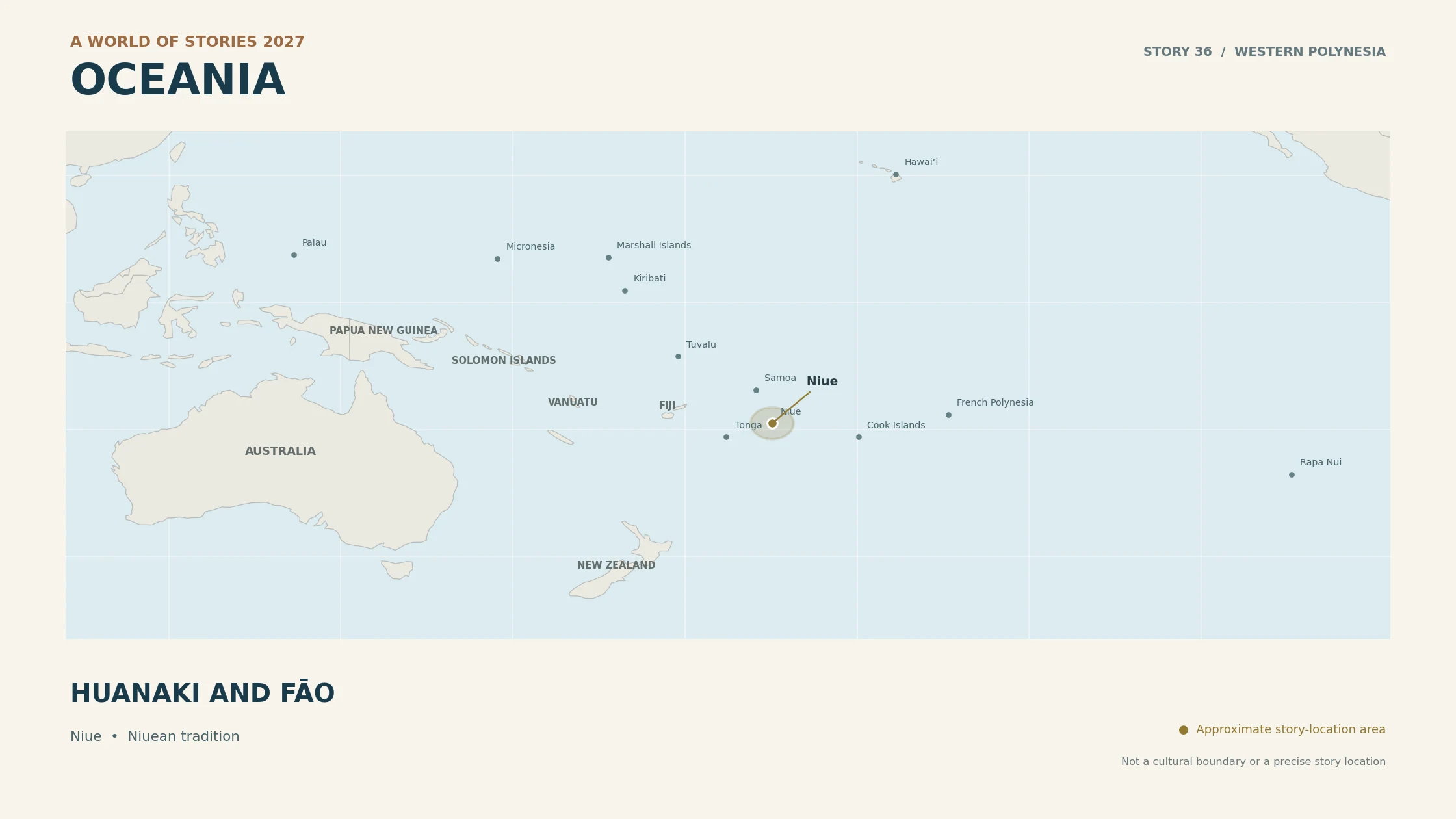
Long ago, the story tells us, Huanaki and Fao travelled across the sea and came upon a place that was hardly an island at all. The ocean washed over it. There was no broad, dry ground on which to make a home, and the waves covered the low reef.
Yet Huanaki and Fao did not turn away. They climbed onto the little patch of land that showed above the water. Then they stamped their feet upon it.
The island rose. Water ran away from its sides, and land that had been hidden beneath the waves stood clear of the sea. Where the ocean had washed across the reef, there was now dry ground.
But the new land was bare. It had no green trees to shelter anyone and no grass spread across its surface.
So Huanaki and Fao stamped again.
This time the island changed in another way. Grass sprang up, trees appeared, and other plants covered the land. The place that had once been washed by the ocean had become an island where life could grow.
And that, according to this Niuean tradition, is how Huanaki and Fao raised Niue from the sea and brought its greenery into being.
Source: This retelling follows the short two-person version of the Niuean origin tradition attributed to Peniamina, as recorded by George Turner, Nineteen Years in Polynesia (1861). Other Niuean accounts name additional ancestral beings and tell the island’s beginnings differently.
After the Story: Read · Create · Reflect · Share
Explore: What changes after Huanaki and Fao stamp the first time? What changes after the second?
Reflect: Why might people tell a story about the island they call home rising from the ocean?
Think & Share: How is this traditional explanation different from a scientific explanation of how islands form?
Create: Draw your favorite scene from this story and imagine what happens next.
Inspired by this story? Create your illustration!
WALLIS AND FUTUNA — The Turtle of Mount Puke
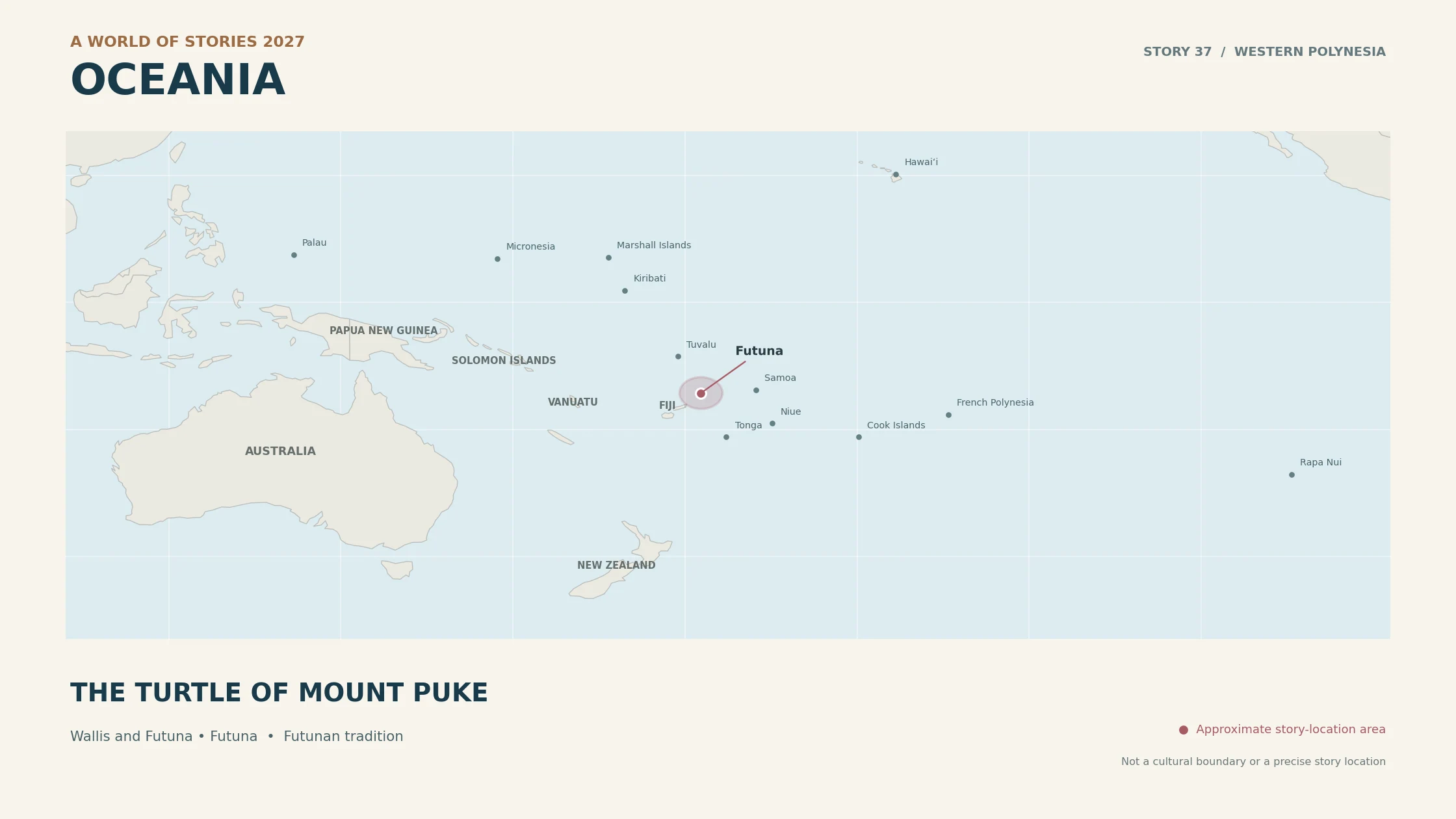
Long ago on the island of Futuna, the people of Tu’a and Sigave disputed who should possess Mount Puke, the island’s highest peak. Each side claimed the mountain, and the arguments between them grew so fierce that fighting seemed close at hand.
Their warrior chiefs finally agreed to settle the matter in another way. There would be a fishing contest. Each side must catch the largest fish of its kind and carry its catch to the summit of Mount Puke. Whichever group arrived first would win the mountain.
At once, canoes from both sides went out upon the sea. The people of Sigave were quick and fortunate: they caught an enormous whale, said to be the biggest ever seen around Futuna. They set about hauling it inland toward the mountain, dragging their tremendous catch along the course of the Vainifao River.
The work was exhausting. The older people urged the younger ones to keep pulling, and the younger ones strained with all their strength. Step by step, they brought the whale closer to Mount Puke.
No tracks lay ahead of them, and they heard no voices from the summit. Surely, they thought, the people of Tu’a could not have reached the mountain first. They called to one another to pull harder: victory was almost theirs.
But just as Mount Puke rose before them, a sound came down from its heights: people were clapping their hands. Up on the summit, the people of Tu’a were already holding a kava ceremony to celebrate their victory.
They too had gone fishing. Instead of a whale, they had caught an enormous turtle, said to be the largest ever seen there. They had carried it to the top of Mount Puke before their rivals arrived.
The people of Sigave had brought in a mighty catch, but they had lost the contest. According to the tradition, Mount Puke belonged thereafter to the victors of Tu’a, whose community became associated with the kingdom of Alo.
And what became of the huge whale that the people of Sigave had dragged so far? The story says that it was abandoned at the foot of the mountain, where it turned to stone. Its shape, the people say, can still be seen there.
Source: The story connects Mount Puke with the two traditional kingdoms of Futuna, Alo and Sigave. This retelling follows the version published by the tourism authority of Wallis and Futuna, "The Turtle of Mount Puke."
After the Story: Read · Create · Reflect · Share
Explore: Why did the two groups decide to hold a fishing contest instead of fighting?
Reflect: Why were the people of Sigave so certain they would win?
Think & Share: What does this story suggest about the difference between having the biggest catch and reaching a goal first?
Create: Draw your favorite scene from this story and imagine what happens next.
Inspired by this story? Create your illustration!
Eastern Polynesia
FRENCH POLYNESIA (RA’IĀTEA) — Rua-ta’ata and the Breadfruit Tree
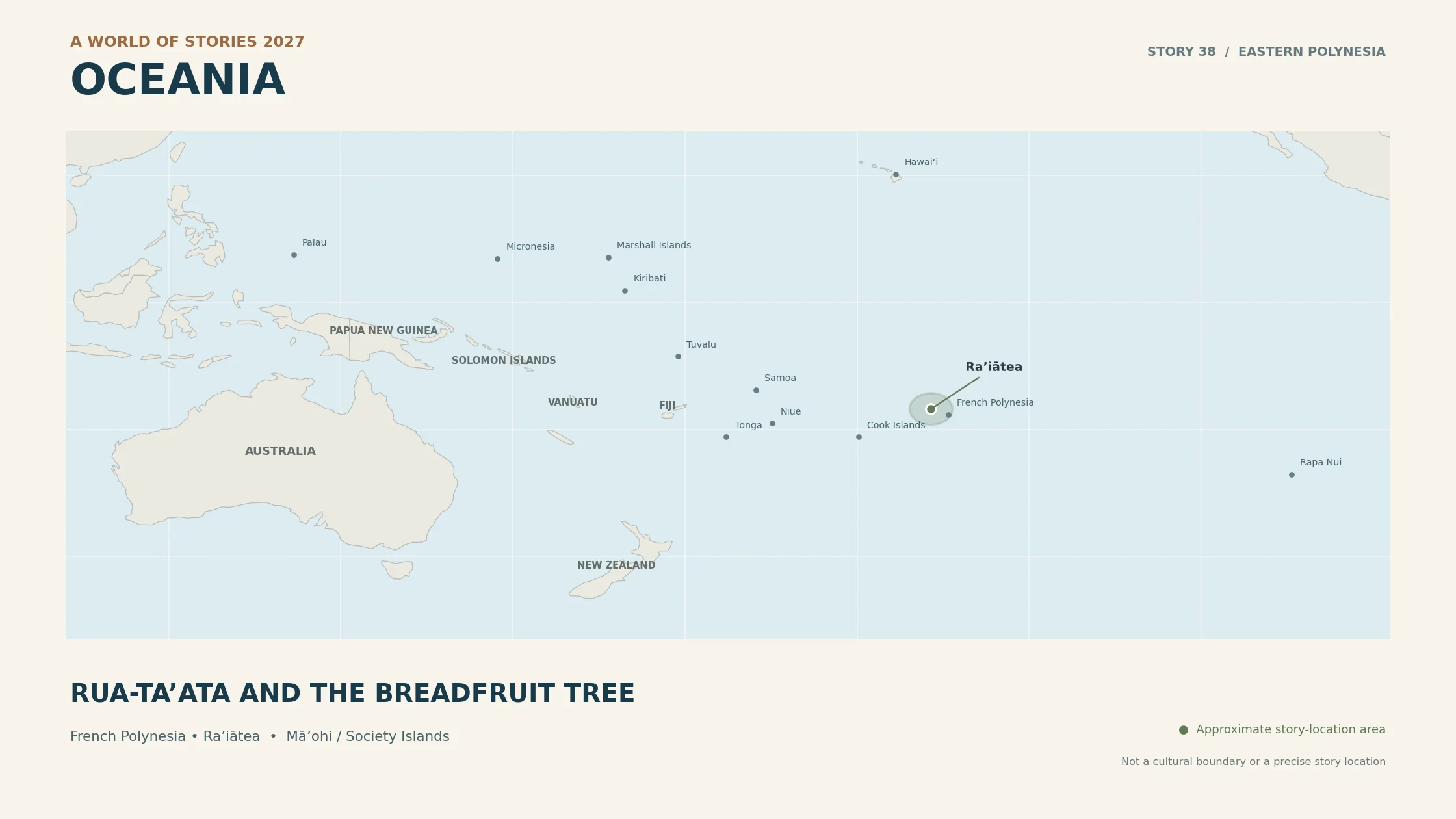
Long ago, during the reign of King Noho-ari’i, a terrible famine came to Ra’iatea. Food grew scarce throughout the island. People searched for whatever they could eat: the fruit of the pandanus, roots, and even bitter plants that they would never have chosen in better times.
Among those who suffered were a man named Rua-ta’ata, his wife Rumau-ari’i, and their four children. The children were so hungry that their parents could hardly bear to watch them. The family climbed into the mountains and sheltered in a cave, where they lived on the ferns they could gather. Still, there was never enough.
One evening, Rua-ta’ata spoke to his wife. His words were strange, and he asked her to remember them carefully. In the morning, he said, she should step outside the cave. There she would find a tree. Its leaves would be his hands; its trunk and two great branches, his body and legs. The round fruits would be his head, and the heart within each fruit would be his tongue.
Then he explained how she could use the fruit. She must roast it, put it into water, remove its skin, and feed the soft food to their children. If she did as he said, they would no longer have to go hungry.
After speaking, Rua-ta’ata left the cave. Rumau-ari’i remained with the children through the night.
At daybreak she went outside. A magnificent tree stood near the cave, spreading its shade across the ground. Heavy, round fruits hung among the leaves, and several ripe ones had fallen beneath it. She remembered every word her husband had spoken. Now she understood what he had given to save them.
Grieving for Rua-ta’ata, she gathered the fruit. She prepared it just as he had instructed and shared it with the children. At last the family had food. The strange tree was the first breadfruit tree—the ‘uru of the tradition.
In time, servants of King Noho-ari’i came up the mountain valley to look for eels and freshwater creatures. In the stream they noticed pieces of breadfruit skin. They tasted it and were astonished at how good it was. They followed the stream into the valley until they found the tree, its branches bending under the weight of its fruit. Rumau-ari’i was there.
She told them that Rua-ta’ata, seeing his wife and children starving, had become the tree so that they might live. The servants carried ripe breadfruit away to present it to the king. They loaded the fruit into a ceremonial canoe, sounded a conch shell, and paddled to ‘Opoa on Ra’iatea, where the king received the first fruits of the land. Noho-ari’i tasted the breadfruit and wanted the remarkable tree brought to ‘Opoa. His people moved it, and Rumau-ari’i and the children went with it.
Others wished to grow the precious tree too. According to the tradition, a person from nearby Taha’a took a root and planted it there. Another woman planted roots farther inland on Ra’iatea, and a cutting was also taken to Bora Bora. In this way, the story explains how breadfruit spread among the islands.
When the original tree was moved, Rumau-ari’i and her children mourned its loss. Yet roots had remained in the earth where it once stood. Before long, fresh shoots appeared. They grew into more breadfruit trees, and those trees bore fruit in abundance.
And so the gift of Rua-ta’ata did not end with one meal, or even with one tree. In the telling of this story, the ‘uru continued to nourish families across the islands.
Source: Breadfruit (‘uru) is an important traditional food in the Society Islands. This adaptation follows the Ra’iatea account recorded in 1887 by Tupaia from his grandfather Tataura, as presented by Tahiti Heritage and Teuira Henry, Ancient Tahiti.
After the Story: Read · Create · Reflect · Share
Explore: How did Rua-ta’ata try to help his family during the famine?
Reflect: Why was Rumau-ari’i both sad and grateful when she found the tree?
Think & Share: How did one family’s discovery become a source of food for people on other islands?
Create: Draw your favorite scene from this story and imagine what happens next.
Inspired by this story? Create your illustration!
COOK ISLANDS — Ina’s Voyage to the Sacred Isle
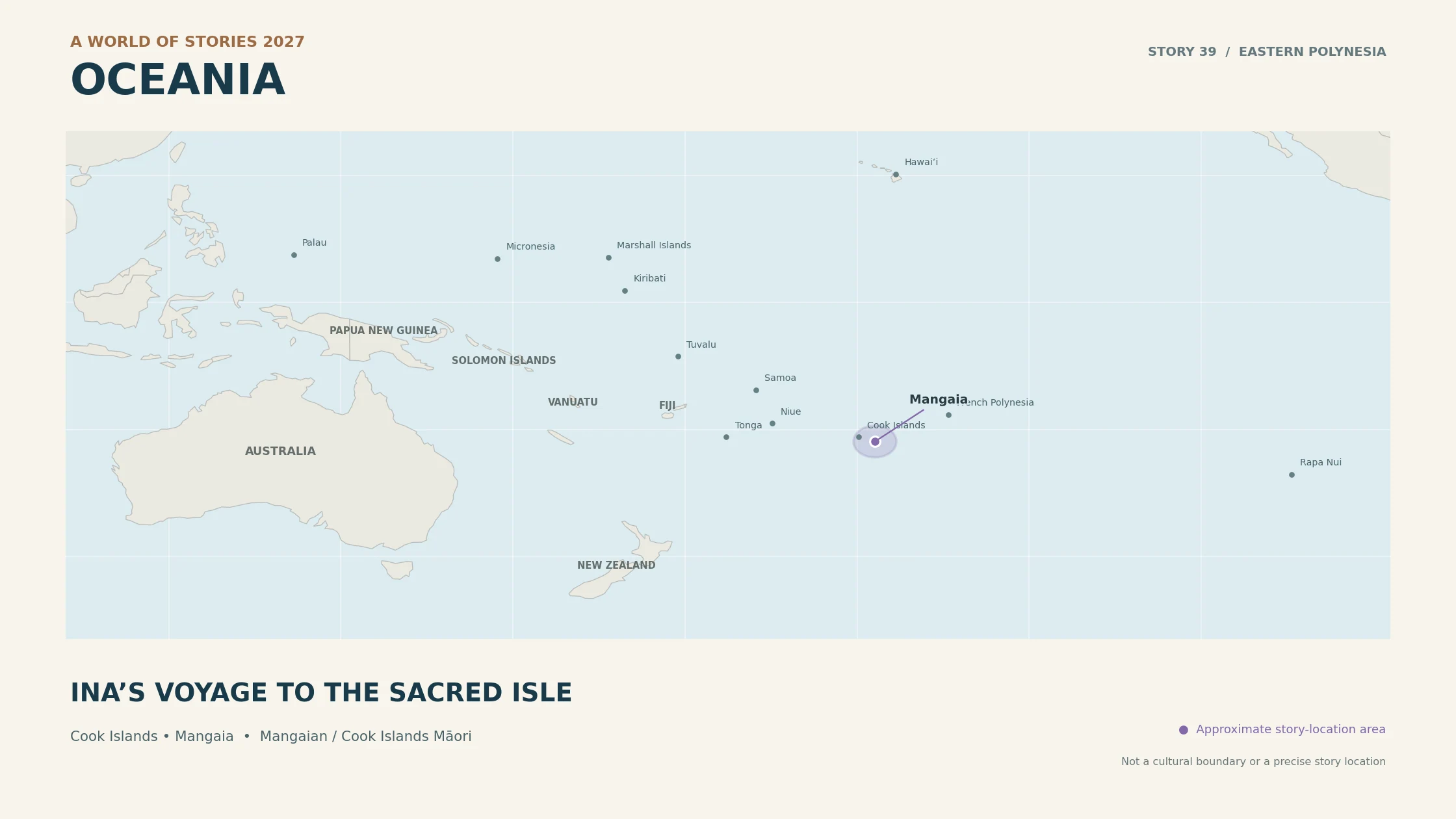
Long ago, in the land of Nukutere, there lived a girl named Ina. Her parents, Vaitooringa and Ngaetua, owned many beautiful treasures: gleaming shells, finely braided ornaments, and a splendid headdress decorated with red and black feathers. Ina had two brothers, Tangikuki and Rupe.
One morning her parents went away and left the treasures in Ina’s care. Her mother told her to lay them out in the sunshine, but to bring them indoors as soon as clouds covered the sky, since Ngana, a cunning thief, dared not approach in bright sunlight.
Ina spread the precious ornaments on clean white cloth. Then clouds gathered. Ngana appeared and spoke to her so pleasantly that she let him try on the ornaments. While Ina admired how they looked, he devised a trick, escaped with the treasures, and disappeared into the sky.
When her parents returned, they saw that everything was gone. Furious, they punished Ina harshly. Hurt and frightened, she resolved to leave home and reach the distant Sacred Isle, where Tinirau, lord of the fishes, lived. On her way to the shore, Ina met Tangikuki and, desperate to keep him from revealing her escape, injured his tongue with a piece of broken bamboo—a cruel deed, remembered in the old telling.
At the beach she looked westward. A little fish called avini came near. Ina asked it to carry her to Tinirau. The fish agreed, but it was too small; before they even reached the reef, Ina slid into the water. In anger she struck the little fish, leaving the stripes that the story calls Ina’s markings.
Next came paoro, a larger fish, which she marked blue. Then api, which the story says became black after it dropped her. A flatfish carried her as far as the breaking waves, but it also failed, and Ina stamped upon its head; the old tale explains that this is why a flatfish has both eyes on one side.
At last a shark approached, its back broad and strong enough to carry her into deep water. Ina climbed aboard with two coconuts for food and drink. Later, Ina struck a coconut against the shark’s forehead to break it open; the blow hurt, and the shark dived away, leaving her alone among the waves. The tale says this is why sharks have a bump upon their heads.
Then Tekea the Great, king of sharks, arrived. He lifted Ina onto his back and carried her onward, driving off threatening sharks along the way.
At last Ina stepped ashore. She entered Tinirau’s dwelling, but no one was there. Inside stood a great wooden drum. Ina struck it gently. Its sound travelled far across the sea to where Tinirau was staying. He returned at once, but Ina hid behind a curtain. She beat the drum a second time; this time Tinirau discovered his visitor. Ina remained on the Sacred Isle and became his wife.
In time Ina had two children, a son named Koromauariki, or Koro, and a daughter named Ature. Back in Nukutere, Rupe still missed his sister. With the help of a little bird, he travelled over the ocean and found her. When the bird changed into Rupe before Ina’s eyes, their reunion was joyful.
Rupe returned with news that Ina was safe. Her family prepared gifts and travelled to the Sacred Isle. Mother and daughter embraced; the suffering of the past was forgiven. For three days they celebrated Ina’s children. Then her visitors made their journey home, leaving Ina with Tinirau beside the sea.
Source: This retelling follows a recorded Mangaian version from the Cook Islands, drawing on William Wyatt Gill, Myths and Songs from the South Pacific (1876), and Edward Tregear’s reproduction of the Mangaian version (1886). Other Polynesian versions of Ina or Hina differ.
After the Story: Read · Create · Reflect · Share
Explore: Why did Ina decide to leave home, and how did her choices affect others along the way?
Reflect: Which helpers made the greatest difference during Ina’s journey?
Think & Share: Why do you think the story connects Ina’s adventures to the shapes and colors of sea creatures?
Create: Draw your favorite scene from this story and imagine what happens next.
Inspired by this story? Create your illustration!
HAWAI’I, USA — Hina and the Wailuku River
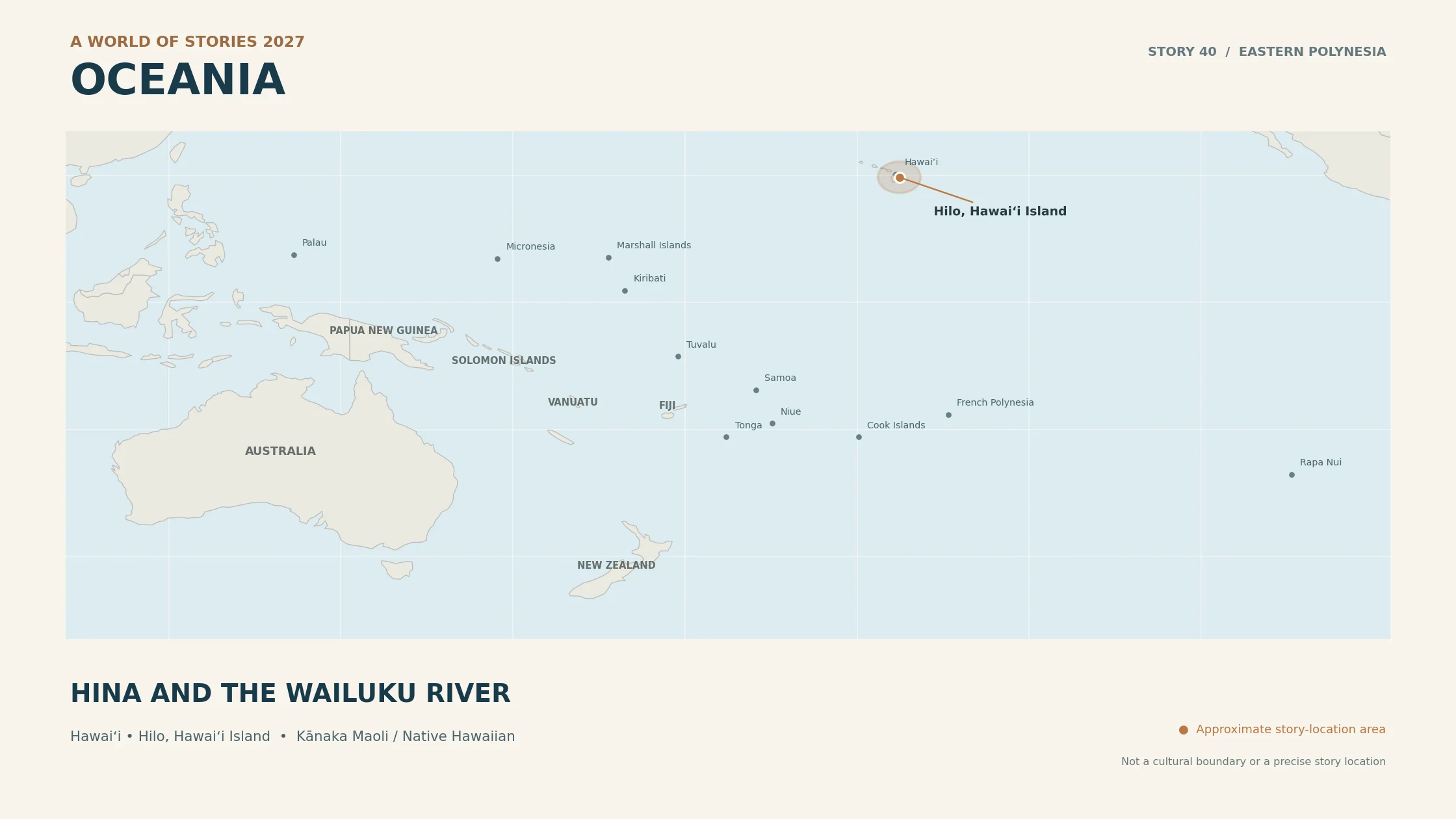
On the island of Hawai’i, the Wailuku River runs through dark volcanic rock. It races over falls, swirls through deep pools, and passes a great waterfall whose spray sometimes shines with a rainbow. Long ago, according to a Hawaiian story, Hina made her home in a cave behind that falling water.
Hina was known for making fine kapa, cloth prepared by patiently beating the inner bark of trees. Her son Maui had land beside the river, but he was often far away, accomplishing extraordinary deeds. Above Hina’s home lived Kuna, a dangerous being associated with the upper waters of the Wailuku.
Kuna had tried again and again to trouble Hina, sending logs and stones tumbling along the river and over the falls. Yet the cave was protected by steep cliffs, and Hina remained there, her chants sounding above the rush of water. Kuna grew angrier each time he failed to drive her away.
One night, he hurled a huge stone into the narrow gorge downstream from Hina’s cave. The rock blocked the river from bank to bank. Water piled up behind it, higher and higher, until it crossed the cave’s threshold and crept over the floor. Hina could not escape past Kuna, who waited above. She called out for Maui, again and again, as the flood climbed around her.
Her cries carried across the mountains and over the sea to the island of Maui, where her son heard them. Maui hurried down from the mountain and launched his magic canoe. With mighty strokes of his paddle, he crossed the channel and reached the mouth of the Wailuku River.
Leaving his canoe, Maui ran upstream with his powerful club. He found the barrier that held back the river and struck at the bank beside it. The earth gave way. The imprisoned water rushed into the new opening, and the flood drained away from Hina’s cave. She was safe.
But Kuna had heard the crash. He fled upriver and hid in deep pools among the rocks. Maui followed him. When Kuna disappeared beneath the water, Maui drove his magic spear through the rocks beside the river. Water streamed through the opening, exposing the hiding place. The place became known in the tradition as Ka Puka a Maui, the opening made by Maui, associated with a natural bridge in the Wailuku River.
Kuna fled from pool to pool. Maui broke through his hiding places until Kuna sought shelter in a series of deep basins. There Maui threw burning stones into the river. The water churned and steamed, driving Kuna out again. The furious, swirling pools became known as the Boiling Pots.
The struggle continued downriver toward the waterfalls. Hina and the women with her called out chants of encouragement. Kuna was swept over the falls and caught in the rushing channel that Maui had opened beside the dam. Maui overtook him near the lower river and finally defeated him.
The story says that a long dark rock lying among the waters recalls Moo-Kuna, the defeated river being. Whenever floods thunder through the Wailuku, the water pounds that stone once more. And so the cliffs, pools, waterfalls, and rocks around Hilo remain part of a story about Hina’s courage, Kuna’s anger, and the son who came to help her.
Source: Adapted from W. D. Westervelt, Legends of Ma-ui: A Demi-God of Polynesia and of His Mother Hina (1910), chapter XIII, "Hina and the Wailuku River." This is a literary retelling of one historical published Hilo-area version; other Hawaiian traditions may differ.
After the Story: Read · Create · Reflect · Share
Explore: Why did Hina call for help instead of trying to pass Kuna on her own?
Reflect: How did Maui use the river and its rocks to protect Hina?
Think & Share: How can a traditional story help people remember and understand a place?
Create: Draw your favorite scene from this story and imagine what happens next.
Inspired by this story? Create your illustration!
RAPA NUI, CHILE — The Seven Explorers of Rapa Nui
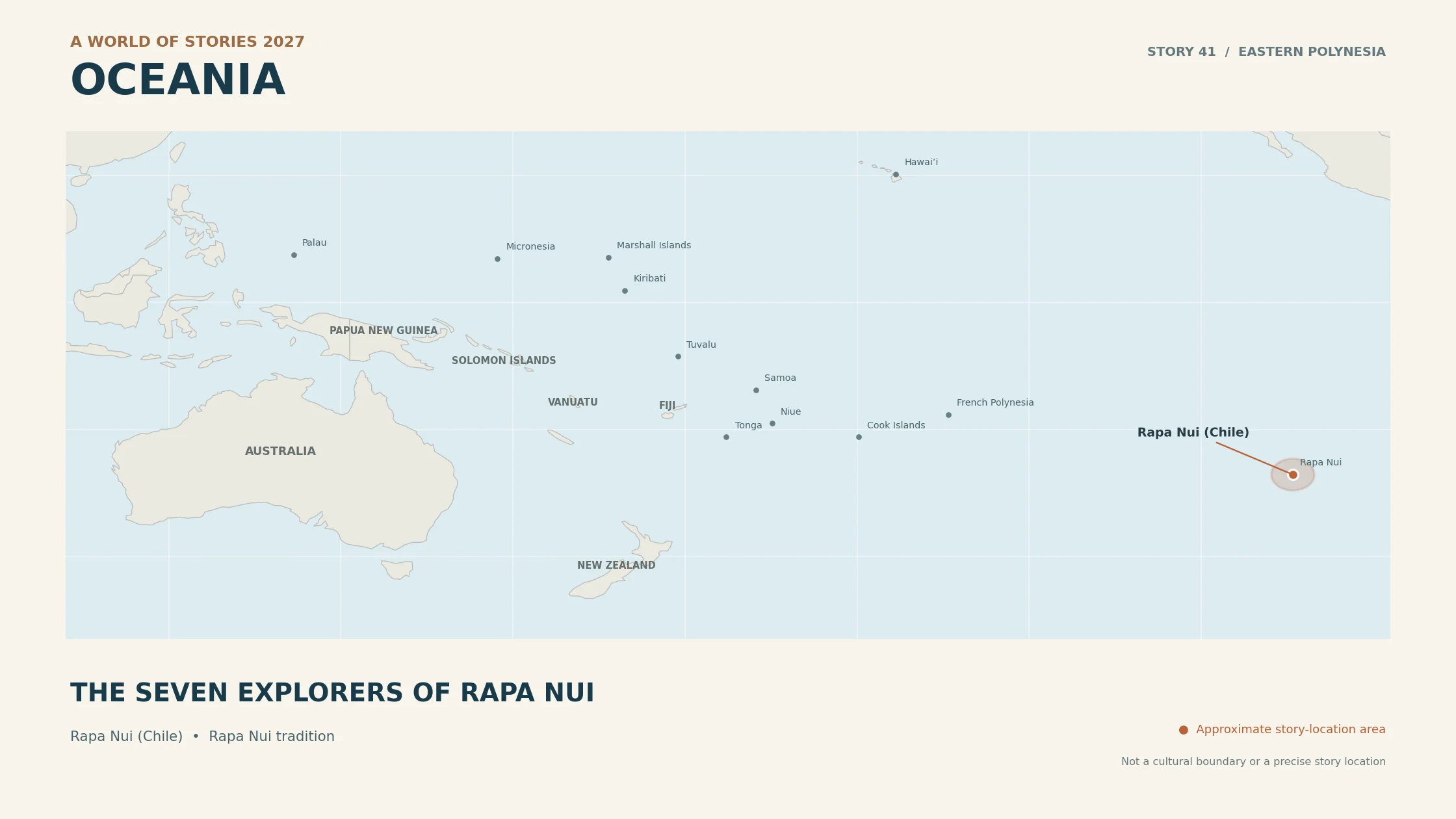
Long ago, in the homeland called Hiva, a priest named Hau Maka had seen another island in a vision. Across the ocean lay a place where a king might settle with his people. He told seven young men to sail ahead and examine that distant land: Ira, Raparenga, Ku’uku’u A Huatava, Ringiringi A Huatava, Nonoma A Huatava, U’ure A Huatava, and Mako’i Ringiringi A Huatava. They carried the important task of finding a safe landing place for Hotu Matu’a.
Before they departed, Hau Maka spoke of small islets rising from the sea; if the voyagers found those islets, they would know they had reached the land he had seen. The seven crossed the wide ocean and finally reached the coast of Rapa Nui, anchoring at Hanga Tepau.
They searched one shore after another. At Poike they turned back, and along the northern coast they inspected beaches where the sand was scarce and the landing places too narrow. Ira was not satisfied; a great chief and his followers would need room to bring their canoes ashore.
At Hanga Hoonu they stopped to fish, and though their catch was plentiful, they had no fire ready for cooking. Two of the young men returned to the boat for fire-making sticks, and the group cooked their fish and ate together.
As they travelled on, the men noticed a turtle coming from the sea, which the tradition says was a spirit that had followed them. The explorers laughed and continued along the coast, but the turtle did not leave them.
The seven reached Ovahe, where they again found too little sand. Beyond it lay Anakena. There the beach was broad and the ground open. The young men rejoiced: at last they had found a place where Hotu Matu’a could bring his people ashore.
But the strange turtle had arrived nearby. Ira tried to lift it and could not. The other companions tried in turn, but none could move it. At last Ku’uku’u stepped forward, heaved the heavy creature onto his back, and started up the beach. Suddenly the turtle struck him with its flippers. Ku’uku’u collapsed, badly hurt. The others carried him into a cave, where he pleaded with them not to leave him.
They promised to stay, but their promise was false. Outside the cave they built six piles of stones and instructed the stones to answer whenever Ku’uku’u called for his friends. Then the six men went away. From the cave came the wounded man’s voice, calling for his companions again and again, believing he had not been abandoned. In the old account, Ku’uku’u eventually died alone.
The remaining explorers continued to Hangaroa. By the waves, Ira and Raparenga spoke quietly about precious objects and the places where they had hidden them. Mako’i overheard part of their conversation, and later, at Orongo, while Ringiringi pretended to sleep, the hidden information was spoken aloud and remembered.
The voyage had brought the explorers to an island of coves, fields, stones, and mysterious places. They had found the broad landing beach of Anakena, but their journey had also exposed courage, greed, and broken promises. In the tradition, some of the explorers eventually returned to Hiva, while others remained connected with the land they had explored for the coming of Hotu Matu’a.
Source: Retold from "Expedition of the Seven Explorers," an Indigenous Rapa Nui narrative published by Museo Chileno de Arte Precolombino (Chile Precolombino). Names and place names may have alternate spellings in different records. This adaptation does not present the voyage as verified archaeological history.
After the Story: Read · Create · Reflect · Share
Explore: Why did the seven explorers examine several beaches before choosing Anakena?
Reflect: What did Ku’uku’u’s companions promise, and what did they actually do?
Think & Share: How do the names of places help preserve the memories of a journey?
Create: Draw your favorite scene from this story and imagine what happens next.
Inspired by this story? Create your illustration!
FRENCH POLYNESIA (MARQUESAS) — Māui and the Gift of Fire
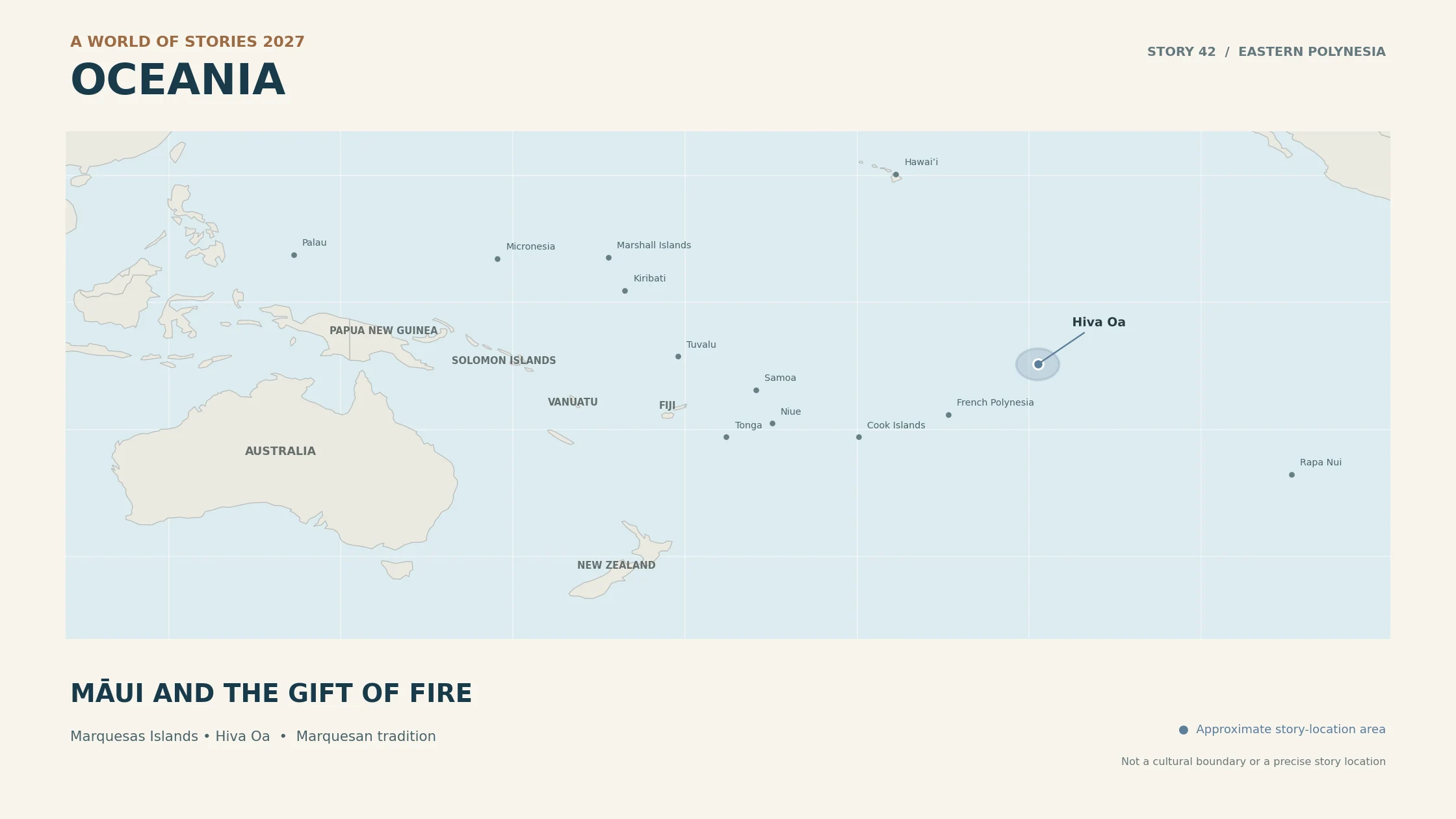
In ancient times, the people of the Marquesas had no fire. They ate their breadfruit, taro, and sweet potatoes without cooking them. Then word reached them of a distant land where food tasted wonderfully different, although its people gathered the very same plants.
‘How can their breadfruit and taro taste so good when ours do not?’ the people asked. A wise tahu’a, a keeper of knowledge, explained that Mahuike possessed fire and used it to cook food. Everyone longed to learn this secret.
Among the people lived Maui, a descendant of Mahuike. They asked him to travel to Mahuike’s home and bring back some fire, and taught him the words to say. Maui agreed and set out carrying a fire-holder fastened to his belt.
When Maui arrived, Mahuike asked where he would keep the fire. Maui showed the holder. Mahuike drew fire from a foot, lit the holder, and gave it to him. Maui started home, but along the way he deliberately rubbed the flame out against the ground, then returned.
‘What happened to your fire?’ Mahuike asked. Maui said he had discovered it was no longer burning. This time Mahuike gave him fire from a knee. Maui took it away—and put it out again. When he came back a third time, Mahuike lit his holder with fire from the stomach and warned that little fire remained.
Maui left, laughing to himself. He knew there was still fire in Mahuike’s head. Once more he extinguished the flame and returned. This time Mahuike had been sleeping. The sacred fire of the head was all that remained, and Mahuike was angry when Maui asked for it.
The two struggled. Mahuike’s strength failed, and Mahuike fell, striking the head against a stone. The last fire escaped. Instead of remaining in one person’s keeping, it passed into plants and stones.
Maui went home. The people gathered around him and asked, ‘Where is the fire?’ He took two pieces of dry wood and rubbed them together until a flame appeared. He also told them that striking stones could bring forth fire.
And so, according to this Marquesan telling, the people learned how to kindle fire for themselves. What had once been guarded in a distant place could now be found in the materials around them—and in the knowledge of how to use them.
Source: Adapted from the Marquesan account narrated by Haapuani of Hiva Oa (1920), recorded in E. S. Craighill Handy, Marquesan Legends (Bernice P. Bishop Museum Bulletin 69, 1930). This is one Marquesan telling of a wider Polynesian Maui-and-fire tradition; names and episodes vary across islands.
After the Story: Read · Create · Reflect · Share
Explore: Why did the people want Maui to find out how Mahuike prepared food?
Reflect: Why did Maui keep extinguishing the fire he had been given?
Think & Share: What changed when the people learned to make fire themselves?
Create: Draw your favorite scene from this story and imagine what happens next.
Inspired by this story? Create your illustration!
Key Dates
October 31, 2027
Submission deadline (or earlier, once 500 eligible artworks are received)
December 1–31, 2027
Virtual exhibition
Dec 1, 2027
Online gallery and digital catalog
Questions Parents Ask
Who can participate?
Children and teens ages 6–17 who live in the United States. A parent or legal guardian submits the artwork.
Does it cost anything?
No. Participation is completely free, and no purchase is ever necessary.
Can my child submit more than one artwork?
One artwork per child for each exhibition. Your child is welcome to take part in all six continents.
What kind of artwork is accepted?
Original artwork made by hand with traditional materials — pencils, crayons, markers, paints, collage and more. Artwork that is AI-generated, traced or copied, or made mostly by an adult cannot be accepted.
Is this a contest?
No. There are no rankings and no winners. The first 500 eligible submissions for each continent are accepted, in the order they are received.
What information is shown publicly?
Only your child’s first name or a nickname, an optional last initial, age group, city (optional), and state — never addresses, phone numbers, or emails.
Who owns the artwork?
Your child keeps the copyright. You give 365 for Kids permission to display and publish the image only in the ways you choose in the form.