
A World of Stories · Volume IV
Folk Tales and Legends from NORTH AMERICA
Travel across North America through its folk tales and legends. Read a story from a country that interests you, imagine its characters and places, and bring it to life in your own illustration.
Free
No purchase necessary
Ages 6–17
Children living in the U.S.
Jun 30, 2027
Submission deadline
How to Participate
1
Explore the folk tales and legends from North America below.
2
Choose your favorite story and read it.
3
Create your own illustration of it — by hand, with any art materials.
4
Ask a parent or guardian to submit a photo of your artwork.
Participation is free. One artwork per child. Participation rules
What Happens to Your Child’s Artwork
- It is shown in an online gallery on our website — and stays there.
- It joins a national virtual exhibition, August 1–31, 2027.
- It appears in a digital exhibition catalog you can download — and, with your permission, in a printed catalog.
- Every accepted participant receives a personalized Certificate of Participation.
- With your permission, it may be selected for an illustrated book of these stories.
Not a contest: the first 500 eligible submissions are accepted, in the order received.
About This Collection
North America is a continent of incredible cultural diversity. From the icy Arctic and the forests of Canada to the mountains and deserts of the United States and Mexico, the tropical landscapes of Central America, and the islands of the Caribbean, every region has stories to share.
Long before today’s countries and borders existed, Indigenous peoples lived across these lands, developing their own languages, traditions, and ways of telling stories. Their cultures continue to thrive today.
Over time, people from Africa, Europe, Asia, and other parts of the world also helped shape the continent’s rich storytelling heritage. Some traditions have been passed down for hundreds of years, while others reflect the meeting and blending of different cultures.
Why Are Some Stories Organized by Culture Instead of Country?
A country is a place with political borders, but a cultural tradition belongs to a community of people. These two things do not always match. For example, Inuit communities live across Greenland, Canada, and Alaska. Maya peoples live in parts of Mexico and Central America. Their stories and traditions cannot always be placed within the borders of just one country. That is why our collection uses both countries and cultural regions to help you discover where stories come from.
How to Explore the Stories
Our North American collection is divided into five groups:
- Canada & Arctic Traditions — Stories from northern landscapes and the communities that call them home.
- United States & Indigenous Traditions — Stories from diverse Indigenous nations and other American storytelling traditions.
- Mexico & Mesoamerican Traditions — Stories connected to Mexico’s many cultures and the wider heritage of Mesoamerica.
- Central America — Stories from the countries and cultural communities of the region.
- Caribbean Islands & Traditions — Stories shaped by the rich Indigenous, African, European, and other cultural heritages of the islands.
Each story invites you to explore a place, discover a cultural tradition, think about its characters and ideas, and create your own illustration.
A map can show us where people live, but stories help us discover the cultures, memories, and traditions they share.
Read · Create · Reflect · Share
Explore the Stories
Canada & Arctic Traditions
GREENLAND (INUIT) — The Raven and the Goose

Long ago, when the birds were receiving the colours and patterns of their feathers, Raven met Goose. They agreed to paint one another.
Raven began. With care, he painted Goose’s feathers black, leaving a fine white pattern between the dark markings. Goose looked at her new coat and was delighted.
Now it was Goose’s turn. She began giving Raven a coat with the same pattern as her own. But Raven did not like what she was doing. He grew angry and declared that the pattern was ugly.
Goose was hurt by his furious complaints. Instead of finishing the careful design, she covered Raven all over in black.
And so, the old tale explains, Raven has worn black feathers ever since.
This tale comes from the Greenlandic Inuit oral tradition, part of the living storytelling heritage of the Kalaallit people of Greenland.
After the Story: Read · Create · Reflect · Share
1. Find Greenland on a map of North America. Can you locate its southeastern coast, where this version of the story was collected?
2. What did Raven and Goose agree to do, and how did Raven paint Goose?
3. What happened when Goose began painting Raven? How did her response change his feathers?
4. How might Raven have expressed his feelings without hurting Goose? What does the story suggest about the way we speak to others?
Inspired by this story? Create your illustration!
GREENLAND (INUIT) — When the Ravens Could Speak

There was once a time, the old story says, when ravens could speak just as people do.
But their words were very strange. Whenever a raven wanted to thank someone, it spoke as though it were angry. When it meant one thing, it said the opposite. No one could be sure what a raven truly wished to say.
The ravens kept speaking this way until, one day, an old man came. Through magic, he took away their power to speak in words.
From then on, the ravens could only cry out in their rough voices.
The old tale ends by saying that losing their speech did not change the ravens’ troublesome ways. They could no longer speak in words, but their behaviour remained the same.
This tale comes from the Greenlandic Inuit oral tradition, part of the living storytelling heritage of the Kalaallit people of Greenland.
After the Story: Read · Create · Reflect · Share
1. Find Greenland on a map of North America. What is the Arctic region, and where is Greenland within it?
2. What was unusual about the way the ravens spoke?
3. What did the old man do, and what could the ravens do afterward?
4. Why does it matter when our words do not match what we mean? How can we communicate more clearly and kindly?
Inspired by this story? Create your illustration!
GREENLAND (INUIT) — The Raven Who Wanted a Wife
Long ago, a little sparrow sat alone, grieving for her lost husband. She remembered how he had cared for her and brought her worms to eat.
A raven came by and asked why she was crying. When the sparrow explained, the raven offered to become her new husband. He proudly described his broad head, long beard, and great beak. He promised to shelter her beneath his wings and bring her food.
But the sparrow did not want to marry him. She refused his offer, and the disappointed raven flew away.
He soon came upon a flock of wild geese preparing for a long journey. The raven approached two geese and announced that he wanted them for wives. They warned him that their route crossed open water. Any bird travelling with them would need to swim or rest on the sea, because there would be no icebergs along the way.
The raven insisted he could simply fly through the air. So the geese set out, and he joined them.
Before long, the raven grew exhausted. He had not slept well, and now he could barely stay in the air. He called to the two geese to settle beside each other on the water so that he could rest upon them.
The geese stopped, and the raven fell asleep on their backs. But as the other geese disappeared into the distance, the two birds slipped away and flew after the flock.
The raven awoke falling into the sea. He begged for something to rest on, but nothing was there. He sank beneath the waves and drowned.
The old tale ends by saying that the raven broke into tiny pieces and that his spirit became little creatures called “sea ravens”—described in the recorded version as small black molluscs.
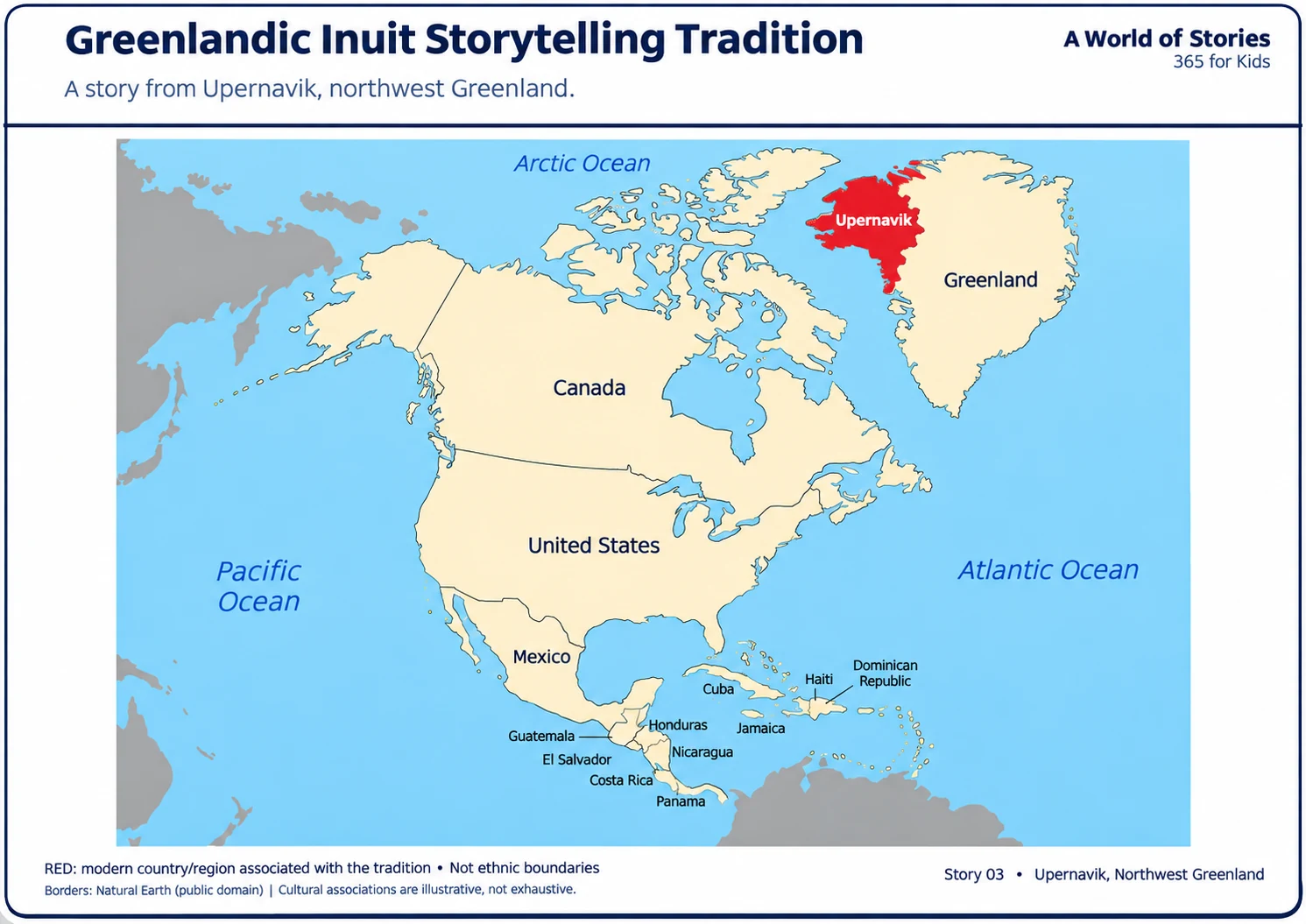
This retelling follows “The Raven Who Wanted a Wife,” recorded in Knud Rasmussen’s Eskimo Folk-Tales (1921), from the Upernavik area of northwest Greenland. It is a public-domain adaptation that keeps the original events and ending.
After the Story: Read · Create · Reflect · Share
1. Find Greenland on a map of North America. Locate the Upernavik area in northwest Greenland, where this version of the tale was recorded.
2. What did the raven offer the sparrow, and how did she respond?
3. What warning did the geese give the raven before they began their journey? Why did that warning matter?
4. The raven was confident he could complete the journey. How is confidence different from listening carefully to advice and recognizing your limits?
Inspired by this story? Create your illustration!
GREENLAND (INUIT) — How the Fog Came
Long ago, people noticed that someone had been disturbing the graves of the dead. A man decided to discover who was responsible. He arranged to be buried as though he had died, but he hid a flat stone beneath his clothing to protect himself.
Before long, a Mountain Spirit came to the new grave. Believing the man was dead, the Spirit carried him away. As they traveled, the man secretly seized willow branches and made himself difficult to carry. By the time they reached the Spirit’s home, the Spirit was exhausted.
The Spirit lay down to sleep. His wife went outside to collect firewood, leaving their children nearby. When the man opened his eyes, the children called out in surprise. Their father dismissed their warning, certain that his burden could not possibly be alive.
The man rose, overcame the Mountain Spirit and his children, and ran from the house. Returning with the firewood, the Spirit’s wife saw someone fleeing and hurried after him.
To escape, the man called for hills to rise behind him. Hills appeared, slowing his pursuer. At a stream, he jumped across and called for the water to overflow its banks. The woman could no longer follow.
She asked how he had crossed. The man told her that he had drunk the water and that she should do the same. As she bent and struggled, he distracted her by pointing to the tail of her tunic. In the old tale, the woman’s body then burst apart, and a cloud of vapor rose from her.
That vapor became the fog that, the storytellers said, still drifts among the hills.
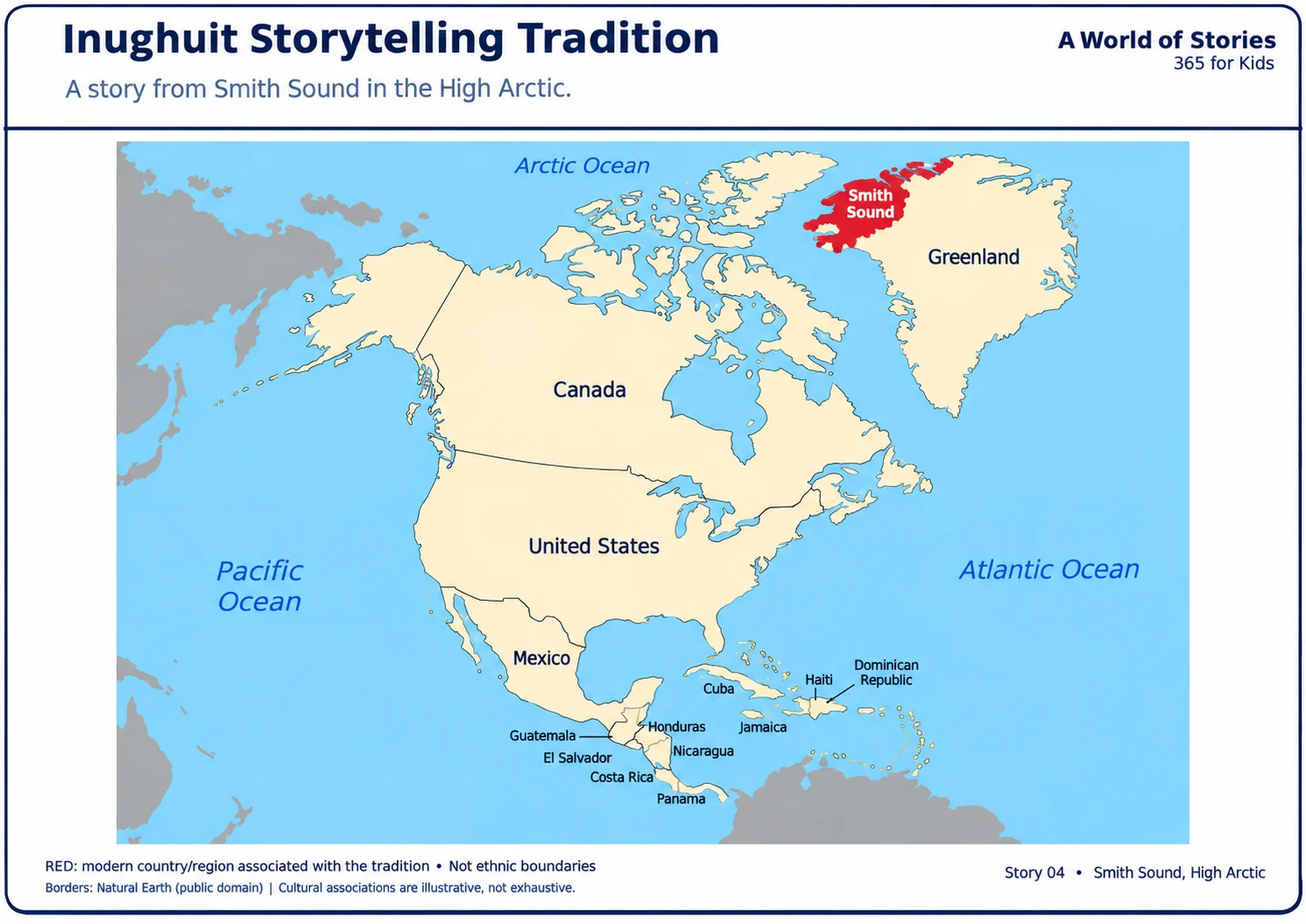
“How the Fog Came” is an Inuit explanatory tale collected by Knud Rasmussen and published in Eskimo Folk-Tales (1921), associated with the Polar Inuit of the Smith Sound region. This is a public-domain adaptation that keeps the original sequence of events.
After the Story: Read · Create · Reflect · Share
1. Find the Smith Sound area between northwestern Greenland and Canada on a map of the Arctic. Why might fog be important to people traveling in this landscape?
2. Why did the man arrange to be buried, and how did he protect himself before the Mountain Spirit arrived?
3. What two changes in the landscape helped the man escape from the pursuing woman?
4. The story explains a natural phenomenon through an extraordinary event. How is a traditional explanation of fog different from a scientific explanation? Why is it valuable to learn about both?
Inspired by this story? Create your illustration!
GREENLAND (INUIT) — The Man Who Became a Star
Long ago, an old hunter stood quietly on the sea ice, waiting beside the breathing holes where seals came up for air. Hunting required patience. He watched and listened, hoping to bring food home.
On the shore opposite him, children were playing in a ravine. Their voices carried across the frozen landscape. More than once, just as a seal approached, the noise frightened it away.
The hunter grew angrier each time. At last he shouted a command to the ravine, calling on its sides to close around the children who were disturbing his hunt.
The hillside obeyed. The earth shut around the children, trapping them inside. They cried out, but no one could open the ravine again. People tried to help, pouring water through a narrow crack in the rock, but they could not bring the children food, and in the old story the children did not survive.
When the people learned what the hunter had done, they were horrified. They went after him, and the old man fled across the land.
But as they pursued him, something extraordinary happened. The hunter began to shine. He rose from the earth into the sky and became a bright point of light.
In the traditional account, that light is called Nâlaussartoq, “he who stands and listens.” It appears low in the western sky when daylight begins to return after the long Arctic darkness. The old storyteller identifies it with the planet Venus, which can look like a brilliant star.
This is how the tale remembers the man who waited and listened on the ice—and the consequences of his anger.
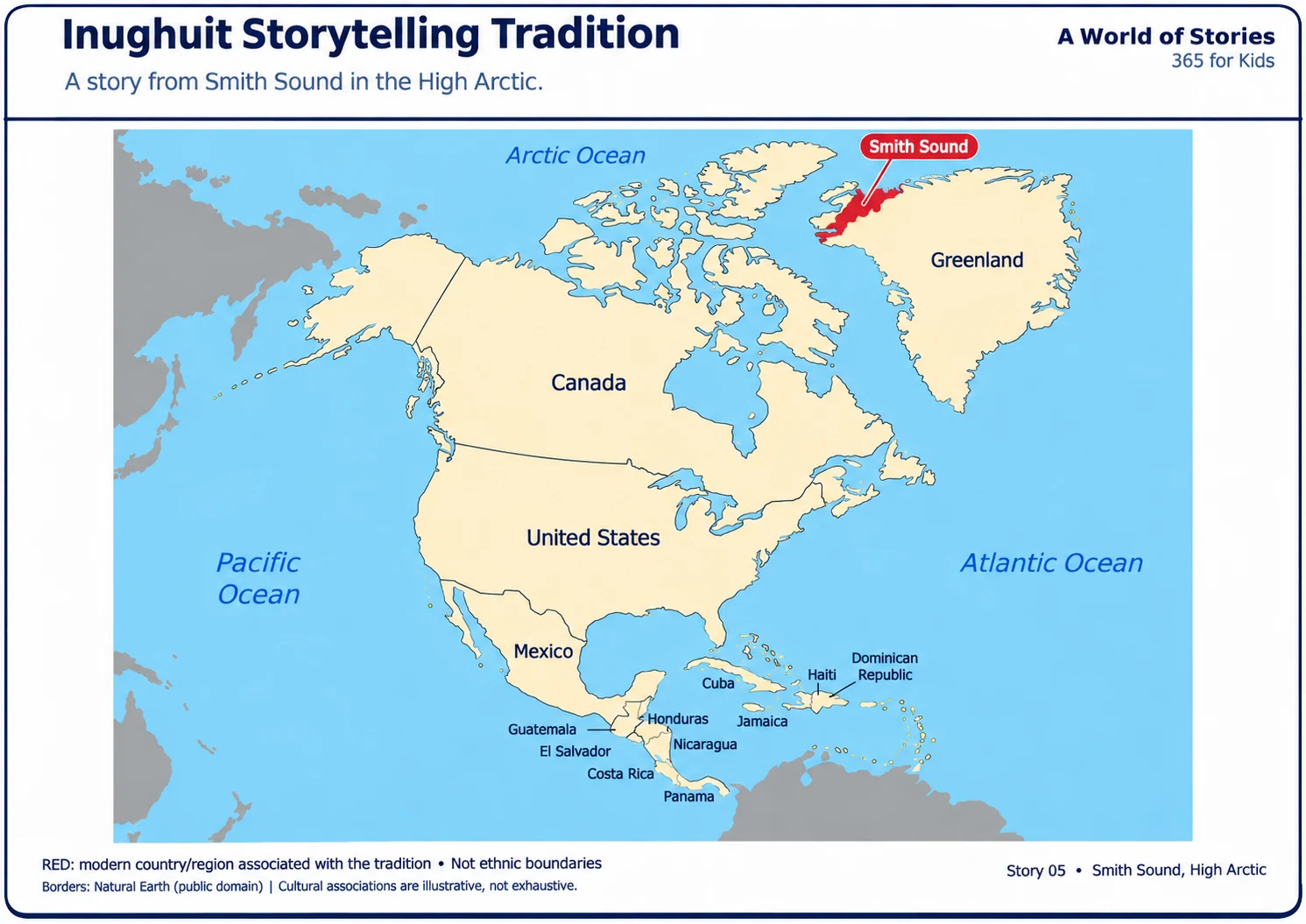
“The Man Who Became a Star” is a traditional Inuit narrative collected by Knud Rasmussen and published in Eskimo Folk-Tales (1921), from the Polar Inuit (Inughuit) traditions of the Smith Sound region. This is a public-domain adaptation that keeps the original sequence of events.
After the Story: Read · Create · Reflect · Share
1. Find the Smith Sound region between Greenland and the Canadian Arctic on a map. Why would people hunting on sea ice need to listen carefully?
2. What were the children doing, and why did their play upset the hunter?
3. What happened after the hunter shouted at the ravine? How did the community respond?
4. The hunter’s anger led to harm that could not be undone. What could he have done differently, and why is it important to think before acting when we are angry?
Inspired by this story? Create your illustration!
GREENLAND (INUIT) — The Eagle and the Whale

Long ago, in a village beside the sea, many brothers lived with their two sisters. The sisters had reached the age when they could marry, and their brothers often urged them to choose husbands. But neither sister wished to do so.
At last, one of the brothers spoke impatiently. “What kind of husband do you want, then? An eagle?” he said to the first sister. “An eagle you shall have!” Turning to the other, he asked whether she wanted a whale. “Then a whale you shall have!”
No sooner had he spoken than a great eagle swept down from the sky and carried the first sister to a ledge high on a steep cliff. A whale came for the second sister and carried her away to a dwelling above the sea.
The first sister lived with the eagle on the cliff. Day after day, while the eagle flew out hunting over the water, she twisted long strands of sinew into a rope. She hoped it would be strong and long enough to lower herself to the ground. Once she tested it and found that it did not reach far enough. She returned to her work and made the rope longer.
Meanwhile, her brothers missed her. They prepared bows and arrows and traveled to the foot of the cliff. With them was a small homeless boy who could not bend his own bow without help. The brothers called up to their sister, and when the eagle was away hunting she lowered herself on the rope and rejoined them.
That evening, the eagle returned from the sea carrying two walruses. Passing over the brothers’ home, he dropped one of the animals down to them. Then he flew back to the cliff and found that the sister was gone. He cast away his other catch and flew toward the house. The brothers shot their arrows at him, but none struck.
“Let me try!” cried the little boy. Someone bent his bow for him. He released his arrow, and this time it struck the eagle. The brothers fired more arrows, and the mighty hunter fell and died.
The second sister was living with the whale. He was so watchful that he scarcely allowed her to leave his sight. She, too, was homesick and secretly made a rope of sinew. Her brothers, longing to bring her home, built a boat called an umiak. They needed a boat fast enough to escape the whale.
To test it, they raced against a guillemot, a seabird nesting nearby. The bird easily passed their first boat. “The whale would catch us,” the brothers decided. They took the boat apart and built another.
When they tried again, boat and bird traveled side by side until the boat drew ahead near the shore. Now the brothers believed it was fast enough.
One day the sister told the whale that she needed to go outside. He ordered her to stay. But she insisted, and he allowed her to go, keeping hold of a string tied to her so that he could pull her back. As soon as she was outside, he tugged on it.
“I have only just reached the passage!” she called. Then she tied the string to a stone and ran toward her brothers. The whale pulled in the stone, thinking that he was drawing his wife back into the dwelling.
The brothers hurried their sister into the umiak and rowed out to sea. The whale discovered her escape and rolled down into the water in pursuit. Though the brothers paddled with all their strength, the whale came closer and closer.
“Throw out your hairband!” they cried. She did, and the water foamed around it. The whale paused, but soon chased them again.
Next she cast out a mitten, then its inner lining, then one garment after another. Each time, the whale stopped among the swirling waves for a moment; each time, he resumed the chase. At last, as the boat reached land, she threw out her final garment.
The umiak made it safely ashore. The whale tried to follow but could go no farther. There on the shore, the tale says, he became a white, sun-bleached whale bone.
So ends the old story of the two sisters, the eagle, and the whale.
This tale comes from Inuit storytelling traditions of West Greenland, recorded by Knud Rasmussen in Eskimo Folk-Tales (1921). It is a public-domain adaptation that keeps the original characters and events, including the rope, the boy’s decisive arrow, the race against the guillemot, and the whale’s transformation into bone.
After the Story: Read · Create · Reflect · Share
1. Find Greenland on a map of North America. Where is West Greenland, and what seas surround the island?
2. How did the first sister prepare to leave the eagle’s cliff, and who helped her return to her brothers?
3. Why did the brothers race their umiak against a guillemot before rescuing the second sister? What did the race show them?
4. Both sisters wanted to return home. How did they show courage and determination, and why is it important to listen to someone’s wishes?
Inspired by this story? Create your illustration!
WABANAKI (CANADA & NORTHEASTERN USA) — How Glooskap Made the Birds
Long ago, in the tale as Cyrus MacMillan recorded it, a fierce giant called Wolf-Wind lived in the far northern Night-Night Land. At times the air was still and the sea lay quiet. But when Wolf-Wind rushed out of his cave, trees bent before him, waves rose against the rocks, and the forest shook with his anger.
One day, while families were fishing far from shore, Wolf-Wind swept across the sea. Their boats were destroyed, and the parents never returned. When the giant turned toward the children waiting on land, they fled among the rocks and sheltered inside a cave. They blocked its entrance with a heavy stone. Wolf-Wind roared outside, but he could not reach them.
After he had gone, the children made their way into a gentler country called Willow-Willow Land. There, tall trees spread thick branches above them. Their leaves formed a shelter so closely woven that even Wolf-Wind, whenever he came hunting for the children, could not force his way through.
The giant grew furious with the trees. He returned from the north with another giant who carried the Charm of the Frost. Together they stripped the leaves from the beech, birch, oak, maple, alder, and willow. The forest became bare and still. Yet the children found protection beside spruce, fir, hemlock, pine, and cedar, which remained green and resisted the frost.
Although the children were safe, they grieved for the trees that had defended them. The bright leaves that had once sheltered their home lay scattered upon the ground. Summer had travelled south along the Rainbow Road, and the woods seemed strangely silent.
At that time, Glooskap came each year to hear the children’s wishes and give them gifts. He arrived in Willow-Willow Land on a sled drawn by his dogs. The children gathered around him, but they did not ask for toys or treasures.
“Please bring back the leaves,” they asked. “The trees lost them because they protected us.”
Glooskap listened and thought for a long while. He could not return the fallen leaves to the branches that autumn. But he imagined a different gift, one that would carry their beauty into the world.
In those days, the tale says, there were seabirds and other useful birds, but no small forest birds singing among the branches. Glooskap decided that the fallen leaves should become bright-feathered birds. When autumn returned, the birds would follow summer away; in spring, they would return to the trees. Their voices would fill the air with music, and the children would care for them in memory of the shelter the leaves had given.
Glooskap also promised the bare trees that they would grow fresh leaves each spring, even after Wolf-Wind and Frost had passed through the woods again.
He raised his magic wand. Suddenly the leaves upon the ground stirred. From them rose flocks of small birds, bright as autumn itself. Robins and thrushes carried the browns and reds of oak leaves. Finches and hummingbirds flashed with the greens and yellows of alder and willow. Golden leaves became yellowbirds and warblers; maple leaves gave their rich colours to tanagers, orioles, and grosbeaks.
The new birds flew to the branches and began to sing. The children looked up in wonder. The trees would be green again in spring, and even through the changing seasons, the forest would never be quite so silent as before.
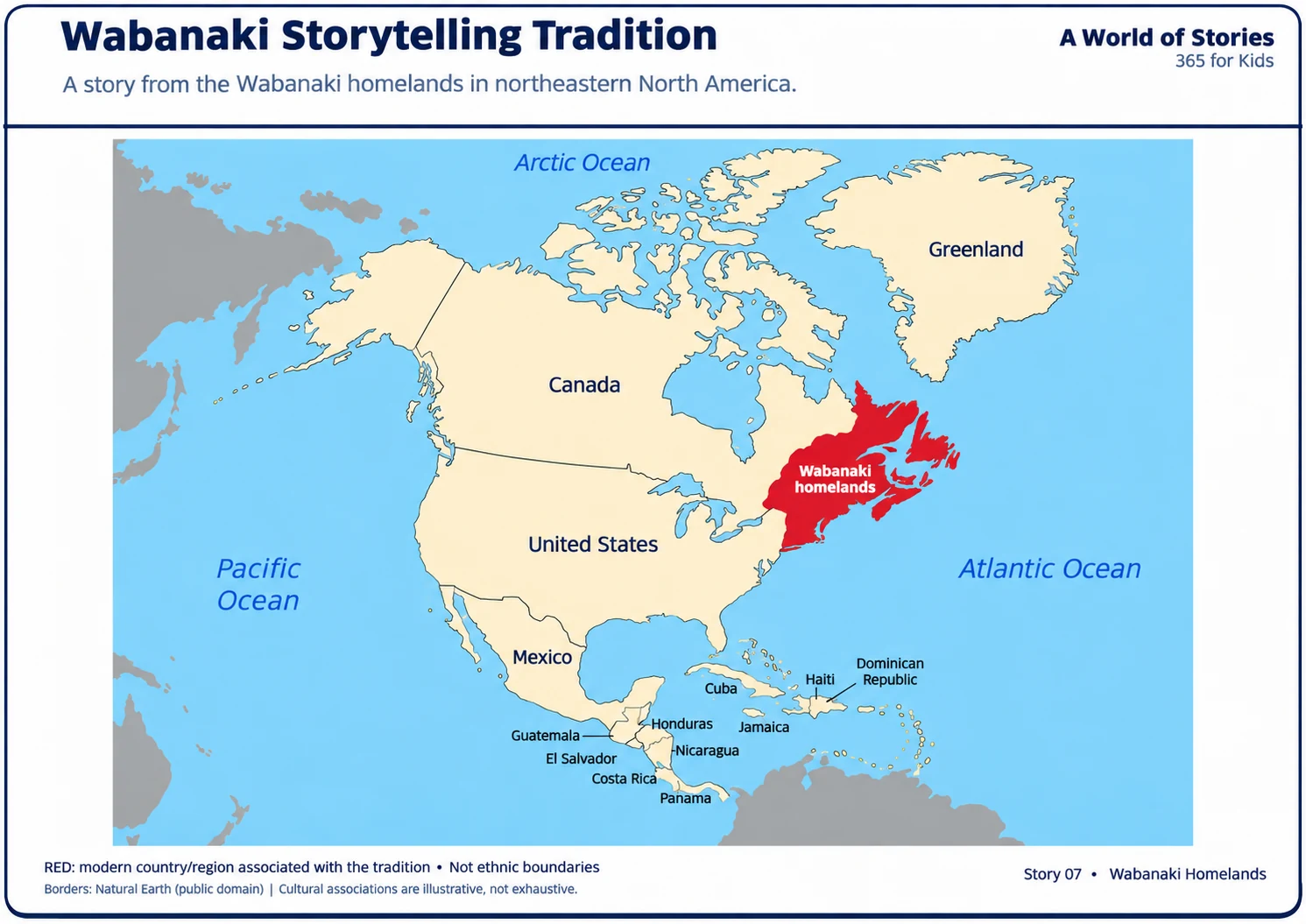
This adaptation follows “How Glooskap Made the Birds” in Cyrus MacMillan’s Canadian Fairy Tales (1922), a public-domain literary retelling based on Indigenous story traditions. Glooskap (also Gluskap or Kluskap) is an important figure in Wabanaki storytelling, including Mi’kmaw and other Wabanaki traditions, which remain living cultures today.
After the Story: Read · Create · Reflect · Share
1. Find the Atlantic Canadian region and the northeastern part of North America on a map. Why might a cultural tradition such as the Wabanaki stories reach across today’s national borders?
2. How did the trees protect the children from Wolf-Wind, and which trees were able to remain green when Frost came?
3. What did the children ask Glooskap to restore, and how did he transform their request into a different gift?
4. The children asked for help for the trees rather than for themselves. What does their choice suggest about gratitude and caring for the natural world?
Inspired by this story? Create your illustration!
CANADA — Rabbit and the Grain Buyers

Long ago, Rabbit decided that he was tired of working for others. He had spent many days guiding Glooskap through the forest, but now he wanted a way to make a living that would bring him riches without much effort. For a while, he stayed at home doing nothing. Soon, however, he grew restless. Rabbit was too energetic to remain idle forever.
One day he watched people trading goods and imagined how easy it must be to become a successful merchant. He questioned Duck, who exchanged eggs for corn, and Bee, who made honey and wax. Neither could offer him a trade that suited a rabbit. Bee was so annoyed by Rabbit’s teasing that he stung him on the nose.
Then Rabbit spotted a field of ripening corn. An idea flashed into his mind. He would offer the grain for sale, collect payment, and secretly take the corn from the farmer’s field. Outside his home he put up a sign promising excellent corn and inviting orders. Soon customers appeared. Rabbit told each one to pay in advance and return in seven days for the grain. Before long he had collected a great deal of money.
But the farmer had noticed Rabbit lurking near the field. He surrounded the corn with strong netting and set dogs to guard it. Rabbit tried again and again to slip through the fence, but every attempt failed. Meanwhile, he spent the money his customers had given him. By the seventh day, he had neither grain nor money to return.
When Earthworm arrived to collect his order, Rabbit welcomed him warmly and invited him to stay for dinner. Just then Duck approached. Rabbit warned Earthworm that Duck might eat him, and persuaded him to hide beneath a clamshell. When Duck came in and asked for her corn, Rabbit offered her a little snack before dinner. He lifted the shell, and Duck ate Earthworm.
Next came Fox. Rabbit told Duck that Fox was dangerous and urged her to hide beneath an overturned basket. Then he offered Fox a duck for an appetizer. Fox found Duck under the basket and ate her. Rabbit had escaped two complaints, but his troubles were far from over.
Bear appeared next, expecting his promised grain. Fox trembled: earlier that day he had stolen Bear’s honey. Rabbit quickly hid Fox in a box. Then he told Bear exactly where the honey thief was hiding. Furious, Bear opened the box and struck Fox down.
At last the Hunter came along the path. Bear knew that the Hunter might kill him, so Rabbit encouraged him to crawl under the bed. Rabbit greeted the Hunter with a promise of pancakes and maple syrup. Then he mentioned that a fat bear was hiding beneath his bed. The Hunter found Bear there, killed him, and took the meat and skin for his family.
While the Hunter was occupied, Rabbit slipped away into the thick forest. His clever tricks had saved him from his angry customers, but they had also brought harm to nearly everyone who trusted him. He decided that trading was not the life for him after all.
The Hunter soon discovered that there was no grain. He searched for Rabbit, but Rabbit was nowhere to be found. And so, in this old tale, Rabbit continued to keep his distance from the Hunter, remembering the trouble caused by his dishonest promises.
This animal trickster tale appears in Canadian Fairy Tales (1922), retold by Cyrus MacMillan from stories heard in Canada. It is a public-domain adaptation; the published version does not identify one particular Indigenous nation as the source of this story.
After the Story: Read · Create · Reflect · Share
1. Find Canada on a map of North America. What kinds of forests, fields, and animals might you encounter there?
2. Why did Rabbit decide to sell corn, and what prevented him from delivering it?
3. How did Rabbit use the fears and habits of his customers to escape their demands?
4. Rabbit was clever, but was he fair? What could he have done when he realized he could not keep his promise?
Inspired by this story? Create your illustration!
CANADA — How Raven Brought Fire to the People

Long ago, so the story tells us, the world was almost entirely dark. Only the stars shone overhead, for all the daylight belonged to White Sea-gull, who kept it locked inside a box. Raven, who lived nearby, believed the light should shine for everyone. Sea-gull, however, refused to share even a little.
Raven was determined to change this. He scattered thorns along the path to the beach, then shouted that their canoes were drifting away. Sea-gull hurried outside and stepped on the thorns. He returned home with sore feet. Raven offered to pull the thorns out, but instead pressed them deeper with a pointed tool. He complained that the room was too dark to see his work and demanded that Sea-gull open the box of daylight.
At first Sea-gull raised the lid only a little. Raven insisted on more light and deliberately knocked the box to the floor. Its lid sprang open. Daylight rushed into the sky and spread across the world. Sea-gull could not gather it back again, and Raven left delighted with his trick.
Raven’s own eyes were unused to such brightness. As the days passed, he began to see farther. One morning he noticed distant hills and a thin thread of smoke rising behind them. He remembered hearing of another people who possessed a wonderful thing called Fire. Now that daylight had come, Raven wanted fire as well.
He gathered Robin, Mole, and Flea for the journey. Flea’s little wagon was far too small to hold them. Mole’s carriage broke apart, and Robin’s toppled over. Finally Raven took Sea-gull’s strong carriage while its owner slept, and the travelers made their way toward the smoke.
When they reached the distant settlement, they found the Fire people gathered around many flames. Raven asked Robin to dart in and carry away a spark. Robin did so, but the fire burned his beak. He dropped it and tried desperately to keep the tiny flame alive by fanning it with his wings. The flame died, and Robin’s breast was scorched. The tale says that this is why the robin has a reddish breast.
Flea feared he would leap straight into the flames, and Mole feared his fur would burn. Raven himself would not attempt the task. Instead he proposed a trick: they would take the chief’s baby and demand Fire in exchange. Mole tunneled beneath the house and brought the child away. The baby’s family searched everywhere and grieved for the missing child.
At last messengers discovered that the child was being kept in Raven’s village. The chief offered beautiful gifts, but Raven refused them. He wanted only Fire. When the messengers carried that demand home, they were astonished. Fire was plentiful in their country, and the chief gladly sent some in exchange for the safe return of his child.
The messengers also brought two stones and showed Raven how to use them with dry grass, birch bark, and wood to kindle a new flame. Raven was proud to possess both light and fire. Yet he was no more generous than Sea-gull had been. For a long time he kept Fire to himself and later demanded costly payment from others who wanted it.
In the end, the people took Fire for their own use. From then on, the tale says, they could rekindle it when it went out. The story remembers Raven as a clever but selfish trickster: he helped bring light and fire into the world, while causing trouble through the ways he chose to obtain them.
This northern Canadian tale is preserved in Cyrus MacMillan’s Canadian Fairy Tales (1922), a public-domain adaptation. Raven is a trickster figure: inventive and determined, but not always kind or honest, and the published collection does not identify a specific Indigenous nation for this version.
After the Story: Read · Create · Reflect · Share
1. Find northern Canada on a map of North America. What might long winter nights be like in Arctic and subarctic places?
2. Why did Sea-gull keep daylight in a box, and how did Raven release it?
3. What happened when Robin tried to carry Fire, and how did Raven finally obtain it?
4. Raven wanted everyone to have light, yet he caused trouble for others and later kept Fire to himself. Can a good goal excuse unfair actions? Why or why not?
Inspired by this story? Create your illustration!
CANADA — Ermine and the Hunter
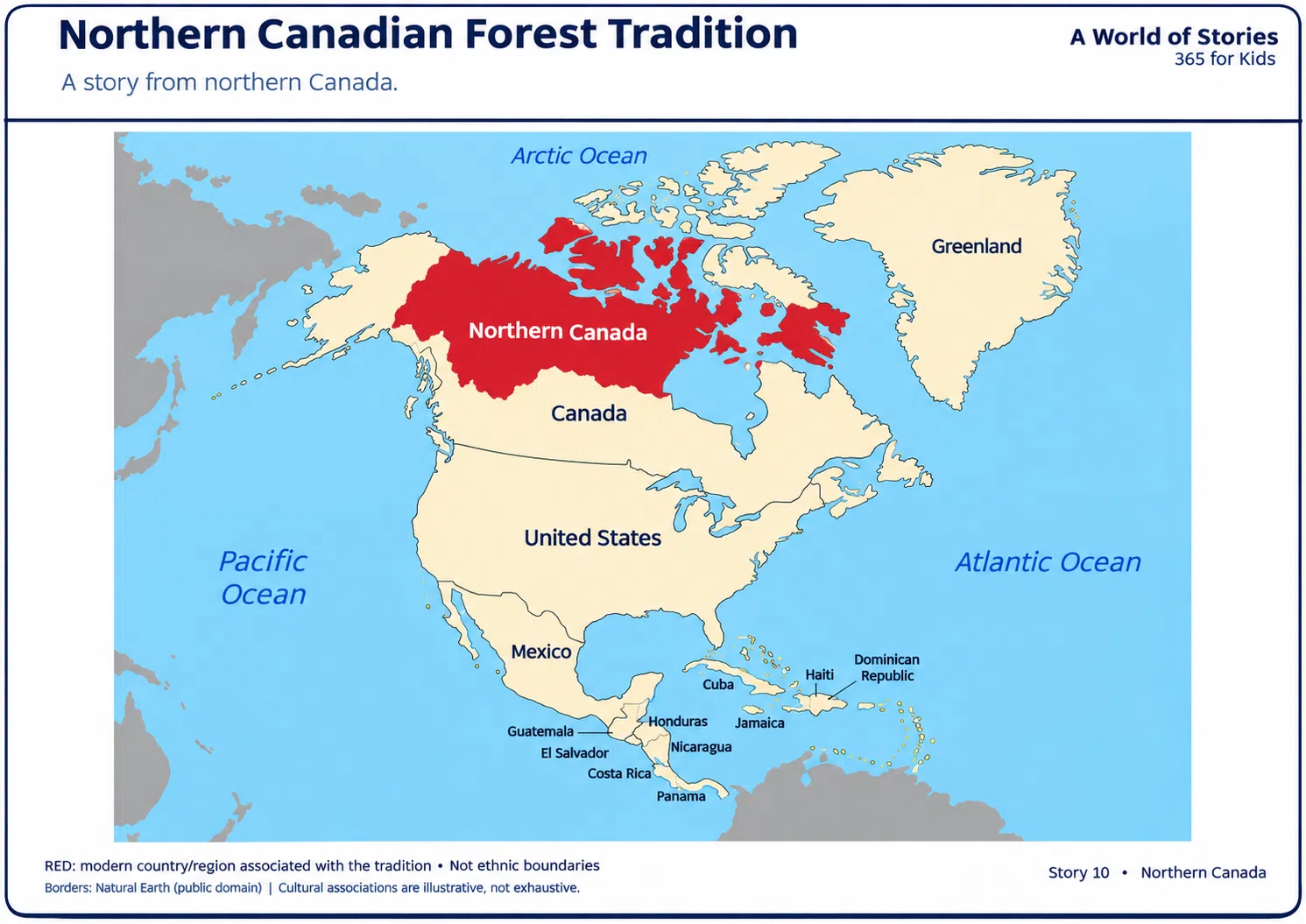
Far away in the northern forests of Canada, a hunter lived with his wife and children. Their home was distant from any village, but there was always plenty to do. The hunter brought home fish and game, and when spring arrived, he collected maple sap to make sweet syrup and sugar.
One summer day, he discovered that three young bear cubs had eaten his store of maple sugar. In a burst of anger, he killed the cubs. When his wife learned what had happened, she was deeply troubled. The cubs had been young, she reminded him, and his anger had cost them their lives.
The next day, their father, a great brown bear, came searching for his missing cubs. When he discovered what the hunter had done, grief turned to fury. He vowed to take revenge upon the hunter and his family.
The hunter raised his bow and shot arrows at the bear, but they did not harm him. This was no ordinary animal. He was Bear of the Stony Heart, a creature whom no human weapon could defeat.
Night after night, the bear returned to steal the family’s food. The hunter tried setting traps, but nothing worked. As their supplies dwindled, he feared that his family would have nothing left to eat before winter.
At last he went to the river and asked its spirit for help. But the River-God was hurrying to the ocean, carrying what was needed for the shells of countless oysters. He could not stop.
The hunter called next to the Wind Spirit. Wind, too, had work to do: ships far out at sea were waiting for a breeze to carry them forward. Then the hunter appealed to the Storm Cloud. But the cloud was bringing rain to fields and grasses suffering from the summer heat.
The hunter sat sadly beside the river, wondering where he could turn.
An elderly woman approached. She was hungry and weary from travelling, and asked for something to eat. Although his stores were almost empty, the hunter shared what little his family had. As she ate, he told her about the terrible bear.
The woman listened. Then she revealed that one small animal could overcome Bear of the Stony Heart. She gave the hunter a magic wand and taught him a short rhyme. He was to wave the wand, say the rhyme, fall asleep, and call to the first creature he saw upon waking.
After she left, he followed her directions. When the sunlight woke him, he noticed a little brown animal peering out from behind a tree. Its coat was rough and untidy. Could such a tiny creature truly defeat the mighty bear?
The animal came closer. “I am Ermine,” it said. “I can help you. My sharp white teeth are the darts that will reach the bear’s stony heart.”
The hunter was delighted, but Ermine had two conditions.
First, he wanted a beautiful coat, white and bright as new winter snow. The hunter waved the magic wand, and Ermine’s rough brown fur became shining white.
Second, Ermine demanded a promise. The hunter must never again kill helpless young bear cubs still following their mother. He must give them the chance to grow and become strong.
The hunter made his promise. At once the magic wand vanished, returning to the mysterious woman.
Ermine hurried through the silent summer forest and soon found Bear of the Stony Heart sleeping beside the river. The bear lay on his back, mouth open, snoring so loudly that he sounded like a waterfall.
Quietly, Ermine crept forward. With a sudden leap he sprang into the bear’s open mouth, reached the stony heart with his sharp teeth, and escaped again as swiftly as he had entered. The great bear never woke.
Ermine returned to the hunter with the news, and that evening the family celebrated their safety.
The tale tells why Ermine received his snowy-white coat and why hunters should allow young bear cubs to grow. The hunter had been rescued by a creature far smaller than himself, but the help had come with a lesson he was never to forget.
This story comes from a collection of Canadian folktales set in the northern forests, presented here as a public-domain adaptation. Like many traditional animal tales, it offers an explanation for an animal’s appearance while asking us to think about how people treat the natural world.
After the Story: Read · Create · Reflect · Share
1. Find Canada on a map of North America. What kinds of forests and wildlife might you discover in its northern regions?
2. What did the hunter do when he found the bear cubs, and why was the great bear angry?
3. Why could the River-God, Wind Spirit, and Storm Cloud not help? What made Ermine different?
4. Ermine asked the hunter to make a promise before helping him. What does that promise teach us about responsibility and respect for living creatures?
Inspired by this story? Create your illustration!
CANADA — How Rabbit Deceived Fox

Long ago, in the forests of Canada, Rabbit served as a guide for Glooskap. He knew the woodland paths better than almost anyone, but he also had a troublesome habit: he stole food from other people’s gardens.
Deep among the trees lived an elderly woman who cared for a small garden. She raised cabbages, carrots, beans, pumpkins, and corn, trading some of her harvest for fish and meat. Every morning she found more vegetables missing. Rabbit had discovered her garden and was returning night after night to eat his fill.
To catch the thief, the woman shaped a little figure from sticky tree gum and balsam. She gave it shining bead eyes, a pinecone nose, and hair made from corn tassels and moss. Then she placed it at the garden entrance.
Under the moonlight, Rabbit saw the strange figure and stopped. “Let me pass,” he ordered. It did not answer. Rabbit struck it with one paw—and stuck fast. He struck with the other, then kicked, then bit. Each time he became more tightly caught, until he could hardly move at all.
The woman heard his cries, freed him from the sticky figure, and tied him inside a strong bag while she went to fetch her axe. Rabbit feared what would happen when she returned.
Just then Fox came along and stumbled over the bag. He was annoyed, but when he heard Rabbit speaking from inside, he asked what had happened.
Rabbit quickly invented an explanation. He claimed the woman wanted him to marry her granddaughter and had shut him in the bag because he refused. Fox, who had long wanted to find a wife, eagerly offered to take his place. He untied the bag, let Rabbit escape, and climbed inside.
When the woman returned with her axe, Fox realized the trick. As she opened the bag, he leaped away before she could catch him. Furious, he searched the forest for Rabbit.
At last Fox spotted him on the far side of a stream. Rabbit pointed to the round moon reflected in the water and said that a delicious wheel of cheese lay below. Fox jumped in after it. The water was shallow enough for him to scramble out, but he came away soaked and hungry.
Fox still wanted revenge. When he asked what Rabbit was eating, Rabbit tossed him a prickly wild cucumber and told him to swallow it whole. Fox did so in the dim light and nearly choked, while Rabbit ran off.
On another evening, Fox surprised Rabbit playing a flute on a log. Rabbit claimed that a wedding party would soon pass and reward their music. He offered Fox the flute and said he would fetch another. Fox agreed, hoping for a reward—and secretly planning to catch Rabbit afterward.
But Rabbit did not return. Instead, he set fire to the dry brush around the log. Fox was so busy playing that he noticed the flames only when they were closing in. He sprang through the fire and escaped with his life, but his coat was scorched reddish brown and his eyelids were singed.
After that, Fox decided Rabbit was too dangerous to pursue. In this old tale, that is why foxes have reddish coats and why Rabbit and Fox no longer travel together as friends.
This story comes from a Canadian collection of traditional tales published in the early twentieth century, presented here as a public-domain adaptation. Rabbit is a trickster character: clever and quick-thinking, but often dishonest, and the published version does not identify one specific Indigenous nation as its source.
After the Story: Read · Create · Reflect · Share
1. Find Canada on a map of North America. What kinds of forests and waterways can you discover there?
2. How did the woman use tree gum to catch the animal stealing from her garden?
3. What tricks did Rabbit use to escape from Fox, and how did each trick change what happened next?
4. Rabbit was clever, but was he fair to the woman and Fox? What is the difference between using intelligence to solve a problem and using it to harm someone?
Inspired by this story? Create your illustration!
CANADA — Rainbow and the Autumn Leaves

Long ago, in the time of this tale, the animals of the northern forests could speak to one another and meet in a great council. Every year, after midsummer, they gathered to discuss the future of their world.
Turtle, the oldest and wisest among them, had always been curious about the sky. One day he asked the Thunder God to carry him there. A mighty sound rolled across the land, and Turtle vanished. That evening, the other animals looked upward and saw him travelling through the heavens in a dark cloud.
Turtle liked his new home. He chose to dwell in a cloud filled with ponds, streams, and lakes, for he had always loved the water. Yet he did not forget his companions. Whenever the animals met for their yearly council, he returned to join them.
As time passed, the animals became troubled. They heard that unfamiliar creatures might soon come to live on the land, and many feared what the future would bring. Turtle seemed fortunate to have a place beyond the earth. The others wished they could visit the sky too, but none knew the way.
One day Deer met Rainbow beside a lake. Rainbow sometimes stretched a shining path of many colours from the water toward the sky.
“Will you carry me to Turtle?” Deer asked.
Rainbow wanted first to ask the Thunder God for permission. He told Deer to return in winter. Deer waited and watched through the long cold months, but Rainbow did not appear.
When Rainbow returned in early summer, Deer reminded him of his promise. Rainbow asked him to wait once more, until fog lay thick over the lake. This time he sought the Thunder God’s permission, and it was granted.
Not long afterward, mist covered the water. Rainbow appeared and swept the fog away with an arch of brilliant colours. “Follow my path,” he told Deer, “and you will reach the sky.”
Deer climbed the radiant bridge over the forests, hills, and streams. He found Turtle among the clouds and was so delighted with his new surroundings that he decided to stay.
When the next great council met, the animals wondered where Deer had gone. Birds searched above the treetops, while Wolf and Fox looked through the woods. At last Turtle arrived in his dark cloud and explained that Deer had crossed Rainbow’s bridge into the sky.
Turtle suggested that all the animals travel there together until they knew whether the earth would be safe for them. They agreed. Yet Bear was angry. Deer had left without telling the council, and Bear believed that companions should face uncertain times together.
When autumn came, Rainbow spread his glowing bridge again. Bear started across first, testing the path with his great weight. Near the sky he met Deer, who had come to welcome the travellers.
Instead of greeting one another, Bear accused Deer of abandoning the others. Deer answered angrily. Their quarrel grew into a fierce disagreement high above the trees, and both were hurt before they could be separated.
From below, the animals watched with alarm. They did not want either of their companions to come to harm. They sent Wolf up the bridge, and he managed to stop the struggle. Bear and Deer moved away to recover, while the others crossed safely into the sky.
As Bear and Deer travelled above the forest, drops of colour from their encounter fell onto the leaves below. In the story, those drops turned the leaves red, gold, and many other brilliant shades.
And so, the tale says, the forests of the north shine with colour each autumn. Bear and Deer, however, never again became friends.
“Rainbow and the Autumn Leaves” is a traditional-style nature tale preserved in a Canadian folklore collection published in 1922, presented here as a public-domain adaptation. It imagines how autumn leaves received their bright colours, and the collection does not identify one specific Indigenous nation as the source of this version.
After the Story: Read · Create · Reflect · Share
1. Find Canada on a map of North America. Where might you see forests whose leaves turn red, yellow, and orange in autumn?
2. Why did the animals want to follow Turtle into the sky, and how did Rainbow help Deer get there?
3. What caused the disagreement between Bear and Deer? How did Wolf change what happened next?
4. Bear and Deer were both angry, but the other animals wanted them to be safe. What could Bear and Deer have said or done to solve their disagreement without fighting?
Inspired by this story? Create your illustration!
CANADA — Sparrow’s Search for the Rain
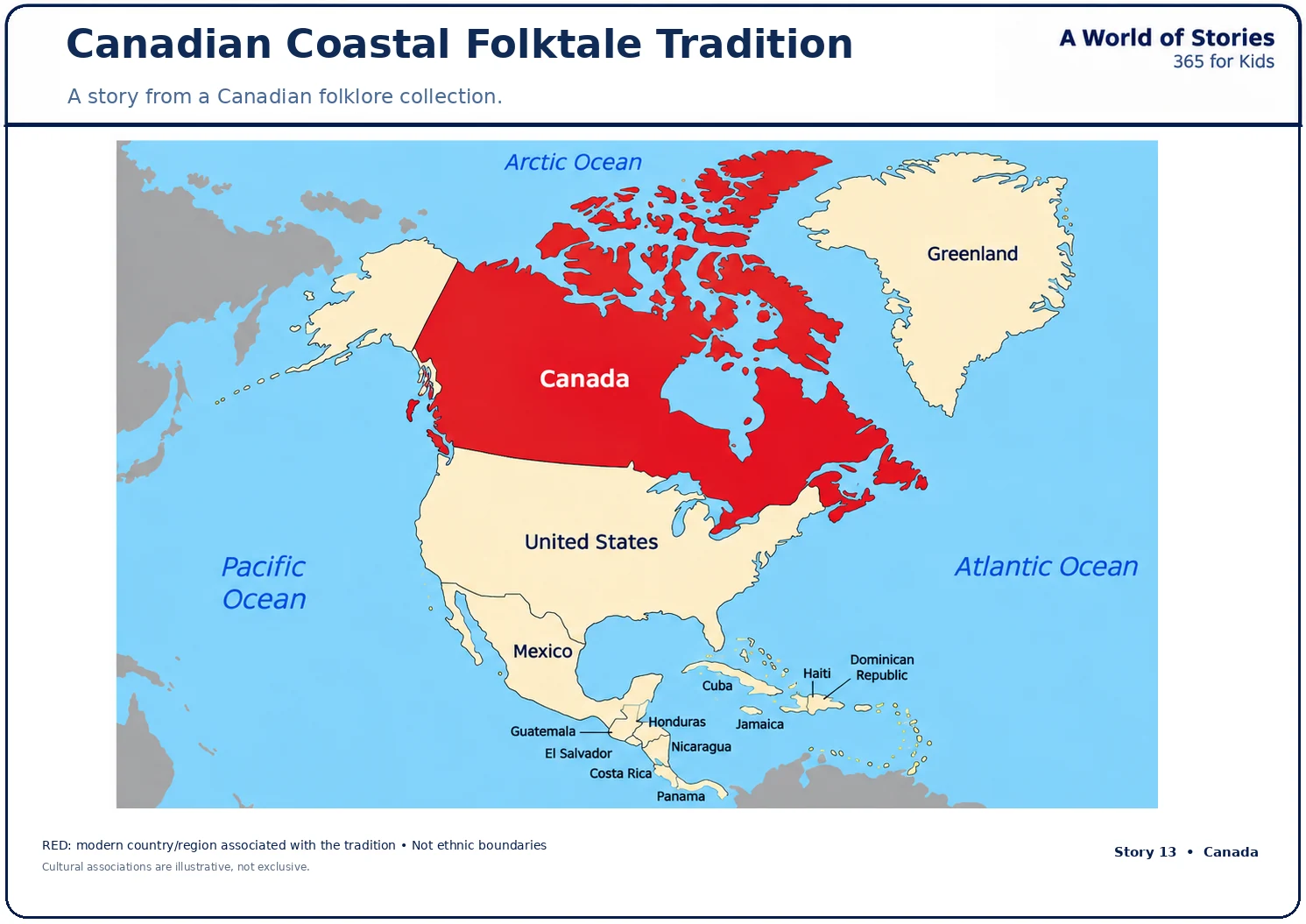
Long ago, near the sea, a wise elder lived with his daughter. The elder was known for his extraordinary knowledge, and his daughter was admired for her thoughtful and independent spirit. Many visitors came hoping to win her affection, but none could hold her interest. Loon tried to impress her with his appearance and his skill at fishing, yet when they spoke he could only laugh awkwardly. Fox bounded about, chasing his own tail in an effort to amuse her. Neither succeeded. The daughter decided that she was happiest living with her father.
Some of the disappointed young men resented her refusal. Instead of respecting her choice, they asked Whirlwind, a mischievous and powerful being, to embarrass her. As she walked nearby, Whirlwind swept into her path, knocked her into the mud, and carried her hat out to sea. The young men laughed, but she went home distressed and told her father what had happened.
Her father demanded justice. The Chief ordered Whirlwind to leave the village without considering what the village might lose. Whirlwind’s closest companion was Rain, who could not see and depended on Whirlwind to guide him. Rain refused to stay behind. Together they departed, telling no one where they were going.
Months passed. Without Whirlwind, the air stood still and fishing boats lay motionless near the shore. Without Rain, streams shrank, the wells began to dry, and the grass faded to brown. At last the Chief understood the harm caused by his hasty decision. The council withdrew the banishment and sent messengers to bring the two companions home.
Fox searched across marshes, mountains, and wooded valleys, but found nothing. Bear overturned logs, peered into caves, and questioned the trees. Mountain Ash, Pine, Red Fir, and Aspen all said they had not seen Whirlwind. Bear returned without news. Crane searched among the reeds, Crow flew over the hills, and Kingfisher journeyed out to sea. None of the birds could find the missing travelers.
Then little Sparrow offered to go. Sparrow plucked one soft down feather from his breast and fastened it to a slender stick, which he carried in his beak. Flying south day after day, he watched the feather closely. At first it hung straight and still. Then, one morning, it began to tremble. Sparrow turned toward the faint movement and flew on.
Soon the dry earth below gave way to green grass, bright flowers, and flowing streams. Sparrow followed a stream to a cave among the hills. Inside, beside a fading fire, Rain and Whirlwind were asleep. Sparrow called and nudged them, but they did not wake. He took a small coal from the hearth and placed it on Rain’s back; it hissed and went out. He tried again. On the third attempt Rain awoke and called for Whirlwind, who was resting nearby.
Sparrow told them about the suffering back home: the empty streams, the motionless boats, and the people who now longed for their return. He explained that the Chief had withdrawn the order of banishment. Whirlwind listened and agreed that he and Rain would go back. Sparrow hurried north to bring the good news.
When Sparrow reached his own flock, the birds chirped and danced with joy. Then he flew to the Chief and told him where he had found the travelers. The Chief thanked Sparrow and promised that sparrows would not be hunted for food.
The next day Whirlwind swept back across the coast. Trees swayed and the sea rose against the rocks. Rain followed close behind. Water filled the streams, the grass grew green, and flowers opened once more. According to the tale, sparrows still hop and chatter excitedly when rain is near, remembering the brave little bird who found what larger creatures could not.
This story appears in a Canadian folklore collection published in 1922, presented here as a public-domain adaptation. It imagines Wind and Rain as companions whose absence changes life along the coast, and the published collection does not clearly identify a specific Indigenous nation for this version.
After the Story: Read · Create · Reflect · Share
1. Find Canada and its Atlantic coast on a map of North America. What might happen to coastal communities if the rain stopped falling?
2. Why did Rain leave the village with Whirlwind, and what happened after they were gone?
3. How did Sparrow use a feather to find the travelers when Fox, Bear, and the other birds could not?
4. The Chief made a decision without thinking about its consequences. What could he have done differently, and what does Sparrow’s success teach us about noticing small clues?
Inspired by this story? Create your illustration!
CANADA — The Song-Bird and the Healing Waters
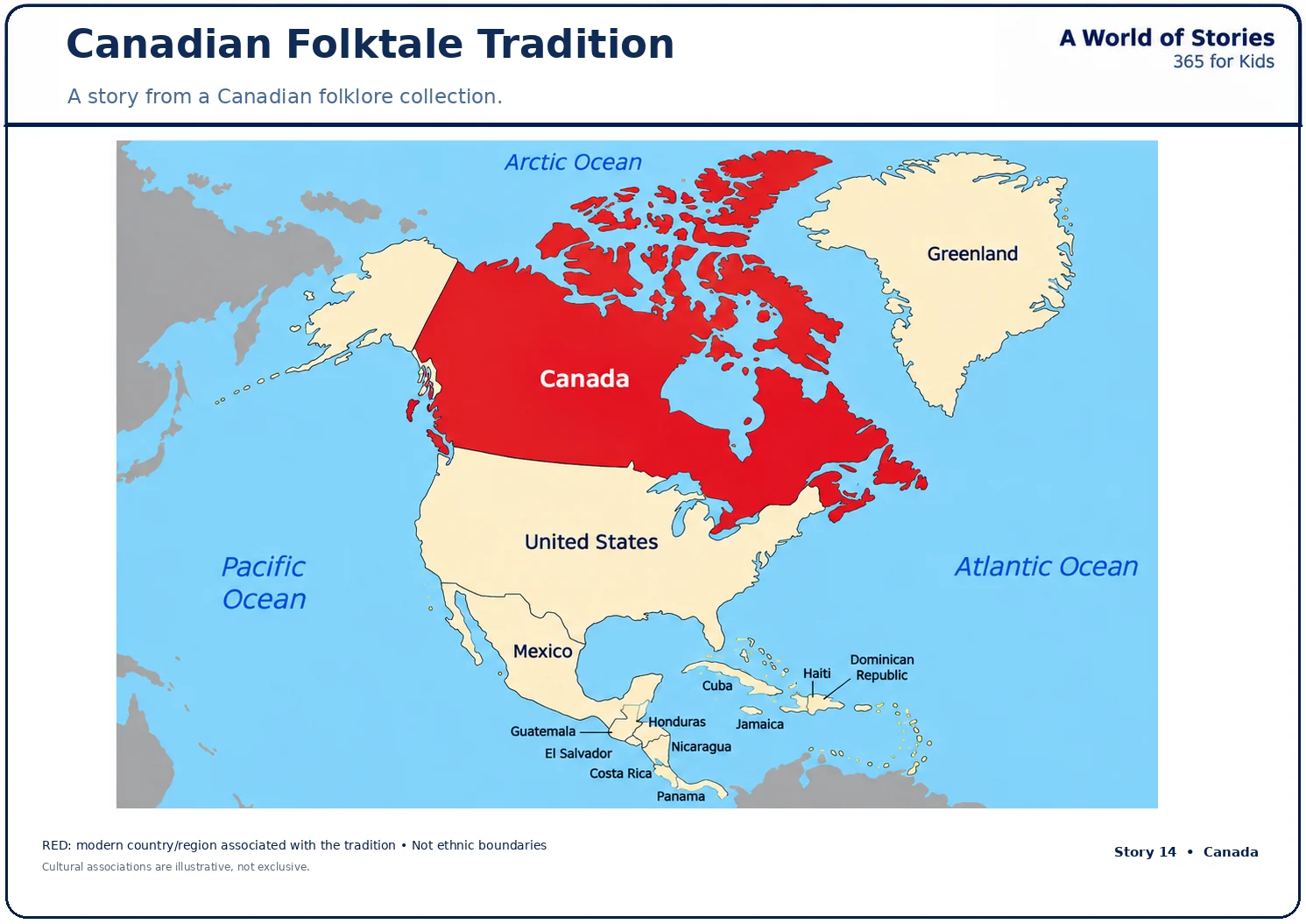
One winter, when snow lay deep across the forests, sorrow came to a village. A terrible sickness had spread among the people. Families tried everything they knew to help those who were ill, yet the sickness continued.
A young warrior had already lost his parents, brothers, and sisters. Now his wife had fallen ill too. He feared that he might lose her, and his heart was heavy with grief.
One day, while walking through the forest, he met an old woman. She saw his troubled face and asked what had happened. When he told her about his wife, she spoke of a place far to the east.
“There is a bird with a beautiful song,” she said. “It lives near the Healing Waters. Find the bird, and it will lead you to the spring.”
The young man knew that the journey might be difficult, but he could not remain at home while his wife suffered. He said farewell to his friends and set out toward the east.
For days he travelled through snow-covered woods, crossed rivers, and climbed steep hills. He listened for birdsong, but heard none. He asked a rabbit where he might find the spring; the rabbit hurried away. He asked a bear, but the bear gave no answer either. Still he went on.
At last the snow grew thinner and the air became warmer. Small streams ran across the land. Along a forest path, the young man found someone who had died. He stopped his search long enough to bury the stranger with care, then continued his journey.
That night, beneath the moon, a Fox appeared before him.
“What brings you through the forest so late?” Fox asked.
“I am searching for the singing bird that can lead me to the Healing Waters,” the young man replied.
“I am the spirit of the person you buried,” said Fox. “You treated a stranger with kindness. You have also cared for animals, birds, trees, and flowers, taking from nature only what you needed. Now I will help you.”
But first Fox told him to rest. The young man lay down to sleep, and Fox stood watch nearby.
In his dream, the young man saw his wife, pale and weak, singing a beautiful melody. Then he heard the sound of running water. A voice seemed to rise from it: “Seek me, and when you find me, your wife shall live.”
When morning came, Fox led him a little way through the forest. Suddenly, a bird began to sing from the branch of a tree. Its melody was the same as the song he had heard in his dream. Nearby he could hear water flowing, but he could not see a spring.
He searched the ground and the trees. He listened again and again.
“Do not give up,” Fox told him. “You must keep searching.”
Then a voice sounded as though it came from beneath his feet: “Set us free, and your wife and your people shall be saved.”
The young man took a strong, pointed stick and began to dig. Soon, clear water burst up from the earth. He had found the Healing Waters at last.
He bathed in the spring, and in the world of the tale its water washed away his weariness. Feeling strong again, he shaped a large clay pot from the soft earth and hardened it in a fire. Then he filled it with the sparkling water.
“Your kindness has been rewarded,” said Fox. “You no longer need my help.” And the spirit vanished.
The young man hurried home with the heavy pot. When he reached his village, he learned that his wife was weaker than ever. He went straight to her, gave her some of the water, and gently bathed her hands and forehead. She fell into a deep sleep.
He watched beside her until she opened her eyes. In the tale, she had recovered. The young man shared the water with the other sick villagers, and they too became well.
The story tells that this was how healing mineral springs came into the world—and why the sound of birdsong can be heard near places where clear waters rise from the earth.
This tale belongs to a collection of Canadian folktales published in the early twentieth century, presented here as a public-domain adaptation. It celebrates perseverance, care for others, and kindness toward the natural world; the magical spring is part of the traditional story, not a real medical treatment, and the original collection does not identify a specific Indigenous nation for this version.
After the Story: Read · Create · Reflect · Share
1. Find Canada on a map of North America. What kinds of landscapes did the young warrior travel through on his journey?
2. Why did the young warrior set out to find the Healing Waters?
3. What did the young warrior do for the stranger on the forest path, and how did that action change his journey?
4. Fox helped the young warrior because of his kindness. What small act of kindness could you offer someone today?
Inspired by this story? Create your illustration!
United States & Indigenous Traditions
BLACKFEET (UNITED STATES) — Why the Chipmunk’s Back Is Striped
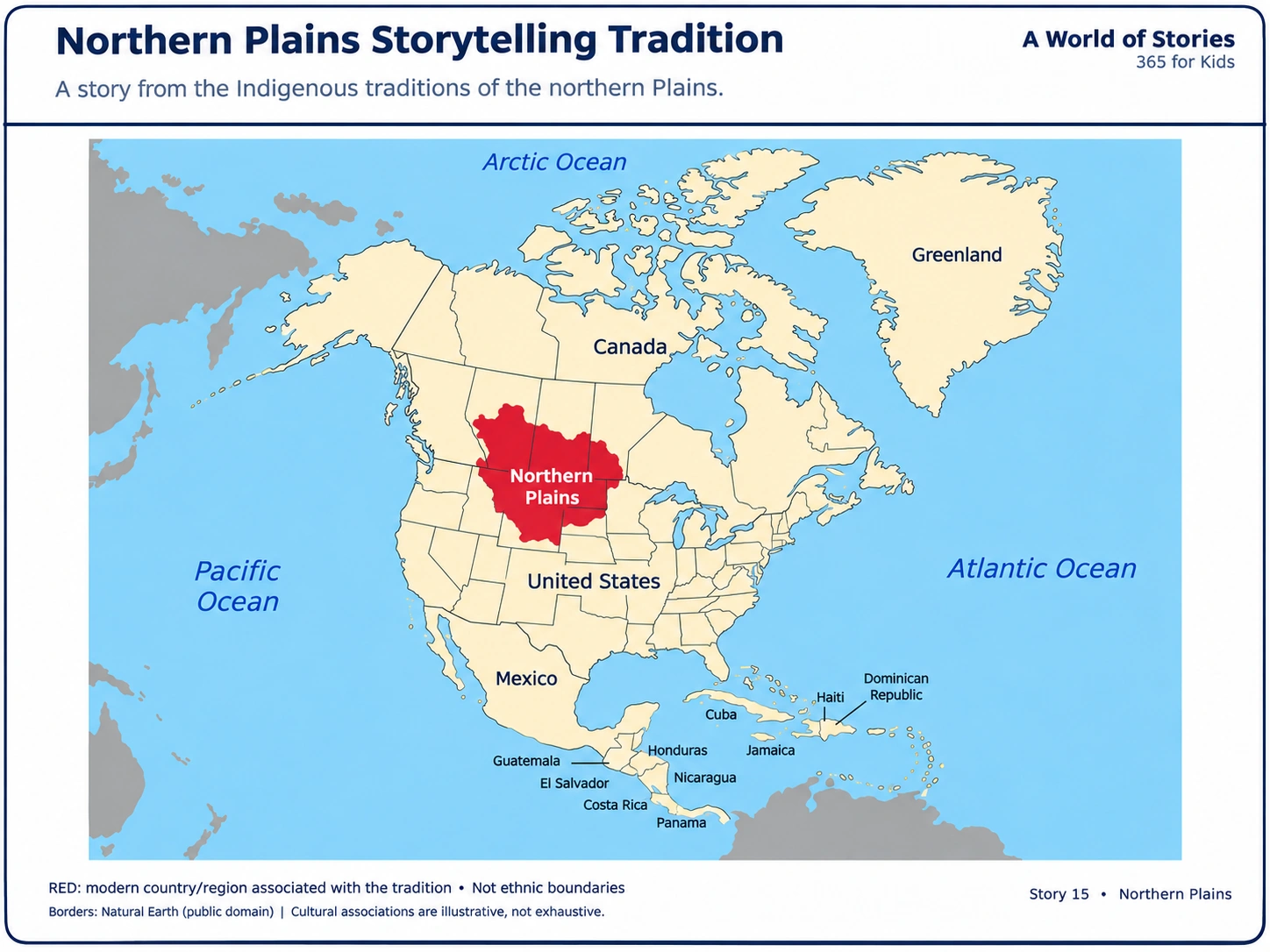
On an autumn evening in the northern plains, the children gathered beside the fire to hear a story from an elder named War Eagle. He spoke of a time when the world was young and animals, birds, and people could understand one another.
In those days, Old Man, known as Napa in Blackfeet stories, traveled through the land. He had helped shape many things in the world, but he was not always wise or kind. Sometimes his curiosity led him into trouble, and sometimes his choices brought trouble to others.
One summer day, Old Man was walking north through a forest. The squirrels and birds greeted him, but he scarcely answered. He continued until he met a strange, unhappy-looking person resting beside a stream.
Old Man offered to bring the stranger water and asked who he was. The stranger replied that he was Bad Sickness, a power that frightened many people. Old Man immediately wanted to learn how to make such sickness himself.
The stranger offered to teach him, but only in return for a gift. Old Man promised to make him small and handsome, so that he would need less food and could live easily among the trees. The stranger explained how Old Man might make a dangerous robe from the skins of young deer and elk.
When the stranger fell asleep, Old Man kept his promise. With a breath he made the great figure tiny. Then he took out his paints and drew bright dark and golden stripes along the small creature’s back. He gave him a lively, bushy tail as well.
When the creature awoke, he was amazed by his new appearance. Old Man called him Chipmunk and declared that his children, and their children after them, would wear the same striped coat. He showed Chipmunk where to find food and told him to gather pine nuts when the leaves turned yellow, storing them for winter.
Chipmunk thanked Old Man and hurried away into the woods.
But Old Man had not forgotten what Bad Sickness had told him. He made the robe as instructed, using the skins of young deer and elk. The finished robe was plain brown, and Old Man thought it dull beside Chipmunk’s handsome coat. He painted it with spots and rows of color.
Then he called the deer and elk together. He told them that, from that time onward, their young would be born with spotted coats, so that he would not have to paint such patterns again. The deer and elk returned to the grasslands, where their little ones rested hidden among the grasses.
And so, in this old telling, Chipmunk received his stripes, while young deer and elk received the spots and markings that distinguish their coats. The story also remembers that the powerful Old Man could create beauty while making choices that harmed others.
The children listened as the fire burned lower, thinking about the little striped animal, the hidden fawns, and the complicated deeds of Old Man.
This story comes from a historical collection of tales told by Blackfeet, Cree, and Ojibwe storytellers of the northern Plains in what is now the United States, and is adapted here from a public-domain source.
After the Story: Read · Create · Reflect · Share
1. Find the northern Great Plains on a map of North America. Which present-day countries include parts of this region?
2. What did Old Man promise the stranger, and how did the stranger become Chipmunk?
3. How did the markings on Chipmunk’s back inspire Old Man’s choice about the coats of young deer and elk?
4. Old Man was able to create beautiful things, yet some of his actions hurt others. Why is it important to think about the consequences of our choices?
Inspired by this story? Create your illustration!
BLACKFEET (UNITED STATES) — How the Ducks Got Their Fine Feathers
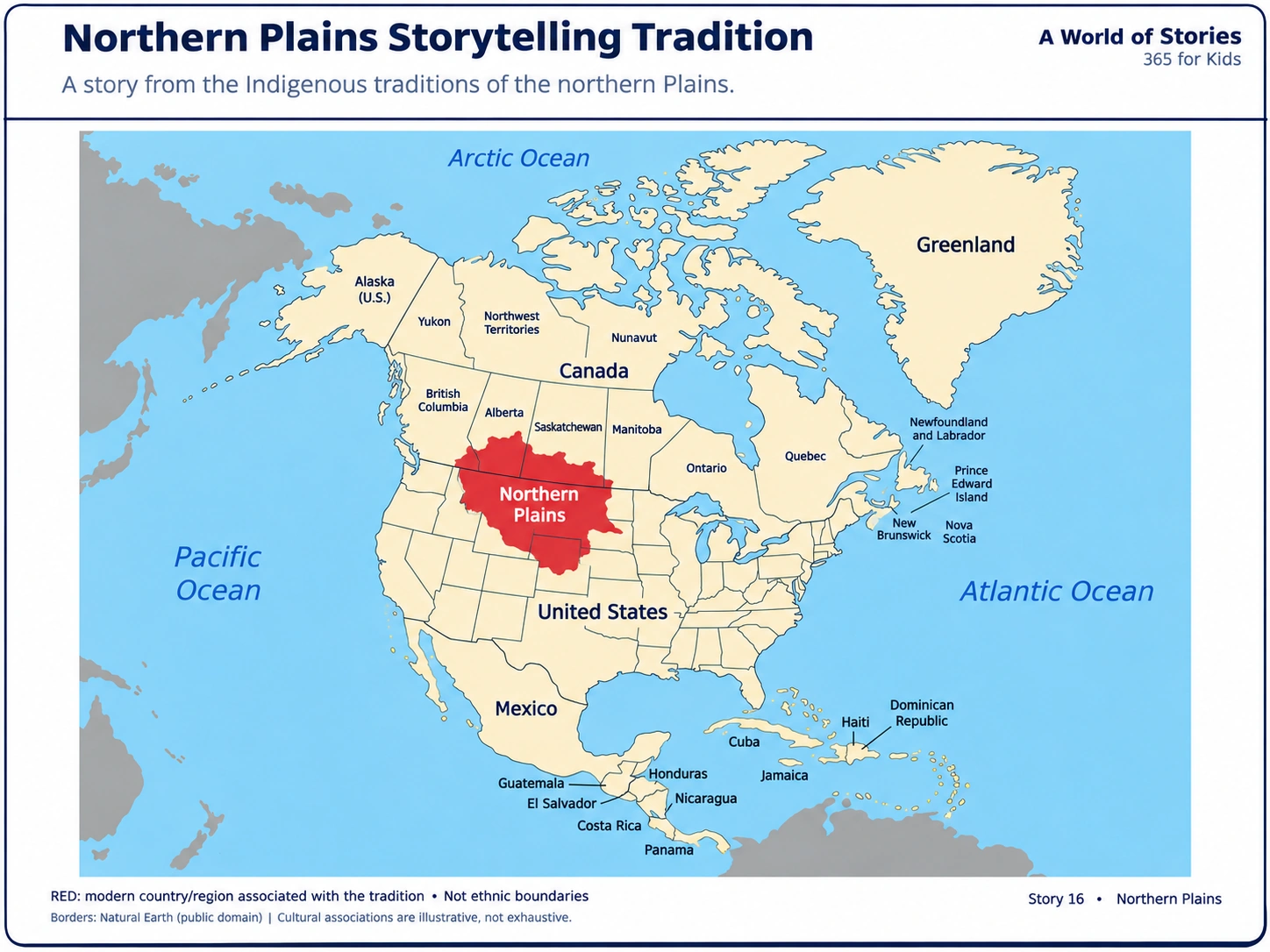
Autumn had arrived. The leaves were turning yellow, and the days were growing shorter. On a lake, ducks, geese, and loons gathered before their long journey to warmer waters. They called to one another, swam in the sunlight, and prepared to leave before winter ice covered the rivers.
In those distant days, the water birds did not yet wear the many colors and patterns we see today. Their feathers looked much alike.
From a hill above the lake, Old-Man, also called Napi in Blackfeet stories, watched the birds. He was clever, but his tricks could be dangerous. As he looked at the flock, he thought of a plan.
He gathered moss from the hillside, rolling it into an enormous bundle. Carrying it on his shoulders, he made his way down to the shore. When the birds noticed him approaching, they swam away.
“Wait, my brothers!” Old-Man called. “I have come to give you a dance. Will you help me prepare it?”
“Be careful,” warned Gray Goose. “Old-Man is planning something. I am sure of it.”
The birds refused to help. But Old-Man did not turn back. He cut long poles and built a lodge beside the water. He covered it with moss, made a doorway facing the lake, and lit a fire inside. Then he began to sing, beating his drum in a rhythm the ducks could hear across the water.
The music was lovely. Little by little, the birds drew closer. At last they waddled ashore and entered the lodge. Loon and Gray Goose remained near the entrance, still uneasy, while the others gathered around the warm fire.
“Before our dance,” Old-Man announced, “I will paint your feathers. Each of you may choose how you wish to look.”
Mallard spoke first. He wanted a shining green head, a white ring around his neck, a brown breast, and yellow legs. He chose a different appearance for his mate. Then Teal, Wood Duck, Spoonbill, Canvasback, and the other water birds took their turns. Old-Man painted each bird in the colors it requested, singing as he worked. By the time he had finished, night had fallen, and the birds looked splendid in the firelight.
“Now we shall perform the Blind Dance,” Old-Man said. “When I beat the drum, close your eyes tightly and circle the fire. Anyone who peeks will have red, sore-looking eyes forever.”
The birds shut their eyes. The drum sounded, and they moved around the fire. But Old-Man’s dance was a trap: as the birds passed him, he caught and killed some of them.
Loon had stayed close to the doorway. Suspicious, he opened his eyes and saw what was happening.
“Fly! Old-Man is killing us!” he cried.
At once the lodge filled with frightened quacks, cries, and beating wings. The surviving birds rushed toward the open doorway and escaped into the darkness. Furious that his trick had failed, Old-Man kicked Loon as he fled.
The old tale says that this is why Loon’s legs are set so far back on his body and why he moves awkwardly on land. It also says that some water birds have red-looking eyes because they opened them during the dance.
But the bright colors remained. And when ducks gather on lakes today, their green heads, patterned wings, and many-colored feathers still recall the strange night when Old-Man painted them before their journey south.
This story was recorded by Frank B. Linderman in Montana from Blackfeet, Cree, and Ojibwe storytellers, and is adapted here from his public-domain collection.
After the Story: Read · Create · Reflect · Share
1. Find the northern Great Plains on a map of North America. Which modern countries share this region, and why can a cultural tradition extend across a border?
2. Why did Gray Goose and Loon hesitate to enter Old-Man’s lodge?
3. How did the birds receive their different feather colors, and what happened when Loon opened his eyes during the dance?
4. Old-Man offered something beautiful but hid a dangerous plan. What can the birds’ experience teach us about trust and listening to warnings?
Inspired by this story? Create your illustration!
BLACKFEET (UNITED STATES) — Why the Curlew’s Bill Is Long and Crooked
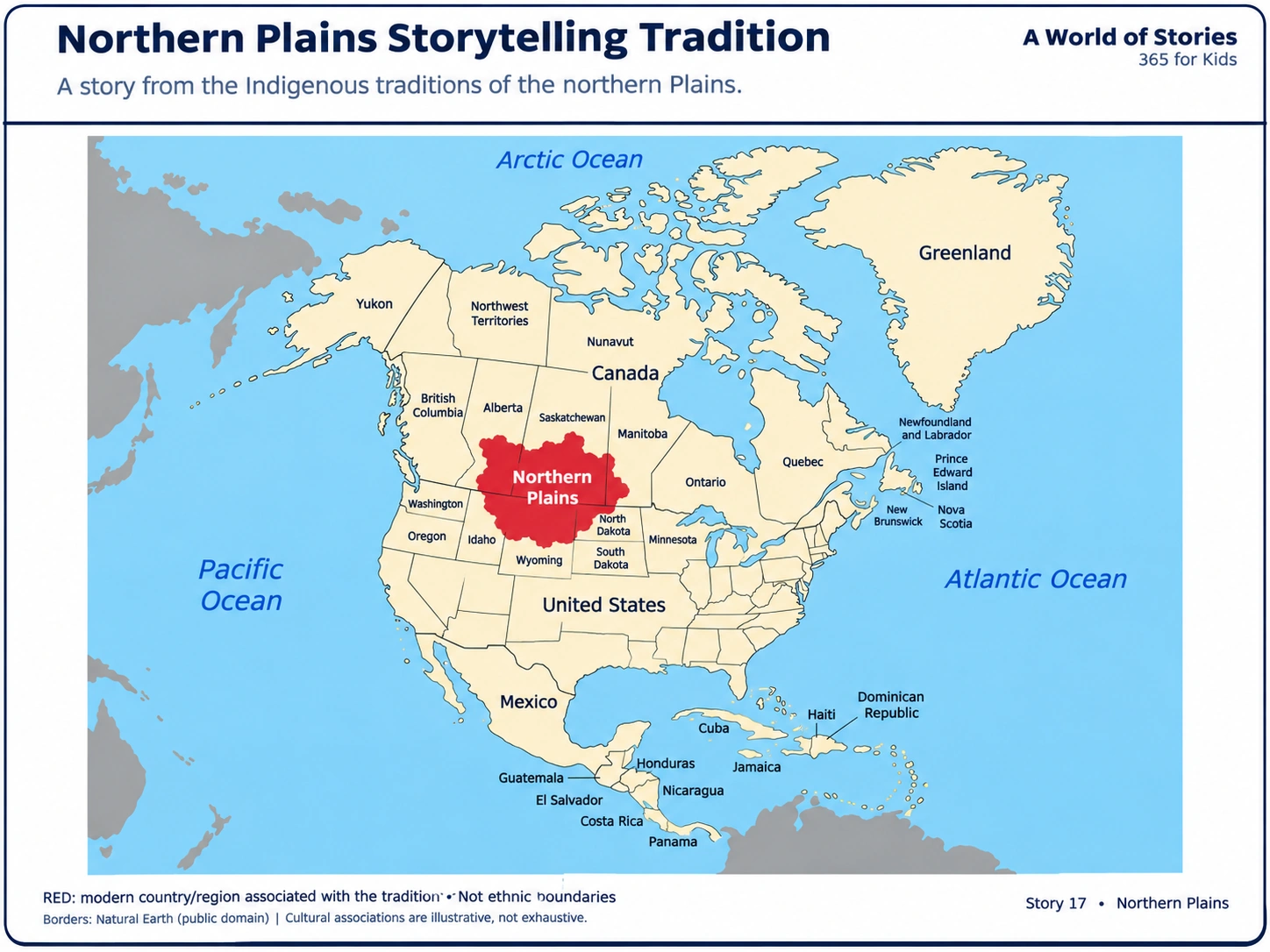
Long ago, when the world was still young, Old-Man wandered through the forests and plains. He was powerful and clever, but he was also quick to boast and even quicker to lose his temper. Sometimes his mischief left the animals wondering what he would do next.
One spring day, Old-Man heard cheerful voices beside a creek. A group of mice were playing a running game near a great flat stone that leaned out from the bank. The warmth of the sun had softened the frozen earth beneath it. Now and then a little soil crumbled away, but the mice were so light that their quick footsteps barely disturbed the ground.
The Chief Mouse sang a song. At his signal, the others dashed beneath the stone, reached the far side, and ran back again. Their tiny feet flashed over the damp earth.
Old-Man watched them and decided that he could play, too.
“I am a fine runner,” he announced. “Let me try.”
The Chief Mouse warned him that the game was made for small creatures. Old-Man was much heavier, and the stone might fall if he shook the bank. But Old-Man would not listen.
“Stand aside and watch!” he declared.
He charged toward the stone. His heavy steps shook the ground. Before he could reach the other side, the loosened rock gave way and crashed down upon him, pressing him into the mud.
Old-Man struggled, shouted, and called for help. The frightened mice hurried away to find someone strong enough to move the rock. After a long search, they returned with Coyote.
Coyote looked at the enormous stone and tried to help. But Old-Man, furious and impatient, shouted insults instead of thanks. At last Coyote had heard enough. He turned and walked away.
Old-Man cried out again. High above the creek, Curlew heard him. The bird flew down to see what was wrong. In those days, Curlew had a short, sturdy bill.
“Perhaps I can break the stone,” said Curlew.
He pecked again and again, searching for a crack. The rock did not move. Still, Curlew kept trying. As he worked, Old-Man scolded him more and more harshly.
Finally Curlew stepped back. “I am too small to break it,” he admitted. “I will go and find someone else. I shall come back.”
Instead of thanking the bird for trying, Old-Man reached out and seized Curlew by the bill. Curlew struggled and cried out, but Old-Man would not let go. He pulled so hard that the bird’s short bill grew long and slender, with its tip bending downward.
At last Old-Man released him. He even laughed at how different Curlew looked.
The bird flew away with the curved bill that, according to this old tale, curlews have carried ever since.
As for Old-Man, someone eventually freed him from beneath the rock. The old storyteller could not remember for certain who it was—perhaps Bear. Old-Man escaped, but the trouble he had caused was not forgotten.
And so the tale leaves us with two things to remember: the shape of Curlew’s bill, and the difference between asking for help and treating helpers with kindness.
This story belongs to a collection of traditional tales within Blackfeet (Siksikaitsitapi) storytelling, recorded in Montana in the early twentieth century, and is adapted here from a public-domain source.
After the Story: Read · Create · Reflect · Share
1. Find Montana and the northern Great Plains on a map of North America. Explore where Blackfeet communities live today, including lands on both sides of the United States–Canada border.
2. What warning did Chief Mouse give Old-Man before he joined the running game?
3. Why did Coyote leave, and what happened when Curlew tried to help?
4. Curlew offered help even though he was small. How could Old-Man have shown gratitude and managed his anger differently?
Inspired by this story? Create your illustration!
BLACKFEET (UNITED STATES) — Why the Night-Hawk’s Wings Are Beautiful
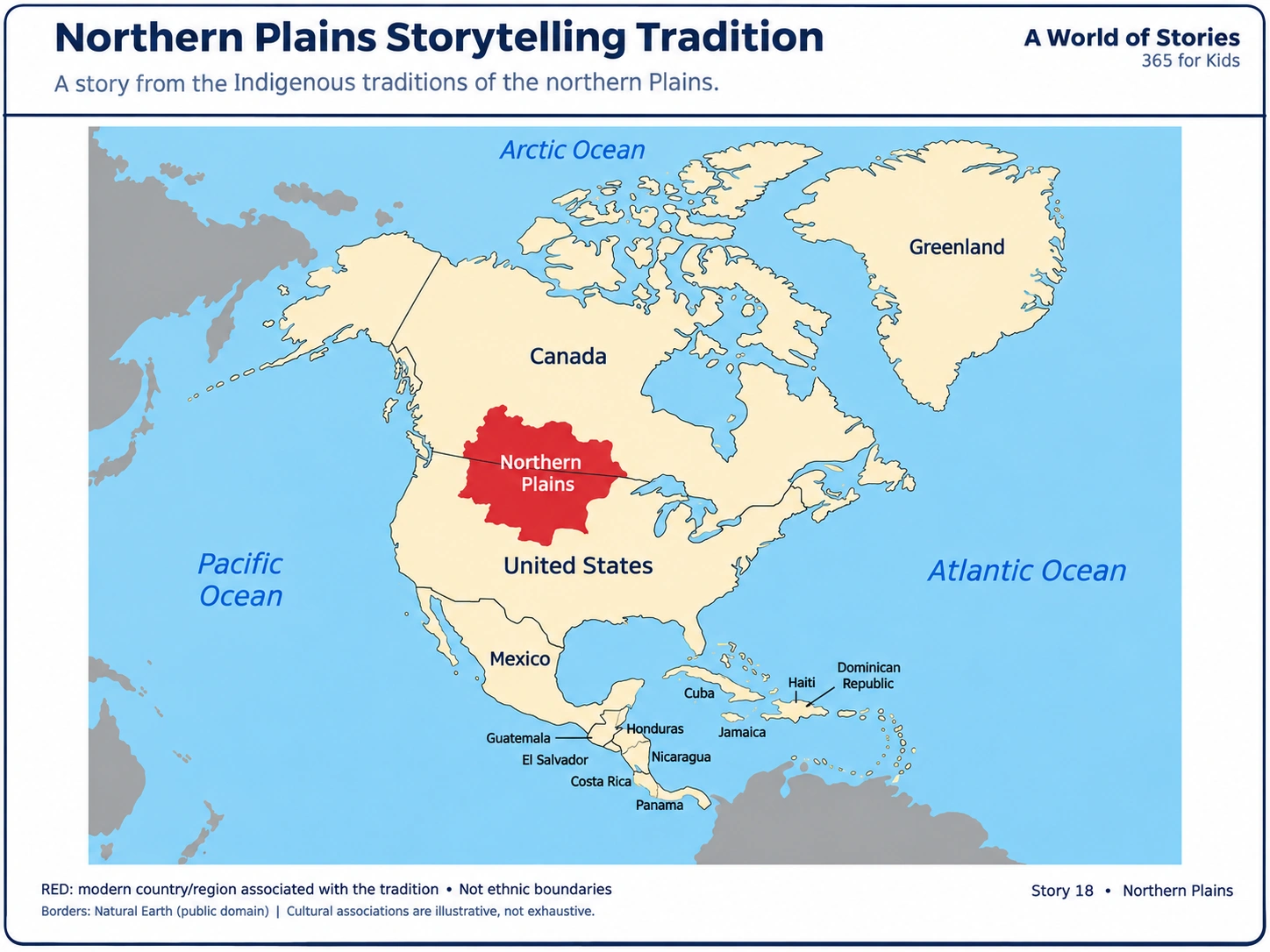
One spring day, Old-Man was wandering through the hills, enjoying the warmth of the sunshine. The trees were waking after winter, and the birds were busy among the branches. Old-Man was in such a cheerful mood that he greeted every living thing he passed.
At last he grew tired and sat down on a great round stone. The stone was cold beneath him, even though the air was mild. Old-Man looked at it and decided to be generous.
“Stone,” he said, “you must be cold. I have hundreds of warm robes at home. You may have this one.”
But Old-Man did not have hundreds of robes. He had only the robe he was wearing. Still, he spread it over the stone and continued down the hillside, pleased with himself for making such a grand gift.
Spring weather, however, can change quickly. Dark clouds gathered over the mountains. Snow began to fall, and a sharp north wind swept across the hills. Soon Old-Man was shivering.
“I need my robe after all,” he muttered. “And what has that stone ever done for me?”
He hurried back, snatched his robe from the stone, and wrapped it around himself. But the stone was furious. A gift had been given, and now it had been taken away.
The great stone began to roll after Old-Man.
Over the grass it thundered, bouncing past smaller rocks and fallen branches. Old-Man ran as fast as he could, but his foot caught against a sagebrush. He stumbled and fell. Before he could rise, the stone rolled onto his back and held him fast.
Old-Man pushed and twisted, but the stone would not move. He shouted angrily. He argued with the stone. Nothing helped. Finally, frightened and helpless, he called out for someone to rescue him.
Only Night-Hawk heard his cries.
The bird flew to the place where Old-Man lay trapped and promised to do what he could. He rose high into the sky until he was no more than a tiny dark speck. Then he folded his wings and plunged downward with all his strength.
He struck the stone so hard that it split into two pieces.
Old-Man was free. But the blow had changed Night-Hawk. His bill had been bent out of shape, and his head had been hurt by the terrible impact.
“Thank you, Brother Night-Hawk,” Old-Man said. “You helped me when I could not help myself. I will give you something that will make you different from all the other birds.”
When the stone broke, it had left fine white dust on the ground. Old-Man gathered some of that powder and scattered it across Night-Hawk’s wings, making beautiful pale spots and bold white stripes.
“These markings shall belong to your kind,” he said.
And so, in this traditional tale, Night-Hawk and his descendants received their striking wing patterns. When the birds swoop and turn through the evening sky, their beautiful wings can be seen flashing in the light—a reminder of the bird who came to help when Old-Man was in trouble.
This story comes from a collection of tales told by Blackfeet, Cree, and Ojibwe storytellers of the northern Great Plains, and is adapted here from a public-domain source.
After the Story: Read · Create · Reflect · Share
1. Find the northern Great Plains on a map of North America. Which parts of today’s United States and Canada are included in this broad region?
2. Why did Old-Man give his robe to the stone, and why did he decide to take it back?
3. How did Night-Hawk free Old-Man, and what happened to the bird as a result?
4. Old-Man made a promise he could not easily keep. What does this story suggest about keeping promises, accepting help, and showing gratitude?
Inspired by this story? Create your illustration!
BLACKFEET (UNITED STATES) — Why the Mountain-Lion Is Long and Lean
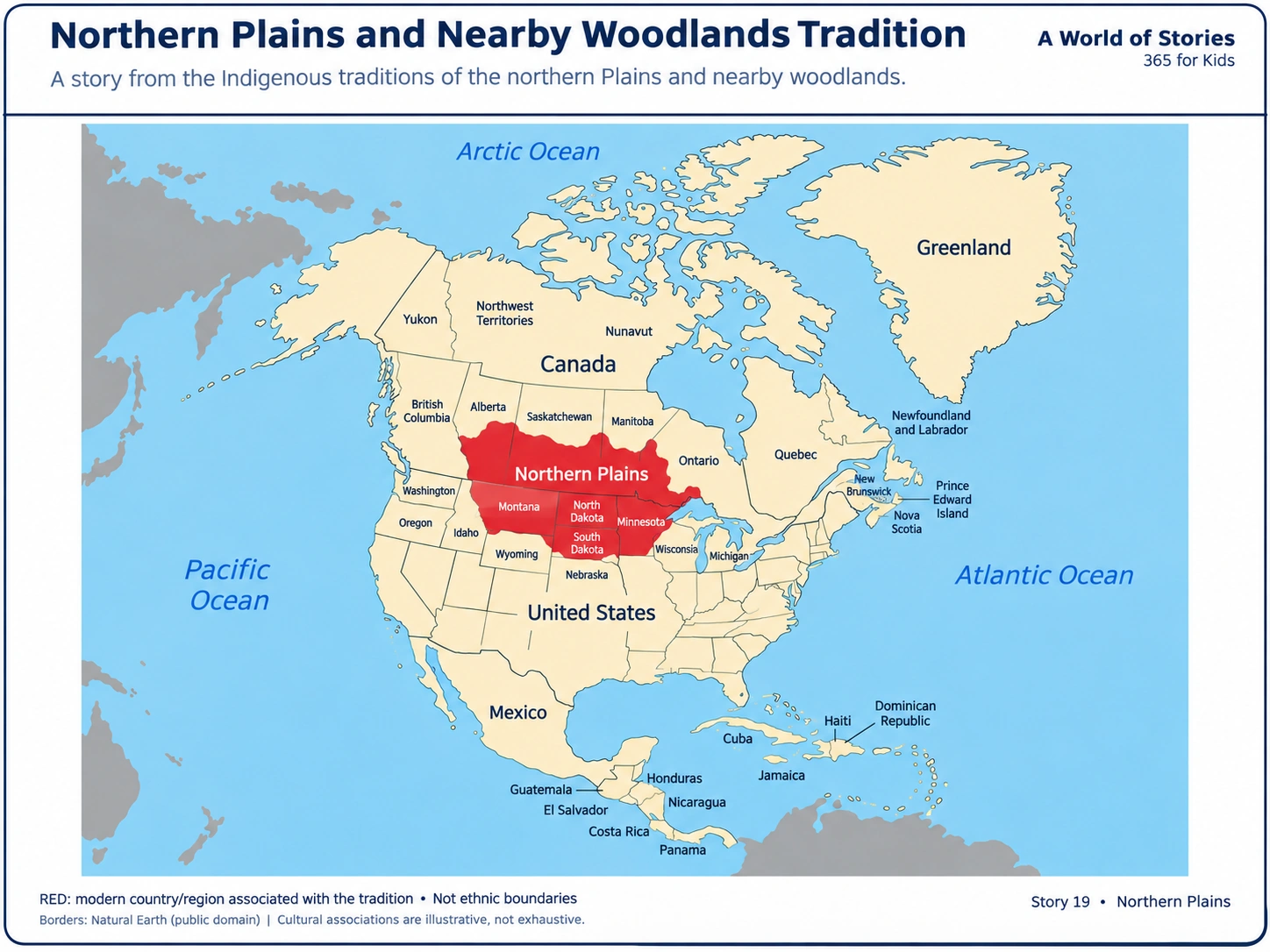
Long ago, according to an old tale, the Mountain-Lion did not look quite as he does today. His body was shorter and heavier, and his tail was not nearly so long. This is the story of how his appearance changed—and of the trouble caused by two very clever but dishonest characters.
One day, Old-Man was walking across the hills when he spotted smoke rising from a grove of trees. Curious to discover who had made the fire, he crossed a ravine and crept through the brush. As he drew nearer, he heard laughter.
A group of squirrels was playing a game beside the fire. They took turns hiding one another beneath warm ashes, then quickly uncovering anyone who called out. They trusted one another to keep the game safe.
Old-Man stepped from the bushes and asked to join them. At first the squirrels fled, but their leader finally agreed. Old-Man lay beside the fire, and the squirrels covered him as they had covered their friends. He soon cried out that the ashes were too hot. Keeping their promise, they dug him out immediately.
Now Old-Man wanted his turn. He persuaded nearly all the squirrels to lie down together so that he could cover them at once. One female squirrel had gone home and did not join the game. The others trusted his promise that he would uncover them when they called.
But Old-Man broke his word. He left the squirrels beneath the hot ashes and added wood to the fire. The squirrels died. Later he returned, gathered their roasted bodies onto a large plate woven from willow branches, and sat beside a stream to eat. A raven passing overhead had called him a liar, but Old-Man paid no attention.
After eating, Old-Man fell asleep. While he slept, Mountain-Lion found the plate, took the remaining food, and carried it away. When Old-Man awoke, he saw that the plate had vanished. He searched the grass, discovered Mountain-Lion’s tracks, and followed them over hills and through low, wet ground.
Mountain-Lion had eaten his fill. Feeling sleepy, he climbed onto a rock where he could watch the country around him. Before long, his eyes closed. Old-Man approached without making a sound and caught him by the tail.
Mountain-Lion woke in fright. He admitted taking the food and begged Old-Man to let him go. He had been hungry, he said, and had taken what Old-Man left behind.
Old-Man would not listen. Angry about the theft, he pulled Mountain-Lion’s body until it became long and lean, then stretched his tail almost as long as his body. He took Mountain-Lion back to the fire and rolled him through the ashes, darkening his fur and nose.
Old-Man declared that all Mountain-Lions would carry those features after him. And so, the old story explains, the great cat came to have a slender body, a long tail, and dark markings around his face.
Yet the storyteller ends with a warning: Mountain-Lion was a thief, but Old-Man had been a thief and a deceiver too. Being powerful does not make someone fair—and blaming another for wrongdoing cannot erase one’s own mistakes.
This story is drawn from storytelling traditions of Indigenous peoples of the Northern Plains and nearby woodlands, with related versions told among different communities, and is adapted here from a public-domain source.
After the Story: Read · Create · Reflect · Share
1. Find the Rocky Mountains and the Northern Plains on a map of North America. Why might stories from neighboring cultural regions have different versions?
2. What promise did the squirrels keep when Old-Man joined their game, and what promise did he break?
3. How did Mountain-Lion take the food, and what happened when Old-Man followed his tracks?
4. Both Old-Man and Mountain-Lion acted dishonestly. Why is it important to recognize our own mistakes before judging someone else?
Inspired by this story? Create your illustration!
BLACKFEET (UNITED STATES) — Old-Man and the Fox
In the days of the old stories, Old-Man and Red Fox were travelling together across the hills. Autumn had brought clear skies and warm sunshine, but winter was not far away. Both travellers were hungry, and neither had found anything to eat.
“Brother,” Old-Man said, “you are quick and clever. Surely you can catch a rabbit among these rocks.”
Fox shook his head. He had searched since morning without success. “You are the one who knows so many things,” he answered. “Perhaps you can find a way.”
Old-Man had already noticed two great buffalo bulls beyond the hill. He had a plan, but it was a plan that would put Fox in danger.
“Let me pull out your fur,” he proposed, “all except the white hair at the tip of your tail. Then go before the buffalo and dance. When they see you, they will laugh. Dance more foolishly still, until they fall to the ground with laughter. While they cannot rise, I will take the meat we need.”
Fox stared at him. “Take away my fur? The cold season is coming. What will happen when the wind turns?”
“The wind is warm today,” Old-Man insisted. “And afterward we will have plenty of food and a fire to warm ourselves.”
Fox hesitated. At last, trusting Old-Man’s promise, he agreed. Old-Man pulled away his fur until Fox was bare except for the little white tip of his tail. The painful work made Fox shiver, even in the sunshine. Old-Man laughed at his strange appearance and sent him toward the buffalo.
Fox walked around the hill. When the two bulls caught sight of him, they began to laugh. Fox stood on his hind legs and danced, turning and twisting just as Old-Man had told him. The bulls laughed harder and harder. Soon they were rolling on the ground, helpless with laughter.
Old-Man rushed forward with his knife and killed both bulls. Proud of his cleverness, he congratulated himself. Then he began the long work of preparing the meat. He worked until evening approached.
Meanwhile, the wind changed. The warm breeze from the south disappeared, and a bitter north wind swept across the hills. Without his fur, Fox had no protection. He waited where Old-Man had left him, growing colder and colder, but Old-Man was too busy with the buffalo to notice.
At last Old-Man looked toward his companion. “Fox! Why are you so quiet? We have enough meat now. Say something!”
Fox did not answer. The cold had taken his life.
Old-Man made a fire and warmed his own hands. He gave scarcely a thought to the companion who had trusted him. He had gained his food, but his selfishness had cost Fox everything.
That is how the old story warns us about promises made carelessly and plans that ask another to bear all the danger. Cleverness without care for others can bring terrible harm.
This story comes from the Indigenous storytelling heritage of the Northern Plains, preserved in a historical public-domain collection.
After the Story: Read · Create · Reflect · Share
1. Find the Northern Plains on a map of North America. Which present-day countries include parts of this region?
2. What did Old-Man ask Fox to do, and why was Fox worried about losing his fur?
3. What changed while Old-Man was preparing the buffalo meat, and why did that change matter?
4. Old-Man was clever, but he did not care for his companion. How could he have acted more responsibly toward Fox?
Inspired by this story? Create your illustration!
BLACKFEET (UNITED STATES) — Why the Birch-Tree Wears the Slashes in Its Bark
Long ago, on a summer day when the air lay hot and still, Old-Man could find no place to rest. He tried to sleep, but the heat troubled him. He climbed a hill in search of a breeze, yet even there the air did not move.
He went down to the river, hoping its waters might bring some relief. Still he felt too warm. He wandered into the woods, where the trees offered shade, but he had walked so far that he was hotter than before.
At last Old-Man called out to the winds. “Come and blow! Drive this heat away!”
The winds began gently. They were careful, for they knew how quickly Old-Man could become angry. But he was not satisfied.
“Harder!” he shouted. “Blow harder than ever before!”
The winds obeyed. Across the land they rushed, stirring the branches and bending the treetops. Old-Man watched their growing strength and began calling to the trees.
“Fir-Tree, bend and break!”
The fir bent beneath the force of the wind and broke.
“Pine-Tree, bend and break!”
The pine bent and broke, too. The spruce met the same fate when Old-Man shouted his command.
Then Old-Man turned toward a birch.
“Birch-Tree, bend and break!”
The birch bent low. Its slender trunk curved almost to the ground, but it did not snap.
“Did you hear me?” cried Old-Man. “Break!”
The wind blew as hard as it could. The birch bent farther, then held fast. However fiercely the wind pushed, the tree would not break.
Old-Man grew furious. “Why will you not obey?”
“I will bend,” answered Birch-Tree, “but I will not break.”
Old-Man rushed forward with his hunting knife. Grasping the bent top of the tree, he cut slash after slash along its pale bark.
“You will carry these marks,” he declared, “and so will all the birch trees that come after you!”
And so, in this traditional tale, the slender birch kept standing, though its bark bore the marks of Old-Man’s anger. To this day, the story explains the dark lines that can be seen on a birch tree’s trunk.
This story comes from storytelling traditions of the northern Plains, preserved in a historical public-domain collection.
After the Story: Read · Create · Reflect · Share
1. Find the northern plains of North America on a map. Can you find areas where birch trees grow? Remember that a cultural tradition does not always follow modern country borders.
2. Where did Old-Man go to escape the summer heat before he called for the winds?
3. How did the birch tree respond differently from the fir, pine, and spruce trees?
4. The birch could bend without breaking. What might the story help us think about when we face pressure or anger?
Inspired by this story? Create your illustration!
OJIBWE (UNITED STATES) — Shin-ge-bis Fools the North Wind
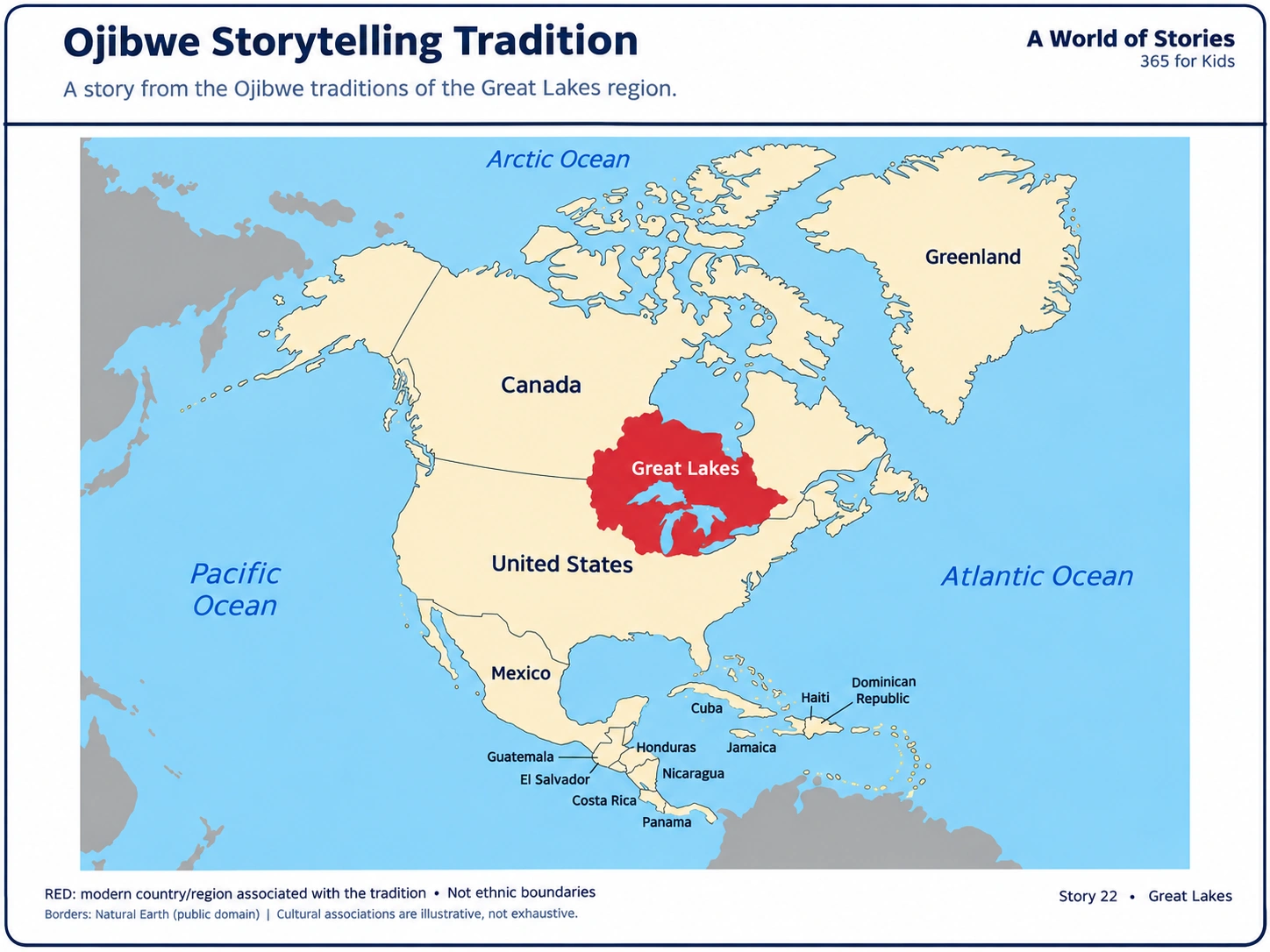
Long ago, near the northern lakes, summer filled the forests with green leaves and warm winds. Fishermen traveled far to catch fish in the clear waters. But everyone knew that summer could not last forever.
Each year, as the days shortened, the gentle South Wind grew quiet. Frost appeared along the shore. Thin ice spread across the lake, and the fishermen prepared to leave before Ka-bib-on-okka, the fierce North Wind, arrived.
Everyone packed their belongings—everyone except Shin-ge-bis.
Shin-ge-bis was known as the Diver. He could take the form of a diving bird, and he was as cheerful on a difficult day as on an easy one. When his companions urged him to come south, he smiled.
“There are still fish beneath the ice,” he told them. “I have warm clothing, dry wood, and a good fire. Why should I run away?”
The fishermen worried about him. They had seen the North Wind freeze rivers and bend great trees. Yet Shin-ge-bis would not change his mind. At last they said goodbye and went on their way.
Soon the northern land was white with snow. Shin-ge-bis gathered bark and twigs, kept his shelter ready, and made holes in the ice to catch fish. Each evening he carried his catch home, warmed himself by the fire, and sang merrily.
Far away, Ka-bib-on-okka heard the singing. The North Wind was astonished that anyone had remained in his frozen country. He sent icy gusts across the lake, rattling branches and piling snow against Shin-ge-bis’s home.
But the Diver only tended his fire and sang again.
“Who dares laugh at the North Wind?” Ka-bib-on-okka roared. He swept toward the shelter, determined to put out its flames.
The entrance shook. The wind whistled through every opening. Still Shin-ge-bis did not tremble. Instead, he invited his visitor inside.
“Come and warm yourself,” he said, as though greeting an old friend.
Ka-bib-on-okka entered, bringing the cold with him. Shin-ge-bis placed another great log on the fire. The flames rose higher. Warmth filled the shelter, and the North Wind began to feel most uncomfortable. Water dripped from the ice in his hair. He grew smaller and weaker in the heat.
Before he could melt away altogether, Ka-bib-on-okka fled into the night. Outside, the freezing air restored his strength, but it did not restore his pride.
“Come out and wrestle!” he challenged. “We shall see who is stronger!”
Shin-ge-bis thought for a moment. He had rested by the fire and felt warm and strong. Then he stepped outside to meet the North Wind.
They grappled on the snow, rolling over and over as the night passed. The harder Shin-ge-bis struggled, the warmer he became. The North Wind, who could freeze a lake, found that he could not freeze his determined opponent.
At sunrise Ka-bib-on-okka was exhausted. He pulled himself free and fled toward the far north, leaving Shin-ge-bis standing beside the shining snow.
And Shin-ge-bis laughed his bright laugh once more. He had met the winter with preparation, courage, and a cheerful heart—and the North Wind had not driven him away.
Shin-ge-bis and Ka-bib-on-okka appear in an Ojibwe (Anishinaabe) traditional story from the Great Lakes region, adapted here from a public-domain source.
After the Story: Read · Create · Reflect · Share
1. Find the Great Lakes on a map of North America. Which parts of the United States and Canada surround them?
2. Why did the other fishermen leave, and why did Shin-ge-bis decide to stay?
3. What happened when the North Wind entered Shin-ge-bis’s warm shelter? How did their struggle end?
4. Shin-ge-bis prepared carefully but also stayed cheerful. When have preparation and a positive attitude helped you face something difficult?
Inspired by this story? Create your illustration!
GREAT LAKES (UNITED STATES) — The Boy Who Snared the Sun

Long ago, when deep snow lay across the land, a sister and her little brother lived together far from other people. The sister was strong and capable. She gathered food and cared for her brother, who was small in stature but determined to prove that he could do things for himself.
As winter grew colder, the boy worried about his thin clothing. One day he saw snowbirds feeding near fallen trees and decided that their feathers could make a warm coat. He practiced shooting with his bow until he could bring home enough birds. His sister carefully stitched the skins together, and soon he had a coat that kept out the cold.
Proud of his new clothing, the boy decided to explore. His sister warned him not to wander too far, but he set off across the snowy ground. At the edge of a hillside, where sunshine had melted a bare patch of earth, he stopped to rest and fell asleep.
While he slept, the warmth of the sun made the fresh birdskins shrink. When he awoke, his beautiful coat felt uncomfortably tight. He looked up at the sun and grew furious. He decided that, somehow, he would catch it and punish it for spoiling his coat.
Back at home, he asked his sister to make a strong cord. First she twisted tough grass into a rope, but he said it would not do. At last she braided strands of her own hair. The boy passed the braid between his lips, and in the telling of the old story it became a long, strong, shining cord, firm as metal.
Before dawn, he climbed to the hillside and set a loop of the cord where the sun would rise. The sky slowly brightened. Then the sun appeared—and was caught fast in the snare.
Daylight could no longer travel across the sky. The world remained dark, and the animals grew frightened. The squirrel chattered in alarm; the raven called out from the trees. The East Wind discovered the cause of the trouble and asked who would dare to cut the cord.
Coyote approached the trapped sun, but its heat drove him back. An eagle flew toward the snare, only to return with singed feathers. The animals needed someone who could endure the burning heat long enough to free the sun.
They thought of Dormouse, who in that long-ago time was an enormous creature, almost as large as a mountain. But Dormouse was sleeping deeply. Coyote howled beside him without success, so he fetched Thunder from his mountain cave. Thunder called with such a mighty voice that Dormouse finally awoke.
Coyote urged Dormouse to help. Because he was so much larger than the other animals, Coyote argued, he might survive the heat that none of them could bear. Dormouse made his way to the hill and began to gnaw through the magical cord.
The closer he came to the sun, the hotter it grew. His great body shrank in the heat. Still he kept working, little by little, until his teeth cut through the snare. At once the sun was free to cross the sky again.
In this old tale, the once enormous Dormouse became the small creature people know today. And the sun, released from the boy’s angry trap, once more brought light to the world.
This story comes from the storytelling heritage of Indigenous peoples of the Great Lakes region, preserved in historical collections and adapted here from a public-domain source.
After the Story: Read · Create · Reflect · Share
1. Find the Great Lakes region on a map of North America. Which present-day countries share the Great Lakes?
2. Why did the boy become angry with the sun, and what did he do about it?
3. Why could neither Coyote nor Eagle free the sun? How did Dormouse finally succeed?
4. How did the boy’s anger affect everyone around him? What could he have done differently when he discovered that his coat had shrunk?
Inspired by this story? Create your illustration!
AFRICAN AMERICAN (SOUTHERN UNITED STATES) — Brer Rabbit’s Riddle
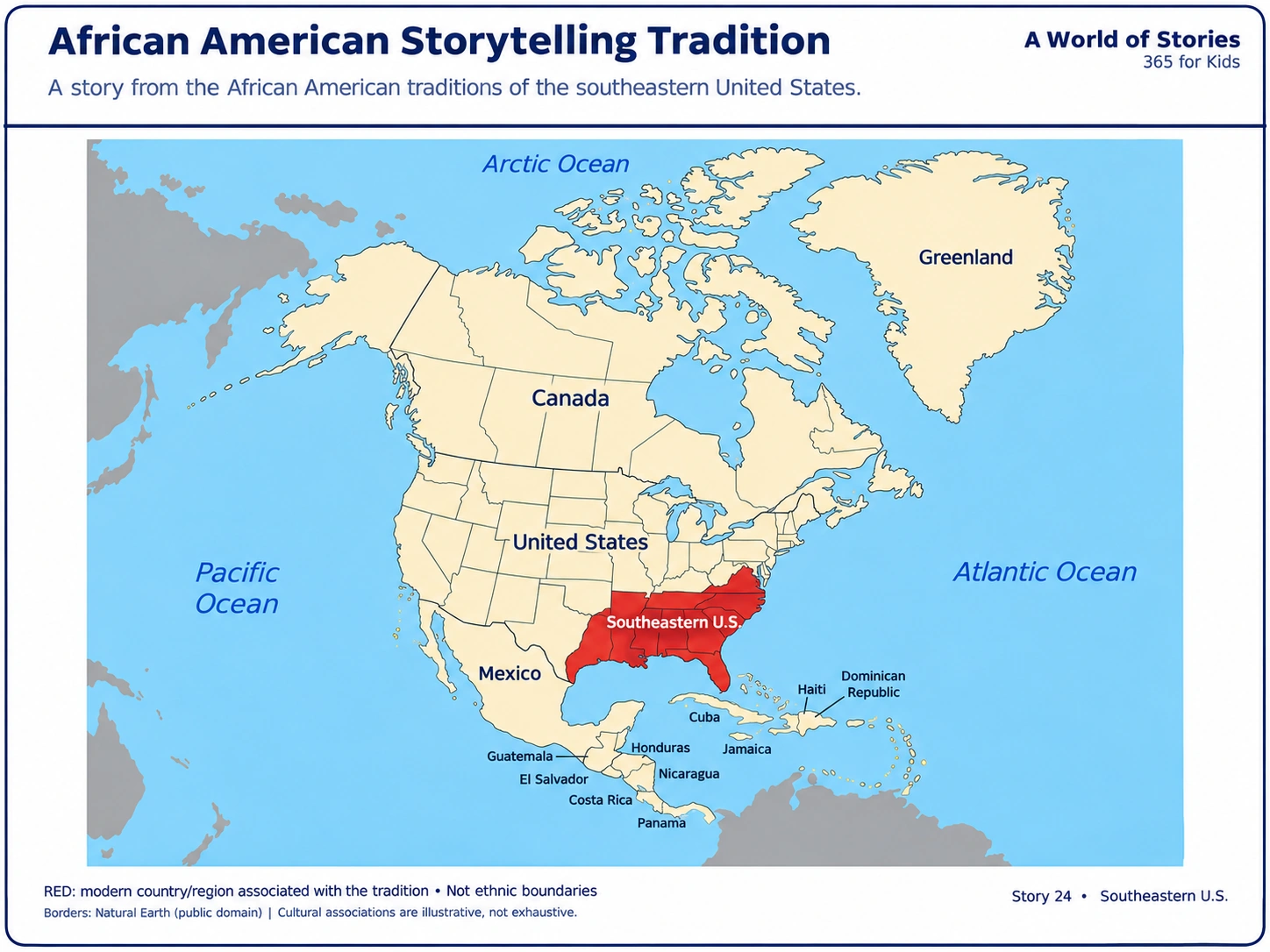
Brer Rabbit was famous for his lively dancing and quick thinking. But one day he decided that it was time to spend less time at gatherings and more time caring for his family. He cleared a little patch of land, planted sweet potatoes, and set about tending his crop.
Brer Fox noticed the change. He remembered all the times Rabbit had outsmarted him, and he was eager to take revenge. Night after night, Fox disturbed the little garden. He left the gate open, knocked rails off the fence, and finally pulled down a whole section. Rabbit saw the damage, but he did not rush into a fight.
Fox mistook that silence for fear. Convinced that Rabbit would no longer resist him, he paid a visit and invited him to take a walk. He claimed to know a peach orchard where they could gather fruit together.
Rabbit agreed, though he was already suspicious. At the orchard, he climbed a tree while Fox waited directly beneath it. Fox hoped that when Rabbit climbed down backward, he would be easy to catch.
“Throw the peaches to me!” Fox called.
Rabbit looked down and saw exactly where Fox was waiting. “If you miss them, they’ll be crushed,” he answered. “I’ll toss them into the soft grass instead.”
He sent the peaches flying away from the trunk. The moment Fox hurried after them, Rabbit scrambled down and ran a safe distance along the path.
“Brer Fox!” he called. “I have a riddle for you!”
Fox stopped. He did not want to admit that a riddle might defeat him. Rabbit recited a little rhyme about a big bird and a small bird, a buzzing bee and a stinging bee, and a little man leading a large horse. It ended with a puzzling question: What is good for a head in a hollow?
Fox scratched his head. He thought and thought, but the answer would not come.
“I know how you can solve it,” Rabbit said. “First you must taste some honey. Brer Bear keeps beehives in his field.”
Fox was not especially hungry for honey, but his curiosity was stronger than his caution. He followed Rabbit to the hives.
Rabbit tapped the hives until he found one that sounded full. “I’ll raise this one,” he said. “Put your head underneath and you can taste the honey.”
Fox bent down. Rabbit tipped the heavy hive, and Fox pushed his head beneath it. Then Rabbit let go. The hive dropped around Fox’s neck, trapping him. Fox twisted and pulled, but could not get free. Rabbit hurried away, leaving Fox struggling.
On the way home, Rabbit met Gray Fox, Fox’s grandfather. The old fox asked whether Rabbit had seen his grandson.
“We’ve been puzzling over riddles,” Rabbit replied. “He’s still trying to solve one near Brer Bear’s beehives.” Rabbit repeated the riddle and added a teasing hint about a beehive making a collar for Fox.
Gray Fox slowly understood and went to find his grandson. But Brer Bear had already heard the commotion. Seeing Fox caught beneath the hive, Bear believed he had been stealing honey. Bear punished Fox, then released him. Before long, the other animals were talking about Fox’s embarrassing adventure.
Rabbit had escaped the orchard by thinking quickly. Fox, who had tried to frighten him, had been caught by his own eagerness to prove himself clever.
Brer Rabbit is a trickster figure in African American storytelling traditions of the Southern United States. This version of “Brer Rabbit’s Riddle” was recorded in the nineteenth century and is adapted here from a public-domain source.
After the Story: Read · Create · Reflect · Share
1. Find the southeastern United States on a map of North America. What kinds of landscapes and farms might you find in this region?
2. What did Brer Fox do to Rabbit’s sweet-potato patch, and why did he invite Rabbit to the peach orchard?
3. How did Rabbit escape from the tree, and what happened when Fox tried to get honey?
4. Rabbit used his cleverness to escape, but he also tricked Fox into trouble. When is being clever helpful, and when can it hurt someone?
Inspired by this story? Create your illustration!
AFRICAN AMERICAN (SOUTHERN UNITED STATES) — Brother Terrapin Deceives Brother Buzzard
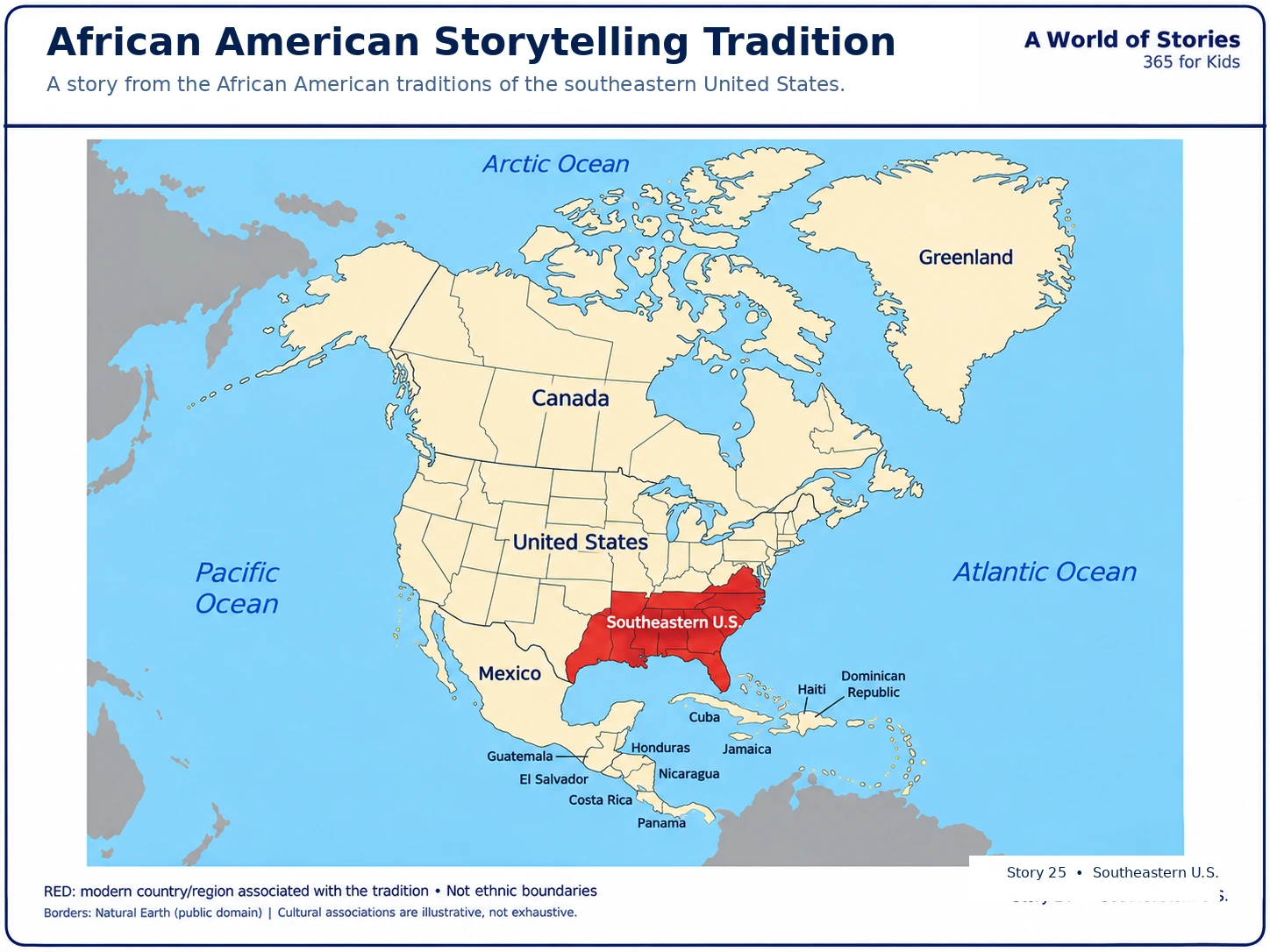
In the old animal tales of the American South, Brother Terrapin loved honey almost as much as Brother Bear. But while a bear could climb a tree, Terrapin’s short legs and slow steps made the search much harder.
One day, as Terrapin was traveling along a woodland path, he met Brother Buzzard. After exchanging greetings, Terrapin suggested that they hunt for honey together.
“You can search from the sky,” he proposed, “and I’ll look along the ground. Whatever we find, we’ll share.”
Brother Buzzard agreed. He spread his wings and rose above the trees while Terrapin continued slowly through the fields.
Before long, Terrapin discovered a nest of bumblebees in a hole in the ground. He peered inside, tasted the honey, and glanced around for Buzzard. There was no sign of his partner.
“Perhaps this isn’t the kind of honey we agreed to find,” Terrapin told himself. He crept into the hole and ate every last drop.
Afterward, he licked his feet clean. But honey had stuck to his shell, where his short neck could not reach. He rubbed against a tree and rolled on the ground, yet the sticky traces remained.
Terrapin was wondering how to hide what he had done when he looked up. There was Brother Buzzard, circling directly overhead.
Now Terrapin feared that Buzzard would discover the truth. Instead of admitting that he had eaten the honey alone, he thought of a cruel trick.
He returned to the empty nest, built a fire inside the hole, and called out to his partner.
“Brother Buzzard! Come quickly! I’ve found wonderful honey! There is enough for both of us!”
Buzzard flew down, pleased that the search had succeeded. Terrapin invited him to go into the hole first while he kept watch outside.
As soon as Buzzard entered, Terrapin rolled a large stone across the opening.
Soon Buzzard cried out that something was hurting him.
“It must be the bees!” Terrapin called back. “Flap your wings and drive them away!”
But the moving wings only fed the flames. Brother Buzzard could not escape, and he died in the fire.
When it was over, Terrapin took the long feathers that remained and made them into little musical pipes. He went about playing a song that boasted of how he had fooled Brother Buzzard.
In this troubling old trickster tale, the clever character wins, but his victory comes through broken trust and cruelty. The story invites listeners to ask whether being clever is the same as being wise—or good.
Brother Terrapin and Brother Buzzard appear in African American animal storytelling traditions of the Southern United States, preserved in a historical public-domain collection.
After the Story: Read · Create · Reflect · Share
1. Find the southeastern United States on a map of North America. This tale belongs to African American storytelling traditions of the American South. What other kinds of stories might communities pass from one generation to another?
2. What agreement did Terrapin and Buzzard make before they began searching for honey?
3. Why did Terrapin call Buzzard back to the nest, and what happened when Buzzard followed his advice?
4. Terrapin was clever, but he broke his promise and hurt his partner. What is the difference between cleverness and kindness? What could he have done instead?
Inspired by this story? Create your illustration!
AFRICAN AMERICAN (SOUTHERN UNITED STATES) — Why Brother Bear Has No Tail
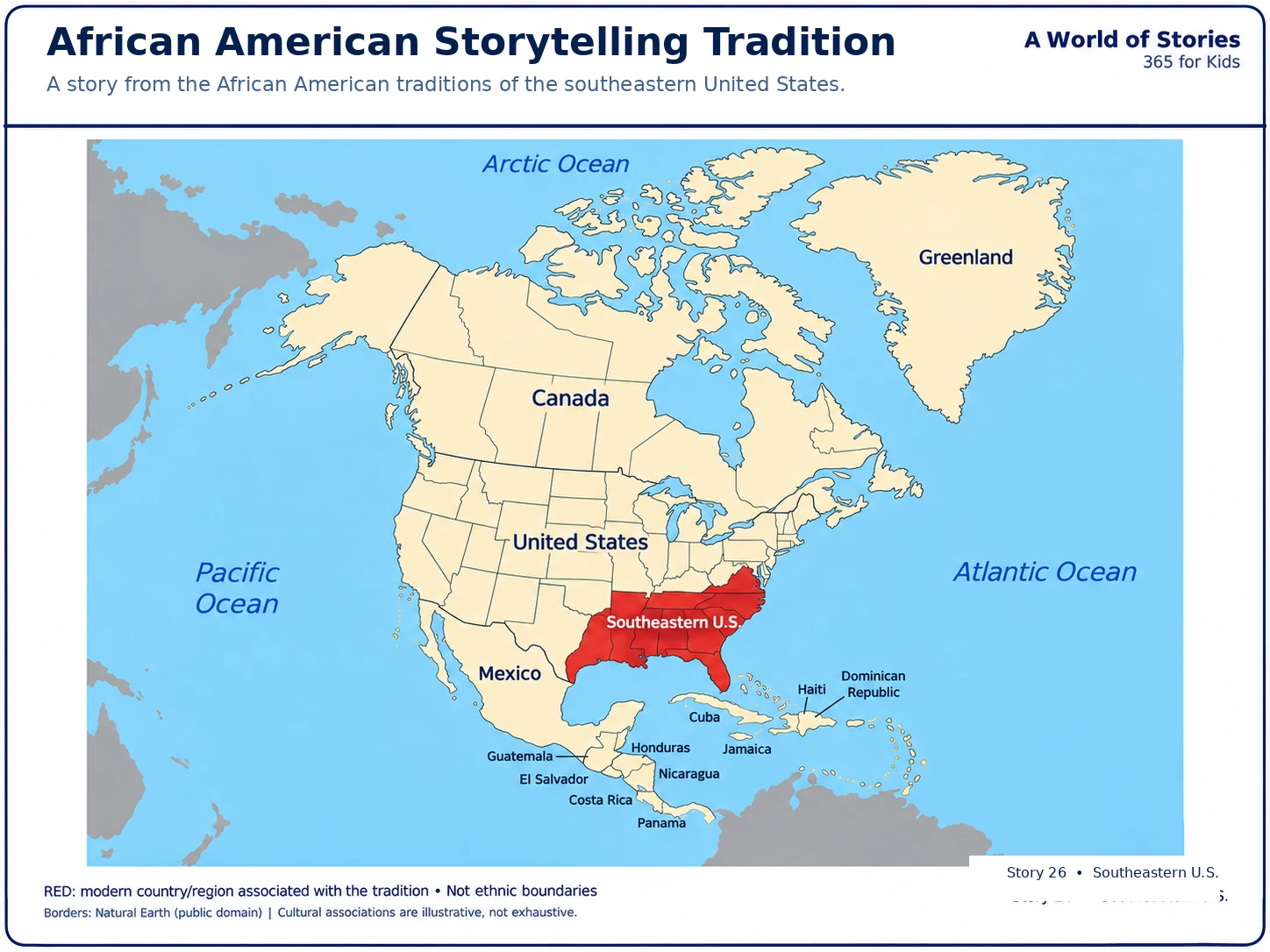
Long ago, in the days of the animal tales, Brother Bear had a fine, long tail. He was proud of his size and strength, and he did not like anyone to suggest that there was something he could not do.
One day, Brother Rabbit visited Brother Terrapin. Terrapin was away at the home of his relative, Mr. Mud-Turtle, so Rabbit went to find him there. The three friends talked and enjoyed a dinner of crawfish. Afterward, they wandered down to the millpond.
At the edge of the pond stood a broad rock that sloped toward the water. Its surface was green and slippery. Brother Terrapin and Mr. Mud-Turtle had discovered that they could climb to the top, sit down, and slide all the way into the pond.
Down went Mr. Mud-Turtle—splash! Then Brother Terrapin followed—splash! Each time they climbed back up, they tried again. Brother Rabbit sat nearby, laughing and cheering as his friends glided into the water.
While they were enjoying themselves, Brother Bear came along. He heard the shouts and splashes and stopped to see what was happening.
“Well, well!” said Bear. “What a lively afternoon! But why are you sitting there, Brother Rabbit, instead of taking a turn?”
Rabbit glanced at Terrapin. Terrapin nudged Mud-Turtle. The three friends seemed to understand one another without another word.
“I have had my share of fun,” Rabbit replied. “Now I am letting my clothes dry. We take turns whenever there is something amusing to do.”
“Perhaps Brother Bear would like a turn,” suggested Terrapin.
Rabbit laughed. “Brother Bear? His feet are far too big, and his tail is far too long for a little slide like that!”
Bear lifted his head. He did not care to be told what he could not do. “Maybe they are,” he said, “and maybe they are not. But I am certainly not afraid to try.”
The others moved aside. Bear climbed the sloping rock, sat down on his haunches, and curled his long tail beneath him. Then he pushed himself forward.
At first he moved slowly, and a pleased smile spread across his face. Soon he was sliding faster. The smile began to fade. By the time he reached the slickest part of the rock, he was moving so quickly that he could no longer stop.
Down he shot with a great cry—and into the pond he went with a tremendous splash!
But the slide had gone badly for Bear. As he slipped down the rock, his long tail broke off. He scrambled out of the water, sore and embarrassed, and hurried away along the road.
Brother Rabbit called after him, offering a teasing suggestion for soothing the injury. Bear did not turn around. He only kept going.
And that, according to this old animal tale, is why Brother Bear has no long tail today.
Brother Rabbit, Brother Bear, and Brother Terrapin appear in African American storytelling traditions of the Southern United States, preserved in a historical public-domain collection.
After the Story: Read · Create · Reflect · Share
1. Find the southeastern United States on a map of North America. This tale comes from African American storytelling traditions of the American South. Which states can you find in this region?
2. What were Brother Terrapin and Mr. Mud-Turtle doing at the pond when Brother Bear arrived?
3. How did Brother Rabbit’s words persuade Brother Bear to try the slippery rock, and what happened next?
4. Brother Bear wanted to prove he could do what the others could. When is it wise to accept a challenge, and when is it better to say no?
Inspired by this story? Create your illustration!
Mexico & Mesoamerican Traditions
MEXICO — The Legend of the Mulata de Córdoba
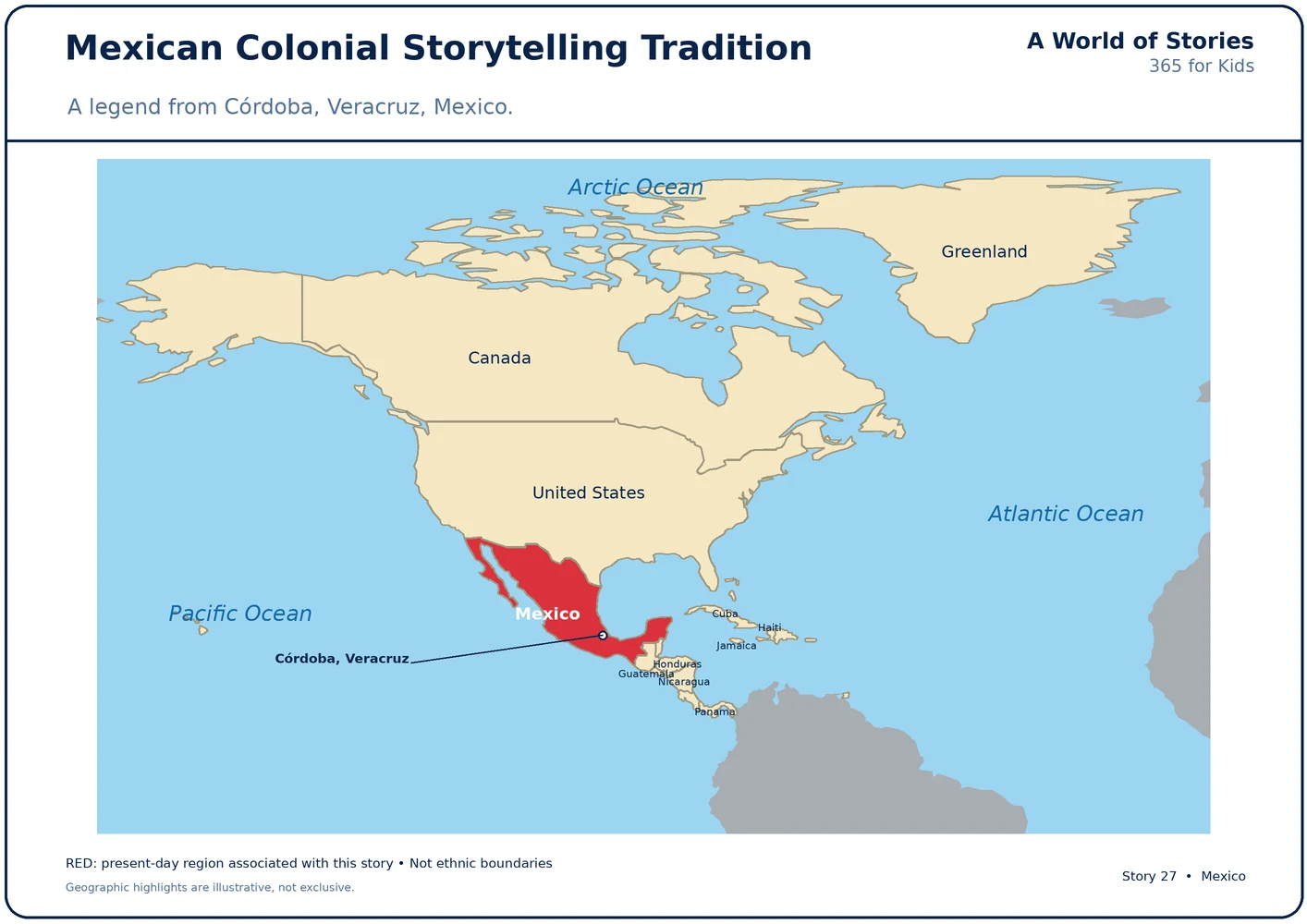
In the Mexican town of Córdoba, near Veracruz, people once told stories about a remarkable woman. No one seemed to know where she had come from or how old she was. As the years passed, her face never appeared to change. People simply called her the Mulata de Córdoba.
She lived modestly and was known for helping those in trouble. She shared food with people who were hungry, and those who faced difficulties often came to ask for her help. Yet kindness did not protect her from suspicion. Neighbors whispered that she possessed mysterious powers. Some claimed to have seen her in two distant places at the same time. Others spoke of strange lights shining from her house at night.
As the rumors spread, stories about her grew more extraordinary. Some people admired her and hoped she could solve problems no one else could solve. Others were frightened by what they could not explain. Suitors who had been turned away joined the gossip, and no one could agree on what was true.
At last the woman was arrested and taken from Córdoba to a prison of the Inquisition in Mexico City. The Inquisition was a powerful religious court in colonial times. Years passed, and the city almost forgot her. Then word spread that she had been condemned and would soon face a terrible punishment.
But before that could happen, something astonishing occurred.
One day, a high official came to speak with the imprisoned woman. As he entered her chamber, he stopped in amazement. Across the stone wall she had drawn a magnificent sailing ship with a piece of charcoal. Every sail, rope, and mast was carefully marked, as though the vessel were ready to set out to sea.
The woman looked at the drawing and asked what the ship still needed.
“Only to sail,” the official replied.
“Then sail it shall,” she answered.
Before his astonished eyes, she stepped up onto the deck of the ship she had drawn. The sails swelled as if a wind had filled them, though the ship was only a picture on a prison wall. Slowly at first, and then faster, the vessel began to move across the stone.
The woman took the helm. The charcoal ship sailed along the wall, reached the far corner of the chamber, and passed straight through the solid masonry. The wall closed behind it, leaving no doorway and no trace of the vessel. The woman had vanished.
The official could scarcely believe what he had seen. When the news spread, everyone offered a different explanation. Some insisted that dark magic had freed her. Others wondered whether the stories about her had ever been true.
No one, the legend says, heard from the Mulata de Córdoba again. But people continued to tell of the extraordinary ship that sailed out of a prison wall—and of the mysterious woman who escaped aboard it.
This legend comes from the colonial-era storytelling traditions of Córdoba, Veracruz, and Mexico City. “Mulata” is a historical term used in the legend for a woman of mixed African and European ancestry, and the tale has been passed down in many versions over the generations.
After the Story: Read · Create · Reflect · Share
1. Find Córdoba in the Mexican state of Veracruz and Mexico City on a map of North America. How far apart are these places?
2. What kindnesses was the woman known for, and why did some neighbors nevertheless become suspicious of her?
3. What did the official see on the prison wall, and how did the woman use the drawing to escape?
4. How can rumors change the way a community treats someone? What would be a fairer way to respond to a person we do not understand?
Inspired by this story? Create your illustration!
MEXICO — The Legend of the Altar del Perdón
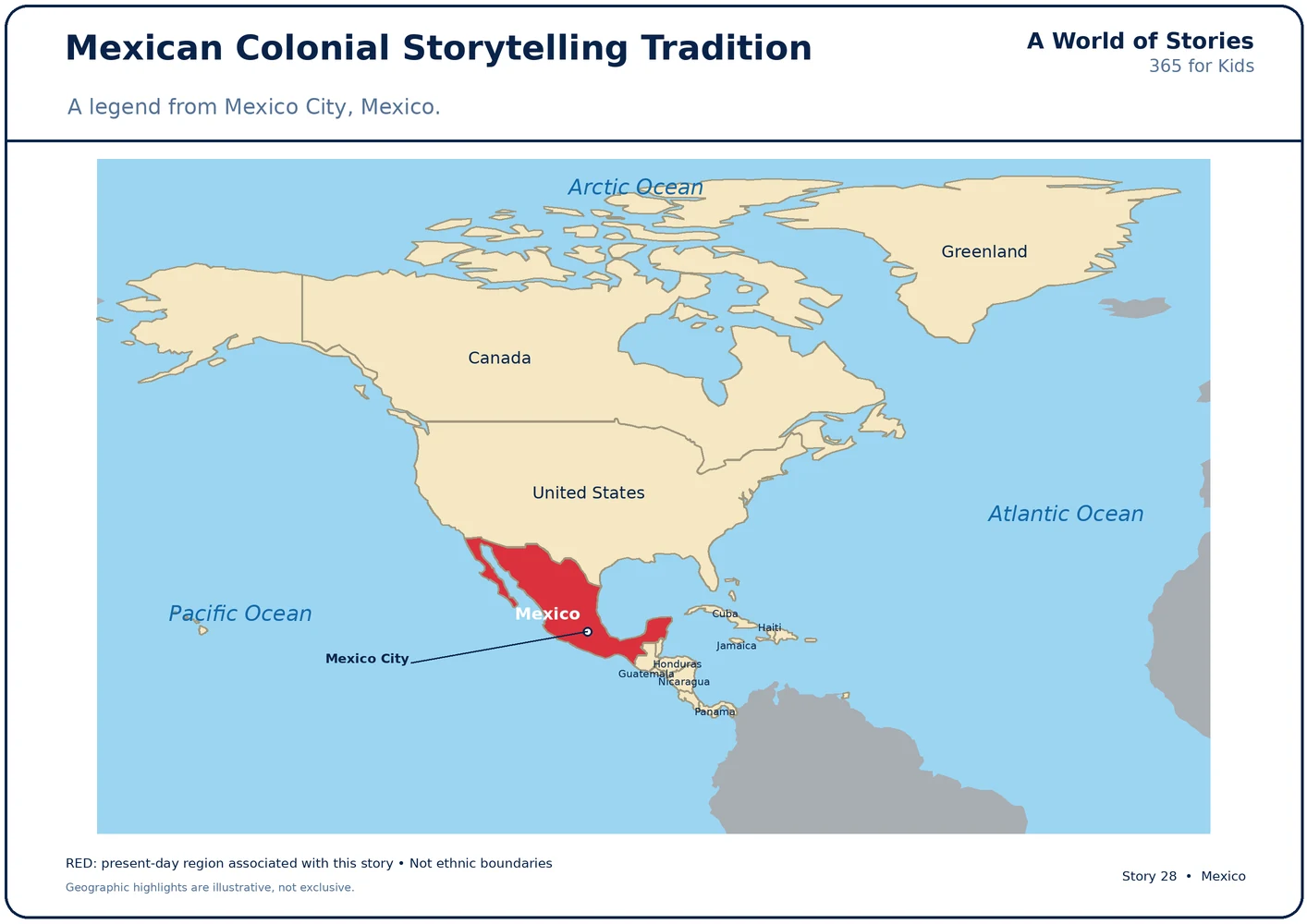
In the old city of Mexico, long ago, there lived a painter named Simón Peyrens. He had come from Europe and was admired for the beauty of his paintings. The viceroy liked his company, and people at the palace knew him as a lively and gifted artist.
One day, the leaders of the cathedral announced a competition. They wished to place a magnificent painting of Our Lady of Mercy above an altar called the Altar del Perdón—the Altar of Forgiveness. Painters throughout the city prepared to enter. Surely, everyone thought, Peyrens would take part as well.
But Peyrens refused. At a gathering in the palace, he spoke carelessly about religious paintings and declared that he would not make one, however great the reward. His words angered powerful church officials. What began as an argument about a painting became a far more serious matter.
Peyrens was arrested by the Inquisition, a religious court of the time, and shut inside a prison cell. In the darkness he faced the frightening possibility of harsh punishment. The artist who had once moved freely through the bright palace now had only bare walls around him.
Then, according to the old legend, something extraordinary happened.
One night, Peyrens awoke to a delicate fragrance. A gentle light appeared in his cell, growing brighter until the small room seemed filled with radiance. Before him stood a vision of Our Lady of Mercy. She looked at him with kindness and spoke to him. Deeply moved, the painter answered with reverence.
When the vision faded, Peyrens began to paint. There was no canvas waiting in his cell, so he used the wooden door. Throughout the night, he worked, painting the figure he believed he had just seen. He gave his attention to every feature, every fold of the robes, and every trace of compassion in the face.
By morning, a remarkable image covered the prison door. The church leaders were summoned to see it. In the story, they were astonished by the painting and decided that the artist had earned both the promised prize and his freedom.
Peyrens was released. The painted door was taken from its hinges, framed, and placed at the Altar del Perdón in the cathedral.
For generations, people repeated the tale of the painter, the prison door, and the unexpected act of mercy. They remembered it as a story in which beauty appeared in a place of fear—and forgiveness changed a person’s fate.
This legend comes from the colonial-era storytelling traditions of Mexico City, centered on the painter Simón Peyrens and the Altar del Perdón in the city’s cathedral.
After the Story: Read · Create · Reflect · Share
1. Find Mexico City on a map of North America. What can you discover about its historic cathedral?
2. Why did the cathedral’s leaders want a painting, and why did Peyrens refuse to enter the competition?
3. Where did Peyrens create his remarkable painting, and what happened when others saw it?
4. The legend connects art with mercy and forgiveness. How can a work of art help people express kindness, hope, or a change of heart?
Inspired by this story? Create your illustration!
MEXICO — The Legend of the Calle de la Cruz Verde
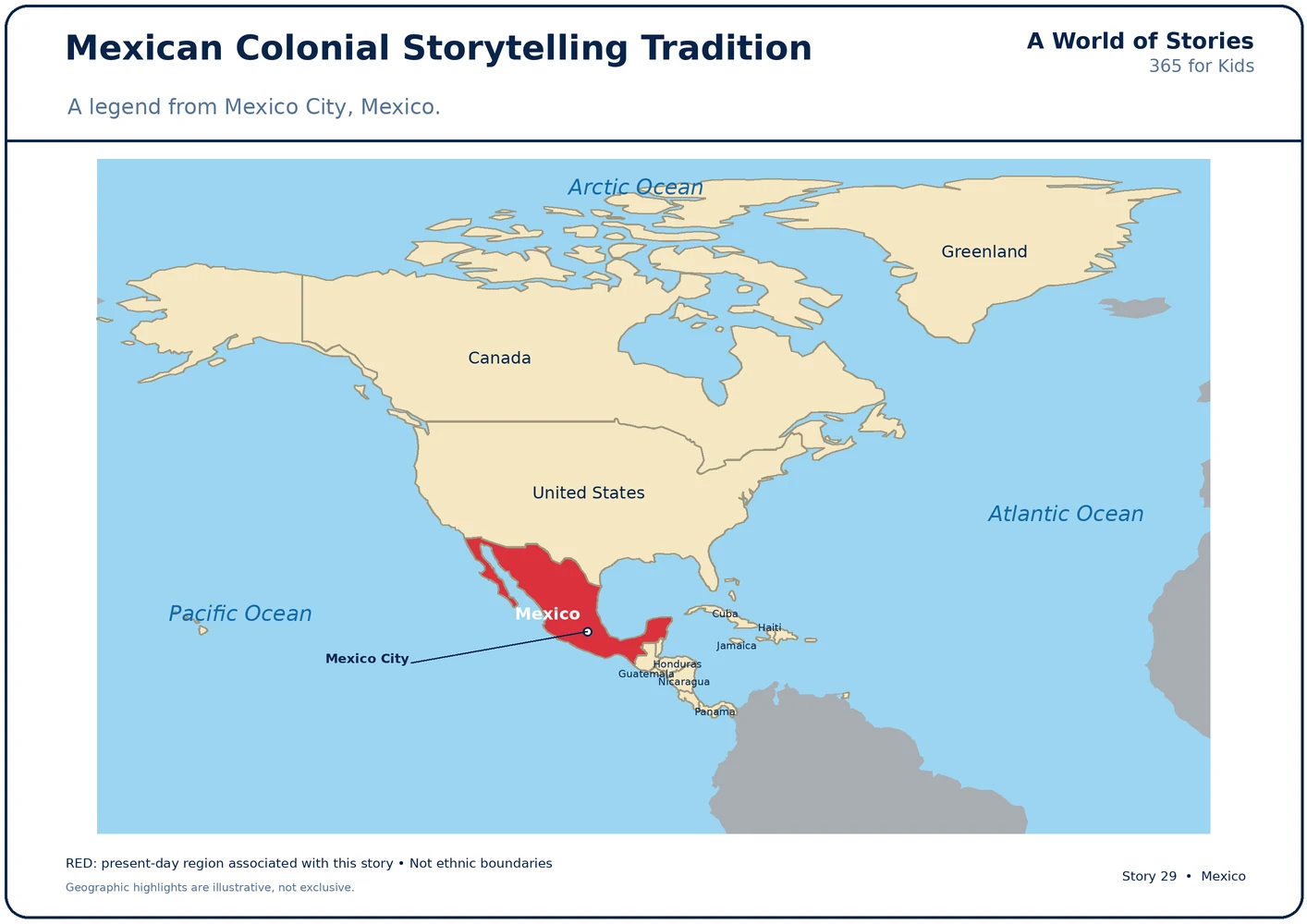
Long ago, in the streets of Mexico City, there stood a handsome house with a balcony overlooking a narrow road. Travelers passed beneath its windows, and people in the neighborhood came to know the corner well. But the house would one day become famous for something unusual: a great green cross carved into its stone wall.
The story begins with a young gentleman named Don Álvaro de Villadiego y Manrique. He had come to Mexico during the time of the Spanish viceroys. One day, dressed in fine clothes and riding his Arabian horse, he passed along the street called Calle de Migueles. Looking up, he noticed a young woman standing on the balcony of a house.
Her name was Doña María de Aldarafuente y Segura. Don Álvaro was immediately captivated. Doña María noticed him, too, but she gave no outward sign of what she felt. In those days, families followed strict customs about courtship, and her parents carefully watched over her.
Don Álvaro began to ride past the house day after day. He hoped for even the smallest indication that Doña María welcomed his attention. Yet whenever he looked toward the balcony, he could not be certain what she was thinking. Doña María, meanwhile, kept her feelings hidden, even as her affection for him grew.
A long time passed. Then Doña María’s mother became ill, and the usual watch over the young woman was less strict. Don Álvaro found a way to send her a letter. In it, he asked whether she returned his love and suggested a simple signal she could give without having to write a reply.
She could hang a cross made from dry palm leaves over the balcony railing if she did not wish to marry him. But if she loved him, she could hang a cross made from fresh, green palm leaves. When Don Álvaro saw the green cross, he would know that her answer was yes.
Doña María did not respond at once. Several days went by, and Don Álvaro waited anxiously. Each time he approached the house, he searched the balcony for the promised sign. Still nothing appeared.
Then, on a bright spring day, with sunlight filling the street and birds singing, Don Álvaro looked up and saw it: a cross of fresh green palm leaves hanging from the balcony. Doña María had given her answer.
With the help of a clergyman who knew both families, the arrangements for their marriage were made. Two weeks later, Don Álvaro and Doña María were married. According to the legend, they remained faithful to one another throughout their lives.
To remember the green sign that had brought him such happiness, Don Álvaro had a large green cross carved in stone on the corner of their house, beneath the balcony where the palm-leaf cross had hung.
The cross became a landmark. People came to call the street Calle de la Cruz Verde—the Street of the Green Cross. And that is how, according to an old Mexico City legend, a message made from a few green leaves gave a street its name.
This legend comes from the colonial-era urban storytelling traditions of Mexico City and explains the origin of the name Calle de la Cruz Verde, the Street of the Green Cross.
After the Story: Read · Create · Reflect · Share
1. Find Mexico City on a map of North America. How is the setting of this city legend different from a story set in a forest or an Arctic landscape?
2. Why did Don Álvaro ask Doña María to hang a cross of palm leaves on the balcony?
3. What did the green cross tell Don Álvaro, and how did it later become part of the house?
4. Doña María took time before giving her answer. Why is it important to respect another person’s time and freedom to make a decision?
Inspired by this story? Create your illustration!
MEXICO — The Legend of the Accursed Bell
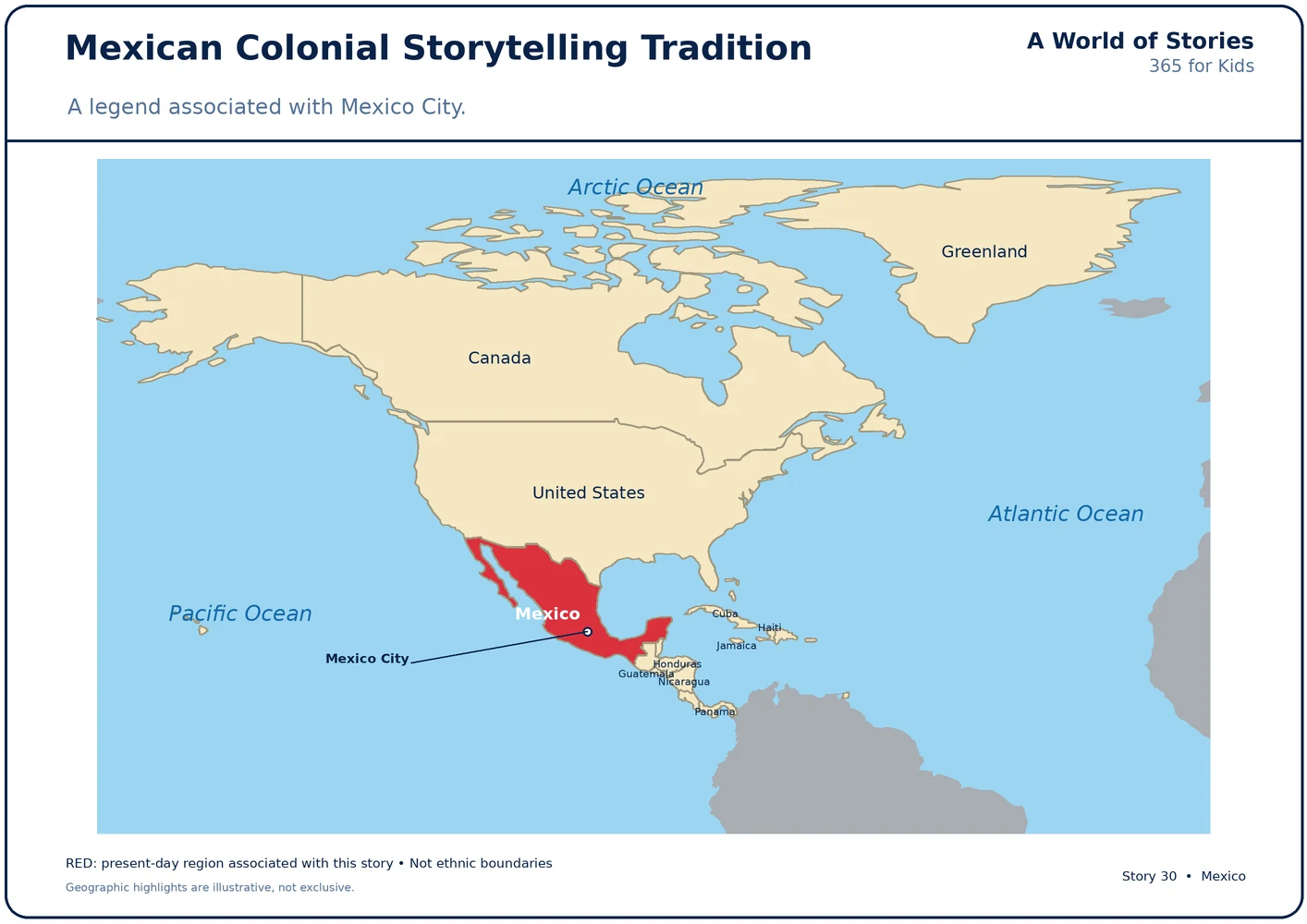
Long ago, in a small town in Spain, people heard a bell ringing in the middle of the night. It was not the usual call to prayer or the striking of an hour. The sound came suddenly, fiercely, as though a dozen people were pulling its rope at once.
The townspeople hurried from their houses. They stared up at the convent tower, where a newly made bronze bell swung in the darkness. Yet the tower door was locked, and no one had gone inside to ring it. How could the bell be moving on its own?
To understand the mystery, the people had to look far into the bell’s past. According to the old legend, the bronze had once belonged to a suit of armor worn by a violent man named Don Gil. Strange stories surrounded the armor. After Don Gil disappeared from a locked cell, the empty armor was said to have moved without anyone inside it.
The armor was melted down and made into a cross. For many years the bronze stood quietly in that shape. Eventually, when a convent needed a bell, the metal was melted again. The new bell was decorated with an eagle bearing two heads, a religious scene, and the figures of two lions near its crown. Everyone admired the workmanship. No one expected the peaceful-looking bell to cause such a disturbance.
But on that extraordinary night, the ringing would not stop. The mayor of the town took a torch and climbed the tower steps. He saw the rope swinging wildly, though no hands touched it. Higher up, beside the moving bell, he found only a black cat. The startled animal dashed past him and disappeared down the stairs.
A priest tried to quiet the bell with holy water, but the ringing grew louder. At last the townspeople left the tower and waited for daylight. The next morning, the mayor questioned everyone who might have entered the building. No one admitted to ringing the bell, and no one could explain what they had heard.
The case was sent to officials, who spent a remarkably long time examining it. After many discussions, they declared that the bell must never ring by itself again. Its clapper—the piece of metal that strikes the inside—was removed. Then the bell was ordered to leave Spain and travel across the ocean.
A ship carried the silent bell to Veracruz, in New Spain, the land we now call Mexico. From the port it was taken inland to Mexico City. There it stood forgotten in a corridor of the viceregal palace for many years. People still remembered the story, and nobody was eager to put the bell to use.
One day a new viceroy noticed the old bronze bell and wondered why such a fine object was gathering dust. An elderly clerk showed him the ancient order: the bell was not to have a clapper. The viceroy thought carefully. A clock bell, he realized, did not need one. A clock could strike it with a hammer from the outside.
And so the mysterious bell found a new purpose. It was placed with the palace clock and, according to the storyteller, sounded the hours regularly for many years. Whatever had once made it ring so wildly seemed to have become quiet.
Much later, during the nineteenth-century French intervention in Mexico, the old bell was replaced and melted down. Yet the legend did not end there. An old metalworker claimed that the melted bronze refused to take a new shape.
Was the metal truly strange? Was there an ordinary explanation that no one had discovered? The legend leaves those questions unanswered. But for generations, people remembered the bell that had crossed an ocean, lost its voice, and finally found a way to tell the time.
This legend comes from the colonial storytelling heritage of Mexico City and reflects the historical ties between Spain and New Spain, as the Mexican viceroyalty was then known.
After the Story: Read · Create · Reflect · Share
1. Find Mexico City on a map of North America. Where is Veracruz, the port through which the bell arrived from Spain?
2. What made the townspeople believe that the bell was unusual, and what did the mayor discover in the tower?
3. Why was the bell sent across the ocean, and how did the viceroy find a way to use it without breaking the old order?
4. When we hear a mysterious story, how can we remain curious while also considering different possible explanations?
Inspired by this story? Create your illustration!
MEXICO — The Legend of the Calle de la Machincuepa
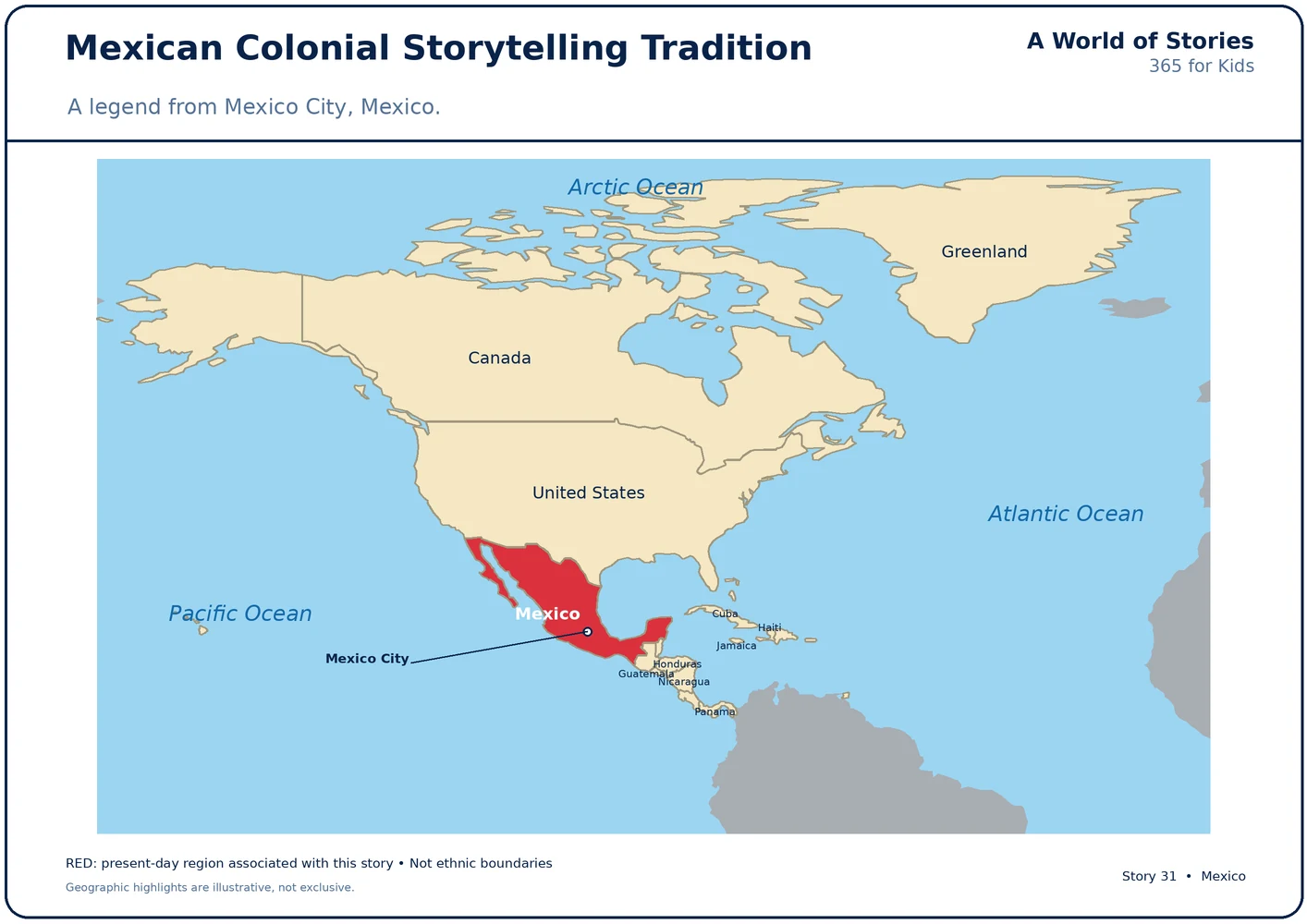
Long ago, when Mexico City was governed by a Spanish viceroy, there lived a wealthy nobleman named Don Mendo. He had made his fortune at sea and later became the owner of great salt works. In his old age he brought his niece, Doña Paz, from Spain to live in his splendid home.
Doña Paz soon had everything she could wish for: fine dresses, magnificent jewels, and a respected place in the city’s highest society. She took great pride in her elegant manners. Whenever she appeared in public, she behaved with the dignity of a queen.
Yet while she enjoyed her uncle’s generosity, she showed him little kindness. As Don Mendo grew older and needed care, she left him to his servants. Even when she visited his room, she offered him neither a warm word nor a gentle smile.
Don Mendo noticed. He said little, but he did not forget.
When he died, his family and advisers gathered to hear his will. At first, Doña Paz could hardly believe her good fortune: her uncle had left her his entire enormous estate. But there was a condition.
To receive the inheritance, she would have to dress in her finest gown and jewels, ride in an open carriage to the Plaza Mayor at noon, and perform a machincuepa—a complete somersault—in the middle of the square, before everyone watching.
For a woman who cared so deeply about appearing dignified, the thought was almost unbearable. She imagined the startled faces in the crowd and the whispers that would follow her through the city. But she also thought of all the wealth she would lose if she refused.
The will gave her six months to decide. If she did not perform the somersault before that time was over, the fortune would be divided between two convents instead.
Weeks passed. Then months. Doña Paz could not make up her mind. Meanwhile, the people of Mexico City grew curious. Would she surrender a vast fortune to protect her pride—or would she dare to tumble across the square?
At last the final morning arrived. The streets filled with people, but Doña Paz was nowhere to be seen. The hours slipped past, and the two convents began to expect the inheritance would soon be theirs.
Then, just before noon, the doors of Don Mendo’s house opened. An open carriage rolled out. Inside sat Doña Paz, dressed in her most splendid gown and wearing her finest jewels.
She travelled through the crowded streets to the Plaza Mayor. There, her servants spread a rich carpet on the ground. As the palace clock struck twelve, Doña Paz stepped into the middle of the square, bent forward, and turned a somersault before the astonished crowd.
She had fulfilled the condition. The inheritance was hers.
But the story says she also gained something she had never expected: a taste of the embarrassment that her unkindness had brought upon her uncle. And the street where she lived became known, according to the legend, as the Calle de la Machincuepa—the Street of the Somersault.
Whether every detail happened exactly as the storytellers said is impossible to know. But the old tale remembers an unusual choice: a proud person who was willing to turn upside down to keep her riches.
This legend comes from the colonial-era urban storytelling traditions of Mexico City. “Machincuepa” is the Spanish word for a somersault.
After the Story: Read · Create · Reflect · Share
1. Find Mexico City on a map of North America. What part of Mexico is it in, and how is it different from a cultural region?
2. How did Doña Paz treat her uncle when he became older and needed help?
3. What condition did Don Mendo place in his will, and why was it such a difficult decision for Doña Paz?
4. Can someone seem polite in public but behave unkindly in private? What does this story suggest about genuine respect and gratitude?
Inspired by this story? Create your illustration!
MEXICO — The Legend of the Aduana de Santo Domingo
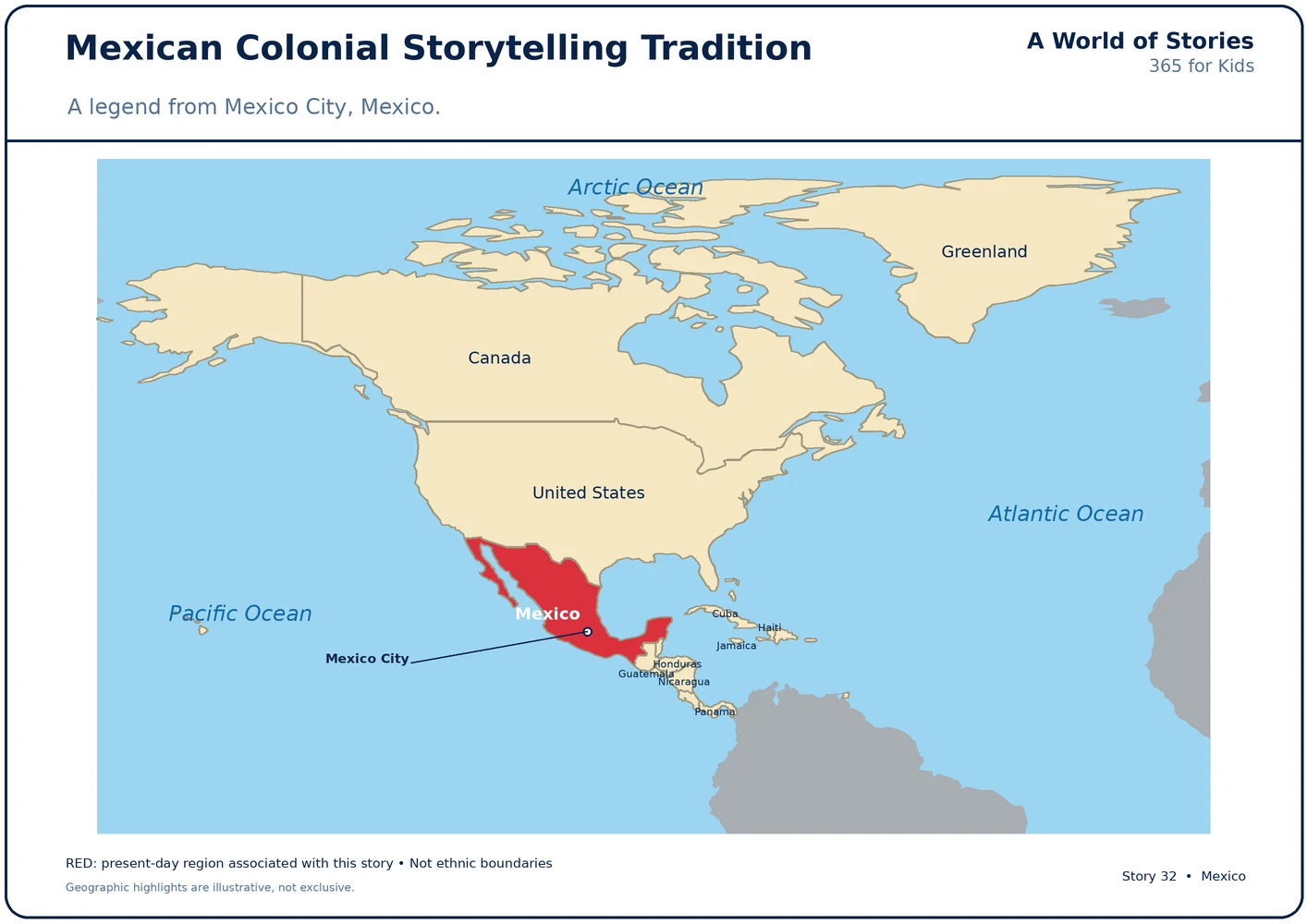
Long ago, when Mexico City was governed by viceroys sent from Spain, a magnificent public building stood unfinished near the Plaza de Santo Domingo. It was intended to become the Aduana, the customs house where merchants’ goods would be registered. Year after year, the work moved slowly. Walls rose a little, then nothing seemed to happen for months.
At that time, there lived in the city a wealthy gentleman named Don Juan Gutiérrez Rubín de Celis. He enjoyed beautiful clothes, grand ceremonies, and a comfortable life. He was friendly and generous, but when it came to completing difficult tasks, he had a habit of putting them off until another day.
One day Don Juan fell deeply in love with a thoughtful young woman named Doña Sara de García Somera y Acuña. Sara knew that Don Juan had many good qualities. Yet she wondered whether someone who avoided responsibility could truly become a dependable partner.
While she considered his proposal of marriage, Don Juan received an important appointment: he was made head of the merchants’ tribunal, the organization responsible for the unfinished Aduana. The new position gave him the authority to see that the building was completed. But at first he seemed quite content to let the work continue as slowly as before.
Then Doña Sara decided to test whether Don Juan could turn his promises into action. She told him that she would marry him on one condition: he must finish the great Aduana within six months.
Six months! The building had already stood unfinished for years. Architects across the city said the task could not possibly be done so quickly. But Don Juan accepted her challenge.
The very next day, he began to work. He sought advice from architects and brought together skilled stonemasons, carpenters, blacksmiths, brickmakers, and many other laborers. Quarries supplied stone. Workshops made doors, windows, hinges, and iron railings. With so many different crafts involved, every part of the building required careful attention.
The old Don Juan might have left all these difficulties for someone else. Now he hurried from one part of the construction site to another, checking the work and pressing everyone to continue. His impatience sometimes made him harsh with the workers, but his energy and organization kept the immense project moving.
As the weeks passed, the unfinished walls grew into a complete building. Doors were fitted. Floors and roofs were finished. At last, only the smallest details remained.
And then, three days before the six months were over, the Aduana was complete.
Don Juan carried the keys to the viceroy’s palace and presented them as proof that he had kept his promise. The city marveled. A task that had seemed impossible had been accomplished through determination and the work of many skilled hands.
Don Juan also ordered an inscription to be carved on the building. Its lines contained a hidden tribute: the first letters spelled out the initials of Doña Sara, whose challenge had inspired him to begin.
Doña Sara was pleased to see that Don Juan could act with purpose and perseverance. According to the legend, she agreed to marry him, and the building remained as a reminder of the extraordinary undertaking.
Whether every detail happened exactly this way is something we cannot know. But the old story remembers a remarkable change: a man who had always delayed his duties discovered what could be achieved when he finally began—and when many people worked together.
This legend comes from the urban storytelling traditions of colonial Mexico City and is connected to the historic Aduana de Santo Domingo, the city’s customs house.
After the Story: Read · Create · Reflect · Share
1. Find Mexico and Mexico City on a map of North America. Why might a large city need a customs house where goods brought by merchants could be registered?
2. What condition did Doña Sara set for Don Juan, and why did it seem almost impossible?
3. Which different kinds of workers helped complete the Aduana? Why could Don Juan not have finished it alone?
4. Don Juan found the determination to act, but he could also be impatient with the workers. What is the difference between leading people with encouragement and pushing them harshly?
Inspired by this story? Create your illustration!
NAHUA (MEXICO) — The Rabbit in the Moon
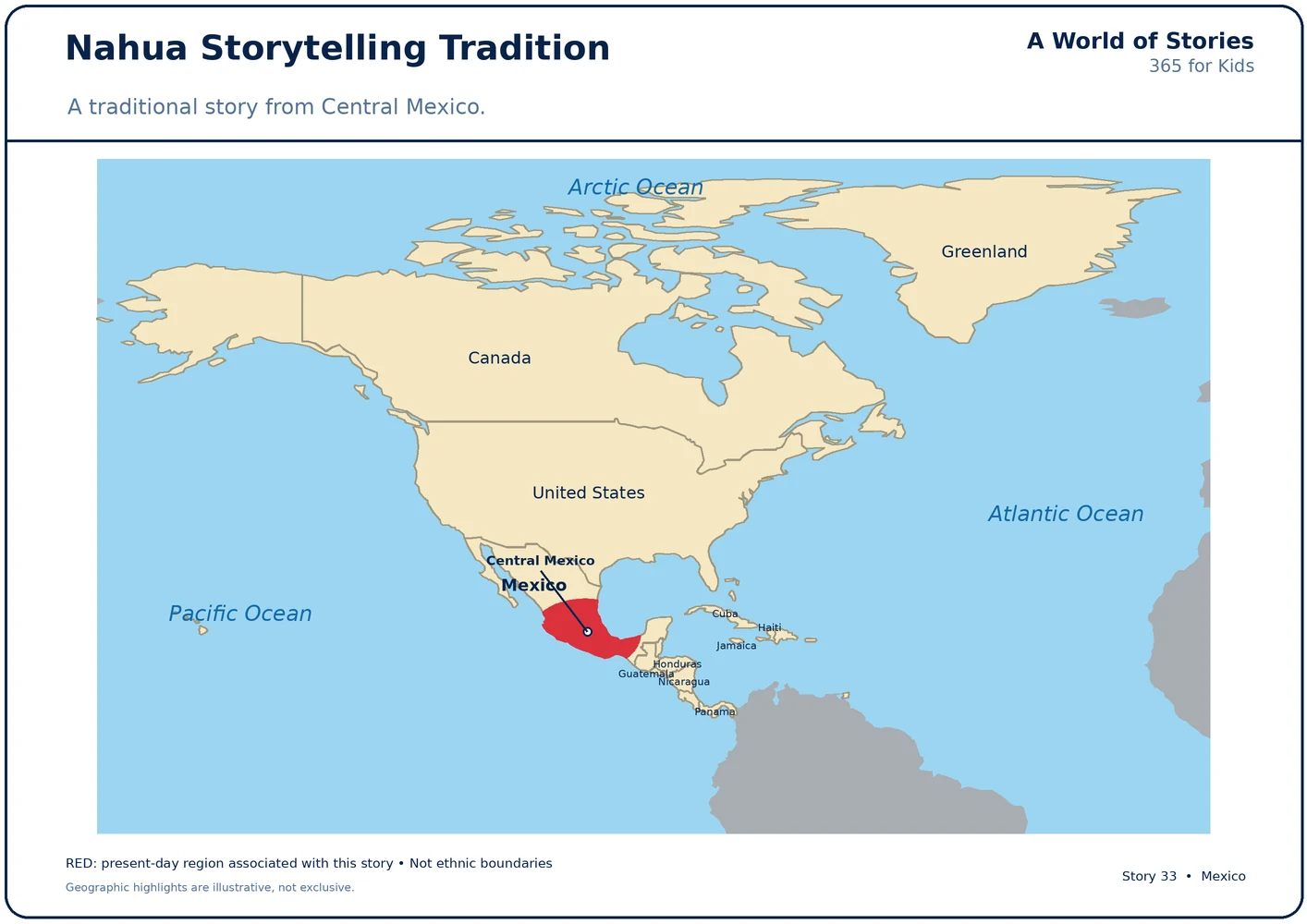
Long ago, according to a story told by the Nahua peoples of central Mexico, the world waited in darkness. The Sun had not yet risen, and there was no dawn to brighten the sky.
The gods gathered at Teotihuacan to decide who would bring light to the world. One of them, Tecciztecatl, stepped forward and offered to become the Sun. But a second volunteer was needed. The gods turned to Nanahuatzin, who was humble and lived with painful sores. Nanahuatzin accepted the task.
For four days, the two prepared. Tecciztecatl presented splendid offerings: fine feathers, gold, and precious stones. Nanahuatzin brought simple offerings instead. At last, a great fire was prepared for the moment of transformation.
When the time came, Tecciztecatl approached the fire, but he hesitated. Again he tried, and again he drew back. Nanahuatzin then went forward and entered the flames. In the sacred story, his act transformed him into the shining Sun.
Only after Nanahuatzin had gone did Tecciztecatl follow. He too rose into the sky, bright and glowing. Now there were two lights, both shining with the brilliance of the Sun.
The gods saw that the two lights could not remain equally bright. One of them took a rabbit and struck the second shining light with it. The brilliance of Tecciztecatl faded. He became the Moon, and the rabbit left its mark upon his face.
And so, in this Nahua account, the Moon carries the image of a rabbit. When people look up at the full Moon, they may imagine the rabbit’s shape in the patterns of light and shadow across its surface.
The Sun and Moon in this story are not ordinary characters. They belong to an ancient account of how the world received its lights—a story remembered through generations and preserved in the cultural heritage of the Nahua peoples.
This story comes from the Nahua peoples of central Mexico and forms part of their traditional account of the creation of the Sun and Moon. Nahua communities and their languages remain part of Mexico’s living cultural heritage today.
After the Story: Read · Create · Reflect · Share
1. Find central Mexico and Teotihuacan on a map of North America. Which part of the continent is this cultural tradition connected with?
2. Who first offered to become the Sun, and who accepted the second invitation?
3. What happened after both figures had risen into the sky, and why did one become the Moon?
4. Nanahuatzin and Tecciztecatl approached the same task differently. What does the story invite you to think about when comparing outward splendor with determination?
Inspired by this story? Create your illustration!
Central America
COSTA RICA — Tío Conejo and His Grandmother’s Sandals
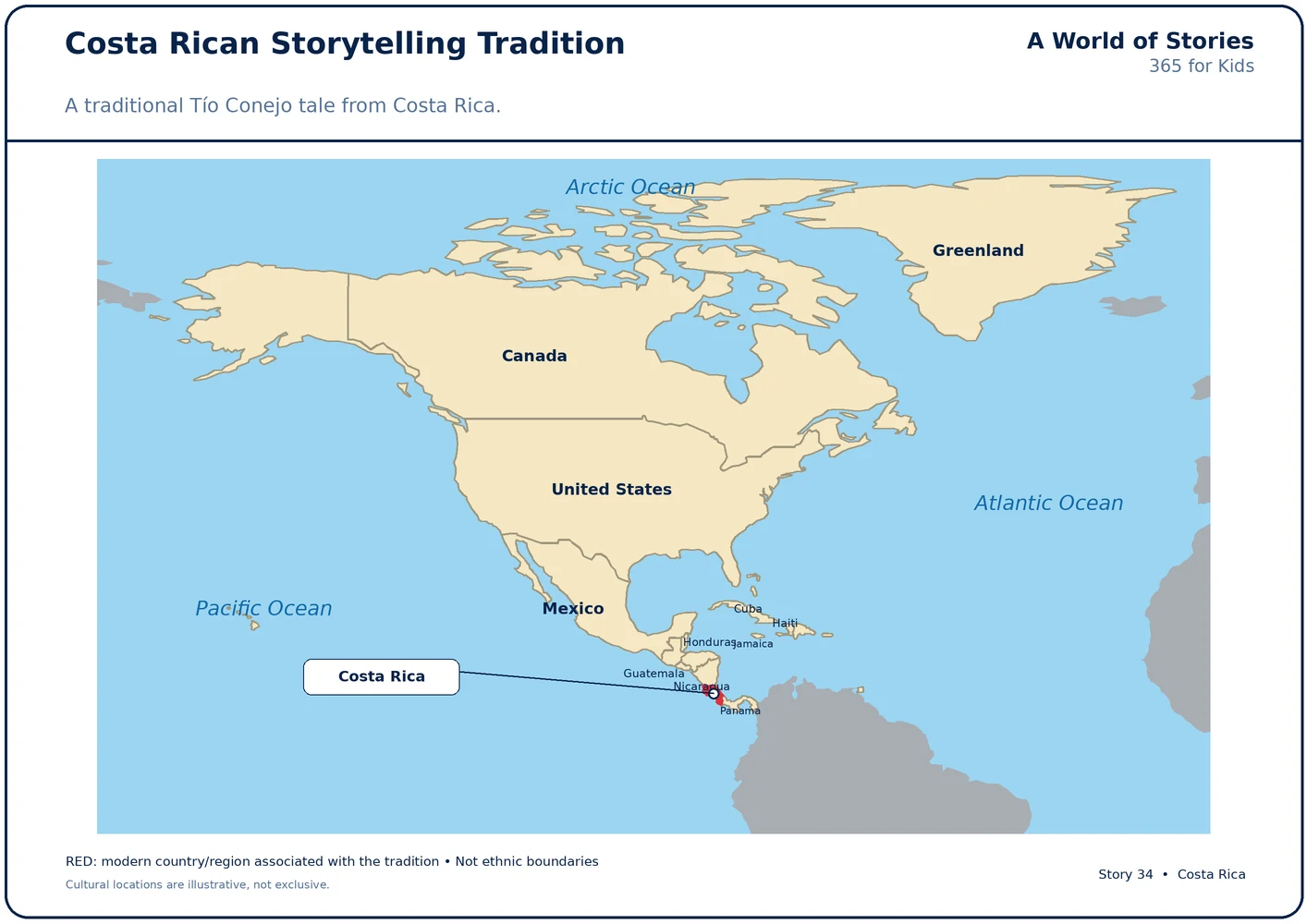
One day in the forest, Tío Conejo—Uncle Rabbit—was telling a little dove a wonderful story about himself.
He claimed to be the son of a king. His home, he said, was a palace of gold and silver. His parents wore magnificent crowns, and hundreds of servants bowed whenever he entered a room.
The dove listened in amazement. But before Rabbit could finish describing his splendid life, a large paw reached out from behind him.
It belonged to Tío Tigre—Uncle Tiger.
“Do not believe a word of that,” Tiger told the dove. “You are listening to Tío Conejo, the greatest teller of tall tales in the forest!”
Rabbit turned around. The sight of Tiger made his grand stories disappear from his mind. He knew Tiger was angry with him, and he knew that running would not be easy.
“Dear Tío Tigre,” Rabbit began, trying to sound friendly, “you know how much I admire you. Why, only yesterday I was telling everyone how brave and strong you are!”
Tiger was not impressed. Rabbit had played too many tricks on him before.
Rabbit tried another approach. He asked Tiger for one last favor: would he walk with Rabbit to his little house, so that Rabbit could put away the few belongings his grandmother had left him?
At first Tiger refused. But Rabbit kept pleading, and finally Tiger agreed—on one condition. He would watch the doorway so Rabbit could not escape.
The two went to Rabbit’s home. Tiger inspected the little house. It had only one door and no other way out. Satisfied, he settled himself across the entrance while Rabbit went inside.
“Pass me your things,” Tiger commanded. “I will throw them outside.”
Rabbit handed him an old, dusty piece of cloth.
“My grandmother’s nightshirt,” he announced. “If you do not want it, throw it far away.”
Tiger tossed it into the grass.
Next came another bundle of old clothing. Tiger threw that away too. Then Rabbit handed out one more piece, and Tiger sent it flying without looking closely.
The bright sunlight made Tiger squint. He was growing impatient.
Inside, Rabbit lowered himself to the floor and pushed his long ears through the doorway.
“And here,” he called, “are my grandmother’s sandals! If you do not want them, throw them as far as you can!”
Tiger seized what he thought were the sandals and hurled them across the clearing.
But it was Rabbit himself!
By the time Tiger understood what had happened, Tío Conejo was already racing through the grass toward the trees.
From a safe distance, Rabbit called out a cheerful farewell. Tiger turned and saw that the “grandmother’s sandals” had become two long ears bobbing away through the meadow.
Once again, the little trickster had escaped—not because he was stronger, but because he had found a way to make Tiger act without looking carefully.
Tío Conejo (Uncle Rabbit) is a trickster figure from Costa Rican oral tradition, preserved in Carmen Lyra’s classic collection Los cuentos de mi tía Panchita (1920).
After the Story: Read · Create · Reflect · Share
1. Find Costa Rica on a map of Central America. Which two countries border it, and which bodies of water lie on either side?
2. What extraordinary things did Tío Conejo tell the dove about his family and his home?
3. How did Rabbit persuade Tiger to throw him away from the doorway?
4. Rabbit escaped by being clever, but he also told lies. When can clever thinking help others, and when can it cause trouble?
Inspired by this story? Create your illustration!
COSTA RICA — Tío Conejo and the Last Watering Place
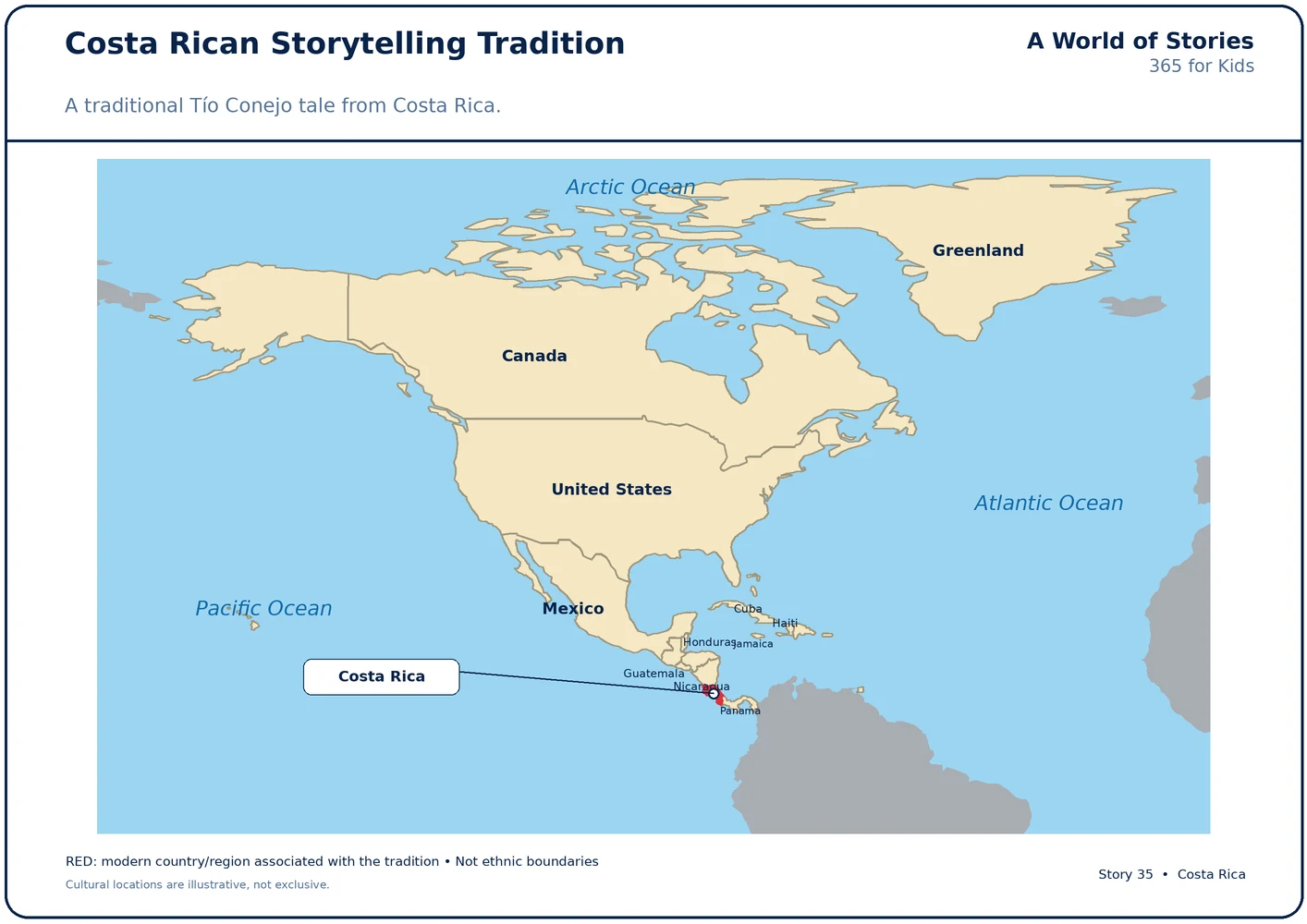
One summer, a terrible drought settled over the countryside. The rivers shrank until their beds were dry, and the animals searched farther and farther for water. At last, only one small spring remained. Every creature depended on it.
But Tío Tigre had taken possession of the spring. He stretched himself beside the water, drank whenever he pleased, and frightened away any animal that dared to approach. The others grew thirsty and afraid. They gathered to decide what could be done.
They talked and argued, but no one had a plan. Then Tío Conejo stepped forward. He was small, quick, and well known for his clever tricks.
“What will you give me if I make Tío Tigre leave the spring?” he asked.
The animals stared at him. “You? How could you possibly do that?” they said. Some told him not to boast.
“Very well,” replied Tío Conejo, and off he went without explaining another word.
First, he visited an old woman he knew and borrowed a large dried-gourd bowl. Then he found a wild bees’ nest. He poked a hole in it, letting honey run onto the ground. Tío Conejo rolled in fallen leaves, then in the sticky honey, and then in leaves again. Soon his small body was hidden beneath a thick, rustling covering.
He made a small opening in the gourd, placed it over his muzzle beneath the leaves, and tried out a deep, hollow howl. The sound was so strange that even the angry bees flew away in alarm.
“Ooooo! Uuuuu!” he called. “Chish! Chash!” rustled the leaves whenever he moved.
Now he walked toward the spring. The animals he passed could hardly believe their eyes. They saw a towering, shaggy shape, and heard a voice that seemed to come from somewhere far inside it.
Tío Tigre was dozing at the water’s edge when the terrible howling woke him. He sat up, listening. Then the strange creature came into view, leaves shaking with every step.
“I am Hojarascal del Monte—the Leaf-Covered One of the Mountain!” thundered the visitor through the gourd. He boasted that even lions and an elephant had been no match for him.
Tío Tigre trembled. “Who are you?” the creature demanded.
“Only Tío Tigre,” he answered meekly. “I came here for a drink of water.”
“This is my spring!” roared the Leaf-Covered One. “Leave at once, and do not show your face here again!”
Tío Tigre needed no second warning. He fled as fast as his legs could carry him.
When Tío Conejo was certain the tiger had gone, he removed the gourd and took a long drink of cool, fresh water. Then he rolled in the stream to wash away the honey and leaves until he looked like himself again.
He hurried back to the other animals. “You may drink now,” he announced. “The spring is free.”
They doubted him at first. To make sure, they sent the little yigüirro, a thrush familiar in Costa Rica, to look. The bird returned with wonderful news: Tío Tigre was nowhere to be seen.
At once the animals rushed to the spring and drank their fill. But Tío Conejo was not pleased to see how quickly they accepted the help they had laughed at before. He scolded them for leaving all the work to him and went away in a huff.
And so the spring belonged to the thirsty animals again—not because the strongest creature had won, but because the smallest had found a way to outwit him.
This Costa Rican folktale belongs to the Tío Conejo (Uncle Rabbit) tradition and was recorded by Costa Rican writer Carmen Lyra in Los cuentos de mi tía Panchita (1920).
After the Story: Read · Create · Reflect · Share
1. Find Costa Rica on a map of Central America. Which two oceans border the region, and why would a small spring be especially important during a drought?
2. Why could the animals not drink from the last spring, and why did they doubt Tío Conejo?
3. How did the honey, leaves, and gourd help Tío Conejo frighten Tío Tigre away?
4. Tío Conejo helped everyone but was still upset at the end. What could the other animals have said or done to show appreciation and share responsibility?
Inspired by this story? Create your illustration!
COSTA RICA — The Song of the Seven Days
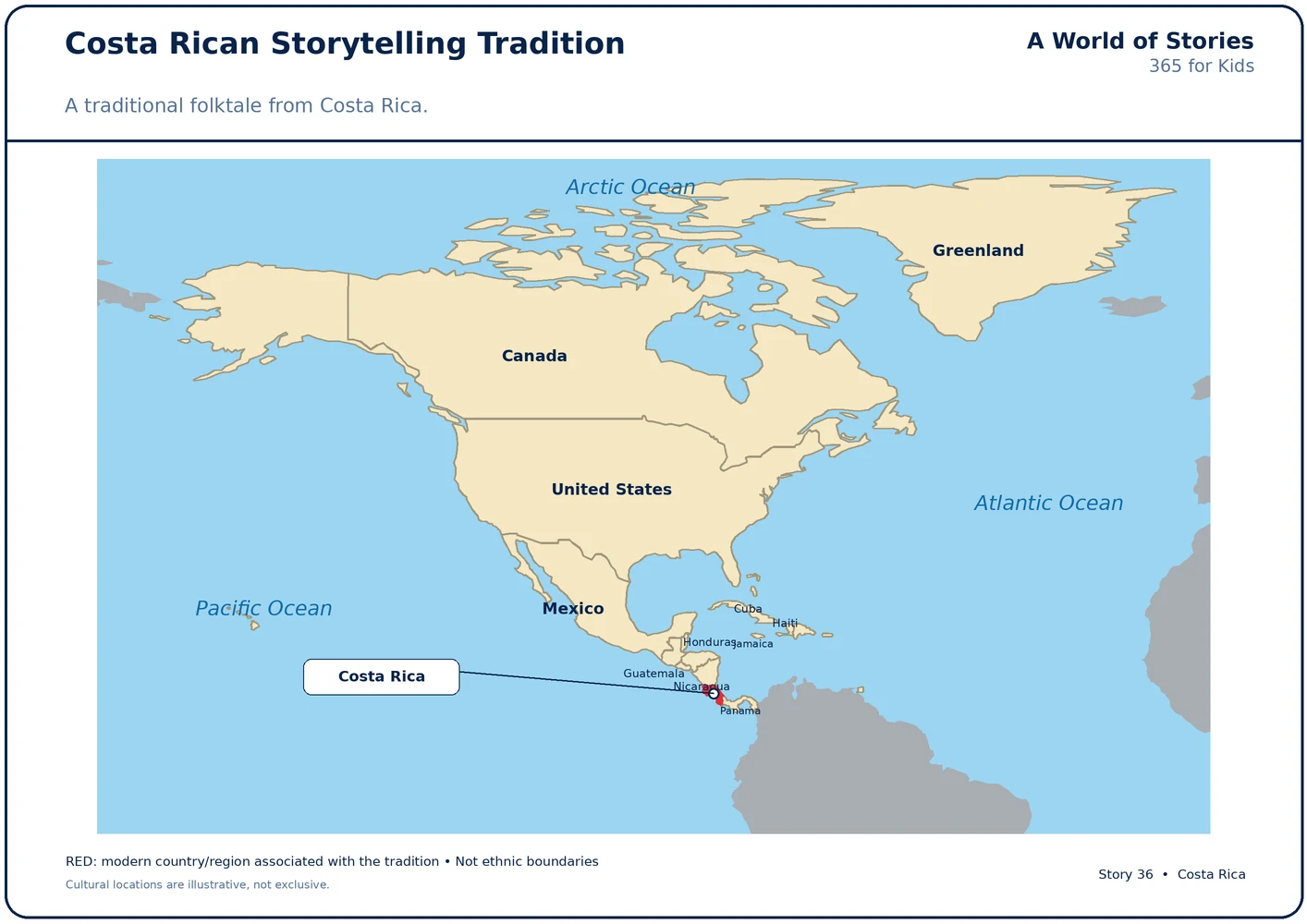
Long ago in Costa Rica, two men who knew each other well lived very different lives. One was wealthy but never satisfied with what he owned. The other was poor and worked hard cutting firewood in the forest to support his family. He had a large swelling on his neck, which made his life still more difficult, yet he went about his work as best he could.
One Friday, the poor woodcutter wandered farther into the forest than he intended. By the time he noticed he had lost his way, evening was falling. He tied his donkey beneath a tree and climbed into its branches to search for a path. Far away, between the dark trunks, he saw a glimmering light.
He climbed down and followed it, stopping now and then to climb another tree whenever the light disappeared from view. At last he reached a bright house in a clearing. Music and laughter drifted through its windows. Inside, a group of witches were dancing and singing the same short song over and over: “Monday and Tuesday and Wednesday—three!”
They sang it again. And again. The woodcutter watched from behind a door. After hearing the tune so many times, he could not help adding a line of his own: “Thursday and Friday and Saturday—six!”
The dancing stopped. The witches looked around in astonishment. Who had completed their song so beautifully? They searched the room and discovered the trembling woodcutter. But instead of scolding him for entering, they greeted him with delight.
They decided to reward him. With their strange magic, they removed the swelling from his neck without causing him pain. Then they offered him sacks of gold. The woodcutter loaded the treasure onto his donkey and made his way home, hearing the completed song behind him as he left the clearing.
His wife and children were overjoyed to see him safe. When he explained what had happened, his wife borrowed a measuring container from the wealthy man’s household so they could count their gold. The wealthy man’s wife suspected that the poor family was hiding something. She secretly put a little sticky substance inside the container, and when it was returned, a few gold coins clung to the bottom.
Soon the wealthy man demanded to know where the gold had come from. The woodcutter told him the story plainly: the forest, the bright house, the dancing witches, and the song. The wealthy man listened closely. If a poor woodcutter could come home rich, surely he could do the same—and perhaps obtain even more.
The next Friday he set out with five mules, cut wood all day, and deliberately lost his way after sunset. He climbed a tree, spotted the light, and found the house. There were the witches, dancing just as the other man had described. Their song now had two lines: “Monday and Tuesday and Wednesday—three! Thursday and Friday and Saturday—six!”
The wealthy man waited behind the door, eager for his reward. Then he called out one more line: “Sunday—seven!”
The music stopped. This time the witches were furious. They believed he had ruined the song they loved. When they found him, they recognized that he had come seeking a reward, not offering a welcome gift. Rather than give him gold, they used their magic to place the first woodcutter’s old swelling on the back of his neck, so that he now carried two. They also released his mules into the forest.
At dawn, he returned home sore, empty-handed, and very different from the man who had set out expecting treasure.
And so the old tale reminds its listeners that a gift freely offered is not the same as a reward demanded—and that envy can lead a person down a very foolish path.
This Costa Rican folktale, known in Spanish as “Salir con un domingo siete,” was included in Carmen Lyra’s collection Los cuentos de mi tía Panchita, first published in 1920.
After the Story: Read · Create · Reflect · Share
1. Find Costa Rica on a map of Central America. Which two countries border it, and which two bodies of water reach its shores?
2. What did the first woodcutter add to the witches’ song, and how did the witches respond?
3. Why did the wealthy man return to the forest? How was his visit different from the first woodcutter’s?
4. Have you ever wanted something because someone else had it? What might help you respond with appreciation instead of envy?
Inspired by this story? Create your illustration!
COSTA RICA — The Bird of Sweet Enchantment
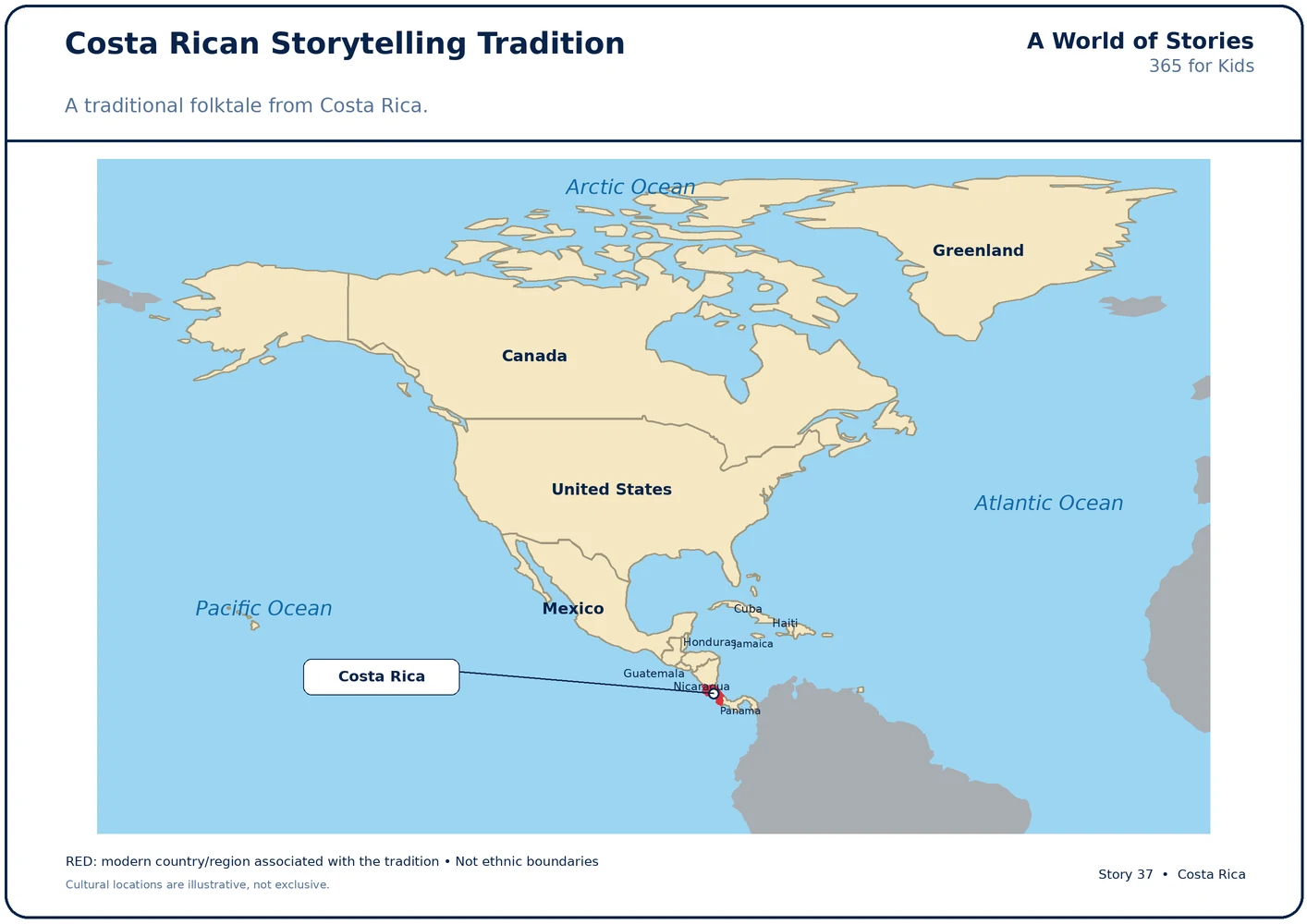
Long ago, a king lost his sight. Physicians came from near and far, but none could help him. At last, an elderly healer was invited to the palace. She spoke of a marvelous bird kept in a distant kingdom: the Bird of Sweet Enchantment. If the person who found the bird gently passed its tail feathers across the king’s eyes, she said, he would see again.
The king had three sons. He promised that whichever one returned with the bird would inherit his throne. The eldest rode away in the morning, the second at midday, and the youngest later that afternoon.
Outside the city, each brother passed a gathering of people. A poor stranger had died, and no one could afford a proper burial. The eldest brother rode on. The second did the same. But the youngest stopped. He spent some of his travel money to make sure the stranger was buried with dignity, and only then continued his journey.
That night, a small mysterious light appeared beside the road. The prince was frightened until the light spoke. It was the grateful spirit of the person he had helped. The light offered to guide him to the distant kingdom, provided he traveled at night and rested during the day. As the nights passed, the prince learned to trust his unexpected companion.
They finally reached a palace garden. Guided by the light, the young man slipped past sleeping guards and entered a great room full of roses. High above him hung a golden cage set with shining red stones. Inside was a snow-white bird with a small crest and coral-colored feet. Its song seemed to contain the music of flutes and violins.
The prince stacked chairs and tables to reach the cage. But just as his fingers approached it, the furniture collapsed with a crash. Guards seized him, and the king of that palace had him imprisoned.
The ruler eventually offered him a bargain: he could have his freedom and the bird if he recovered a magnificent black horse stolen by a giant. The guiding light showed the prince where to find it and warned him of a strange detail: the giant slept with his eyes open, not shut. The horse could also speak, and a small screw near its shoulder could make it fly.
The prince waited until the giant was truly asleep. Twice the horse shouted an alarm; twice the prince hid before he was seen. On the third attempt, the horse stayed quiet. The prince turned the little screw and soared away on its back. He returned the horse to the palace, keeping its remarkable secret to himself.
Yet the king broke his promise. He now demanded the rescue of his daughter, who was also held by the giant. With the light’s help, the prince flew back, climbed to a window, and signaled to the princess while the giant slept after his meal. She gladly escaped with him, and together they returned to her father’s kingdom.
Still the king refused to surrender the bird. The light suggested one last request: three rides around the public square, with the princess on the horse and the birdcage in the prince’s hand. The king agreed and placed guards at every exit. At the end of the third circuit, the prince turned the screw. Horse, princess, prince, and bird rose above the square and vanished into the clouds.
On the journey home, the youngest prince met his two brothers. They had wasted their money and accomplished nothing. Seeing his success, they grew jealous. They invited him to a meal and secretly gave him a drink that made him lose consciousness. Then they left him near a steep ravine and took the princess, horse, and bird to their father’s palace, claiming the triumph as their own.
The young prince survived: a branch caught his clothing, and passing travelers helped him reach home. Meanwhile the bird would not heal the king when his older sons tried to use it. When the youngest finally arrived, the princess recognized him, and the marvelous bird sang again. He lifted the bird and passed its tail feathers gently over his father’s eyes. At once, the king could see.
The brothers’ deception was uncovered. But the youngest asked that they be forgiven, and he shared the kingdom rather than seeking revenge. He married the princess, and the Bird of Sweet Enchantment filled their days with music.
When the prince was safe and happy, the mysterious light came to say farewell. It had returned his kindness with kindness, and its journey was complete.
This tale appears as “El Pájaro Dulce Encanto” in Carmen Lyra’s collection Los cuentos de mi tía Panchita (1920), part of the Costa Rican storytelling tradition.
After the Story: Read · Create · Reflect · Share
1. Find Costa Rica on a map of Central America. Which two oceans lie on opposite sides of the country?
2. Why did the mysterious light decide to help the youngest prince?
3. How did the prince use the flying horse to overcome the palace king’s broken promise?
4. The youngest prince chose forgiveness when his brothers’ deception was revealed. Would you have made the same choice? Why or why not?
Inspired by this story? Create your illustration!
K’ICHE’ MAYA (GUATEMALA) — The People Made from Maize
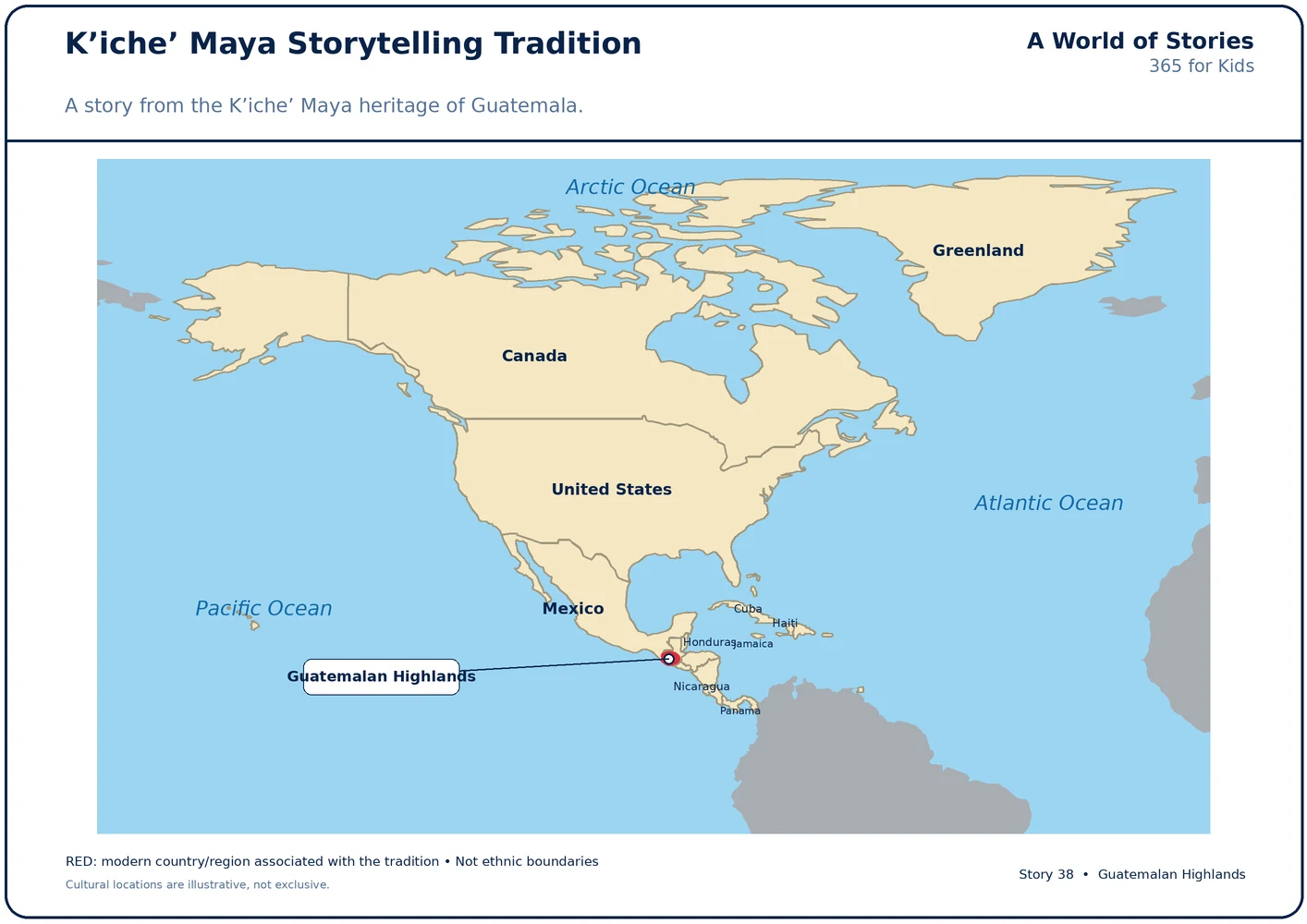
At the beginning of the world, the sky stretched over a vast, quiet sea. The land had not yet risen, and the forests had not yet grown. In the ancient K’iche’ Maya account preserved in the Popol Wuj, the Creators spoke together in the darkness about the world that was to come.
By their will, the earth appeared. Mountains rose, valleys opened, and trees covered the land. Animals came to live in the forests and along the rivers. Birds called from the branches; deer moved through the woods; other creatures found their places among the hills and streams.
Yet the Creators wished for beings who could speak, remember, and give thanks for the world around them.
They tried to form a person from earth and mud. But this first figure could not hold together. It was too soft, and it could not stand or move as a living person should. The attempt did not last.
Next came people shaped from wood. They could move about and speak, and the world seemed full of their footsteps. But they did not understand or remember those who had brought them into being. They lived without the awareness the Creators had hoped for. In the traditional account, their time came to an end.
The Creators considered once more how people might be made. This time the answer was not stone or wood. It was maize — the corn that nourished the people and grew from the earth.
From yellow maize and white maize, the Creators fashioned the first four men. They were Balam-Quitzé, Balam-Aqab, Mahucutah, and Iqi-Balam. They could speak and understand. They looked about them and recognized the world in which they had been placed.
Indeed, their sight was so extraordinary that they could see far beyond the nearby mountains, as though nothing were hidden from them. The Creators decided that human vision should have limits. A mist was placed over their eyes, and afterward they saw the world as people do today: one place at a time, with much still left to discover.
Then the four men slept, and four women were created to share their lives. Together they became ancestors in the K’iche’ story of beginnings.
This is why maize holds such deep meaning in K’iche’ Maya tradition. It is more than food. In this creation story, the substance that sustains life is also the substance from which the first people were made.
This story comes from the Popol Wuj (also written Popol Vuh), the sacred book of the K’iche’ Maya people of Guatemala. The K’iche’ Maya are a living people whose traditions continue today.
After the Story: Read · Create · Reflect · Share
1. Find Guatemala on a map of Central America. The K’iche’ Maya live in the Guatemalan highlands. Can you find this mountainous region?
2. What happened when the Creators first tried to make a person from mud, and why were the wooden people not the answer?
3. Why was maize important in the creation of the first four people? What changed when a mist was placed over their eyes?
4. What does the story suggest about the relationship between people and the food that sustains them? How can we show respect for the natural world?
Inspired by this story? Create your illustration!
EL SALVADOR — Cipitín and Tenáncin: The Secret of the Volcano
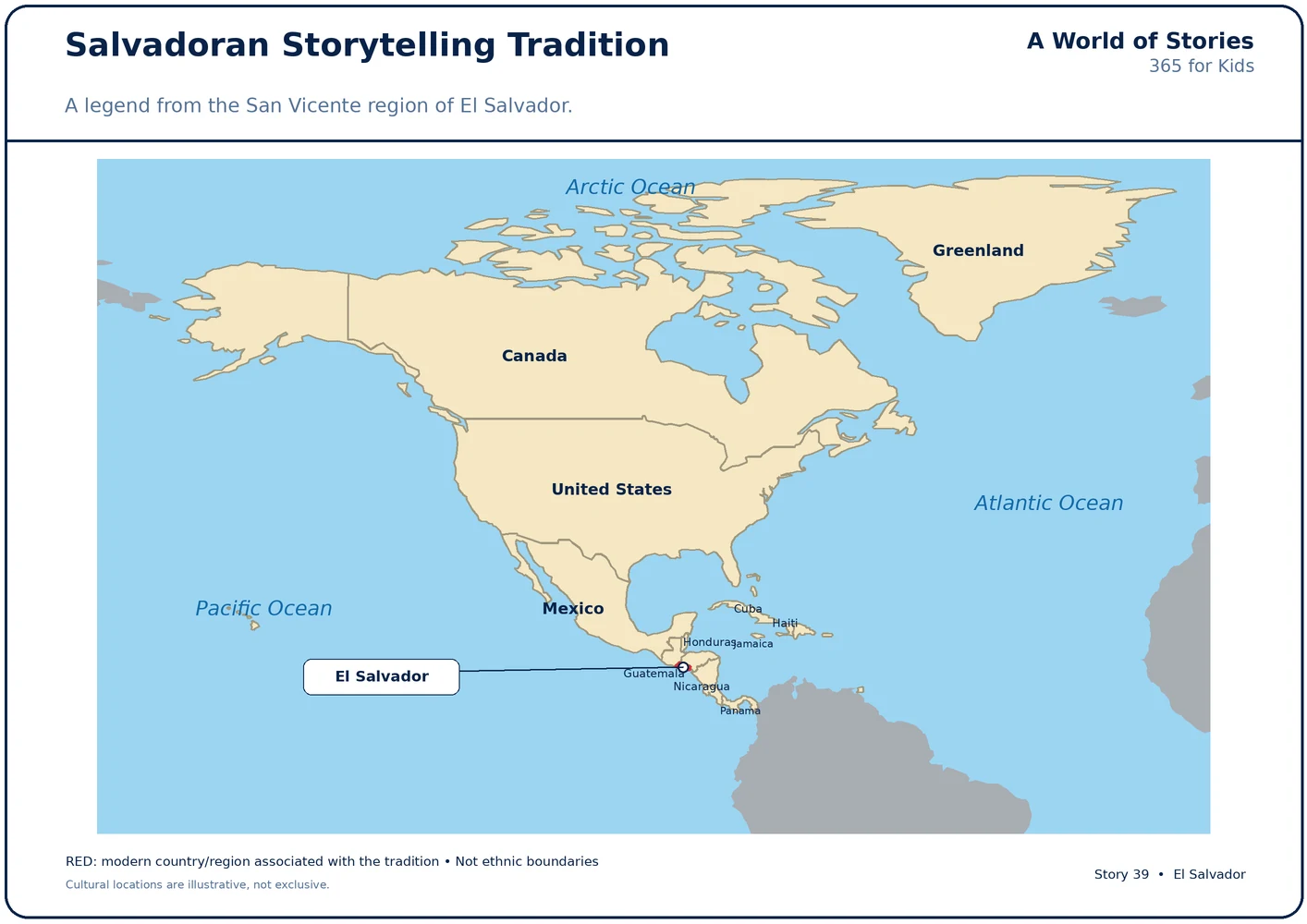
Long ago, beside the rivers and mountains of El Salvador, people told stories of a mysterious child named Cipitín.
His mother was La Siguanaba, a figure from the old legends. Cipitín had left the riverbanks and gone into the mountains, where he lived near a cave at the foot of a volcano. Although the seasons passed and the trees grew old, he remained a child of ten.
He had dark eyes and warm brown skin. Sometimes he balanced on a great flower. Sometimes he slipped into the green branches of the forest, or crossed a stream with a slender cane. He preferred to stay hidden, but he was not always silent. When young women walked by the river, he sometimes shook blossoms from the branches above them.
There was one girl whose story became part of his own. Her name was Tenáncin, and she, too, was young.
One day, Cipitín fell asleep while resting on a flower. Tenáncin was gathering blossoms in the forest. She wandered farther among the trees, lost the path, and came upon the flower where Cipitín slept.
She saw him there. But the rustle of the thorny bushes woke him, and he sprang away.
Cipitín hurried from flower to flower, singing as he went. Tenáncin followed him into the thick forest. The path became difficult, and the thorns scratched her hands and feet. Still, she continued until they reached a great rock on the slope of a volcano.
At the rock, Cipitín touched the stone with a slender twig. A doorway hidden by moss opened before them.
The two children took each other by the hand and stepped inside. Tenáncin entered last. Behind them, the moss closed over the doorway, hiding it once more.
The story says that no one saw them emerge. Tenáncin’s father searched the hills, grieving for his missing daughter, and died not long afterward.
People said the hidden cave was in the volcano of Sihuatepeque, in the region now called San Vicente. Years passed, rivers changed, and generations came and went. Yet Cipitín remained forever ten years old, a mysterious child of the flowers, streams, and mountain forests.
And so the tale of Cipitín and Tenáncin has remained among the legends told in El Salvador.
This retelling follows the Cipitín legend as told in the storytelling tradition of El Salvador, associated with the region of San Vicente and the historic Cuscatlán area.
After the Story: Read · Create · Reflect · Share
1. Find El Salvador on a map of Central America. Locate the region of San Vicente and look for its volcanic landscape.
2. Where did Cipitín live, and what made him different from an ordinary child?
3. How did Tenáncin discover Cipitín, and what happened when they reached the rock on the volcano?
4. Tenáncin followed Cipitín into an unfamiliar forest. What does this legend make you think about curiosity, caution, and caring for people who may be worried about us?
Inspired by this story? Create your illustration!
BELIZE — The Night Traveler and Tata Duende
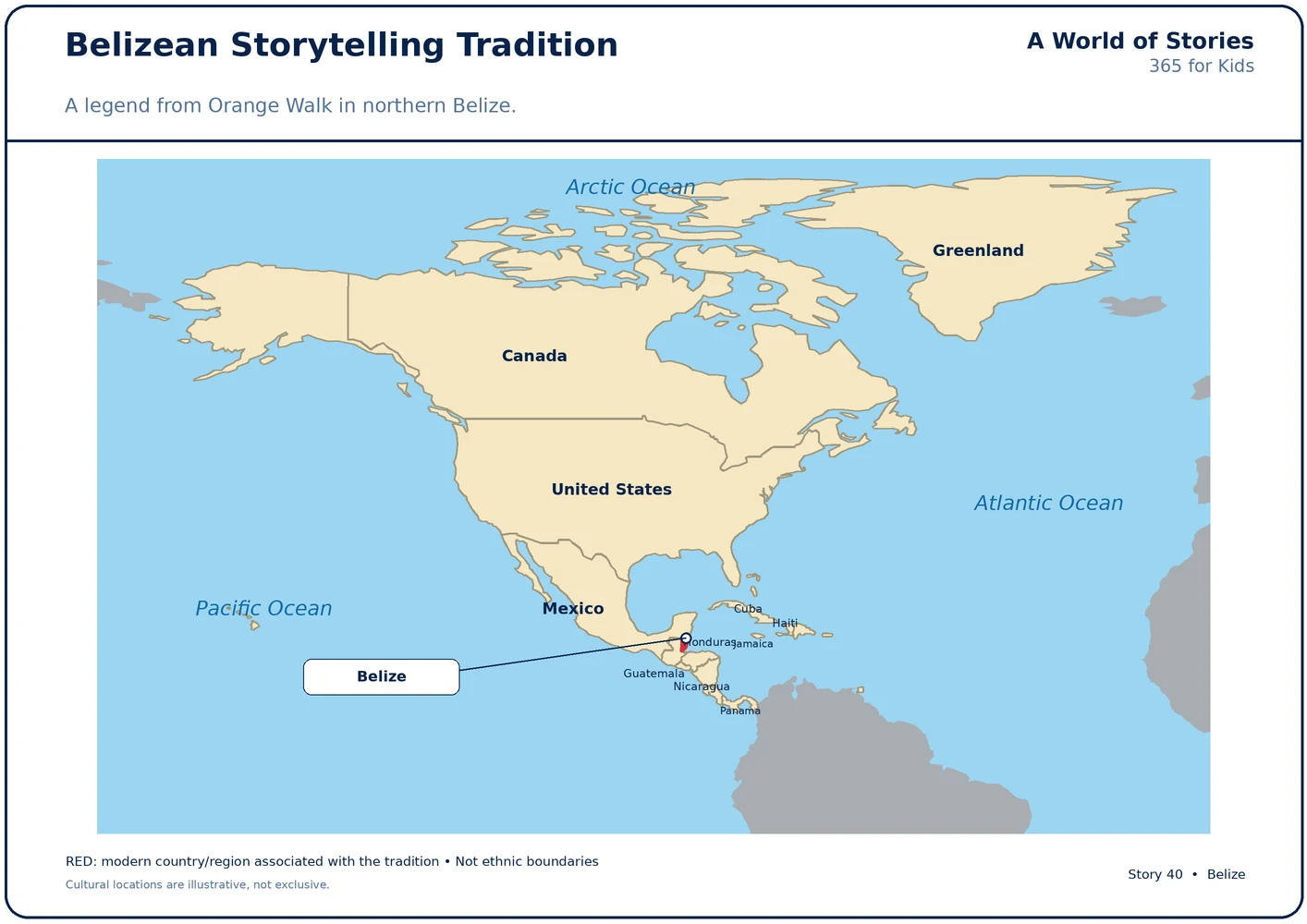
In the north of Belize, people have long told stories about Tata Duende, a mysterious figure said to wander through the countryside and watch over the forest. Some describe him as a guardian of the trees and animals. Others tell of unsettling encounters along quiet paths after dark.
One story, passed down by a storyteller from the Orange Walk region, concerns a young man who went into town one evening to visit a girl. He had left without his parents’ permission and began his journey home after nightfall.
His way back took him through farmland, where horses and cattle were kept. As he crossed the area, the animals suddenly grew restless. They stirred and moved about so wildly that the young man turned and ran.
Looking back toward the distant lights of town, he saw a strange shape outlined against them. There was a broad hat, a figure he recognized from the stories he had heard: Tata Duende.
Then, according to the tale, the young man saw Tata Duende on the back of a horse. The mysterious rider waved his arms and urged the horse onward. The other animals rushed about, and the frightened traveler ran faster than he ever had before.
He did not stop at the edge of the farm. He did not stop when the road came into view. He kept running all the way to his home, where he knocked urgently on the door and called for his mother and father.
That was the end of his extraordinary journey. Whether Tata Duende had meant to frighten him or merely appeared along his path, the story does not say. Like many traditional tales, it leaves listeners to wonder what happened in the darkness—and why the animals reacted as they did.
The story is still remembered as one of the many ways people in Belize describe Tata Duende: sometimes mysterious and frightening, sometimes a guardian of the natural world.
This retelling follows an oral account of Tata Duende from the Orange Walk region of Belize, part of the Yucatec Maya-influenced storytelling traditions of northern Belize.
After the Story: Read · Create · Reflect · Share
1. Find Belize on a map of Central America. Look for the northern region around Orange Walk, where this version of the story was told.
2. Where was the young man traveling, and what first made him realize that something unusual was happening?
3. What did the traveler see when he looked back toward the lights of town, and how did he respond?
4. Different communities describe Tata Duende as frightening or as a protector of the forest. Why might people tell different stories about the same mysterious figure?
Inspired by this story? Create your illustration!
NICARAGUA — Tío Conejo and the Zapote Tree
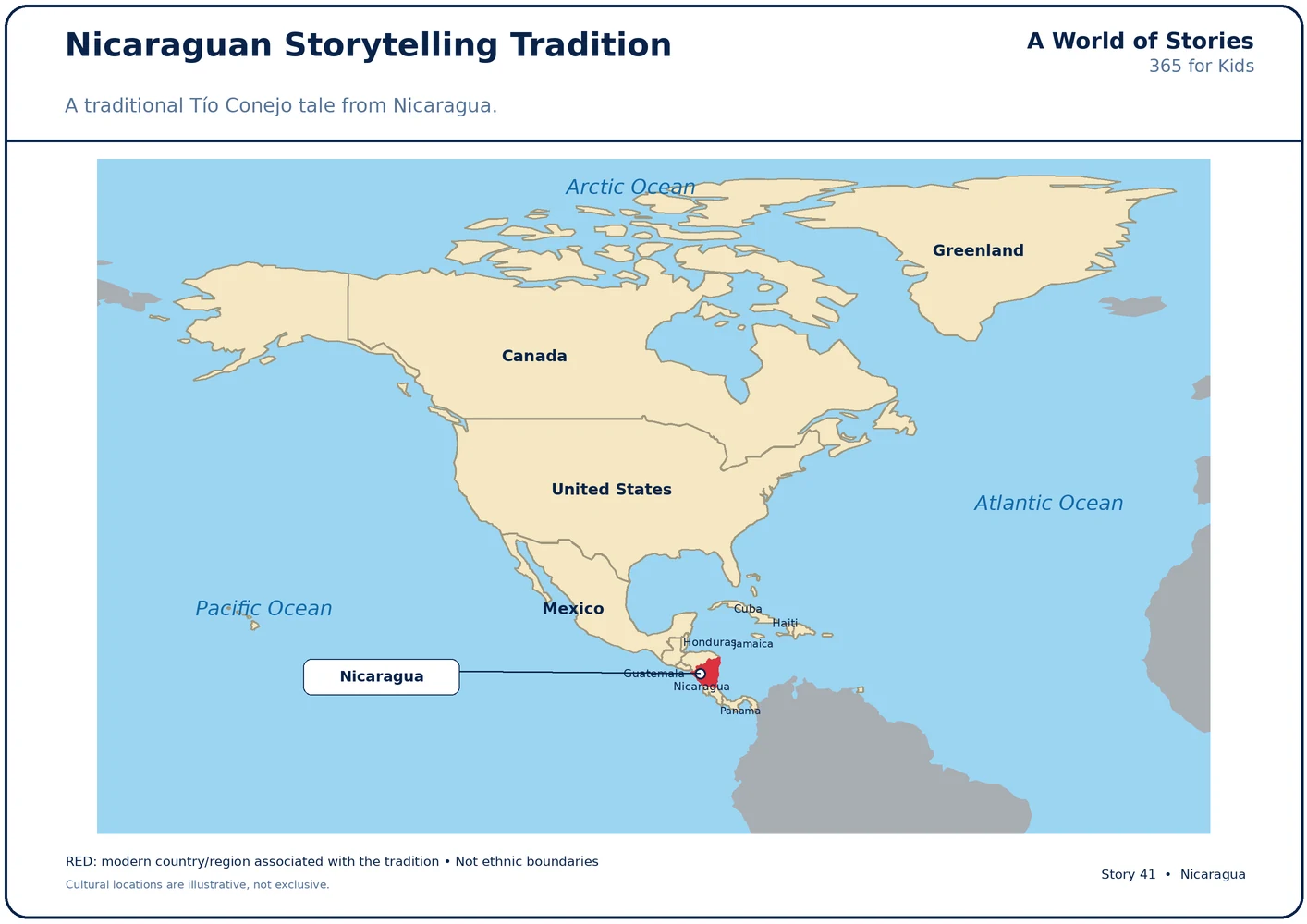
On a day when both Tío Conejo and Tío Coyote were hungry, they met beside a zapote tree. Its branches were heavy with fruit, and some of the zapotes looked soft and ready to eat.
“Come and have some zapotes with me,” suggested Tío Conejo.
Tío Coyote hesitated. He knew that the rabbit was clever, and he had good reason to be suspicious of his tricks. But the fruit looked delicious, and hunger finally overcame his caution.
“All right,” he agreed.
Tío Conejo looked up into the branches. “You stay down here,” he said. “I can climb the tree and toss the fruit to you.”
Up he went, quick and nimble, until he reached the branches where the zapotes grew. From below, Tío Coyote watched and waited.
Tío Conejo picked the ripest fruits, one after another. But instead of sending them down, he ate them himself. Sweet, soft zapotes disappeared while the hungry coyote stood beneath the tree.
At last, the rabbit called down, “Now it is your turn! Open your mouth. Here comes a beautifully ripe one!”
Tío Coyote tilted his head back. Trusting that he would catch something soft and sweet, he opened his mouth wide.
But the fruit Tío Conejo threw was not ripe at all. It was a hard, green zapote.
It struck Tío Coyote in the mouth with a painful blow, breaking his teeth. Startled and hurt, he ran away from the tree as fast as he could.
From high among the branches, Tío Conejo watched him go and laughed at the trick he had played.
And so this old tale ends with a clever rabbit enjoying his fruit alone—while the coyote pays a painful price for trusting him.
Tío Conejo (Uncle Rabbit) and Tío Coyote (Uncle Coyote) are well-known characters in the oral storytelling traditions of Nicaragua and neighboring Central American countries.
After the Story: Read · Create · Reflect · Share
1. Find Nicaragua on a map of Central America. What countries and bodies of water surround it? Where else in Central America might people tell stories about Tío Conejo?
2. Why did Tío Coyote agree to stay beneath the zapote tree even though he was suspicious of Tío Conejo?
3. What was different about the fruits Tío Conejo ate and the one he threw to Tío Coyote? How did that choice change the story?
4. Tío Conejo was clever, but was he kind? What could he have done differently to share the fruit fairly?
Inspired by this story? Create your illustration!
LENCA (HONDURAS & EL SALVADOR) — Comizahual: The Woman Who Became a Bird
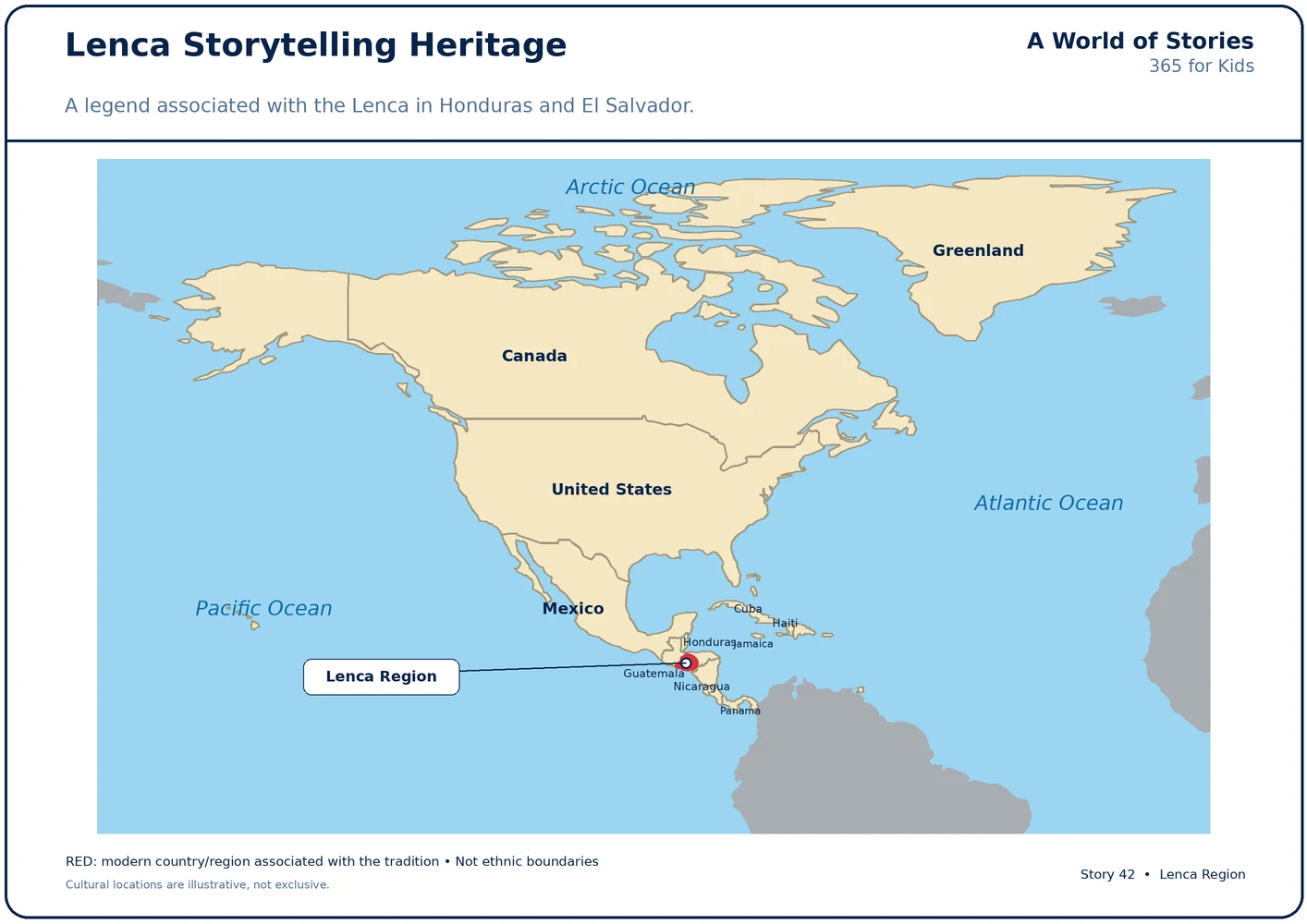
In the mountains and valleys of Central America, people have long told a remarkable story about a wise woman named Comizahual. Her name is often explained as “Flying Jaguar.” In the telling of this legend, she arrived as mysteriously as the wind.
Comizahual came to the region of Cerquín, in the lands of present-day Honduras. The people wondered who she was and how she had reached them. Some said the air itself had carried her there. They told of a powerful stone that she possessed, marked with three points and carved faces. The stone, they believed, helped her overcome her enemies.
Yet Comizahual was remembered for more than mysterious powers. She became a leader and teacher. According to the old account, she taught the people about the Great Father and the Great Mother, whom they honored and asked for well-being. Her wisdom became part of the memory of the communities who told her story.
Years passed. The legend says that Comizahual helped establish order in the land and guided its people. When the time came for her to leave her place as leader, she divided the territory among three members of her family. Some tellings call them her sons; others say they were her brothers. Before she departed, she gave them advice about governing well and treating the people in their care with fairness.
Then something extraordinary happened.
Comizahual asked for a resting place to be prepared. Suddenly the sky flashed with lightning. Thunder rolled overhead, and a great storm swept across the land. Through the wind and rain, the people saw a beautiful bird rising into the air.
When they looked again, Comizahual was gone.
The people believed that the bird was Comizahual herself, flying toward the heavens. They remembered her teachings and told the story of her departure for generations. The old accounts say that the event was commemorated with gatherings and ceremonies.
Was she a great leader whose deeds became legend? Was the bird a sign of her mysterious power? The story does not give us a single answer. Instead, it leaves us with an image that is hard to forget: a wise woman, a sky filled with thunder, and a bird disappearing among the clouds.
In this way, the legend of Comizahual carries memories of leadership, responsibility, and the traditions of the people who passed her story from one generation to the next.
Comizahual is a legendary figure associated with Lenca heritage in the region of present-day Honduras and El Salvador, recorded in early historical accounts. The Lenca are living communities whose cultural traditions continue today.
After the Story: Read · Create · Reflect · Share
1. Find Honduras and El Salvador on a map of Central America. Why might a cultural tradition be shared across the borders of more than one country?
2. What did Comizahual teach the people, according to the legend?
3. What advice did Comizahual give when she divided the land among three relatives, and why might that advice matter?
4. Why do you think people remembered the bird that appeared during the storm? What qualities make a leader worth remembering?
Inspired by this story? Create your illustration!
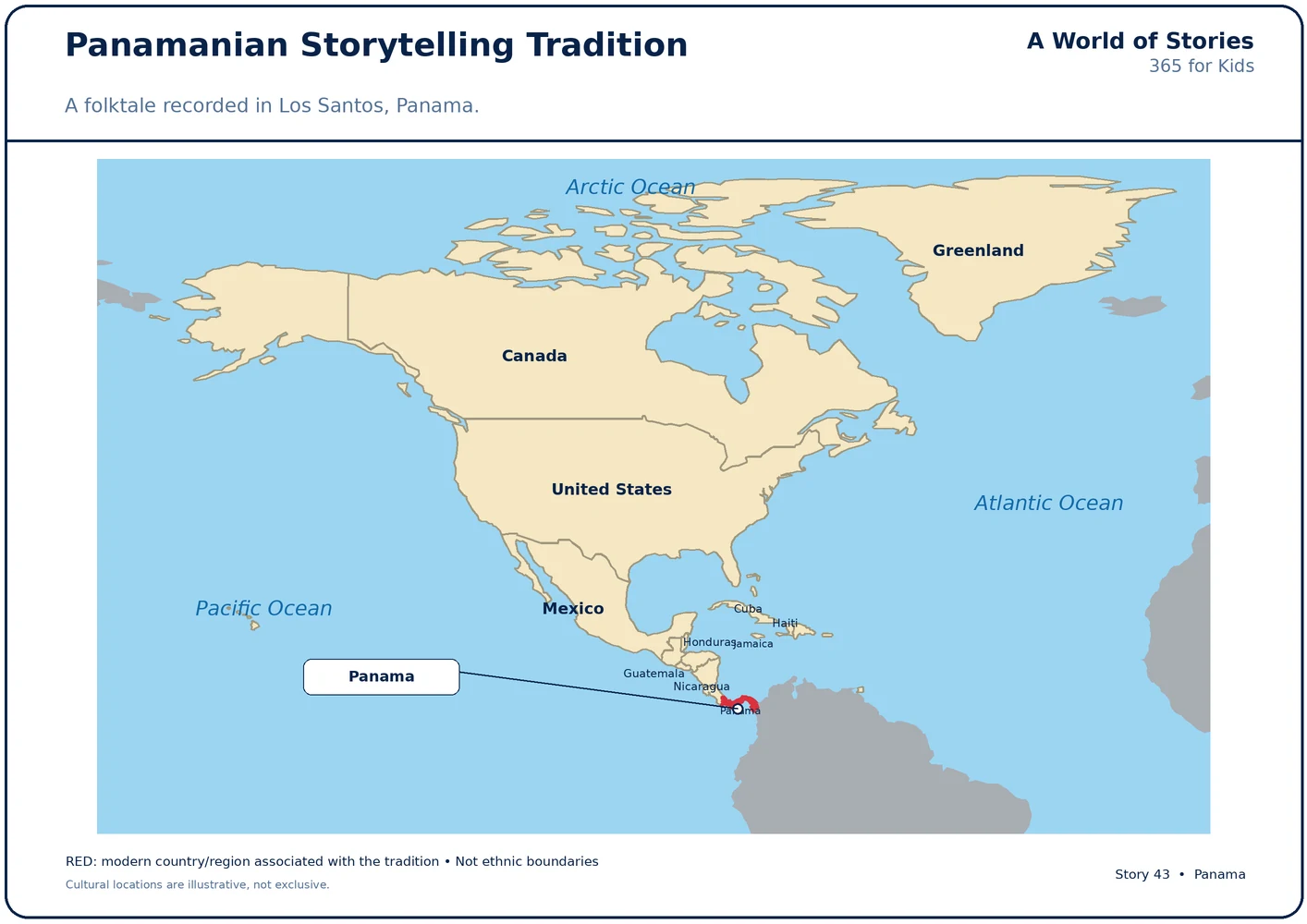
Caribbean Islands & Traditions
BAHAMAS — Diving for Bananas
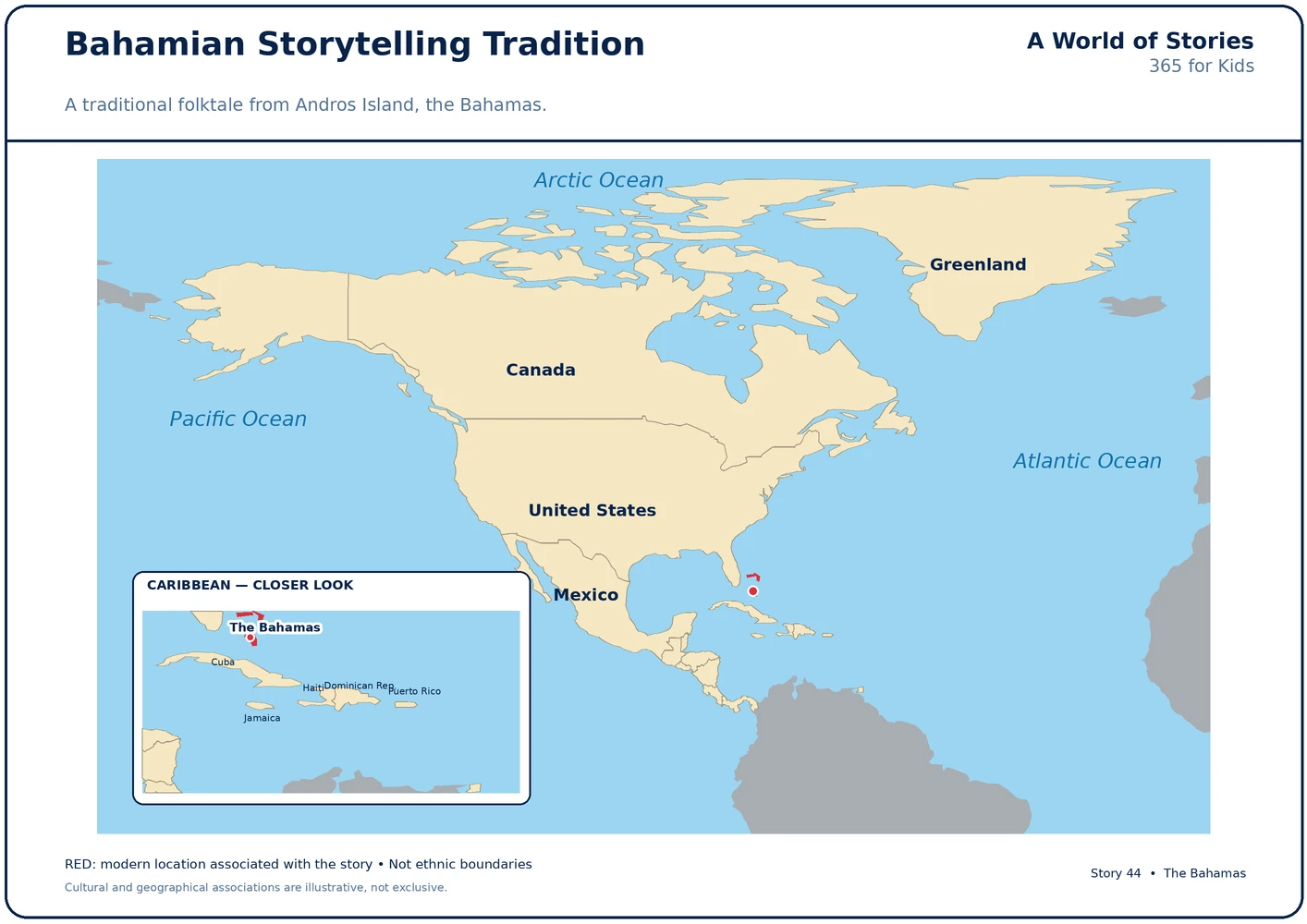
Brother Rabbit had found a banana tree beside a river. Its branches stretched out over the water, heavy with bunches of ripe bananas. Whenever he wanted something sweet to eat, Rabbit knew exactly where to go.
Brother Boukee often saw Rabbit carrying bananas. He wondered where they came from, but Rabbit never showed him the tree.
At last, one day, Rabbit agreed to take Boukee along. The two travelers walked until they reached the river. There, on the surface of the water, Boukee could see what looked like a bunch of bananas hanging far below.
The water was so still that it reflected the banana tree overhead. But Rabbit did not point up at the branches. He pointed down at the reflection instead.
Boukee wanted the bananas. He went into the river and dived toward the shapes he could see beneath the surface. When he came up without a single banana, he tried again.
Each time he reached for the fruit, the image slipped away. The bananas seemed to be there, yet his hands could not grasp them. Boukee dived again and again, growing more tired with every attempt.
All the while, Rabbit knew the truth: the bananas were not in the river at all. The water held only their reflection. The real bunches hung from the tree above.
At last, Rabbit took the whole bunch of bananas and went away with it. Boukee was left with nothing to show for all his diving.
That is how the old tale ends: with clever Rabbit carrying off the fruit, while Boukee was tricked by an image in the water.
This folktale comes from an early published collection of Bahamian folklore gathered on Andros Island, where animal trickster tales have long been part of the oral storytelling tradition.
After the Story: Read · Create · Reflect · Share
1. Find the Bahamas on a map of North America and locate Andros Island. What kind of landscape surrounds these islands?
2. Where were the real bananas, and what did Boukee see when he looked into the river?
3. Why did Boukee keep diving without finding any bananas? What did Rabbit know that Boukee did not?
4. Rabbit was clever, but was he fair to Boukee? What could he have done differently?
Inspired by this story? Create your illustration!
JAMAICA — Anansi and the Coming Storm

Brother Tiger had a mango tree in his yard. Its branches were heavy with fruit, and on warm days the ripe mangoes were a lovely sight. Anansi saw them and wanted some for himself.
He went to Tiger and asked whether he might buy a small amount of mangoes. But Tiger would not sell him any. Anansi left empty-handed, although he was still thinking about the fruit.
Soon he came back with an alarming piece of news. “A terrible storm is coming,” he told Tiger. “There is a new rule: anyone who owns a tree must be tied securely to it before the storm arrives!”
Tiger believed him. Worried about the approaching storm, he allowed Anansi to bind him firmly to the mango tree.
Once Tiger could no longer move, Anansi climbed into the branches. He ate mango after mango, tossing the skins and fruit remains down onto Tiger’s head. When he had eaten his fill, he shook the ripe mangoes from the tree, gathered them, and went away. Tiger was left tied to the trunk.
Tiger called for help. First one passerby, and then another, hurried past without stopping. At last a slow-moving creature called Duck-ants came along. Tiger begged to be released. Duck-ants took the time to loosen the knots, and at last Tiger was free.
Tiger was grateful. He told Duck-ants that any friend or relative of his would always be welcome at Tiger’s home.
But Anansi had been listening from a nearby tree. The following evening he knocked on Tiger’s door and announced that he was Duck-ants’s brother.
Because Tiger remembered the help he had received, his household welcomed the visitor warmly. They offered him food and a place to sleep. By morning, they even prepared something for him before he had fully awakened.
Then, as Anansi washed his face, he took off his hat. The family saw his unmistakable bald head. They realized that their guest was not Duck-ants’s brother at all, but the same Anansi who had tricked Tiger beside the mango tree.
This time Anansi’s clever disguise did not protect him. Tiger and his household sent him away.
This Anansi tale was recorded in Jamaica, part of the island’s Afro-Jamaican oral storytelling tradition passed down through generations.
After the Story: Read · Create · Reflect · Share
1. Find Jamaica on a map of the Caribbean. Which sea surrounds the island, and what other islands can you find nearby?
2. What did Anansi tell Tiger about the coming storm, and why did Tiger believe him?
3. How did Duck-ants help Tiger, and how did Anansi try to benefit from Tiger’s gratitude?
4. Anansi was clever, but was he fair to Tiger and Duck-ants? What could he have done differently?
Inspired by this story? Create your illustration!
TRINIDAD AND TOBAGO — Gang Gang Sarah and the Journey Home
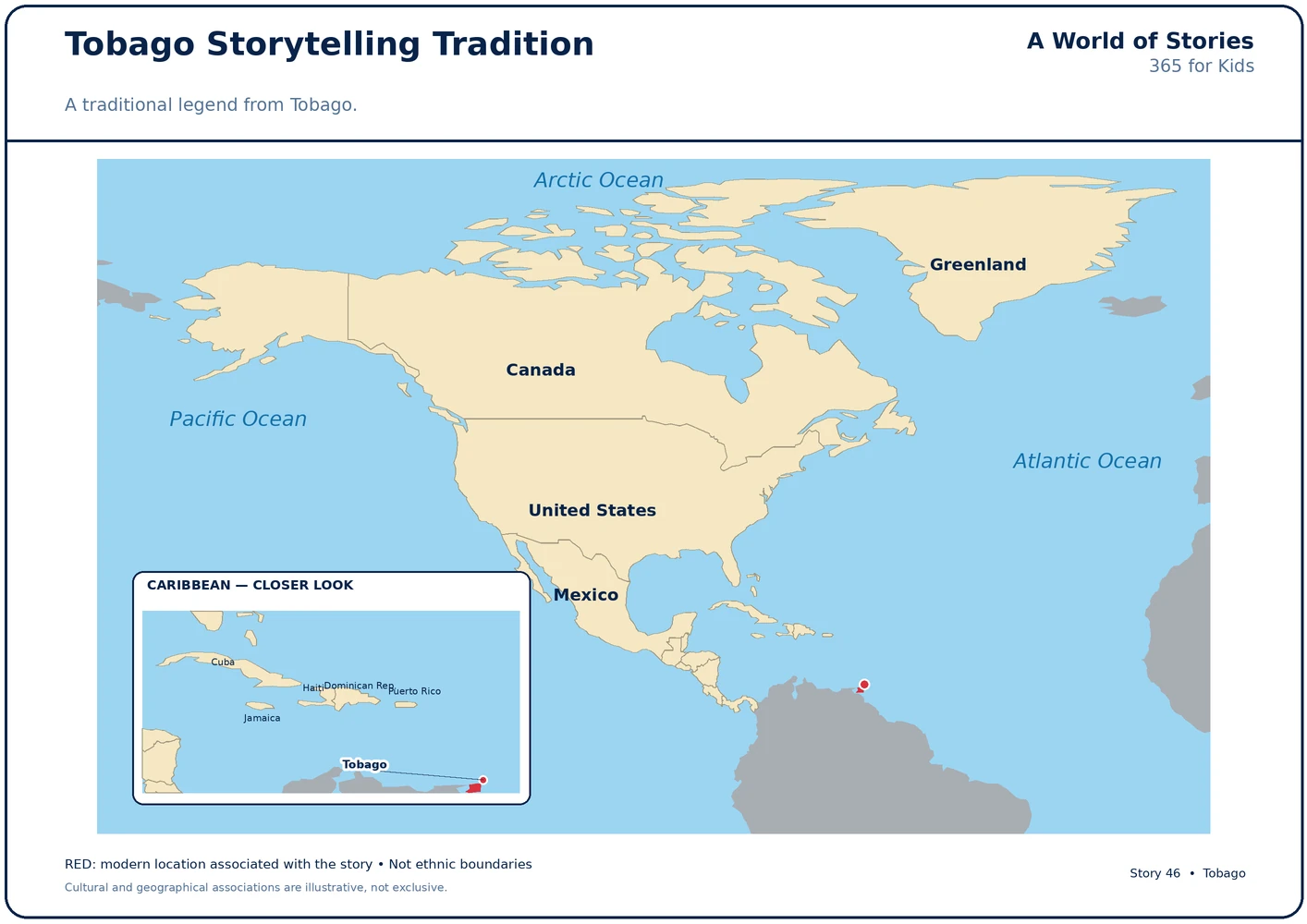
Long ago, people on the island of Tobago told the story of a woman named Gang Gang Sarah. They said she had come from Africa in a most extraordinary way: she could travel through the air.
Across the wide Atlantic Ocean lay Tobago, an island of green hills, villages, and tall silk-cotton trees. Many Africans had been brought there against their will and forced into slavery. In the legend, Sarah longed to find the family from whom she had been separated.
One stormy night, the story says, she flew across the sea and arrived near the village of Les Coteaux. She made her way to Golden Lane, where she hoped to find her loved ones.
Sarah stayed on the island. People remembered her as a wise and caring woman. She shared what she knew and offered comfort to others. In some versions of the tale, she found her husband, Tom, again. In others, she married him after arriving in Tobago. The two made their home there.
Years passed. Sarah grew older, and the island became a place filled with familiar faces and memories. Yet she never forgot the distant land where her journey had begun.
After Tom died, Sarah wanted to return to Africa. She remembered the extraordinary power that had once carried her over the ocean. If she could fly to Tobago, surely she could fly home again.
She climbed a great silk-cotton tree, high above the ground. From its branches she prepared to take flight. But something had changed during her years on the island.
According to the legend, Sarah had eaten salt in her food. In this old story, salt had the mysterious power to take away her ability to fly. Sarah did not know that her gift was gone.
When she tried to soar into the air, she fell. She did not survive the fall.
People in Tobago kept telling her story. They spoke of Sarah and Tom, of the great tree, and of a woman who crossed the sea in search of those she loved. Her journey became part of the island’s folklore — a story about family, belonging, and the longing for home.
Gang Gang Sarah is a well-known legend from Tobago, part of the nation of Trinidad and Tobago, passed down in different versions across generations.
After the Story: Read · Create · Reflect · Share
1. Find Tobago on a map of the Caribbean. Which larger island lies close to it, and where is Africa across the Atlantic Ocean?
2. Why did Gang Gang Sarah travel to Tobago, according to the legend?
3. What had changed when Sarah tried to fly back to Africa, and how did it affect her journey?
4. Why might stories about home and family remain important to people across many generations?
Inspired by this story? Create your illustration!
CUBA — The Wandering Image of El Cobre
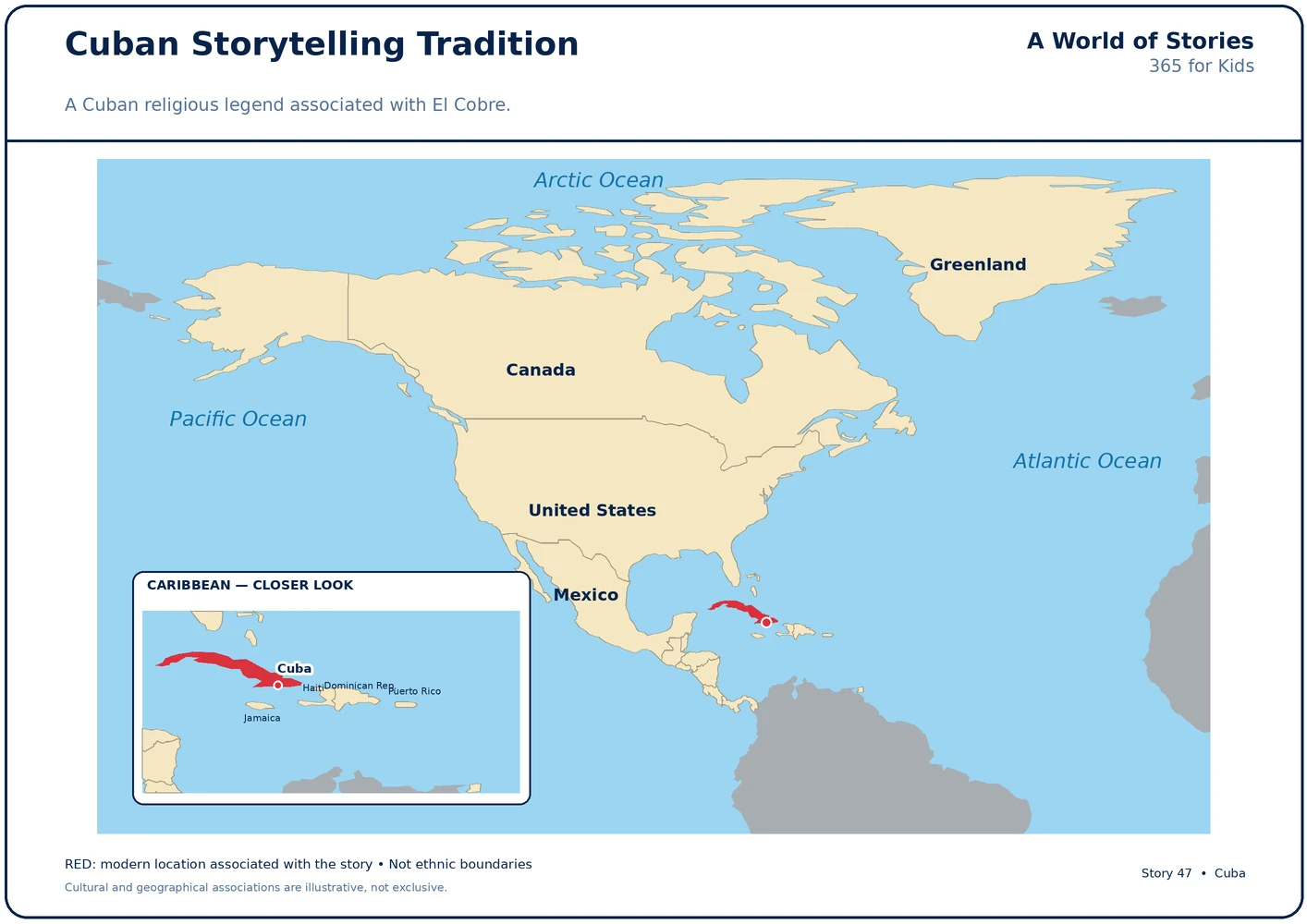
On the island of Cuba, near the town of El Cobre, there is a hill associated with a much-loved sacred image. For generations, people have told an unusual story about that image — one in which the sea seems to play a part.
According to the old legend, the image did not always remain where it was kept. At times, people discovered that it had disappeared. Later it would be found in its place again, bearing traces of sand and seaweed, as though it had traveled far beyond the hill and returned from the coast.
No one in the story could explain these mysterious journeys. The image was made of wood, yet the signs of the sea appeared again and again. Each return left the same question: where had it been while it was gone?
One day, the legend says, the image did not come back on its own. It was found far out at sea by a fishing boat. The boat brought it ashore, and the image was returned to its place at El Cobre.
In this way, the people remembered the sacred image not only as something that belonged to one hill, but also as something linked in their imagination with the waters surrounding their island.
The old account does not explain how the image reached the sea or why it sometimes vanished. That mystery is part of the legend itself. What remains is the picture of a wooden image, a distant fishing boat, and a community whose stories joined a place on land with the wide Caribbean Sea.
This Cuban folk legend is connected with the image of Our Lady of Charity of El Cobre and follows an early written account of the image’s disappearances and its return from the sea.
After the Story: Read · Create · Reflect · Share
1. Find Cuba on a map of the Caribbean. What body of water surrounds this island, and where is the region of El Cobre?
2. What clues suggested that the wooden image had traveled away from its usual place?
3. What happened on the occasion when the image was found far out at sea?
4. Why do you think communities preserve stories about important places and objects, even when parts of those stories remain mysterious?
Inspired by this story? Create your illustration!
DOMINICAN REPUBLIC — La Ciguapa and the River of Memories
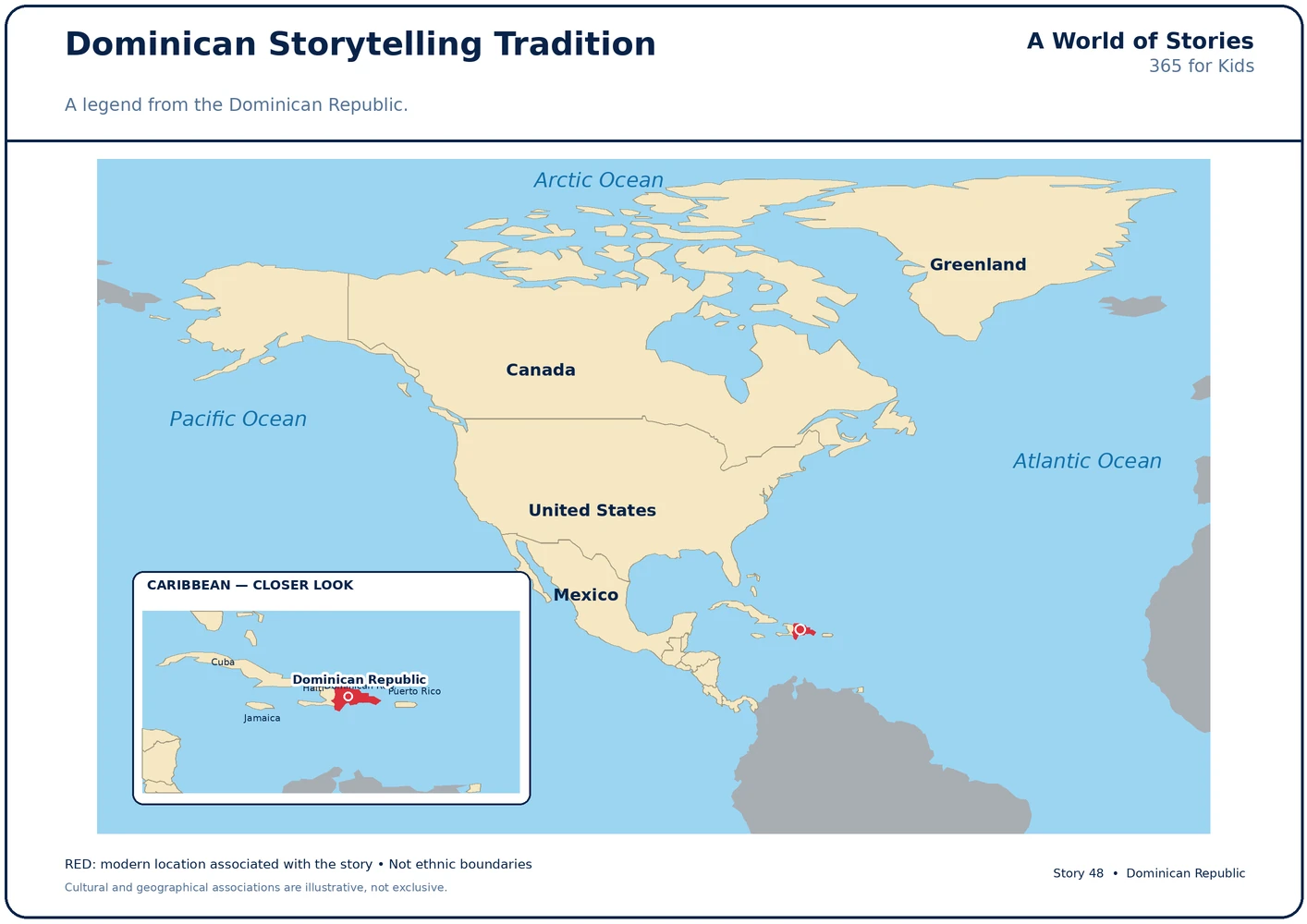
Long ago, in the mountains of the island of Hispaniola, a traveler followed a winding road toward the northern coast. The path climbed over green hills and descended beside rushing rivers. By midday, his horse was tired, so he stopped near the Bajabonico River to rest.
A young farmer came to help him. The young man was called Jacinto, and although he spoke kindly, there was sadness in his eyes. When the traveler admired the quiet countryside, Jacinto glanced uneasily at the distant forest.
“There are dangers here that you cannot see,” he said. “Have you heard of La Ciguapa?”
The traveler had never heard the name. He asked Jacinto to explain, and the young farmer began a story he had carried in his heart for years.
When Jacinto was a boy, his father had been forced to leave his home. A farmer named Andrés welcomed Jacinto into his family. There Jacinto grew up beside Andrés’s daughter, Marcelina. They collected water at the river, walked along the wooded paths, and shared their hopes for the future.
As the years passed, their affection deepened. One morning, they sat beneath a tree beside the river, speaking about the home they hoped to build together. Jacinto told Marcelina that he loved her, and she answered that she loved him too. They dreamed of returning to her father with their happy news.
But just as they prepared to leave, a piercing cry rang out from the mountains. Another cry followed. Marcelina looked toward the forest and caught sight of a mysterious figure among the trees.
“La Ciguapa!” she exclaimed.
Overcome with fear, she fainted. Jacinto carried her home. Her father and brothers cared for her, but she remained terribly ill. Three days later, Marcelina died. Jacinto never forgot the sound of the cry or the sorrow that followed.
The traveler listened quietly. “What do people say La Ciguapa is?” he finally asked.
Jacinto explained that local stories described Ciguapas as elusive beings of the mountains, swift and shy, with long hair and a cry that could startle anyone who heard it. In the version Jacinto had been taught, a Ciguapa’s terrible jealousy could bring misfortune to people in love.
Yet Jacinto did not claim to know what had truly happened beside the river. He knew only that fear and grief had changed his life. The traveler understood that a frightening story could hold great power over people who believed it.
At last the traveler resumed his journey. Jacinto returned along the mountain path, and the river flowed on beneath the trees, carrying the memory of a morning he could never forget.
This adaptation follows a nineteenth-century Dominican literary telling of the La Ciguapa legend, a well-known figure in the folklore of the Dominican Republic, which shares the island of Hispaniola with Haiti.
After the Story: Read · Create · Reflect · Share
1. Find the Dominican Republic on a map of the Caribbean. Which country shares the island of Hispaniola with it?
2. Who welcomed Jacinto into his family, and how did Jacinto come to know Marcelina?
3. What happened beside the river, and why did Jacinto remember that day so vividly?
4. Jacinto could not be certain what caused Marcelina’s illness. Why is it important to distinguish a frightening belief from something we know for sure?
Inspired by this story? Create your illustration!
HAITI — Bouki and Malis Divide the Harvest
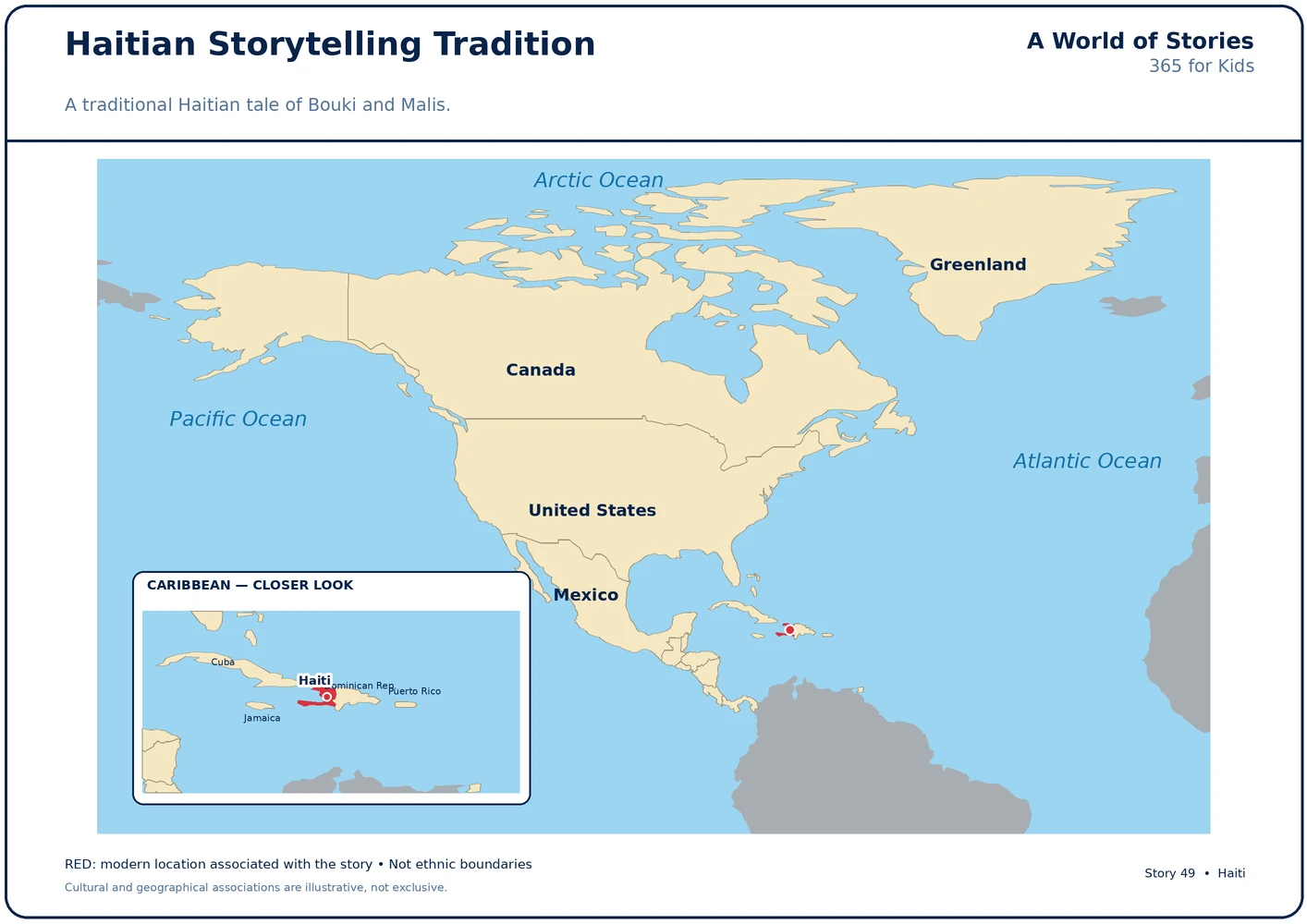
In Haiti, people have long told stories about Bouki and Malis. Bouki was trusting, while Malis was famous for finding clever ways to get the better of him. One day, the two decided to plant a garden together.
They would work the soil and share whatever grew there. It sounded like a fair arrangement, and Bouki agreed happily.
But Malis was already thinking about how to get the best part of the harvest.
“When our crop is ready,” Malis suggested, “you can have everything that grows above the ground. I will take what grows beneath it.”
Bouki considered the offer. There would surely be something good growing above the soil, and the division sounded simple enough.
“Agreed!” he said.
They planted sweet potatoes. As the weeks passed, green leaves spread across the garden. Bouki watched them grow, pleased with how healthy they looked.
At harvest time, however, Malis dug beneath the leaves and collected the sweet potatoes. Bouki was left with the vines and leaves above the ground. The part he had chosen was not the part he had hoped to eat.
Bouki looked at the harvest and understood his mistake. Next time, he decided, he would choose more carefully.
When it was time to plant again, Bouki spoke first.
“This time I will have whatever grows below the ground,” he said. “You can take what grows above.”
Malis agreed without arguing.
Together they planted corn. The stalks rose tall and green, and ears of corn developed high above the roots. When harvest day came, Malis gathered the corn. Bouki received the roots hidden in the soil.
Once again, Bouki had worked in the garden but missed out on the food they had grown.
He had changed his choice, yet Malis had changed the crop. Bouki began to see that the problem was not simply whether he chose the top or the bottom. It was the way Malis arranged the bargain.
And so this Haitian tale leaves us with a question worth asking whenever someone proposes a deal: does it only sound fair, or is it fair to everyone involved?
Bouki and Malis are well-known figures in Haitian storytelling, shared in Haitian Creole across generations of oral tradition.
After the Story: Read · Create · Reflect · Share
1. Find Haiti on a map of the Caribbean. What island does Haiti share with the Dominican Republic?
2. What did Bouki receive after the sweet potato harvest, and why was he disappointed?
3. How did Malis arrange the second harvest so that he received the corn?
4. Have you ever agreed to something that seemed fair at first but was not? How could Bouki and Malis have shared their harvests more fairly?
Inspired by this story? Create your illustration!
BARBADOS — The Tailor and the Seven Flies
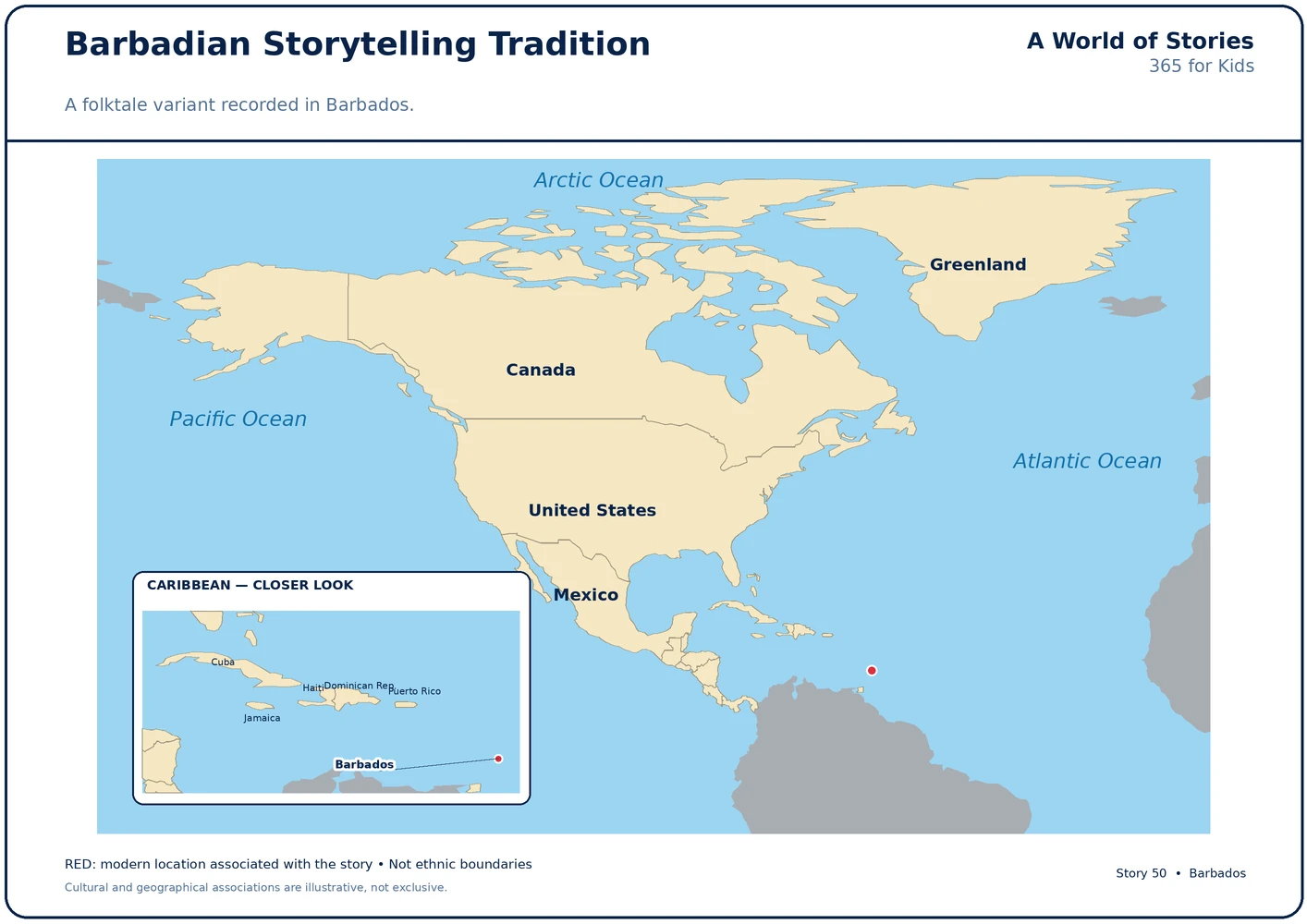
In a tale told on the Caribbean island of Barbados, a tailor became famous because of seven very small creatures — and a very large misunderstanding.
The tailor had killed seven flies with a single blow. Seven flies! It was a little victory, but he was pleased with it. Soon, however, the words “seven at one blow” began to sound far more impressive than the deed itself.
People who heard that a tailor had struck down seven at once did not necessarily imagine insects. They imagined something much grander. A person who could defeat seven opponents in a single stroke must surely be extraordinarily brave!
The tailor allowed the misunderstanding to grow. The claim traveled farther than the simple truth, until it reached the ears of a king. Before long, the little boast had opened the door to a royal life. The tailor became a prince by marriage, and the princess was left to wonder just what sort of astonishing deed her husband had performed.
For a while, the mystery remained. The tailor could dress as grandly as anyone at court, but fine clothes could not change the truth of what had happened. The seven that had made him famous were still only flies.
One night, as the tailor slept, he began to speak. Sleep loosened the secret that pride had kept hidden. He spoke of the seven flies he had killed at one blow.
The princess heard him. At last she understood: the seven mighty foes were not foes at all. They were tiny flies! When the king learned the truth, he too was angry. The famous claim that had made the tailor seem so powerful had rested on a misunderstanding.
And so the tailor’s extraordinary reputation came undone — not through a battle, but through a few words spoken in his sleep.
The story leaves us with a question worth thinking about: when does being proud of something we have done become pretending to have done something greater?
This tale was collected in Barbados in the early twentieth century, a local retelling of the widely traveled “seven at one blow” folktale.
After the Story: Read · Create · Reflect · Share
1. Find Barbados on a map of the Caribbean. Is it one of the larger islands or one of the smaller islands in the region?
2. What did the tailor actually defeat when he said he had struck down seven at one blow?
3. How did the princess and the king finally learn the truth about the tailor’s boast?
4. Why might people exaggerate their achievements? How can we feel proud of ourselves while still being truthful?
Inspired by this story? Create your illustration!
SAINT VINCENT AND THE GRENADINES — Ba Nancy and the King’s Well

On the island of Saint Vincent, people told stories of Ba Nancy, a small, clever trickster who rarely faced a problem without searching for a way around it.
One season, the rain stayed away. The earth grew dry, and water became precious. The king had a well dug, but he did not want anyone taking water without his permission.
To protect the well, a figure was placed nearby. It looked like someone standing guard, yet it was made of sticky tar. Anyone who touched it would find it difficult to pull away.
Ba Nancy heard about the well. He was thirsty, and the thought of cool water was hard to resist. But when he approached, he noticed the motionless figure. It did not move or speak. He looked carefully. Something about this silent guard seemed strange.
Ba Nancy understood the danger: the figure was a trap. Even so, curiosity and the hope of reaching the water drew him closer.
He addressed the guard, but received no answer. The stillness only made the encounter more difficult. When Ba Nancy reached out to the figure, he found himself caught fast. The more he struggled, the more helpless he became.
Before long, it was clear that the trap had worked. Ba Nancy could not simply walk away from the king’s well. Yet his mind was still busy. If strength could not free him, perhaps words could.
When his captors considered what to do with him, Ba Nancy made it seem that one punishment would be worse than all the others: he begged not to be thrown into the sea.
His plea gave them an idea. Into the water he went.
But the sea was not the end of Ba Nancy. It was the escape he had been hoping for. Once in the water, he was free of the sticky figure and able to get away.
The tale ends with the trickster escaping through a clever use of words. Ba Nancy had not won by force. He had watched, thought, and persuaded others to choose the very thing that would set him free.
Ba Nancy is a Caribbean name for Anansi, the trickster whose stories have roots in West African tradition and have been told in Saint Vincent and the Grenadines for generations.
After the Story: Read · Create · Reflect · Share
1. Find Saint Vincent and the Grenadines on a map of the Caribbean. What other islands can you see nearby?
2. Why did the king place a silent figure beside the well, and what happened when Ba Nancy touched it?
3. How did Ba Nancy use his words to escape from the trap?
4. Ba Nancy was clever, but he also tried to take water without permission. When can cleverness help others, and when can it cause problems?
Inspired by this story? Create your illustration!
DOMINICA — The Flower of Pegoua Rock
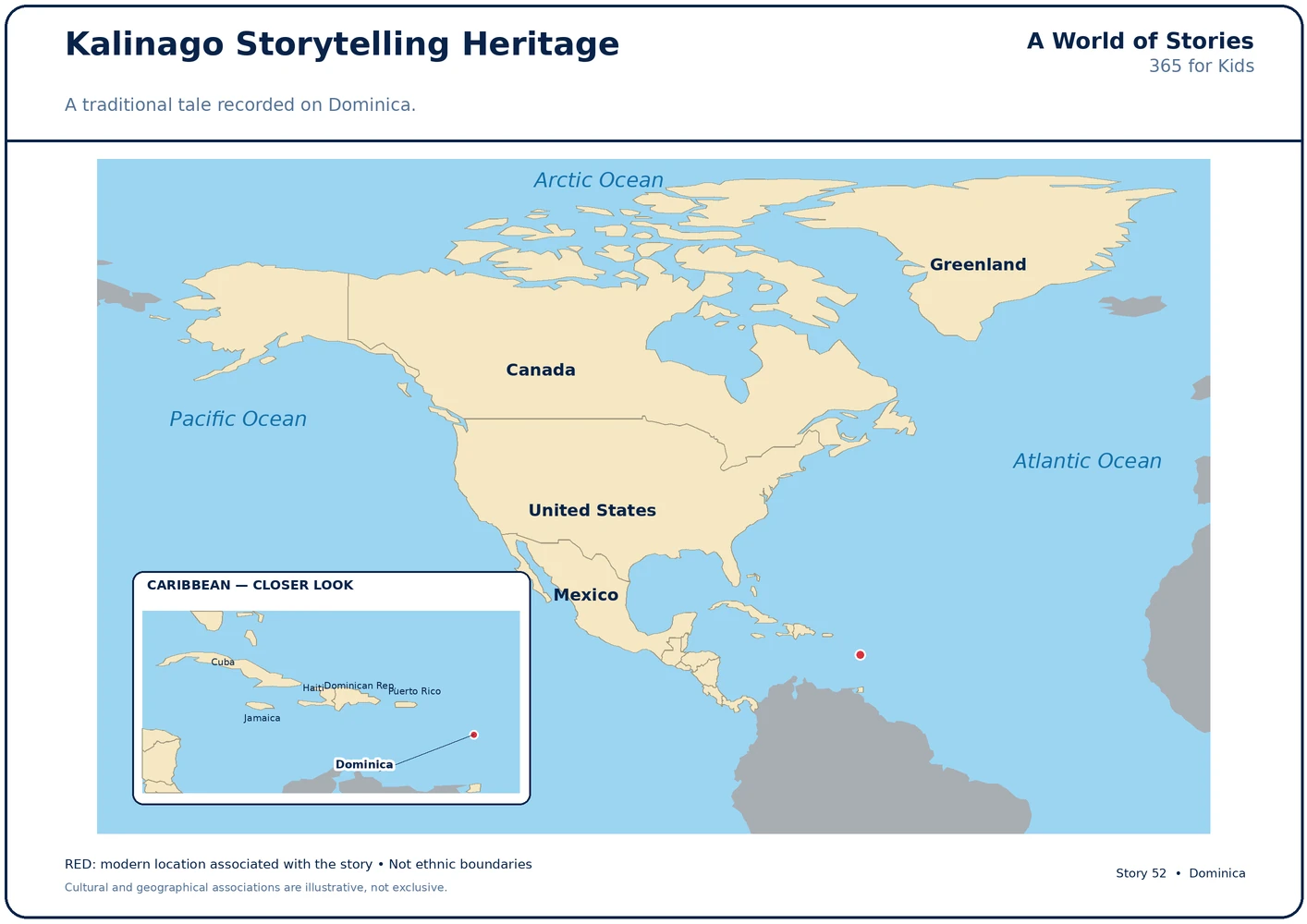
On the Caribbean island of Dominica, beyond the winding paths and green hills of Bataka, a great rock rises above the valley. People call it Pegoua Rock. In an old story from this region, a spirit lives there, and an extraordinary white flower sometimes blooms near its summit.
The flower is not an ordinary one. Its fragrance is so sweet that travelers far below the rock can smell it from the road. Each hour, one blossom opens and another fades. According to the story, whoever finds a flower may call someone from far away, and that person will be compelled to come.
Long ago, a mother lived near Bataka with her children. Her husband treated her badly and often left her alone. She wanted to take her children somewhere they could live in peace.
One day, while her husband was away fishing, she prepared a great quantity of cassava bread for the journey. Then she gathered her children and climbed the difficult path to Pegoua Rock.
At the top she found what she had hoped for: one of the remarkable white flowers.
With the flower in her possession, the mother went down to the river and bathed. She rubbed the flower over herself and cast the remaining pieces into the wind, calling on them to find their master. The fragments vanished.
Then she took her children onto the road and hurried toward Toulamon, a place later called Londonderry. She knew she must keep moving.
Not long after they had crossed the Cachibona River, she heard footsteps behind her. Her husband was following them, carrying fish. The mother took her children by the hands and ran.
At last they reached a cave known in the old account as the Caserne Caraïbe. She knocked at its entrance, and someone let them in just as her husband reached for her.
Inside the cave, the mother told him that she would not return. He could not follow her. As he turned away, the legend says, he changed into a bird with a yellow beak and yellow claws, known as the Pierrot Vanter.
People said that the bird’s sharp, repeated call could still be heard in the region. They also told that the mother and her children remained safely inside the cave, among people of earlier times, and that those within would sometimes travel by boat at night.
That is how the old story remembers Pegoua Rock, its mysterious flower, a mother’s journey, and a bird whose cry carries across the island.
This legend comes from Dominica in the eastern Caribbean and was recorded among Kalinago communities in the early twentieth century.
After the Story: Read · Create · Reflect · Share
1. Find Dominica in the Lesser Antilles on a map of North America. What sea lies to the west of the island?
2. Why did the mother climb Pegoua Rock, and what did she find there?
3. How did the mother and her children reach safety when someone followed them?
4. What does the mother’s decision tell you about protecting people you care about? What might help someone who needs a safe place?
Inspired by this story? Create your illustration!
ANTIGUA AND BARBUDA — The Fox and the Land Crab Race
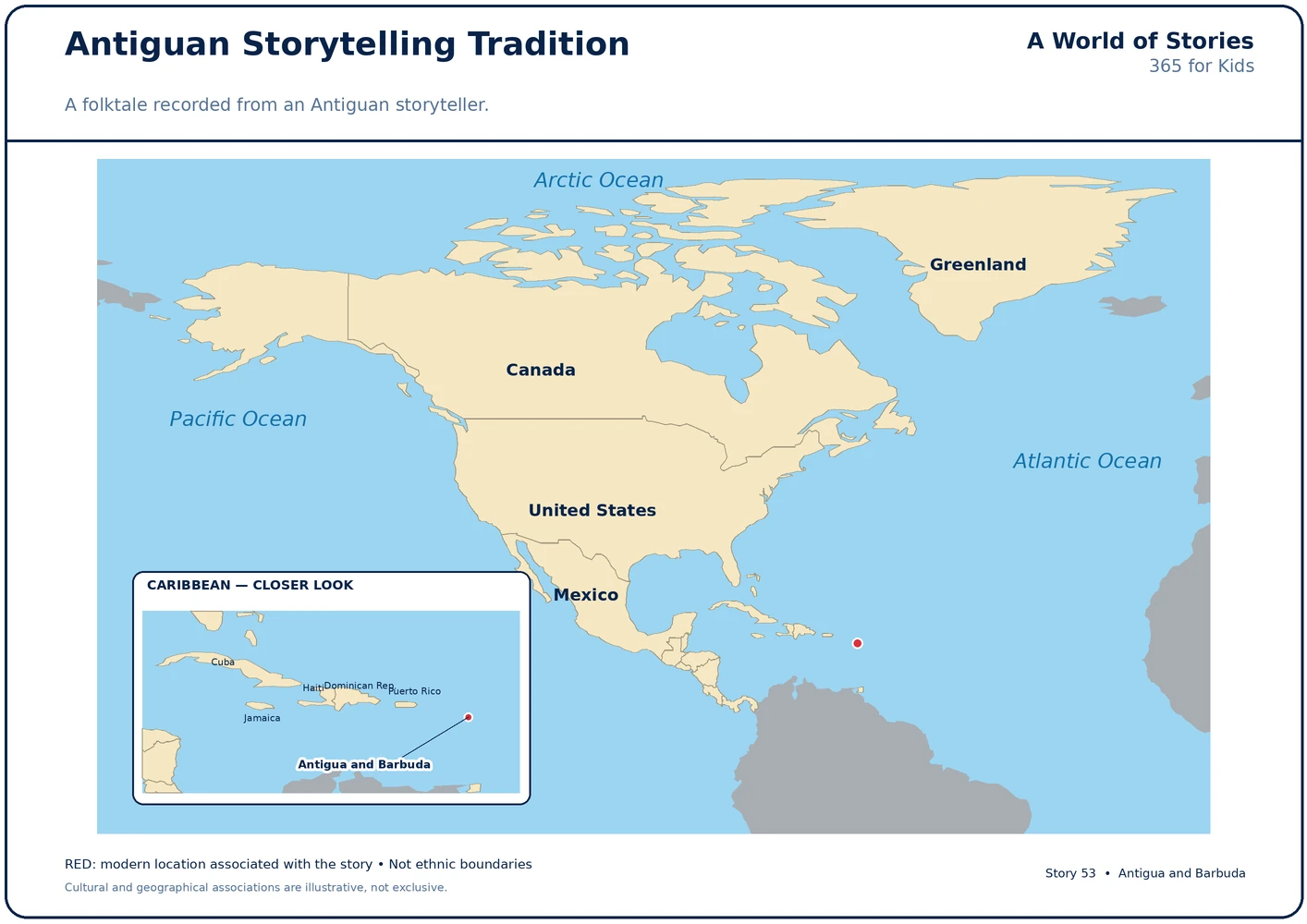
One morning, while the air was still cool, Fox met Land Crab on a path. The little crab was out for a walk, moving in the sideways, uneven way that crabs do.
“Where are you going so early, Mr. Crab?” Fox asked.
“Just taking a walk,” answered Land Crab.
Fox watched him for a moment and began to laugh. “Why, it looks as though you are walking backwards!”
Land Crab was not troubled by the laughter. “If you think I am so slow,” he replied, “perhaps you would like to race me.”
Fox laughed harder. How could a little land crab possibly race a fox? Still, he accepted the challenge. They agreed that the finish would be a mile away, and they made a small wager of onions and ground provisions.
Land Crab had a plan. He told Fox to stand a little farther along the path before they began. When Fox turned toward the finish, the crab quietly fastened one claw to the long brush of Fox’s tail.
“Ready?” called Fox.
“Ready,” answered Land Crab.
Off sprang Fox, his feet flying over the ground. He dashed along the path, certain that he had left his tiny opponent far behind. But all the while Land Crab hung tightly to Fox’s tail, carried along with every leap.
At last Fox reached the end of the mile. He stopped, turned around, and called triumphantly, “Where are you, Mr. Crab?”
Just then Land Crab let go of the tail and landed beside him.
“Here I am!” he said.
Fox stared in astonishment. The crab was already at the finish. The little creature he had mocked had won their wager.
And that is how, in this old Antiguan story, Land Crab won a race against Fox — not by running faster, but by finding a clever way to travel the distance.
This tale was recorded in the early twentieth century from Antiguan storyteller George W. Edwards, part of the Afro-Caribbean storytelling tradition of Antigua and Barbuda.
After the Story: Read · Create · Reflect · Share
1. Find Antigua and Barbuda on a map of the Caribbean. Are the islands close to Central America, or farther east among the Lesser Antilles?
2. Why did Fox think that Land Crab could never win a race against him?
3. How did Land Crab reach the finish line at the same time as Fox?
4. Was Land Crab’s clever trick fair? What is the difference between being resourceful and cheating in a competition?
Inspired by this story? Create your illustration!
SAINT LUCIA — Compère Lapin and the Hurricane
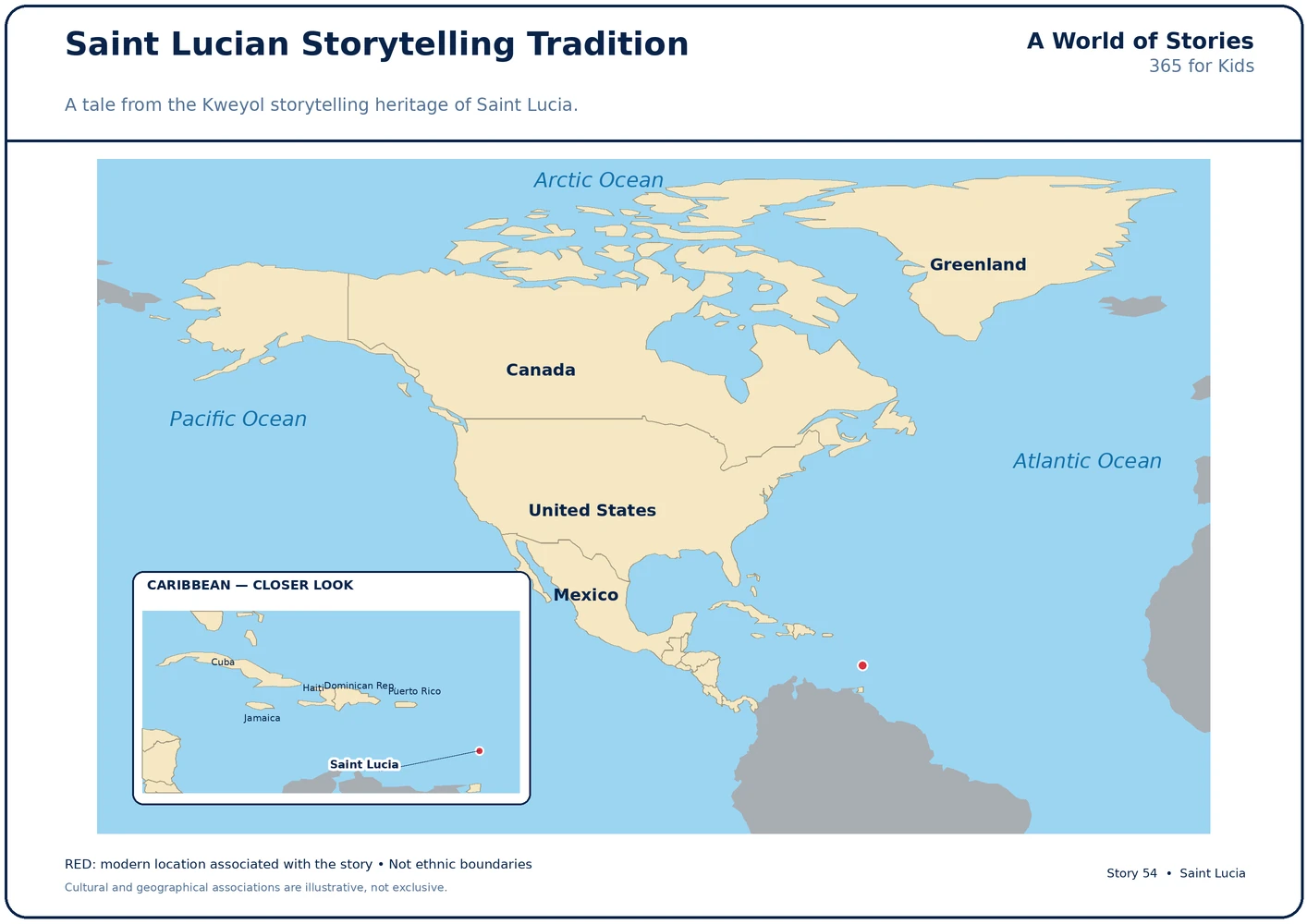
In the warm forests of Saint Lucia, stories are told about Compère Lapin, a small rabbit whose clever ideas often bring him into trouble — and sometimes lead him out again. One day, Lapin was hungry. He wandered through the trees, thinking of food, until he came upon a clearing where Compère Lion had more than enough to eat.
Lion was much larger than Rabbit. He guarded his food carefully and had no intention of sharing it with an unexpected visitor. Lapin looked at the food, then at the great tree standing near the clearing. He began to imagine a way to turn Lion’s strength and confidence against him.
Suddenly Lapin acted alarmed. He warned Lion that a terrible hurricane was approaching. He spoke of powerful winds and of the danger of being swept away. Then he pointed to the tree and urged Lion to let himself be tied securely to its trunk, where the storm would not carry him off.
Lion hesitated. He was strong, but even the strongest animal knows that a storm can be stronger still. Lapin repeated his warning. At last Lion agreed to the plan. The rabbit fastened him to the tree, making sure the great animal could not easily move away.
Now Lapin had what he wanted: a clear path to the food. While Lion waited for the hurricane, Rabbit helped himself. Time passed. The trees still stood quietly around the clearing. The terrible winds Lapin had announced did not arrive.
Lion began to understand that the warning had been a trick. The little rabbit had used fear of a storm to get what he could never have taken by force. Lapin, meanwhile, slipped away with his meal before Lion could catch him.
In this Saint Lucian tale, the smallest animal defeats the largest not by strength but by quick thinking. Yet his cleverness also raises a question: when does finding a smart solution become taking unfair advantage of someone else?
Compère Lapin (“Brother Rabbit”) is a familiar trickster in Saint Lucian Kwéyòl storytelling, part of the island’s Afro-Caribbean oral heritage shared across generations.
After the Story: Read · Create · Reflect · Share
1. Find Saint Lucia on a map of the Caribbean. What other islands lie nearby, and why might strong tropical storms matter to people who live there?
2. Why did Compère Lapin tell Lion that a hurricane was coming?
3. What made Lion believe Lapin’s warning, and how did Lapin use the tree to carry out his plan?
4. Lapin solved his problem by tricking Lion. Can you think of a fairer way he might have asked for food?
Inspired by this story? Create your illustration!
GRENADA — Cat and Rat Go Bathe
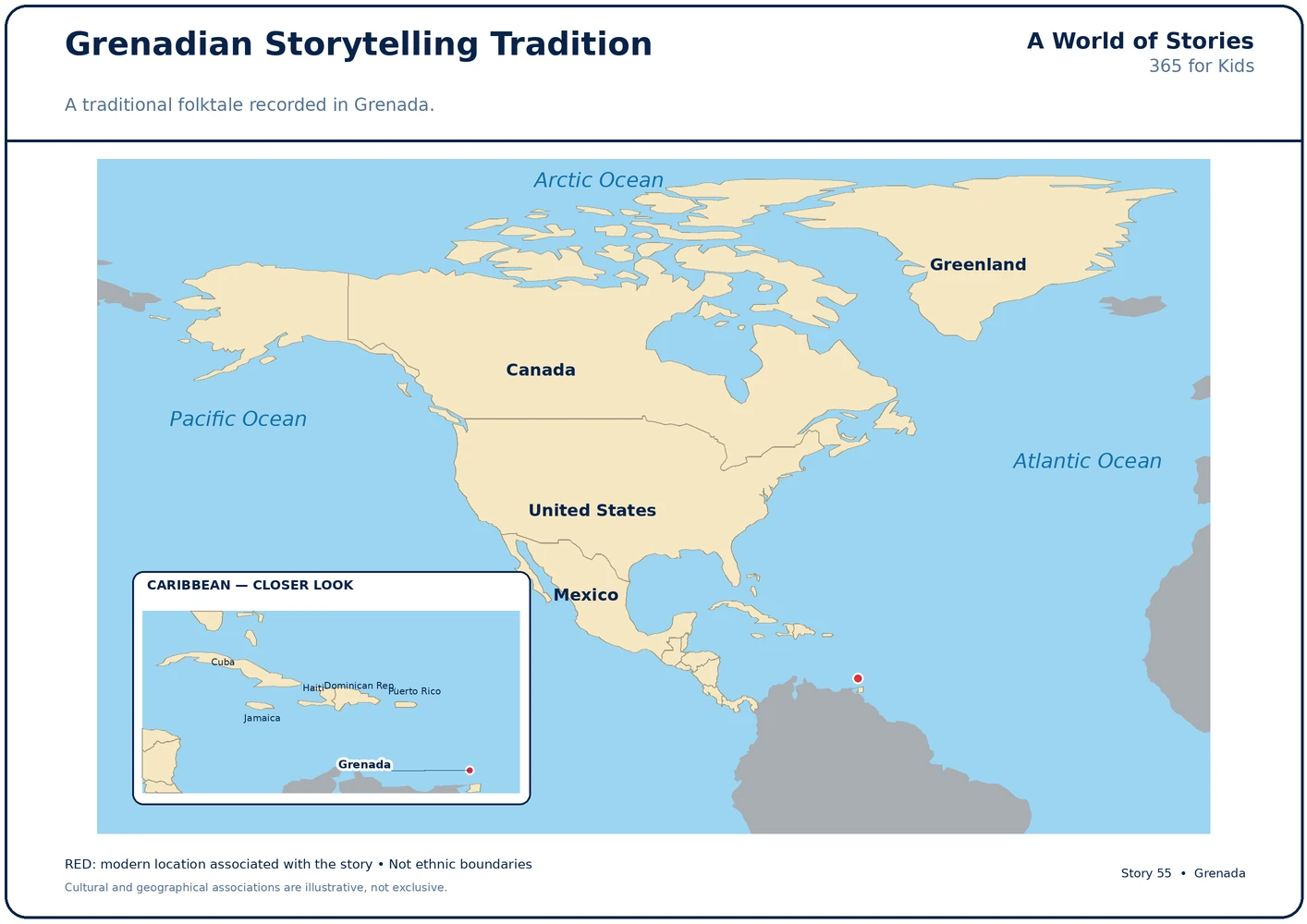
On the island of Grenada, a young Cat and a young Rat were friends. Each day, they went to bathe together. They enjoyed the water, and neither thought it strange that one had soft paws and whiskers while the other had a long tail and tiny feet.
To the two young animals, friendship was simple. They had found someone whose company they liked. Day after day, they returned to the water, and their friendship grew.
But their parents did not see things in the same way.
When Cat’s family learned that Cat had been spending time with Rat, they were alarmed. Cats, they explained, were not supposed to be friends with rats. They spoke of rats as creatures that cats should hunt, not as companions.
Rat’s family reacted just as strongly. They warned Rat that cats were dangerous. A rat should keep away from a cat, they said, because a cat might one day catch and eat it.
Cat had never thought of Rat as prey. Rat had never thought of Cat as an enemy. Yet now each heard a different story about the friend they knew. Their parents’ warnings filled the space where trust had once been.
The next time they thought of going to the water, it no longer seemed as easy as before. Cat remembered what the cats had said. Rat remembered what the rats had said.
And so the two friends stopped bathing together.
The old tale ends there. It does not tell of a quarrel between Cat and Rat, nor of any harm one did to the other. Their friendship ended because they were taught to fear each other.
It is a small story with a question that reaches far beyond the animals: when we are told someone must be our enemy, should we forget what we have learned about them for ourselves?
This folktale comes from Grenada in the Caribbean, where storytelling reflects a mixture of African and island traditions.
After the Story: Read · Create · Reflect · Share
1. Find Grenada on a map of the Caribbean. Which sea surrounds the island, and what other islands can you find nearby?
2. What did Cat and Rat enjoy doing together before their parents spoke to them?
3. Why did their friendship end, even though neither friend had harmed the other?
4. Have you ever heard someone make an unfair assumption about another person? What could you do to make your own kind and thoughtful choice?
Inspired by this story? Create your illustration!
PUERTO RICO — The House That Answered Back
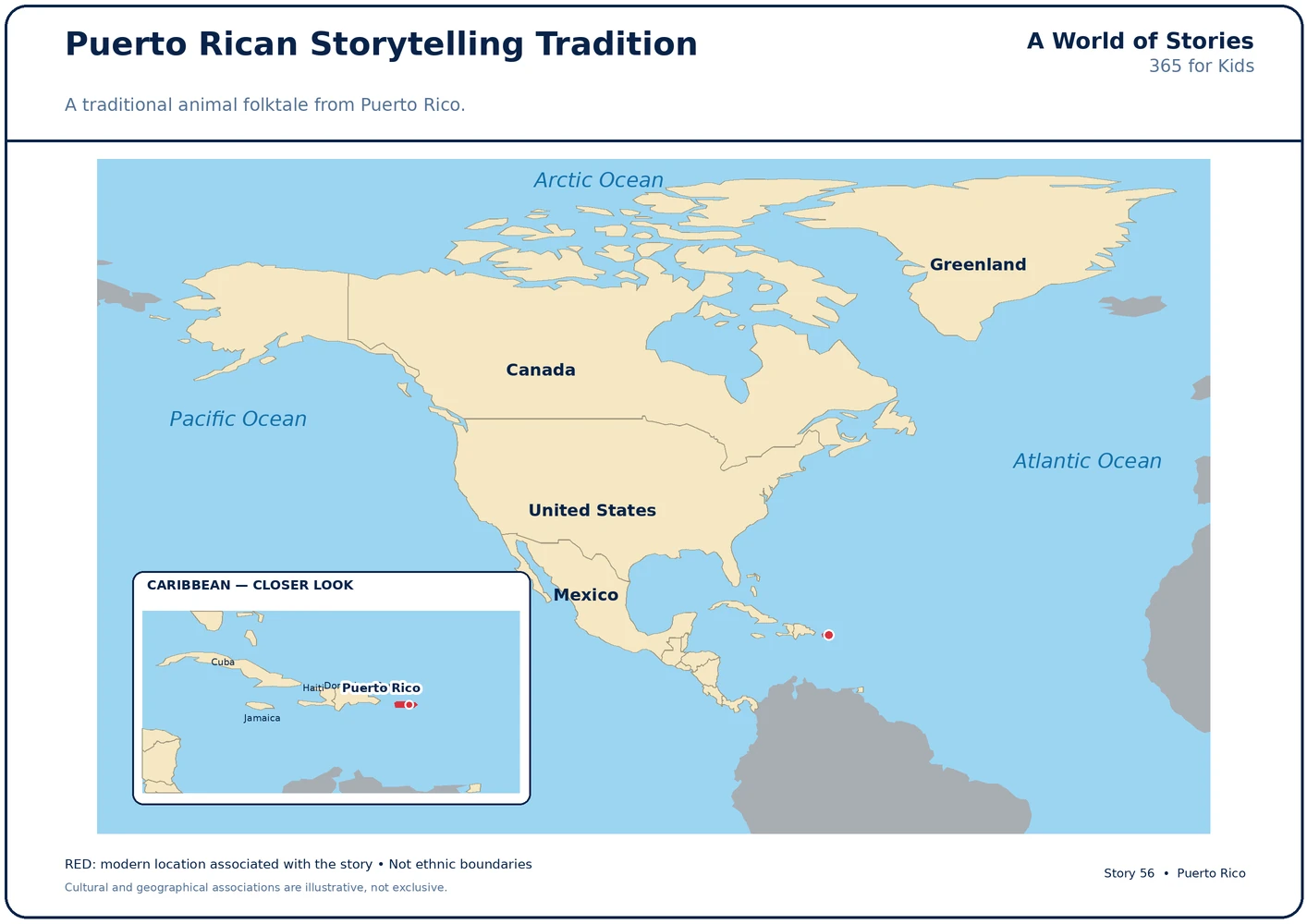
Long ago, in a Puerto Rican folktale, Rabbit and Tiger knew each other well. For a time they had even been friends. But one day, after a quarrel over a young goat they had caught together, their friendship came apart. Tiger was angry, and Rabbit knew that an encounter with him might be dangerous.
Tiger was much larger and stronger than Rabbit. He decided that the easiest way to catch his smaller rival was not to chase him along the paths, but to wait where Rabbit would least expect trouble: inside Rabbit’s own little house.
So Tiger crept into the house while Rabbit was away. He settled himself inside and waited. He imagined Rabbit returning, crossing the threshold, and discovering too late who was hiding there.
But Rabbit was observant. When he reached his doorway, something made him cautious. Rather than step inside immediately, he called out a greeting.
“Good morning, little house!”
There was no reply.
Rabbit waited. Then he spoke again, loudly enough for anyone inside to hear.
“That is strange. Every other day my little house answers me. Today it is silent. Perhaps I shall have to burn it down!”
Inside, Tiger grew alarmed. He believed that Rabbit might really set the house on fire. He did not know that houses were not in the habit of returning greetings, or that Rabbit was trying to discover whether someone was hiding within.
“Good morning!” Tiger called from inside.
That was all Rabbit needed to hear.
“So you are in there!” he cried.
And before Tiger could rush through the door, Rabbit ran away, laughing as he went. Tiger had hidden himself carefully, but he had given away his hiding place with his own voice.
In this old tale, Rabbit escapes not because he is stronger than Tiger, but because he notices a danger and thinks before he acts.
This story comes from Puerto Rico, where Rabbit and Tiger appear in many recorded oral folktales; this retelling follows one such recorded episode.
After the Story: Read · Create · Reflect · Share
1. Find Puerto Rico on a map of the Caribbean. Which sea and ocean surround the island?
2. Why did Tiger hide inside Rabbit’s house?
3. How did Rabbit discover that someone was hiding inside without entering?
4. Rabbit noticed something unusual before taking a risk. When have you stopped to think carefully before making a decision?
Inspired by this story? Create your illustration!
MARTINIQUE — Yé and the Clever Ti Fonté
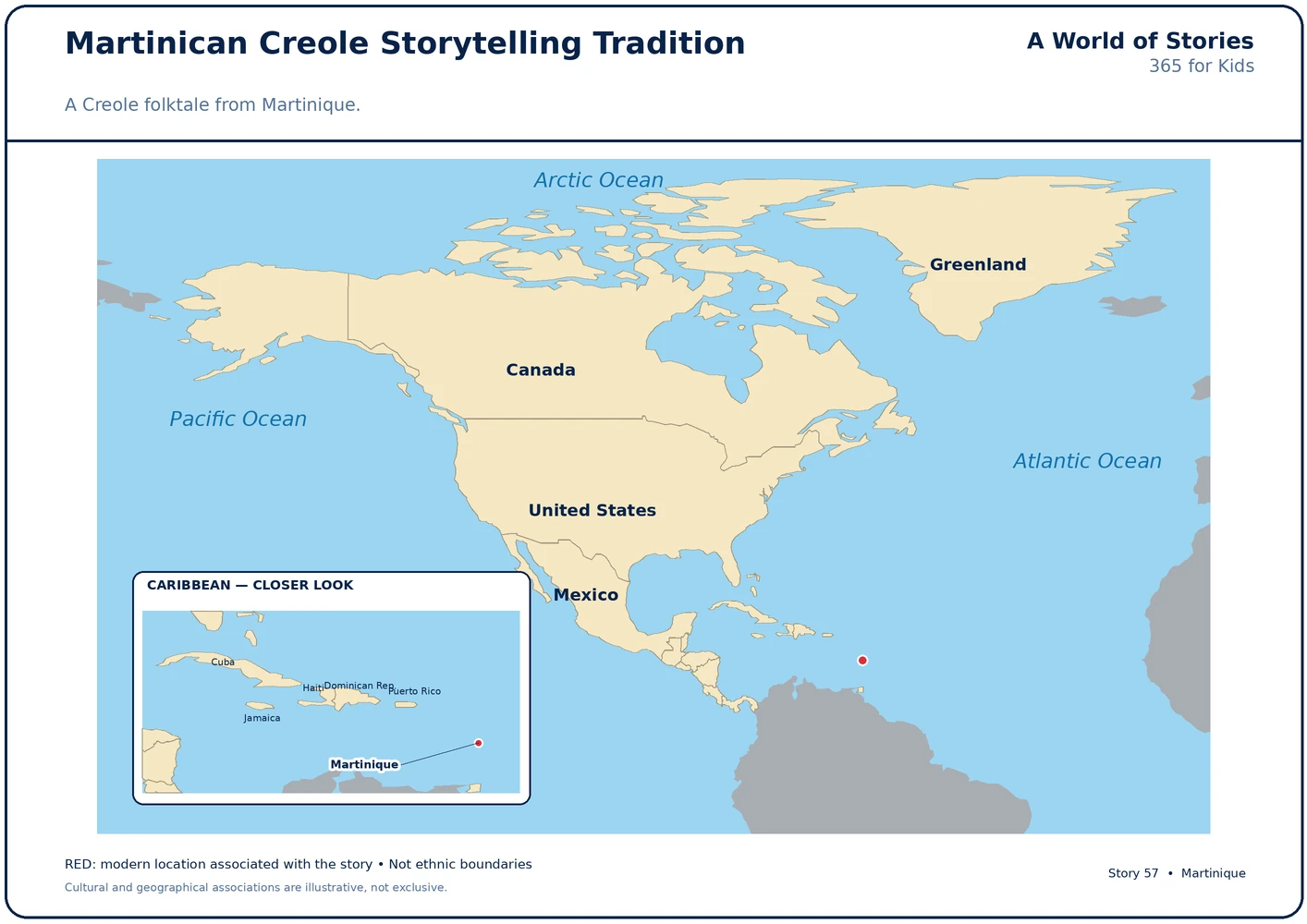
On the island of Martinique, storytellers tell of a man named Yé. He had a family to care for, but he was far too fond of eating and far too unwilling to work. One day, when there was almost nothing left at home, he wandered into the forest in search of food.
After hours of walking, Yé heard a crackling fire. In a clearing sat a strange old visitor, roasting snails and eating a calabash full of seasoned fish and cassava. Yé crept closer. The visitor appeared unable to see him, so Yé began stealing small handfuls of food. Each time the old man raised his hand, Yé reached into the bowl again.
He took more and more, until only one bite remained. Then the stranger caught his hand. This was no ordinary traveler but a frightening figure from the old tales — a Devil. He climbed onto Yé’s back and ordered him to carry him home.
Yé’s children ran to greet their father, hoping he had brought dinner. Instead, they found an unwanted guest. From then on, whenever the family prepared a meal, the visitor made them fall still under his spell. He ate every morsel, spoiled what remained, and woke them again. The family grew desperately hungry.
Yé’s wife urged him to seek help. So Yé climbed the slopes of Mount Pelée and called toward the sky until Bon-Dié, the Good God of the story, answered. Bon-Dié taught him a special phrase that would break the visitor’s power. But there was one condition: Yé must eat nothing on his journey home, so that he could pronounce the words clearly.
Yé repeated the phrase all the way down the mountain. Then he saw wild guavas beside a stream. He tasted one, and another, and soon had eaten so much sour fruit that his mouth could no longer shape the words. At dinner he tried to speak, but only a muddled sound came out. The stranger remained.
Twice more Yé climbed the mountain, and twice more he gave in to the temptation of the fruit. His wife became more and more worried. At last their clever child, Ti Fonté, had an idea.
“Send Papa once more,” Ti Fonté told his mother. When Yé put on his long coat, the child slipped unnoticed into one of its enormous pockets.
All the way up Mount Pelée, Ti Fonté stayed hidden. When Bon-Dié repeated the special words, the child listened carefully and remembered every sound. On the return journey Yé stopped to eat sour fruit yet again. Ti Fonté, however, had not forgotten a thing.
At home the child whispered to their mother, “Prepare dinner. This time we know what to say.”
When the unwelcome guest rose to take the family’s food, Ti Fonté stood up and called out the words perfectly. At once the stranger lost his power and fell to the ground, never to trouble them again. For the first time in many days, the family could eat in peace.
But Yé’s adventures were not finished. Later he went back into the forest, foolishly disturbed the fallen stranger, and found that his own nose had swollen enormously. Again he climbed Mount Pelée to ask for help.
Bon-Dié told him to gather the birds by the sea and ask them to set their beaks aside while they bathed. Yé did so, choosing the narrow beak of a bird called the coulivicou to replace his swollen nose. According to the tale, this is why the coulivicou looks so solemn and carries such an unusual beak.
And as for the family? They had learned that a child who listens carefully and acts wisely may succeed where a grown-up repeatedly fails.
Yé and Ti Fonté belong to the French Caribbean Creole storytelling tradition of Martinique, passed down through generations of local storytellers.
After the Story: Read · Create · Reflect · Share
1. Find Martinique on a map of the Caribbean. Which other islands are nearby? What does it mean that Martinique is part of France but has its own Creole storytelling traditions?
2. What mistake did Yé make in the forest, and how did it affect his family?
3. Why could Yé not say the special words correctly? How did Ti Fonté solve the problem?
4. Ti Fonté listened carefully and helped the whole family. When have you solved a problem by paying close attention or helping someone else?
Inspired by this story? Create your illustration!
JAMAICA — Anansi Rides Tiger

In the old animal stories of Jamaica, Anansi the spider is famous for his clever schemes. He is small, but he never lets that stop him from challenging animals many times his size. One of his favorite rivals is Tiger, who is strong, proud, and not always careful about whom he believes.
One day, Tiger went to visit a house where two young women lived. He was hoping to make a good impression, and he walked toward their yard with all the dignity he could gather.
Anansi heard about Tiger’s visit and decided to play a trick. He reached the house first. When the young women asked whether he had seen Tiger, Anansi answered without hesitation.
“Of course I have! Why, Tiger is my father’s old riding horse.”
The young women were surprised. A powerful animal like Tiger, someone’s riding horse? It sounded unlikely. But Anansi spoke as though it were the most ordinary thing in the world.
When Tiger arrived, the young women repeated Anansi’s astonishing claim. Tiger’s pride was hurt. He went straight to Anansi and demanded that the spider come to the house and explain himself in front of everyone.
Anansi put on a miserable expression. “I am much too weak to walk,” he said.
“Then I shall carry you there on my back,” Tiger replied. “You will tell them the truth.”
Anansi agreed, but he was not ready to leave. First, he brought out a saddle.
“What is that for?” Tiger asked.
“I am so weak that I might slip,” Anansi explained. “The stirrups will help me keep my balance.”
Tiger wanted to settle the matter quickly, so he allowed the saddle.
Next Anansi fetched a bridle.
“And what is that for?” asked Tiger.
“If I begin to fall, I shall need something to hold on to,” said Anansi.
Tiger grumbled, but he allowed the bridle as well.
Then Anansi appeared with a riding whip. When Tiger protested again, Anansi explained that he needed it only to brush away troublesome flies. Finally, he put on spurs, claiming that they would keep his feet from cramping.
Tiger was growing impatient. He had come to prove that Anansi was a liar, not to debate every piece of riding equipment. So, one by one, he accepted the spider’s excuses.
At last they started down the road. Anansi sat high on Tiger’s back, with his feet in the stirrups and the bridle in his hands. As they neared the house, Anansi urged Tiger forward. To the watching young women, it looked exactly as though the great Tiger was being ridden like a horse.
They came into the yard at a lively pace. Before Tiger could explain a single word, Anansi called out proudly that he had told the truth: Tiger was indeed his father’s old riding horse!
Tiger had meant to shame Anansi in public. Instead, Anansi had made him part of the very joke he hoped to disprove. Humiliated and furious, Tiger fled into the woods, while Anansi celebrated his trick.
And so, in this Jamaican tale, the smallest character wins — not with strength, but by turning his rival’s impatience and pride against him.
Anansi is a trickster figure in Afro-Jamaican oral storytelling, with roots in West African tradition.
After the Story: Read · Create · Reflect · Share
1. Find Jamaica on a map of the Caribbean. Which sea surrounds the island, and what other islands can you find nearby?
2. What did Anansi tell the young women about Tiger, and why did Tiger insist that Anansi come to their house?
3. How did Anansi explain the saddle, bridle, whip, and spurs? Why did Tiger agree to each of them?
4. Anansi was clever, but his trick embarrassed Tiger. How can we use our cleverness without hurting or humiliating someone else?
Inspired by this story? Create your illustration!
Key Dates
June 30, 2027
Submission deadline (or earlier, once 500 eligible artworks are received)
August 1–31, 2027
Virtual exhibition
Aug 1, 2027
Online gallery and digital catalog
Questions Parents Ask
Who can participate?
Children and teens ages 6–17 who live in the United States. A parent or legal guardian submits the artwork.
Does it cost anything?
No. Participation is completely free, and no purchase is ever necessary.
Can my child submit more than one artwork?
One artwork per child for each exhibition. Your child is welcome to take part in all six continents.
What kind of artwork is accepted?
Original artwork made by hand with traditional materials — pencils, crayons, markers, paints, collage and more. Artwork that is AI-generated, traced or copied, or made mostly by an adult cannot be accepted.
Is this a contest?
No. There are no rankings and no winners. The first 500 eligible submissions for each continent are accepted, in the order they are received.
What information is shown publicly?
Only your child’s first name or a nickname, an optional last initial, age group, city (optional), and state — never addresses, phone numbers, or emails.
Who owns the artwork?
Your child keeps the copyright. You give 365 for Kids permission to display and publish the image only in the ways you choose in the form.