
A World of Stories · Volume V
Folk Tales and Legends from SOUTH AMERICA
Travel across South America through its folk tales and legends. Read a story from a country that interests you, imagine its characters and places, and bring it to life in your own illustration.
Free
No purchase necessary
Ages 6–17
Children living in the U.S.
Aug 31, 2027
Submission deadline
How to Participate
1
Explore the folk tales and legends from South America below.
2
Choose your favorite story and read it.
3
Create your own illustration of it — by hand, with any art materials.
4
Ask a parent or guardian to submit a photo of your artwork.
Participation is free. One artwork per child. Participation rules
What Happens to Your Child’s Artwork
- It is shown in an online gallery on our website — and stays there.
- It joins a national virtual exhibition, October 1–31, 2027.
- It appears in a digital exhibition catalog you can download — and, with your permission, in a printed catalog.
- Every accepted participant receives a personalized Certificate of Participation.
- With your permission, it may be selected for an illustrated book of these stories.
Not a contest: the first 500 eligible submissions are accepted, in the order received.
Explore the Stories
Discover 40 folk tales and legends from across South America — from the high peaks of the Andes to the rivers of the Amazon, the plains of the Pampas, and the islands of Tierra del Fuego. Each story includes a map, questions to explore together, and an invitation for your child to create an illustration and share it with us.
Exploring the Stories of South America
South America is a continent of towering mountains, vast rainforests, wide grasslands, mighty rivers, and distant southern islands. For thousands of years, people have shared stories about the natural world, remarkable animals, mysterious beings, courage, kindness, and the mysteries of life.
In this collection, we explore 40 traditional stories from South America, organized into eight cultural and geographical regions.
You may notice that the stories are not arranged simply by country. That is because cultures, languages, and storytelling traditions do not always follow the borders we see on modern maps. Some communities live across several countries, while a single country may be home to many different peoples and traditions.
Our eight regions take us from the high Andes and the Amazon rainforest to the Guianas, the lands of the Guaraní, the Pampas, and the faraway landscapes of Patagonia.
Along the way, you will discover stories from Indigenous peoples, as well as traditions shaped by African, European, and other cultural influences. Each story offers a different way of understanding the world.
Every story includes a map to help you discover the place or cultural region connected to its origins. Remember that these maps show where traditions come from or are shared—not exact borders between cultures.
As you read, imagine the people and landscapes behind each tale. Think about what the story means, create your own illustration, and share what you have discovered.
Read · Create · Reflect · Share
Let the stories of South America take you on a journey through a continent of many voices, cultures, and imaginations!
Andean Highlands
PERU — The Children of the Sun
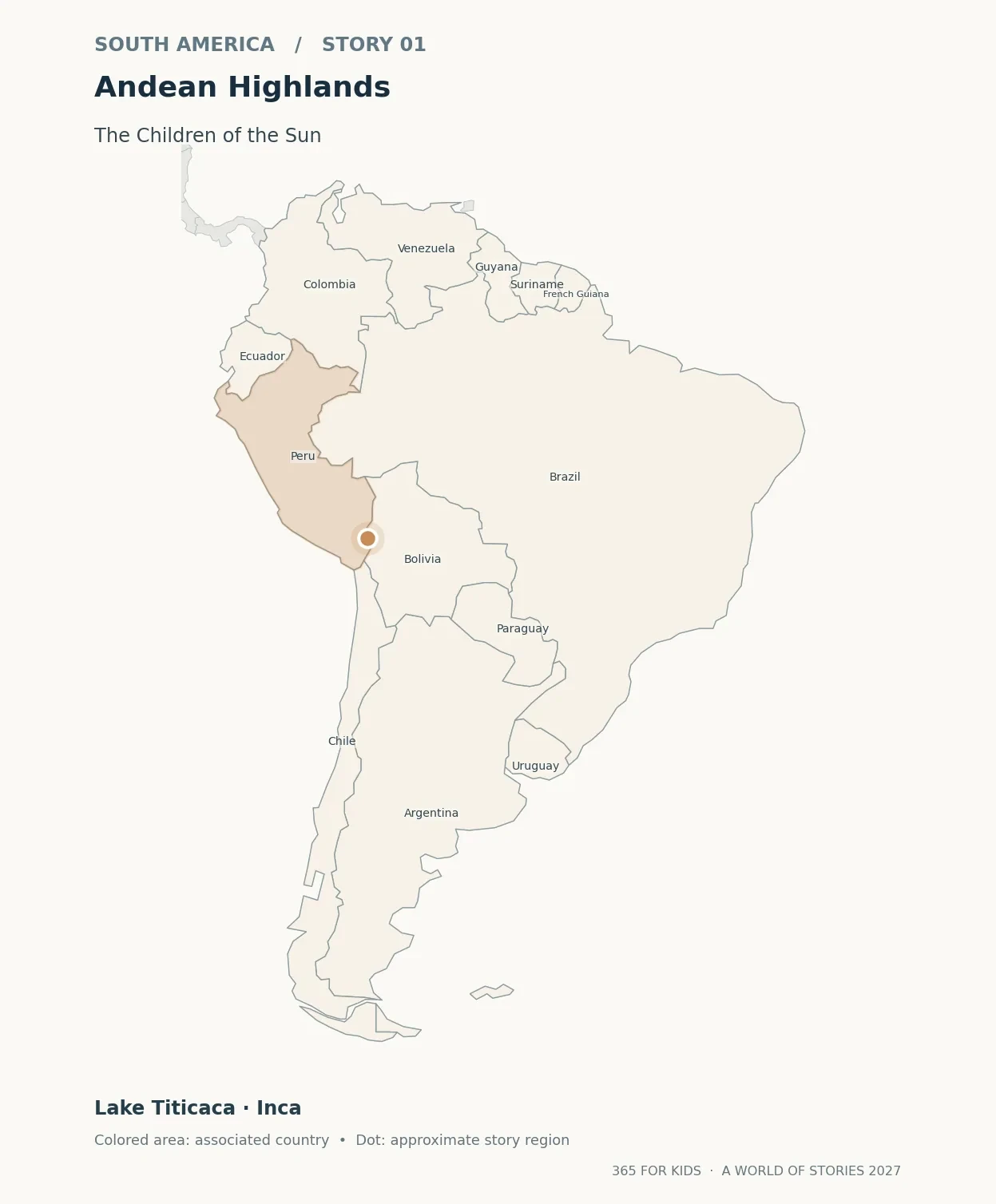
Long ago, according to an Inka story, the Sun looked down upon the high mountains and valleys of the Andes. The Sun was called Inti, and his light reached the lakes, fields, and distant hills. Yet the people living across those wide lands were scattered. Inti wished to send them guidance and bring them together.
So Inti called upon two of his children, Manco Capac and Mama Ocllo. He gave them a task: they were to travel through the mountains, find a place where a new city could be founded, and share what they knew with the people they met.
Their journey began at Lake Titicaca, where the blue water stretched beneath the enormous sky. From the lake they emerged and looked toward the mountains that rose beyond its shores.
Inti had given them a golden staff. It was not an ordinary walking stick. They were to carry it as they traveled, testing the earth along the way. Where the staff sank easily into the ground, there they should make their home and establish a city.
Manco Capac and Mama Ocllo set off together. Their path took them across rocky slopes, over high passes, and into valleys where they stopped to rest. At different places they pressed the golden staff against the soil. Each time, the earth resisted. Their journey was not yet finished.
They continued north, watching the land and meeting people along the way. In the story, Manco Capac and Mama Ocllo spoke of living together in communities and sharing useful skills. Manco Capac taught methods of tending fields and growing food. Mama Ocllo shared knowledge of spinning thread and weaving cloth. Their work gave the people reasons to gather and build a life together.
At last the travelers came to the valley of Cusco. Near the hill called Huanacauri, Manco Capac tested the earth once more. This time, the golden staff sank into the ground. The sign they had been waiting for had appeared.
Here, the two decided, was the place to settle. People came to join them, and Cusco became the heart of their new community. In the Inka tradition, this was the beginning of the city that would later become the capital of a great Andean empire.
This Inka story comes from the Andes, where Lake Titicaca and the city of Cusco are important places, and was written down long ago by Inca Garcilaso de la Vega.
After the Story: Read · Create · Reflect · Share
1. Find Lake Titicaca and the city of Cusco on the map above. Both are in the country of Peru today — can you see how far apart they are?
2. Why did Manco Capac and Mama Ocllo carry the golden staff?
3. What skills did the two travelers share with the people they met?
4. Why might a community tell stories about how an important city began?
5. Can two communities remember the beginnings of the same place in different ways?
Inspired by this story? Create your illustration!
Illustration ideas:
- Lake Titicaca under the brilliant Andean sun as the two travelers begin their journey.
- Manco Capac and Mama Ocllo carrying the golden staff across a mountain pass.
- The golden staff sinking into the soil near Huanacauri, with the Cusco valley beyond.
- Families learning to grow crops and weave cloth in the new community.
BOLIVIA — The Fox Who Went to the Sky
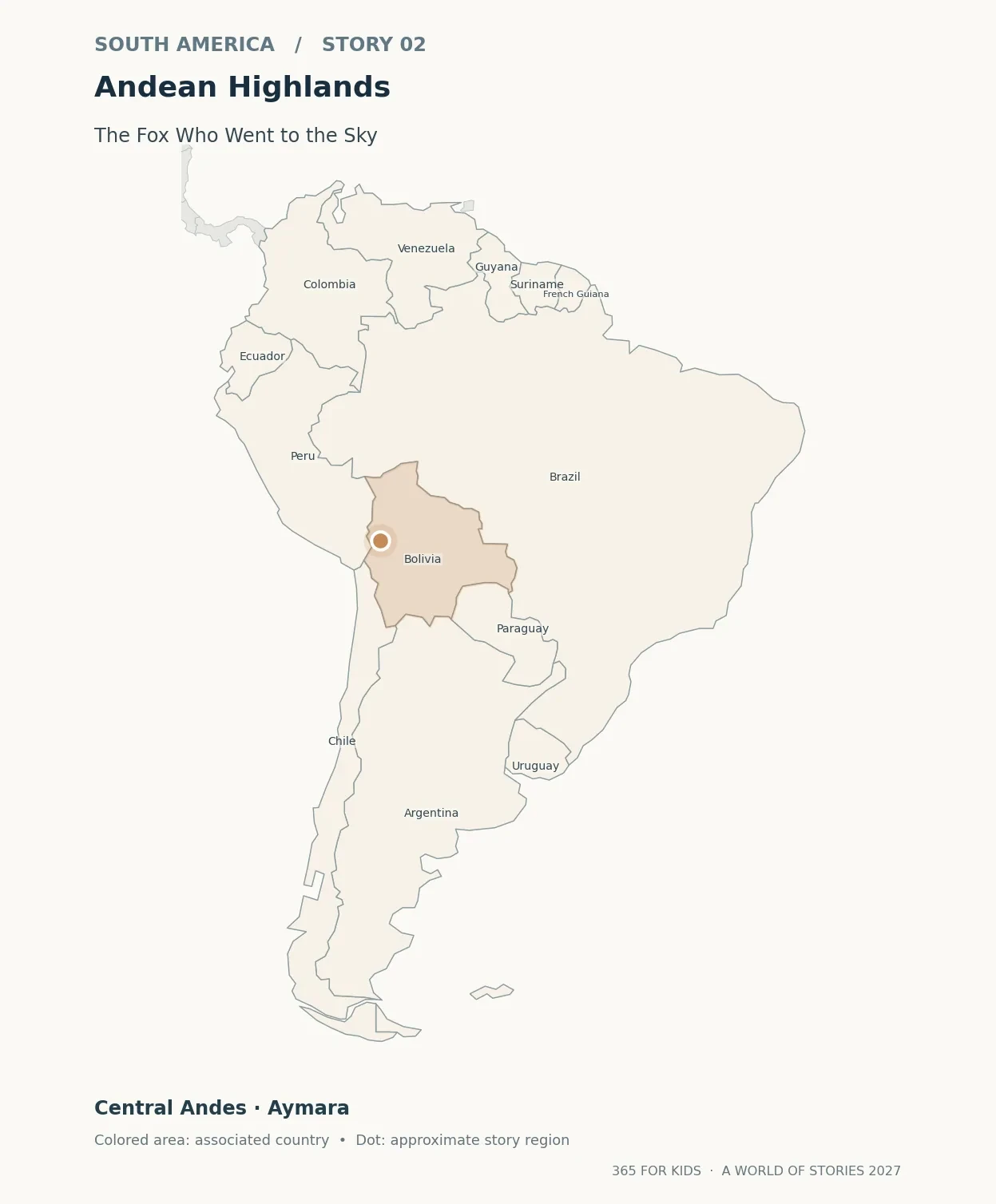
In an old story told in the Andes, a fox wanted to visit the sky. High above the mountains was a place unlike the world he knew, and he longed to see it for himself.
One day, a condor agreed to carry him. The great bird spread his broad wings, and together they rose above the slopes, valleys, and fields. Far below, the land grew smaller as they traveled upward.
When they reached the sky, the fox found wonderful things to eat. He tasted the fruits there and liked them so much that he kept eating. The condor reminded him that it was time to return, but the fox did not listen.
At last, the condor flew back to the earth without him. The fox was left alone in the sky. Now he wanted to go home, but he had no wings to carry him down.
He found a way to make a long rope from grass. He fastened it securely and began to lower himself toward the world below. For a while, his plan worked: the sky was above him, the earth was below him, and the rope held fast.
Then some parrots flew past. They teased the fox, and the fox answered them with unkind words. Angered by his insults, the birds cut through his rope with their beaks.
The fox began to fall. As he rushed toward the earth, he called to the spiders to weave a web and save him. But he fell before they could help.
When he struck the ground, the fox died. The fruits he had eaten in the sky scattered over the earth. According to this version of the story, that is how people came to have some of the plants they grow and eat.
In the high Andes, Aymara and Quechua communities have long told stories about the clever fox and the mighty condor, and this Aymara version also explains how plants came to the earth.
After the Story: Read · Create · Reflect · Share
1. Find Bolivia and the Central Andes on the map above. Why do you think a story about a condor flying “up to the sky” would come from such a high, mountainous place?
2. Why did the fox remain in the sky after the condor wanted to leave?
3. How did the fox’s words to the parrots change what happened next?
4. What does the story suggest about the relationship between the sky and the foods people grow?
5. Why might the same traditional story have different versions in different communities?
Inspired by this story? Create your illustration!
Illustration ideas:
- A condor carrying a fox above the high Andes, with mountain valleys far below.
- The fox discovering the fruits of the sky while the condor prepares to leave.
- A fox descending on a long rope as parrots fly nearby.
- Plants and fruits scattered across the mountain fields beneath a vast Andean sky.
PERU — The Llama Who Warned of the Flood
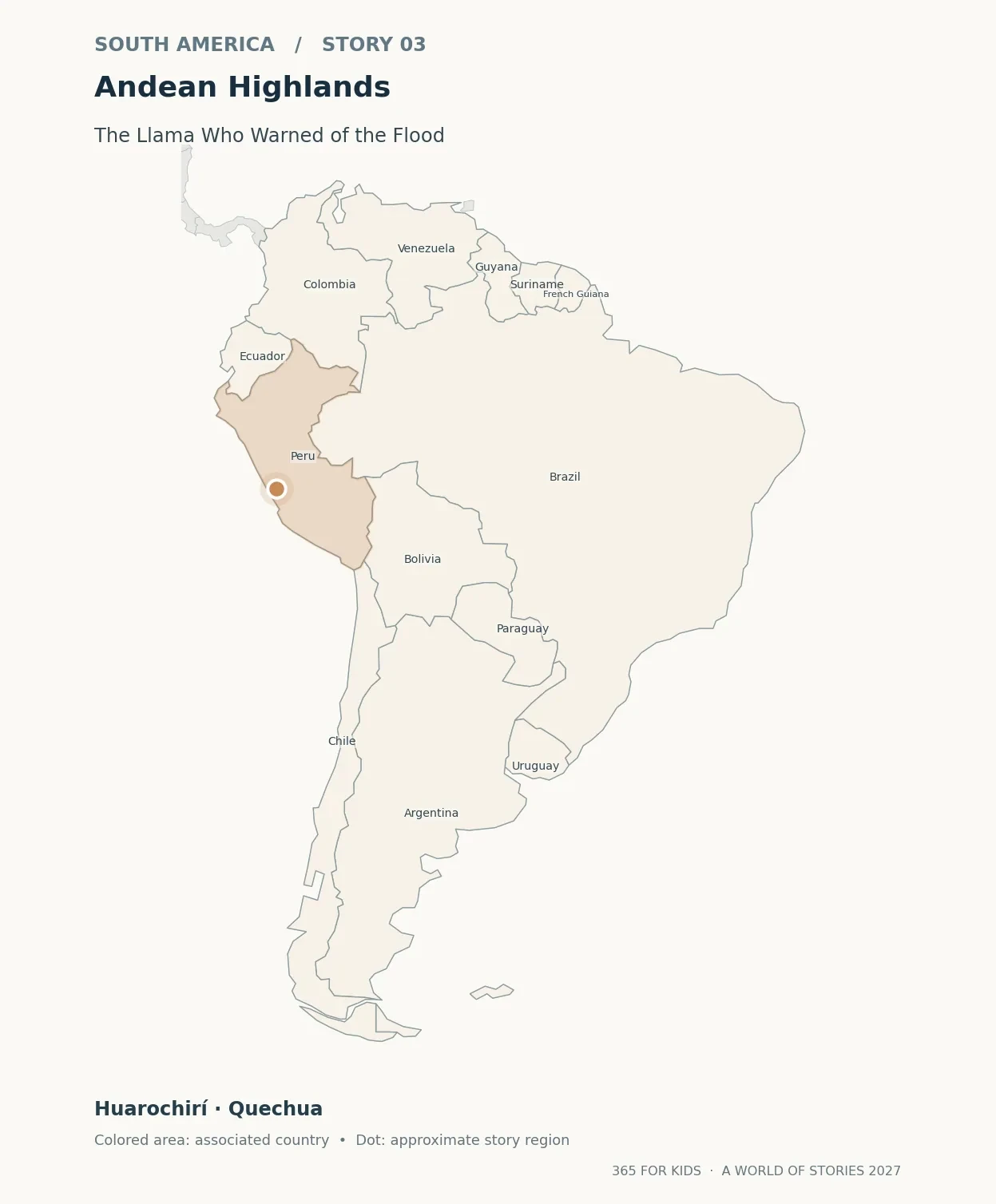
Long ago, in the mountains of what is now Peru, a man took his llama to graze where the grass was rich and green. Usually the animal would have eaten eagerly. But on this day, the llama lowered its head and refused the grass.
The man watched in surprise. Why would an animal turn away from such good pasture? At last he grew angry. He had been eating an ear of maize, and he threw the empty cob toward the llama, telling it to eat.
Then something astonishing happened. The llama spoke. It warned the man that in five days the waters of the ocean would rise and spread over the land. The world, the llama said, was in terrible danger.
Fear replaced the man’s anger. “Where can we go?” he asked. The llama knew a place: a mountain called Villca Coto. Its summit would offer safety above the waters. The man must take enough food for five days and go there without delay.
The man listened. He gathered the provisions and set out for the mountain, bringing the llama with him. In his haste, he even carried the animal and its load along the way.
When they reached Villca Coto, they discovered that they were not alone. Pumas, foxes, guanacos, condors, and many other creatures had already gathered on the heights. The mountain was crowded with animals seeking shelter.
Just as the man arrived, the flood began. The waters rose through the valleys and over the hills. At last, only the uppermost peak of Villca Coto remained above the water. The animals pressed close together on the little space that was left.
The water reached the tail of a fox. In this telling, that is why the tip of a fox’s tail is dark. After five days, the waters began to fall. The mountain slopes slowly appeared again, and the sea withdrew.
This story belongs to the traditions of Huarochirí, a region in the mountains of Peru, and was preserved in a Quechua-language collection of stories written down centuries ago.
After the Story: Read · Create · Reflect · Share
1. Find the Huarochirí region in the mountains of Peru on the map above. Why might a mountain be the safest place to go during a great flood?
2. What first prevented the man from understanding that something was wrong?
3. Why was the llama able to help when the man did not know what to do?
4. How do the gathered animals change the picture of the mountain during the flood?
5. Why might people tell a story that explains the color of a fox’s tail?
Inspired by this story? Create your illustration!
Illustration ideas:
- A llama standing in green mountain pasture while its owner looks puzzled.
- The man carrying supplies along a steep path toward Villca Coto.
- Condors, guanacos, pumas, foxes, and a llama gathered on a mountain summit.
- The peak above the great waters, with the fox’s tail touching the water.
ECUADOR — Cantuña and the Missing Stone
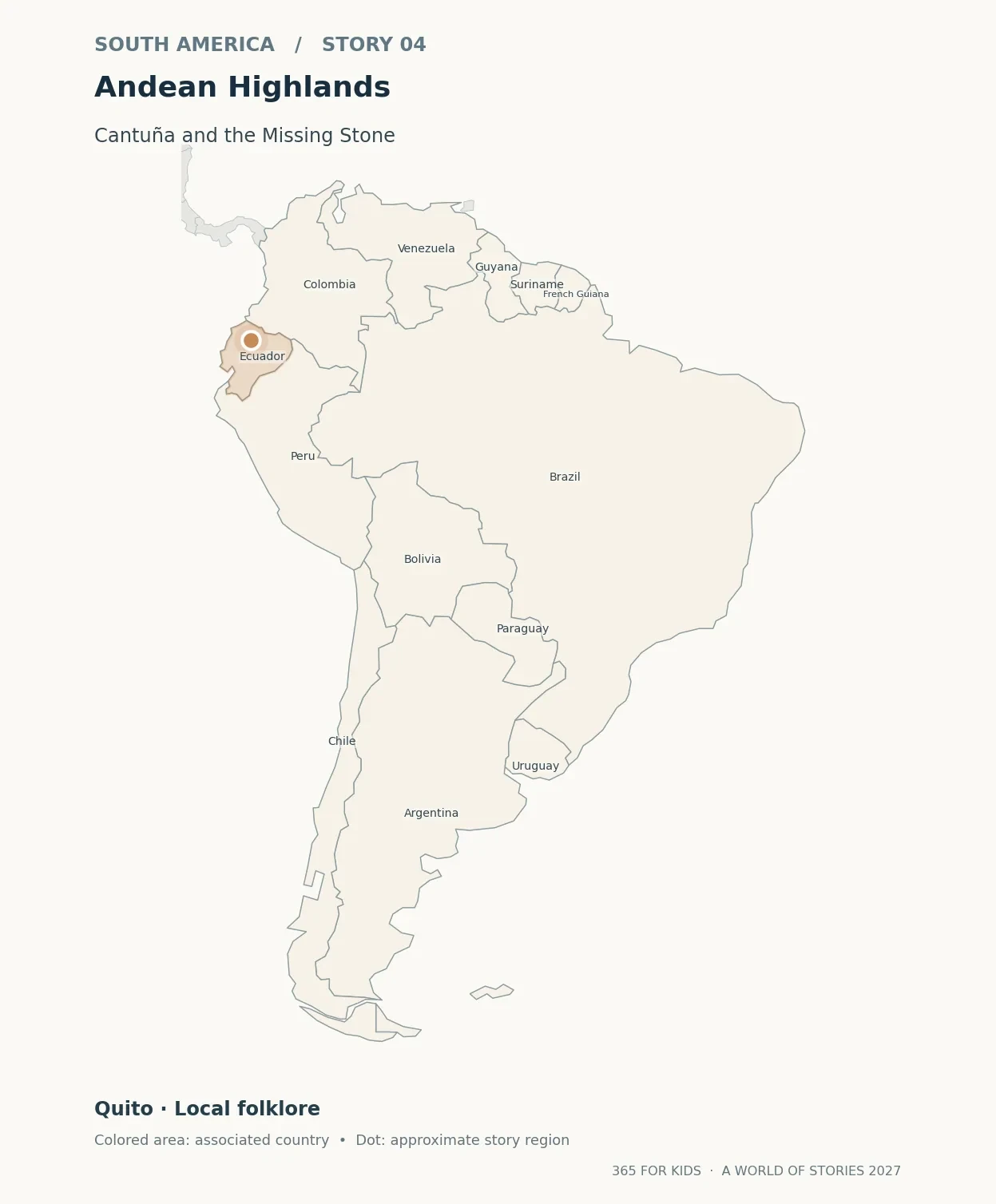
High in the Andes, in the city of Quito, stands the great Church of San Francisco. Its stone courtyard has been there for centuries. People in Quito still tell a remarkable story about how that courtyard was built. It is the legend of a man named Cantuña.
According to the tale, Cantuña had promised to complete the courtyard by a certain day. The work was difficult, and the deadline drew near. There were far too many stones left to place. As evening fell, Cantuña looked at the unfinished work and worried that he could never finish in time.
Then a mysterious visitor appeared. It was the Devil, offering a terrible bargain: his helpers would finish every last stone before dawn, but in return Cantuña must give up his soul. Cantuña knew the price was dreadful. Yet the task seemed impossible, and he agreed to the bargain.
Night settled over Quito. Soon the courtyard rang with the sound of stones being lifted and fitted into place. The Devil’s many helpers hurried back and forth. A wall rose here, a pathway appeared there, and the empty spaces vanished one by one.
Cantuña watched the stones settle into their places. He saw that the bargain was nearly fulfilled, and he began to search for a way out. Then he thought of something important: the Devil had promised to finish every single stone before the first light of morning.
While the workers were busy, Cantuña quietly slipped one stone away and hid it beneath his poncho. He kept it out of sight as the final moments of darkness passed. The courtyard looked complete. Only Cantuña knew that one small piece was missing.
At dawn the Devil returned, certain that he had won. “The work is finished,” he declared. But Cantuña pointed to the place where the stone should have been. “Not every stone,” he answered. “One is missing. You have not kept your promise.”
The Devil could not claim that the courtyard was complete. The bargain had not been fulfilled, and Cantuña kept his soul. The visitor and his helpers disappeared, leaving behind the splendid courtyard—and one empty space in the legend.
This is a well-known folk legend from Quito, Ecuador, connected with the historic Church of San Francisco and the stories people told during and after the colonial period.
After the Story: Read · Create · Reflect · Share
1. Find Quito, the capital of Ecuador, high in the Andes on the map above. How might building a stone courtyard be especially hard work in the mountains?
2. Why did Cantuña feel he had to accept the mysterious visitor’s offer?
3. What was the danger in the bargain, even though the work would be finished?
4. How did the missing stone change the ending of the story?
5. What do you think this legend suggests about promises and clever choices?
Inspired by this story? Create your illustration!
Illustration ideas:
- The historic city of Quito among the high Andean mountains, with the Church of San Francisco in the foreground.
- Cantuña standing before an unfinished stone courtyard as the sun sets.
- The mysterious night workers carrying stones across the courtyard under a moonlit sky.
- Cantuña at dawn, pointing to the empty place where one stone is missing.
ECUADOR — The Two Macaws of Cañar
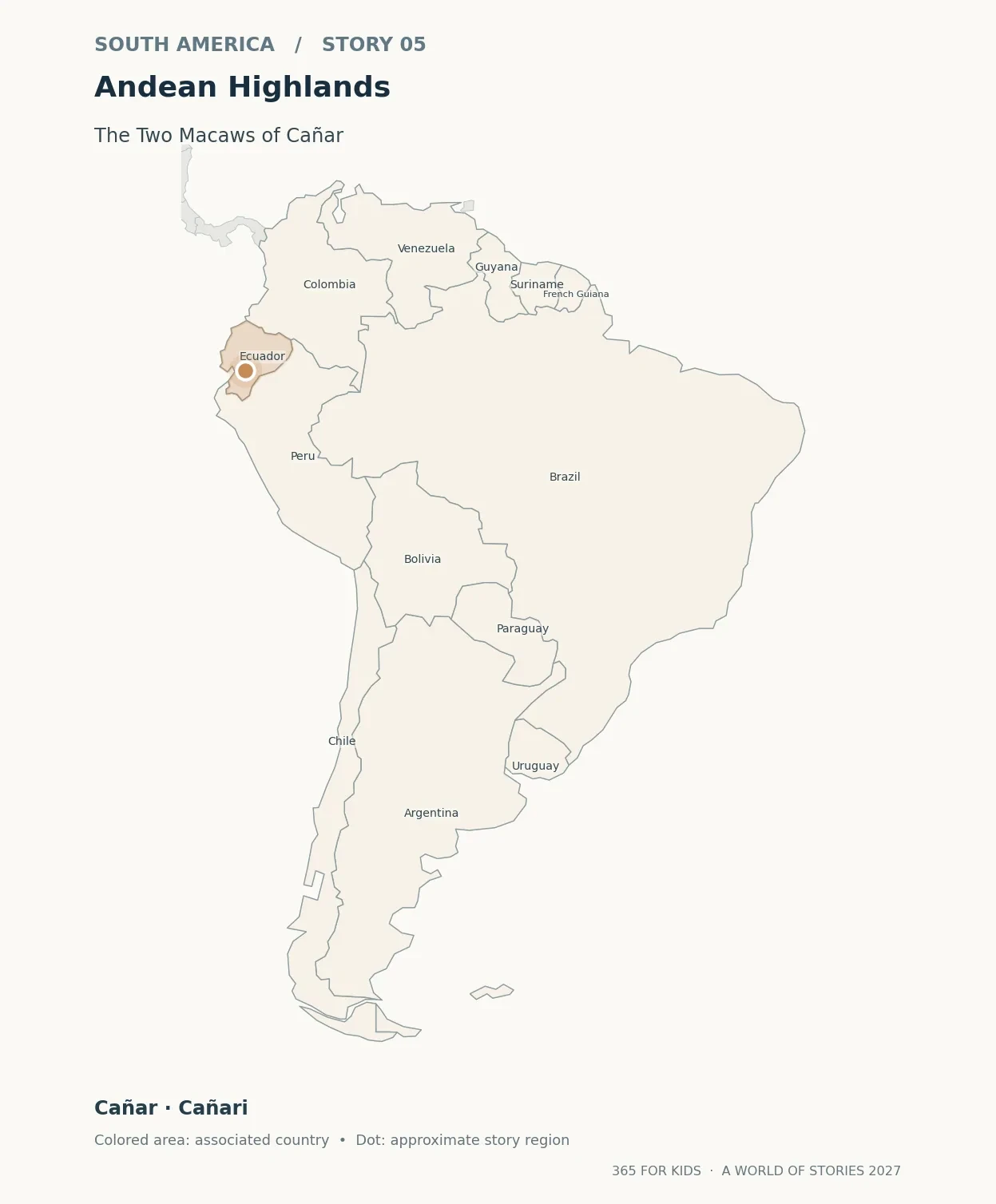
Long ago, according to a story told by the Cañari people of the Ecuadorian Andes, a great flood spread across the land. Rivers overflowed and valleys disappeared beneath the water. Two brothers climbed a mountain called Huacayñán, hoping to escape.
The water rose higher and higher. But the mountain rose too, keeping its summit above the flood. At last the rain stopped, the waters drew back, and the brothers looked down upon a changed world. They were safe, but they had almost nothing to eat.
They made a small shelter and searched the hills for roots and wild plants. One day, when they returned from their search, they found a wonderful surprise: food and a drink made from maize had been prepared for them. Yet no one was there.
The same thing happened again and again. Who was helping them? The older brother decided to stay behind and discover the answer. From his hiding place he watched two brightly feathered macaws enter the shelter. In the telling of the legend, they had the faces of women and wore clothing like the Cañari people. When the older brother stepped forward, the birds became frightened and flew away.
The younger brother was disappointed to hear what had happened. Later, he hid in the shelter himself. After several days the macaws returned. This time, when the meal was ready, the younger brother closed the entrance and caught the younger macaw while the other escaped.
The legend says that the younger macaw became his wife. Together they had children, and the children grew into families. The macaw had also brought seeds, which could be planted in the earth. As the crops grew, the families had food to share.
The descendants of these children, the story tells us, became the Cañari people. The mountain that had sheltered the brothers and the splendid macaws remained deeply important in Cañari tradition.
The Cañari are an Indigenous people of the southern Ecuadorian Andes, and their traditional origin story honors the mountain Huacayñán and the macaws connected with the beginnings of their community.
After the Story: Read · Create · Reflect · Share
1. Find the southern Andes of Ecuador on the map above, home of the Cañari people. Why might a very tall mountain be remembered as a place of safety in a flood story?
2. Why did the two brothers climb the mountain?
3. What mystery did the brothers discover when they returned to their shelter?
4. Why are the macaws and the seeds important to the ending of the legend?
5. How can a traditional story help a community remember its identity and its connection to nature?
Inspired by this story? Create your illustration!
Illustration ideas:
- Two brothers watching the floodwaters from the high summit of Huacayñán.
- A small mountain shelter with an unexpected meal waiting inside.
- Two colorful macaws wearing traditional Cañari clothing as they enter the shelter.
- A family planting seeds in the Andean valley, with the mountain rising in the distance.
PERU & BOLIVIA — The Star Who Brought Quinoa
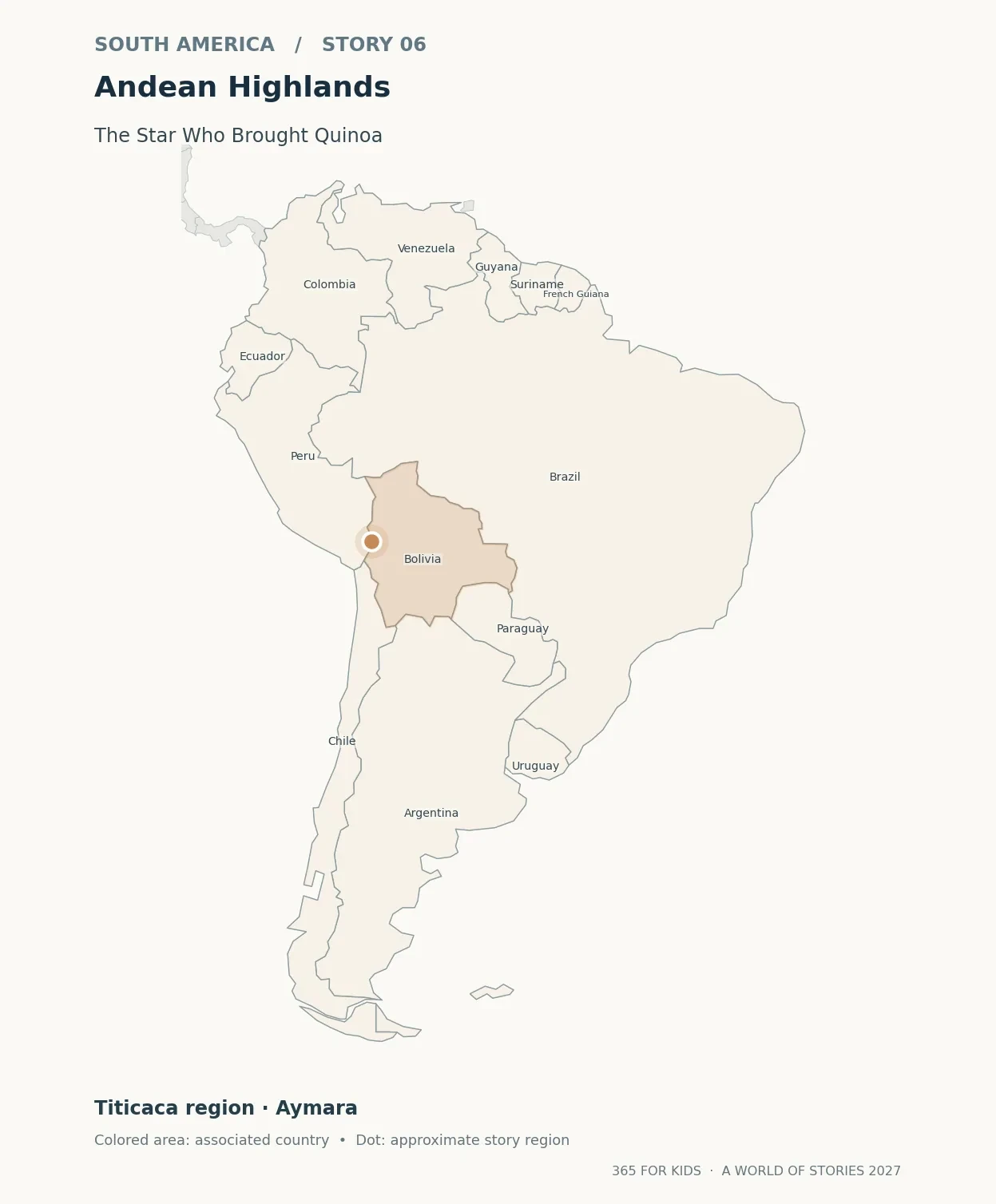
Long ago, beside Lake Titicaca in the high Andes, people told of a time when the stars could come down to Earth and speak with human beings. In the fields near the lake, families grew potatoes and watched carefully over the young plants.
One season, someone began pulling up potato plants at night. A young farmer decided to discover who was disturbing the fields. He stayed awake and watched as darkness settled over the land.
In the night, several young women appeared among the plants. The farmer hurried toward them and caught one, but the others escaped. He was astonished by the strange visitors and waited for morning to learn more.
Before the sun rose, the young woman changed into a bird. She flew upward, higher and higher, until she reached the stars. Only then did the farmer understand that she belonged to the sky.
The next day, he went to the condor, the great bird of the mountains, and asked the condor to carry him up to the place where the stars lived. The condor agreed, lifted him on its strong wings, and flew toward the heavens.
Far above Earth, the farmer found the star maiden again. He stayed with her for a time, and she gave him a food he had never tasted before: tiny grains called quinoa. They nourished him in that distant place among the stars.
Yet the farmer missed his parents and his home beside the lake. At last, he wished to return to Earth. The star maiden understood his longing. Before he left, she sent quinoa with him, a gift from the sky.
When the farmer reached his homeland, he brought the precious grains to his people. They planted the seeds in their fields, cared for the growing plants, and harvested the food that the star had shared.
This story comes from the Aymara oral tradition of the Lake Titicaca region, shared across parts of present-day Peru and Bolivia, and tells of quinoa, a grain cultivated in the Andes for thousands of years.
After the Story: Read · Create · Reflect · Share
1. Find Lake Titicaca on the map above, on the border between Peru and Bolivia. Why do you think a farmer in this story needed a condor’s help to reach the stars?
2. Why did the young farmer stay awake beside the potato fields?
3. How did he discover that the mysterious young woman belonged to the stars?
4. Why did the farmer decide to return to Earth?
5. What does the gift of quinoa suggest about the connection between people, nature, and the sky?
Inspired by this story? Create your illustration!
Illustration ideas:
- A young farmer watching the potato fields beneath a sky full of stars.
- The star maiden turning into a bird and flying toward the heavens.
- A condor carrying the farmer above Lake Titicaca and the mountains.
- Andean families sowing quinoa seeds in the sunlight, with the stars faintly visible overhead.
Amazon Basin
BRAZIL — How Night Came
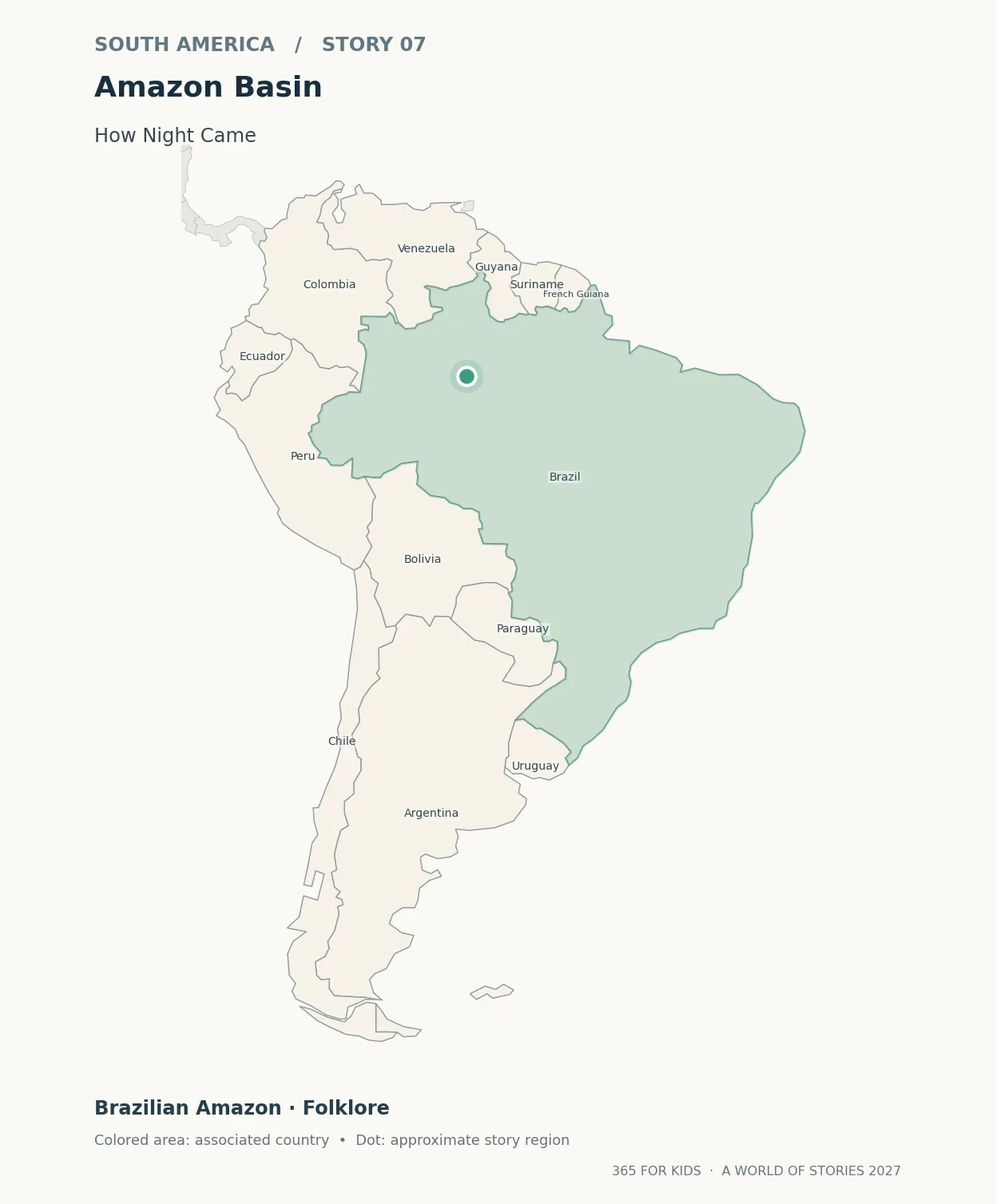
Long ago, the world knew only daylight. The sun shone without rest. No one had seen a sunset or heard a night bird call. There were no stars to watch, no moonlit paths, and no cool darkness in which to sleep.
At that time, the daughter of the Great Sea Serpent lived on land with her husband. She had grown up deep beneath the sea, where gentle shadows surrounded her father’s home. Although she loved her husband, the endless sunlight made her weary.
“How I wish night would come,” she said. “There is darkness in my father’s kingdom. If only we could have a little of it here.” Her husband had never heard of night, but he sent three travelers to the Great Sea Serpent to ask for a share of the darkness.
The Great Sea Serpent gave them a large, tightly fastened bag. “Take this to my daughter,” he said, “but do not open it before you reach her.” The travelers promised and began the journey home.
Before long, they heard strange noises coming from the bag. Something chirped. Something fluttered. One wished to leave the bag behind. Another was afraid of what might happen. But the third could not bear not knowing what was inside. They set the bag down and opened it.
All at once, darkness poured across the land. Night birds flew out, insects began to sing, and animals of the darkness hurried away. The travelers stared in astonishment as the bright world disappeared beneath a great shadow.
Far away, the daughter of the Great Sea Serpent stood beneath a palm tree. When she saw the dark sky approaching, she cried with joy, “Night has come at last!” She closed her eyes and slept. When she awoke, she felt rested and happy, and she called a bright star the morning star, asking it to announce the return of day.
The three travelers returned without their gift. In the old folktale, they were punished for opening the bag and were changed into monkeys. From then on, the world had both daylight and darkness, and that is how, in this Brazilian folktale, night first came into the world.
This folktale was recorded in Brazil more than a century ago and imagines a time before night existed, explaining the calls of night animals, the songs of morning birds, and the first dawn.
After the Story: Read · Create · Reflect · Share
1. Find the Amazon Basin of Brazil on the map above. What night sounds and creatures does this story imagine spilling out across the forest?
2. Why did the daughter of the Great Sea Serpent wish for night?
3. What warning did the travelers receive, and why did they ignore it?
4. How did the world change when the bag was opened?
5. Which part of the story would you most like to share with someone else, and why?
Inspired by this story? Create your illustration!
Illustration ideas:
- A bright world where the sun never sets and the sea serpent’s daughter longs for shadows.
- Three travelers carrying a mysterious sealed bag along a forest path.
- Night birds and insects spilling out as darkness spreads over the trees.
- The morning star shining above a palm tree while birds welcome the dawn.
BRAZIL — The Girl Who Became a Water Lily
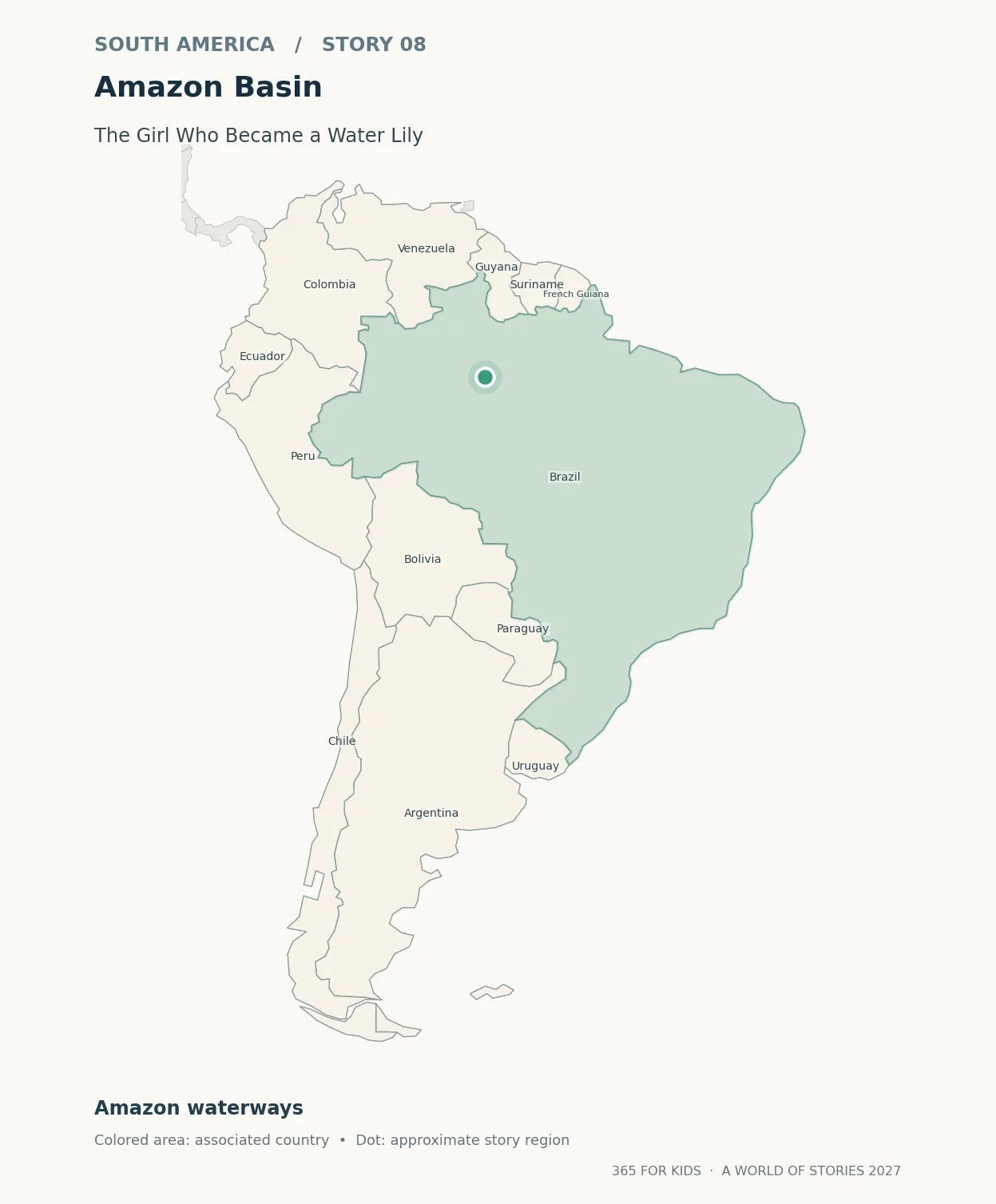
Long ago, beside the rivers of the Amazon, people told a story about a young girl named Naiá. Each evening, as daylight faded and the forest grew quiet, Naiá looked up at the moon. She had heard that the moon could lift a girl into the sky and make her shine among the stars.
Naiá loved the stars. They glittered above the dark trees like tiny lanterns. She wished to join them, to look down upon the winding rivers and the green forest from high above.
Night after night, she followed the moon with her eyes. Her family and friends missed her company and called her back to the village, but Naiá kept watching the heavens, certain that one day the moon would notice her longing.
One still night, she came to a quiet pool beside the river. There, on the dark water, she saw a shining circle: it was the moon’s reflection, round and bright, trembling gently among the ripples.
Naiá believed the moon had finally come close enough to touch. She stepped toward the light. Reaching for it, she fell into the deep water. The river closed over her, and Naiá did not return.
High above the forest, the moon looked down and saw what had happened. In the old legend, the moon felt sorrow for the girl who had dreamed of becoming a star. Although Naiá could no longer live among her people, the moon chose to honor her wish in another way.
Instead of placing her in the sky, the moon made her a star of the water: a great water lily, with broad round leaves that floated on the river and a beautiful flower that opened beneath the night sky.
When the moon shone across the river, the flower rested among the silver reflections, and the people remembered Naiá whenever they saw the water lily blooming on the quiet water.
This Amazonian legend, often told as the story of Naiá, is associated with Tupi-Guarani storytelling in Brazil and offers a poetic explanation for the giant water lily that grows in South American rivers and wetlands.
After the Story: Read · Create · Reflect · Share
1. Find the rivers of the Amazon Basin on the map above. Why do you think a story about reaching the stars might end instead at the edge of a quiet river?
2. What did Naiá hope would happen when she watched the moon?
3. Why did Naiá think the moon had come close to her at the river?
4. How does the legend explain the giant water lily?
5. If you could give a new name to the water lily, what would it be, and why?
Inspired by this story? Create your illustration!
Illustration ideas:
- Naiá standing beside an Amazon river, watching the moon above the forest.
- The moon reflected in a still pool beneath a sky full of stars.
- A giant water lily with broad floating leaves and a flower opening at night.
- The moonlight turning the river into a path of silver around the water lilies.
BRAZIL — The Jaguar’s Fire
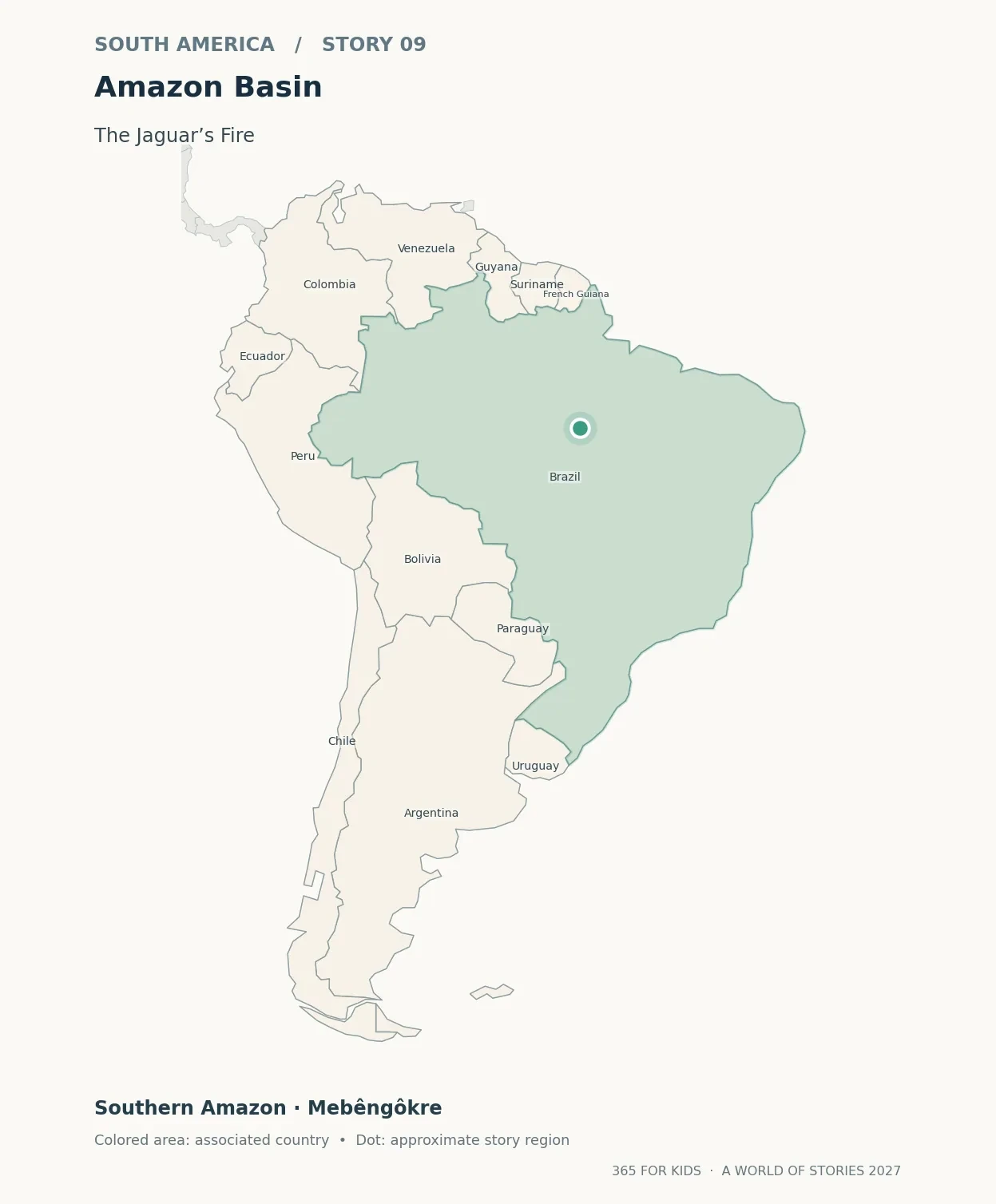
Long ago, the people of a forest village had no cooking fire. They ate their food without roasting it, for they did not yet know the warmth and taste of a cooking hearth.
One day a young boy named Botoque went with his older brother-in-law to a high rocky place where bright macaws had made their nest. The older man leaned a long pole against the rock so the boy could climb, but Botoque could not bring down the young birds. The man below grew angry, pulled away the pole, and walked home, leaving the boy alone on the high ledge.
The sun passed overhead. The forest grew dark and bright again. Botoque waited, hungry and frightened, but no one came to help him.
At last a jaguar passed beneath the rock. Seeing the boy’s shadow, the great animal looked up. Botoque trembled at the sight of its spotted coat and powerful paws. But the jaguar spoke kindly and raised the pole so the boy could climb down. “Come to my home,” the jaguar told him. “There is food there.”
Inside the jaguar’s home, a great log glowed with red fire, and meat roasted over the heat lay on the hearth. Botoque had never tasted anything like it. But the jaguar’s wife did not welcome him, and when her husband went hunting, she frightened Botoque and refused him food.
The jaguar gave Botoque a bow and arrows so he could protect himself. When the wife threatened him once more, he defended himself, and she was killed. Afraid to remain, Botoque left the house, taking a piece of roasted meat and the bow with him.
At last he found his way back to the village and told everyone about the jaguar’s home, the glowing log, and the wonderful taste of cooked food. The villagers traveled to the jaguar’s house while he was away, carried off the burning wood, and brought its glowing embers back to the village.
Soon cooking fires warmed the houses, and food could be roasted over the flames. But the jaguar had lost his fire. From that time on, the old story says, people cooked their food, while the jaguar ate his meat raw.
This traditional story is told among the Kayapó, also called Mebêngôkre, an Indigenous people of Brazil, and explains how cooking fire came into human hands.
After the Story: Read · Create · Reflect · Share
1. Find the Amazon Basin of Brazil on the map above, home of the Kayapó people. Why would learning to make fire change daily life for a whole village?
2. Why was Botoque left alone on the high rock?
3. What did Botoque discover at the jaguar’s home?
4. How did fire finally reach the village?
5. What choices in this story show kindness, fear, or unfairness?
Inspired by this story? Create your illustration!
Illustration ideas:
- A bright pair of macaws flying above a high rocky nest in the forest.
- The jaguar looking up at Botoque on the ledge, with a long climbing pole below.
- A glowing log and cooking hearth inside the jaguar’s forest home.
- The villagers carrying burning wood carefully along a forest path toward their village.
PERU — The Tree That Held the Water
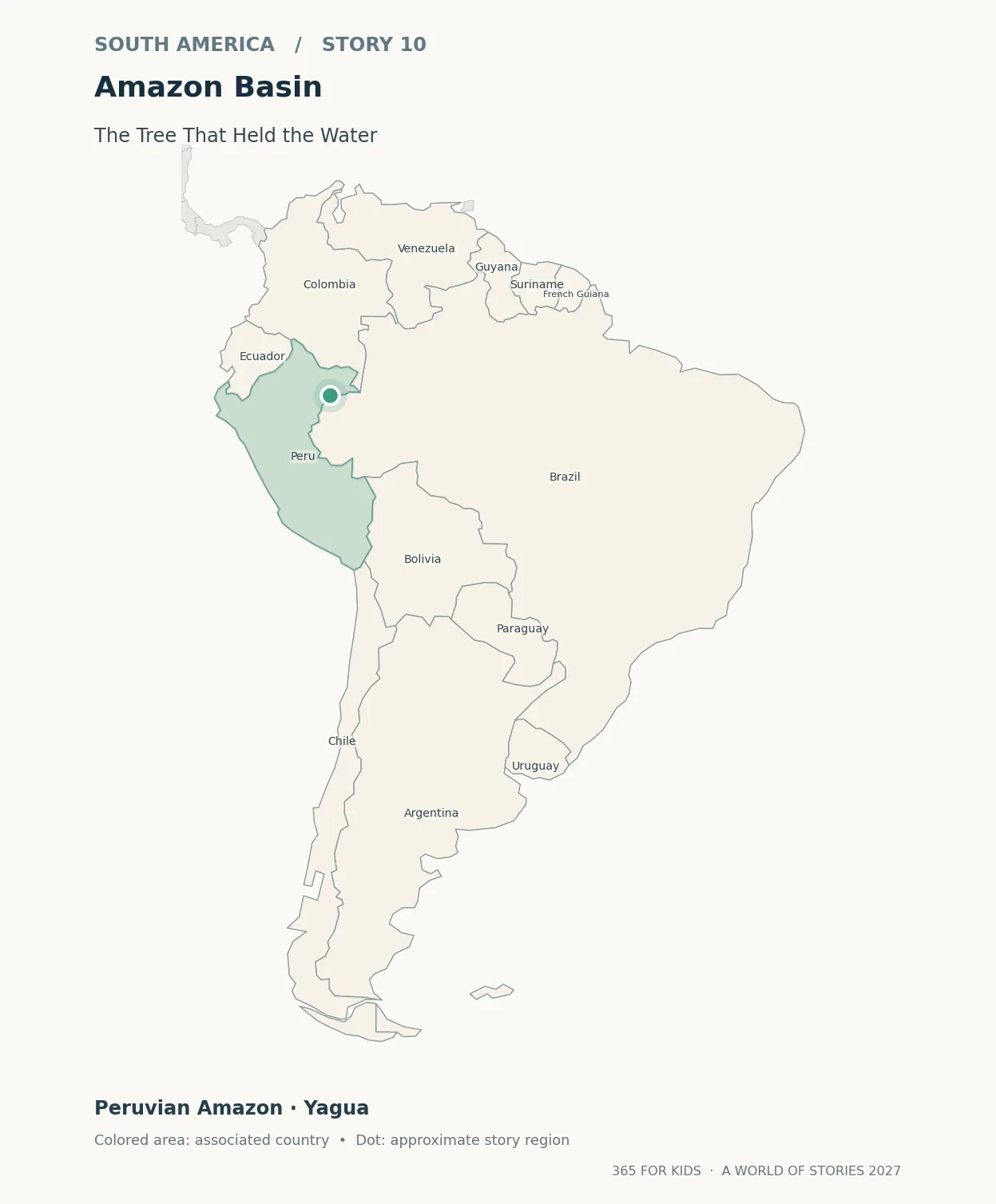
Long ago, in a story told by the Yagua people of the Amazon, water was not free to flow through the forest. An old grandfather kept it hidden, and the people received only what he chose to give them. Each day, they carried small amounts of water in jars.
Two brothers grew tired of the long journeys and the little water they could bring home. They wondered where the grandfather found his supply. Surely so much water must be hiding somewhere.
The younger brother changed himself into a hummingbird and followed the old man through the forest. He watched as the grandfather approached an enormous tree, opened a place in its trunk, and stood beneath a stream of fresh water flowing from inside.
Now the brothers knew the secret: a great tree was holding the water. They decided to bring it down so that everyone could drink. They asked woodpeckers, squirrels, and other creatures that could cut or gnaw to help them, and together they worked at the trunk until evening.
But when they came back the next morning, the tree was whole again. Every chip and splinter seemed to have returned to its place. The younger brother went to discover what had happened, and saw the grandfather holding a vine with his foot, keeping the enormous tree from falling.
The younger brother became a scorpion and stung the grandfather’s little toe. The great tree shuddered and leaned, but still it did not fall. So the brother became a red scorpion and stung him again. At last the grandfather lifted his foot and let go of the vine.
With a mighty crash, the tree fell across the land. Its huge trunk became the great river. Its branching limbs became the smaller waterways running into it. Leaves and wood chips turned into fish, filling the new waters with life.
The grandfather was upset that the brothers had cut down his tree, but they explained that they had done it so that the many people who would come after them could have water to drink.
The Yagua are an Indigenous people of the western Amazon, especially in Peru, and in one telling of this longer traditional story the fallen tree becomes the great Amazon River, its branches smaller streams, and its leaves fish.
After the Story: Read · Create · Reflect · Share
1. Find the Amazon Basin of Peru on the map above. How does this story imagine one single tree becoming an entire river system?
2. Why did the brothers want to discover where the water was kept?
3. How did the hummingbird help them find the secret of the tree?
4. What happened when the great tree finally fell?
5. Why might sharing water matter to everyone living in a forest?
Inspired by this story? Create your illustration!
Illustration ideas:
- The younger brother as a tiny hummingbird beside a giant tree with water pouring from its trunk.
- Woodpeckers, squirrels, and other forest creatures working together around the enormous tree.
- The grandfather holding a vine as the tree begins to lean.
- The fallen tree transforming into a broad winding river, with its branches becoming streams and its leaves becoming fish.
COLOMBIA — Yuche and the First Ticuna People
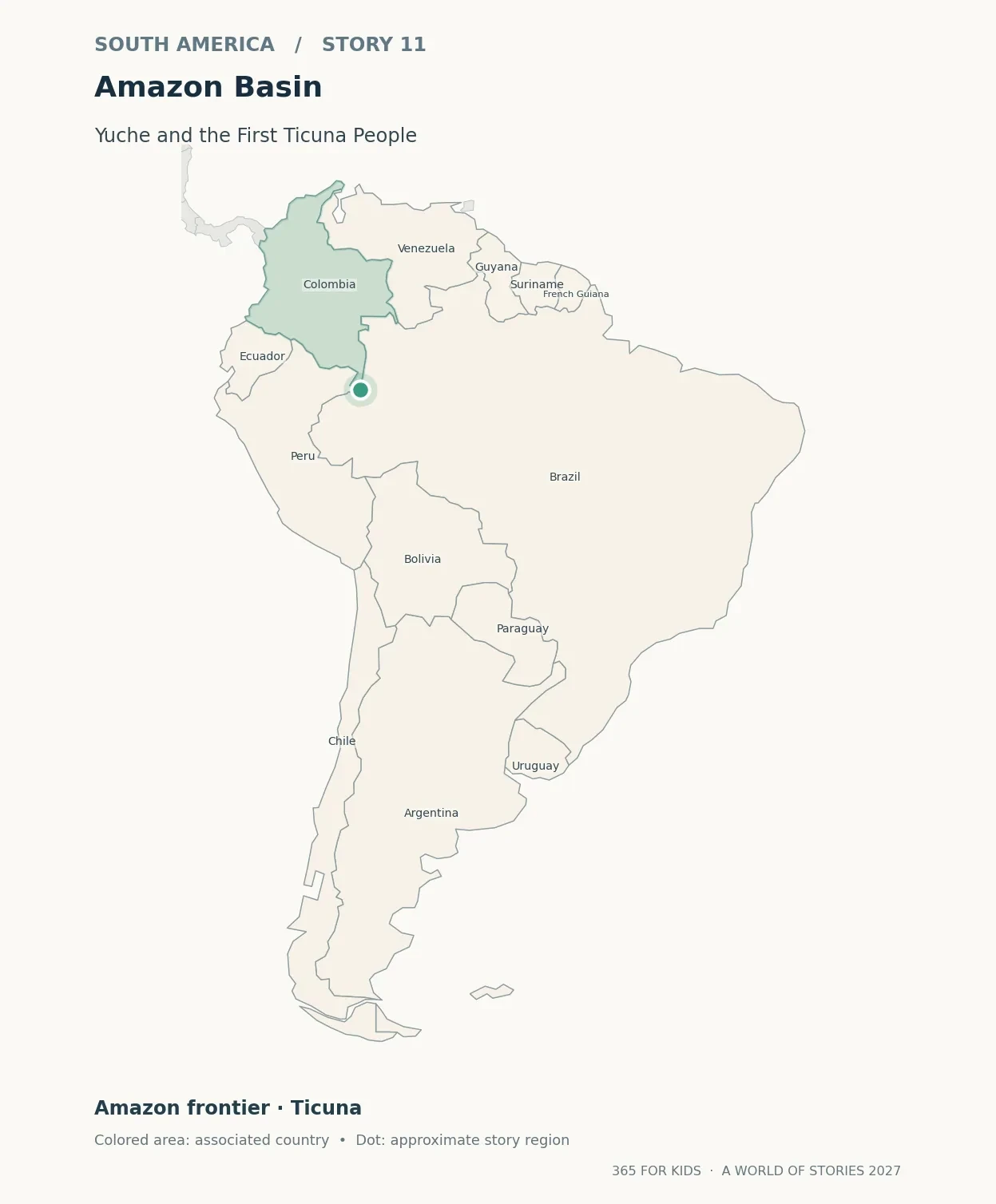
Long ago, the story says, Yuche lived alone in a beautiful clearing deep in the Amazon forest. A little house stood near a stream, where the sand was fine and the water ran clear. Birds called from the branches, monkeys moved through the trees, and crickets sang when the forest grew quiet.
Yuche had known this place for as long as he could remember, but he had no other person to speak with, no one to share his memories or his hopes.
One morning he went to the stream to wash his face. When he bent over the still water, he saw his reflection and noticed, for the first time, how old he had become. “If I am gone,” he wondered, “who will be here to live in this beautiful place?”
Along the path home, a sharp pain suddenly struck his knee. By the time he reached home, he was so tired that he lay down and fell asleep. That night Yuche dreamed a strange dream, feeling himself growing older while new beings seemed to be coming into the world.
When he awoke, his knee still hurt and had become swollen, the skin almost as clear as the stream. To his amazement, Yuche could see two tiny people inside his knee: one a man working with a bow, the other a woman weaving a hammock.
“Who are you?” Yuche asked. “How did you come to be here?” The two small figures looked toward him but did not answer, and went on with their work. As Yuche struggled to stand, he fell against the earth.
At that moment, his knee opened and the two little people stepped out. Before his eyes they grew taller and taller, until they were the size of adults. As they grew, Yuche’s life came to an end. But the forest was no longer without people.
The man and woman stayed for a time in the lovely clearing beside the stream, and in the years that followed they had children. According to the tradition, these were the first Ticuna people, and their descendants spread through the Amazon.
The Ticuna, also written Tikuna, are an Indigenous people whose communities live in the Amazon region of Colombia, Brazil, and Peru; this origin story has been passed on in different retellings, including a version collected by Colombian writer Hugo Niño.
After the Story: Read · Create · Reflect · Share
1. Find Ticuna lands in the Amazon Basin of Colombia on the map above. What does the forest clearing in this story suggest about how a people might remember their own beginning?
2. What did Yuche notice when he looked at his reflection in the stream?
3. What were the two tiny people doing when Yuche first saw them?
4. What happened after the first man and woman came into the forest?
5. Why might a story about the beginning of a people be important to a community?
Inspired by this story? Create your illustration!
Illustration ideas:
- Yuche’s quiet home in a forest clearing, with a stream, birds, monkeys, and tall trees.
- Yuche seeing his older face reflected in the clear water of the stream.
- A magical, gentle illustration of the two tiny people weaving a hammock and working with a bow, as Yuche looks on in wonder.
- The first Ticuna family setting out along a river path to discover new lands beyond the forest.
BRAZIL — The First Guaraná
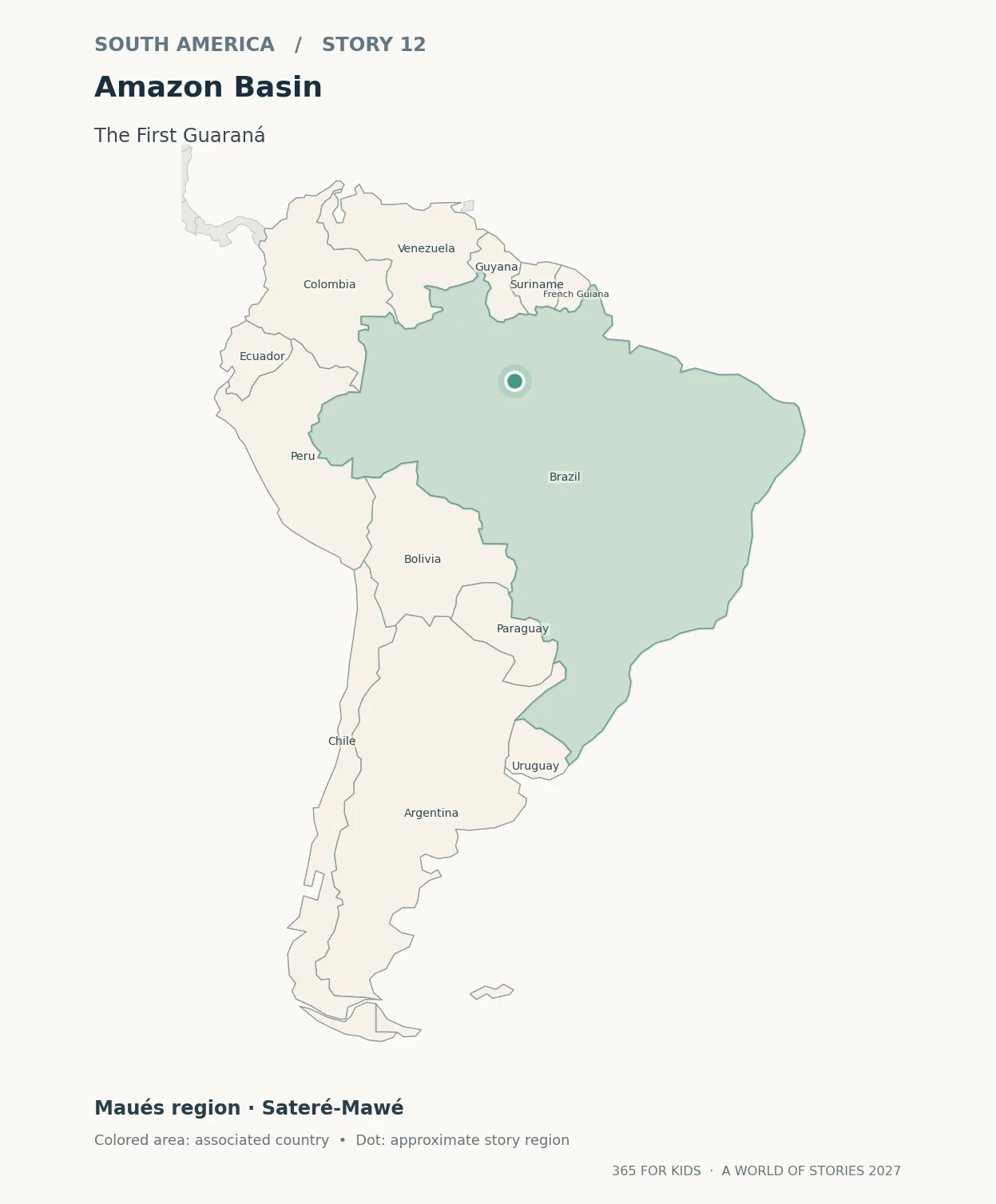
Long ago, according to a story told by the Sateré-Mawé people, there was a wondrous place called Nusoken. Trees grew tall there, and the forest offered many gifts. A woman named Onhiámuáçabe cared for this place and knew its plants well.
Onhiámuáçabe had a little son whom she loved dearly. As he grew, he became curious about the forest around him, listening to the birds and watching the small animals at work.
But his uncles were angry with his mother, and they did not want the boy to enter a special part of the forest. They told an agouti, a small forest animal, to guard the place and keep him away.
One day the boy went into the forbidden place and found a beautiful tree. He reached toward its gifts, not knowing the danger that waited nearby. A snake bit him, and the child died. When his mother found him, her heart filled with grief.
Onhiámuáçabe mourned her son, yet in her sorrow she imagined that his life might bring something precious to others. In the old telling, she planted one of his eyes in the earth. A plant grew, but it was not the true guaraná.
Then she planted his other eye. From that place a different plant appeared: the first true guaraná. When its fruit ripened and opened, the dark seed inside a pale covering looked remarkably like a little eye.
Onhiámuáçabe wished that the new plant would give strength and help to the people who would come after him. The story also tells that from the boy came the first Sateré-Mawé people, whose lives, like the guaraná plant, would belong to this land.
Many years passed. Families learned to prepare guaraná and share it when they gathered to speak and listen to one another, and the small seed became part of their everyday life and their deepest stories.
The Sateré-Mawé are an Indigenous people of the Brazilian Amazon, especially around the Andirá and Marau rivers, who have cultivated guaraná for generations and call themselves the children of guaraná.
After the Story: Read · Create · Reflect · Share
1. Find Sateré-Mawé lands along the Andirá and Marau rivers on the map above. Why might a plant people have cultivated for generations also be part of their story of how they began?
2. What place did Onhiámuáçabe care for, and what did her son love to explore?
3. What happened when the boy entered the guarded part of the forest?
4. How did the first true guaraná plant appear in the story?
5. Why might people share a story about a plant that is important in their community?
Inspired by this story? Create your illustration!
Illustration ideas:
- Nusoken as an enchanted Amazon forest, with towering trees, birds, and winding paths.
- The curious boy watching an agouti near a special tree in the forest.
- The first ripe guaraná fruit opening to show its dark seed and pale covering.
- A Sateré-Mawé family sharing a bowl of prepared guaraná while elders tell the story.
ECUADOR — The Two Brothers and the Moonlight
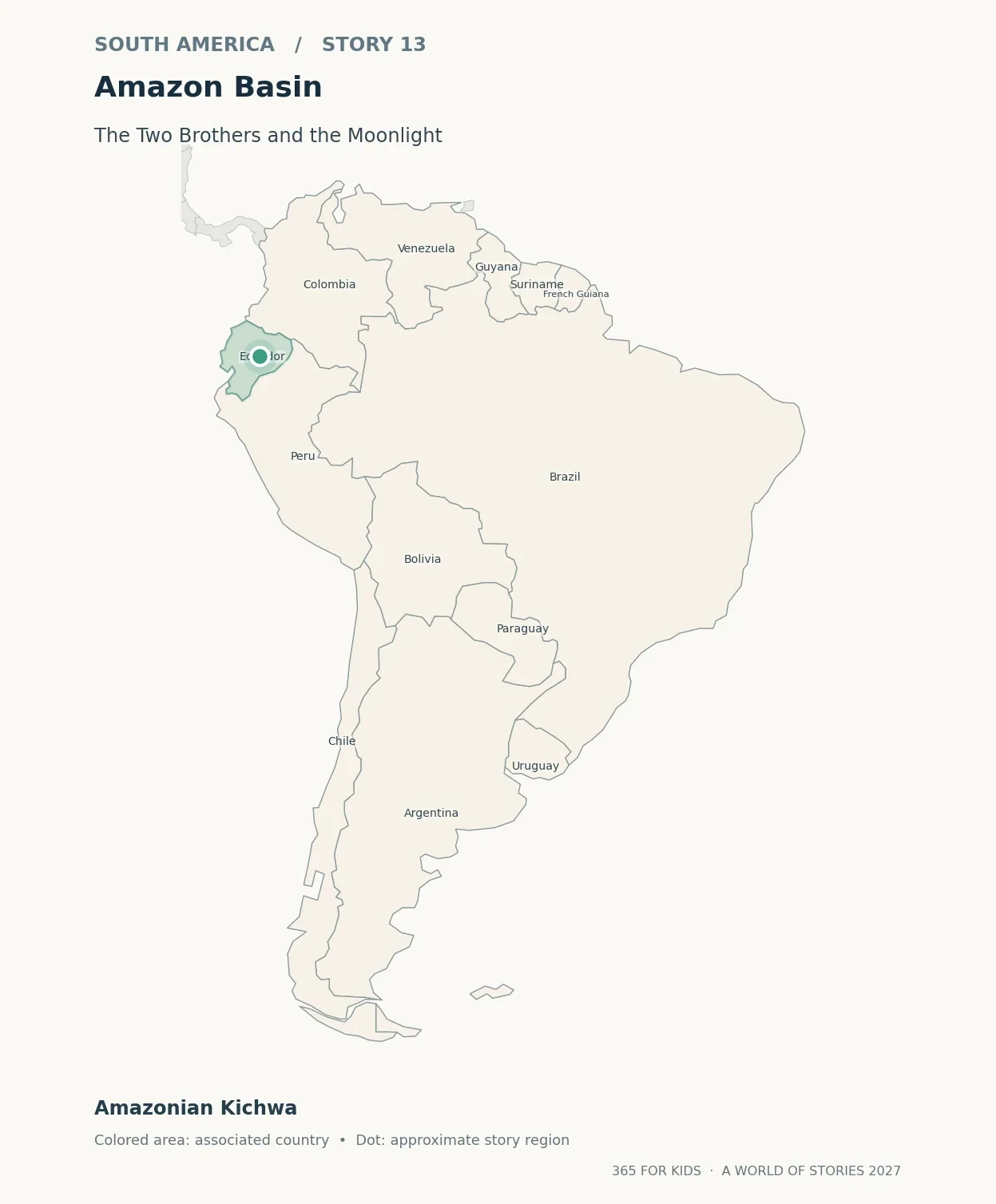
Long ago, in a story told among the Kichwa people of the Ecuadorian Amazon, families lived close to a great forest. The trees gave shade, the rivers carried water, and the mountains rose beyond the green canopy. Yet the people had a worry they could not set aside: dangerous pumas moved through the forest.
The villagers called upon Killa, the Moon, and asked for help. Killa did not send a wall to surround the village or a storm to drive away the animals. Instead, the answer came in the form of two children: a young woman was given two sons, named Kuyllur and Dužiru, also called Lucero.
The boys grew with a purpose that was larger than either of them knew. One day, they would help the people face the danger in the forest. But how could two young people stop such powerful animals? They did not need to be stronger — they needed to be clever, to move quickly, and to work together.
The brothers led the pumas toward a cave. Dužiru went in first, and the pumas rushed after him. He was so swift that he escaped and closed the rear opening with a heavy stone. At the other end of the cave, Kuyllur closed the entrance with another stone.
Now the pumas could not follow the brothers back into the forest. The two entrances were blocked, and the animals remained inside the mountain. The people who had asked Killa for help would no longer meet those pumas on the paths outside.
Night came, and the forest changed its voice. Day birds fell quiet. Insects began their evening chorus. Above the treetops, the Moon shone over the dark slopes of the Napo mountains.
Killa sent down a ray of moonlight for the two brothers. Following its silver brightness, Kuyllur and Dužiru rose from the earth to join the Moon in the sky. Their work in the forest was finished, but the story of their courage was not.
The people looked upward. The brothers were no longer walking among the trees, yet the night sky held a reminder of them. And when the Moon lit the mountains, there was another sound to remember: the hungry roars of the pumas deep inside the cave.
The Kichwa people of Ecuador’s Amazon region share stories that connect forests, mountains, animals, and the night sky; Killa is the Moon in this legend, recorded from Amazonian Kichwa communities near the Napo region.
After the Story: Read · Create · Reflect · Share
1. Find the Napo region of the Ecuadorian Amazon on the map above. Why do you think this story connects two brave brothers with the Moon shining over the mountains at night?
2. Why did the villagers ask Killa for help?
3. How did Kuyllur and Dužiru work together to stop the pumas?
4. What happened when Killa sent the ray of moonlight?
5. What do you think this story teaches about courage and cooperation?
Inspired by this story? Create your illustration!
Illustration ideas:
- An Amazonian village among trees and rivers, with distant mountains beneath the Moon.
- Kuyllur and Dužiru planning together outside the cave while the pumas approach.
- The two brothers sealing the opposite cave openings with large stones.
- A silver ray of moonlight reaching down to the brothers as they rise toward the sky.
Northern South America & Caribbean Coast
COLOMBIA — Bachué and the Sacred Lake
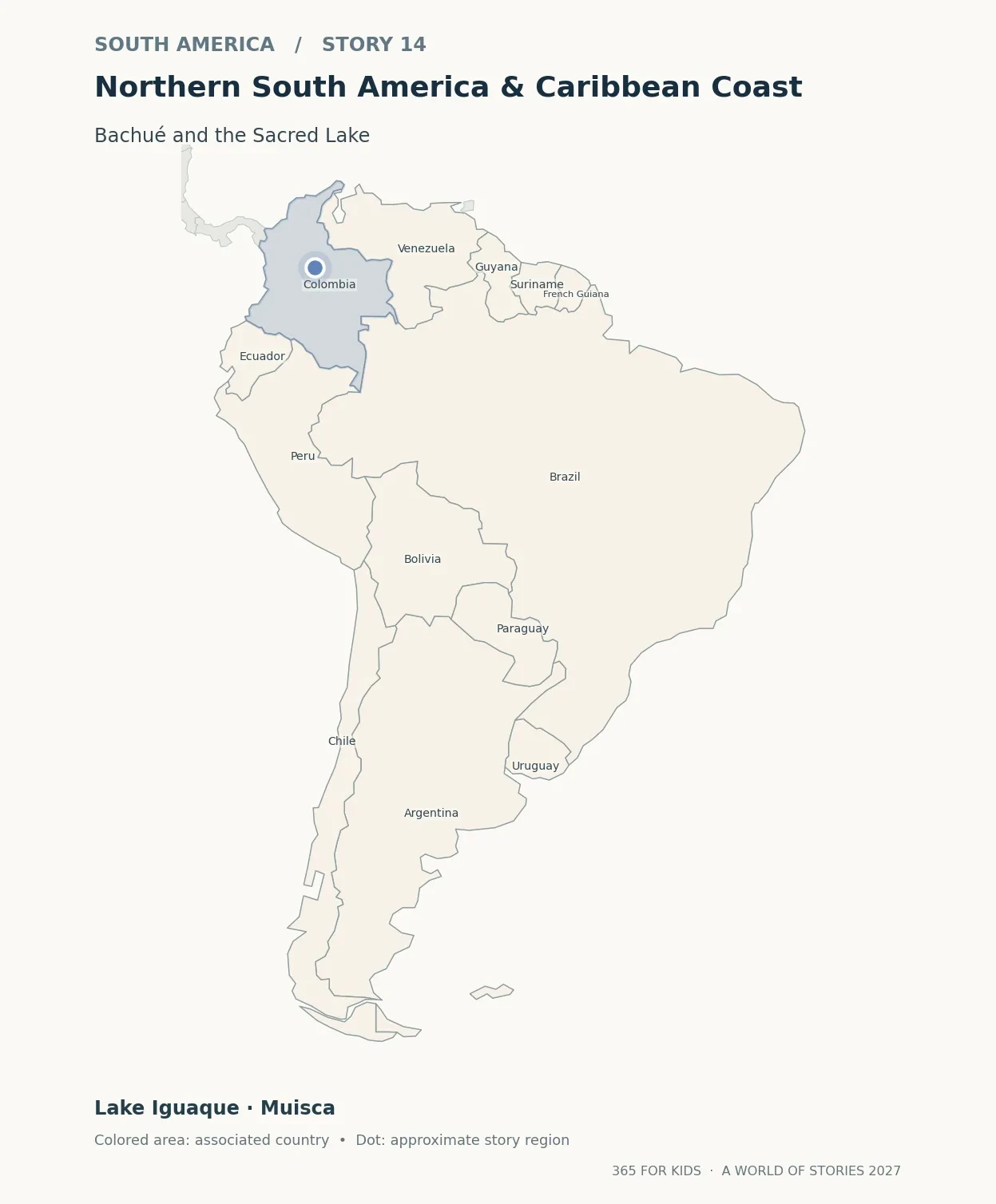
Long ago, according to a story of the Muisca people, the mountains of the land we now call Colombia rose above a quiet world. High among them lay Lake Iguaque. Mist crossed its still water, and the slopes were green with grasses and plants.
One morning the surface of Lake Iguaque stirred. Out of the water came a woman named Bachué, carrying a small boy in her arms. They stepped onto the shore together, leaving the shining lake behind them. No village stood there to welcome them, and no path showed them where to go.
Bachué and the child traveled down from the mountains and made a home. As the seasons passed, the child grew, and when he had become a man, he and Bachué began a family, as the ancient story tells. Their children grew, and the family became larger.
The families spread across the highlands, planting crops, making homes, and sharing their work. In tellings of the legend, Bachué helped her descendants learn how to live together, how to make useful things, and how to care for the world around them.
Years followed years. Bachué and her companion grew old, and looking over the many families who now lived among the hills, they knew that the time had come to return to the place where their journey had begun.
They set out for Lake Iguaque. The people followed them through the mountains, sad to see them go. Before leaving, Bachué spoke to her descendants, asking them to live in peace with one another and to respect the world that sustained them.
Then Bachué and her companion took each other’s hands and stepped into the lake. As the old legend tells it, they changed into two great serpents, their long bodies slipping beneath the surface until only the ripples remained.
Bachué had returned to the lake from which she first appeared. Yet her story remained with the families of the highlands, who remembered a beginning, a journey, and the hope that people would live in harmony with one another and with the earth.
The Muisca people belong to the highlands of present-day Colombia, where Lake Iguaque is a sacred place, and this legend tells of the beginning of the Muisca people and Bachué’s return to the lake as a serpent.
After the Story: Read · Create · Reflect · Share
1. Find Lake Iguaque in the Colombian highlands on the map above. Why might a people remember a lake as the very place where their story began?
2. Where did Bachué and the young boy first appear?
3. How did the land change as Bachué’s family grew?
4. What did Bachué ask her descendants to remember before she returned to the lake?
5. Why do you think the lake and the two serpents are important images in this story?
Inspired by this story? Create your illustration!
Illustration ideas:
- Bachué emerging from misty Lake Iguaque with a small child in her arms.
- A mountain valley where new homes and families appear among the green hills.
- Bachué speaking to a gathering of people beside the sacred lake.
- Two great serpents gliding into the lake as the mountain water reflects the sky.
COLOMBIA & VENEZUELA — Wale’kerü, the Weaving Spider
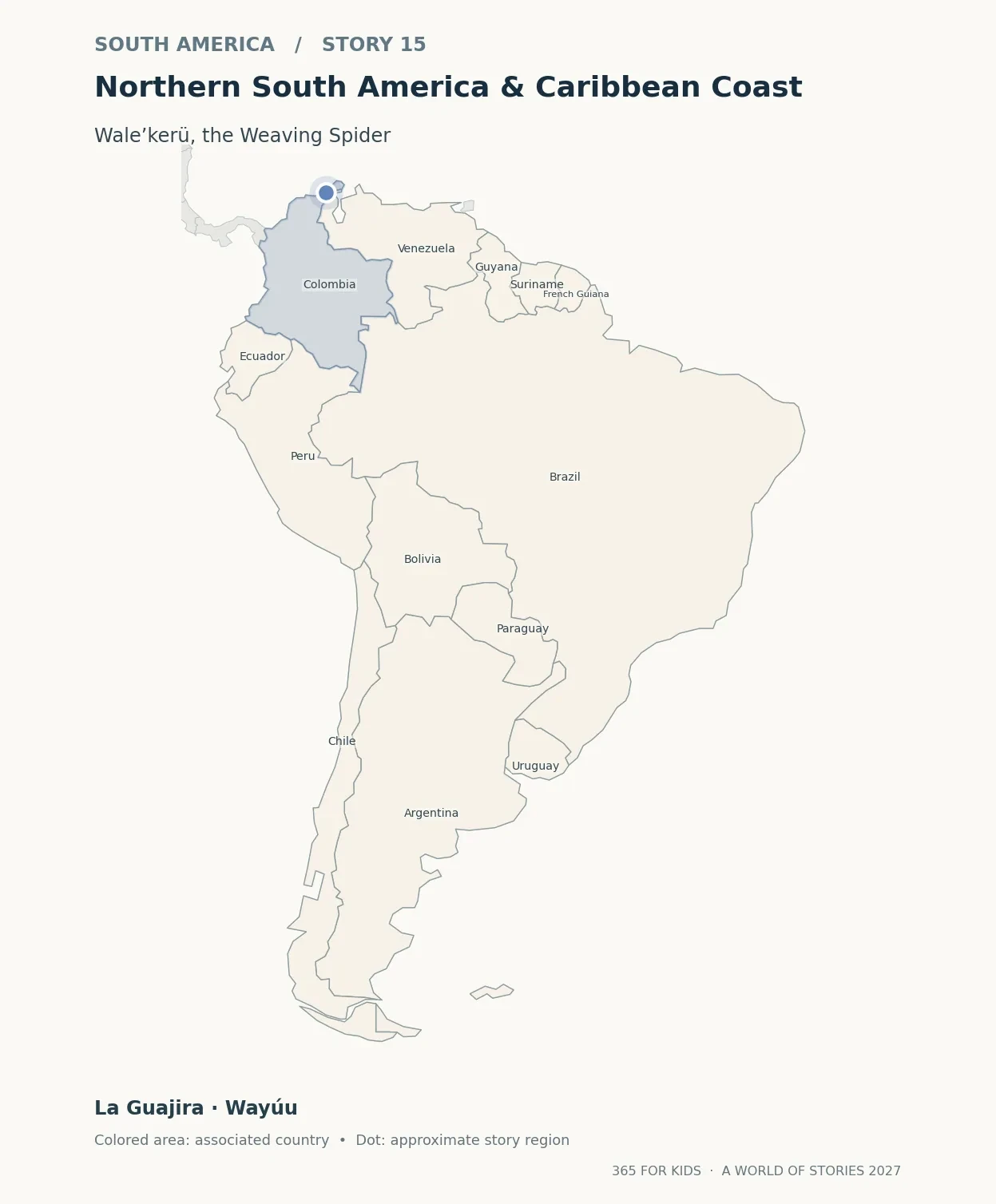
On the Guajira Peninsula, where the dry land meets the Caribbean Sea, the Wayúu people have long made beautiful things with thread. Their woven bags, belts, and hammocks carry patterns that speak of the world around them. An old Wayúu legend tells how the art of weaving was first taught to people.
The teacher in this story was not an ordinary person. Her name was Wale’kerü, and she was a remarkable spider. While others slept, she worked with astonishing skill. By morning, a woven belt or a hammock could be ready, its threads crossing neatly in ways that seemed almost impossible.
One telling of the legend says that Wale’kerü lived for a time among a Wayúu family. When she was given cotton to weave, the cotton disappeared into her mouth, and from it came a fine, twisted thread, ready for her work.
With this thread, Wale’kerü wove belts and hammocks carrying shapes and designs that people had never learned to make before. But she did not keep her knowledge to herself: she began to teach the Wayúu women, who in turn passed the knowledge to others.
Wale’kerü asked those who learned from her to pay attention — to watch how the thread moved, how one strand crossed another, and how a pattern slowly took shape. Learning was not a matter of a single moment; it took patience, practice, and the willingness to try again.
The patterns came to be known as kanas, or kanaas. Their geometric shapes could recall features of the land, the living world, and the experiences of the Wayúu people, so that a woven piece was more than something useful: it could also carry meaning.
As time passed, weaving became knowledge shared from one generation to the next. People made hammocks for resting and bags for carrying their belongings, and each maker brought care and skill to the work.
So the legend of Wale’kerü is still remembered. According to the story, it all began with an extraordinary spider who showed people what patient hands and threads could do.
The Wayúu people live on the Guajira Peninsula in present-day Colombia and Venezuela, where weaving is an important part of cultural life and many designs have names and meanings of their own.
After the Story: Read · Create · Reflect · Share
1. Find the Guajira Peninsula, shared by Colombia and Venezuela, on the map above. How can a pattern woven into cloth carry a story the way a spoken tale does?
2. Who was Wale’kerü, and what special skill did she have?
3. What did the people learn by watching how Wale’kerü worked?
4. Why do you think patience and practice matter when someone learns a craft?
5. How can a pattern in a piece of cloth tell a story about a place or a community?
Inspired by this story? Create your illustration!
Illustration ideas:
- Wale’kerü the spider weaving shining threads beneath the night sky.
- A loom or weaving frame with colorful geometric patterns slowly appearing.
- A Wayúu learner watching closely as the spider demonstrates how threads cross.
- A collection of woven bags, belts, and hammocks decorated with different kanas patterns.
COLOMBIA — The Mother and the Nine Soils
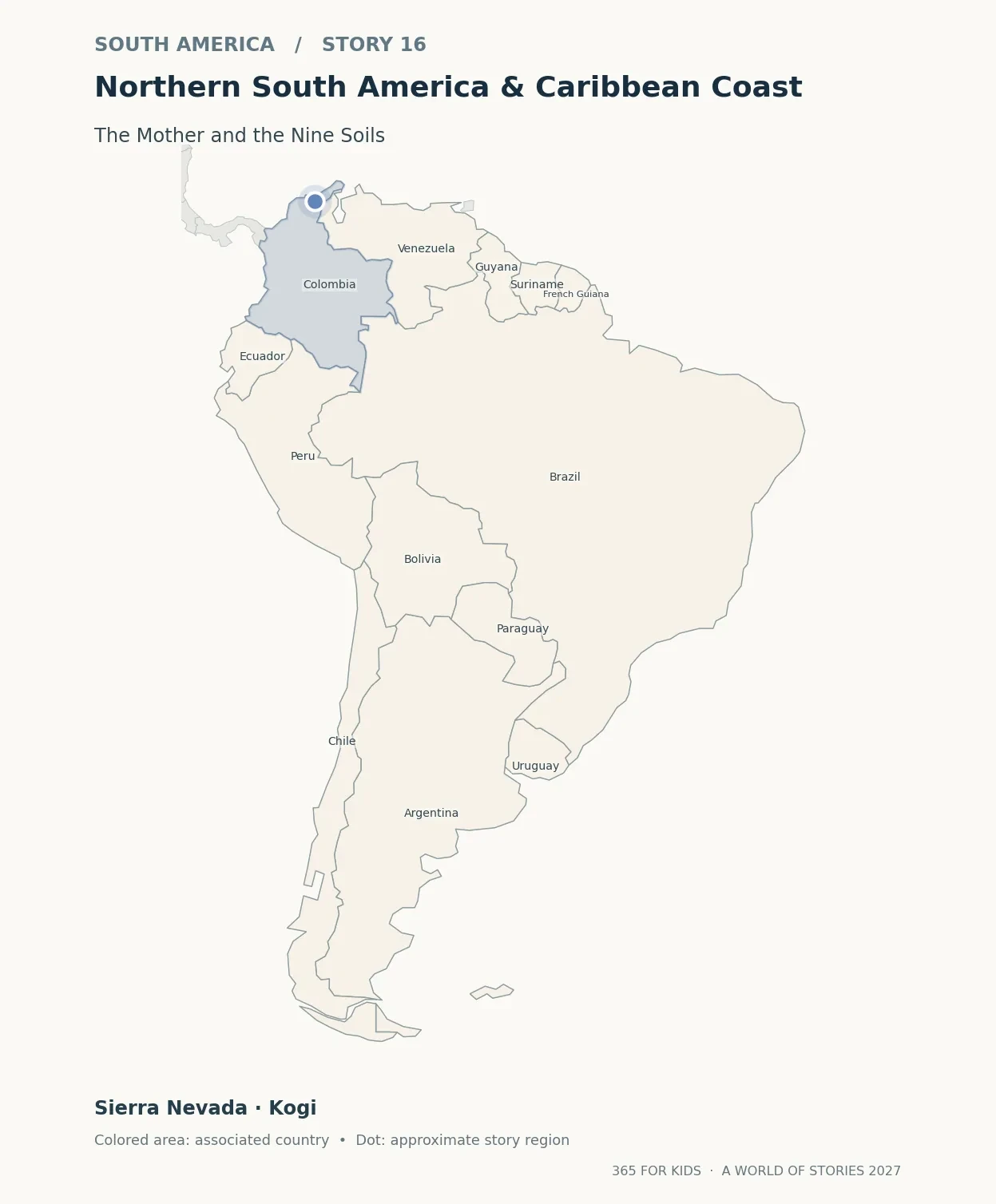
Long ago, according to a story told by the Kogi people of Colombia, water covered the world. There were no fields where food could grow. Little by little, the water was moved away, but the soil that remained was not ready for planting — some too hard, some pale and stony.
The Mother of the Earth kept nine kinds of soil. In the story, they were her nine daughters. Among them was the dark, fertile soil that could nourish seeds and help plants rise toward the sun.
The first beings went to the Mother and asked for earth in which they could plant. She gave them a pale soil, and they spread it over the ground and tried to grow food, but nothing came of their work. They returned and asked again, and again, learning each time that not every kind of ground could feed a village.
The Mother still held back the best soil, keeping the dark earth hidden deep inside her house, beyond a series of rooms. It was the earth they needed, but they could not reach it.
Then Seraira and Kimaku began to make music. They played their instruments and sang as beautifully as they could, and their music drifted through the rooms of the house, reaching places their footsteps could not.
At last the daughter who was the fertile black soil heard the music and came out of her hiding place. Seraira and Kimaku took the dark earth with them and carried it out into the world.
They spread the soil across the land and planted once more. This time the seeds grew. Food rose from the ground, and the earth could support life.
That is why, in this Kogi telling, good soil is not an ordinary thing. It is a gift that allows people to plant, harvest, and live, remembered through both patience and the power of music to bring change.
The Kogi, also called Kággaba, live in the Sierra Nevada de Santa Marta mountains of northern Colombia, where in one recorded telling the Mother has nine daughters who are different kinds of earth.
After the Story: Read · Create · Reflect · Share
1. Find the Sierra Nevada de Santa Marta in Colombia on the map above. Why might good, fertile soil be worth an entire story of its own?
2. Why could the first beings not grow food in the soil they received at first?
3. What was special about the dark soil that the Mother kept hidden?
4. How did music help Seraira and Kimaku in the story?
5. What can we do to care for the soil and plants where we live?
Inspired by this story? Create your illustration!
Illustration ideas:
- A world of water with the first patches of land beginning to appear.
- The Mother of the Earth with nine differently colored kinds of soil.
- Seraira and Kimaku playing music outside the Mother’s many-roomed house.
- Dark fertile soil spreading across the land as green plants begin to grow.
VENEZUELA — The Hunter Who Found the Earth
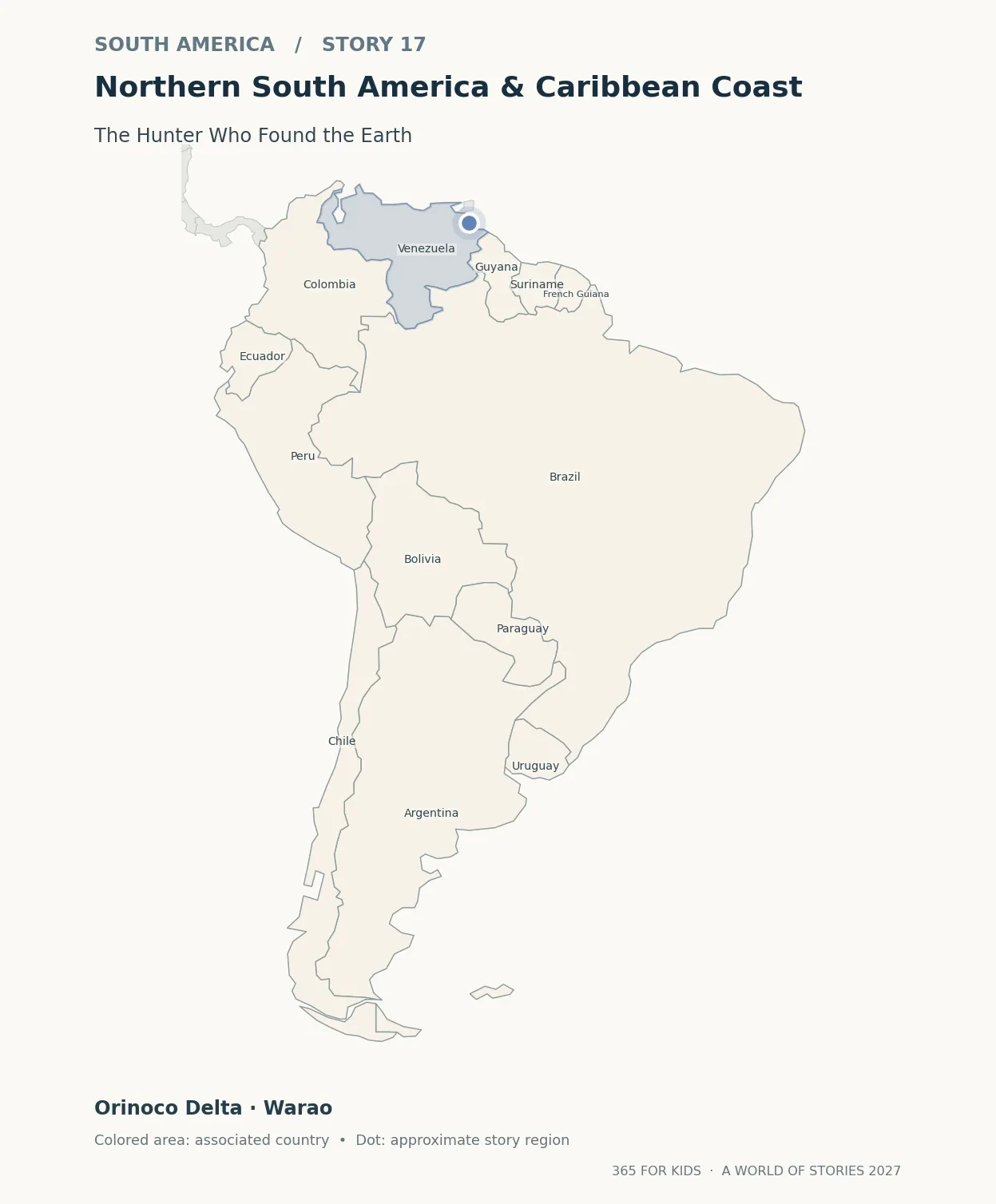
Long ago, in a story told by the Warao people, human beings lived high above the Earth, in a world in the sky. They knew the birds that flew around them, but they had not yet seen the rivers, forests, and rich lands far below.
Among the people was a skilled young hunter named Jara Yakera, whose name is remembered as “Good Arm.” One day he went hunting with his bow and arrows, but an arrow flew past its mark and disappeared.
Jara Yakera went to look for it. As he searched, he discovered something he had never noticed before: a hole in the floor of the sky. He knelt beside the opening and peered down.
What a sight met his eyes! Below him spread an unfamiliar world of green land and places where food grew — unlike the sky world he had always known.
The hunter found a long rope, secured it above the opening, and slowly lowered himself through the clouds. Down he went, farther and farther, until at last his feet touched the Earth.
Here he found a land full of wonders. Food was plentiful, and everywhere he looked, there was something new to discover. The young hunter explored and understood that people could make a home in this place.
But Jara Yakera did not keep the discovery to himself. He climbed the rope again and returned to the world above, telling his people what he had seen: the fertile Earth, its many gifts, and the chance to live there.
The others listened with astonishment, and one by one, people began their journey down the rope from the sky. And so, according to this Warao story, the people came to live on the Earth.
The Warao are an Indigenous people whose homeland includes the waterways of the Orinoco Delta in northeastern Venezuela, where this origin story of a hunter discovering the Earth beneath the sky world is still told.
After the Story: Read · Create · Reflect · Share
1. Find the Orinoco Delta of Venezuela on the map above. What do you imagine Jara Yakera saw first when he looked down through the hole in the sky?
2. What did Jara Yakera discover while looking for his missing arrow?
3. How did he travel from the sky world to the Earth?
4. Why do you think the hunter returned to tell the others what he had found?
5. If you discovered a beautiful new place, what would you want to explore first?
Inspired by this story? Create your illustration!
Illustration ideas:
- Jara Yakera hunting birds in the world above the clouds.
- The hunter discovering a small opening in the sky and looking down at the green Earth.
- A long rope hanging through the clouds as Jara Yakera descends.
- The people following the rope toward their new home below.
The Guianas
SURINAME — Anansi Eats Mutton
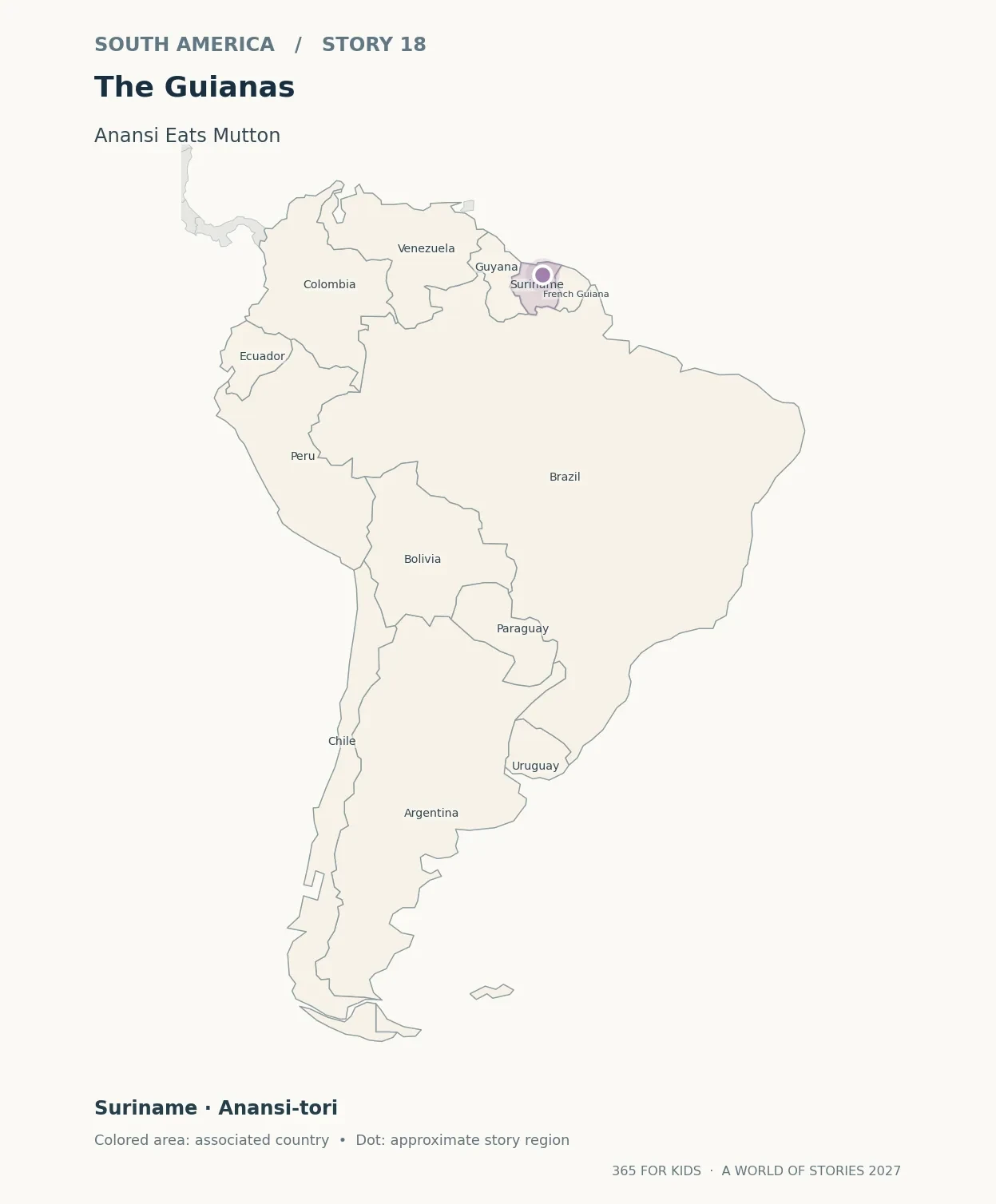
Once upon a time in Suriname, Anansi the spider lived with his wife and their children. His wife had raised a fine sheep, and she was proud of how well she had cared for it. Anansi, however, thought about only one thing: how delicious a meal it would make.
Again and again, Anansi asked his wife to cook the sheep. Again and again, she refused. At last he muttered to himself, “If asking does not work, I shall have to think of something clever.” And Anansi was never short of clever ideas.
The next morning, he stayed in bed, shaking and groaning as though terribly ill. His wife hurried to his side. “What is wrong?” she cried. Anansi answered weakly, “Perhaps the wise healer beneath the great forest tree can help me.”
His wife set off with the children to find the healer. The moment they disappeared, Anansi sprang out of bed, put on a disguise, and hurried along a shortcut through the forest. By the time his family reached the great tree, he was waiting there, looking very important indeed.
“Please help us,” his wife told the supposed healer. “My husband Anansi is very sick.” The disguised Anansi announced that Anansi could recover only if he ate a whole, well-cooked sheep — and that the meal must be for Anansi alone!
The worried family thanked the healer and hurried home. Anansi raced back by the shortcut, took off his disguise, and climbed into bed just before they arrived. “Such wisdom!” he whispered, listening solemnly as his wife repeated the instructions.
So his wife prepared the sheep, and Anansi ate and ate while his family watched. Not a morsel was left for anyone else.
When the last bite was gone, Anansi praised his wife, then turned to the children with a very serious expression: “Always be generous. Never be greedy!” And there sat Anansi, who had kept every bite for himself, giving everyone else a lesson in sharing.
Anansi is a famous trickster in stories with West African roots that traveled across the Atlantic and became part of Suriname’s storytelling traditions, where they are often called Anansi-tori.
After the Story: Read · Create · Reflect · Share
1. Find Suriname on the map above, in the region known as the Guianas. Can someone be clever and still make an unfair choice?
2. What did Anansi want, and why did his wife refuse him?
3. How did Anansi trick his family into believing the healer’s advice?
4. What is funny or surprising about Anansi’s final advice to the children?
5. Can someone be clever and still make an unfair choice? Explain your answer.
Inspired by this story? Create your illustration!
Illustration ideas:
- Anansi looking longingly at the sheep while his wife cares for it.
- The forest path and the enormous tree where the disguised “healer” waits.
- Anansi with his old hat pulled low, pretending to give wise advice.
- Anansi after the enormous meal, lecturing the astonished children about generosity.
GUYANA — The Lake of the Spoiled Feast
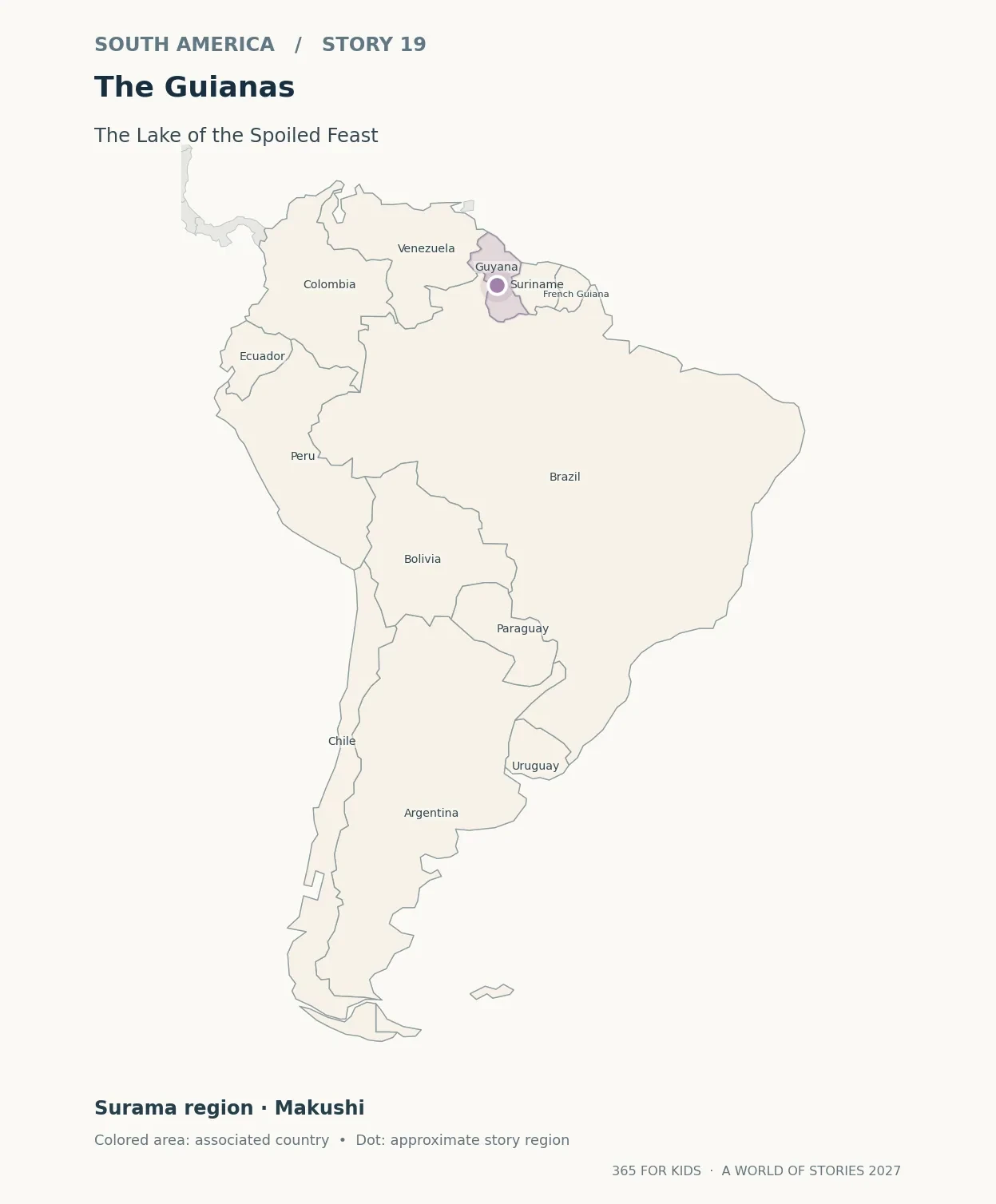
Long ago, two powerful brothers traveled across the lands that today lie between Brazil and Guyana. The elder brother, Inshikira, was known for his kindness and liked to help others. His younger brother, Aniki, had a very different nature — whenever things went well, Aniki seemed to find a way to spoil them.
One day their journey brought them to a place in the North Rupununi where two lakes lay beneath the open sky. The travelers were tired and hungry, and the brothers decided that a meal of freshly caught fish would restore their spirits.
Inshikira fished in the larger lake and caught many fine fish, while Aniki, fishing in the smaller one, returned with only a little catch. The younger brother watched the growing pile of fish beside his brother and felt jealousy rise inside him.
Soon everyone prepared to roast the fish, but first they needed special stones called ure, used to help make a fire. Inshikira searched for a suitable stone and found none. Aniki, seeing his brother’s trouble, decided to play a trick instead of helping.
With his extraordinary power, Aniki changed the last available ure stone into a great rock standing in the middle of the larger lake. Even with all his strength, Inshikira could not move it back to the cooking place.
At last Inshikira asked Aniki to lend him what he needed to light the fire, and the younger brother agreed. The travelers cleaned the fish, built up the fire, and waited for their meal.
But Aniki was not finished. He used his power once again, making his brother’s cooking fire blaze far too high. The flames leaped up, and before anyone could save the food, the fish had burned to ashes.
People remembered the place with the words “Shurama Ta,” meaning that the barbecue had been spoiled, and the tale connects those words with the name Shurama and the great rock in the lake.
The Makushi are an Indigenous people of the Rupununi region of Guyana and neighboring Brazil; this traditional account of Surama Lake was shared by Makushi storyteller Paulette Allicock and published in a 2020 collection of stories about water and place.
After the Story: Read · Create · Reflect · Share
1. Find the North Rupununi region of Guyana on the map above. How might the story of two very different brothers explain the name of a real lake?
2. How were Inshikira and Aniki different from each other?
3. Why did Aniki turn the fire-making stone into a rock in the lake?
4. What happened to the travelers’ meal, and how did the place get its name?
5. How might the story have ended differently if Aniki had helped his brother?
Inspired by this story? Create your illustration!
Illustration ideas:
- The two brothers and their companions arriving beside the two lakes in the North Rupununi.
- Inshikira with his plentiful catch of fish, while Aniki looks on from the smaller lake.
- The enormous stone rising from the middle of the lake after Aniki’s trick.
- The cooking fire leaping too high as the travelers discover their meal has burned.
FRENCH GUIANA & BRAZIL — The First Palikur and the Great Rain
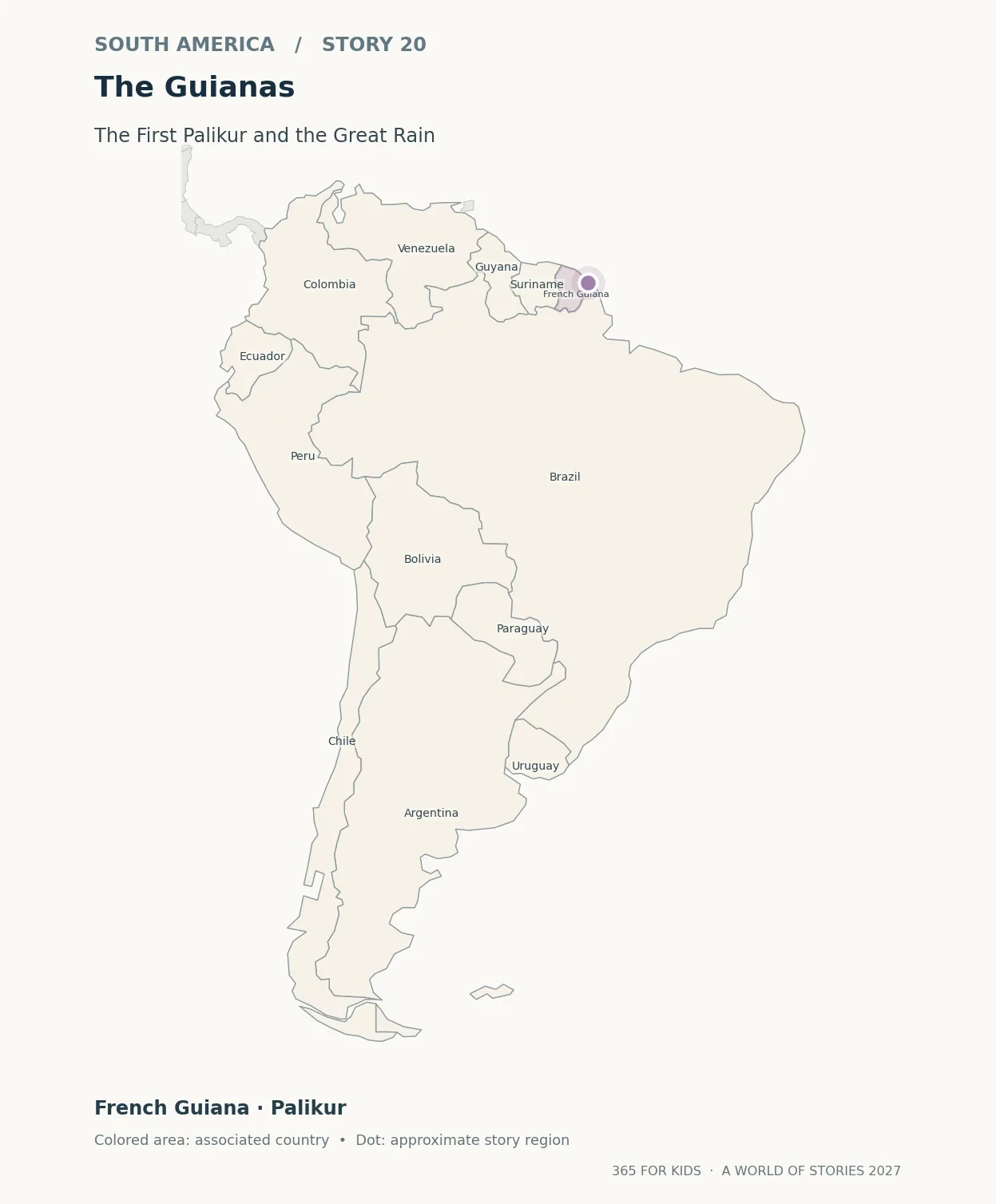
Long ago, at the beginning of the world, a Palikur man was building a great canoe. Above him, in the branches of a tree, a cuckoo called again and again, its sharp cry seeming to warn that something was coming.
A visitor appeared and told him that a great rain was approaching: rivers would rise, and water would cover the land. The man would need a vessel large enough to shelter his family, and was told to build it carefully and take a flute inside.
He worked until the vessel was ready. When the time came, the sky changed. A rainbow appeared, and rain began to fall without stopping. The rivers overflowed. Even the hills disappeared beneath the water.
The man and his family sheltered inside the vessel as it floated over the flooded world. For many moons they waited, with no shore to see, only water stretching into the distance. When the man opened the vessel too soon, tragedy struck: the water took his child. Grieving, he closed it again and waited until the land was safe.
When the waters finally withdrew, the man stepped outside, planted food in the earth, and began to make a home again. Yet the world around him seemed strangely empty.
Then, on certain evenings, he heard voices talking, singing, and celebrating somewhere nearby, though each time he went to look, he found no one. At last he watched more closely and discovered a wonder.
In one place, caterpillars had become a group of people. Elsewhere, pineapples had become another group. In other places, ants and lizards had changed into people too. The separate groups had different beginnings, yet they belonged to one shared world.
According to this Palikur tradition, these are the beginnings of the communities and clans that became part of the Palikur people, a reminder that a community can have many roots and still belong together.
The Palikur are an Indigenous people whose homeland lies in today’s French Guiana and northern Brazil; this version was shared by Palikur storyteller Paulo Noriño and recorded by researcher Martijn van den Bel.
After the Story: Read · Create · Reflect · Share
1. Find Palikur lands in French Guiana and northern Brazil on the map above. What does it mean to belong to one community while having different beginnings?
2. What warning did the cuckoo and the visitor bring to the man building the canoe?
3. What did the man do to keep his family safe during the great rain?
4. Which animals and plants were connected with the beginnings of different groups of people?
5. What does it mean to belong to one community while having different beginnings?
Inspired by this story? Create your illustration!
Illustration ideas:
- The canoe builder listening to a cuckoo high in the branches above him.
- The great vessel floating on rising waters beneath a rainbow and rainy sky.
- The man exploring the land again after the water has gone down.
- Caterpillars, pineapples, ants, and lizards transforming into groups of people in a bright forest.
GUYANA — The Deer and the Turtle
A long time ago, the animals of the forest did not look quite as they do today. The turtle had sturdy hoofs on its feet, while the deer walked with claws. That is how this old story begins.
One day, the deer came upon the turtle carefully cleaning its hoofs, busy with the work and proud of its handsome feet. The deer stopped to admire them. “My friend,” the deer said, “what fine sandals you have! May I try them on?”
The turtle looked at its hoofs. They were indeed fine, and the request sounded friendly enough. “Certainly,” replied the turtle. So the two animals exchanged what they wore on their feet: the turtle handed over its hoofs, and the deer gave the turtle its claws.
As soon as the deer tried the hoofs, it discovered something wonderful: it could travel much faster than before! The new feet carried it swiftly across the ground, and the deer was delighted.
The turtle’s experience was quite different. With the deer’s claws in place of its own hoofs, moving became difficult, and each step took effort. The turtle could not hurry after its friend.
It waited for the deer to come back, thinking this was only a trial and that the two would soon exchange their feet again. But the deer had already trotted away.
The turtle waited and waited. The deer never returned to give back the hoofs. And so, the old tale says, deer have kept their swift hoofs, while turtles have had claws ever since.
The story leaves us with a small but important question: when someone lends us something precious, what promise do we make by accepting it?
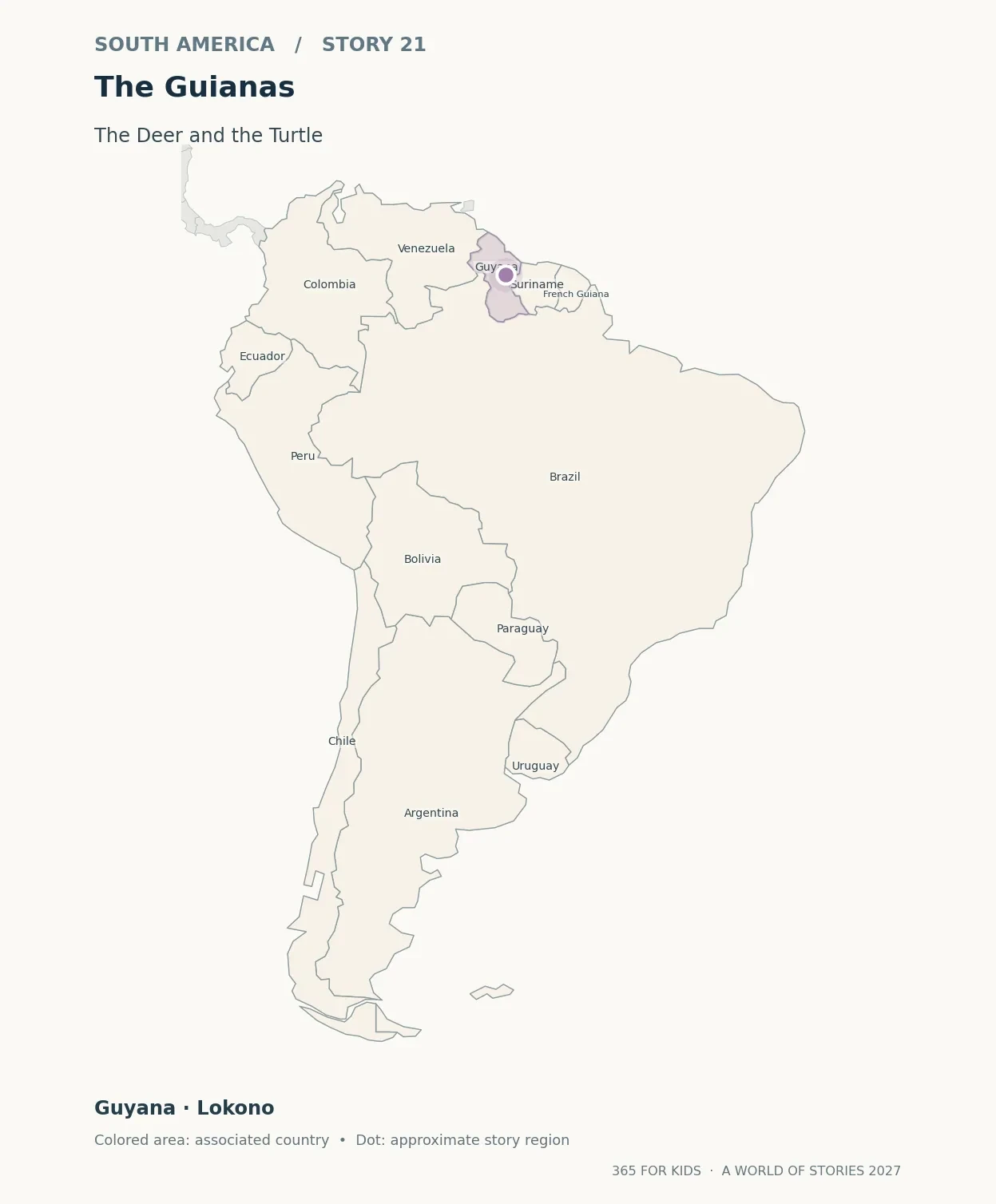
The Arawak (Lokono) people have long lived in the Guianas and other parts of northern South America; this traditional animal tale was recorded by Walter E. Roth in 1915.
After the Story: Read · Create · Reflect · Share
1. Find Arawak (Lokono) lands in the Guianas on the map above. What would you have done if you had borrowed something precious from a friend?
2. What did the deer ask to borrow from the turtle?
3. What happened when the two animals exchanged their feet?
4. Why could the turtle not catch up with the deer?
5. What would you have done if you had borrowed something precious from a friend?
Inspired by this story? Create your illustration!
Illustration ideas:
- The turtle carefully cleaning its strong hoofs beside a forest path.
- The deer admiring the turtle’s unusual “sandals” and asking to try them.
- The moment the animals exchange their hoofs and claws.
- The deer bounding away while the turtle waits in the green forest.
Eastern Brazil & Atlantic Forest
BRAZIL — Curupira and the Five Peccaries
In the forests of Brazil, people have long told stories about Curupira, a mysterious guardian of the trees and wild animals. In many tellings he is small, with feet that point backward, so that his footprints can confuse anyone who tries to follow him.
Curupira knows the secret paths of the forest. He watches over its creatures, especially when hunters enter the trees, for the forest provides food, but its gifts are not meant to be wasted.
One day, a hunter went into the woods and found a group of peccaries, wild animals that resemble small pigs. Instead of taking only what he needed, the hunter killed five of them — far more meat than one person could eat.
Then Curupira appeared. The strange little forest guardian confronted the hunter and asked why he had taken so many animals, telling him that five were more than he needed.
The hunter stood before the guardian of the woods. He had come to gather food, but now he had to face what his hunting had cost the forest.
Curupira raised his hand and waved it over the animals. At once, four of the peccaries came back to life, scrambling to their feet and hurrying away among the trees.
The hunter was left with only one peccary. Curupira told him that he was fortunate to have even that one to take home: the forest had given him enough, but not more than enough.
And that is how this Brazilian tale reminds its listeners of a simple balance: people may depend on the forest, but they must also leave room for its animals to live.
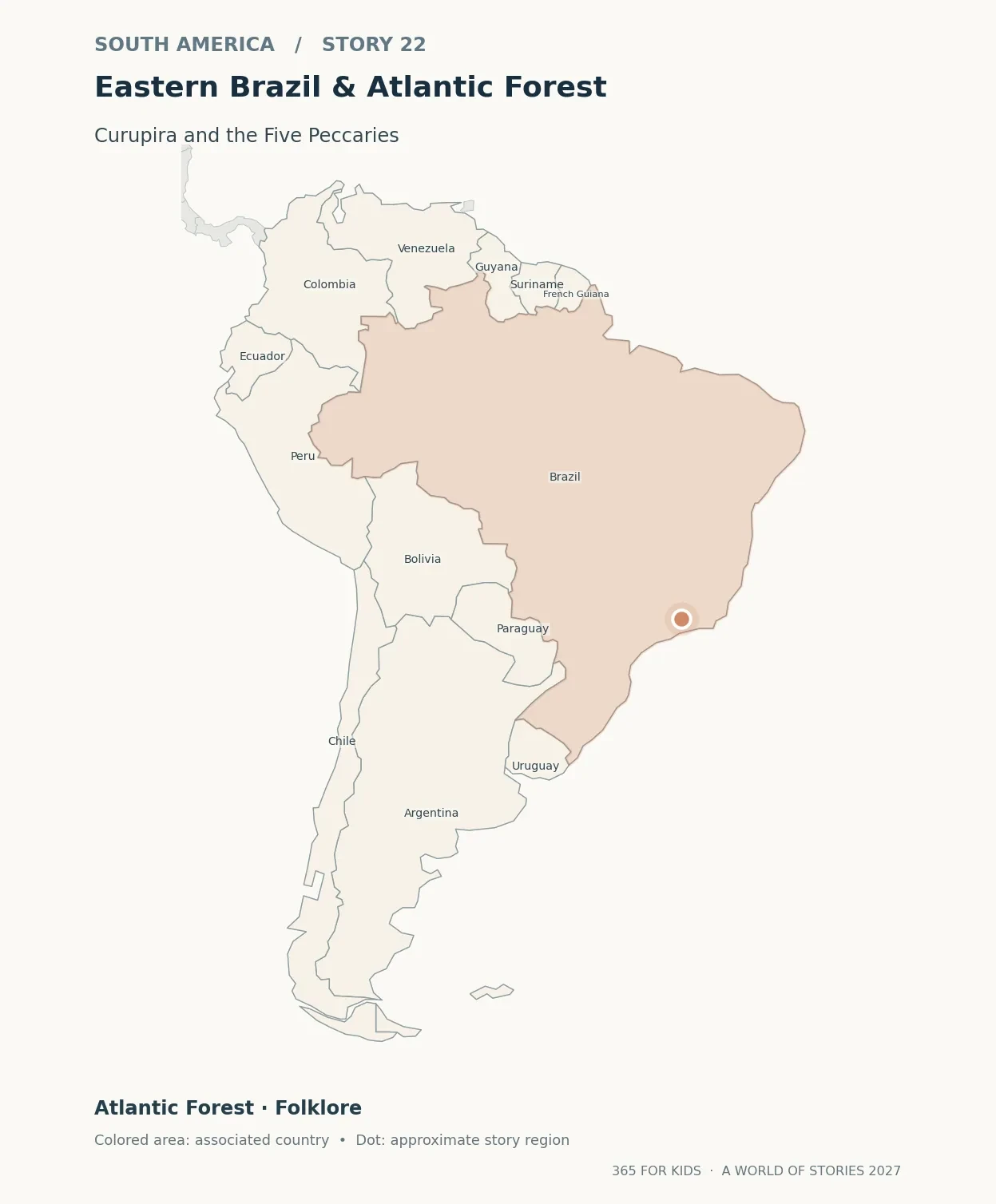
Curupira is a forest guardian in Brazilian folklore, with roots in Indigenous traditions and many regional versions told across the Atlantic Forest.
After the Story: Read · Create · Reflect · Share
1. Find the Atlantic Forest of Brazil on the map above. How can we use what nature gives us without wasting it?
2. Who is Curupira, and what does he protect?
3. Why was Curupira unhappy when he saw the five peccaries?
4. What happened when Curupira waved his hand?
5. How can we use what nature gives us without wasting it?
Inspired by this story? Create your illustration!
Illustration ideas:
- Curupira standing among tall trees, with his unusual backward-pointing feet.
- The hunter discovering a group of five peccaries in the green forest.
- Curupira raising his hand as four peccaries spring back to life.
- Four peccaries running into the trees while the hunter watches with one left behind.
BRAZIL — Saci and the Whirlwind
In the countryside of Brazil, people tell stories of a small, mysterious visitor named Saci-Pererê. He has only one leg, wears a bright red cap, and moves with extraordinary speed. Where the wind curls into a sudden whirlwind, some say Saci may be dancing.
He is a master of mischief. A toy that seemed to vanish, a door that opened at the wrong moment, a meal spoiled when no one was looking — such surprises have often been blamed on Saci.
But how can a person see someone who moves as quickly as the wind? Listen for a sharp whistle, the storytellers say, and watch the leaves twist in the yard.
In one telling, Saci slips through the trees and stirs up trouble around a home. Someone looks away for a moment; when they turn back, the things they left in place are no longer where they expected.
Sometimes animals are found wandering where they should not be. Sometimes a missing toy turns up in an unlikely corner. No one can prove who caused the confusion, but someone is sure to whisper, “Saci has been here!”
His red cap is especially important: in many versions, it holds the secret of his magical freedom, while his one strong leg carries him through the forest faster than anyone could imagine.
Yet Saci is more than a maker of tricks. Some people say he knows the plants of the forest and does not welcome visitors who carelessly damage what grows there.
Perhaps that is why a whirlwind can make a traveler smile and wonder at the same time — is it only dust and leaves spinning in the sunlight, or is a little red cap hidden somewhere in the dance?
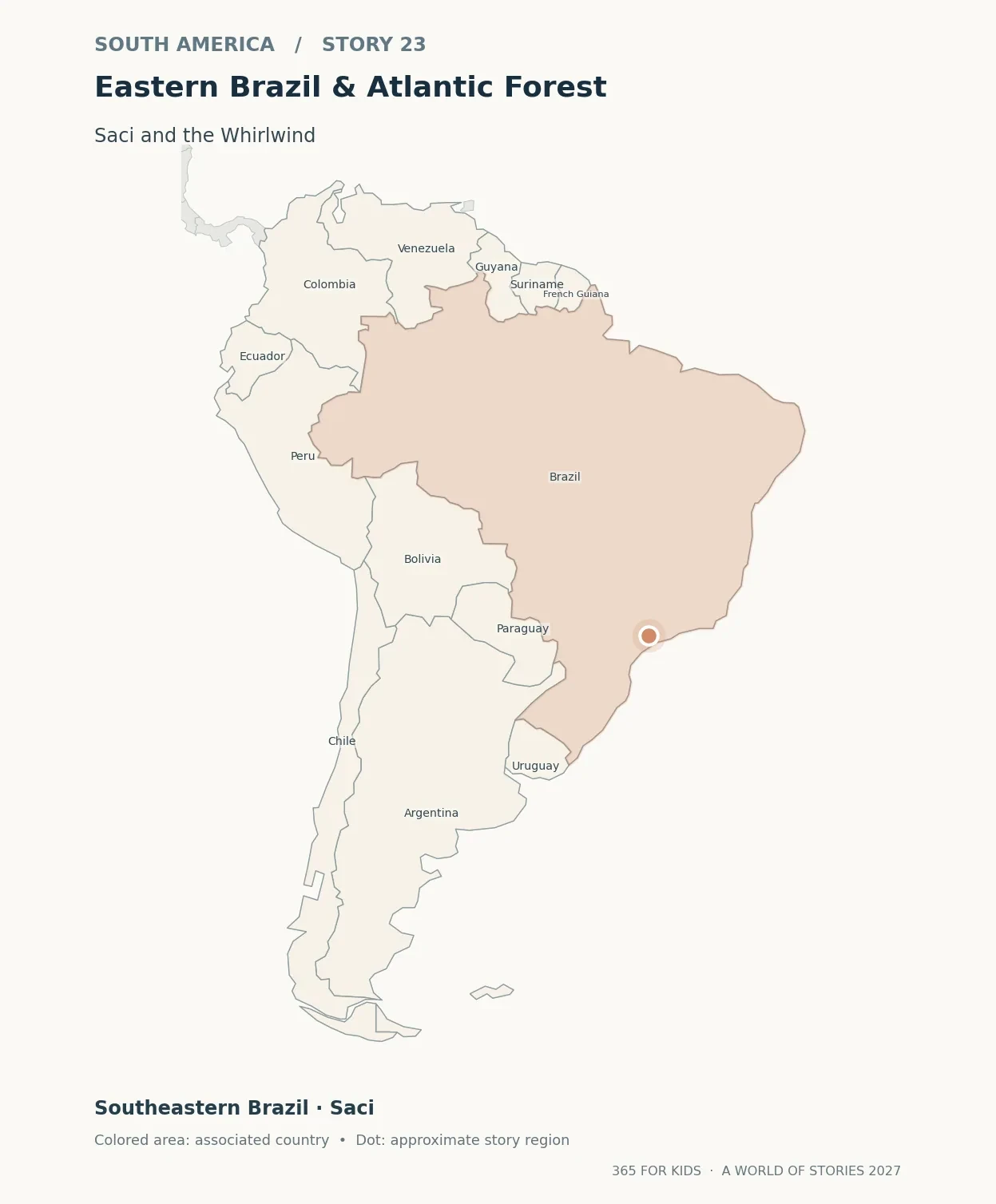
Saci-Pererê is a figure of Brazilian folklore, especially familiar in the south and southeast of the country, whose stories reflect a mixture of Indigenous, African, and European cultural influences.
After the Story: Read · Create · Reflect · Share
1. Find the Brazilian countryside on the map above. Can a playful trick be funny for one person but troublesome for another? Why?
2. What are three things that make Saci different from an ordinary traveler?
3. Why do people sometimes blame Saci when something surprising happens?
4. How is Saci connected to the wind and the forest?
5. Can a playful trick be funny for one person but troublesome for another? Why?
Inspired by this story? Create your illustration!
Illustration ideas:
- Saci in his bright red cap, standing beside a path through the Atlantic Forest.
- A small whirlwind of leaves curling through a sunny Brazilian village.
- A family searching for a missing toy while a red cap peeks from behind a tree.
- Saci leaping through the forest as birds and butterflies scatter around him.
BRAZIL — The Dancing Ox of Santa Catarina
On the island of Santa Catarina, beside Brazil’s Atlantic coast, there is an old kind of celebration called Boi-de-Mamão. It is a story told not only with words, but with songs, music, bright costumes, and dancing.
At the heart of the celebration is an ox. People make its body from a frame covered in colorful cloth, and hidden inside, a performer makes it step, turn, and dance as though it were alive.
When the music begins, the ox enters the circle, trotting and swaying as everyone watches. The herder, Mateus, follows close behind, proud to see his beloved animal dancing.
But then the celebration takes an unexpected turn: the ox suddenly falls and lies still. Mateus is terribly upset, and for a moment the lively circle falls quiet. Someone goes to find a doctor, and in some performances a traditional healer is called as well.
Meanwhile, other extraordinary figures join the festivities. A little horse skips across the circle. Maricota, a towering puppet with long, swinging arms, dances among the people. And Bernúncia — a strange creature that looks a little like several animals at once — appears to surprise the audience.
The songs and drumming continue, and everyone joins in the playful commotion. Then, at last, the ox begins to move: its head lifts, its legs stir, it stands — and starts dancing again!
What a celebration follows! The musicians play, the dancers spin, and the people cheer, for the ox has returned and the circle is filled with laughter and joy.
Every performance may be a little different, with new voices and characters joining the songs, but the heart of the story remains: an ox is lost, an ox returns, and everyone celebrates together.
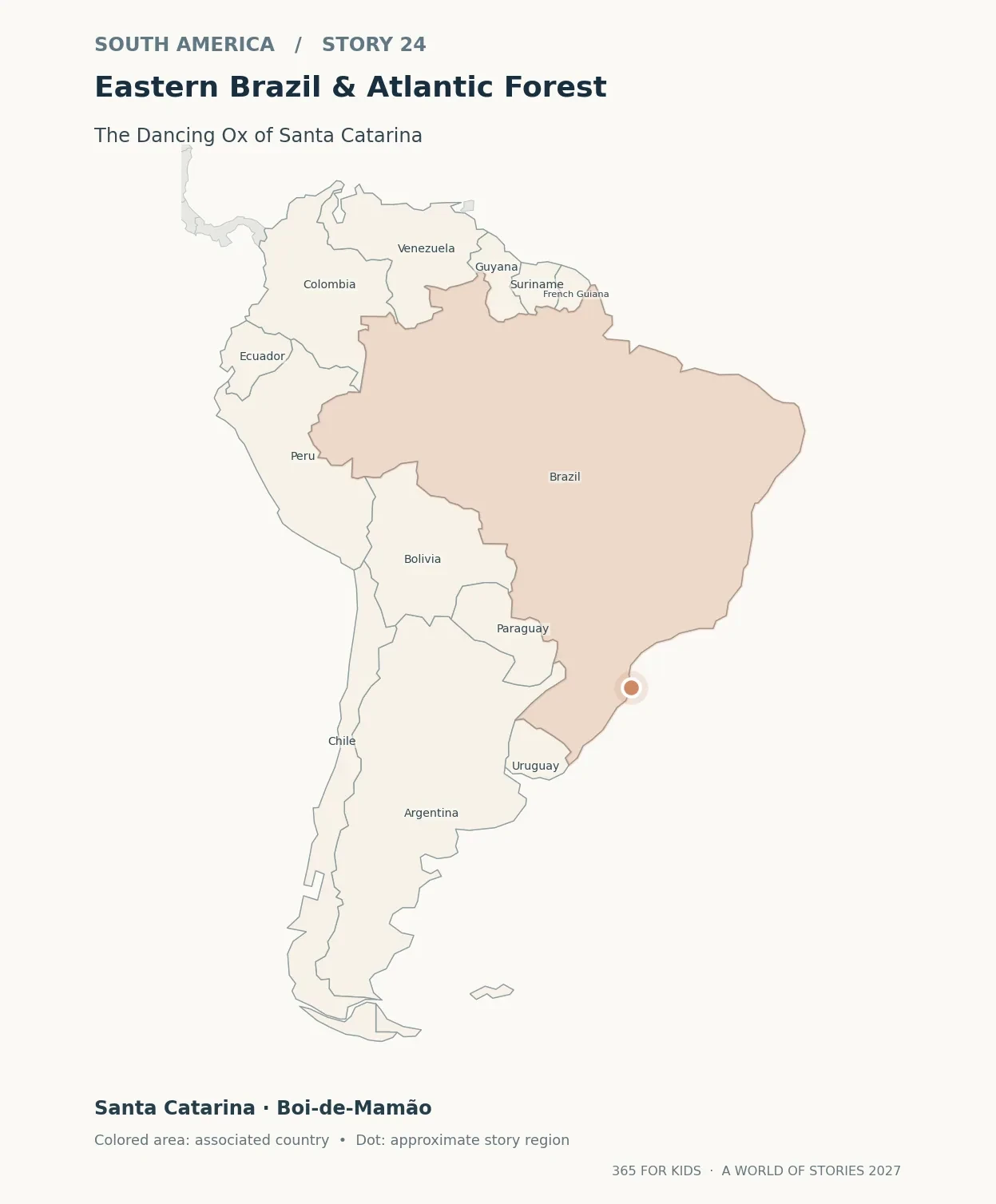
Boi-de-Mamão is a traditional folk performance from the coast of Santa Catarina in southern Brazil, told through music, dance, and handmade figures as one regional form of Brazil’s larger dancing-ox tradition.
After the Story: Read · Create · Reflect · Share
1. Find the island of Santa Catarina on Brazil’s Atlantic coast on the map above. What is one story or celebration that people in your community share together?
2. Why was Mateus so upset when the ox fell down?
3. How do the songs, costumes, and puppets help tell this story?
4. Which moment changes the mood of the celebration from sadness to joy?
5. What is one story or celebration that people in your community share together?
Inspired by this story? Create your illustration!
Illustration ideas:
- The brightly decorated ox dancing in a circle of musicians and families.
- Mateus kneeling beside the fallen ox while the crowd waits for help.
- Maricota and Bernúncia appearing beside a colorful coastal village stage.
- The ox rising again as everyone sings and dances in celebration.
BRAZIL — The Blue Jay and the Araucaria Tree
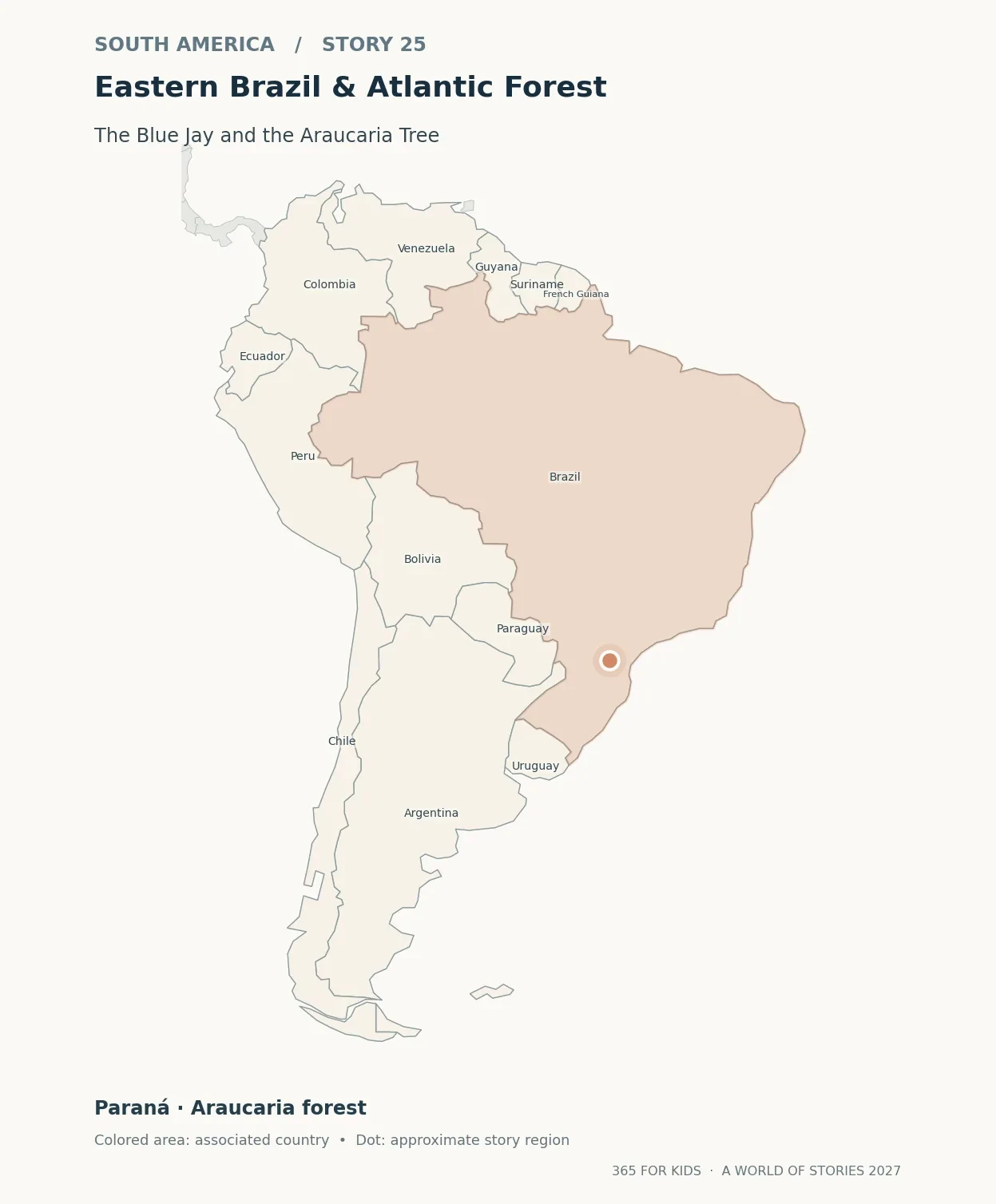
Long ago, in the high forests of southern Brazil, a small brown jay lived among tall araucaria trees. Their straight trunks rose above the hills, and their wide crowns stretched across the sky like green umbrellas.
The bird flew from branch to branch each day, calling to the other birds and watching the forest change with the seasons. Yet she sometimes wondered whether such a small creature could do anything important for the trees she loved.
One day, the jay looked upward and made a wish: “I want to be useful. Is there something I can do to help this forest grow?” According to the old tale, her wish was heard, and she was given a pinhão — a seed from an araucaria tree.
She held the seed carefully in her beak. Its hard shell was difficult to open, but she worked at it until she could eat a little, saving the rest and tucking it into the soft earth under fallen leaves.
Then the days passed, and by the time she remembered her hidden food, she could no longer find the place where she had buried it. She searched beneath one tree and then another, until at last she noticed a tiny green shoot risen from the ground.
Now she understood what her small act had done. She began to carry more pinhões and hide them in different places; some she found again, and some she forgot, and in the tale, those forgotten seeds became young araucaria trees.
As the years went by, the forest gained new trees. The jay had not planted them with a gardener’s tools or a great plan — she had simply followed the small task she could do, and it mattered.
The story says that, in thanks for her care, the brown jay received a wonderful gift: feathers as blue as the sky. From then on she was known as the gralha-azul, the blue jay of Paraná, and whenever she carried a seed, the forest held the promise of another tree.
In the Brazilian state of Paraná, people tell different versions of the legend of the gralha-azul, or blue jay, celebrating how even small creatures can help care for the natural world of the Atlantic Forest.
After the Story: Read · Create · Reflect · Share
1. Find the araucaria forests of Paraná in southern Brazil on the map above. What small action could you take to help a plant, tree, or animal near you?
2. Why did the brown jay want to be useful to the forest?
3. What happened to the seed that the jay buried and forgot?
4. Why do you think the jay received blue feathers at the end of the tale?
5. What small action could you take to help a plant, tree, or animal near you?
Inspired by this story? Create your illustration!
Illustration ideas:
- The little brown jay looking up through tall araucaria trees.
- The jay hiding a pinhão beneath leaves and soft forest soil.
- A tiny green araucaria sprout growing where the seed was buried.
- The bird with new blue feathers flying above a forest of araucaria trees.
BRAZIL — Boitatá and the Longest Night
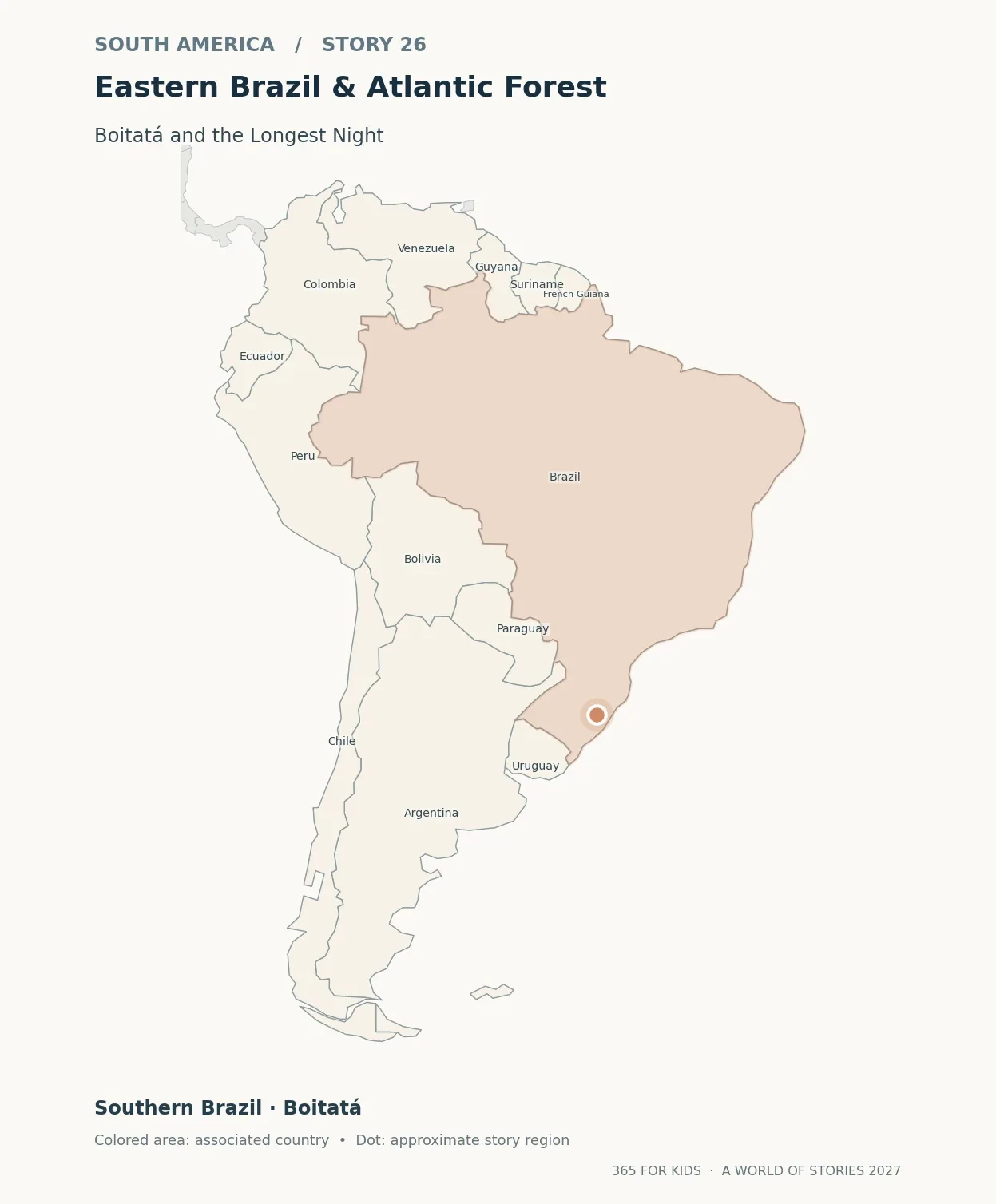
Long ago, people told of a night so deep and so long that it seemed the morning had forgotten how to return. Across the fields of southern Brazil, rain poured from the sky, streams overflowed, and animals hurried away from their flooded shelters.
When the rain finally grew quiet, darkness remained. No path was easy to follow, the stars were hidden, and everyone waited for the first pale line of dawn, but the sky did not brighten.
Under the water lay the resting place of a great serpent. The rising flood disturbed its sleep, and the enormous creature began to move. It was called Boitatá, a name remembered in stories of strange lights that cross the land at night.
Boitatá was no ordinary snake. Its body was almost transparent, and within it shone the bright eyes of animals it had swallowed, so that as it slipped through the wet grass, the serpent seemed to carry a trail of living fire.
People watching from far away saw a moving brightness above the dark fields, curving around the pools and vanishing behind a hill before appearing again. No one dared go near the mysterious glow.
The creature wandered on through the endless night. Its light shone on the rain-soaked earth, yet it did not bring back the day, and the people could do nothing but wait.
At last Boitatá grew weak and tired. The fire within its body flickered, and the serpent returned to its hidden place to sleep. Then, little by little, the darkness loosened its hold, and the first warm sunlight spread across the fields.
The people stepped outside and welcomed the light. But on other dark nights, when a mysterious glow traveled through the countryside, some still whispered the old name: “Boitatá.”
Boitatá is a famous figure in Brazilian folklore, often imagined as a glowing serpent; this version follows the long-night legend told in southern Brazil and recorded by João Simões Lopes Neto in Lendas do Sul (1913).
After the Story: Read · Create · Reflect · Share
1. Find the fields of southern Brazil on the map above. How could you show the difference between darkness and light in a drawing?
2. What made the people believe that the long night might never end?
3. How was Boitatá different from an ordinary serpent?
4. What changed when Boitatá finally returned to sleep?
5. How could you show the difference between darkness and light in a drawing?
Inspired by this story? Create your illustration!
Illustration ideas:
- Rain filling the fields while animals search for higher ground.
- The mysterious shining serpent moving through a dark, flooded landscape.
- People watching a distant ribbon of light from their homes.
- The first sunrise spreading across the fields after the longest night.
Gran Chaco & Guaraní Lands
PARAGUAY — The Gift of Yerba Mate
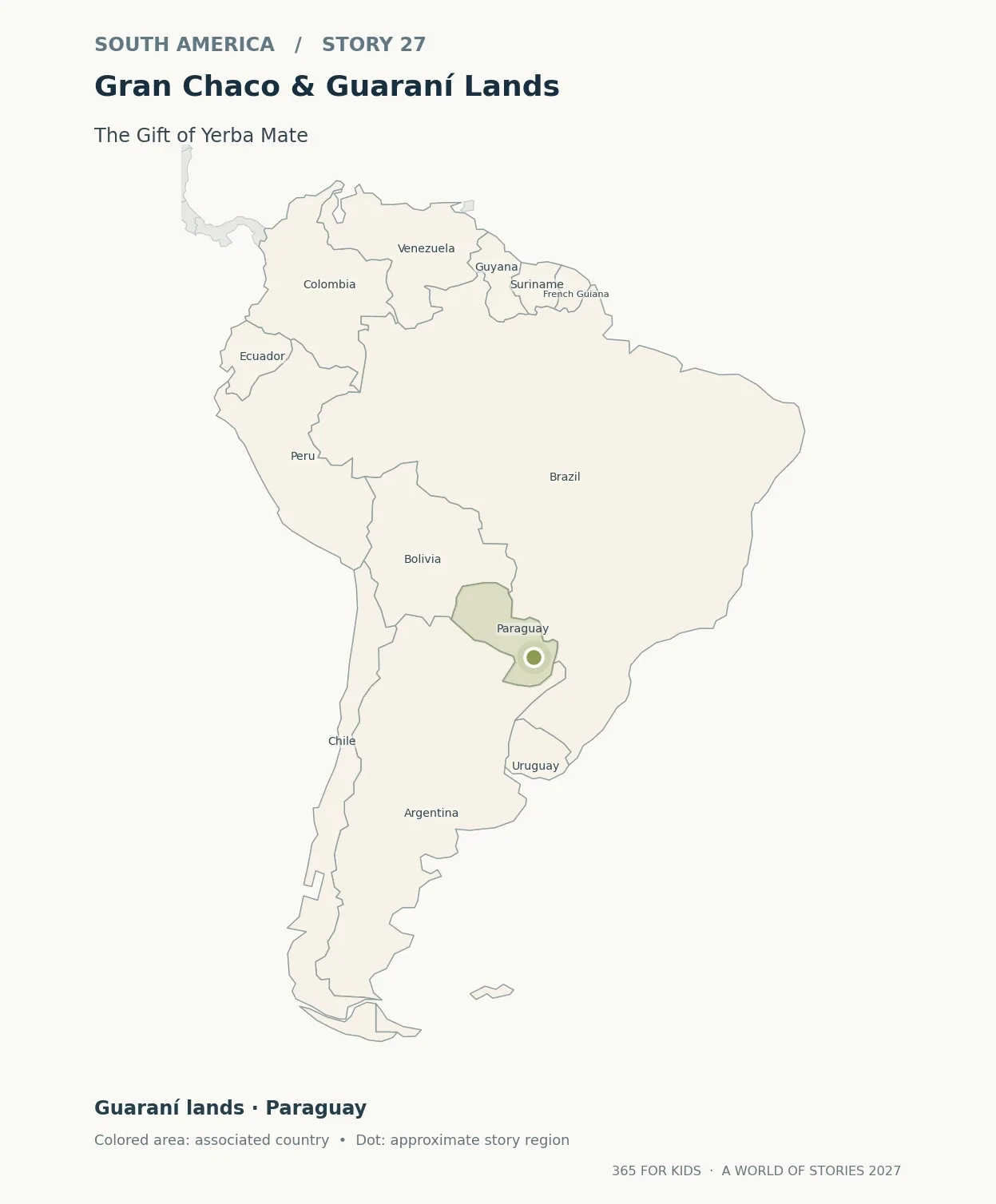
Long ago, when the forests were full of winding paths and hidden streams, Yasí, the Moon, looked down from the sky, wondering what life was like beneath the leaves. Her friend Araí, the Cloud, wished to explore the forest too.
So the two friends descended to Earth, taking the appearance of young women, and walked beneath tall trees, listening to birds calling from branch to branch, until they were tired.
At the edge of a clearing they noticed a small home. They were about to ask for a place to rest when a jaguar emerged from the forest, crouching, ready to spring. The two travelers froze.
Suddenly an arrow flew through the air. A hunter nearby had seen their danger and stopped the jaguar, then invited the strangers to his home, where they would be safe.
The hunter lived with his wife and their daughter, Caá Yarí. Although the family had little food, they welcomed the visitors warmly, and the daughter brought out their last small corn cake to share with everyone.
When night came, Yasí and Araí returned to the sky. From above, Yasí remembered the hunter who had protected them and the family who had offered food without asking for anything in return, and she wanted to leave them a gift that could be shared for many years.
Yasí descended once more and planted special seeds near the family’s home. A new green plant grew there, and she showed the family how its leaves could be prepared as a drink, which they gathered together to taste.
The drink became a way to welcome visitors and spend time with friends. As the years passed, more people came to know it as yerba mate, and in this telling, Caá Yarí became its guardian.
The Guaraní people have long lived across areas that are now Paraguay and neighboring countries, where this legend tells how Yasí, the Moon, rewarded kindness with the gift of yerba mate.
After the Story: Read · Create · Reflect · Share
1. Find Guaraní lands in Paraguay on the map above. How could sharing something simple help people feel welcome?
2. Why did Yasí and Araí want to visit the forest?
3. What did the hunter and his family do to help the two travelers?
4. Why did Yasí choose to give the family a special plant?
5. How could sharing something simple help people feel welcome?
Inspired by this story? Create your illustration!
Illustration ideas:
- Yasí and Araí walking beneath tall forest trees for the first time.
- The hunter helping the two travelers when the jaguar appears.
- The family sharing its last corn cake with the visitors.
- A circle of friends sharing mate beneath the Moon.
ARGENTINA — How Rabbit Took Fire from Jaguar
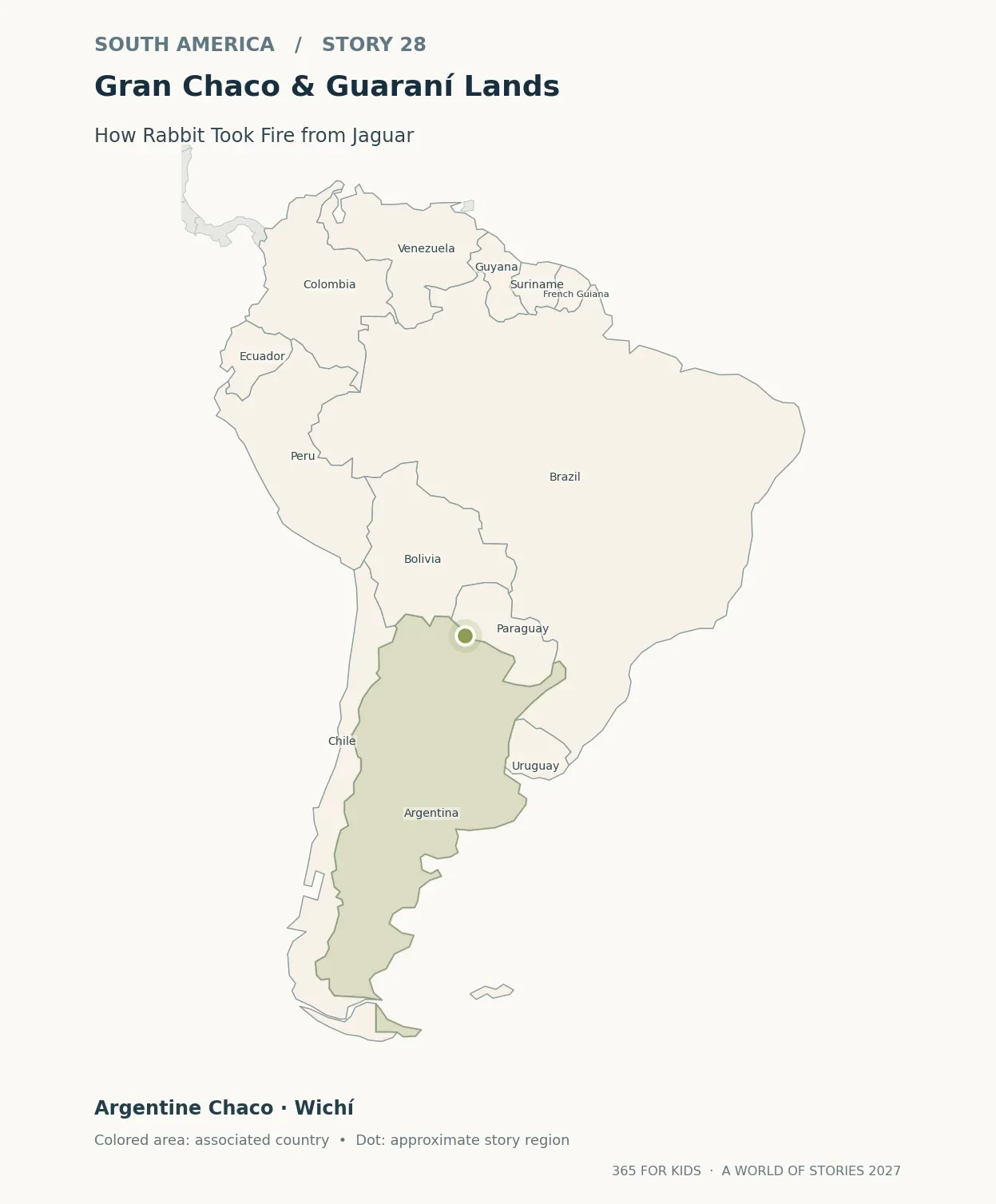
Long ago, people in the Gran Chaco had no fire of their own. They ate their food without cooking it, and on cool evenings they had no warm flames around which to gather. But deep in the forest, Jaguar kept a fire burning, and beside its glowing coals he cooked the food that others could only eat raw.
Rabbit knew about Jaguar’s fire and that Jaguar guarded it closely. Still, he thought of the people who needed its warmth. One day he approached Jaguar’s camp and watched the flames flicker beneath the cooking food, pretending to be interested in nothing more than a friendly visit.
Jaguar was proud of his fire and did not want to give away even the smallest glowing coal. Rabbit stayed nearby, talking and watching, until he saw his chance and, with a quick movement, took a little ember from the edge of the fire and hid it beneath his chin.
At first Jaguar noticed nothing. Rabbit hopped away, trying to look calm, but a thin thread of smoke began to rise from his fur. Jaguar turned, saw the smoke, and understood at once: Rabbit was carrying off his fire!
With a furious roar, Jaguar sprang after him. Rabbit ran over the dry ground as quickly as his legs would carry him, but the glowing ember grew hotter, and Jaguar was getting closer.
So Rabbit threw the ember into the dry grass. The grass caught fire, and the flames spread. Jaguar stopped in alarm: the little fire he had guarded so carefully was no longer his alone.
People learned to keep burning coals and to use fire for cooking, and no longer had to eat every meal raw. Jaguar, however, had lost his special fire and had to learn to find his own food in a different way, hunting as jaguars do today.
And whenever a cooking fire glowed in the evening, people could remember how a small Rabbit had taken a great risk to bring something precious into the world.
The Wichí are Indigenous peoples of the Gran Chaco, a region shared by parts of present-day Argentina, Bolivia, and Paraguay, where stories about how people first gained fire have been told in several communities.
After the Story: Read · Create · Reflect · Share
1. Find the Gran Chaco region of Argentina on the map above. Do you think Rabbit was brave, mischievous, or both? What makes you think so?
2. Why did Rabbit want to take a glowing ember from Jaguar?
3. What gave Jaguar the clue that Rabbit was carrying fire away?
4. How did the small ember change life for the people?
5. Do you think Rabbit was brave, mischievous, or both? What makes you think so?
Inspired by this story? Create your illustration!
Illustration ideas:
- Jaguar beside his bright cooking fire in the dry Chaco forest.
- Rabbit quietly watching the glowing embers at Jaguar’s camp.
- Rabbit racing through the grass while a thin curl of smoke rises beneath his chin.
- People gathered around a warm cooking fire beneath the evening sky.
ARGENTINA — The Rainbow That Saved the Fisherman
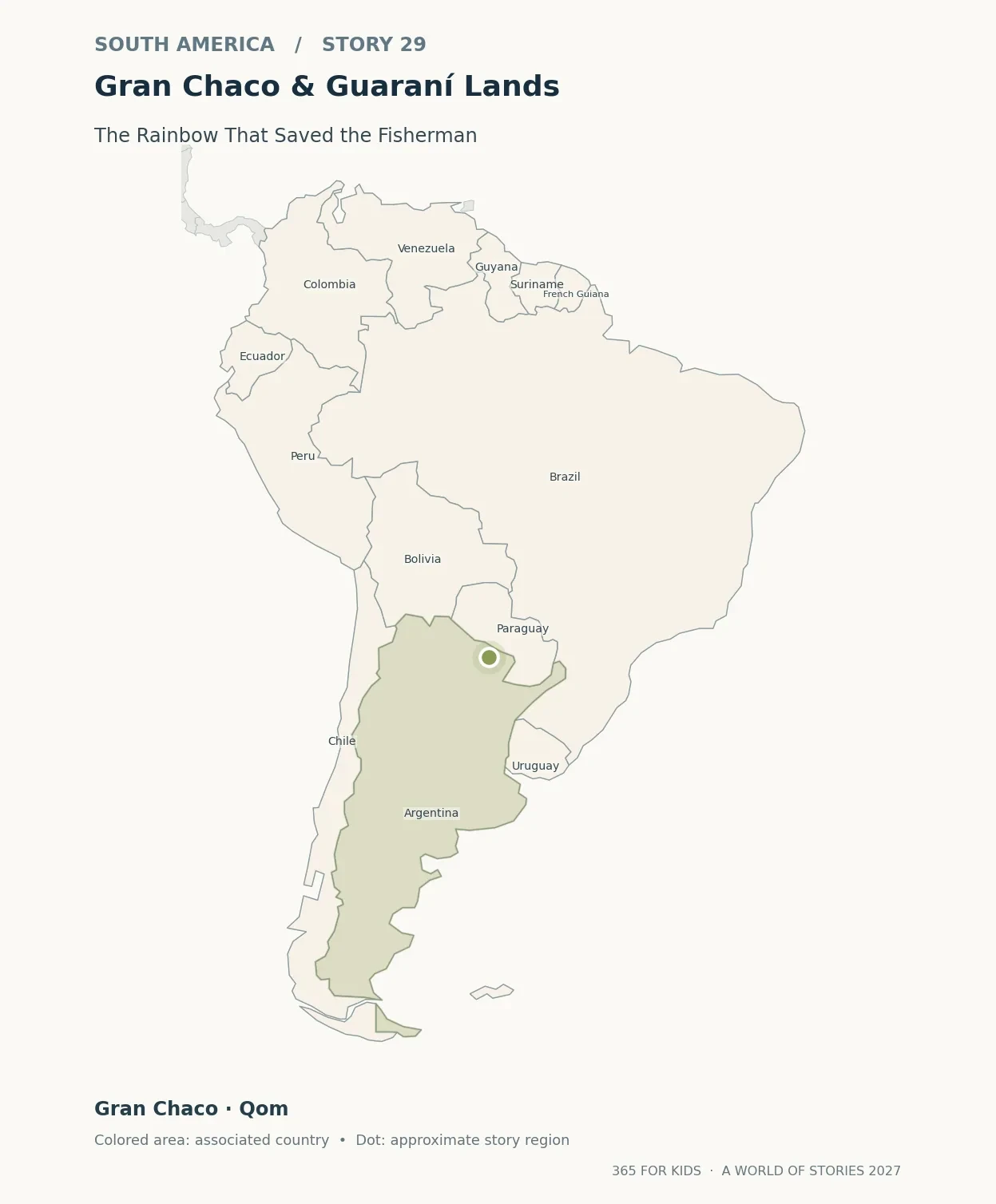
Long ago, in the Gran Chaco, a fisherman walked toward a quiet lagoon. Trees grew near its banks, and the still water reflected the open sky. He had come to find food, just as people in his community had done for generations.
Before he began to fish, the man offered a prayer, for he knew that the forest and the water were not simply places to take what he wanted. The Qom people spoke of a spiritual guardian who watched over the forest, the lagoon, and the rain that fell from the sky.
The fisherman asked permission to gather what he needed, then stepped closer to the water. Suddenly, a gigantic snake rose from the lagoon, seized him, and began to pull him toward the depths.
The man struggled, but the snake was much stronger, and he could no longer reach the bank. Remembering the guardian he had honored, he prayed again as the lagoon rippled around him.
Then something extraordinary appeared above the water: a rainbow stretched across the sky, its many colors shining down and glittering on the lagoon’s surface, reaching the place where the snake held the fisherman.
The snake released him. Free at last, the man made his way back to the shore and stood on solid ground, looking up at the colors glowing over the water. He was safe.
The fisherman gave thanks. In this Qom telling, the shining colors of the rainbow had saved his life.
The story remembers the rainbow not only as a beautiful sight, but also as a sign of a living world that deserves respect.
The Qom are an Indigenous people of the Gran Chaco, including northern Argentina; in a story shared by Qom teacher Graciela García, the tale reminds listeners of the deep respect the community gives to water and forests.
After the Story: Read · Create · Reflect · Share
1. Find Qom lands in the Gran Chaco of Argentina on the map above. How does this story invite us to think about the natural world around us?
2. What did the fisherman do before he began to fish, and why?
3. What danger rose from the lagoon?
4. How did the rainbow help the fisherman escape?
5. How does this story invite us to think about the natural world around us?
Inspired by this story? Create your illustration!
Illustration ideas:
- A Qom fisherman standing beside a peaceful lagoon in the Gran Chaco.
- The fisherman pausing to offer a prayer before fishing.
- A huge water snake rising from the lagoon as the fisherman reaches for safety.
- A brilliant rainbow reflected in the water while the fisherman returns to shore.
PARAGUAY — Karãu: The Bird That Cried at Dawn
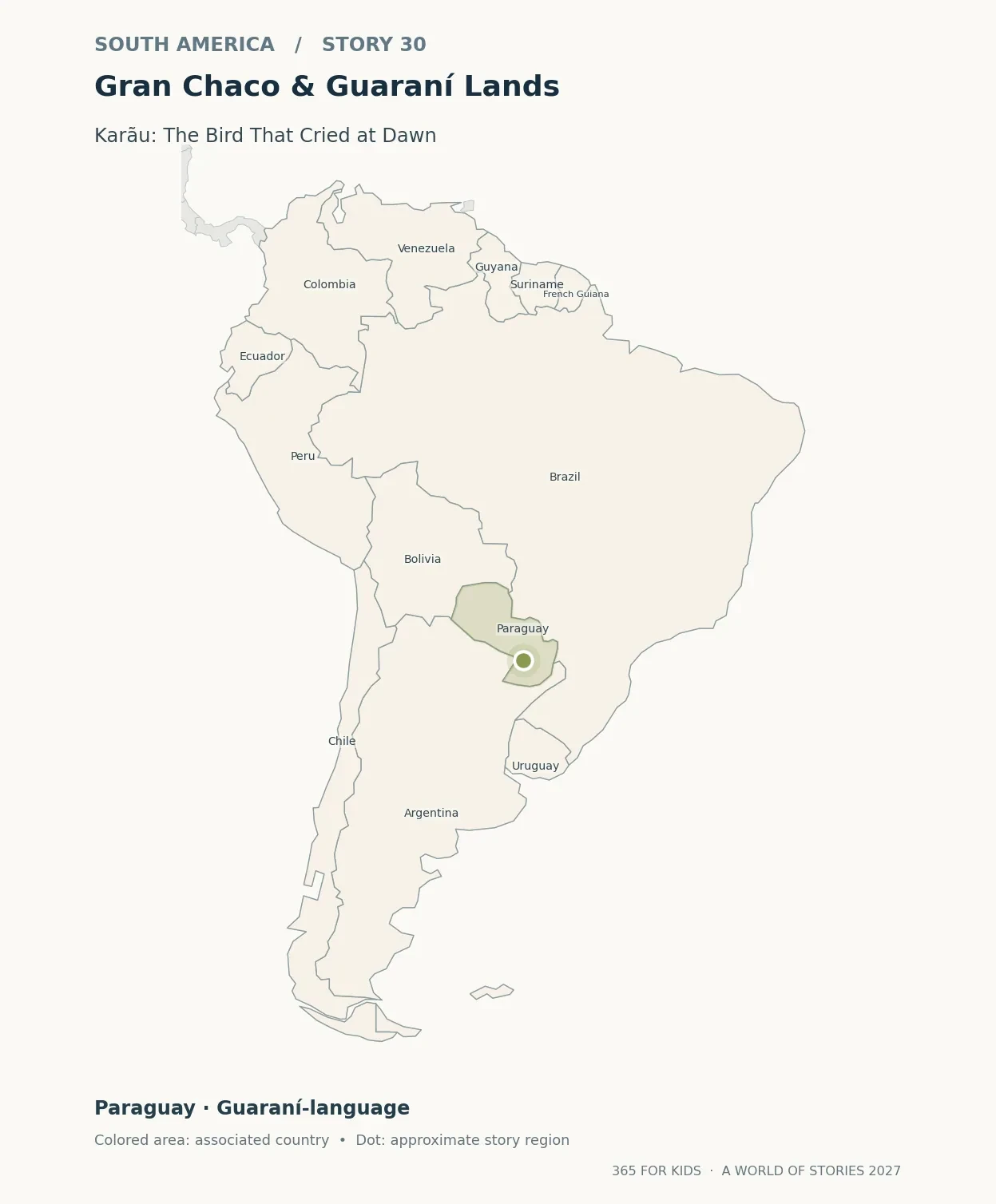
Long ago, in a village of Paraguay, a mother cared for her children with great patience. One of her sons grew into a lively young man who loved music and dancing, and whenever a celebration began, he was sure to be there.
One evening, the young man went to a crowded dance. Musicians played, feet beat time upon the ground, and he danced with such delight that he scarcely noticed the hours passing.
A friend hurried through the crowd and found him. “Your mother is very ill,” the friend said. “She is asking you to come home.” But the young man thought someone was trying to spoil his evening. “There will be time later,” he answered, and returned to the dance.
Much later, the friend came back: “Please come now. Your mother needs you.” The music went on, and the young man turned away once more. “There will be time to be sad,” he said, not understanding how little time remained.
As dawn drew near, another friend brought terrible news: his mother had died. At once the young man stopped dancing, felt cold with shock, and without saying goodbye, rushed outside, climbed onto his horse, and raced toward home.
To shorten the journey, he tried to cross a broad marsh. Rain had softened the ground, and the horse sank into the deep mud. The young man struggled to escape, but the marsh held him fast. No one in the village saw him again.
When the first light spread across the reeds, those returning from the dance saw a dark bird rise from the marsh, with long, slender legs and a curved beak. As it flew slowly over the water, it gave a mournful call: “Karãu! Karãu!”
People began to tell that the young man had become the bird. Its lonely cry, they said, carried the sorrow of someone who had waited too long to answer a loved one’s call.
In Paraguay, the karãu is a marsh bird known for its distinctive cry; this traditional tale told in Guaraní follows a version shared by Paraguayan writer and collector Lino Trinidad Sanabria.
After the Story: Read · Create · Reflect · Share
1. Find the marshes of Paraguay on the map above. What do you think the bird’s call asks people to remember?
2. Why did the young man stay at the dance when his friend first came?
3. How did he react when he finally heard the news about his mother?
4. What happened when he tried to cross the marsh?
5. What do you think the bird’s call asks people to remember?
Inspired by this story? Create your illustration!
Illustration ideas:
- A village dance in Paraguay, full of music and moving figures.
- A worried friend reaching the young dancer in the crowded celebration.
- The horse and rider approaching a wide, misty marsh before sunrise.
- The dark karãu bird lifting into the rosy dawn above the reeds.
PARAGUAY — Mainumby: The Girl Who Became a Hummingbird
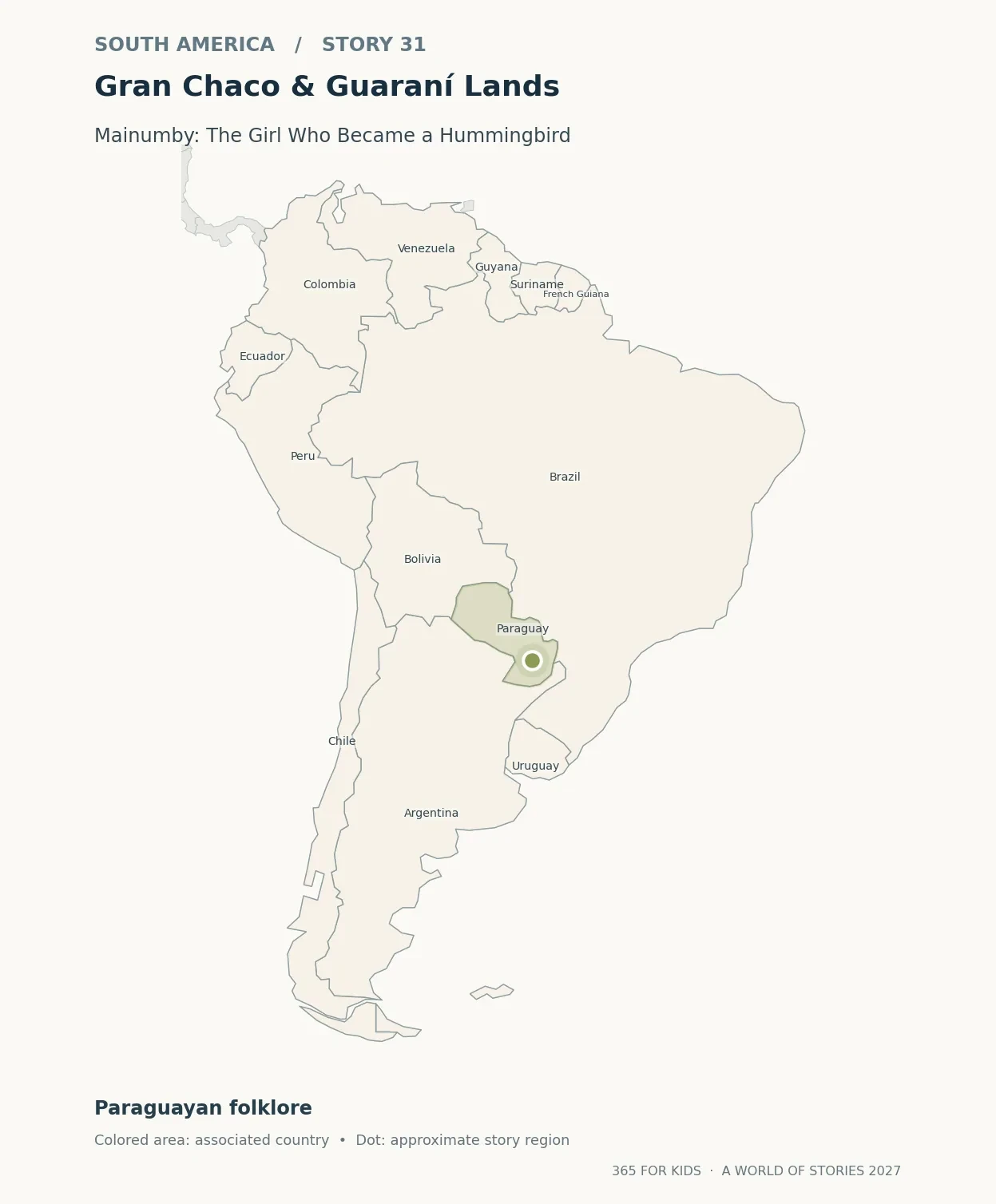
In an old Paraguayan tale, there was a place called Guaraúna, not far from the scent of the sea. Beyond a steep hillside lay a grove where enormous leaves spread beside the water, and white lilies and bright wildflowers grew among the climbing plants.
A young woman named Yvoty Jurú lived nearby. One day, two helpers went to the spring to fetch water. When they reached the flowering grove, they stopped: something tiny and brilliant was moving among the blossoms, too quickly for their eyes to follow.
The little bird seemed made of sunlight and color. Its wings trembled in the air while its narrow beak visited one flower after another. The helpers forgot their water jars, astonished by a creature so small and so full of life.
When Yvoty Jurú’s mother came to look for them, she too stopped beneath the trees. Soon Yvoty Jurú arrived and looked toward the flowers — and saw the marvelous visitor.
The bird hovered close to her face. Mistaking her rosy lips for a blossom, it darted forward with its long beak, searching for nectar. At that instant, something extraordinary happened: Yvoty Jurú shivered, lifted her arms, and felt them grow light as wings.
A thousand colors seemed to ripple around her, and the ground dropped away beneath her feet. In the telling of the legend, Yvoty Jurú changed into a hummingbird and rose into the air, flying beside the little creature that had enchanted her.
Together the birds passed from flower to flower, flashing through the grove, until the people watched the two bright shapes vanish among the leaves.
The bird was called mainumby. Its quick wings, brilliant colors, and love of flowers made it seem like a tiny wonder, and some people also said that a hummingbird near the house could be a sign that a welcome visitor was on the way.
This tale comes from Paraguayan folklore, in a version told by Milciades Giménez and included in a collection of legends published in 1998; mainumby is a Guaraní name for the hummingbird.
After the Story: Read · Create · Reflect · Share
1. Find Guaraní-speaking lands of Paraguay on the map above. Why might people remember this story when they see a hummingbird?
2. What made the helpers stop beside the spring?
3. Why did the little bird fly so close to Yvoty Jurú?
4. How did the legend describe her transformation?
5. Why might people remember this story when they see a hummingbird?
Inspired by this story? Create your illustration!
Illustration ideas:
- A flowering grove with large leaves and a spring beneath a hillside.
- Two helpers standing still as a jewel-colored hummingbird hovers above the flowers.
- Yvoty Jurú surrounded by swirling blue and green feathers as she grows wings.
- Two hummingbirds moving among white lilies and bright blossoms in the sunlight.
Pampas & Río de la Plata
ARGENTINA — Umbí and the Ombú Tree
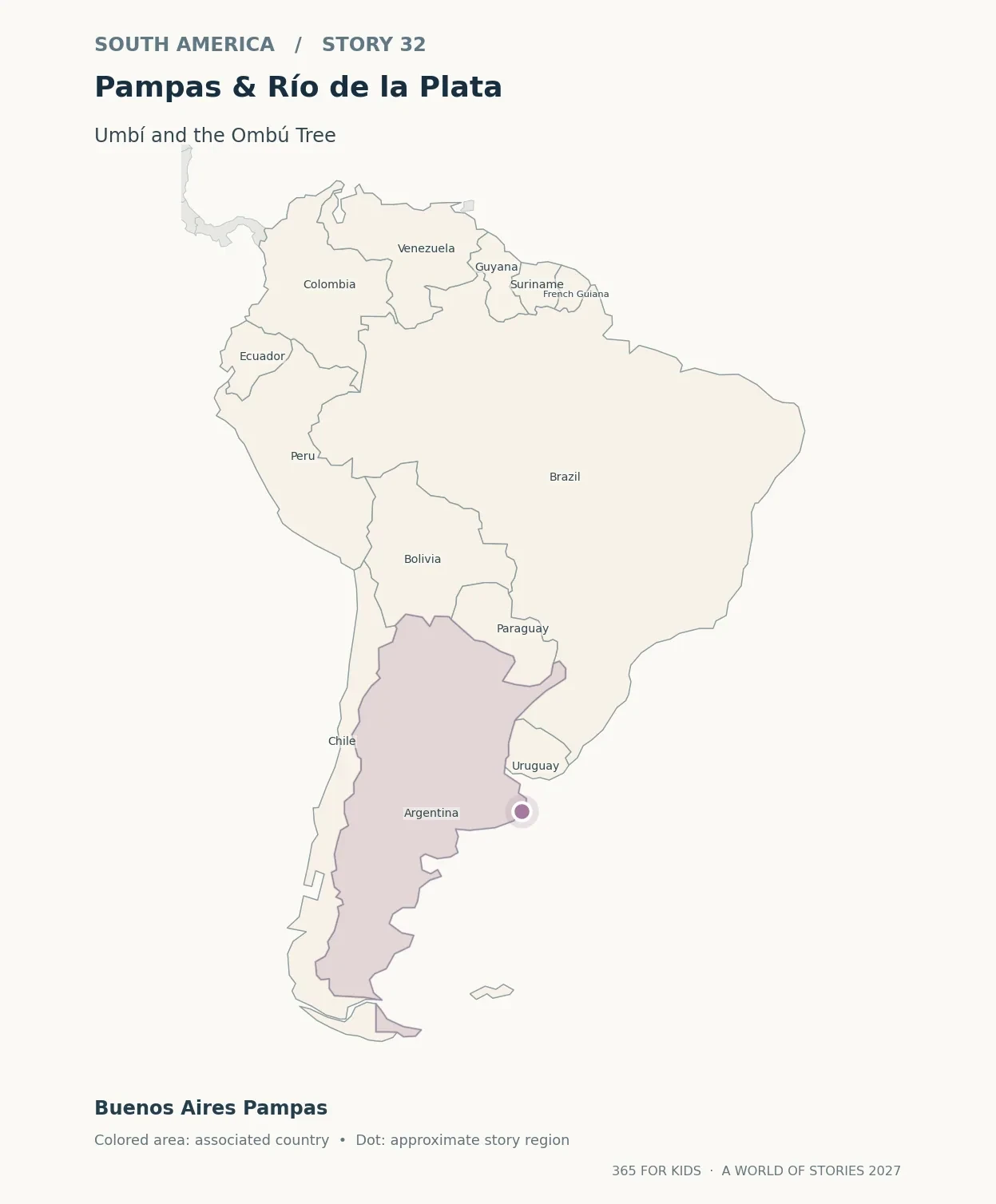
Long ago, on the wide plains of the Pampas, a community planted maize, and everyone watched the young green shoots rise from the soil, hoping there would be plenty to eat in the seasons ahead.
But a conflict called many of the men away from their homes. Before leaving, the community’s leader asked his wife, Umbí, to protect the crops, for the children, elders, and everyone waiting at home would need the maize when the cold days returned.
Then the rain stopped. Day after day, the sky remained clear and the ground grew dry. The maize leaves began to curl. Umbí carried water wherever she could find it and watched the sky for a cloud, but the heat continued, and each morning there were fewer strong plants in the field.
Umbí refused to abandon them. She knew she might not save the whole harvest, yet even a few ears of maize could provide seeds for another planting, so she stood beside the last living stalks and spread her arms, trying to shade them from the burning sun.
When the earth was too dry to give the plants any more water, Umbí wept over the roots and asked Gúnec he, the powerful being named in this telling, to see how hard she was trying. Her strength was nearly gone, but she remained with the maize.
At last, Gúnec he answered — not with rain, but with a wonder. Umbí began to change. Her feet seemed to take root in the earth, her arms reached outward, and her body became a broad, sheltering ombú tree. Beneath its generous shade, one precious maize plant survived.
When the people returned, they found the fields dry, but a great tree stood where Umbí had kept her watch, and beside it grew the maize that would give them seeds for the next harvest. The leader embraced the tree, understanding how much Umbí had given to protect her community.
And so, in this legend, the ombú became a living reminder of care and perseverance, its wide branches offering rest from the sun just as Umbí had once offered shelter to the small green plants.
This story comes from a Pampas-region legend of the ombú tree, in a version by Teresa Villafañe Casal published by the municipality of General Juan Madariaga in Argentina.
After the Story: Read · Create · Reflect · Share
1. Find the Pampas of Argentina on the map above. What does Umbí’s care teach us about helping others?
2. Why did Umbí promise to look after the maize fields?
3. What made it so difficult to keep the plants alive?
4. How did the ombú tree help save the next harvest?
5. What does Umbí’s care teach us about helping others?
Inspired by this story? Create your illustration!
Illustration ideas:
- A vast Pampas landscape with green maize fields beneath an open sky.
- Umbí carrying water as the sunlight grows hotter and the maize leaves curl.
- Umbí stretching out her arms to shade the last small maize plant.
- A great ombú tree sheltering a surviving maize stalk as the community returns.
URUGUAY — Anahí and the Red Ceibo Flowers
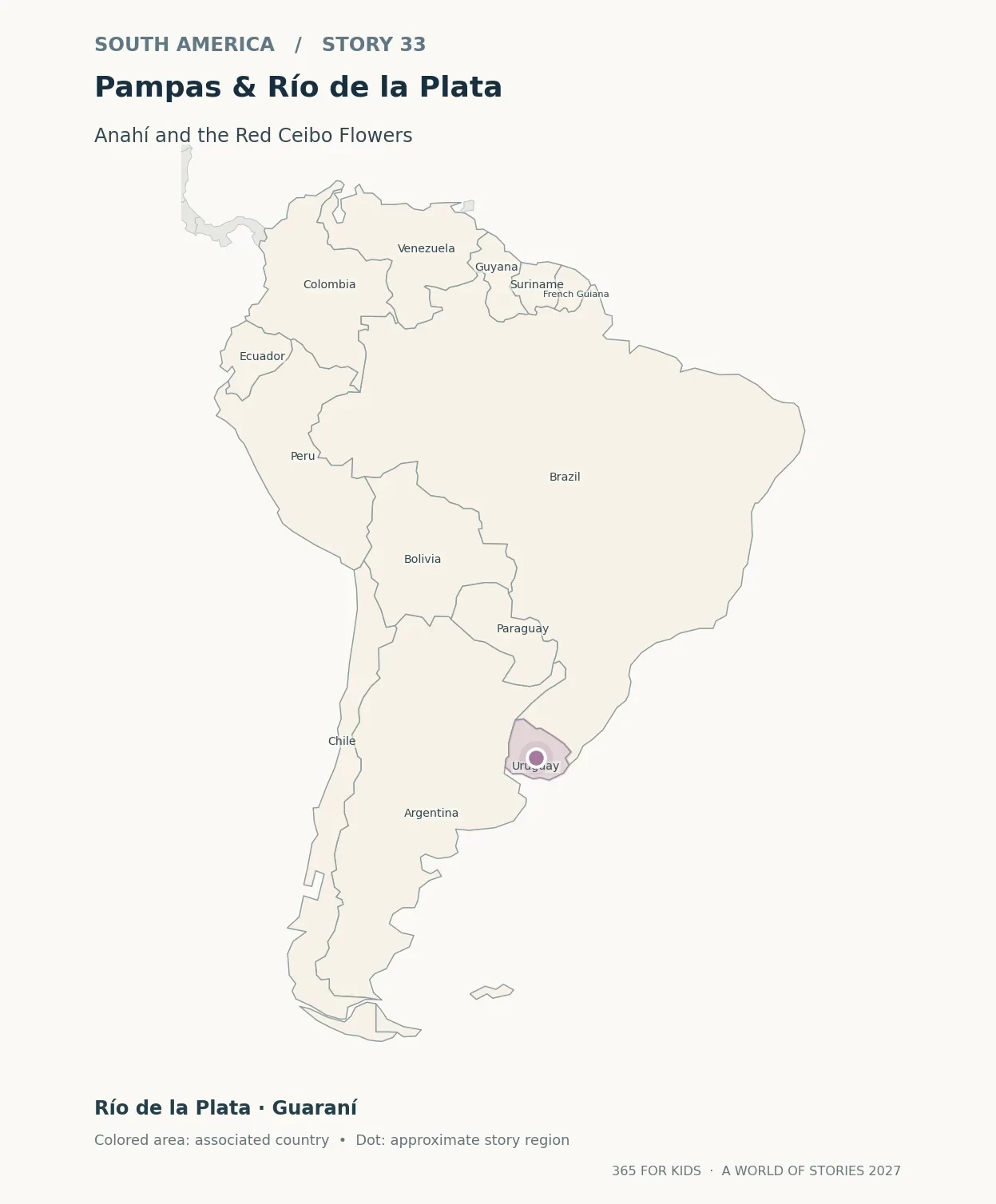
Long ago, near the Paraná River, there lived a young woman named Anahí. She belonged to a Guaraní community and loved the land around her: the river, the trees, and the birds that made their homes among the branches.
Anahí had a beautiful singing voice. When she sang the songs of her people, even the busiest birds seemed to grow quiet. Her songs told of the river, the forest, and the home she loved.
One day, strangers arrived by boat, carrying weapons and wanting to take the land for themselves. Anahí’s people defended their home. Her father, a leader of the community, died in the fighting, and Anahí grieved for him.
Anahí did not give up. She watched the invaders and tried to resist them, but she was captured. When she found a chance to escape, she struck the guard who stood in her way and ran toward the familiar shelter of the forest.
The soldiers caught her again before she could reach safety. They tied her to a tree and prepared a fire to punish her. The night grew dark, and Anahí knew she would not return to her people.
Yet Anahí began to sing. She sang of the river that had carried so many stories, of the birds whose voices she knew, and of the trees that had given her shade. Her song rose above the crackling fire and into the night.
At sunrise, the soldiers stared at the place where Anahí had stood. There was a tree with green leaves and brilliant red blossoms, bright as little flames. Anahí was gone, but the flowers seemed to hold the courage of her song.
According to the legend, this was how the ceibo came to bloom in red, and whenever its flowers appeared along the river, people remembered Anahí and her love for her home.
This legend of Anahí and the ceibo is shared in Uruguay and Argentina and is associated with Guaraní storytelling; the ceibo is cherished for its bright red flowers and is a national floral symbol in both countries.
After the Story: Read · Create · Reflect · Share
1. Find the Paraná River and the Río de la Plata region of Uruguay on the map above. How can stories help people remember courage and love for a place?
2. What did Anahí love about her home beside the river?
3. How did Anahí respond when strangers threatened her community?
4. Why do you think her song is important to the legend?
5. How can stories help people remember courage and love for a place?
Inspired by this story? Create your illustration!
Illustration ideas:
- Anahí singing beside the Paraná River while birds listen in the trees.
- The arrival of boats on the river, seen from the edge of the forest.
- Anahí’s song rising into the dark night beneath the branches of a tree.
- A ceibo tree in morning light, covered with vivid red flowers.
ARGENTINA — The Light That Followed the Gaucho
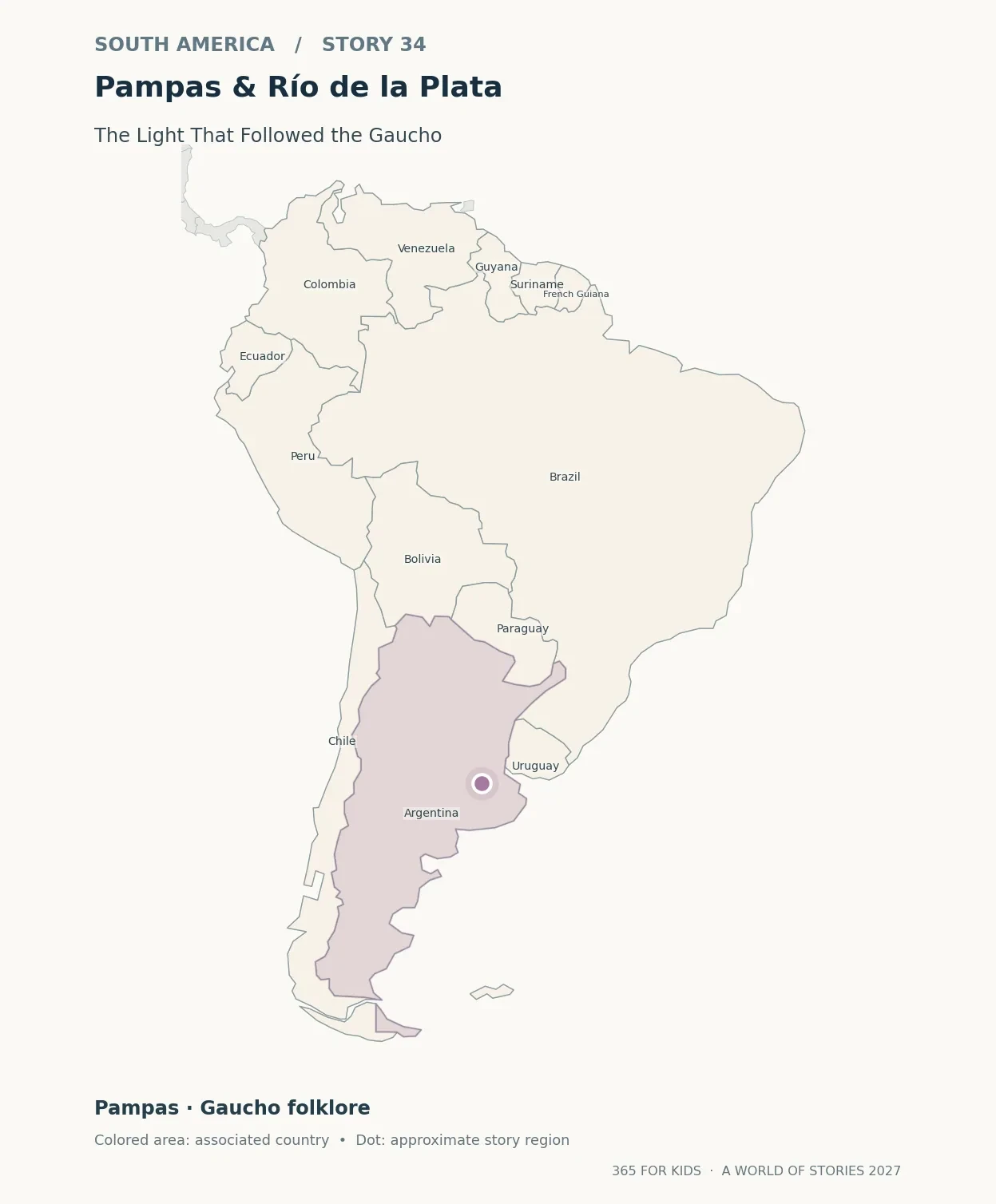
Across the wide grasslands of Argentina, people once traveled long distances on horseback. At the end of the day, gauchos rested beside their campfires and told stories about things they had seen on lonely roads.
One story concerned a mysterious glow called La Luz Mala — the Strange Light. People said it appeared after sunset, hovering above the fields like a small flame, sometimes pale blue, sometimes reddish or green.
In an old tale, a gaucho was riding home when he noticed a light shining in the darkness. There was no house nearby and no lantern hung from a gate, yet the light seemed to move whenever he moved.
He rode on. The light followed across the open country. He turned his horse toward the track home, but still the glow remained behind him. His horse grew uneasy, and the rider felt afraid.
The gaucho remembered what older people had told him around the fire: some believed that such a light belonged to a wandering soul that had not found peace, and that a prayer could be offered for that soul.
So the rider made a promise: when he reached home, he would light a candle in memory of the person the light might represent. He spoke his promise aloud and continued on his way.
In the tale, the strange light stopped following him, and soon the rider could see the familiar path again. He returned home and kept the promise he had made.
For many years afterward, stories about La Luz Mala were told beside campfires throughout the countryside, some imagining a spirit seeking peace, others wondering whether the glow came from something in the land itself.
La Luz Mala is a traditional belief found in Argentina and other parts of the Río de la Plata region, retelling a documented folk motif about a traveler followed by a light who promises to light a candle.
After the Story: Read · Create · Reflect · Share
1. Find the grasslands of the Río de la Plata countryside in Argentina on the map above. How can people tell a mysterious story while also asking questions about what really happened?
2. What made the gaucho realize that the light was unusual?
3. What did people in the countryside believe La Luz Mala might be?
4. Why did the gaucho promise to light a candle?
5. How can people tell a mysterious story while also asking questions about what really happened?
Inspired by this story? Create your illustration!
Illustration ideas:
- A gaucho riding across the enormous pampas beneath a starry evening sky.
- A small blue-green glow hovering over grass beside an empty country track.
- The horse and rider looking back as the mysterious light follows them.
- A candle glowing in a quiet home, with the dark pampas visible through the window.
BRAZIL — The Little Shepherd of the Pampas
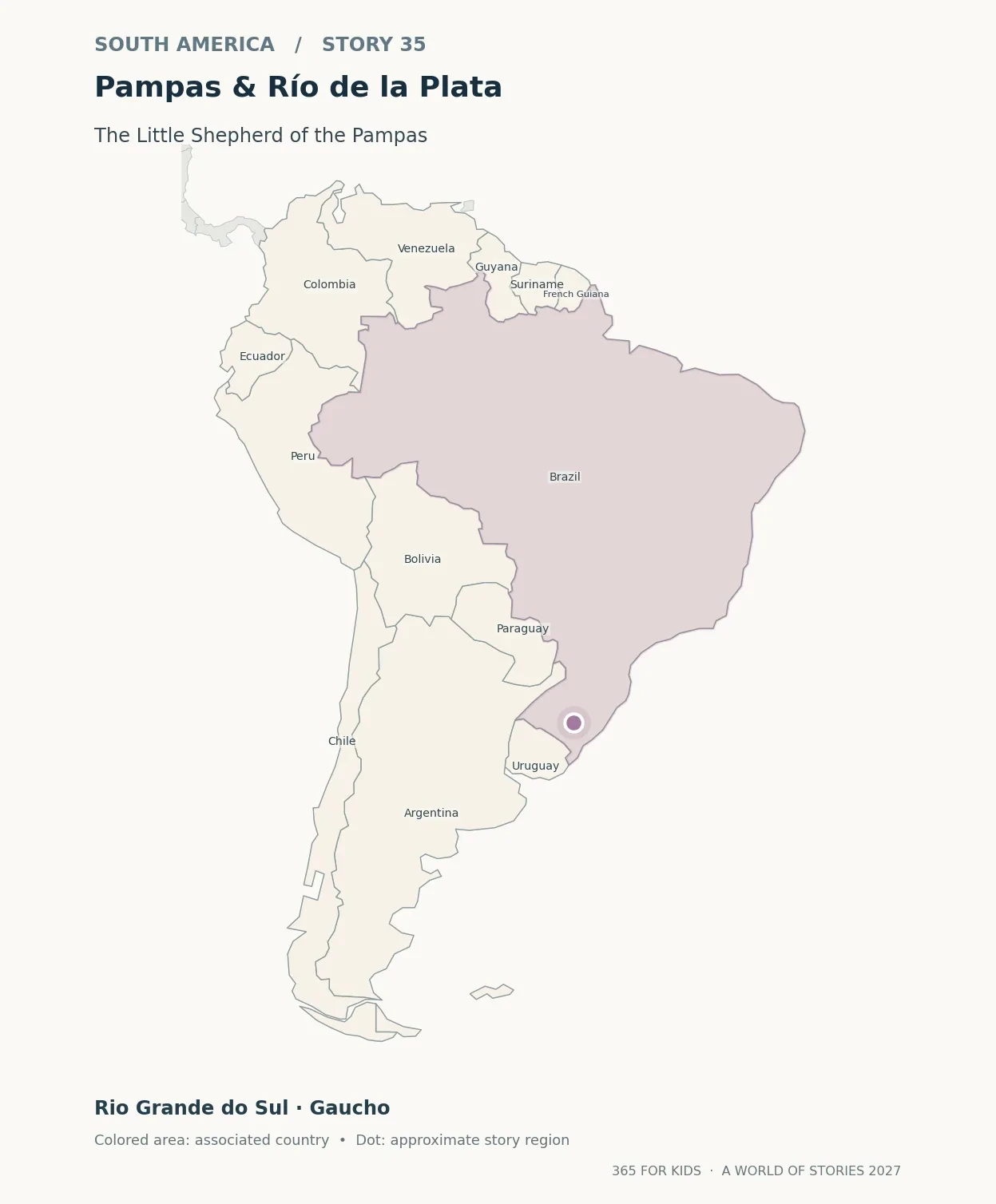
Long ago, across the rolling grasslands of southern Brazil, a wealthy rancher kept many horses. He had fine fields and silver coins, but little kindness to share. Among the people he enslaved was a young Black boy who cared for the horses, known in the old legend only as the Little Shepherd.
The rancher treated him unfairly, and his son was cruel to him too. Yet the boy took gentle care of the horses and found comfort in praying to the Virgin Mary, whom he thought of as his godmother and protector.
One day, the rancher entered his favorite horse in a race and lost. Angry at the defeat, he blamed the boy and ordered him to watch over a herd of horses through the night. The Little Shepherd led the animals onto the open grassland and stayed awake as long as he could.
But the rancher’s son deliberately frightened the horses and scattered them far across the fields. When the rancher discovered the herd was missing, he punished the boy and sent him out again to find every horse before dawn.
With only a small candle, the Little Shepherd crossed the dark grassland, praying for help. As he walked, drops of candle wax fell onto the earth, and wherever they fell, a tiny light appeared, until the fields glimmered with dozens of little flames bright enough to see the scattered horses by.
But the rancher’s son scattered the animals a second time. The rancher became furious and hurt the boy so badly that he seemed to die, leaving him beside an anthill and walking away.
Three days later, the rancher returned and, to his amazement, saw the Little Shepherd alive and smiling, with no wounds at all. Beside him stood the Virgin Mary, and around them waited the missing horses. The boy mounted a golden-brown horse and rode away across the pampas, free from the rancher at last.
People began to tell of a young rider who traveled unseen through the fields, helping others find what they had lost — a boy treated so unjustly who became a symbol of hope, kindness, and the search for what is missing.
This story comes from the gaucho traditions of Rio Grande do Sul in southern Brazil; in one well-known version collected by João Simões Lopes Neto in Lendas do Sul (1913), the Virgin Mary protects the enslaved child, who later helps people recover lost things.
After the Story: Read · Create · Reflect · Share
1. Find Rio Grande do Sul in southern Brazil on the map above, near the Pampas grasslands. How can we show kindness and stand up for someone who is being treated unjustly?
2. How did the Little Shepherd care for the horses, even when other people were unkind to him?
3. What happened when the candlelight spread across the fields?
4. Why does the ending of the legend offer hope after so much unfairness?
5. How can we show kindness and stand up for someone who is being treated unjustly?
Inspired by this story? Create your illustration!
Illustration ideas:
- The Little Shepherd caring gently for horses on the wide, green pampas.
- A dark grassland filled with tiny candle flames that show the way to the missing herd.
- The boy riding a golden-brown horse with the herd moving across the hills at sunrise.
- A small candle glowing in a window while a distant rider crosses the pampas beneath the stars.
Patagonia & Southern Andes
CHILE & ARGENTINA — Trentren and Caicai: When the Mountains Rose
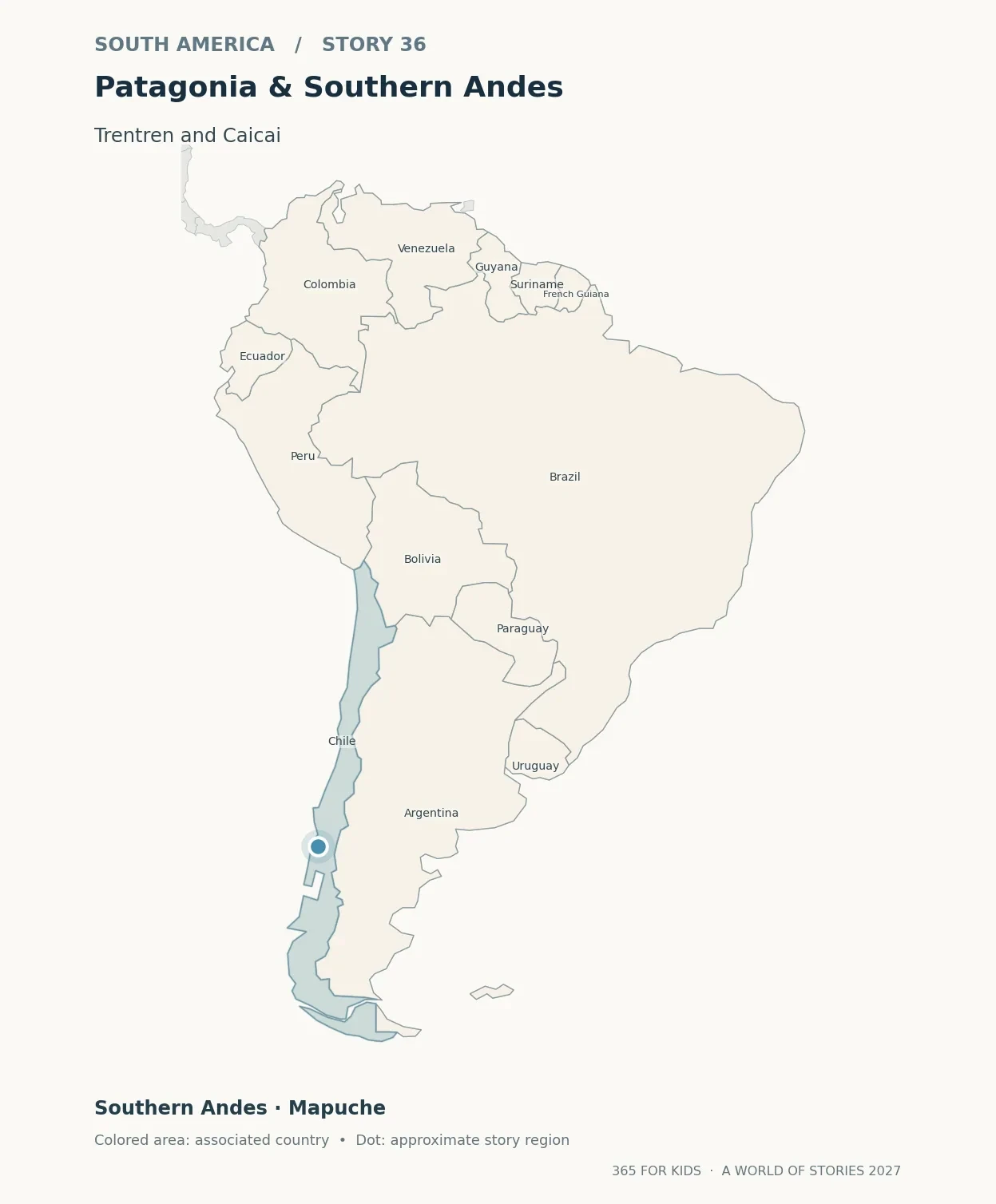
Long ago, the land beside the southern sea was home to forests, rivers, hills, animals, and people. The sea gave fish and other gifts to those who lived near its shores. But in one old Mapuche story, people stopped being thankful for what the waters provided.
Deep beneath the waves slept Caicai, a mighty serpent of the sea. When Caicai woke and saw how carelessly people had treated the sea’s gifts, the great serpent grew angry. Its enormous tail struck the water, and waves climbed the beaches and swept toward the homes of the people.
The people ran from the rising water. Above the land lived another powerful serpent, Trentren, who watched over the earth and its living creatures. When Trentren heard the cries for help, it called for the hills to rise higher, lifting the frightened people toward safety.
But Caicai would not give up. The sea rose again, and the hills rose to meet it. Water rushed between the slopes. Trees shook, stones rolled, and the earth trembled as the two serpents struggled — one commanding the sea, the other raising the land.
Not everyone reached the high places in time. In some versions of the legend, those caught by the water became fish or other sea creatures; others became birds or stones.
At last, both great serpents grew tired. Caicai’s waves began to settle, and Trentren’s mountains stood firm. The people looked out and saw a changed world: high hills above the sea and islands scattered across the water.
The survivors could begin again, remembering the power of the land and the sea, and the need to treat the natural world with care.
Even today, the legend of Trentren and Caicai helps tell how the southern landscape came to have its mountains, shores, and islands.
This legend belongs to the oral traditions of the Mapuche people, whose homeland extends across southern Chile and Argentina; Trentren is connected with the land and Caicai with the sea.
After the Story: Read · Create · Reflect · Share
1. Find Mapuche lands in southern Chile and Argentina on the map above. What is one way we can show gratitude and care for the natural world today?
2. Why did Caicai become angry with the people in this version of the legend?
3. How did Trentren try to protect the people and animals?
4. What details in the story help you imagine the changing landscape?
5. What is one way we can show gratitude and care for the natural world today?
Inspired by this story? Create your illustration!
Illustration ideas:
- Caicai rising from the ocean as enormous waves move toward the shore.
- Trentren lifting green mountains while people and animals climb to safety.
- A dramatic view of the two serpents, one in the water and one among the hills.
- The calm southern coastline after the storm, with mountains and islands under a bright sky.
ARGENTINA & CHILE — Elal and the Animals: The Journey to Patagonia
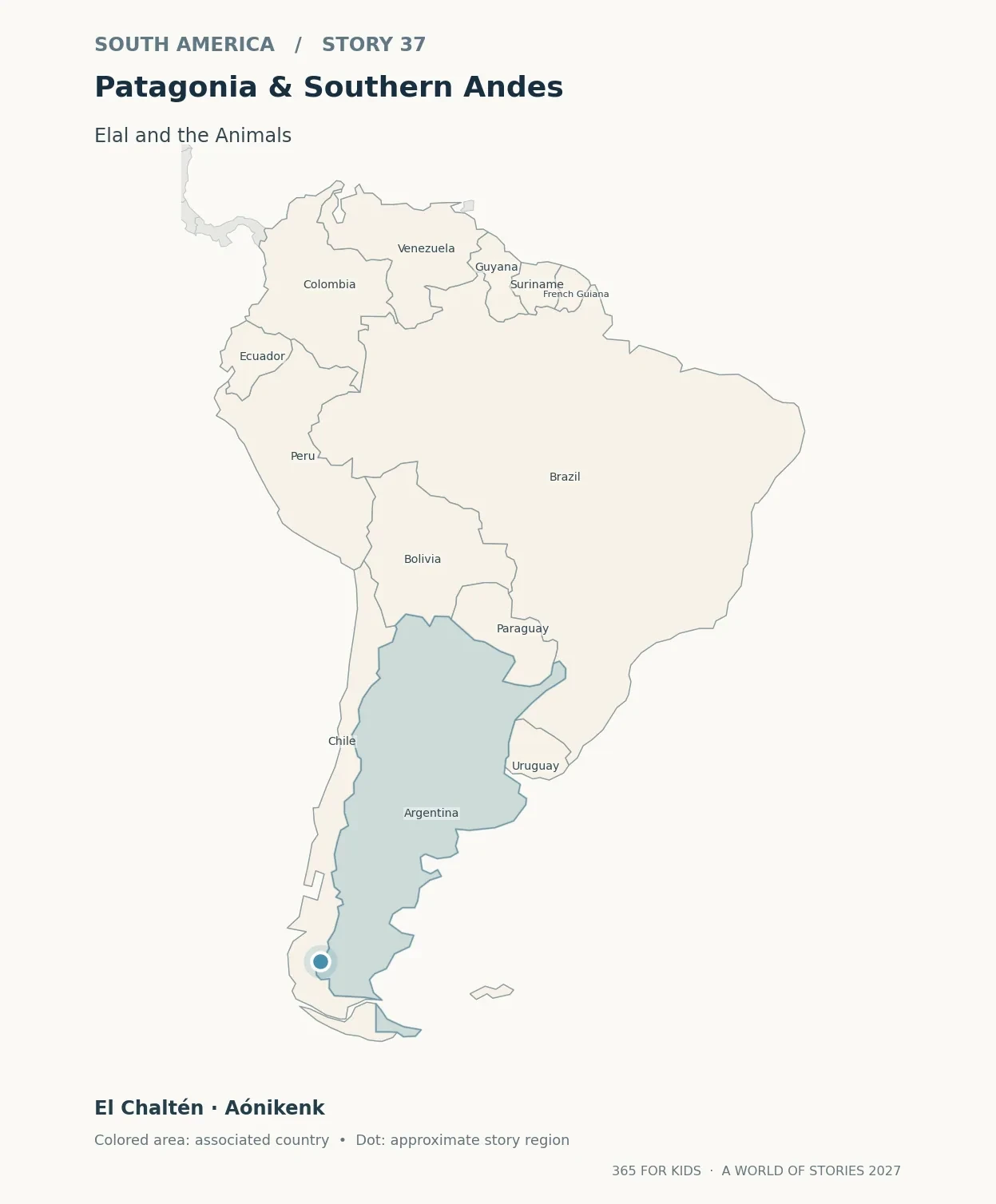
Long ago, the stories say, a young boy named Elal lived on an island beyond the sea. His father was Noshtex, a powerful giant, but instead of protecting his son, Noshtex grew jealous of him. The animals knew that Elal was in danger and wanted to save him.
The animals thought about where the child might be safe. Far away, across the water, lay Patagonia: a cold, open land of high mountains and wide plains where Noshtex would have a difficult time reaching him. The animals decided to carry Elal across the sea.
A great white swan offered its strong back to the boy and rose above the waves. Other birds followed through the sky, while fish swam in the water below, and land animals made the journey too, helping one another across the sea.
At last the swan reached a tall mountain called El Chaltén, settling on the summit and letting Elal climb down. He looked across Patagonia: the snow and rock seemed to stretch forever, and the wind swept the slopes.
The birds stayed close, sheltering the boy with their feathers and bringing him food. Around the mountain, other animals began to find places to live: guanacos on the open ground, foxes among the rocks, and birds beside the lakes.
For three days and three nights, Elal remained on the mountain, looking out over the country before him. The animals had carried him to safety, and their kindness had changed his future.
The story says that Elal would grow into a wise figure who helped shape life in Patagonia.
Even now, the mountain, the birds, and the wide Patagonian landscape remind listeners of that remarkable journey, in which the smallest traveler is saved not by strength alone, but by the many creatures who choose to help him.
Among the Aónikenk, also called Southern Tehuelche, Elal is a central figure in traditional stories; one telling describes how the animals carry him to Patagonia, where a swan leaves him on Mount El Chaltén.
After the Story: Read · Create · Reflect · Share
1. Find Patagonia and Mount El Chaltén on the map above, in Argentina and Chile. What does this story suggest about helping someone who is in danger or alone?
2. Why did the animals decide to take Elal away from his first home?
3. How did the swan and the other animals help Elal during and after the journey?
4. Which details make Patagonia seem unfamiliar when Elal first arrives?
5. What does this story suggest about helping someone who is in danger or alone?
Inspired by this story? Create your illustration!
Illustration ideas:
- A white swan carrying young Elal above the sea, with other birds flying beside them.
- Animals traveling together toward distant snow-covered mountains.
- Elal standing on the summit of El Chaltén as the swan spreads its wings.
- Birds protecting Elal with their feathers while guanacos and foxes explore Patagonia.
CHILE & ARGENTINA — Kenós and the First People of Tierra del Fuego
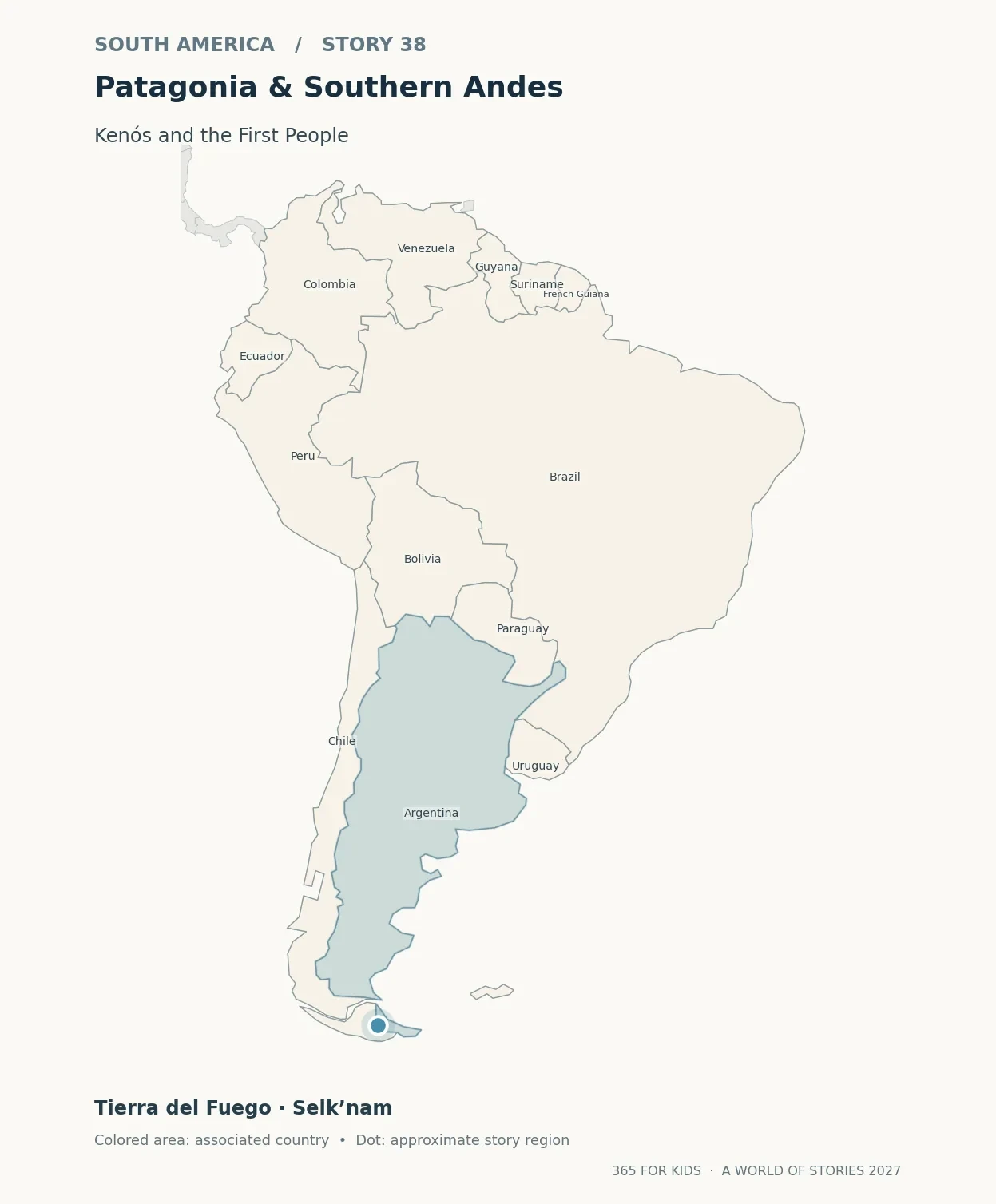
Long ago, the Selk’nam told of a time when the earth was flat and bare. There were no people walking across its wide spaces. The world was waiting for the shape it would one day take.
From the eastern sky came Kenós. He traveled across the empty land, and wherever he went, the ground began to change: what had been a level plain became a country of rising hills and deep places, taking the features by which it could be known.
Yet there were still no people. Kenós was alone as he looked over the earth. He went to a damp place, where the soil held water and grass roots, and there he gathered pieces of the wet ground and carefully prepared them.
Kenós placed the earth he had gathered upon the ground, then went away. During the night, something extraordinary happened: from the earth came the first of the ancient people.
The first ancestor was no helpless infant. In the telling of the story, this new person grew at once, and the miracle did not happen only once — as the nights passed, other ancestors appeared, until the once-empty land was home to many people.
Kenós taught these early people how to live together. The ancestors, remembered as the hoowin, belonged to a time unlike the world we know today, when food was plentiful and death had not yet entered their lives.
In later times, people remembered that many of those first ancestors became animals, stars, and parts of the landscape.
The earth beneath their feet and the sky above them were filled with reminders of that earliest age.
This origin story belongs to the Selk’nam people of Tierra del Fuego, at the far south of South America, where Kenós helps shape the land and brings forth the earliest ancestors from moist earth.
After the Story: Read · Create · Reflect · Share
1. Find Tierra del Fuego, shared by Chile and Argentina, on the map above. How does the idea that ancestors became animals and stars change the way you look at nature?
2. What was the earth like before Kenós arrived?
3. What did Kenós use when the first ancestors appeared?
4. How did the land change when Kenós traveled across it?
5. How does the idea that ancestors became animals and stars change the way you look at nature?
Inspired by this story? Create your illustration!
Illustration ideas:
- Kenós crossing a wide, nearly empty landscape as hills begin to rise.
- A quiet place of wet earth and grass roots under the night sky.
- The first ancestors appearing in a landscape of Tierra del Fuego.
- A sweeping scene linking mountains, animals, and stars with the ancient ancestors.
CHILE — The Ibis and the Long Winter
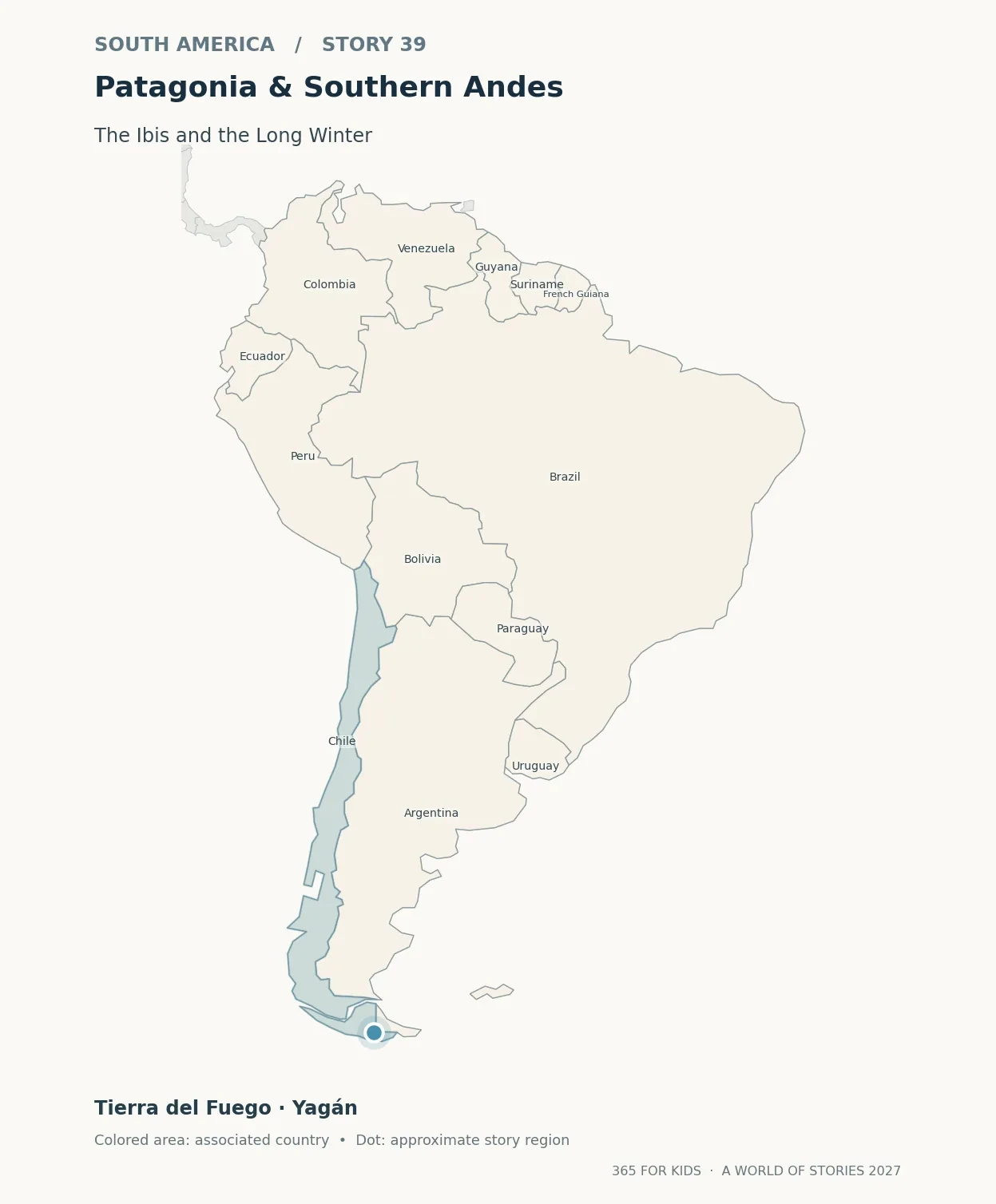
Long ago, in the islands at the far southern end of the world, the Yagán people watched the seasons closely. Their homes stood near cold channels where they traveled by canoe, and after the long winter, the first signs of spring were precious.
One day a man stepped outside his shelter and looked up. A bird was flying over his roof: a bandurria, a kind of ibis whose return meant that warmer days might be near. The man was delighted and called to the neighboring shelters so that everyone could see.
People hurried outside, looked toward the sky, and shouted with joy. “Spring is coming! The ibises have returned!” Children jumped, adults called to one another, and the air filled with excited voices.
But the ibis heard their loud cries differently. In this old telling, Lexuwa, the ibis, was a proud and sensitive bird who expected to be greeted with quiet respect. The shouting upset her deeply, and instead of continuing on her way, she brought a fierce snowstorm upon the land.
Snow fell and fell. Sharp winds swept over the islands, and bitter cold followed, month after month. Ice closed the channels where canoes once passed, and many did not survive the terrible winter.
At last the snow stopped. A brilliant sun appeared, shining so strongly that the great ice began to melt, and water rushed down the slopes and into the sea. The channels opened again, and the survivors could take their canoes out to gather food.
Yet not all the snow disappeared. Thick ice remained in high valleys and on great mountain slopes, reaching toward the sea — reminders of the winter brought by the offended ibis.
From then on, people greeted the bird quietly and taught their children to show her respect.
The Yagán, also called Yámana, are a people of the islands and sea channels around Cape Horn and Tierra del Fuego; this tale comes from a Yagán account recorded by Martín Gusinde.
After the Story: Read · Create · Reflect · Share
1. Find Tierra del Fuego and the Yagán lands of Chile on the map above. How can we show respect for animals and nature even when we are excited?
2. Why were the people happy when they saw the ibis flying above the shelters?
3. How did Lexuwa understand the people’s shouting?
4. What changed when the snow finally stopped and the sun returned?
5. How can we show respect for animals and nature even when we are excited?
Inspired by this story? Create your illustration!
Illustration ideas:
- The ibis flying above a small group of seaside shelters as spring approaches.
- Families looking toward the sky beside their canoes and rocky shore.
- The long winter: snow-covered hills, frozen channels, and quiet wooden canoes.
- Sunlight melting the ice, with bright water flowing toward the sea and distant glaciers.
CHILE — The Dance of the Pincoya
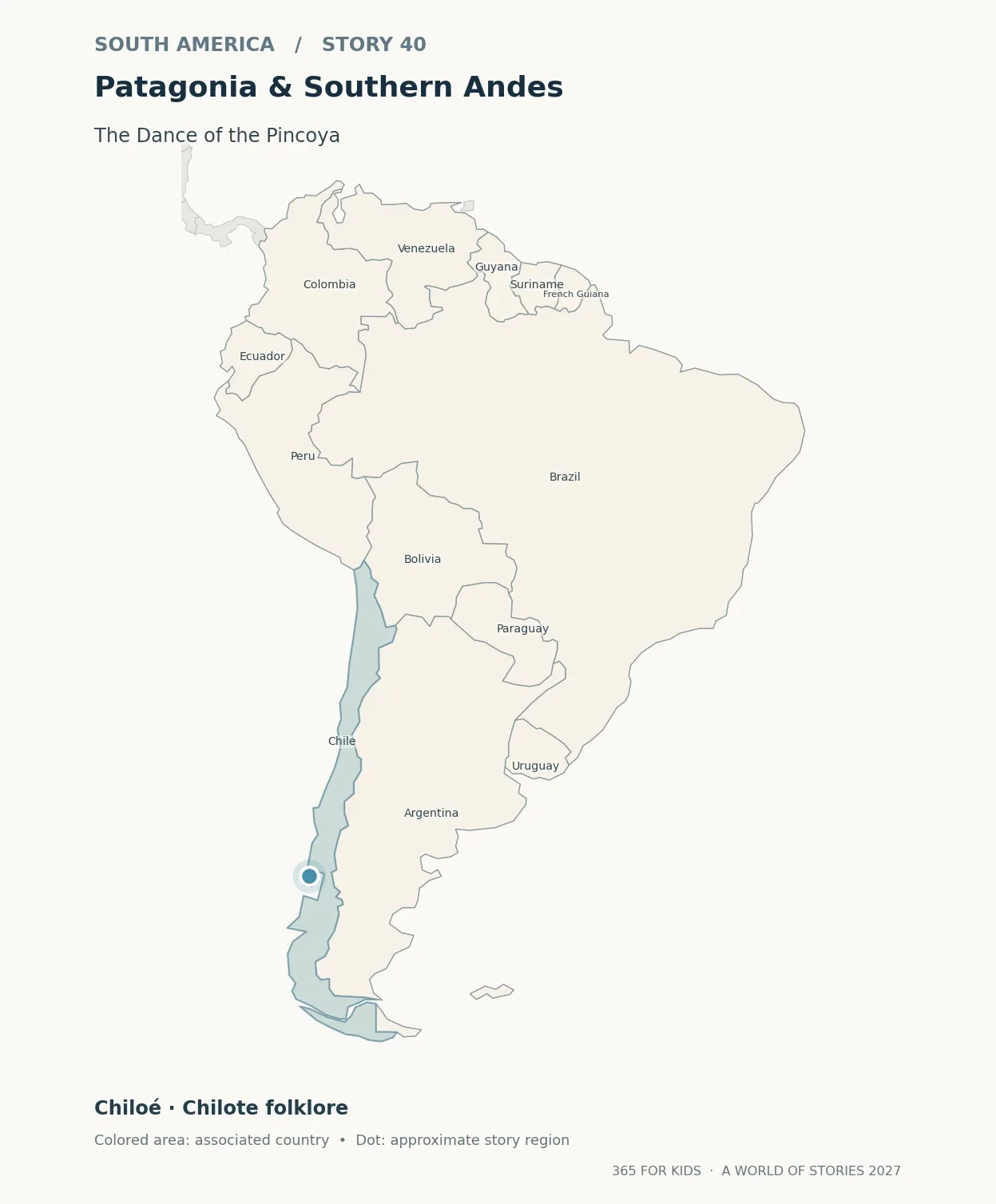
Off the southern coast of Chile lies Chiloé, a land of green islands, rocky beaches, and winding sea channels. For generations, families there have lived close to the ocean, knowing its changing winds, its tides, and the long patience of those who fish and gather shellfish.
In the stories of Chiloé, the sea is home to a mysterious figure called the Pincoya. She is said to rise from the water and appear along the shore, with long hair and a dancer’s graceful movements, glimpsed only for a moment before the waves hide her again.
But the Pincoya’s dance is never meaningless: the direction she faces carries a message. When she turns toward the open sea and stretches out her arms, her dance announces abundance — fish and shellfish will be plentiful in the waters around the islands.
If the Pincoya turns her face toward the land, the meaning changes: her dance tells of a time when fish will be scarce, and families may need to work harder and remember that the sea cannot always give them everything they wish for.
People tell how the Pincoya belongs to the living world of the water, connected with the creatures beneath the surface and the rhythms of the tides. Some tellings also say that she helps lost fishermen find their way back toward safety.
So when the morning light spreads across the beaches of Chiloé, the old question remains: will the Pincoya turn toward the sea or toward the shore?
No one can command her dance. The people can only watch, listen, and remember that life beside the ocean depends on both its generosity and its limits.
And in this way, the dance of the Pincoya has been remembered: a beautiful sign of the bond between island families and the sea that surrounds their homes.
Chiloé is an archipelago in southern Chile with a rich tradition of stories about the sea, and the Pincoya is a beloved figure in Chilote folklore whose dance is understood as a sign of plentiful or scarce fish and shellfish.
After the Story: Read · Create · Reflect · Share
1. Find the islands of Chiloé off the coast of southern Chile on the map above. What can this legend teach us about respecting the ocean and the food it provides?
2. Where does the Pincoya appear, and what is special about her dance?
3. What does it mean when she dances facing the sea?
4. How is the meaning different when she turns toward the land?
5. What can this legend teach us about respecting the ocean and the food it provides?
Inspired by this story? Create your illustration!
Illustration ideas:
- The Pincoya emerging from the ocean at dawn, with islands and sea mist in the distance.
- The Pincoya dancing toward the open sea as silvery fish swim beneath the water.
- A quiet shore with fishing boats and baskets when the Pincoya dances toward the land.
- A wide view of Chiloé: green islands, rocky coast, boats, seabirds, and the mysterious dancer.
Key Dates
August 31, 2027
Submission deadline (or earlier, once 500 eligible artworks are received)
October 1–31, 2027
Virtual exhibition
Oct 1, 2027
Online gallery and digital catalog
Questions Parents Ask
Who can participate?
Children and teens ages 6–17 who live in the United States. A parent or legal guardian submits the artwork.
Does it cost anything?
No. Participation is completely free, and no purchase is ever necessary.
Can my child submit more than one artwork?
One artwork per child for each exhibition. Your child is welcome to take part in all six continents.
What kind of artwork is accepted?
Original artwork made by hand with traditional materials — pencils, crayons, markers, paints, collage and more. Artwork that is AI-generated, traced or copied, or made mostly by an adult cannot be accepted.
Is this a contest?
No. There are no rankings and no winners. The first 500 eligible submissions for each continent are accepted, in the order they are received.
What information is shown publicly?
Only your child’s first name or a nickname, an optional last initial, age group, city (optional), and state — never addresses, phone numbers, or emails.
Who owns the artwork?
Your child keeps the copyright. You give 365 for Kids permission to display and publish the image only in the ways you choose in the form.