
A World of Stories · Volume II
Folk Tales and Legends from AFRICA
Travel across Africa through its folk tales and legends. Read a story from a people or cultural tradition that interests you, imagine its characters and places, and bring it to life in your own illustration.
Free
No purchase necessary
Ages 6–17
Children living in the U.S.
Feb 28, 2027
Submission deadline
How to Participate
1
Explore the folk tales and legends from Africa below.
2
Choose your favorite story and read it.
3
Create your own illustration of it — by hand, with any art materials.
4
Ask a parent or guardian to submit a photo of your artwork.
Participation is free. One artwork per child. Participation rules
What Happens to Your Child’s Artwork
- It is shown in an online gallery on our website — and stays there.
- It joins a national virtual exhibition, April 1–30, 2027.
- It appears in a digital exhibition catalog you can download — and, with your permission, in a printed catalog.
- Every accepted participant receives a personalized Certificate of Participation.
- With your permission, it may be selected for an illustrated book of these stories.
Not a contest: the first 500 eligible submissions are accepted, in the order received.
Explore the Stories
23 folk tales and legends from different African peoples and cultural traditions, grouped by region. Tap a tradition to read its story.
About This Collection — Peoples, Not Borders
Africa is the world’s second-largest continent, home to 54 internationally recognized countries and an extraordinary diversity of peoples, languages, and cultures. Across its vast landscapes — from the Sahara Desert and tropical rainforests to great rivers, mountains, savannas, and islands — generations of storytellers have preserved a remarkable cultural heritage.
Many African countries gained independence during the twentieth century, but the peoples and cultural traditions of Africa have histories stretching back centuries and, in many cases, thousands of years. Long before today’s national borders existed, communities shared stories that explained the natural world, celebrated courage and wisdom, explored human relationships, and passed knowledge from one generation to the next.
Stories Beyond Borders
Unlike our European collection, which is organized by country, our African collection follows peoples and cultural traditions.
This distinction is important because cultural communities do not always fit within modern national boundaries. The same people may live in several countries, while a single country may be home to many different cultures, languages, and storytelling traditions.
A story told among the Akan people, for example, may be known in both Ghana and Côte d’Ivoire. Swahili storytelling traditions connect communities along the East African coast, while Amazigh traditions extend across several countries of North Africa.
Stories themselves also travel. Over generations, storytellers adapt them, preserve different versions, and share them with neighboring communities. A single tale may therefore belong to a much wider cultural world than any one country.
The Living Tradition of Storytelling
For generations, oral storytelling has been an important way of sharing knowledge, history, imagination, and values across many African communities.
Stories have been told by parents, grandparents, community elders, and skilled storytellers. Some were accompanied by songs, rhythms, gestures, or audience participation, turning storytelling into a shared experience.
The characters are wonderfully varied. Clever spiders and tortoises outwit stronger animals. Brave children face extraordinary challenges. Kings and queens must make difficult decisions. Magical creatures, mysterious forests, and powerful spirits appear alongside ordinary people whose kindness, curiosity, or determination changes their lives.
Not every traditional story offers a simple moral lesson or a happy ending. Some are humorous, some mysterious, and others explore difficult emotions and choices. Together, they invite us to think about fairness, honesty, courage, friendship, responsibility, and the consequences of our actions.
About Our Collection
A World of Stories — Africa presents a carefully selected collection of traditional folktales, legends, and stories from different African cultural traditions.
This collection is not intended to represent every African country, people, or storytelling tradition. Africa’s cultural heritage is far too rich and diverse to be captured in a single collection. Instead, we have chosen documented traditional stories that offer young readers an opportunity to discover some of this remarkable diversity.
Each story includes information about its cultural origins and the present-day countries associated with that tradition. Our English literary adaptations aim to remain faithful to the events, characters, and meanings of the documented versions, while making the stories accessible to young readers.
Read, Explore, Reflect & Create
As you discover these stories, we invite you to do more than simply read.
Explore the map and discover where different cultural traditions are found. Learn about the people who have preserved these stories. Think about the characters, their emotions, their decisions, and the challenges they face.
Then let your imagination become part of the journey.
Choose a story that inspires you and create your own illustration. You might draw a courageous hero, a mysterious creature, a dramatic landscape, or a moment that made you laugh, wonder, or think.
Every illustration is an opportunity to connect with a story, discover another culture, and express your own creative vision.
One continent. Countless traditions. A world of stories waiting to be discovered.
North Africa
ANCIENT EGYPT — The Shipwrecked Sailor
The ship had come home, and its ropes lay safely on the shore. The men embraced one another. They had crossed dangerous waters and returned to Egypt, yet the leader of the expedition was troubled. He feared what he would say to the king, for the journey had not brought the success he had hoped for.
One of his attendants, an experienced sailor, saw his distress. “Take heart,” he urged him. “We have reached our homeland. When you stand before the king, speak clearly and without fear. Words can sometimes save a man.”
The leader remained silent. So the sailor began to tell him of another voyage, one that had changed his life.
“Once,” he said, “I sailed on a great ship sent on a royal mission. It was one hundred and twenty cubits long and forty cubits wide, and it carried one hundred and twenty sailors, the finest men of Egypt. They were brave, skilled, and watchful. They could recognize the signs of a coming storm before the sky broke open.
“But one day, while we were still far from land, a fierce wind rose. The sea swelled. Waves struck the ship, towering above the men. The mast could not save us. Our vessel was overwhelmed, and the ship went down. I alone survived, carried by the waves to an island.
“For three days I lay there by myself. My heart was my only companion. At night I slept beneath the shelter of a tree. When I could rise and search the island, I discovered that it was filled with good things: figs, grapes, cucumbers, vegetables, birds, and fish. There was more food than I could carry. I ate, gathered what I needed, made a fire, and gave thanks to the gods.
“Then came a sound like thunder. The trees trembled, the earth shook, and I covered my face. When I dared to look again, I saw an enormous serpent approaching.
“It was thirty cubits long. Its beard was longer than two cubits, its body shone like gold, and above its eyes gleamed the deep blue of lapis lazuli. It raised itself before me and spoke.
‘Who brought you here, little one? Who brought you to this island?’
“I was so terrified that I could not answer. The serpent warned me to speak, but fear had stolen my voice. Then it took me gently into its mouth and carried me to its dwelling. Though its size and strength were astonishing, I was not harmed.
“There the serpent asked again how I had come to the island. This time I found my words. I told it of the king’s mission, the ship, the skilled sailors, the storm, and how I alone had reached the shore.
“The serpent listened. Then it told me not to be afraid. I had been spared, it said, and the island held everything I needed. I would remain there four months. After that, a ship from Egypt would arrive with sailors I knew, and they would take me home.
“I could hardly believe this promise. Yet the serpent had more to tell. Once, it said, it had lived on the island among its brothers and children, seventy-five serpents in all. There had also been a little daughter dear to it. One day, while the great serpent was away, a star fell from the sky. Fire swept over the island, and its family was lost. When the serpent returned, it found only grief.
“The serpent’s golden body was magnificent, but now I understood that its heart had known sorrow greater than I could imagine. I was no longer thinking only of my own shipwreck.
‘Be strong,’ the serpent told me. ‘You will hold your children again, kiss your wife, and see your home. There is no greater happiness than coming through hardship and returning to those you love.’
“I bowed low and promised that when I returned to Egypt I would tell the king of the serpent’s kindness. I would send fine oils, incense, and gifts to honor it.
“But the serpent laughed. It told me that it already possessed precious fragrances and riches, for it was lord of Punt. It had no need of such gifts. And once I sailed away, I would never find the island again: the island would become water.
“The months passed, and at last a ship appeared on the horizon, exactly as the serpent had said. Before I departed, the serpent gave me a generous cargo: rare fragrant woods, oils, incense, and other precious things. I thanked it and bowed once more. Then I boarded the ship and sailed toward Egypt.
“When I reached home, I brought the gifts to the king and told him all that had happened. He received my account, and I returned to my life in my own country. I had faced the loss of my ship and companions, the loneliness of the island, and the terror of meeting the great serpent. Yet I had lived to tell the tale.”
The sailor turned to the troubled leader. He hoped the story would give him courage to stand before the king. He had learned that fear and disaster do not always have the last word.
But the leader was not comforted. He answered with a dark saying about the uselessness of giving water to a goose that would soon be slaughtered. And there, with the ships safely home but the future uncertain, the ancient story ends.
One of the oldest surviving works of Egyptian storytelling, composed roughly four thousand years ago and preserved on a papyrus now held in the State Hermitage Museum. This is an original English retelling of the ancient narrative, not a reproduction of any modern translation.
After the Story: Read · Create · Reflect · Share
Create: Draw the golden serpent with its lapis-lazuli brows — what colors would show both wonder and fear?
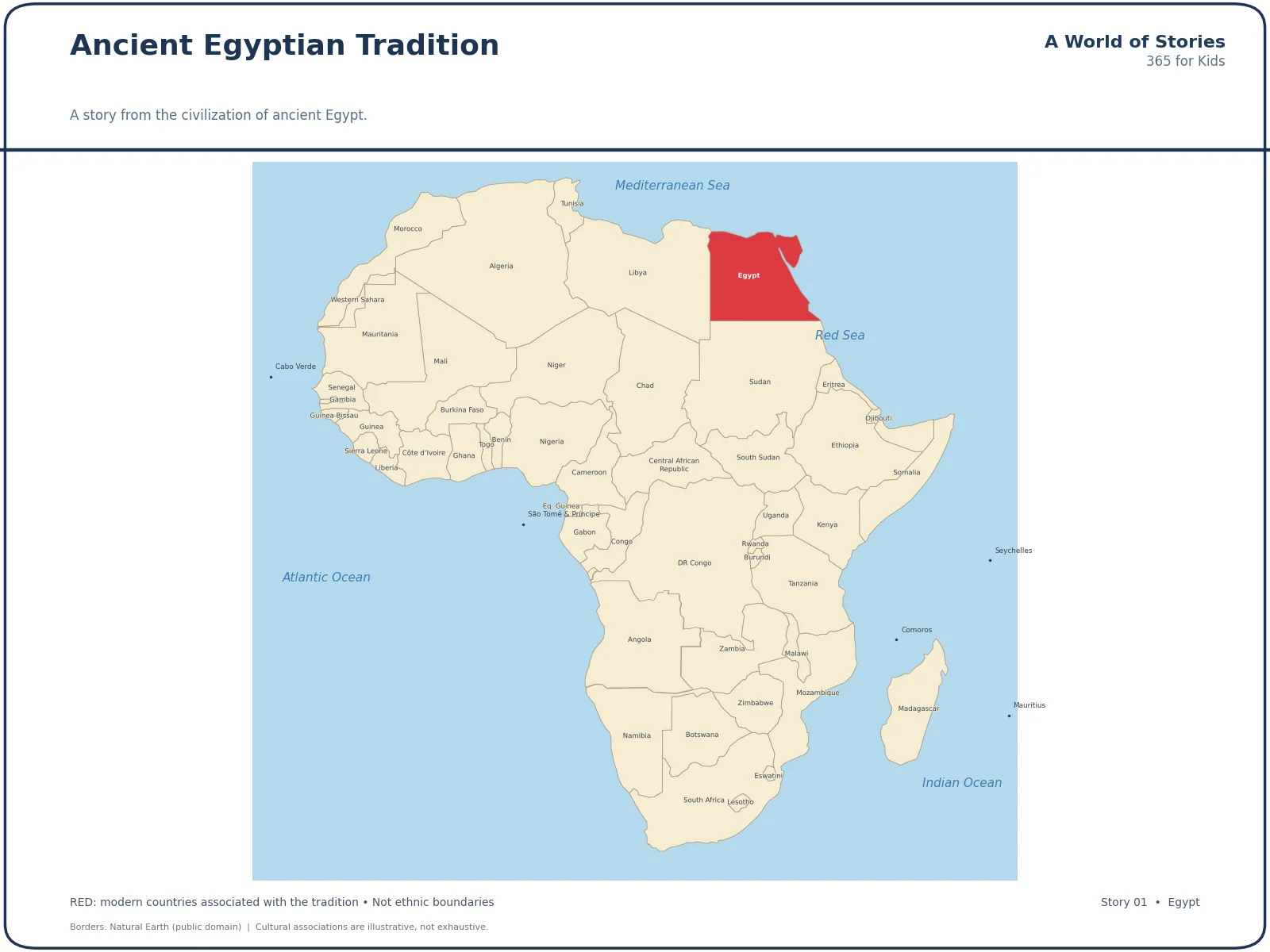
Explore: Find Egypt on the map of Africa. Which sea lies to its north, and which river runs through the country?
Reflect: Why does the serpent seem frightening at first, and how does the sailor’s understanding of it change once it tells him about its lost family?
Think & Share: The sailor’s story doesn’t comfort the troubled leader. Why might a true story sometimes fail to reassure someone?
Inspired by this story? Create your illustration!
KABYLE (ALGERIA) — The Wagtail and the Jackal
Long ago, when animals could speak, a wagtail made her nest upon the ground. There she laid her eggs, and in time her little ones hatched and began to grow.
One day, a jackal came near the nest with a fox. The jackal wanted to claim something that did not belong to him. Turning to the fox, he told him to swear that the wagtail owed the jackal a pound of butter.
The fox agreed. He gave his word in support of the jackal’s false claim, though he had no reason to believe it was true.
The wagtail was distressed. How could she answer an accusation backed by another animal’s testimony? She began to weep.
A greyhound happened to come by. Seeing her tears, he asked what troubled her. The wagtail explained that the fox had falsely accused her.
The greyhound listened. Then he offered a plan. He asked the bird to put him inside a leather sack and tie the opening securely.
The wagtail did as he asked. When the jackal returned, she told him to come and measure the butter he said she owed him.
The jackal stepped forward and opened the sack. Instead of butter, he found the greyhound, who stretched out his paws.
Startled, the jackal drew back. He said that he was unwell and urged the fox to come and do the measuring instead.
The fox approached the open sack. At once, the greyhound seized him.
The jackal, who had persuaded the fox to give false testimony in the first place, now reminded him of that very lie.
And so the wagtail’s tears had brought a helper, while the false accusation had led the fox straight into danger. The story leaves us to consider what happens when someone chooses to support a lie.
Traditional Kabyle (Amazigh) tale from the mountainous Kabylia region of northern Algeria, first published in English in 1901 (“Popular Tales of the Kabyles”). This is a newly written English adaptation keeping the original sequence of events, including its ambiguous ending.
After the Story: Read · Create · Reflect · Share
Create: Draw the flag of Algeria. What two colors make up its background, and which two symbols appear in the center?
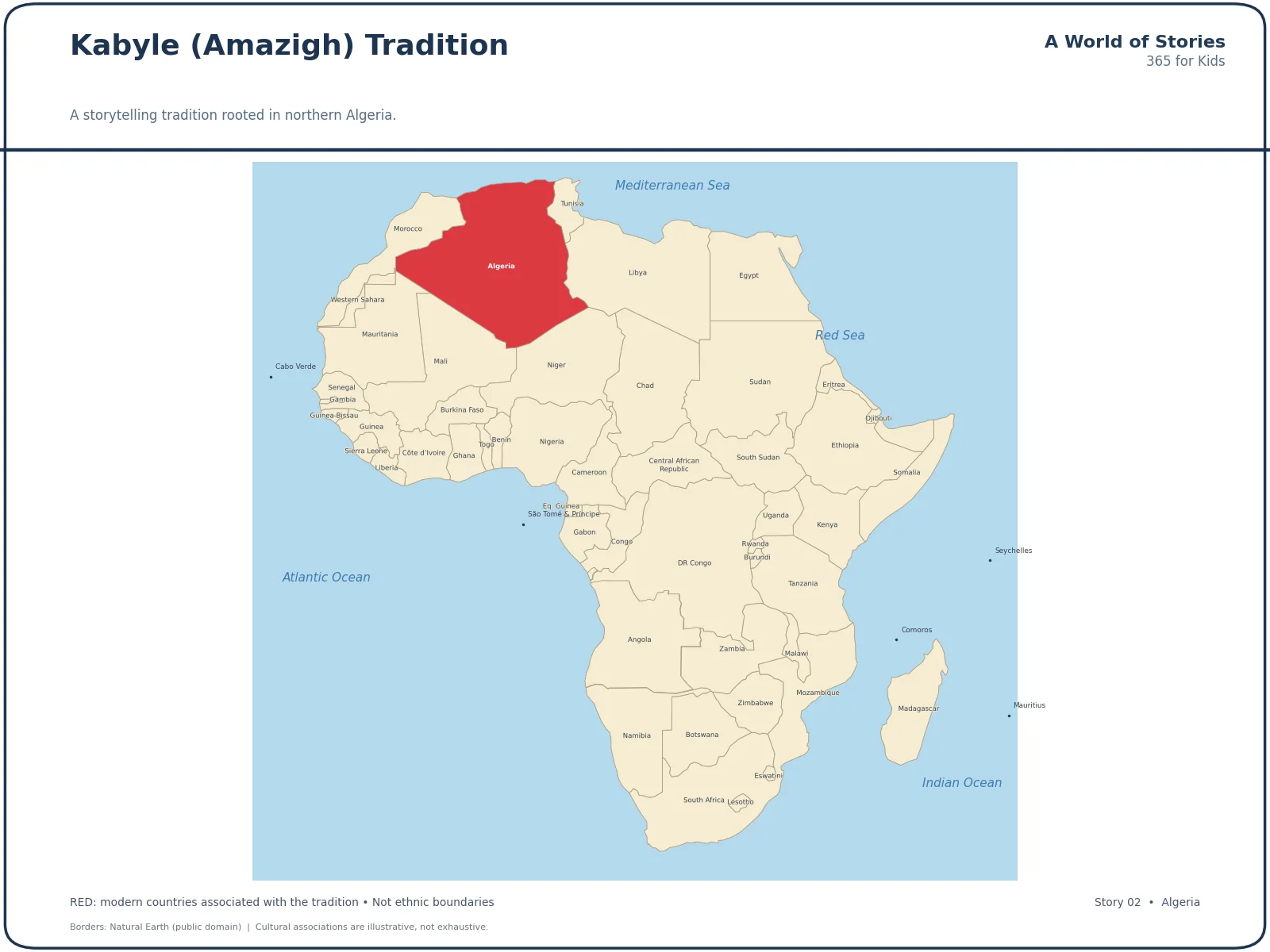
Explore: Find Algeria on a map of North Africa, and locate the mountainous Kabylia region near the Mediterranean coast.
Reflect: What did the jackal ask the fox to say about the wagtail? Why was it wrong for the fox to agree?
Think & Share: Imagine a friend is unfairly accused of something. What could you do to help fairly and safely?
Inspired by this story? Create your illustration!
AMAZIGH (MOROCCO) — Zadraqa, the Ruling Bird
Long ago, two birds shared a nest. One bird had laid eggs there. The other was called Zadraqa. When Zadraqa offered to keep the eggs warm, the mother bird accepted her help.
But after some time, the mother bird wanted to sit on her eggs again. “Please, Zadraqa,” she said, “let me return to my nest.”
Zadraqa refused. She would leave only if the mother bird brought her a twig from a tree.
So the mother bird flew to a tree and begged for a twig. The tree would not let one fall unless a wolf shook its branches.
The mother bird found a wolf. He said that he would shake the tree only if she first brought him a young goat.
She hurried to a shepherd and asked for a kid. The shepherd wanted a puppy in return.
She flew to a mother dog. The dog would give her a puppy only if she brought something from a mare that had just given birth.
The mare, in turn, asked for a bundle of medick, a plant used as fodder. So the little bird went to the harvesters. They demanded a jar of butter.
At last the bird reached the field of an Arabic-speaking woman who had a jar of butter. The bird warned her that cattle had wandered through the fence and were feeding in a nearby field. While the woman ran to check, the bird asked a rat to cut the strap holding the jar. The rat did so, and the bird carried away the butter.
Then the long chain of exchanges could begin. The harvesters gave her the fodder. The mare gave what the dog had asked for. The mother dog gave her a puppy; the shepherd gave her a young goat; the wolf shook the tree; and a twig fell to the ground.
With the twig at last in her beak, the mother bird hurried home. She had done everything that was demanded of her. Surely Zadraqa would now let her take back her place.
But when she reached the nest, it was too late. Zadraqa had already hatched the eggs, and there were no eggs or chicks there for the mother bird to reclaim.
Overcome by grief and anger, the mother bird fainted. After so much effort, she had lost what mattered most to her.
And here the old story ends — not with an easy reward, but with the sorrow of a bird whose trust was betrayed.
Told by Fadma Tainsirt, a Tamazight-speaking storyteller from the Azilal region in Morocco’s Atlas Mountains; collected by Lhoussain Simour for the MULOSIGE project (SOAS University of London, 2021). This retelling keeps the recorded sequence of events and its sorrowful ending.
After the Story: Read · Create · Reflect · Share
Create: Draw Morocco’s flag and identify its colors and central symbol.
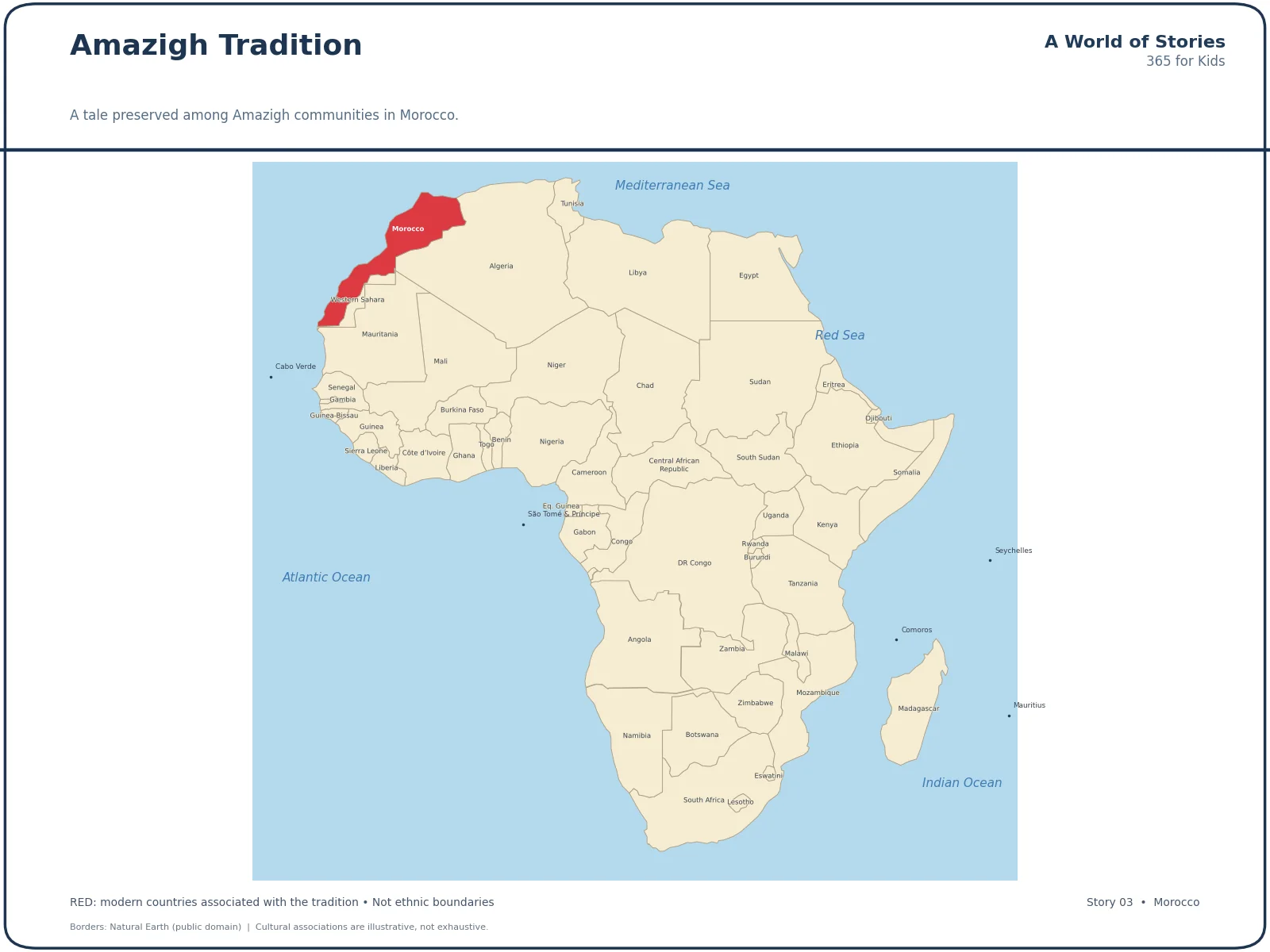
Explore: Find Morocco on a map of Africa. Where are the Atlas Mountains?
Reflect: Retrace the mother bird’s requests: what did the tree, wolf, shepherd, mother dog, mare, and harvesters each demand?
Think & Share: How did the mother bird feel at the end? Was Zadraqa fair? Imagine one way the other characters might have helped without demanding a reward.
Inspired by this story? Create your illustration!
MAGHREBI (MOROCCO) — Juha and the Braying Donkey
One day, a neighbor came to Juha with a request.
“Juha, my friend,” he said, “would you lend me your donkey? I have something to do at the market.”
Juha did not want to lend the animal. Yet he also did not want to say plainly that he refused. He searched for an excuse.
“Ah, my brother!” he replied. “If only you had come yesterday! The donkey is not here. My son took him out to the countryside.”
The neighbor had hardly heard these words when a loud sound came from the stable.
“Hee-haw! Hee-haw!”
It was the donkey.
The neighbor looked toward the stable and then turned back to Juha.
“But you just told me that your donkey was away,” he said. “I can hear him right there!”
Juha was caught. Still, rather than admit that he had made up the excuse, he acted offended.
“What kind of neighbor are you?” he demanded. “We have known each other for so long, and now you believe a donkey instead of believing me?”
And that was Juha’s answer: he hoped that a complaint about trust would distract his neighbor from the truth coming straight out of the stable.
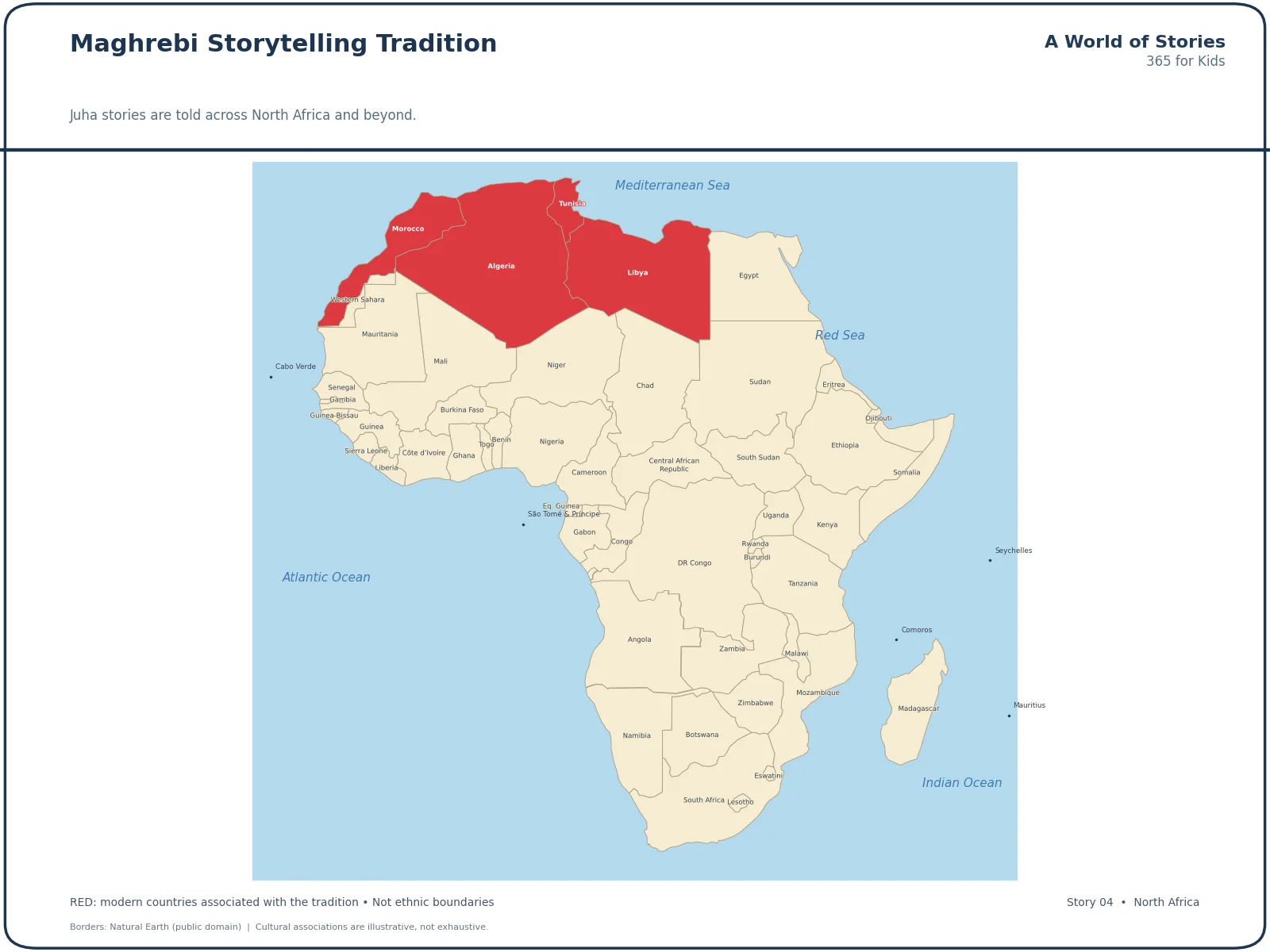
Juha (also spelled Djeha, Jha, or Goha) is a familiar trickster told across North Africa and far beyond. This short version follows a Moroccan Arabic (Darija) telling; the tale should not be treated as belonging exclusively to one modern country.
After the Story: Read · Create · Reflect · Share
Create: Draw Morocco’s flag. Notice the red field and the green five-pointed star. Then sketch the donkey in Juha’s stable.
Explore: Find Morocco on a map of Africa. What ocean and what sea touch its coasts? Can you find another North African country where stories about Juha are told?
Reflect: What does Juha tell his neighbor, and what sound reveals the truth? Retell the moment in two sentences, in your own words.
Think & Share: Juha says his neighbor should trust him rather than the donkey. Is trust the same as believing someone even when the evidence disagrees? How could Juha have answered more honestly?
Inspired by this story? Create your illustration!
Sahara & Sahel
TUAREG (SAHARA & SAHEL) — The Woman and the Djinn’s Wife
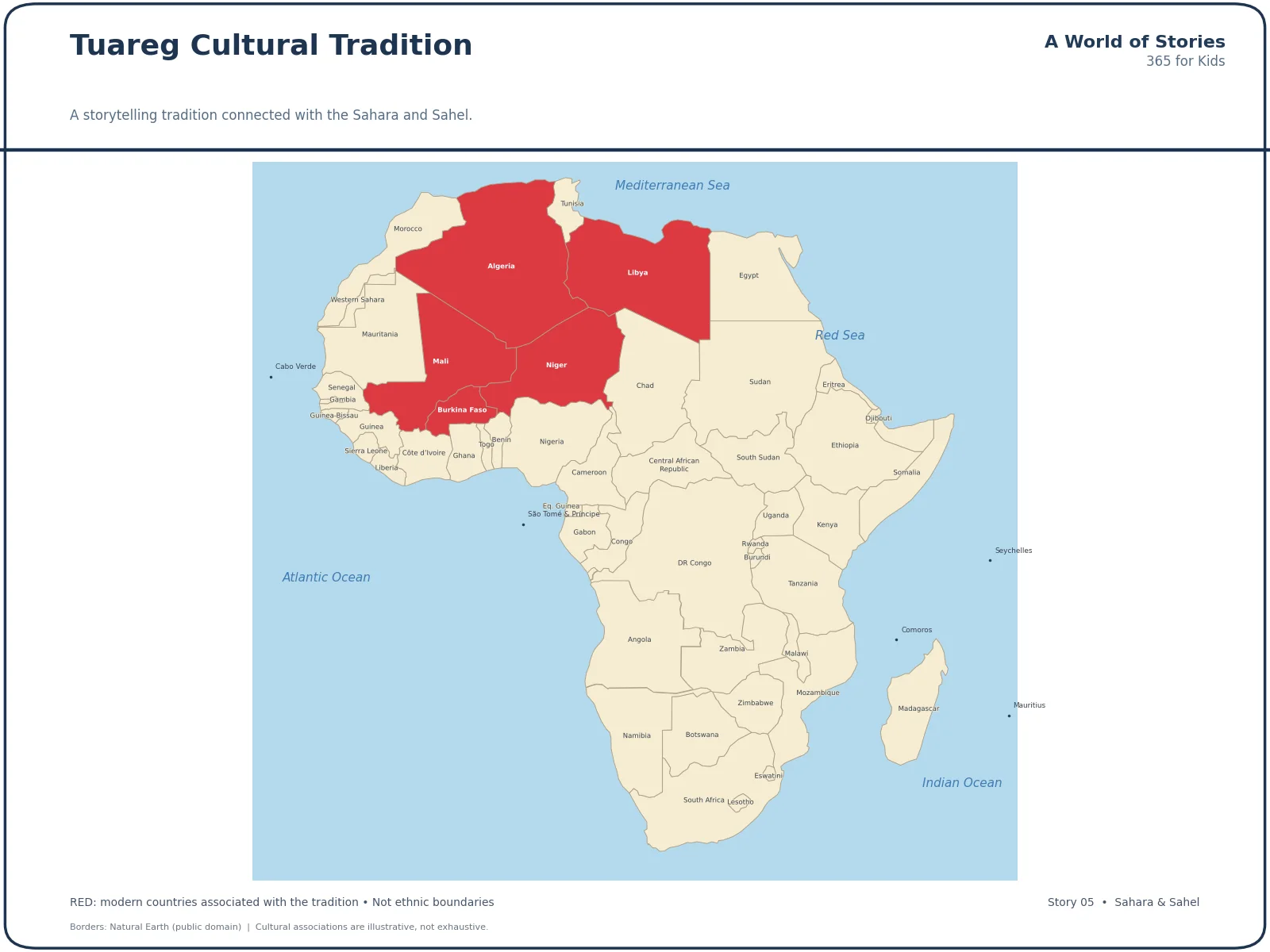
One day, a woman from a Tuareg camp went out into the bush. There she noticed a small rock hyrax. She picked up a stone, intending to chase the animal away.
Before she could throw it, the creature spoke. It asked her not to strike, explaining that it was a woman, just as she was. Then the hyrax took on the form of a woman.
The stranger said that she was a gennia, the wife of a djinn. Her home was not far away, and she was expecting a child. Would the woman come to help her when the time arrived?
The woman agreed, but there was one difficulty: she did not know the way to the gennia’s home. The stranger promised to send someone to guide her. They parted.
Some time later, a dog came to the Tuareg tents. The woman went out after it. Once they were clear of the camp, the dog changed into a child and asked her to follow.
The child led her toward the mountains. There a djinn waited on horseback. The sight of him frightened her, but he reassured her: he had come to take her to his wife, whose child was about to be born.
The woman mounted the horse. The djinn told her to shut her eyes. She obeyed. When he told her to open them again, she found herself in a place she had never seen before: the camp of the djinn, with its animals and people.
They brought her to the gennia, and the woman helped at the birth. Seven children were born. After the babies had been washed and wrapped in goatskins, the woman prepared to go home.
The djinn thanked her for her help. He gave her cattle and camels as gifts. The woman returned from the extraordinary visit with the animals, richly rewarded for the kindness she had shown.
Tuareg oral tradition, recorded in an early twentieth-century collection of tales from Senegal and Niger (F. de Zeltner, 1913). The Tuareg are Amazigh-speaking communities whose cultural life spans the Sahara and Sahel, across present-day Niger, Mali, Algeria, Libya and Burkina Faso.
After the Story: Read · Create · Reflect · Share
Create: Draw two pictures showing the rock hyrax before and after its transformation into a woman.
Explore: Find the Sahara and the Sahel on a map of Africa. Locate Niger and Mali, and name two more present-day countries where Tuareg communities live.
Reflect: Put the woman’s journey in order: the speaking animal, the visiting dog, the horse in the mountains, and the camp of the djinn. Which moment would surprise you most?
Think & Share: The woman agrees to help someone she has only just met. What do kindness and courage mean in this story? How can we help someone while also keeping ourselves safe?
Inspired by this story? Create your illustration!
West Africa
AKAN (GHANA) — How We Got the Name “Spider Tales”
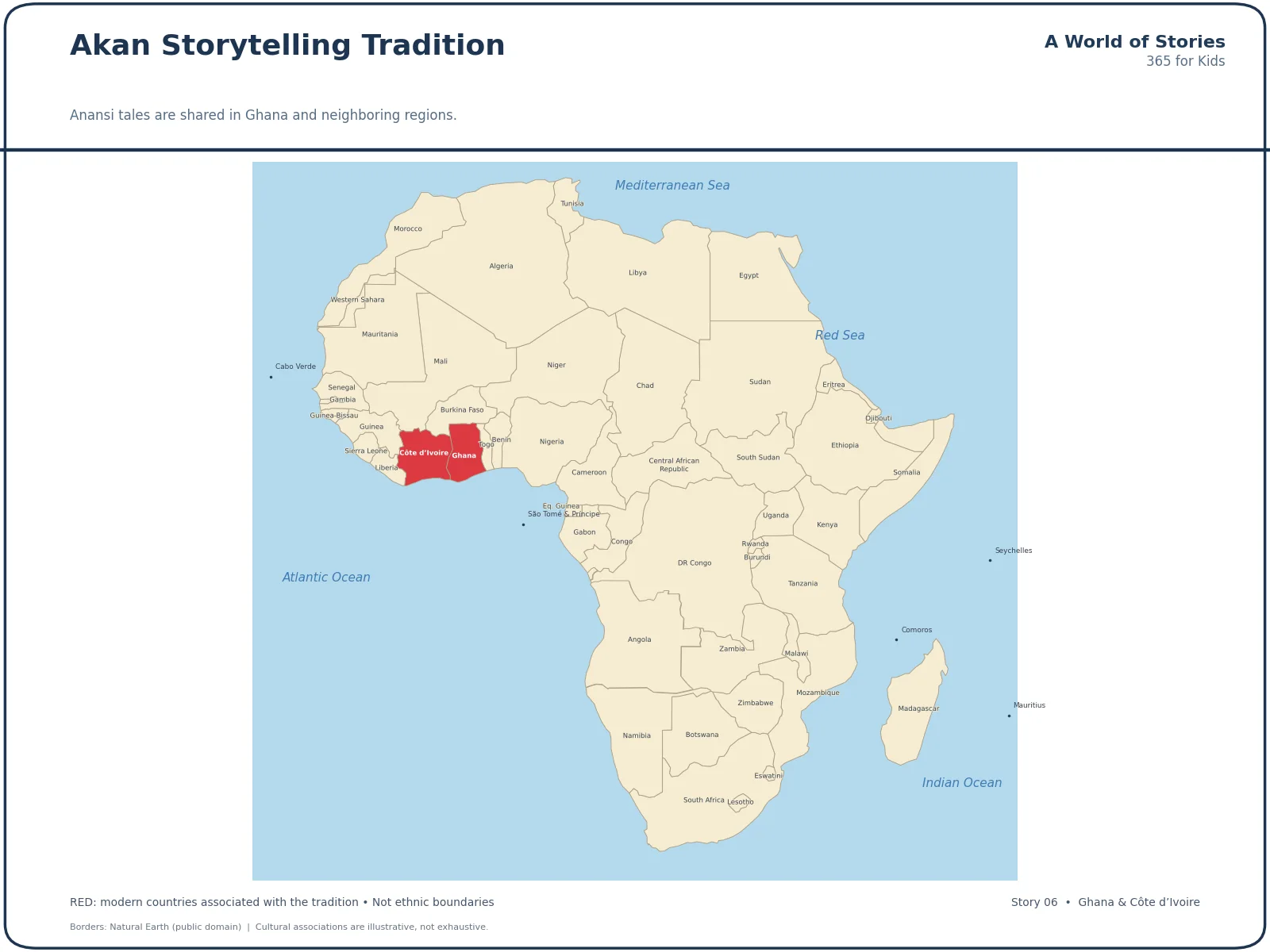
Long ago, the stories people told belonged to Nyankupon, the chief of the gods. But Anansi the Spider thought highly of himself, and he wanted the stories to bear his own name.
He went to Nyankupon and asked that, from then on, people should call them Anansi stories. Nyankupon listened and set him three tasks. Anansi must bring him a jar filled with living bees, a boa-constrictor, and a tiger. Anansi promised to do it.
First he took an earthen jar to a place where many bees were flying. He began to argue aloud with himself: “They can fill this jar.” Then he answered his own words: “No, they cannot!” Back and forth he went until the bees came near to ask what he meant.
Anansi explained that he and Nyankupon had disagreed. Nyankupon, he claimed, said the bees could never fly into the jar, while Anansi insisted that they could. The bees were eager to prove their ability. They flew inside at once. Anansi closed the jar and sent it to Nyankupon.
On the next day, Anansi carried a long stick to the place where a boa-constrictor lived. Again he argued aloud, this time about whether the snake was as long as the stick. The boa came out to hear the dispute.
Anansi said that people in Nyankupon’s town believed the boa was shorter than the stick, but he was sure they were wrong. Would the boa allow himself to be measured? The snake stretched out straight beside the stick. Anansi promptly tied him to it from head to tail and sent him to Nyankupon.
For the third task, Anansi took a needle and thread and sewed one of his own eyes shut. Then he approached the tiger’s den, singing and shouting with delight.
The tiger came out and asked why he was making so much noise. Anansi replied that, with his eye sewn shut, he could see wonderful sights. The tiger wanted to see them too. He asked Anansi to sew up his eyes. Anansi did so, leaving the tiger unable to see, and led him straight to Nyankupon.
Nyankupon was amazed. Anansi had brought all three things he had been asked to bring. He gave the Spider permission to call the old stories Anansi stories from that time onward.
And so, according to this tale, the stories received the Spider’s name.
Akan storytelling tradition, present-day Ghana. Adapted from W. H. Barker and Cecilia Sinclair, West African Folk-Tales (1917). Anansi, the Spider, is a celebrated trickster whose clever words sometimes hurt others — a theme this adaptation keeps rather than softens.
After the Story: Read · Create · Reflect · Share
Create: Draw Ghana’s flag and name its colors.
Explore: Find Ghana on a map of Africa. Which ocean borders the country?
Reflect: Name the three challenges Nyankupon gives Anansi. How does Anansi accomplish each one?
Think & Share: Anansi is clever, but he deceives the bees, snake, and tiger. Can intelligence be used unfairly? Choose one scene to picture in your mind, thinking about how the animal might feel.
Inspired by this story? Create your illustration!
FANTE/AKAN (GHANA) — How Wisdom Became the Property of the Human Race
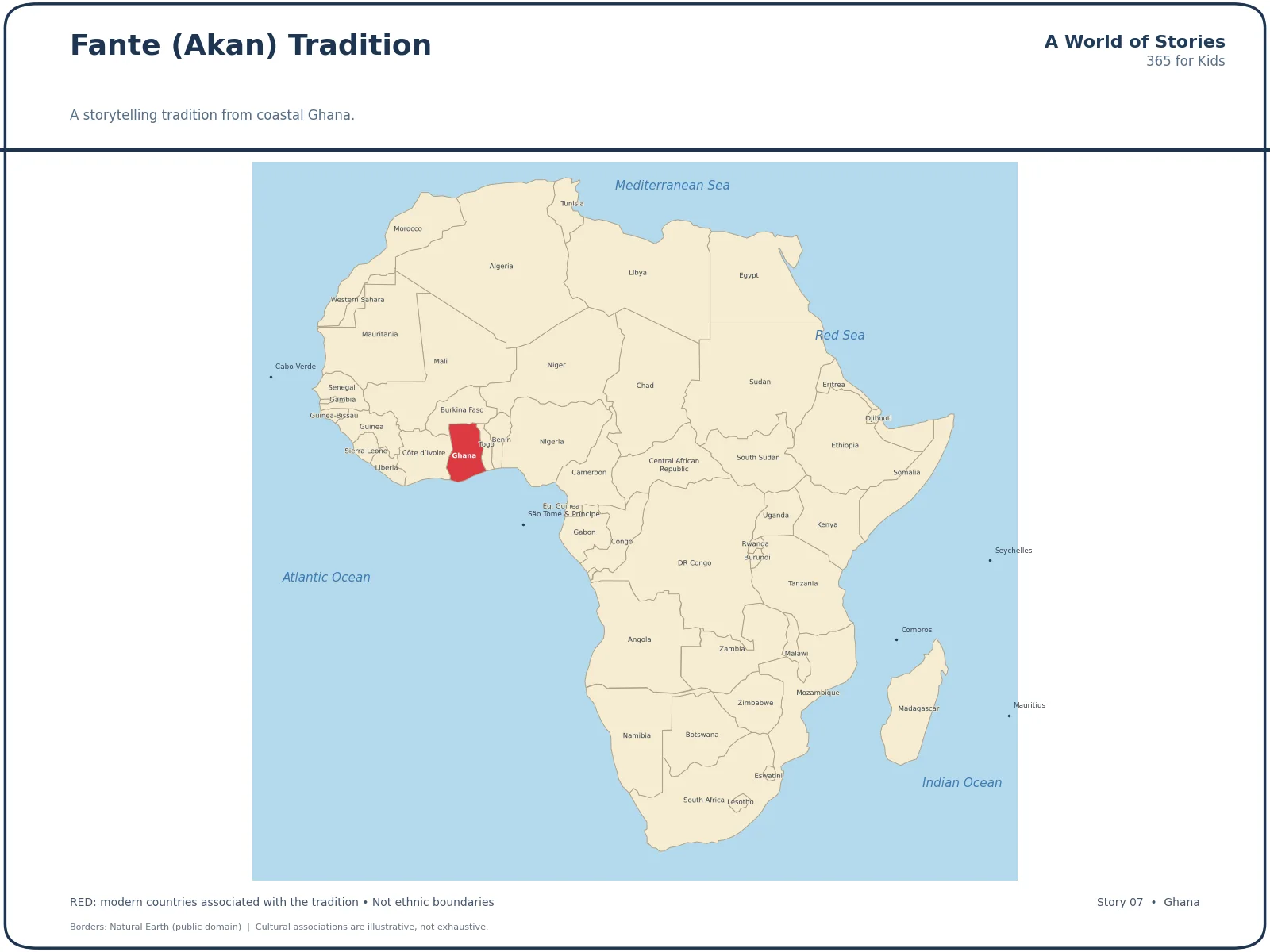
Long ago, in Fante-land, there lived Father Anansi, who possessed all the wisdom in the world. Whenever people needed advice or help, they came to him, and he shared what he knew.
But one day the people offended Father Anansi. He grew angry and decided to punish them. He would take back all the wisdom he had given away and hide it where no one could ever find it.
He gathered up the wisdom, as much as he believed he could recover, and placed it inside a great pot. Then he sealed the pot carefully. He needed a hiding place beyond the reach of every human being.
Father Anansi had a son named Kweku Tsin. The boy suspected that his father was planning something secret, so he watched him closely.
The next day Father Anansi slipped quietly out of the house, carrying the precious pot tied around his neck. Kweku Tsin followed at a distance. His father walked deep into the forest until the village was far behind.
There Father Anansi chose a tree that was very tall and looked difficult to climb. He meant to hang the pot at its top, where nobody else could reach it.
But the pot hung in front of his body. Whenever he tried to climb, it swung against the tree and got in his way. He tried again and again, yet he could not reach the top.
Kweku Tsin watched his father struggle for some time. Finally he called out, “Father, why don’t you carry the pot on your back? Then you could climb much more easily.”
Father Anansi turned toward his son. “I thought I had all the wisdom of the world in this pot,” he said. “Yet you have thought of something I could not. All the wisdom I have was not enough to show me how to climb this tree.”
He was so angry that he hurled the pot down. It struck a great rock and shattered.
All the wisdom inside escaped and spread throughout the world. And so, the story tells us, wisdom became the property of humankind.
Adapted from W. H. Barker and Cecilia Sinclair, West African Folk-Tales (1917), a Fante (Akan) tale from coastal Ghana. Preserves the characters, sequence, and ending without inventing additional episodes.
After the Story: Read · Create · Reflect · Share
Create: Draw the Ghanaian flag and look carefully at the star in its center.
Explore: Find Ghana on a map of West Africa. Which ocean lies along its southern coast?
Reflect: Why did Father Anansi try to hide wisdom, and how did Kweku Tsin show that his father did not know everything?
Think & Share: Think of something you learned from a younger person, a friend, or a family member. How did it feel?
Inspired by this story? Create your illustration!
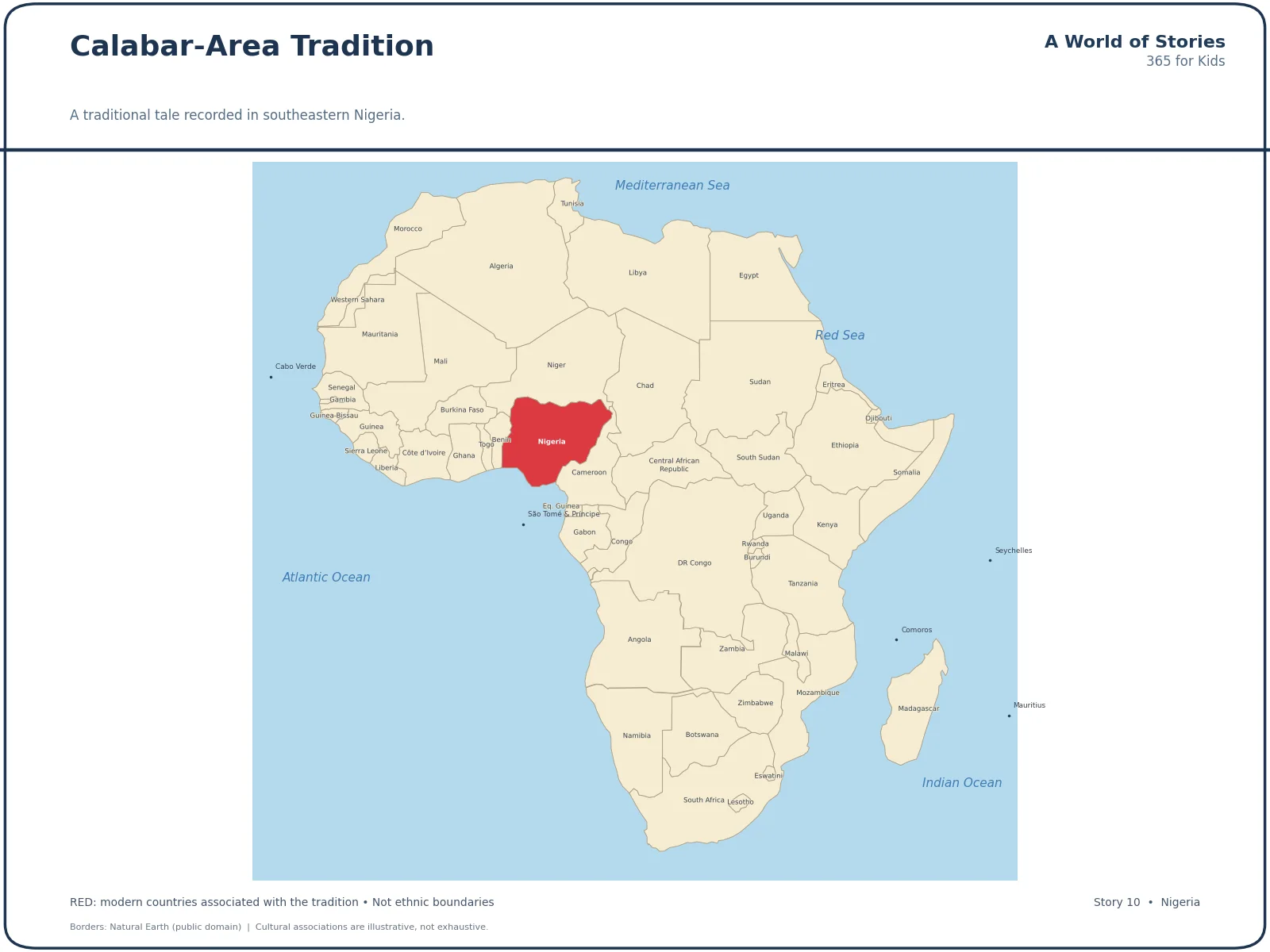
CALABAR (NIGERIA) — The King’s Magic Drum
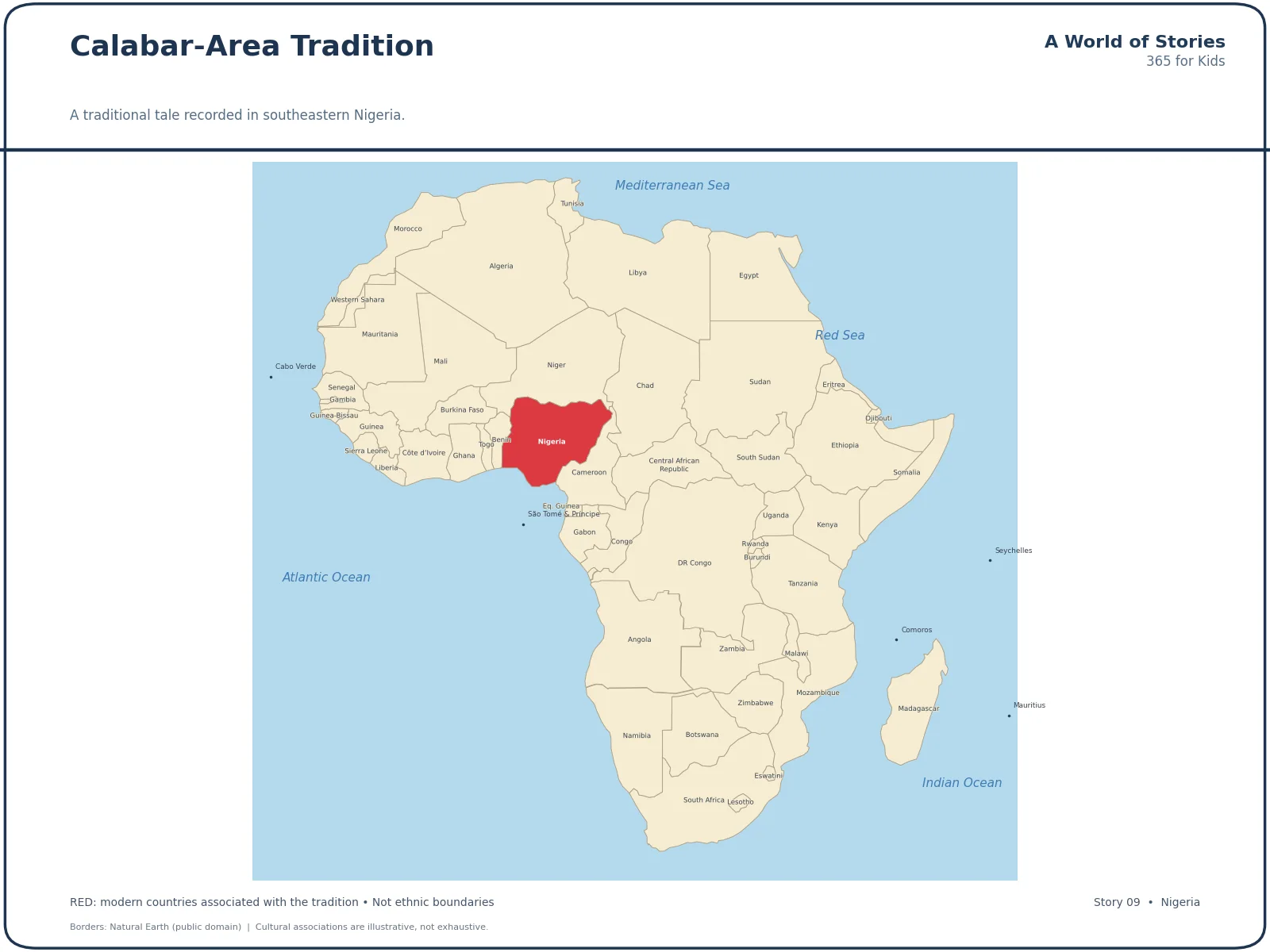
Long ago, Efriam Duke was king of Calabar. Although he was rich and powerful, he hated war. He possessed a wonderful drum: whenever he beat it, a feast appeared, with fish, fufu, yams, soup, and drinks enough for everyone. When enemies threatened his country, he invited them to a meal instead of a battle. The guests went away content, and peace returned.
The drum, however, had a dangerous condition. If its owner stepped over a stick or a fallen tree, the food would turn bad. Then three hundred Egbo men, armed with sticks and whips, would appear and punish the owner and the guests. King Efriam knew this and was careful.
He often held great feasts for his people. Even the wild animals came: elephants, hippopotamuses, leopards, and antelopes sat among the guests without attacking one another. Everyone admired the drum, but the king would not give it away.
One morning the king’s wife, Ikwor Edem, took her little daughter to a spring. Above them, a tortoise was climbing a palm tree to gather nuts. One nut dropped near the child, who cried for it. Thinking it was simply a fallen nut, Ikwor Edem gave it to her daughter.
The tortoise climbed down and demanded his nut. He wanted the king’s magic drum and saw his chance. He accused the woman of taking the food he had gathered for his family. Ikwor Edem explained that she had not intended to steal anything and offered to bring the matter before her husband.
At the palace the king offered compensation: money, cloth, palm oil, and other goods. The tortoise refused everything. At last Efriam said that he could choose whatever he wished. Immediately the tortoise pointed at the magic drum.
The king agreed to hand it over. But he did not tell the tortoise the drum’s dangerous secret.
The tortoise carried his prize home, announcing that his family would never have to work for food again. He struck the drum, and a feast appeared. For three days they ate until they were satisfied. Proud of his sudden wealth, the tortoise invited the king, the people, and the animals to a banquet. Many laughed at the invitation, for they knew he had always been poor, and only a few came.
But when he beat the drum, food appeared in abundance. The guests ate wonderfully well. Word spread, and those who had stayed away regretted missing the feast. The tortoise became famous, and the people treated him as a rich and important host.
After several weeks he grew lazy and boastful. One day, after drinking too much palm wine at a distant farm, he walked home with the drum. Without noticing a stick on the path, he stepped over it. The magic condition was broken, though he did not yet know it.
The next morning his family asked for breakfast. He struck the drum. Instead of food, three hundred Egbo men appeared and beat the tortoise, his wife, and his children. The tortoise was furious. Rather than accept his mistake, he decided that others should suffer as he had.
He sent invitations to another great feast. This time crowds came, including people who needed friends to help them reach his home. The king and his household declined. Before the guests arrived, the tortoise sent his own family away. Then he beat the drum and hid beneath a bench.
Again the Egbo men appeared, carrying whips. The doors had been shut, and the guests were trapped. For two hours they were beaten. Only the leopard leaped out of the enclosure and escaped. When the tortoise had seen enough, he opened the door and gave the drum a special tap. The Egbo men vanished, and the frightened guests fled.
Afterward the angry people confronted the tortoise. He decided to return the drum and asked the king to exchange it for something valuable. The king refused to make such a trade, but he offered the tortoise another magical gift: a fufu tree.
The tree produced fruit only once a year, yet every day it dropped fufu and soup to the ground. Its rule was simple and strict: the family could collect enough for one day, but no one was to return for a second helping on the same day.
The tortoise and his wife gathered food in their calabashes and took it home. Their children ate well, but one son became curious and greedy. He asked where the food came from. His father would not tell him, fearing that a child might break the rule by taking more.
Determined to discover the secret, the son filled a long-necked calabash with wood ashes and placed it inside the bag his father carried, leaving a small opening. When the tortoise walked through the bush, ashes trickled onto the ground and marked his path.
The boy followed the trail and watched from hiding as his father gathered food beneath the wonderful tree. He returned home without saying anything. The next day, after the tortoise had collected the family’s food, the son brought several of his brothers back to the tree. They took fufu and soup a second time that day.
By morning, the magical tree had disappeared beneath a thick mass of prickly tie-tie palms. When the tortoise came for the day’s food, he saw only thorns. He knew at once that someone had broken the condition. He returned home sorrowfully and asked who had done it, but his children denied everything.
Finally, the tortoise brought his family to the place where the magic tree had stood. He told them that they had lost the gift that fed them. From then on, he said, they would have to live beneath the prickly palms.
And that, according to the old tale, is why tortoises make their homes beneath the thorny tie-tie palm.
Recorded in the Calabar/Cross River region of what is now southeastern Nigeria and published by Elphinstone Dayrell in 1910. The original collector did not identify one specific ethnic community for this tale; it is presented here as a story from the Calabar area.
After the Story: Read · Create · Reflect · Share
Create: Design a pattern for the king’s magic drum. Which foods and animals from the story would you include?
Explore: Locate Nigeria on a map of Africa. Find the southeastern region around Calabar and the Cross River.
Reflect: What mistake did the tortoise make before the drum began summoning the Egbo men? Why did he then invite the other guests?
Think & Share: The family lost the food-giving tree because its rule was broken. What feelings might the tortoise and his children have had? How could they have acted differently?
Inspired by this story? Create your illustration!
CALABAR (NIGERIA) — The Woman with Two Skins
Long ago, Eyamba I ruled over Calabar. He was a powerful king whose wars brought suffering to the neighboring lands. He took captives to work for him, and though he had two hundred wives, he had no son to inherit his throne. As the king grew older, the people became anxious. They urged him to marry a daughter of Spider, whose family, they said, was blessed with many children.
When the king saw Spider’s daughter, Adiaha, he thought her ugly and did not wish to marry her. At last he agreed to please his subjects. But the other wives mocked her appearance and refused to live with her. The king had a separate house built, where she was given her share of food and drink. No one who laughed at Adiaha knew her secret. She had been born with two skins. Beneath the unattractive outer skin was a beautiful young woman. At her birth her mother had promised that Adiaha would not remove the outer skin until the appointed time, except at night, when she must put it on again before dawn.
The king’s chief wife knew this secret. Fearing that the king might come to love Adiaha, she bribed a ritual specialist to prepare a powerful medicine. She mixed it into the king’s food, and he forgot Adiaha so completely that he passed her without recognition. For four months he did not call for her. At last Adiaha returned, unhappy, to her parents.
Her father Spider sought the help of another ritual specialist, who discovered what the chief wife had done. He prepared a medicine to undo the spell. Spider paid him, and Adiaha carried a dish of food to the king. As soon as he ate it, he remembered her and asked her to visit him that evening. Adiaha bathed in the river, put on her finest cloth, and went to the palace. In the darkness she removed her outer skin, and the king saw her beauty. When the cock crowed, she put the skin back on and went home. She visited him in this way for four nights.
In time Adiaha bore a son. This astonished the people, who had expected Spider’s daughter to have many babies at once. The chief wife grew even more jealous. Again she paid the same specialist, this time to make the king ill and to persuade him that his own little son was the cause of the sickness. The king was told that he would recover only if the child were cast into the river. At first he resisted. But his advisers pressed him, and finally he gave way. He ordered the boy thrown into the water. Adiaha mourned bitterly.
Unknown to the king, a Water Spirit who had helped Spider’s family was waiting in the river. The spirit rescued the boy, brought him home and raised him safely. Meanwhile another spell caused the king to forget Adiaha again. For three years she grieved for the child she believed lost. Then she returned to her father, and with help from the friendly ritual specialist she once more broke the spell and was recognized by the king.
After some time Adiaha gave birth to a daughter. The chief wife repeated her terrible scheme. Although the king took longer to persuade, he finally allowed the little girl to be thrown into the river too. The Water Spirit saved her as well. The spirit now decided that the hidden wrongdoing must be brought into the open. He encouraged the young men of the country to hold wrestling matches in the marketplace, and prepared Adiaha’s son, who had grown strong, to compete.
A grand contest was announced, with the king and his chief wife in attendance. The country’s finest wrestlers arrived. When they saw the young stranger, they laughed at him because he seemed too small to defeat them. But he threw every opponent, and at the end of the day the king presented him with cloth and money. Everyone remarked how much the champion resembled the king. The king invited him to dinner.
At the meal the chief wife sat beside the young man and tried to win his affection, not knowing who he was. He already knew the truth of her actions and declined to encourage her. Later he told the Water Spirit what had happened. The spirit advised him to request a public hearing, where the truth of the family could be judged. In the old custom described by the teller, the hearing carried a terrible risk: the person judged guilty might be put to death, and the young man himself would face that punishment if his accusation proved false.
The king granted his request and summoned the people. Before the hearing, the son went to Adiaha, revealed who he was and told her that the time had arrived to remove her outer skin for good. On the appointed day Adiaha appeared in fine clothes, so transformed that no one recognized her. Her son sat beside her and brought his sister forward. Adiaha recognized the girl she had long believed dead and embraced her.
In front of the king and the assembled people, the young man asked whether he was worthy to be the son of a chief. The crowd agreed. He brought out his sister and asked whether she was worthy to be a chief’s daughter. Again the crowd agreed. Then Adiaha came forward. The people praised her, and the young man told the entire story: her hidden second skin, the spells that had made the king forget her, the orders to cast both children into the river, and the Water Spirit who had saved them.
The king learned that the champion was his own son. He was overjoyed to find both children alive. The chief wife was judged responsible for the deception. In the traditional telling, she was taken away and killed after a cruel punishment. Adiaha was acknowledged as queen, and the king welcomed his daughter and son. A great feast was held to celebrate their return.
The old story does not end there. The king made another harsh law against the use of magic to deceive husbands and continued to hold people in slavery. He gave separate households to Adiaha, his son and his daughter. After some years the king died, and his son took the throne. So the family was reunited, even though the kingdom in which they lived remained a difficult and unjust place.
Recorded by Elphinstone Dayrell in the Calabar region of southern Nigeria and published in 1910 (Folk Stories from Southern Nigeria, West Africa). This is a new literary retelling of the documented version, not a transcription; it retains the difficult traditional ending. The source describes slavery, child endangerment and execution without graphic detail; adult guidance is recommended for younger readers.
After the Story: Read · Create · Reflect · Share
Create: Draw a scene showing the river and the Water Spirit protecting the children. What details could show safety and hope without using words?
Explore: Locate Nigeria on a map of Africa. Find the southern coastal region around Calabar. Which ocean connects to its coastline through the Gulf of Guinea?
Reflect: Why did the king believe the accusations against his children? What could he have done differently before making such a serious decision?
Think & Share: Adiaha is mocked for her appearance, and the story ends with severe punishments. Which actions were unfair? How could a community seek truth and justice without cruelty?
Inspired by this story? Create your illustration!
Central Africa
KIMBUNDU (ANGOLA) — The Hare and the Leopard
The Hare had woven a long, strong basket. He looked at his work and said to himself, “I shall go to the fields and gather some squashes.”
He set off along the road, carrying the basket. Before he had gone far, he met the Leopard.
“Hare!” called the Leopard. “You are very bold to carry such a great basket. Where are you taking it?”
“My lord,” the Hare answered, “I am going to the fields to gather a few squashes.”
The Leopard looked at the basket. “But it is bigger than you are. When you fill it with squashes, how will you ever carry it?”
The Hare replied, “My lord, I could even carry you yourself in it.”
“You are boasting, Hare,” said the Leopard. “And if you cannot carry me, what shall I do to you?”
“You may beat me, my lord,” said the Hare.
So the Leopard climbed into the basket.
“My lord,” said the Hare, “I must fasten the ropes to the basket. Do not cry out while I tie them, or you might fall to the ground.”
“Very well,” said the Leopard.
The Hare told him to stretch out comfortably inside the basket. The Leopard did so, and the Hare bound him tightly with the rope.
Then the Hare took the small axe he carried at his waist and struck the Leopard.
“Hare!” cried the Leopard. “What are you doing to me?”
“Your kind hate us,” the Hare answered.
The Hare struck again, and the Leopard died.
The Hare took the Leopard’s skin and returned home with the meat, which he ate.
And so the storyteller ended the tale.
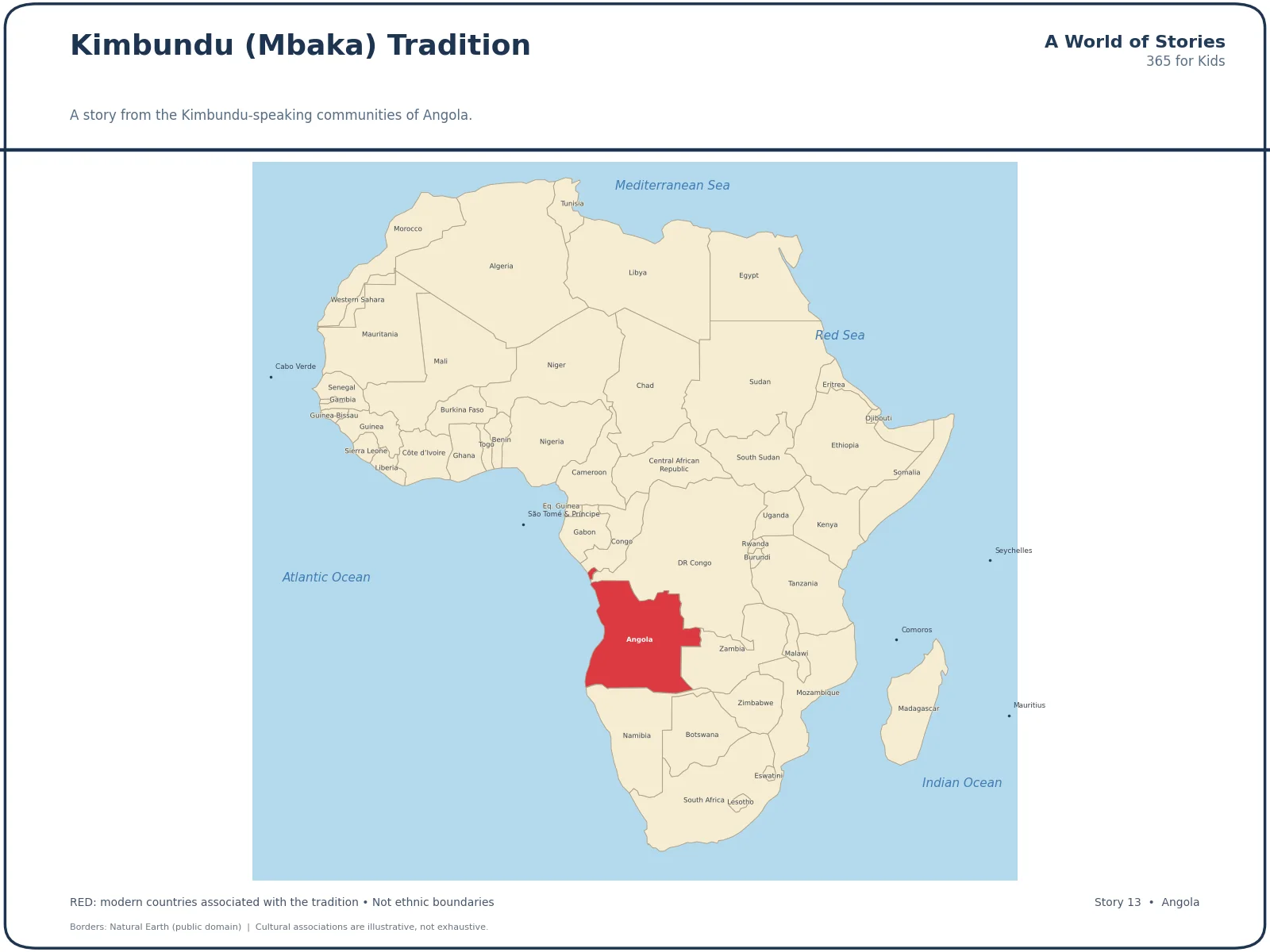
Original title: Kabulu Ni Na Ngo. Told by Jelemía dia Sabatelu, recorded by Héli Chatelain in Angola, 1885–1888, in Kimbundu (Mbaka dialect), published in Folk-tales of Angola (1894). The ending is severe and is kept as recorded rather than softened.
After the Story: Read · Create · Reflect · Share
Create: Draw a simple map and mark Angola on it.
Explore: Find Angola on a map of Africa. Which ocean lies along its western coast?
Reflect: How does the Hare persuade the Leopard to climb into the basket? Identify the moment when the Leopard could have recognized the danger.
Think & Share: The ending is severe. Does the Hare act from fear, anger, revenge, or something else? Discuss how the Leopard might have told the same story.
Inspired by this story? Create your illustration!
KIMBUNDU (ANGOLA) — The Lion and the Wolf
The Lion gave a mighty roar.
“In all the world,” he declared, “there is no one whose strength equals mine. Only my friend the Elephant, Ngola-Aninii, and the Red Ant of Malemba, whose resting place is pain, are as strong as I am.”
Nearby, the Wolf had been hiding in a thicket. He heard the Lion’s boast. Rising from his hiding place, he moved a little way off.
“Lion!” he called. “You have spoken falsely when you say that no one in the world is your equal. Know-Much is stronger!”
The Wolf went a little farther away, then called again:
“Hang-Arms is stronger!”
The Lion turned toward him. Anger seized him, and he rushed after the Wolf. But the Wolf escaped, and the Lion gave up the chase.
And that, the storytellers say, is why the Lion and the Wolf hate one another: the Lion made a boast that was not true, and the Wolf exposed it.
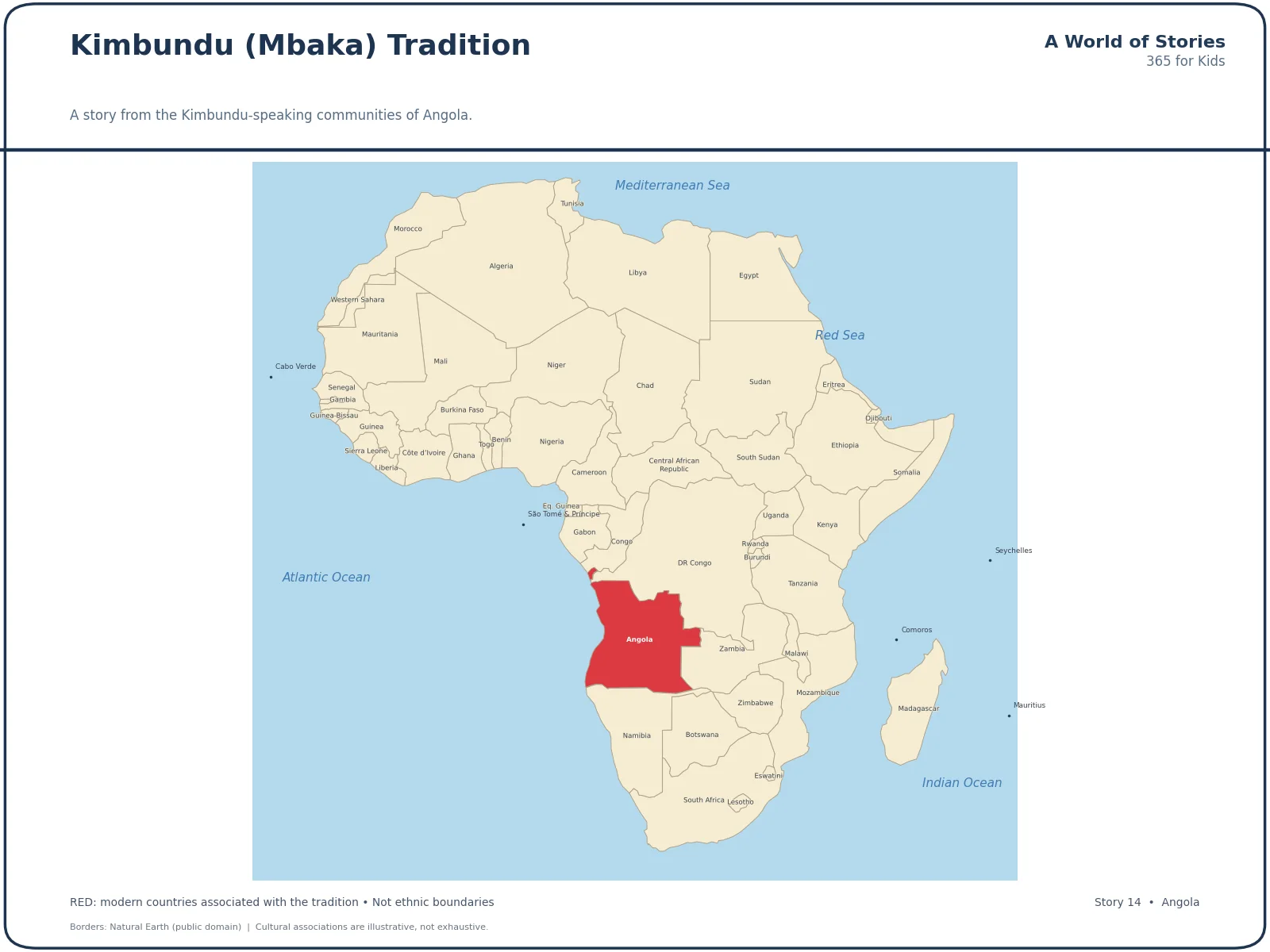
Kimbundu title: Hoji Ni Kimbungu. Told by Jelemía dia Sabatelu, recorded by Héli Chatelain in Angola, 1885–1888, published 1894. A very short tale — its brevity is part of its traditional form.
After the Story: Read · Create · Reflect · Share
Create: Draw the flag of Angola. What colors and symbols can you see on it?
Explore: Find Angola on a map of Africa. Point to a neighboring country.
Reflect: What did the Lion claim about his strength, and what did the Wolf say in reply? Retell their disagreement in your own words.
Think & Share: How does it feel when someone challenges something you say? What could the Lion and the Wolf have done differently to avoid becoming enemies?
Inspired by this story? Create your illustration!
FJORT (REPUBLIC OF THE CONGO) — The Younger Brother Who Knew More Than the Elder
Two brothers lived in the same town. The elder was steady and careful; the younger was clever, and knew it, and liked to remind people of it.
One day the younger brother said, “Let us travel together and see what fortune brings us.” The elder agreed, and the two set out along the forest path.
Before long they came to a wide pit dug across the road, the kind hunters dig to trap animals. The younger brother looked at it and laughed. “A child could see that and step around it,” he said. “You need me to show you these things.” The elder said nothing, and they walked on.
They walked until night came, and they found lodging in a stranger’s house. The host welcomed them, gave them food, and in the evening proposed a bargain for the next day’s hunting: “Whatever we catch, the males will belong to one of you, and the females to the other.” The younger brother, eager to seem clever, agreed at once on behalf of them both, choosing males for himself without thinking it through.
In the morning they went out together, and it was the host who fell into a hunting pit — the very kind the younger brother had mocked the day before. The host called out for help, and the elder brother ran to pull him free.
But the younger brother stopped him. “Wait,” he said. “Yesterday we agreed that males belong to me. You are a male, and you have fallen into a pit. By our own bargain, you belong to me now.”
The host protested that this was absurd — the bargain was about the hunt, about animals, not about a man who stumbled. But the younger brother held firm, repeating the host’s own words back to him, and the host found he had no answer, because the bargain had indeed been made exactly as stated, and he himself had proposed it.
Realizing his own reasoning had been turned against him, the host agreed to settle the matter fairly. In the end the younger brother released him, and the host released something of his own in return: his wife, who had been held against her will in the house, was set free to leave with the brothers.
The two brothers and the younger brother’s wife returned together to their town.
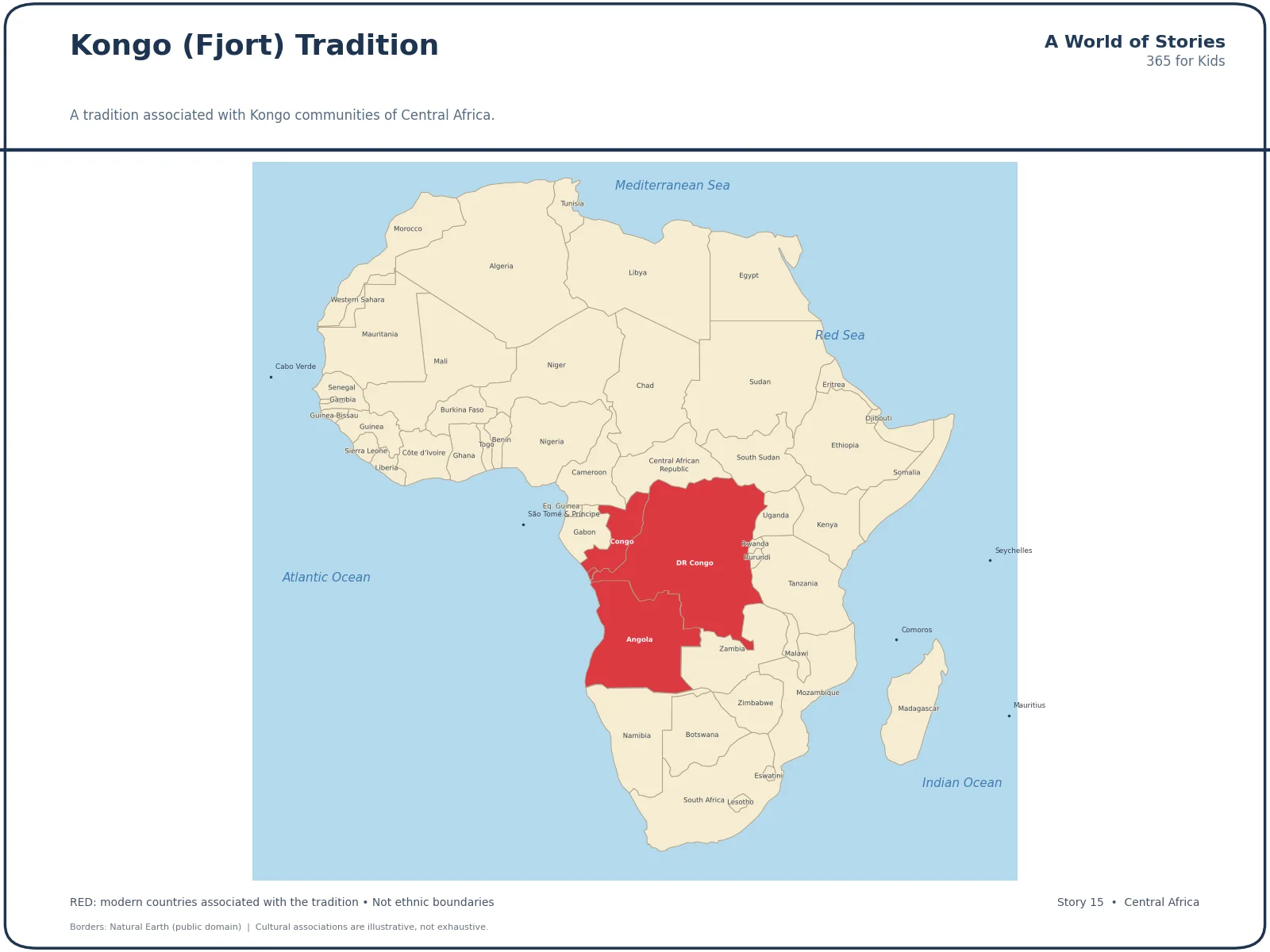
Based on “The Elder and Younger Brother,” recorded by Richard Edward Dennett in Notes on the Folklore of the Fjort (French Congo), 1898. The tale is part of the Fjort (Mavumbu) oral tradition of the Kongo-speaking peoples of the Loango coast, present-day Republic of the Congo.
After the Story: Read · Create · Reflect · Share
Create: Locate the Republic of the Congo on a map. What Kongo-speaking neighboring countries can you find nearby?
Explore: The younger brother was confident he knew more than his elder brother. Where in the story does his overconfidence almost work against him, and where does it help him?
Reflect: Was it fair for the host to claim the younger brother belonged to him just because he was male and had fallen in a pit? Explain why or why not, and how the younger brother turned the host’s own claim around.
Think & Share: Draw the moment of the clever solution. Then talk about humility and gratitude: how might the story have ended differently if the younger brother had refused to help the host at all?
Inspired by this story? Create your illustration!
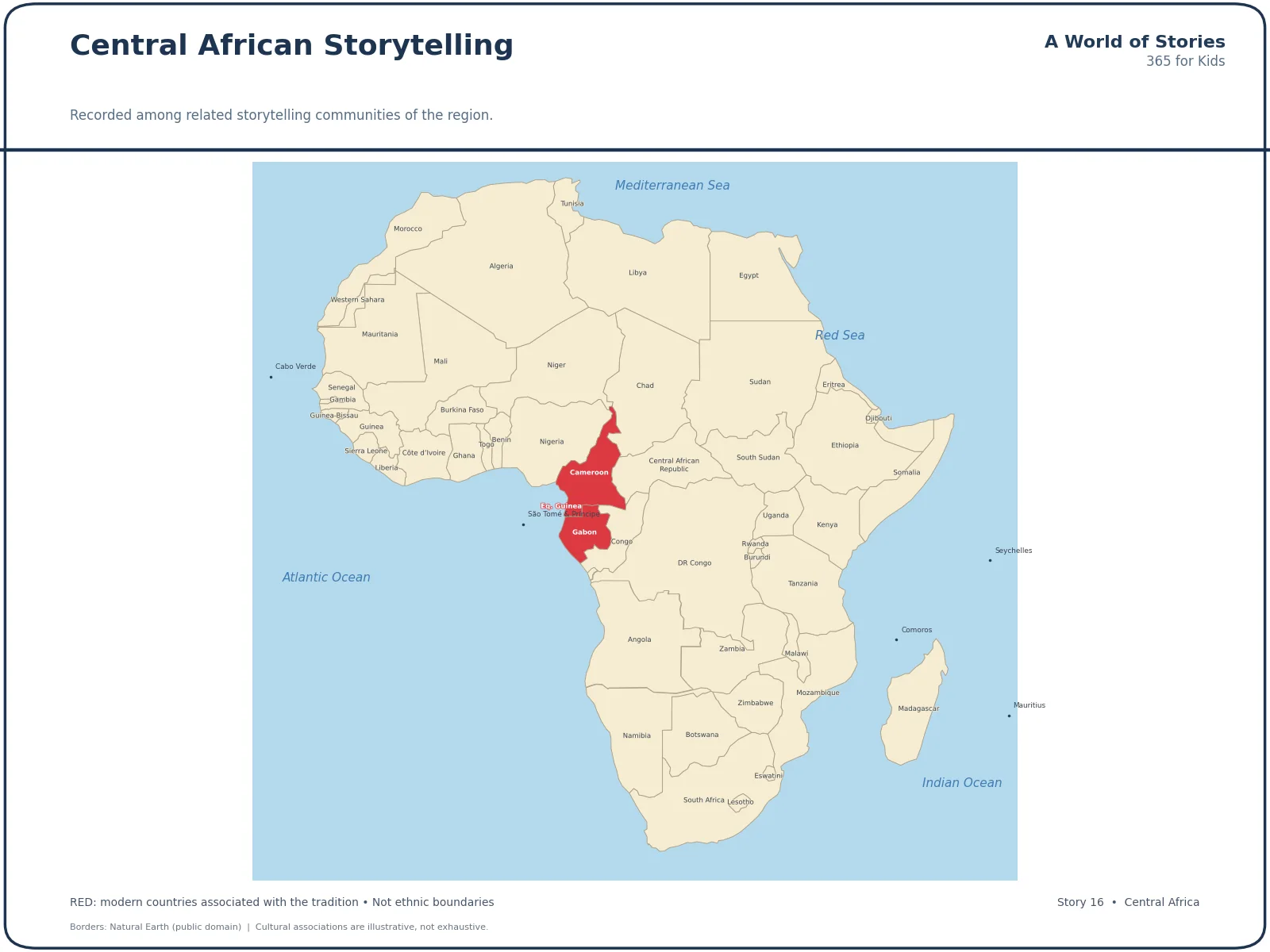
FANG (GABON, EQUATORIAL GUINEA & CAMEROON) — A Chain of Circumstances
In a village, Tortoise worked as a blacksmith. He had a pair of bellows for making the fire burn hotter, and he allowed others to use them.
One day Cockroach came to the forge. Cockroach possessed a remarkable spear, known to everyone. He had barely begun to work the bellows when he spotted Chicken approaching along the road.
“Chicken may catch me!” he said to Tortoise. “Where can I go?” Tortoise told him to hide in the grass, and Cockroach did so.
Chicken arrived and noticed the spear on the ground. “Is that Cockroach’s spear?” he asked. Tortoise said it was. “Where is Cockroach?” Chicken wanted to know. Tortoise pointed to the grass. Chicken found Cockroach and swallowed him.
Before Chicken could leave, Tortoise called him back to work the bellows. Chicken was about to begin when he saw Genet coming along the road. Afraid of being caught, Chicken asked where he could hide. Tortoise sent him into the grass.
Genet arrived, saw the spear, and asked whose it was. Tortoise said it belonged to Cockroach. Genet asked where Cockroach had gone. “Chicken swallowed him,” said Tortoise. And where was Chicken? Tortoise showed Genet the hiding place. Genet caught Chicken and ate him.
Again Tortoise asked his visitor to work the bellows. Genet was ready to do so when Leopard came into view. Frightened, Genet hid in the grass at Tortoise’s suggestion.
Leopard saw the spear and began asking questions. Tortoise explained that Chicken had swallowed Cockroach and Genet had eaten Chicken. When Leopard asked where Genet was, Tortoise pointed to the grass. Leopard found and killed Genet.
Tortoise invited Leopard to work the bellows. But Leopard spotted a man walking toward the forge with a gun on his shoulder. “I do not want to meet a human being!” Leopard cried. Tortoise told him to hide, and Leopard disappeared into the grass.
The man came to the forge and recognized Cockroach’s wonderful spear. He asked where Cockroach was. Tortoise answered that Chicken had swallowed Cockroach. He asked after Chicken, and learned that Genet had eaten him. Genet, said Tortoise, had been killed by Leopard.
“And where is Leopard?” asked the man. At first Tortoise gave no answer. When the man asked again, Tortoise pointed to the place where Leopard was hiding.
The man went there and shot Leopard — who had killed Genet, who had eaten Chicken, who had swallowed Cockroach, the owner of the wonderful spear at Tortoise’s forge.
And so the old tale traces one event to another, ending with the conflict between Leopard and human beings.
Based on Robert Hamill Nassau, Where Animals Talk: West African Folk Lore Tales (1912), Part Third, “Fang Tribe,” Tale 11, “A Chain of Circumstances.” The Fang and related Bulu-speaking communities live across parts of Central Africa, including Gabon, Equatorial Guinea, and Cameroon; the exact community of origin for this particular tale is not established in the collector’s account.
After the Story: Read · Create · Reflect · Share
Create: Find Gabon, Equatorial Guinea, and Cameroon on a map of Africa. Draw one flag from these three countries.
Explore: What do you notice about the borders and location of Gabon, Equatorial Guinea, and Cameroon?
Reflect: Who swallowed or killed whom? Trace the chain of events from Cockroach to Chicken, Genet, Leopard, and the man, in the tale’s order.
Think & Share: Tortoise tells each frightened visitor to hide, then reveals the hiding place. Discuss whether his actions were clever, unfair, or both, and how the story might change if Tortoise protected someone’s trust instead.
Inspired by this story? Create your illustration!
East Africa
SWAHILI (ZANZIBAR, TANZANIA) — The Monkey, the Shark, and the Washerman’s Donkey
Keema the monkey lived in a great mkooyoo tree at the edge of the sea. Half its branches stretched over the land; the others reached over the water. Every morning Keema ate the tree’s fruit, and every morning his friend Papa the shark swam beneath the branches. When Papa asked for something to eat, Keema gladly threw him some of the fruit.
This went on for many months. One day Papa said, “You have shown me so much kindness that I should like to welcome you to my own home.” Keema reminded him that a land animal could not travel through the sea, but Papa offered to carry him on his back, keeping him safely above the water. Keema agreed, and they set out together.
When they were halfway across, Papa stopped swimming. He confessed that the ruler of the sharks was ill, and that he had been told the only remedy was the heart of a monkey. Keema immediately understood the danger. He asked why Papa had not told him sooner. Then, pretending to be annoyed, he explained that monkeys always left their hearts in their trees when they went out. He had come without his.
Papa believed him. He insisted on returning to the shore to collect the missing heart, even though Keema pretended that he would rather continue. Once they reached the mkooyoo tree, Keema leapt up among its highest branches and stayed there. Papa waited below and called for him. At last Keema looked down and asked, as though surprised, where Papa imagined they were going.
“To my home,” said the shark. But Keema would not move. “Do you take me for a washerman’s donkey?” he asked. Papa wanted to know what that meant. Keema said that a washerman’s donkey had neither heart nor ears, and at the shark’s request he began another tale.
A washerman once owned a donkey named Poonda. She escaped into the forest, where she lived idly and grew very fat. Soongoora the hare happened upon her and thought how fine a meal she would make. He visited Simba the lion, who had recently been ill and was too weak to hunt, and offered to bring him something to eat if Simba would do the killing.
The hare returned to Poonda with a flattering message: Simba wished to marry her. Delighted by the supposed proposal, the donkey accompanied Soongoora to the lion’s home. The hare signalled secretly to Simba and went outside. The lion sprang at Poonda, but he was still weak. The donkey kicked and struggled until she escaped back into the forest, leaving the lion unsuccessful.
Soongoora waited until both animals had recovered. Then he again offered Simba a meal and returned to Poonda. She remembered the dreadful reception she had received, but the hare persuaded her that the lion’s attack had merely been his strange way of showing affection. Once more Poonda went with him. This time the strong lion killed her.
Simba told Soongoora to roast the meat, setting aside the heart and the ears for himself. The hare cooked the meat out of sight, hid those parts, and ate his fill. When Simba came to claim what he had asked for, Soongoora pretended that there had been no heart or ears at all. Had the animal possessed a heart and ears, he argued, she would never have returned a second time to the creature that had attacked her. The lion accepted this explanation.
Keema finished his story and spoke down to Papa from the safety of the branches. The shark had tried to lead him to his death, just as the hare had led the donkey to the lion. Keema would not be fooled into a second journey. He ended their friendship and sent Papa away alone.
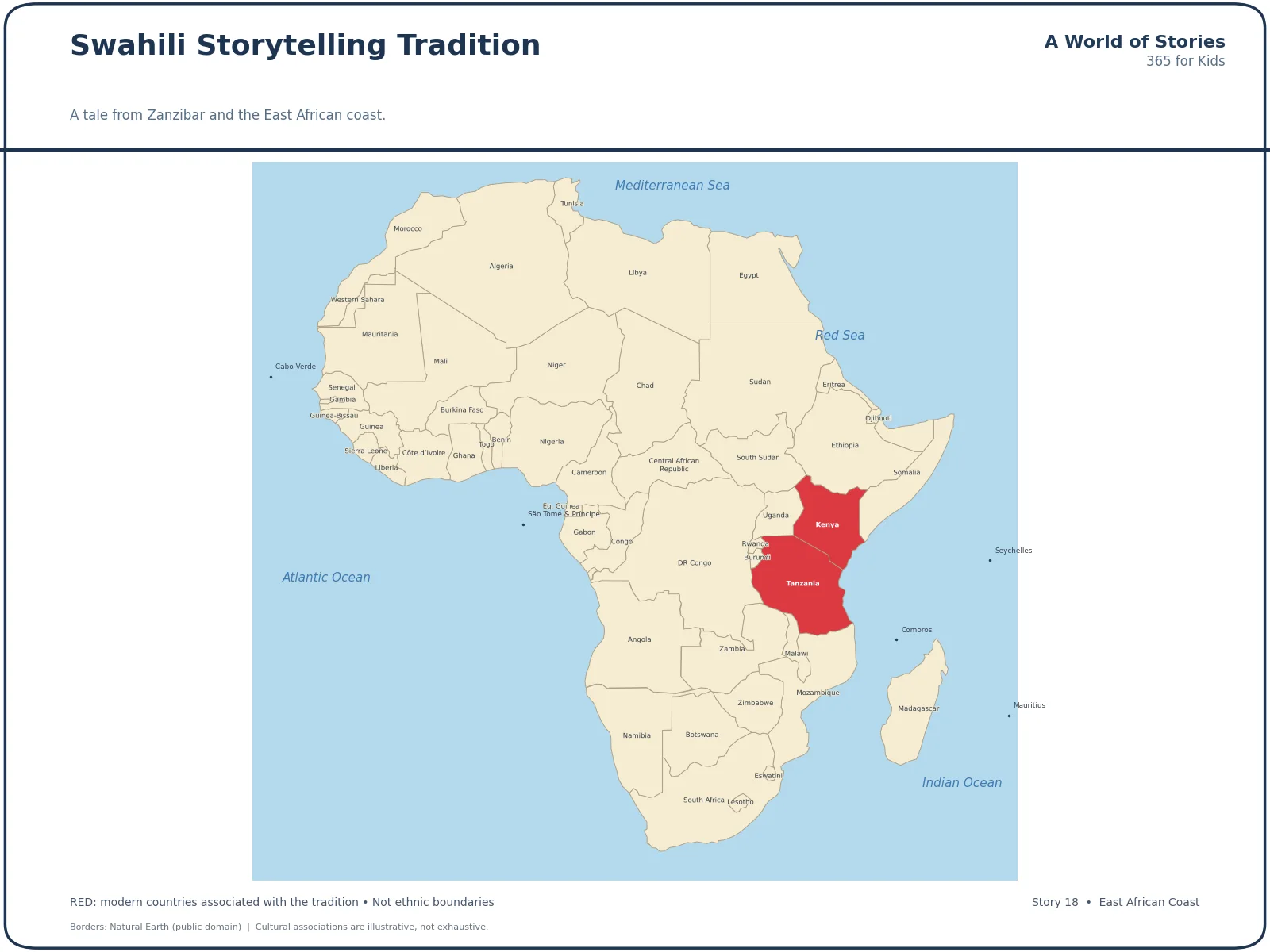
Based on George W. Bateman, trans., Zanzibar Tales: Told by Natives of the East Coast of Africa (1901), a Swahili storytelling tradition of Zanzibar, present-day Tanzania.
After the Story: Read · Create · Reflect · Share
Create: Find Zanzibar on a map of the Indian Ocean, locate Tanzania on mainland Africa, and draw Tanzania’s flag.
Explore: This tale contains a second tale told by one character. Who tells it, and why?
Reflect: What does Keema say about his heart to persuade Papa to return? Why does the example of Poonda the donkey matter to the ending?
Think & Share: Keema escapes by inventing a story. How is his deception different from the hare’s deception of the donkey in the story-within-the-story?
Inspired by this story? Create your illustration!
SWAHILI (ZANZIBAR, TANZANIA) — The Hare and the Lion
One day Soongoora the hare was looking for food in the forest when he noticed bees living inside a hole high in a great calabash tree. Their hive promised plenty of honey. He hurried back toward town to find someone who would help him reach it.
As he passed Bookoo the big rat’s house, Bookoo asked him in. Soongoora sat down and said that his father had died and left him a hive of honey. Would Bookoo come and help eat it? Bookoo agreed at once.
They went to the tree with straw, climbed to the hive, lit the straw to drive away the bees, put out the fire, and began eating. Then Simba the lion appeared below. The honey belonged to him.
“Who is up there?” Simba called. Soongoora whispered to Bookoo to keep silent and claimed that the lion was mad. But Simba demanded an answer again, and the frightened rat cried out that it was only them.
Soongoora told Bookoo to wrap him in the straw, warn Simba to stand aside, and throw the bundle down. Bookoo obeyed. While the lion stared upward, Soongoora slipped out of the straw and escaped. Bookoo had no way to avoid climbing down. Simba seized him, learned who the other visitor had been, and ate him. The lion searched for the hare in vain.
Three days later, Soongoora invited Kobay the tortoise to eat honey. “Whose honey?” Kobay asked. Soongoora said it had belonged to his father. They climbed the same tree, drove out the bees with smoke, and began their meal.
Again Simba came to the foot of the tree. Soongoora urged Kobay to keep quiet, but the tortoise suspected that the honey was not theirs. He answered Simba and agreed to come down.
Soongoora proposed the same trick: Kobay should wrap him in straw and throw him down while Simba moved aside. But Kobay saw that the hare meant to escape and leave him to face the lion. Instead, he called, “Soongoora is coming!” as he dropped the bundle.
Simba caught the hare beneath his paw. Soongoora told him that his flesh was far too tough to eat. If Simba wished to make him tender, he should seize the hare by the tail, whirl him around, and strike him against the ground. Simba tried it. Just before the blow, Soongoora slipped from his grasp and fled.
The furious lion ordered Kobay down. “Your shell is hard,” he complained. “How shall I eat you?” Kobay laughed and advised him to put the tortoise in mud and rub his back until the shell came away. Simba carried him to the water and began rubbing. But Kobay slipped away in the mud. Simba went on scraping a rock until his paws were sore and bleeding. Once more he had been fooled.
Simba set out to find Soongoora, asking everyone where the hare lived. Soongoora and his wife had moved, and the neighbors could not tell Simba the way. At last someone pointed toward a house high on a mountain.
Simba climbed there and found the house empty. He hid inside to wait for the hare and his wife, planning to eat them both when they returned.
When Soongoora approached with his wife, he saw lion tracks on the steep path. He urged her to return to their friends. She wished to stay with him, but he persuaded her to go back to safety. Following the footprints, he discovered that they led into his house.
From a little distance away, Soongoora called, “Good day, house! Good day!” He waited, then said loudly that his house always answered him and that its silence today must mean someone was inside.
Simba, listening within, called out a greeting. Soongoora laughed. “Simba! You are in there, hoping to eat me. But whoever heard of a house that could talk?”
The lion came out and gave chase. Soongoora ran until Simba was utterly exhausted. At last the lion admitted that the hare had beaten him and decided to have nothing more to do with him. He returned to his home beneath the calabash tree.
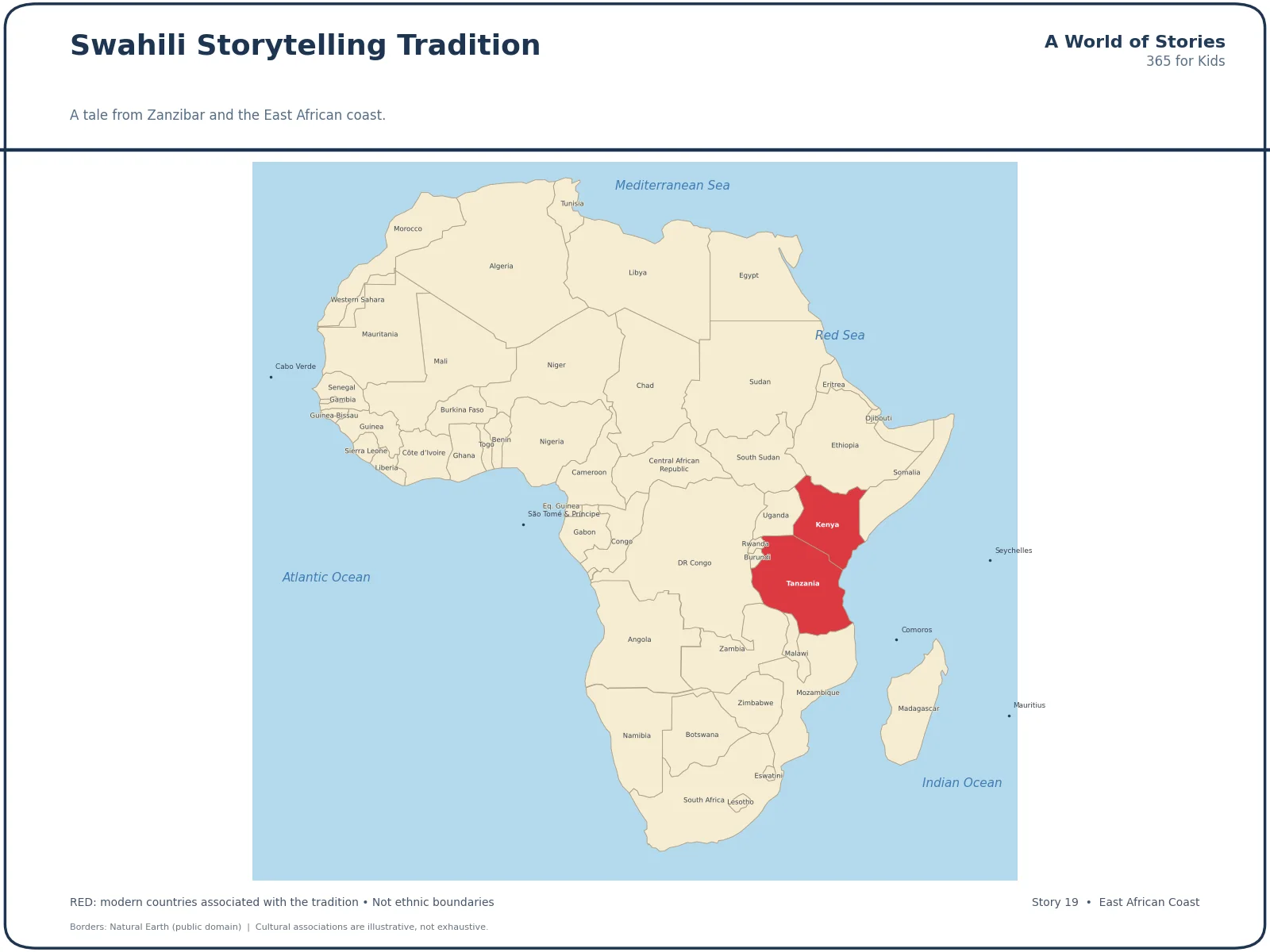
Based on George W. Bateman, trans., Zanzibar Tales (1901), a Swahili storytelling tradition of Zanzibar, present-day Tanzania. Soongoora survives by trickery; a companion dies because of his escape, so the story invites reflection on both ingenuity and responsibility.
After the Story: Read · Create · Reflect · Share
Create: Find Zanzibar on a map of East Africa and draw a scene from the tale, labeling a feature of the natural world that shapes the action.
Explore: How does Soongoora escape Simba on each of the three occasions? Put his tricks in order.
Reflect: Soongoora is clever, but his cleverness costs Bookoo his life. Is Soongoora a hero of this story? Why or why not?
Think & Share: Which of Soongoora’s escapes do you think requires the most careful observation of his surroundings?
Inspired by this story? Create your illustration!
SWAHILI (ZANZIBAR, TANZANIA) — Goso, the Teacher
Long ago, there was a teacher named Goso. He did not teach his children inside a schoolhouse. Each day they gathered beneath a calabash tree, where he helped them learn to read.
One evening, while Goso sat studying his lessons for the following morning, a gazelle named Paa quietly climbed the tree to steal some of its fruit. As Paa moved among the branches, a calabash fell and struck Goso on the head. The blow killed him.
When the children arrived the next morning, they found their beloved teacher dead. They grieved and buried him. Then they resolved to discover who had caused his death and to punish the culprit.
At first they blamed Koosee, the south wind. They seized the wind and beat it. But the wind protested: “Why do you blame me? If I were so mighty, how could a mud wall stop me?”
The children turned to Keeyambaaza, the mud wall, and punished it instead. The wall argued that it could not be the strongest, since Paanya the rat could bore holes through it.
So the children seized Paanya. The rat pointed to Paaka the cat, who could catch and eat it. The children went to the cat, and the cat pointed to Kaamba the rope, which could tie it up.
They punished the rope, but the rope said that Keesoo the knife could cut it. They went after the knife, which reminded them that Moto the fire could burn it.
Then they punished the fire. Yet the fire answered that Maajee the water could put it out. The children went to the water, and the water named Ngombay the ox, which could drink it.
They punished the ox. The ox protested that even so large an animal could be tormented by Eenzee the fly. So the children caught the fly, too.
The fly had its own answer: Paa the gazelle could eat it. Hearing this, the children set off to find the gazelle.
When they found Paa, they accused the gazelle and struck it. They recounted the whole chain: the fly troubled the ox, the ox drank the water, the water quenched the fire, the fire burned the knife, the knife cut the rope, the rope tied the cat, the cat ate the rat, the rat pierced the wall, and the wall stopped the wind. And the wind, they had first believed, had shaken loose the calabash that killed their teacher.
Paa was astonished that the truth had finally reached the children. Frightened by what might happen after the accidental death, the gazelle could not speak.
The children took Paa’s silence as proof. They killed the gazelle, believing that they had avenged Goso.
So ends the story of Goso, the teacher, and the long chain of blame that led back to the calabash tree.
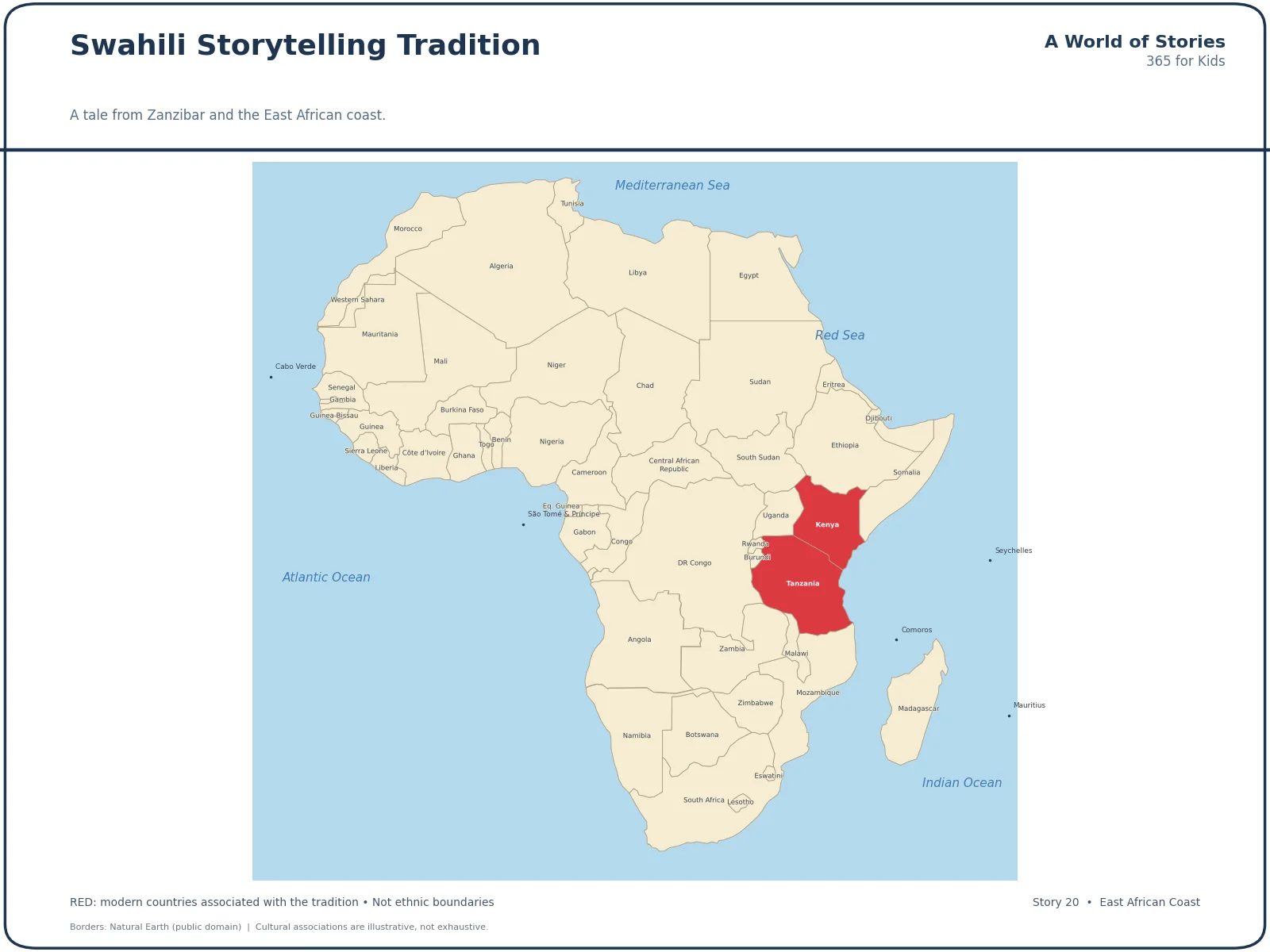
Based on George W. Bateman, trans., Zanzibar Tales (1901), “Goso, the Teacher.” A Swahili storytelling tradition of Zanzibar, present-day Tanzania. Content note: includes an accidental death and a harsh act of revenge, kept as recorded in the source rather than softened. Younger readers may benefit from discussing the story with an adult.
After the Story: Read · Create · Reflect · Share
Create: Find Tanzania on a map of Africa, locate Zanzibar off its eastern coast, and draw the Tanzanian flag.
Explore: Can you retell the chain of blame from the south wind to the gazelle in the correct order?
Reflect: What really caused the calabash to fall? Why did the children keep changing whom they blamed?
Think & Share: The children loved their teacher and were grieving. Did their sadness make their final decision fair? What could they have done differently?
Inspired by this story? Create your illustration!
AFAR (ETHIOPIA) — The Four Brothers and the Hyena
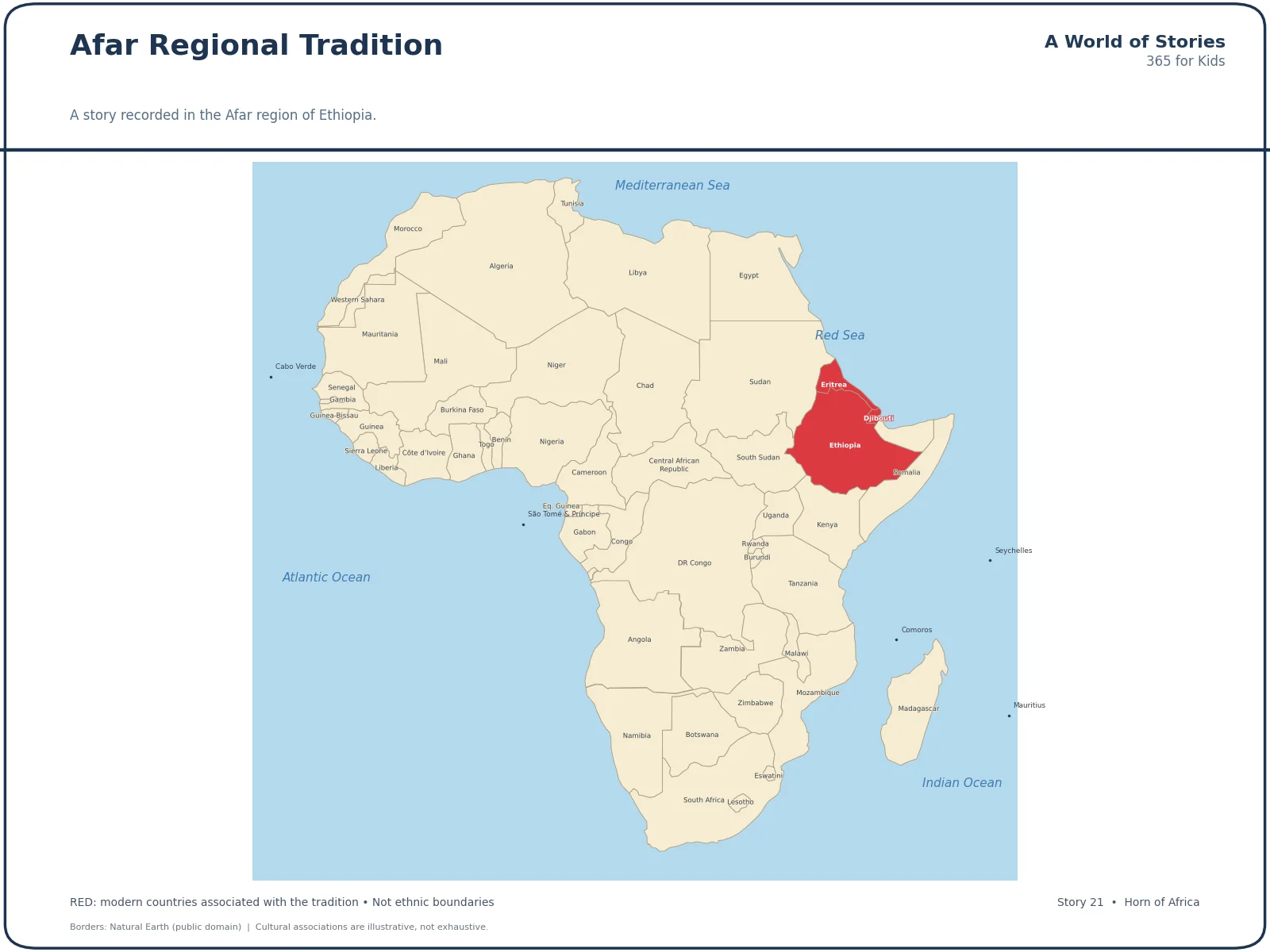
Near a village stood a vast forest into which people did not venture. The forest belonged to the king of the hyenas, and the many hyenas who lived there made everyone afraid to enter.
One day four brothers decided to explore it together. They walked farther and farther between the trees until they reached the middle of the forest. There they were surrounded by hyenas, with their king at their head.
The king demanded to know why they had dared to enter his domain, and what had given them the courage to do so. He questioned the brothers one at a time.
The eldest said that he placed his trust in God, the maker of the world. His life and the day of his death, he believed, were already known to his Creator. For that reason he was not afraid.
The second brother said that he trusted his clan. His relatives were brave and would not allow the death of one of their own to go unanswered. Anyone who harmed him would have to reckon with them.
The third brother put his trust in Mother Earth. She had brought him into the world, he said, and when his life ended, he would return to her. He relied upon the earth that held every living creature.
The youngest brother told the king that he trusted the hyenas themselves. He had hyena friends, he explained, and he believed in their strength and goodwill.
Then the king summoned his followers and considered the four answers. The first brother relied upon the Creator, and the hyenas could not quarrel with God. The second relied upon his clan, and the king did not wish to start a feud with those who would seek revenge. The third relied upon Mother Earth, and who could live upon the earth while waging war against her?
So the king allowed those three brothers to leave.
But the fourth brother had placed his trust in the hyenas. The king reasoned that the hyenas could quarrel among themselves without difficulty. He therefore ordered his followers to eat the fourth brother, and they did so.
That is how the traditional telling ends.
Based on “The Four Brothers and the Hyena,” recorded in the Afar region of Ethiopia as part of the Ethiopian Folktales project (fieldwork 1997–2001). The tale has a severe traditional ending, kept as recorded; readers may wish to discuss it with an adult.
After the Story: Read · Create · Reflect · Share
Create: Find Ethiopia in East Africa, locate the Afar region, and draw the Ethiopian flag.
Explore: The four brothers trust different sources of protection: the Creator, their clan, Mother Earth, and the hyenas. Why might each source have seemed important to its speaker?
Reflect: Which three brothers are allowed to leave the forest? Explain the hyena king’s reasoning in each case.
Think & Share: How might the youngest brother have felt when the king responded to his answer? Discuss the difference between placing trust in someone and knowing that person is trustworthy.
Inspired by this story? Create your illustration!
MALAGASY (MADAGASCAR) — The Three Sisters and Itrimobe
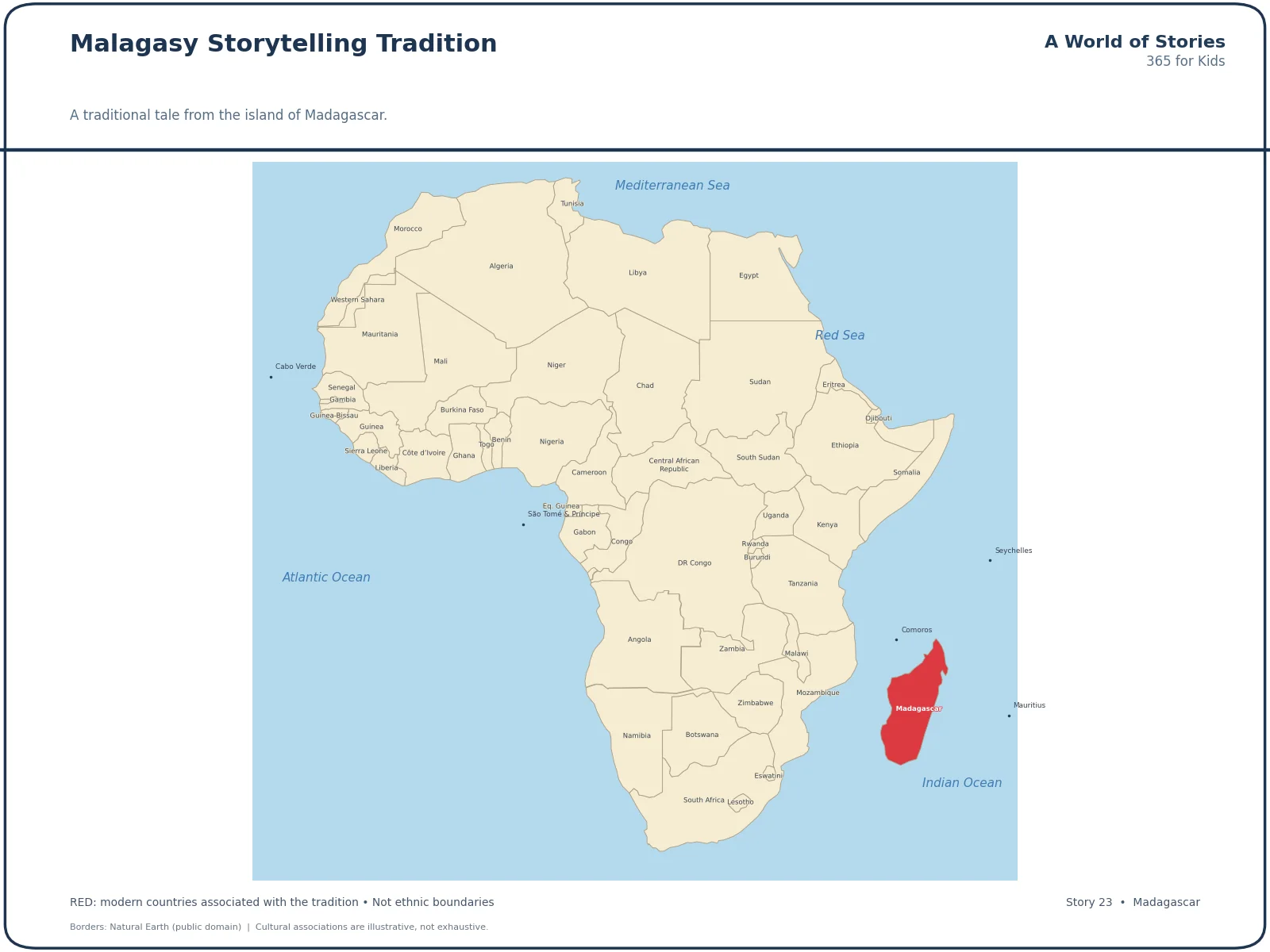
Once there lived a wealthy husband and wife who had three daughters. The youngest, Ifara, was the most beautiful of them all. One night she dreamed that the Son of the Sun descended from heaven to choose a bride. In her dream he chose her, leaving her two elder sisters behind.
When Ifara told her sisters, jealousy took hold of them. They knew that her beauty might attract a prince, and they resolved to find a way to be rid of her. Pretending that they wished to play, they persuaded her to go walking with them.
First they met an old woman, and the sisters asked which of them was the prettiest. The woman praised all three, but said Ifara was the loveliest. Angry, the elder sisters took away her outer lamba, the cloth she wore. Then they encountered an old man and asked him the same question. He, too, chose Ifara. Her sisters stripped her of her remaining clothing. Even then they could not make the old man change his answer.
At last they met Itrimobe, a monstrous creature, half human and half beast, with a terrible sharp tail. They asked him to judge their beauty. He named Ifara, just as the others had done. The sisters’ jealousy turned to cruelty. They decided to lead her into Itrimobe’s vegetable garden so that he would seize her.
The sisters proposed a game: each should gather the finest vegetables. They told Ifara to pick the youngest shoots, but secretly gathered fully grown plants themselves. When she noticed the difference, they blamed her and sent her back to collect larger ones. There Itrimobe caught her. He accused her of stealing and threatened to eat her. Terrified, Ifara begged him to take her as his wife instead.
Itrimobe agreed, but in truth he intended to feed her until she was fat enough to eat. He took her to his house, kept her shut indoors beneath mats, and went out hunting for more food. Meanwhile the sisters returned home and told their parents that Itrimobe had eaten Ifara. Their father and mother wept for their lost daughter.
One day while Itrimobe was away, a little mouse dressed in plantain-fibre cloth came to Ifara and asked for some white rice in exchange for advice. She gave the mouse the rice. It told her to flee south, taking an egg, a broom, a small cane, and a smooth round stone.
Ifara gathered the four objects. In her place beneath the mats she laid the stem of a plantain tree, then locked the house and fled. Itrimobe returned carrying his spear and cooking pot. Finding no answer at the door, he broke in and thrust his spear through the covered figure. When he pulled the mats aside, he saw only a plantain stem. Enraged, he sniffed in every direction until he discovered that Ifara had fled south, and he raced after her.
As he drew near, Ifara threw down her broom and invoked the protection of her father and mother. Instantly it became a thick thorny thicket. Itrimobe cut his way through with his sharp tail. When he caught up again, she threw down the egg. It became an enormous pool of water. Itrimobe drank and emptied the water into the river until the path was clear.
Next Ifara cast down the small cane. It grew into a dense forest, but Itrimobe hacked through it with his tail. Her last object was the smooth stone. When she threw it down, it rose into a towering, inaccessible precipice. Itrimobe struck at the rock with his tail until the point became blunt. He tried to climb, but could not.
From below he called, promising not to hurt her if she would pull him up. Ifara told him first to plant his spear in the ground. When he obeyed, she lowered a rope. But as he neared the top, he cried that he had caught her at last. Ifara released the rope. He fell upon his own spear and died.
Safe from the monster, Ifara was nevertheless stranded high on the rock. She grieved for her parents. A crow passed, and she sang, asking it to take her to her father’s well, promising to smooth its tail in return. The crow refused, remembering unkind things said about its food. A hawk also refused her plea. Then came a bird called the reo. Hearing her request, it took pity on the sorrowful girl and carried her to a tree above her parents’ well.
A young servant girl came to draw water. She saw Ifara’s beautiful face reflected in the well and mistakenly believed it was her own. She declared that someone so beautiful should not have to carry water, and broke her water pot. From the tree, Ifara reproached her for wasting the pot her parents had paid for. The girl looked around but could not find the speaker.
The same thing happened the next day. This time the servant hurried home, saying that a hidden voice at the well sounded just like Ifara’s. Her parents went to the well. Ifara climbed down from the tree, and the three embraced, weeping with joy.
Ifara told her parents how her sisters had deceived her and delivered her into Itrimobe’s hands. Her parents disowned the two elder daughters and welcomed Ifara home. So the old tale ends.
Based on James Sibree, Jr., “The Three Sisters and Itrimobé,” The Folk-Lore Journal, vol. 1 (1883), pp. 233–243, translated from a contribution by Rev. J. Richardson to the Publications of the Malagasy Folk-Lore Society. A Malagasy oral tradition of Madagascar. The original contains threats of cannibalism, cruelty, and death; adults may wish to preview it for younger children.
After the Story: Read · Create · Reflect · Share
Create: Find Madagascar on a map. Draw the four magical obstacles Ifara’s objects became, in the order they appeared.
Explore: Which ocean surrounds Madagascar, and which part of Africa lies nearest to it?
Reflect: How did the sisters’ jealousy change their actions? What might they have done differently after hearing about Ifara’s dream?
Think & Share: The crow and hawk refused to help, but the reo bird showed compassion. What can this part of the story teach us about responding to someone in trouble?
Inspired by this story? Create your illustration!
Southern Africa
XHOSA (SOUTH AFRICA) — The Story of Hlakanyana
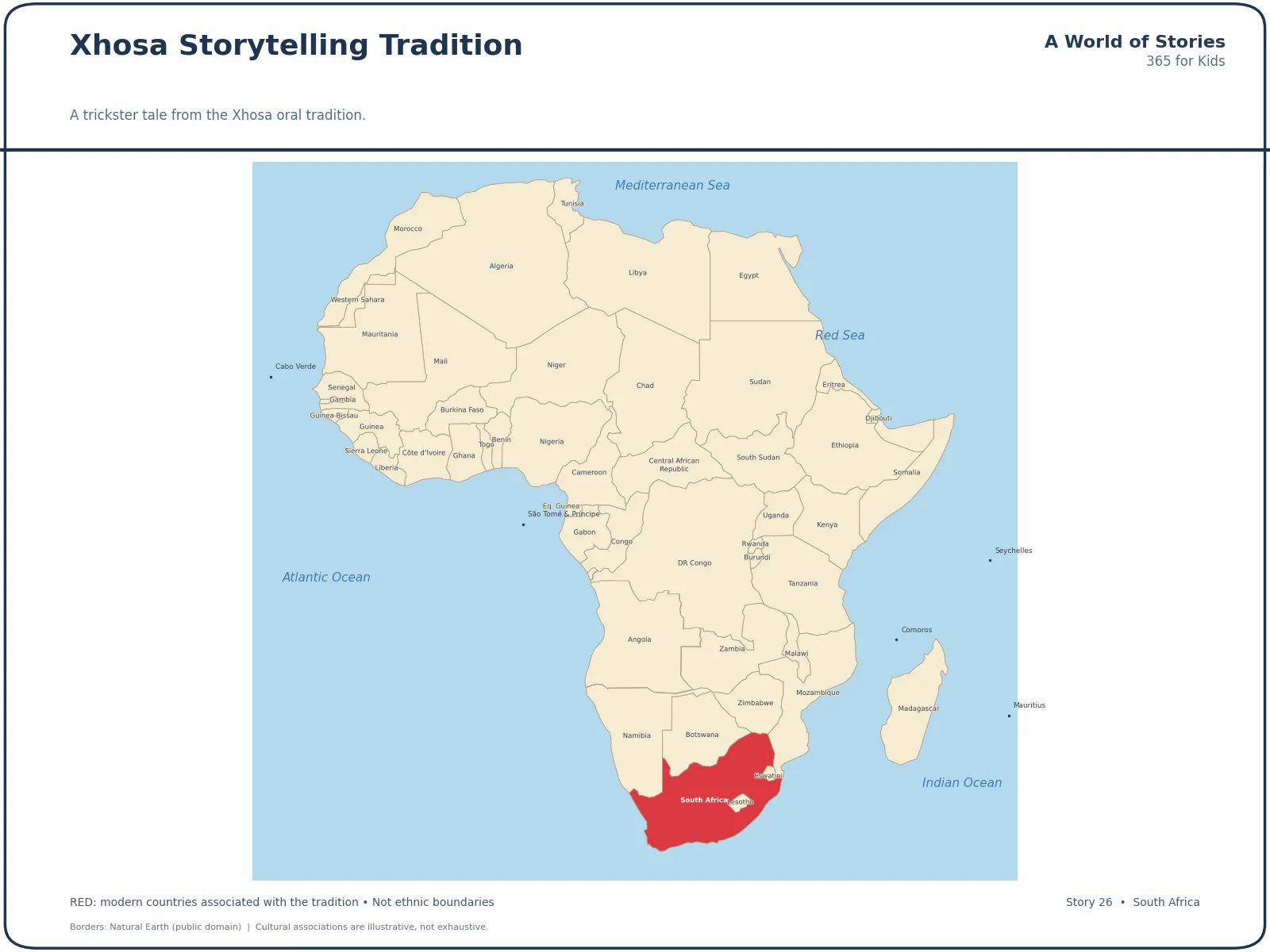
Long ago a chief’s wife had no child, though the women of the village had borne children and watched them grow. The people proposed slaughtering an ox, hoping that afterward the chief’s wife might have a child. As they prepared the animal, she heard a strange voice asking her to give birth before all the meat was gone. At first she thought something was wrong with her ears. But the voice persisted, and she gave birth to a tiny boy with the face of someone very old.
The boy immediately demanded a skin cloak and hurried to the place where his father was preparing the ox. “Father, give me meat,” he insisted. The chief could scarcely believe the small stranger was his son. He pushed him away again and again, but the boy returned. At last the men advised the chief to give him some meat. Even then Hlakanyana kept asking. He was given different cuts; he set some aside and took others, declaring himself a man already. To the astonishment of the men, he lifted a heavy portion of meat that they themselves could not carry.
He offered to take meat to their homes, but carried it instead to his own mother. Then he left traces of blood on their mats, claiming that dogs must have stolen their portions. Innocent members of their households suffered because of his lie. At home he told his mother to cook the meat and leave it until morning. During the night he ate it all. When she heard a disturbance at the pot, he imitated a dog. The next morning he pretended to be surprised that only bones remained.
The other boys mocked him for being so young. Hlakanyana announced that he was older than they were. That night he killed two cattle and smeared one sleeping boy with blood. In the morning the villagers blamed and killed that boy, while the real culprit quietly congratulated himself on his cleverness.
Later, when the chief had an ox head cooking, Hlakanyana drove the village cattle into thick woodland and fastened them to trees. He scratched himself with a sharp stone, raised the alarm that enemies were stealing the cattle, and pointed the men in the wrong direction. An old man remained behind. Hlakanyana sent him for water, ate the meat, put dung in the cooking pot, and planted a bone and grease beside the sleeping man. After releasing the cattle he returned triumphantly, claiming to have defeated the raiders.
The villagers were ready to punish the old man for stealing the food, but children who had watched from hiding told the truth. Hlakanyana denied everything and requested permission to question the women. On the way he escaped. When warriors pursued him, they found an old woman beside a bush who told them to hurry across the river. It was Hlakanyana himself, magically disguised; once they were gone, he resumed his own form and set out on his travels.
In another village he offered an elderly woman a way to become young. He persuaded her to fetch water and heat a great cooking pot. First he let himself be warmed briefly in it and called to be taken out. Trusting him, the woman entered the pot in her turn. Hlakanyana refused to lift her out, and she died. Wearing her clothes, he deceived her returning sons and gave them food from the pot. When they suspected the truth, he fled. They pursued him to a river, where he changed into a round stone. One son picked up the stone and hurled it across the water; it changed back into Hlakanyana, who escaped laughing. He continued his journey singing of the dreadful episode.
Next he met a boy tending goats and persuaded him to chase birds. When they had caught some, Hlakanyana proposed a contest to see who could remain underwater longest. On the second try he surfaced early, ate the birds, and left only their heads. He then accused the other boy and demanded his digging stick as compensation.
He offered the stick to potters who were digging clay. When it broke, he repeated his long complaint about the boy and his birds until the potters gave him a pot. He lent that pot to boys milking goats; when it broke, he claimed a goat. He then gave the goat to calf-herders; it died, and they compensated him with a calf. A similar trick among cowherds cost him the calf but won him a cow. Each time he retold the entire chain of supposed injuries, though the trouble had begun with his own deception.
He found a young man willing to travel with him. At successive places Hlakanyana announced that it was time to throw away walking sticks, spoons, knives, and the pointed tools used for taking thorns from feet. His companion obeyed. Hlakanyana secretly kept his own things. When thorns pierced their feet, only he could remove them. When villagers later served them meat and millet, only he had a knife and spoon. He refused to share and ate alone.
At another settlement he learned that a girl was tending goats because there were no boys. He promised her father to tend the herd in exchange for taking the girl as a companion. Day by day he killed and ate the goats. Then he scratched himself and blamed wild dogs for taking them, abandoning the place before he could be questioned further.
He stole birds from a trap whose owners were cannibals. They caught him and prepared to cook him. Hlakanyana offered them a choice of two oxen in his place. They chose the white one, and he escaped with the red. When the cannibals followed, he began to sing upon a large stone. His song made them dance, and, by magic, the stone went on singing after he ran away.
He came upon baboons feasting and asked for food. They promised some if he fetched water. When they refused to give it to him afterward, he shouted that a baboon wedding was taking place in his village. The baboons rushed away, leaving their feast behind. Next he offered to help a hyena put a thatched roof on a house. While working he fastened the hair of its tail in the roofing. Unable to climb down, the hyena watched as Hlakanyana ate its cooked meat and tossed it the bones.
By a river an iguana was playing an instrument called an ugwali. Hlakanyana borrowed it, promising not to run away with another creature’s property. Then he did exactly that. Pursued by the iguana, he became a rush beside the river. The iguana threw the rush across the water, and Hlakanyana changed back into himself, taking the instrument away.
He persuaded a leopardess to leave her four cubs in his care while she hunted. He ate one cub and gave the others to her one at a time when she returned to nurse them, secretly presenting the same cub twice to disguise the loss. Over successive days he devoured all four. He narrowed the doorway so the leopardess could not enter and dug himself a rear exit. When she discovered the loss and chased him, he pretended a great rock was falling. She held it up while he promised to fetch a support, but he disappeared instead.
Among the animals he found a richly fruiting tree reserved for their chief. He sent a monkey to ask its name, but the monkey stumbled and forgot the answer. During the night Hlakanyana ate the fruit and attached a branch to a monkey. He then invented a test: all must cross a rope strung between rocks, and whoever fell was the guilty one. He crossed carefully, while the monkey carrying the branch fell. Once again he made others believe that his own victim was to blame.
At a jackal’s home he arranged another trap. He told the jackal to announce from the roof that Hlakanyana was dead. The animals rushed inside to hear the news, and he shut them in, killing them for food. Eventually he returned to his father’s village. When his sister came back from fetching red clay, he used a ridiculous proclamation about black cattle and white teeth to trick the chief into slaughtering an ox. He enjoyed another meal.
One day while tending his father’s calves, Hlakanyana saw a tortoise walking toward a great stone. He offered to carry it, although the tortoise said it was not tired. At home he asked his mother to lift it from his back. But the tortoise held fast and would not release him. His mother heated fat and poured it over the tortoise. The tortoise let go, and the hot fat burned Hlakanyana so badly that he died. Thus ended the life of the little deceiver who had escaped so many others.
Based on George McCall Theal, Kaffir Folk-Lore (2nd ed., 1886), “The Story of Hlakanyana,” a Xhosa oral tradition of South Africa. Content note: this traditional trickster cycle includes death, cruelty to animals, cannibalism, and unfair punishment, stated without graphic detail rather than removed or softened. Most suitable for older readers or guided discussion.
After the Story: Read · Create · Reflect · Share
Create: Draw the flag of South Africa and find the southeastern coastal region where isiXhosa is widely spoken.
Explore: Make a picture sequence showing how Hlakanyana turns a digging stick into a pot, then a goat, a calf, and finally a cow. Who really caused each loss?
Reflect: Choose one person or animal wrongly blamed by Hlakanyana. How might that character have felt? What evidence could have helped the others discover the truth?
Think & Share: Hlakanyana is clever, but is he wise or kind? Compare two of his tricks, then imagine an alternative ending in which he makes a different choice.
Inspired by this story? Create your illustration!
XHOSA (SOUTH AFRICA) — The Story of the Bird That Made Milk
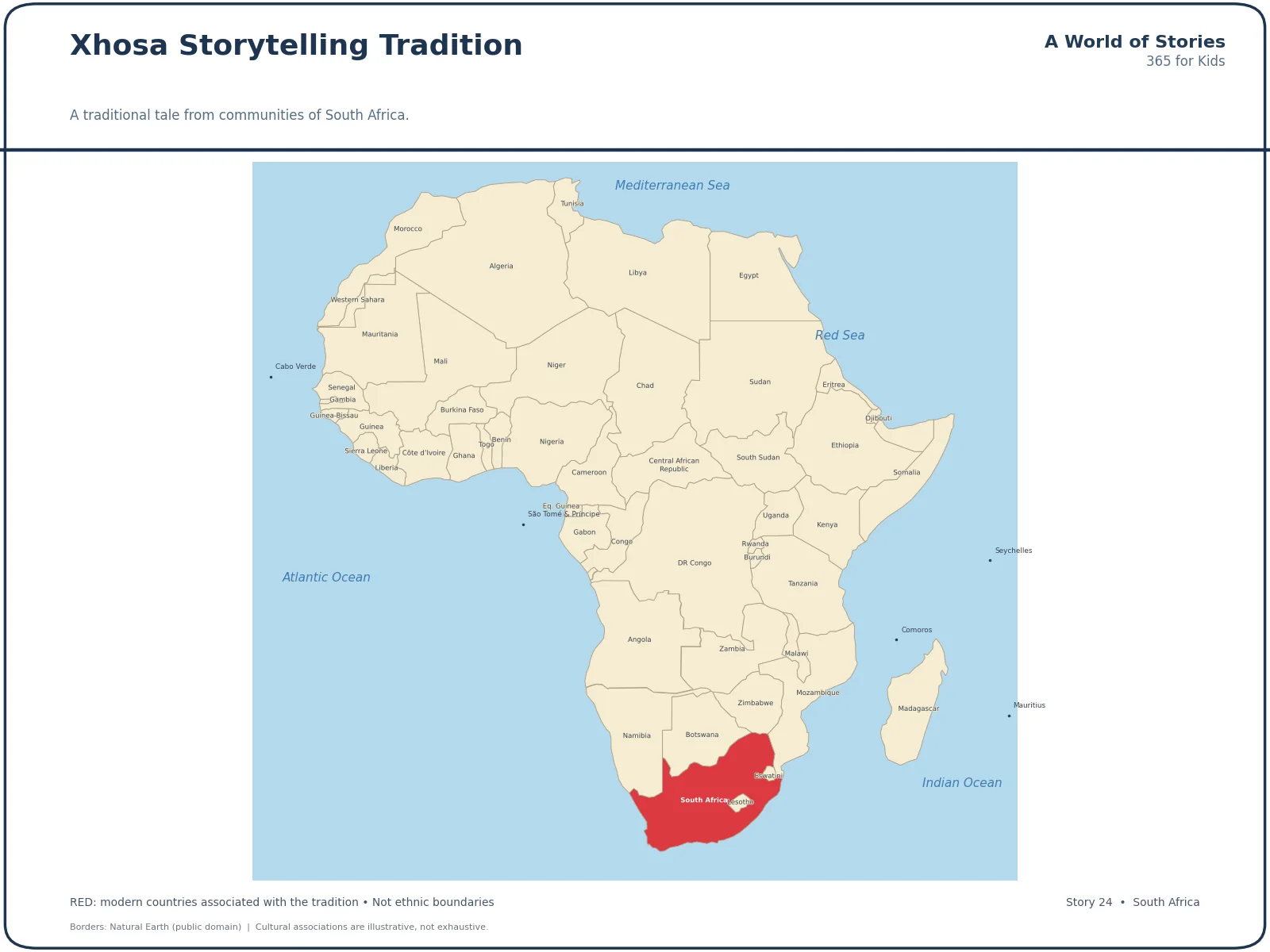
Long ago, in a village, a poor man lived with his wife and their three children: Gingci, the eldest son, Lonci, his younger brother, and their sister, Dumangashe. The family had little to eat. They squeezed a milky liquid from a tree, but it was not as nourishing as the milk of cattle.
One day the mother went to clear a garden. She cut the grass and piled it up. When she returned the next morning, every weed seemed to have grown back and her work had vanished. She cleared the garden again and marked the ground with sticks. Yet on the third morning the grass had returned once more. Her husband accused her of laziness, and she went back to the field in sadness.
As she began to work, a bird settled on a stick. It sang to the garden, calling the dug earth to return to its former state and the handle of her hoe to break. Immediately the earth shifted and the hoe broke. The woman told her husband what she had seen. Together they dug a hidden pit and covered it. The man concealed himself beneath it while the woman resumed her work.
The bird returned and sang its powerful song. This time it perched on the man’s outstretched hand, and he seized it. He threatened to kill it for destroying their labour. But the bird spoke: “Do not kill me. I can make milk.” To prove it, it filled his hand with delicious milk, then produced enough to fill a basket. The man was delighted. He brought it home and kept it in a large jar.
From then on he woke even in the night and ordered the bird to make milk. He and his wife drank it, while their children still had only the poor food from the tree. The father grew strong and well fed. Dumangashe wondered aloud why their father flourished while they remained thin. Gingci did not know. So the children watched him secretly one night and saw him lift the covering of the jar, summon the bird and drink its milk.
The next day both parents went out. The father locked the house and forbade the children to enter. But Gingci and Dumangashe went inside. Gingci lifted the mat covering the jar and demanded milk. The bird asked him to set it beside the hearth and made only a little. It then asked to be moved beside the door and made a little more. When Dumangashe asked, the bird told her to place it in the sunlight. There it filled a jar with milk.
Then the bird sang a strange song naming the children and their father and speaking of the river that swallows could cross. It opened its wings and flew away. The children called it back in vain. In terror they followed it to a tree full of birds. Gingci caught another bird and ordered it to make milk, but it was an ordinary bird; when he hurt it, it bled, and he let it go.
At evening their father returned and noticed that the door had been opened. Lonci told him he had gone to the river and did not know where the other two were. The father found Gingci hiding behind a stone and Dumangashe beneath ashes. They confessed what had happened. Furious, he tied them to a tree over the river and abandoned them there, ignoring their mother’s pleas for mercy.
Gingci struggled free, climbed the tree, and released his sister. The two children left home. After three nights on the road, they came upon a huge rock. “We have neither father nor mother,” Gingci said. “Rock, be our home.” The rock opened, and they entered. They lived there for a long time. Gingci hunted for food, and Dumangashe grew older. One day a bird arrived carrying a child and left the child near their home.
Later a crocodile appeared. Gingci was about to kill it, but the crocodile called out that it was a friend. It led the young man to its home in a deep place beneath the water, where it possessed cattle and millet. It gave Gingci ten cows and ten baskets of grain, asking that Dumangashe be sent to marry it. The brother built an enclosure for the cattle; his sister planted millet. More cattle came, until the enclosure was full.
A bird appeared and announced that Dumangashe had reached the time for the customary transition to married life, while Gingci should enter manhood. The crocodile gave one of its daughters to Gingci as his wife. Dumangashe went to the crocodile’s village and, when asked whom she chose, answered that she chose Crocodile. At his request, she licked his face. He shed his crocodile skin and stood before her as a strong, handsome man. He explained that enemies of his father’s household had caused his transformation.
Years passed. A great famine came upon the children’s old village. Their mother arrived seeking food, but did not recognize the grown children. They recognized her and fed her. Their father came too, and they gave him food without revealing themselves. When he returned again, Gingci reminded him that he had expected his children to die when he tied them to the tree. Their father was astonished to learn who they were.
Crocodile gave the parents three baskets of grain and told them to settle in the mountains. The father went there, built a home, and eventually died there. So ends the first recorded version of the tale of the bird that made milk.
Based on George McCall Theal, Kaffir Folk-Lore (2nd ed., 1886), “The Story of the Bird that Made Milk. I.” A Xhosa oral tradition of South Africa. Some scenes involve threats, harsh parental treatment, and harm to an animal; adult guidance may help younger readers.
After the Story: Read · Create · Reflect · Share
Create: Locate South Africa on a map of Africa. Find its southern coastline and name one ocean that borders the country.
Explore: What is amasi? Find out why fermented milk has an important place in food traditions in southern Africa.
Reflect: Put these events in order: the bird escapes; the children find refuge in a rock; the father captures the bird; Crocodile reveals his human form. Which event changes the children’s future the most?
Think & Share: The parents keep the bird’s milk for themselves, yet the grown children later give them food during a famine. What feelings might Gingci and Dumangashe experience? Would you have made the same choice?
Inspired by this story? Create your illustration!
XHOSA (SOUTH AFRICA) — The Story of Demane and Demazana
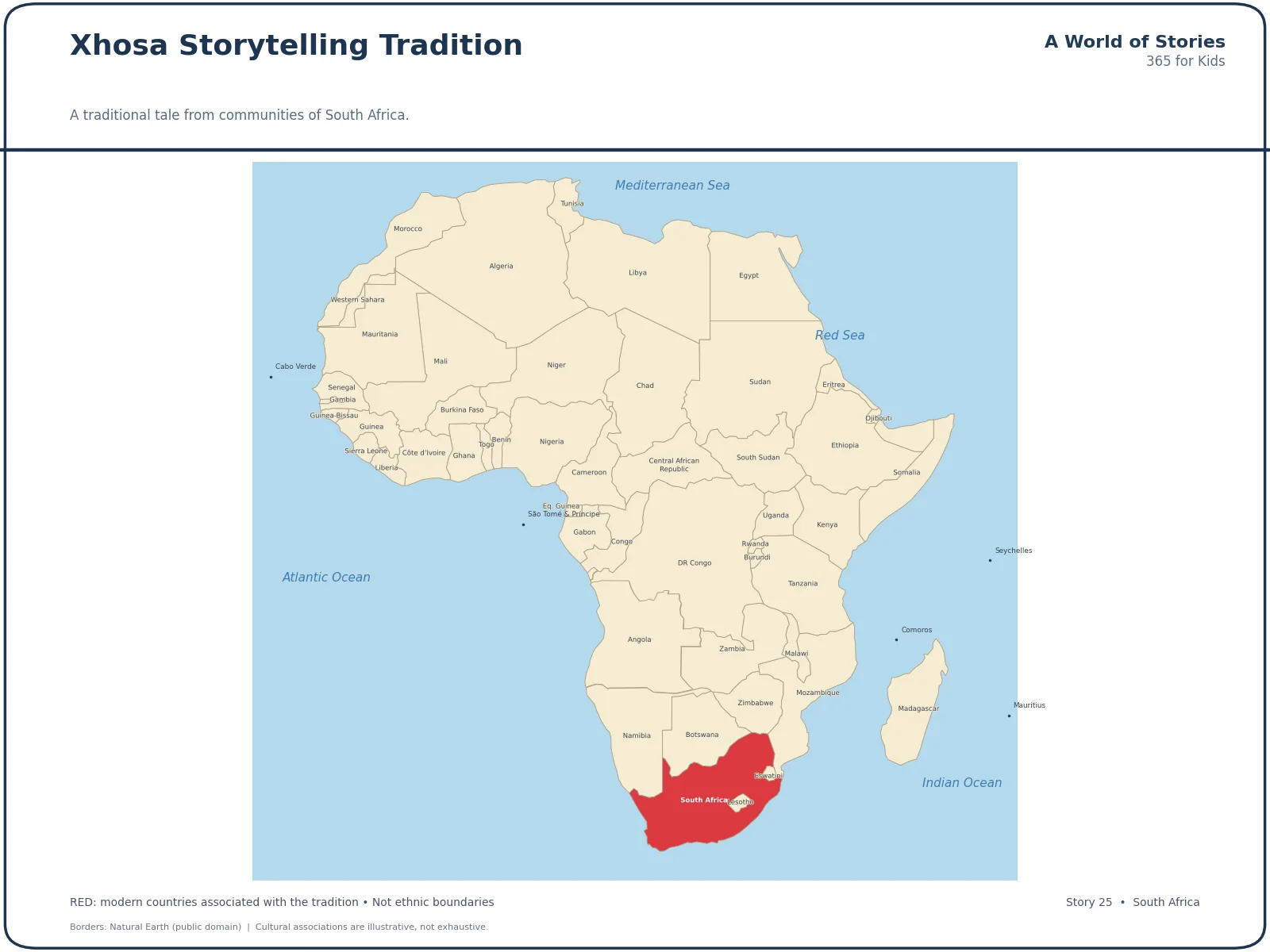
Long ago, there lived two orphaned twins, a brother named Demane and a sister named Demazana. Their relatives treated them so badly that they decided to run away. Far from the village, they found a cave where they could make a home. Two openings high in the rock admitted air and light, while a strong door, fastened from within, guarded the entrance.
Every day Demane went hunting. Before he left, he warned his sister not to roast meat while he was gone. The smell, he told her, might lead cannibals to their hiding place. But one day Demazana took some buffalo meat and began roasting it over a fire.
The smell traveled beyond the cave. A cannibal came to its door and found it locked. He pretended to be Demane and sang a call to the girl, speaking of the cave and the swallows that could enter through its openings. But Demazana knew her brother’s voice. She refused to open the door.
The stranger went away and returned, trying to change the sound of his voice. Again Demazana heard that he was not her brother. She sent him away.
The cannibal then asked another cannibal how he might obtain what he wanted, without revealing his true purpose. His companion advised him to burn his throat with hot iron. He did so, and his harsh voice changed.
When he returned to the cave and sang the familiar call once more, Demazana believed that her brother had come home. She unfastened the door. The cannibal seized her and carried her away.
As he took her along the path, Demazana secretly dropped little patches of ash upon the ground. Demane returned later with a swarm of bees he had caught. Finding the cave empty, he understood that something terrible had happened. He followed the ashes until they led him to the home of a cannibal named Zim.
Zim’s wife and children had gone to gather firewood. Demazana had been shut inside a large bag, to be kept there until the fire was ready. Demane addressed Zim respectfully and asked him for a drink of water.
Zim agreed, but made Demane promise not to touch the bag. When Zim left to fetch water, Demane opened it, freed his sister, and put his swarm of bees inside instead. The twins hid themselves.
Zim returned with water, and soon his wife, son, and daughter came back carrying wood. Zim told his daughter that there was something good in the bag and ordered her to fetch it. She reached inside, and a bee stung her. She cried that something was biting.
Zim sent his son to the bag, and the same thing happened. He sent his wife, too. She also drew back in pain. Furious with them all, Zim drove them out, placed a wooden block across the doorway, and opened the bag himself.
The bees burst out and swarmed around his head, stinging especially near his eyes until he could no longer see. He forced himself through a little hole in the thatched roof, leapt wildly about, and then plunged headfirst into a pond.
His head sank into the mud, and he was changed into a stump of wood. Bees made their home in the stump, but no one could take their honey: whoever reached for it found that their hand stuck fast.
Demane and Demazana were free. They took Zim’s many possessions, and the twins, who had fled their relatives with nothing, became prosperous.
Based on George McCall Theal, Kaffir Folk-Lore (2nd ed., 1886), “The Story of Demane and Demazana.” A Xhosa oral tradition of the Eastern Cape, South Africa.
After the Story: Read · Create · Reflect · Share
Create: Find South Africa on a map of Africa, draw its flag, and locate the Eastern Cape region, where this story was collected.
Explore: What clues helped Demazana refuse the stranger at first? What did she do to help Demane follow her trail?
Reflect: Why do you think Demazana opened the door the third time? How might she and Demane have felt when they found each other again?
Think & Share: Draw two scenes side by side: the cave with its two openings, and the moment the bees fly out of Zim’s bag. What details make each scene recognizable?
Inspired by this story? Create your illustration!
SOUTHERN AFRICAN (SOUTH AFRICA) — The Lost Message
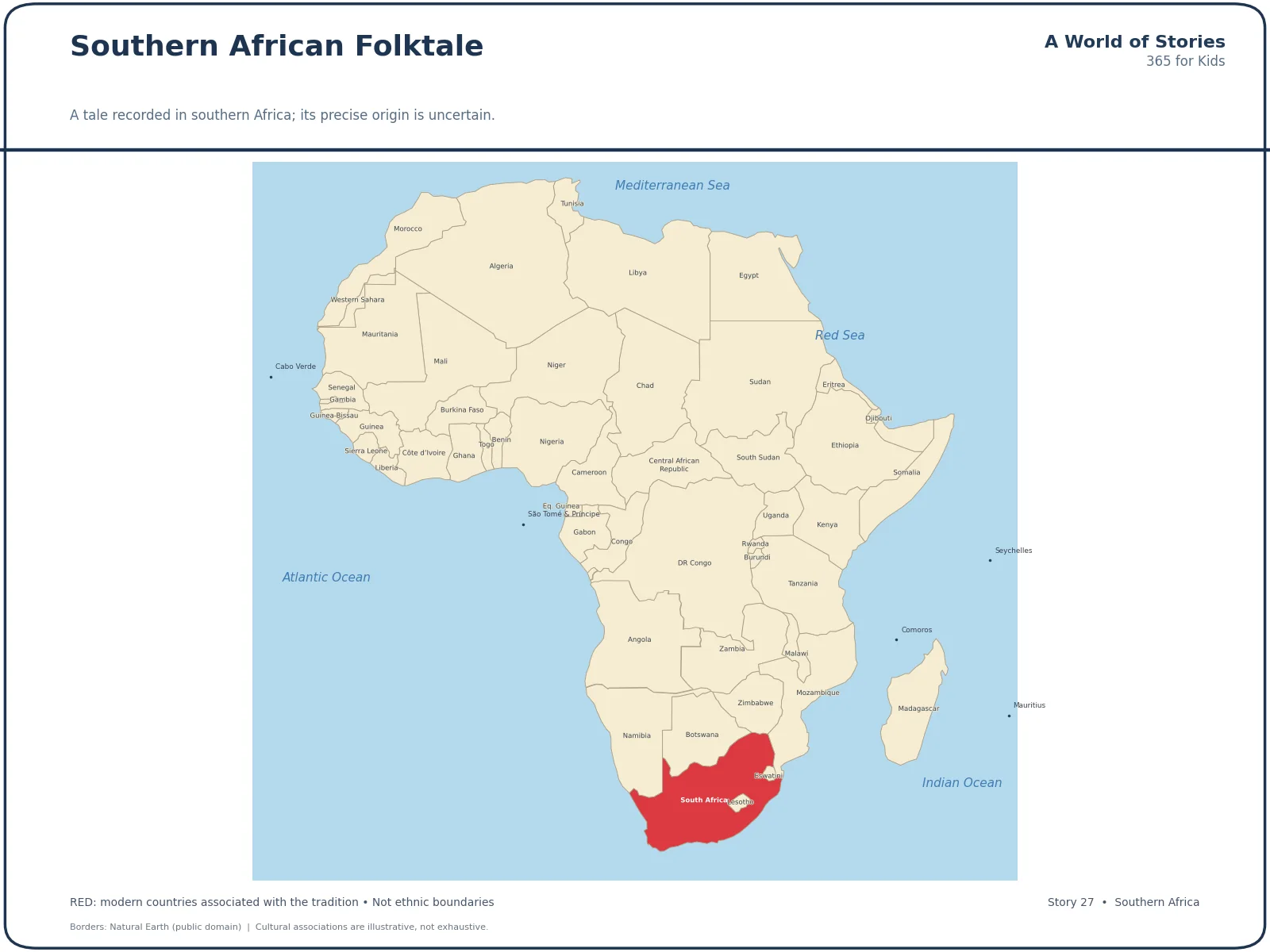
For as long as the ants could remember, danger had surrounded them. Though each ant was small, their enemies were many. Birds searched for them from above. The anteater lived almost entirely upon ants. And the centipede was always ready to seize them whenever it had the chance.
At last, some ants proposed a council. Perhaps, if they came together and considered their dangers, they could discover a place of safety.
To the gathering came red ants, rice ants, black ants, wagtail ants, gray ants, shining ants, and many others. But when they began to discuss their future, agreement proved impossible.
Some wanted to hide in a tiny hole beneath the ground. Others wished to raise a great, strong dwelling on the earth, with an entrance that only an ant could pass through. Others argued for homes in the trees, far beyond the reach of the anteater — though they forgot about the birds waiting in the branches. Still others thought that wings and flight might save them.
They talked and talked. Yet no decision was reached. At length, the different groups went away, each determined to follow its own plan.
Within each group there was remarkable order. Every ant had work to do, and everyone performed that work carefully. Some groups even chose kings and divided their tasks so precisely that their homes were built with great skill. But none of them had found a way to face their enemies together.
The red ants built a home on the ground. They labored for many days, yet the anteater could destroy their dwelling in a moment.
The rice ants made their homes beneath the earth. But when they ventured out, the anteater came and carried them off.
The wagtail ants fled to the trees. There they encountered the centipede, or fell prey to the hungry birds.
The gray ants hoped that speed would save them. But lizards, hunting spiders, and birds moved faster still.
News of their disagreement reached the Insect King. He wanted to help the ants and sent them a message containing the secret of unity: they must work together.
Unfortunately, the messenger he chose was a beetle.
That beetle has not reached the ants to this day. So the message was lost, the ants remained divided, and their enemies continued to trouble them.
Based on James A. Honeÿ, “The Lost Message,” South-African Folk-Tales (1910), pp. 10–13. The collection does not establish a secure ethnic attribution for this individual tale, so it is presented as a Southern African folk tale.
After the Story: Read · Create · Reflect · Share
Create: Find South Africa on a map. Which oceans meet along its coasts? Locate two other countries in Southern Africa.
Explore: Different groups of ants wanted to live underground, on the ground, or in trees. Draw three small scenes showing their plans and the dangers each one faced.
Reflect: What did the Insect King want the ants to learn? Why did working hard within separate groups not solve their common problem?
Think & Share: Imagine that you are the beetle carrying the lost message. How would you help the ants listen to one another and make a shared plan?
Inspired by this story? Create your illustration!
SOUTHERN AFRICAN (SOUTH AFRICA) — When Lion Could Fly
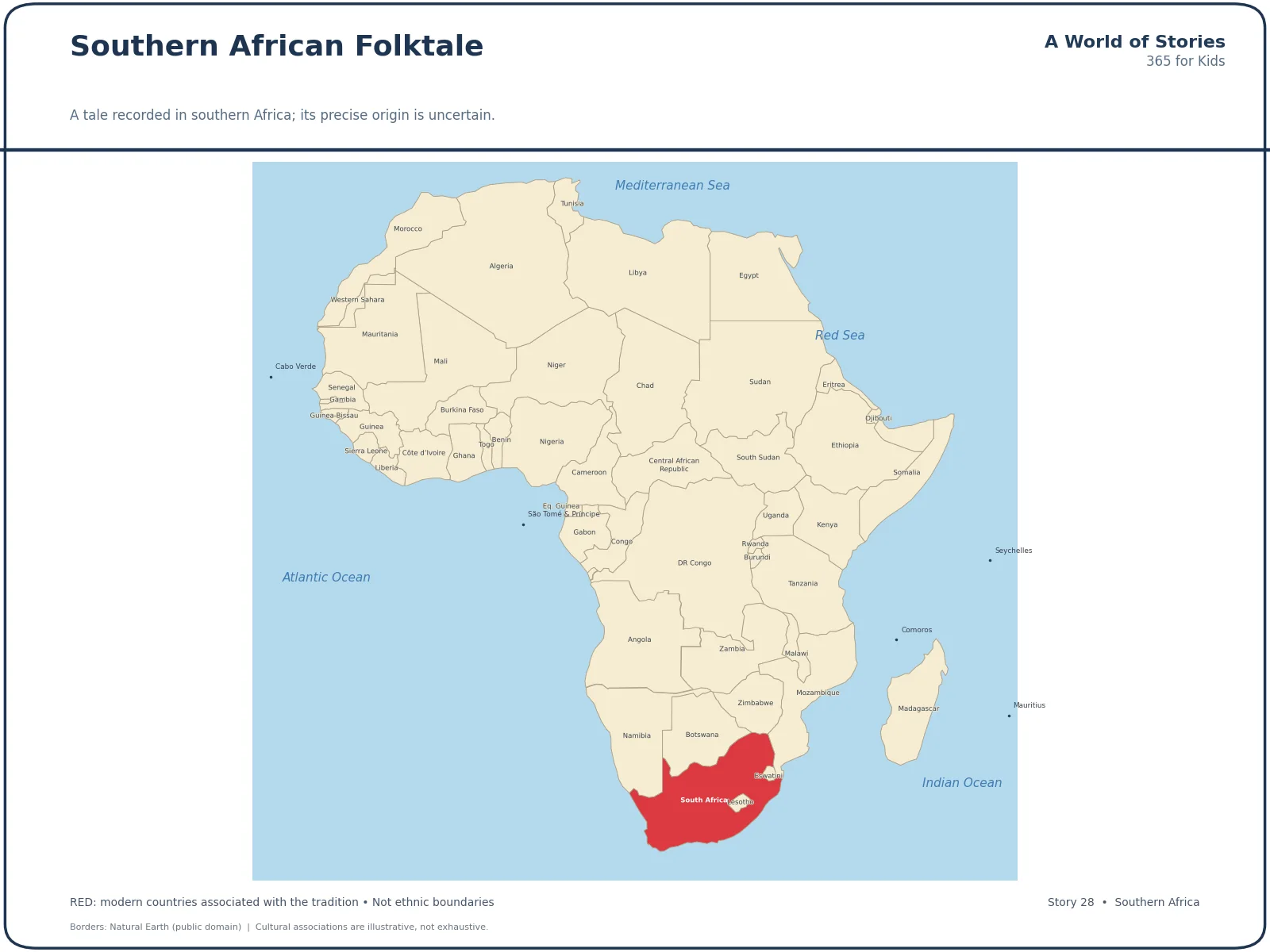
Long ago, people said, Lion could fly. Whenever he rose into the air and swept down upon his prey, no creature could escape him. He was so powerful that other animals and human beings could scarcely live in peace.
Lion had one strange rule. He did not want the bones of the creatures he caught to be broken. Whenever he went hunting, he left the bones at his kraal and appointed two White Crows to watch over them.
One day, while Lion was away, Great Frog came to the kraal. Seeing the bones, Frog broke them into pieces. Then he turned to the White Crows.
“Why should people and animals be unable to live any longer?” Frog asked. “Tell Lion that I live beside the pool over there. If he wishes to find me, he may come to the water.”
The two White Crows remained at the kraal while Frog went away.
Meanwhile, Lion was lying in wait for his prey. He tried to rise into the air as he had always done, but he could no longer fly. He tried again. Nothing happened.
Furious, Lion wondered whether something had gone wrong at home. He hurried back to his kraal and demanded of the White Crows, “What have you done? Why can I no longer fly?”
They told him that someone had come, broken the bones, and left a message: if Lion wanted to find the stranger, he should go to the pool.
Lion set out at once. When he reached the water, he saw Great Frog sitting at its edge. Lion crept toward him as quietly as he could, intending to catch him by surprise.
But just as Lion was about to seize him, Frog cried out and dived into the water. He appeared again on the far side of the pool.
Lion tried to follow him, but he could not catch Frog. At last he gave up and went home.
And that, the storytellers say, is why Lion has walked on his feet ever since and must creep toward his prey instead of flying down upon it. The two White Crows also became silent, because when questioned about what had happened, they could say nothing more.
Based on James A. Honeÿ, South-African Folk-Tales (1910), pp. 124–125. The collector does not firmly identify the specific community of origin for this tale, so it is presented as a Southern African folktale.
After the Story: Read · Create · Reflect · Share
Create: Find South Africa on a map of Africa and draw its flag. Can you identify the six colors in the design?
Explore: This tale explains why lions cannot fly. Why do you think people tell stories that imagine how animals acquired their familiar habits?
Reflect: What did Great Frog do to the bones? How did that action change Lion’s life, and why could Lion not catch Frog?
Think & Share: Lion’s power made life difficult for everyone else. How do you think the other creatures felt when he lost the ability to fly? Draw the moment Frog dives into the pool.
Inspired by this story? Create your illustration!
Key Dates
February 28, 2027
Submission deadline (or earlier, once 500 eligible artworks are received)
April 1–30, 2027
Virtual exhibition
Apr 1, 2027
Online gallery and digital catalog
Questions Parents Ask
Who can participate?
Children and teens ages 6–17 who live in the United States. A parent or legal guardian submits the artwork.
Does it cost anything?
No. Participation is completely free, and no purchase is ever necessary.
Can my child submit more than one artwork?
One artwork per child for each exhibition. Your child is welcome to take part in all six continents.
What kind of artwork is accepted?
Original artwork made by hand with traditional materials — pencils, crayons, markers, paints, collage and more. Artwork that is AI-generated, traced or copied, or made mostly by an adult cannot be accepted.
Is this a contest?
No. There are no rankings and no winners. The first 500 eligible submissions for each continent are accepted, in the order they are received.
What information is shown publicly?
Only your child’s first name or a nickname, an optional last initial, age group, city (optional), and state — never addresses, phone numbers, or emails.
Who owns the artwork?
Your child keeps the copyright. You give 365 for Kids permission to display and publish the image only in the ways you choose in the form.