
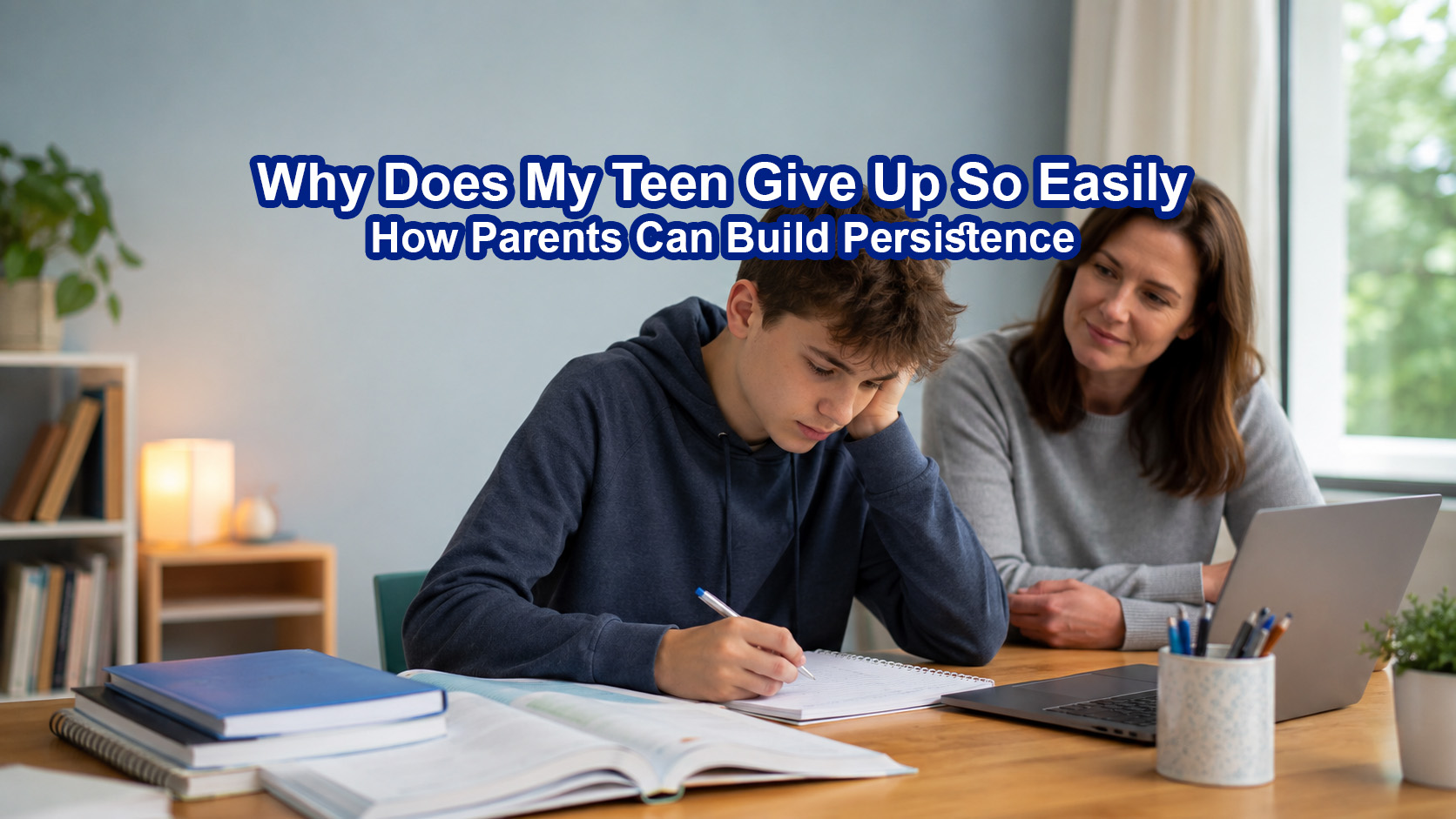
Why Does My Teen Give Up So Easily? How Parents Can Build Persistence
When a teen gives up easily, parents may feel confused and frustrated. Your teenager may begin an assignment, encounter one difficult question, and immediately stop. They may quit a sport after a disappointing practice, abandon a new hobby when progress is slow, or say, “I can’t do it,” before making a serious attempt.
From the outside, this can look like laziness, impatience, or a lack of ambition.
But giving up is often a form of self-protection.
A teenager may stop trying because failure feels embarrassing, effort feels risky, or the task seems too large to manage. Quitting provides immediate relief from frustration. Unfortunately, it also prevents the teen from experiencing the satisfaction and confidence that come from working through difficulty.
Parents can help teenagers build persistence—but not by simply telling them to “try harder.”
Persistence grows when teens learn that struggle is manageable, mistakes are survivable, and progress does not need to be immediate.
Why Does a Teen Give Up Easily?
A teen who gives up easily is not necessarily unwilling to work. Different emotional, practical, and developmental factors may be influencing the behavior.
Understanding the reason matters because the same parental response will not help every teenager.
Fear of failure
Some teenagers stop before they have a chance to fail.
If they do not try seriously, they can tell themselves:
- “I could have done it if I had really tried.”
- “The assignment was stupid anyway.”
- “I just didn’t care enough.”
- “I wasn’t prepared.”
This explanation may feel less painful than:
- “I tried my best and still struggled.”
Quitting protects the teen’s self-image in the moment, even though it limits growth over time.
Low confidence
A teenager who has experienced repeated difficulty may begin to expect failure.
They may think:
- “I am bad at math.”
- “I never understand anything.”
- “Other people are naturally better than me.”
- “There is no point in trying.”
Once a teen believes the result is already decided, effort feels useless.
Perfectionism
Perfectionism does not always look like excellent work and high achievement. Sometimes it looks like avoidance and giving up.
A perfectionistic teen may believe:
- the first attempt should be good;
- mistakes are evidence of weakness;
- needing help is embarrassing;
- anything less than excellent is failure.
When success feels possible only through perfection, quitting may seem safer than producing imperfect work.
Feeling overwhelmed
A task may appear simple to an adult but feel enormous to a teenager.
“Write the essay” may include many hidden steps:
- understand the question;
- choose a position;
- find information;
- organize ideas;
- write an introduction;
- complete several paragraphs;
- edit the work;
- submit it correctly.
A teen may give up because they cannot see the smaller steps inside the larger task.
Difficulty tolerating frustration
Persistence requires the ability to remain present when something feels uncomfortable.
Teenagers who are used to quick entertainment, instant answers, or immediate rewards may find slow progress especially difficult. This does not mean technology is the only cause. Frustration tolerance is a skill that develops through repeated experience.
Comparison with others
A teenager may compare their beginning with someone else’s advanced performance.
They see:
- a classmate who finishes quickly;
- an athlete who performs with confidence;
- an artist whose work looks effortless;
- a friend who receives better grades.
They do not see the practice, mistakes, support, and previous effort behind that performance.
Comparison can turn a normal learning process into proof that the teen is “not good enough.”
Exhaustion or emotional strain
A tired, anxious, distracted, or emotionally burdened teenager has less energy for persistence.
Giving up may become more frequent during periods of:
- poor sleep;
- heavy school demands;
- friendship problems;
- family stress;
- packed schedules;
- low mood;
- anxiety;
- attention or learning difficulties.
Parents should consider the whole teenager—not only the unfinished task.
Signs That Giving Up Has Become a Pattern
Every person occasionally decides that a task is not worth continuing. Persistence does not mean finishing everything at any cost.
The concern is a repeated pattern in which the teenager:
- stops as soon as something becomes difficult;
- refuses to begin unfamiliar tasks;
- expects immediate success;
- becomes extremely upset by ordinary mistakes;
- abandons activities they once wanted to try;
- asks for help before making an independent attempt;
- says “I can’t” without examining the problem;
- avoids challenges that could expose weaknesses;
- blames teachers, teammates, instructions, or circumstances every time;
- loses confidence after one disappointing result.
The goal is not to force the teen to complete every activity. It is to help them make thoughtful decisions instead of automatically escaping discomfort.
Start by Changing the Meaning of Struggle
Many teenagers interpret difficulty as evidence that something is wrong.
They may believe:
“If I were intelligent, this would be easy.”
Parents can help replace that belief with a more accurate message:
“Difficulty often means that you are learning something you have not mastered yet.”
This does not mean pretending every problem is enjoyable. Some tasks are genuinely frustrating.
You can say:
“I can see that this is difficult. Difficult does not mean impossible.”
Or:
“You do not need to know how to do the whole thing yet. What part do you understand?”
The words “not yet” can also be helpful:
- “You do not understand this yet.”
- “You have not found the right strategy yet.”
- “You cannot do it independently yet.”
“Not yet” turns failure from a permanent identity into a temporary stage.
Avoid Labels Such as Lazy, Weak, or a Quitter
When parents are worried, they may say:
- “You always give up.”
- “You are so lazy.”
- “You never finish anything.”
- “You have no determination.”
These labels may describe how the situation feels, but they do not teach persistence.
A teenager who repeatedly hears “You are a quitter” may eventually accept that identity:
“That is just who I am.”
Describe the behavior instead of defining the person.
Rather than:
“You are giving up again.”
Try:
“You stopped when the task became frustrating. Let’s look at what happened right before that.”
This keeps the focus on a pattern that can change.
Help Your Teen Identify the Moment They Want to Quit
The urge to give up often appears at a specific moment:
- when the instructions become confusing;
- after the first mistake;
- when progress is slower than expected;
- when the teen sees how much work remains;
- when someone else performs better;
- when they feel embarrassed;
- when they become tired or distracted.
Ask calmly:
“What was happening when you decided you could not continue?”
Or:
“Which part made you want to stop?”
The answer may reveal the real problem.
For example:
- “I didn’t understand the question.”
- “I knew my answer would be wrong.”
- “There was too much left to do.”
- “Everyone else was already finished.”
- “I didn’t know what to write first.”
Once the difficult moment is clear, the next response can be more specific.
Break the Challenge into a Smaller Commitment
A teen who gives up easily may be imagining the entire task at once.
Instead of asking for complete success, ask for a limited commitment:
- solve one problem;
- write three sentences;
- practice for ten minutes;
- read one page;
- make one attempt;
- ask one question;
- try one different strategy.
You might say:
“You do not need to finish the whole assignment right now. Stay with this one part for ten minutes.”
Or:
“Make one more attempt before deciding whether you need help.”
A small commitment teaches the teenager to remain with discomfort slightly longer than before.
Persistence is often built in minutes, not in dramatic acts of determination.
Teach Your Teen to Change Strategies, Not Abandon the Goal
Persistence does not mean repeating the same unsuccessful action forever.
A teenager may need to learn the difference between:
- giving up, and
- changing approach.
When something is not working, help your teen consider:
- rereading the instructions;
- looking at an example;
- asking the teacher a specific question;
- taking a short break;
- using a different study method;
- beginning with an easier section;
- working with a tutor or classmate;
- practicing the missing skill separately.
You can ask:
“What is one different way you could approach this?”
This teaches flexible persistence: continue toward the goal, but adjust the method.
Let Your Teen Experience Manageable Struggle
Parents naturally want to protect their children from disappointment. But if adults immediately solve every problem, teenagers may not learn that frustration can be tolerated.
When your teen says:
“I can’t do this.”
Pause before stepping in.
Try:
“Show me what you have tried so far.”
Or:
“What do you think the first step could be?”
Offer enough support to prevent total shutdown, but not so much that you remove the challenge.
A useful pattern is:
- Let the teen try.
- Ask what is confusing.
- Offer a hint or question.
- Let the teen take the next action.
- Step back again.
Support should help the teenager become more capable—not more dependent.
Praise the Process Specifically
General praise such as “Good job” is pleasant but does not always show the teen what behavior helped them succeed.
Notice specific actions:
- “You stayed with that problem even after the first answer was wrong.”
- “You changed strategies instead of stopping.”
- “You asked for clarification when you became confused.”
- “You took a short break and then returned.”
- “You finished even though the result was not perfect.”
- “You were frustrated, but you did not let the frustration make the decision.”
This helps teenagers connect persistence with actions they can repeat.
Praise should be truthful. Teens quickly notice exaggerated approval.
Do Not Praise Effort Without Looking at Strategy
Effort matters, but “just try harder” is not always helpful.
A teen may spend an hour staring at the same page without using an effective method. Praising only the time spent can reinforce inefficient habits.
Instead, discuss both effort and strategy:
“You worked hard, but this approach does not seem to be helping. What could you try differently?”
The lesson is:
Effective persistence combines effort, reflection, and adjustment.
Normalize Mistakes in Everyday Life
Parents can model a healthier response to mistakes.
You might say:
- “I made an error, so I need to correct it.”
- “That did not work. I am going to try another way.”
- “I am frustrated, but I do not have to solve it immediately.”
- “I did not know how to do this at first either.”
- “I need help with this, and that is okay.”
Teenagers learn not only from what parents tell them, but from how adults react to their own difficulties.
When parents become deeply upset by small mistakes, children may learn that errors are dangerous. When parents treat mistakes as information, teens are more likely to do the same.
Watch How You Respond to Results
A teenager may avoid effort if family attention focuses almost entirely on outcomes:
- the grade;
- the score;
- winning;
- being selected;
- finishing first;
- producing impressive work.
Results matter, but they should not be the only topic.
After a test, performance, or project, ask:
- “What part went better than before?”
- “Where did you get stuck?”
- “What did you learn about your preparation?”
- “What would you do differently next time?”
- “What helped you keep going?”
These questions make the experience useful even when the result is disappointing.
Help Your Teen Build Confidence Through Small Wins
Confidence rarely appears before action. It grows after a person experiences themselves handling difficulty.
For a teen who gives up easily, choose challenges that are neither too easy nor overwhelming.
The ideal task should require effort but remain achievable with an appropriate level of support.
Examples might include:
- completing one missing assignment;
- practicing a skill for 15 minutes each day;
- preparing for one quiz using a clear plan;
- finishing a small home responsibility independently;
- returning to an activity for two more sessions before deciding whether to stop.
Small successes create evidence:
“I did not feel confident, but I managed it.”
That evidence is more powerful than repeated reassurance.
Set a Thoughtful Rule for Quitting Activities
Not every activity should continue forever. Sometimes stopping is reasonable.
A teenager may discover that:
- the activity is no longer meaningful;
- the schedule is unhealthy;
- the environment is harmful;
- the financial or time commitment is too great;
- another goal has become more important.
The problem is not quitting itself. The problem is quitting automatically at the first discomfort.
Families can create a rule such as:
“We do not make quitting decisions during a bad day.”
Or:
“Before leaving an activity, we finish the current commitment and discuss the reasons calmly.”
For a class, team, or club, you might agree that the teen will:
- attend a certain number of sessions;
- speak with the teacher or coach;
- identify what is difficult;
- try one practical adjustment;
- decide after a calm review.
This teaches responsibility without trapping the teenager indefinitely.
Reduce Unhelpful Comparisons
Parents sometimes use comparison to motivate:
- “Your brother never gave up this easily.”
- “Your classmates can manage this.”
- “Look how hard your friend works.”
- “Other children would be grateful for this opportunity.”
Comparison often produces shame rather than persistence.
Focus on the teen’s own progress:
“Last month you stopped after five minutes. Today you worked for twenty.”
Or:
“This is still difficult, but you handled the frustration better than before.”
Personal progress is a more stable source of motivation than competition with others.
Use Encouragement Without Applying Constant Pressure
There is a difference between encouragement and pressure.
Encouragement communicates:
“I believe you can take the next step.”
Pressure communicates:
“Your result determines whether I am satisfied with you.”
Helpful phrases include:
- “What support would help you continue?”
- “Let’s find the smallest next step.”
- “You can pause without abandoning the goal.”
- “One mistake does not decide the result.”
- “You do not need to feel confident before trying.”
- “Let’s give this another attempt with a different strategy.”
Avoid repeating these phrases every few minutes. Too much encouragement can begin to feel like monitoring.
Give your teen space to act.
When a Teen Gives Up Easily at School
School provides frequent opportunities for frustration: difficult material, grades, deadlines, public comparison, and expectations from adults.
When a teen gives up easily at school, help them answer four questions:
- What exactly is difficult?
- What have I already tried?
- What is one smaller step?
- Who can help me if I remain stuck?
For example:
“I do not understand the entire science chapter”
becomes
“I will read the first section and write down two questions.”
Or:
“I cannot write this essay”
becomes
“I will choose my main idea and write one rough paragraph.”
The goal is to replace a global statement—“I can’t”—with a specific problem that can be addressed.
When Parents Should Look Deeper
Occasional frustration and quitting are normal. But persistent avoidance may signal that the teen needs more support.
Pay closer attention if your teenager:
- gives up across nearly every area of life;
- shows intense fear of mistakes;
- avoids school or frequently complains of physical symptoms before school;
- experiences major changes in sleep, appetite, energy, or mood;
- no longer enjoys activities they once valued;
- appears unable to focus or organize tasks;
- becomes extremely distressed by ordinary demands;
- repeatedly calls themselves stupid, useless, or a failure;
- expresses hopelessness or says there is no point in trying.
In these situations, consider speaking with a teacher, school counselor, pediatrician, learning specialist, or mental-health professional.
The goal is not to label your teenager. It is to understand whether anxiety, low mood, attention difficulties, learning challenges, bullying, exhaustion, or another concern is making persistence unusually difficult.
A Simple Persistence Plan for Parents and Teens
When your teenager wants to stop, try this process:
- Pause. Do not begin with criticism.
- Name the feeling. “This is frustrating.”
- Identify the difficult moment. “Where did you get stuck?”
- Shrink the task. Choose one manageable action.
- Set a short time. Try for 10–20 minutes.
- Change strategies if necessary.
- Ask for appropriate help.
- Notice what worked.
- Decide calmly whether to continue, pause, or revise the goal.
This process does not guarantee immediate success. It teaches the teen how to respond when success is not immediate.
Final Thoughts
When a teen gives up easily, parents may worry that the child lacks discipline, ambition, or strength. But the behavior may be connected to fear, low confidence, perfectionism, overwhelm, exhaustion, or difficulty managing frustration.
Persistence does not grow through shame or lectures.
It grows through repeated experiences of:
- facing a manageable challenge;
- remaining with discomfort a little longer;
- changing strategies;
- asking for help appropriately;
- recovering from mistakes;
- recognizing progress.
Your teenager does not need to become someone who never struggles or never wants to quit.
They need to learn:
“Feeling frustrated does not mean I must stop. I can pause, adjust, and take one more step.”
Related Reading
Take the Next Step
Explore practical support, a guided self-check, and books created to help teens understand themselves—and help parents hear what may be difficult to say.
GUIDANCE FOR PARENTS
Teen Motivation & Support
Explore clear guidance about motivation, procrastination, school pressure, giving up, family conflict, and other common teenage challenges.
Explore Teen SupportFREE SELF-REFLECTION TOOL
Teen Motivation Self-Check
A short, private self-check completed by the teenager—not the parent—to help identify what may be interfering with motivation, focus, or the ability to begin.
Take the Self-CheckBOOK FOR TEENS
Confessions for Teens
Honest reflections about the struggles many teenagers experience but cannot always explain—with compassionate perspective and realistic ways to move forward.
View on AmazonBOOK FOR PARENTS & TEENS
Things I Wish My Parent Knew
Fourteen fictional teen voices reveal what may lie behind anger, silence, pressure, mistakes, and closed doors—opening the way to deeper understanding and conversation.
View on Amazon