
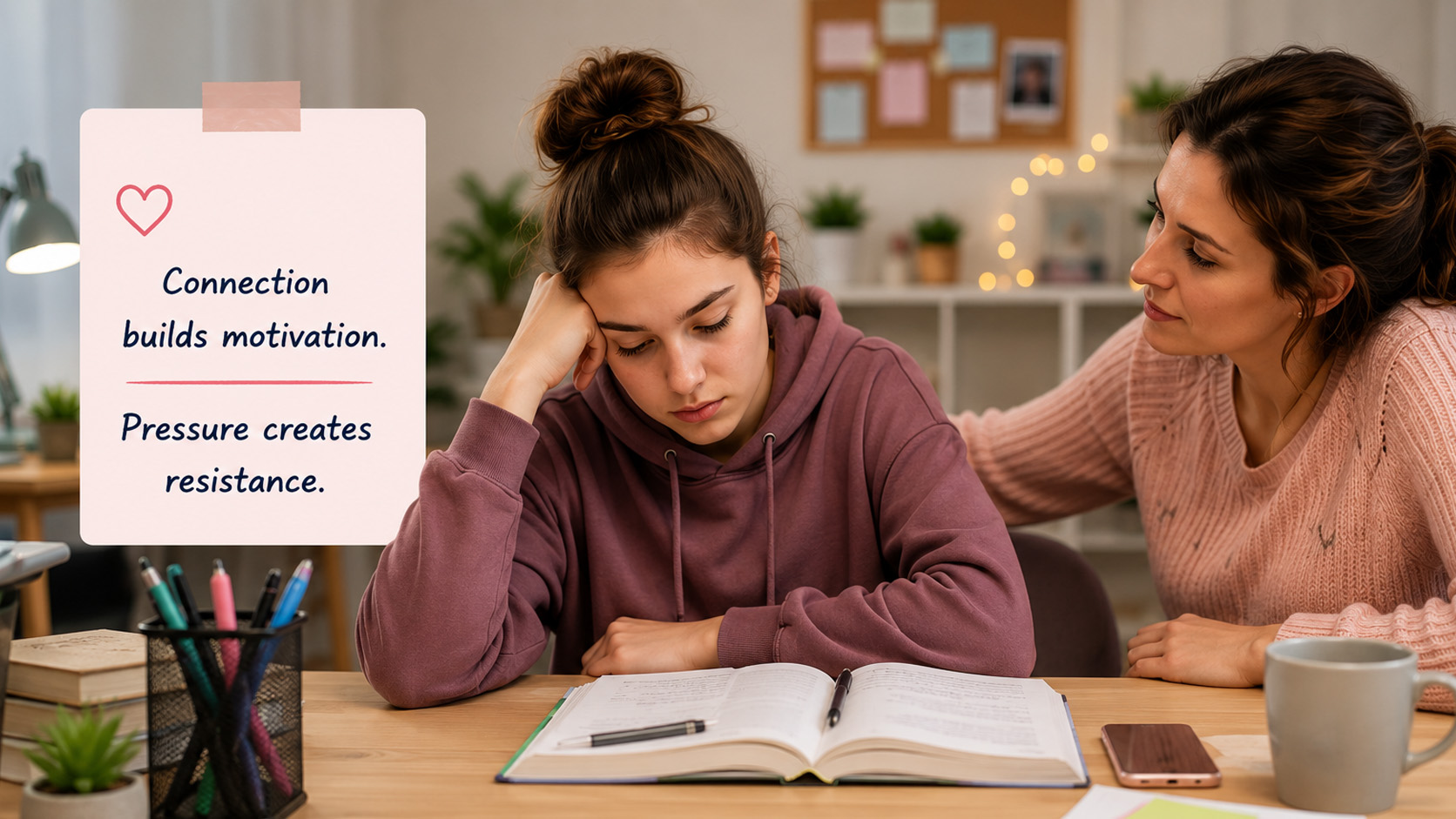
How to Motivate a Teenager to Study Without Fighting
Many parents want to know how to motivate a teenager to study without turning every evening into an argument.
You ask about homework.
Your teen rolls their eyes.
You remind them again.
They say, “I know.”
You get frustrated.
They shut down, argue, or disappear into their phone.
Soon, the problem is no longer just studying. It becomes a daily fight.
If this sounds familiar, you are not alone. Many families struggle with study motivation during the teenage years. Teenagers want more independence, but they do not always have the skills, confidence, or emotional strength to manage school responsibilities on their own.
The goal is not to stop caring about school. The goal is to support your teen in a way that builds responsibility instead of resistance.
Motivation rarely grows from constant pressure. It grows from clarity, confidence, connection, and small wins.
Start with curiosity, not criticism
When a teenager avoids studying, it is easy to assume they are lazy, careless, or irresponsible.
But what looks like laziness may be something else:
- feeling overwhelmed;
- fear of failure;
- lack of study skills;
- too many distractions;
- low confidence;
- emotional stress;
- not understanding the purpose of school;
- not knowing where to begin.
Before you try to motivate your teen, try to understand what is blocking them.
Instead of starting with:
“Why are you so lazy?”
try:
“What feels hardest about studying right now?”
or:
“Is it hard to start, hard to focus, hard to understand, or hard to care?”
These questions lower defensiveness. They show your teen that you are trying to understand, not just control.
A teenager who feels judged is more likely to resist. A teenager who feels understood is more likely to talk.
Separate the teen from the problem
When school becomes stressful, parents and teenagers can end up on opposite sides.
The parent thinks:
“I am trying to help.”
The teen thinks:
“They are always against me.”
A better approach is to put the problem in the middle and stand on the same side.
Instead of:
“You never study.”
try:
“It looks like getting started has been really hard lately. Let’s figure out what gets in the way.”
This small change matters. It tells your teen:
“You are not the problem. The problem is something we can understand and work on.”
That does not mean removing responsibility. Your teen still needs to do the work. But responsibility is easier to build when shame is lower.
Do not turn every reminder into a lecture
Parents often repeat the same reminders because they are worried:
“You need to take school seriously.”
“You cannot keep waiting until the last minute.”
“You know this will affect your future.”
“You need better habits.”
These things may be true. But if your teen has heard them many times, they may stop listening.
A lecture often makes the parent feel like they have done something, but it may not help the teen take action.
Try replacing long lectures with short, clear conversations.
Instead of a ten-minute speech, ask:
“What is one assignment you need to start today?”
Then ask:
“What is the first small step?”
Teenagers often need help moving from emotion to action. A short question can do more than a long lecture.
Make the first step very small
One reason teens avoid studying is that the task feels too big.
“Study for the test” is not a clear task.
“Do your homework” may feel like a mountain.
“Get your grades up” feels too far away.
Small steps are easier to begin.
Help your teen break studying into actions like:
- open the assignment;
- read the instructions;
- write the first sentence;
- solve the first problem;
- review one page;
- make five flashcards;
- study for ten minutes;
- email the teacher one question.
A useful sentence is:
“You do not have to finish everything right now. You only have to start with one small step.”
Starting matters because motivation often comes after action, not before it.
Many teens wait until they “feel motivated.” But sometimes they need to begin first, and motivation slowly follows.
Use time limits instead of open-ended demands
Open-ended studying can feel endless.
If you say:
“Go study until you are done,”
your teen may feel trapped before they even begin.
A time limit can make studying feel more manageable.
Try:
“Let’s do 15 minutes of focused work, then take a short break.”
or:
“Start with 10 minutes. After that, you can decide the next step.”
Short work periods reduce resistance. They also help teens experience success.
For some teens, even 15 minutes is too much at first. Start with 7 minutes if needed.
The first goal is not perfection. The first goal is rebuilding the habit of starting.
Give more ownership as your teen grows
Teenagers need structure, but they also need autonomy.
If every study plan comes from the parent, the teen may resist simply because they feel controlled.
Instead of making the whole plan for them, offer choices.
For example:
“Would you rather study before dinner or after dinner?”
“Do you want to start with math or English?”
“Would it help to work at the kitchen table or in your room with your phone outside?”
“Do you want me to check in after 20 minutes or leave you alone until 7:30?”
Choices help teens feel some control. Control is important because motivation is stronger when the teen feels ownership.
You are still setting expectations. But you are inviting your teen to participate in how the work gets done.
Focus on systems, not just willpower
Many parents say:
“My teen just needs more discipline.”
But discipline is easier when there is a system.
A system can include:
- a regular study time;
- a clean place to work;
- phone away during focus time;
- a visible weekly plan;
- a short checklist;
- a timer;
- breaks;
- a Sunday evening planning routine.
Do not expect motivation to do all the work. Build an environment that makes studying easier.
For example, instead of asking your teen to “be more responsible” every day, help them create a simple weekly plan:
Monday: finish math homework
Tuesday: review science notes
Wednesday: start essay outline
Thursday: study for quiz
Friday: check missing assignments
A simple plan reduces chaos.
Be careful with rewards and punishments
Rewards and punishments can work for short-term behavior, but they do not always build real motivation.
If the only reason to study is to avoid punishment or earn a reward, the teen may never develop internal responsibility.
That does not mean there should be no consequences. It means consequences should be clear, reasonable, and connected to the problem.
For example:
“If homework is not started by 7:00, the phone stays in the kitchen until the first assignment is done.”
This is different from:
“You are lazy, so I am taking everything away.”
The first is a structure. The second is a shame message.
Try to use consequences as guardrails, not weapons.
Notice effort, not only results
If you only notice grades, your teen may feel that effort does not matter unless it produces an A.
But motivation grows when teens see that effort changes something.
Notice small actions:
“I saw that you started earlier today.”
“You worked for 20 minutes even though you did not feel like it.”
“You asked for help instead of giving up.”
“You turned in the assignment. That matters.”
This does not mean praising everything. It means helping your teen notice progress.
Confidence is built through evidence. Small wins give teens evidence that they can move forward.
Reduce the emotional temperature
If every conversation about school becomes tense, your teen may begin avoiding you and the schoolwork.
Sometimes the most important first step is to lower the emotional temperature in the home.
You might say:
“I know we have been fighting a lot about school. I do not want every conversation between us to feel like pressure. I still care about your responsibilities, but I want us to handle this differently.”
This kind of statement can reset the tone.
It does not excuse missing work. It opens the door to a different kind of conversation.
A calmer home atmosphere makes it easier for teens to be honest about what is hard.
Ask what kind of help they actually need
Not all study problems are the same.
A teen who does not understand algebra needs different help from a teen who understands but procrastinates.
A teen who is overwhelmed needs different help from a teen who is bored.
Ask your teen:
“Do you need help starting, planning, understanding, or focusing?”
This simple question can guide the next step.
If they need help starting, make the task smaller.
If they need help planning, create a weekly checklist.
If they need help understanding, consider tutoring or teacher support.
If they need help focusing, change the environment and reduce distractions.
The right support depends on the real problem.
Avoid comparing your teen to others
Comparison may seem motivating, but it usually creates shame.
Try not to say:
“Your brother never had this problem.”
“Other kids can handle this.”
“When I was your age, I worked harder.”
Even if you mean well, comparison can make a teen feel defective or misunderstood.
Instead, compare your teen to their own progress.
“Last week it was hard to start at all. This week you started twice. That is progress.”
Motivation grows better through personal progress than through comparison.
Connect studying to freedom, not only pressure
Teenagers often want freedom. They want more control over their time, choices, and future.
Studying can be framed not only as an obligation, but as a way to create more options.
You might say:
“School is not only about grades. It is also about building skills that give you more choices later.”
or:
“I do not expect you to love every subject. But I want you to have enough skills and habits so you are not trapped by avoidable problems.”
This kind of conversation respects the teen’s growing independence.
It helps them see studying as connected to personal agency, not just adult approval.
Create a weekly check-in instead of daily battles
Daily reminders can create daily conflict.
A weekly check-in can be calmer and more productive.
Choose one time each week, such as Sunday afternoon or Monday evening.
Ask:
- What assignments or tests are coming up?
- What feels most important this week?
- What might be hard?
- What is the first step?
- What support do you want from me?
- When should I check in?
Keep it short. Twenty minutes is enough.
The goal is not to control every detail. The goal is to help your teen learn how to look ahead.
What to do when your teen refuses to talk
Sometimes teens answer with:
“I don’t know.”
“Nothing.”
“Leave me alone.”
“I said I’ll do it.”
Do not force a deep conversation in that moment.
You can say:
“Okay. I will not push right now. But we do need to come back to this later because school responsibilities still matter.”
This gives space without giving up.
Later, try again in a calmer moment. Some teens need time before they can talk honestly.
Consistency matters more than one perfect conversation.
When extra support may be needed
Sometimes lack of study motivation is connected to something deeper: anxiety, depression, ADHD, learning differences, bullying, sleep problems, family stress, or other emotional challenges.
If your teen seems persistently hopeless, withdrawn, extremely anxious, unusually angry, unable to function, or says they do not want to live, it is important to seek professional help immediately.
A study problem can sometimes be more than a study problem.
Parents do not have to handle everything alone.
A simple script to try this week
Here is one calm way to begin:
“I know studying has become a stressful topic between us. I do not want us to keep fighting every day. I want to understand what is making it hard for you and help you build a plan that gives you more control. What feels hardest right now — starting, planning, understanding, or focusing?”
Then listen.
Do not correct the first answer immediately. Do not jump into a lecture. Let your teen speak, even if the answer is messy.
After that, choose one small next step together.
Final thought
You cannot force a teenager to become internally motivated overnight.
But you can create conditions where motivation has a better chance to grow.
Less shame.
More clarity.
Less fighting.
More structure.
Less control.
More ownership.
Less labeling.
More curiosity.
Helping a teenager study without fighting does not mean lowering expectations. It means changing the way you support those expectations.
Your teen still needs responsibility. But responsibility grows best when it is connected to confidence, trust, and small steps forward.
Related articles:
Take the Next Step
Explore practical support, a guided self-check, and books created to help teens understand themselves—and help parents hear what may be difficult to say.
GUIDANCE FOR PARENTS
Teen Motivation & Support
Explore clear guidance about motivation, procrastination, school pressure, giving up, family conflict, and other common teenage challenges.
Explore Teen SupportFREE SELF-REFLECTION TOOL
Teen Motivation Self-Check
A short, private self-check completed by the teenager—not the parent—to help identify what may be interfering with motivation, focus, or the ability to begin.
Take the Self-CheckBOOK FOR TEENS
Confessions for Teens
Honest reflections about the struggles many teenagers experience but cannot always explain—with compassionate perspective and realistic ways to move forward.
View on AmazonBOOK FOR PARENTS & TEENS
Things I Wish My Parent Knew
Fourteen fictional teen voices reveal what may lie behind anger, silence, pressure, mistakes, and closed doors—opening the way to deeper understanding and conversation.
View on Amazon