
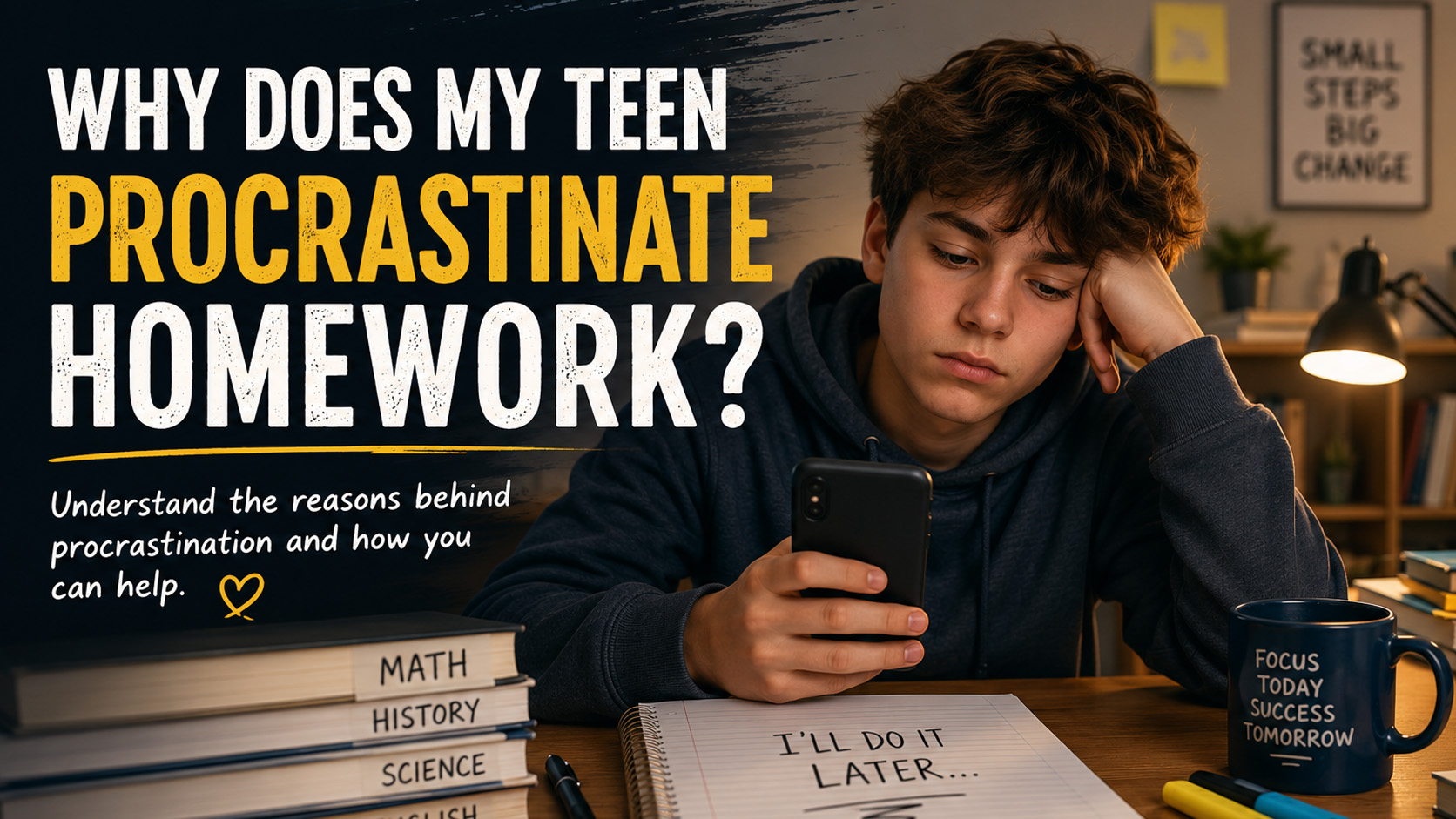
Why Does My Teen Procrastinate Homework?
Many parents feel frustrated when homework turns into a nightly struggle. Teen procrastinates homework…
Your teen says, “I’ll do it later.”
Then later becomes too late.
They check their phone, get a snack, lie on the bed, start another task, or suddenly decide they need a break before they have even begun.
You remind them.
They get annoyed.
You remind them again.
They say, “I know.”
Nothing happens.
From the outside, homework procrastination can look like laziness or irresponsibility.
But procrastination is usually not simply a character problem. It is often a sign that something about the task feels too big, too unclear, too boring, too stressful, or too emotionally uncomfortable.
Your teen may not be choosing failure. They may be avoiding a feeling.
Understanding that difference can change the way you respond.
Teen procrastinates homework – is not always laziness
When a teen procrastinates homework, parents often think:
“They just don’t care.”
Sometimes teens do act like they do not care. They may shrug, joke, argue, or say, “It doesn’t matter.”
But many teens who procrastinate do care. They may care so much that starting feels stressful.
Homework can bring up feelings like:
- fear of failing;
- confusion;
- boredom;
- shame;
- pressure;
- overwhelm;
- frustration;
- not knowing where to begin.
Avoiding homework gives temporary relief. The teen does not have to face the uncomfortable feeling right away.
The problem is that the relief does not last. The homework is still there, and now there is less time, more stress, and often more conflict at home.
This creates a cycle:
avoid → feel relief → fall behind → feel more stressed → avoid again
To help your teen, you need to interrupt the cycle gently and practically.
1. The task may feel too big
A teenager may look at homework and see one giant problem.
“Study for the test.”
“Write the essay.”
“Finish the project.”
“Catch up on missing work.”
These are not small tasks. They are large, vague demands.
When the task feels too big, the brain may respond by freezing. The teen may not know what to do first, so they do nothing.
Parents can help by making the first step smaller.
Instead of saying:
“Go do your homework.”
try:
“Let’s name the first tiny step.”
That first step might be:
- open the assignment;
- read the instructions;
- write the title;
- solve one problem;
- review one paragraph;
- make a list of what is due;
- email the teacher one question.
A teen who cannot begin a large task may be able to begin a tiny one.
Small steps reduce resistance.
2. Your teen may not know how to start
Many teens procrastinate because they do not have a clear starting routine.
Adults may think starting is simple: sit down and begin.
But for a teen, starting may require several hidden skills:
- finding the assignment;
- knowing what materials are needed;
- understanding the instructions;
- deciding which task comes first;
- estimating time;
- managing distractions;
- tolerating discomfort.
If one of those steps breaks down, the whole process can stop.
A useful question is:
“What is the very first thing you need to do?”
If your teen says, “I don’t know,” that is information. They may not be refusing. They may truly not know how to turn the assignment into action.
You can help them create a simple starting ritual:
- Put the phone away.
- Open the assignment.
- Write down the first task.
- Set a timer for 10 minutes.
- Begin.
A routine makes starting easier because the teen does not have to decide from scratch every time.
3. They may be afraid of doing it badly
Some teens procrastinate because they are afraid to fail.
They may delay writing the essay because they do not know how to make it good.
They may avoid math because mistakes make them feel stupid.
They may postpone studying because they fear the test will show what they do not know.
Procrastination protects them from facing that fear.
If they do not start, they do not have to feel inadequate yet.
This is why saying “Just do it” often does not work. The problem is not only the task. The problem is the emotion attached to the task.
Try saying:
“It does not have to be perfect. It only has to be started.”
or:
“A messy first draft is better than no draft.”
or:
“The first version is allowed to be bad. That is how work begins.”
This helps lower the emotional risk of starting.
4. Perfectionism can look like laziness
Some teens who procrastinate are not careless. They are perfectionistic.
They may want to do well, but they avoid starting because they cannot guarantee the result.
They may think:
“If I cannot do it perfectly, I do not want to do it at all.”
This kind of teen may wait for the “right mood,” the “right plan,” or the “right time.” Unfortunately, the right time often never comes.
Parents can help by praising progress over perfection.
Say:
“Your goal is not to make it perfect tonight. Your goal is to make progress.”
or:
“Let’s make a rough version first. You can improve it later.”
Perfectionistic teens need permission to begin imperfectly.
5. Phone distractions make procrastination easier
Phones make procrastination extremely easy.
A teen can avoid homework without even feeling like they made a decision. One notification, one video, one message, one quick scroll — and suddenly 45 minutes are gone.
The phone gives fast rewards. Homework gives delayed rewards.
That is a hard competition.
This does not mean phones are evil. But it does mean that many teens need help creating boundaries around study time.
Instead of saying:
“You are addicted to your phone.”
try:
“Your phone makes it harder to start. Let’s make starting easier by putting it somewhere else for 20 minutes.”
Possible solutions:
- phone in another room during focus time;
- phone on the kitchen counter;
- app limits during homework hours;
- short focus periods followed by a break;
- using a timer that is not the phone.
The goal is not punishment. The goal is reducing friction.
If the phone is next to the homework, the phone often wins.
6. Your teen may be emotionally overwhelmed
Homework procrastination is not always about homework.
A teen may be carrying stress from friendships, social media, family conflict, sports, identity questions, anxiety, sleep problems, or pressure about the future.
When emotional energy is low, even ordinary homework can feel impossible.
Parents may ask:
“Why can’t you just finish this?”
But the teen may be feeling:
“I cannot handle one more thing.”
This does not mean school responsibilities disappear. But it does mean your support should include emotional awareness.
Try asking:
“Is this homework hard because of the subject, or because you are already feeling stressed?”
That question helps your teen separate the task from the emotional load.
Sometimes the first support needed is not a study plan. It is a moment of calm.
7. They may not see the point
Some teens procrastinate because they do not see why the work matters.
They may say:
“This is useless.”
“I’ll never need this.”
“School is pointless.”
Parents often respond with:
“You will need it for your future.”
That may be true, but it may not feel meaningful to the teen in the moment.
Instead of arguing about whether every assignment is useful, try shifting the focus:
“Even when the assignment feels boring, finishing it is a way to practice responsibility and keep your options open.”
or:
“You do not have to love every subject. But learning how to complete hard or boring things is a life skill.”
This frames homework as skill-building, not just rule-following.
Teens are more likely to cooperate when they see a connection to freedom, choice, and future independence.
8. They may be stuck in a conflict pattern with you
When homework becomes a daily fight, teens may begin avoiding the parent as much as the homework.
The cycle may look like this:
Parent asks about homework.
Teen feels criticized.
Teen becomes defensive.
Parent becomes more anxious and pushes harder.
Teen withdraws or argues.
Homework becomes even more emotionally loaded.
At that point, procrastination is no longer only about schoolwork. It is part of a relationship pattern.
To change the pattern, try naming it calmly:
“I notice we keep getting into the same fight about homework. I do not want every evening to feel like pressure. We still need a plan, but I want us to make it in a calmer way.”
This kind of statement can reset the tone.
It tells your teen that you are not giving up on responsibility, but you are willing to change the way you talk about it.
9. Your teen may need structure, not more reminders
Many parents remind their teens again and again.
But reminders can become background noise.
A teen may hear:
“Homework, homework, homework…”
and tune out.
Instead of more reminders, your teen may need a visible structure.
Try creating a simple homework plan:
- What needs to be done?
- What is due first?
- What is the smallest first step?
- When will the work begin?
- Where will the phone be?
- How long is the first focus period?
- What happens after the first focus period?
This can be written on paper, a whiteboard, or a simple weekly planner.
A structure reduces the need for constant verbal reminders.
10. Starting late can become a habit
Some teens become used to working only under pressure.
They wait until the last minute because panic creates energy.
This can work for a while, especially for smart students. But over time, it creates stress, lower-quality work, and conflict at home.
If your teen says:
“I work better under pressure,”
you might respond:
“Pressure may help you start, but it also makes life more stressful. Let’s practice starting before panic is the only fuel.”
The goal is not to remove all pressure. The goal is to help your teen build a healthier starting habit.
Start small:
10 minutes today is better than 2 hours of panic tomorrow.
What parents can do this week
You do not need to solve all procrastination at once.
Start with one assignment.
Ask your teen:
“What homework are you most likely to avoid today?”
Then ask:
“What is the smallest possible first step?”
Set a short timer — 10 or 15 minutes.
During that time, the goal is not to finish everything. The goal is simply to begin.
After the timer, ask:
“Was it easier, harder, or about what you expected?”
This helps your teen notice that starting is often the hardest part.
Over time, these small starts can rebuild trust in their ability to act.
What not to say
Try to avoid phrases like:
“You are just lazy.”
“You always do this.”
“You do not care about your future.”
“You are wasting your potential.”
“Other kids can handle this.”
These phrases may come from fear, but they usually increase shame and resistance.
Instead, try:
“Let’s figure out what makes starting hard.”
“You do not have to feel ready to begin.”
“One small step is enough for now.”
“I want to help you build a system, not just argue about homework.”
Calm language does not mean weak parenting. It means effective parenting.
When teen procrastinates homework may need extra support
Some procrastination is normal. Everyone delays tasks sometimes.
But if your teen’s procrastination is severe, constant, or connected with major distress, it may be helpful to seek additional support.
Consider reaching out to a school counselor, teacher, tutor, or mental health professional if your teen:
- cannot complete work even with support;
- seems extremely anxious or hopeless;
- has sudden changes in mood or behavior;
- is failing multiple classes;
- cannot focus at all;
- avoids school entirely;
- talks about not wanting to live;
- seems overwhelmed beyond normal stress.
A homework problem can sometimes be connected to anxiety, depression, ADHD, learning differences, or other challenges.
Parents do not have to figure everything out alone.
A simple script to try
Here is a calm way to begin the conversation:
“I notice homework has been hard to start lately. I do not want us to fight about it every night. I want to understand what gets in the way. Is it hard to start, hard to focus, hard to understand, or hard to care about it?”
Then listen.
After your teen answers, choose one small action together.
Not a perfect plan.
Not a full transformation.
Just one next step.
Final thought
If your teen procrastinates homework, it does not mean they are lazy or hopeless.
It means something is blocking action.
That block may be fear, overwhelm, distraction, perfectionism, lack of structure, low confidence, or simply not knowing how to begin.
Your job is not to fight harder every night. Your job is to help your teen understand the block and build a better path through it.
Motivation often begins with one small step.
And sometimes the most powerful thing a parent can say is:
“Let’s just start with the first ten minutes.”
Related articles:
Take the Next Step
Explore practical support, a guided self-check, and books created to help teens understand themselves—and help parents hear what may be difficult to say.
GUIDANCE FOR PARENTS
Teen Motivation & Support
Explore clear guidance about motivation, procrastination, school pressure, giving up, family conflict, and other common teenage challenges.
Explore Teen SupportFREE SELF-REFLECTION TOOL
Teen Motivation Self-Check
A short, private self-check completed by the teenager—not the parent—to help identify what may be interfering with motivation, focus, or the ability to begin.
Take the Self-CheckBOOK FOR TEENS
Confessions for Teens
Honest reflections about the struggles many teenagers experience but cannot always explain—with compassionate perspective and realistic ways to move forward.
View on AmazonBOOK FOR PARENTS & TEENS
Things I Wish My Parent Knew
Fourteen fictional teen voices reveal what may lie behind anger, silence, pressure, mistakes, and closed doors—opening the way to deeper understanding and conversation.
View on Amazon